



















White roller blinds are a roller with a light fabric, made to measure for a specific window. “White” isn’t one colour: next to a white frame, one fabric looks bluish, another warm. Density decides what’s visible from the street during the day and in the evening. Base price is from 5,400 ₸/m², manufacturing takes 4–6 days, measurement is free.
What a white roller blind is and why “white” is not one colour
White roller blinds are a fabric that rolls onto a tube right at the glass and stays up without a rail. We make them to measure in our own workshop: first we look at the window, then we decide which fabric fits. The main thing to understand before ordering: “white” is not one colour. Next to a white frame, one fabric goes cool and reads bluish, another warms up and looks yellowish. And you can only see this on your own window, in your own light.
The difference is not a bad batch or the grade of the fabric. The manufacturer dyes the fabric to a certain shade, but the surroundings change how it reads: the plastic of the frame, the side the light comes from, the colour of the walls nearby. Cool white against warm plastic looks a bit dirty, while warm white next to a bright white windowsill, on the contrary, looks yellow. That is exactly why our measurers bring samples: in a warehouse or showroom the fabric will not show what it shows in your home.
The density of the fabric decides the other half of the question. A dense fabric does not let light through at the edge, while a less dense one against backlight gives a noticeable strip along the edge of the roll. And a white fabric that almost dissolves on a white frame behaves differently on dark lamination: it gives a sharp contrast and becomes a focal point. There is no universal answer here — only trying it on your specific window.
Shade of white: snow white, milky, warm
Snow white is the coolest: next to a white plastic window it often looks bluish. Milky white leans into a soft warmth and reads calmer next to a white frame. Warm white, with a slight hint of cream, turns yellow during the day on the sunny side. Which one to take depends on what is next to the window: the walls, the windowsill, the furniture.
Back side and edge
The side facing the street looks different from the one facing the room: on some fabrics the back is lighter or more matte than the front. Seams and the edge are checked on a sample against the light — hold the fabric up to the window and look through it. That way you can see whether there will be a light strip along the edge of the roll and how the seam will behave when it rolls up.
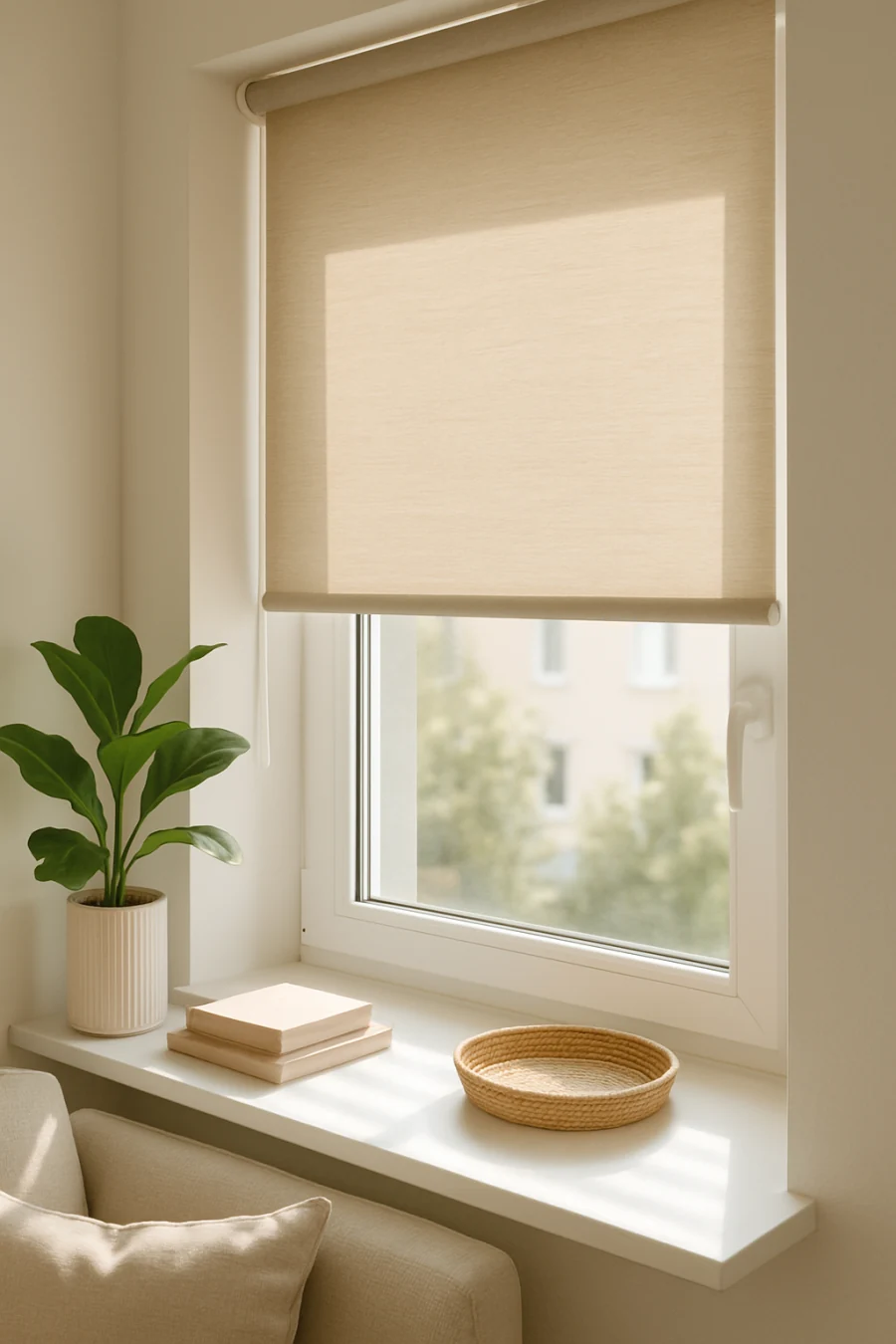
White fabric rolls onto a tube at the glass, and its shade only reads next to a specific frame in a specific light.
Density of white fabric: what is visible from the street during the day and in the evening with the lights on
During the day, light fabric diffuses light and hides the room from prying eyes. In the evening the picture changes: as soon as a lamp is switched on in the room, any less dense fabric shows silhouettes — a milky semi-transparent roller just as much as a semi-transparent linen. This is not a defect of the fabric but physics: light from inside is always stronger than light from outside.
White roller blinds are chosen in two cases: when you need to softly dim bright light, or when you want to hide the room from the house next door. These are different tasks, and the density of the fabric decides them. If the window faces a road or is on the ground floor where passers-by stand right up close, density alone may not be enough — then guide rails are added to the fabric or a denser collection is chosen. But on the fifth floor, where the window looks at the sky, a milky semi-transparent roller is enough: during the day it diffuses light, and in the evening no one is looking in.
In my view, density is the main decision when choosing a white blind, more important than shade and texture. The shade is only noticeable to you, while density determines what the street sees.
Density table
| Fabric | How much light passes through | What is visible in the evening | For which room |
|---|---|---|---|
| Milky semi-transparent | Most of it — the room is bright during the day | Silhouettes with the lamp on | Living room, kitchen, dining area |
| White dim-out | Part of it: the light is soft, but silhouettes are not visible from outside | Outlines of objects, faces cannot be made out | Bedroom, study, meeting room |
| White blackout | Little: white blackout darkens the room completely | Nothing | Bedroom, home cinema |
White blackout darkens the room completely, and that is its main difference from dim-out: dim-out diffuses light without giving full darkening.
Warm lamp in the evening
In warm light, cool white can read greyish — this is noticeable in the evening, when a yellow lamp is on in the room and blue dusk is outside. You can only check this on your own window: take a sample home and look at it under your own lamp. The measurer comes with samples, so it is possible to see the fabric in your conditions without buying.
During the day, light fabric diffuses light and hides the room, while in the evening with the lamp on any less dense fabric shows silhouettes.
How much a white roller blind costs and what a cassette or electric motor changes
The base price of a white roller blind is from 5,400 ₸/m², and manufacturing takes 4–6 days. This is the price-list item for polyester fabric on an open roller tube, that is, the simplest construction. The total is made up not of one figure but of the area of the opening and coefficients for the control and mounting. We make white roller blinds in Almaty to measure, so the measurer gives the exact amount on site — with the samples already in hand.
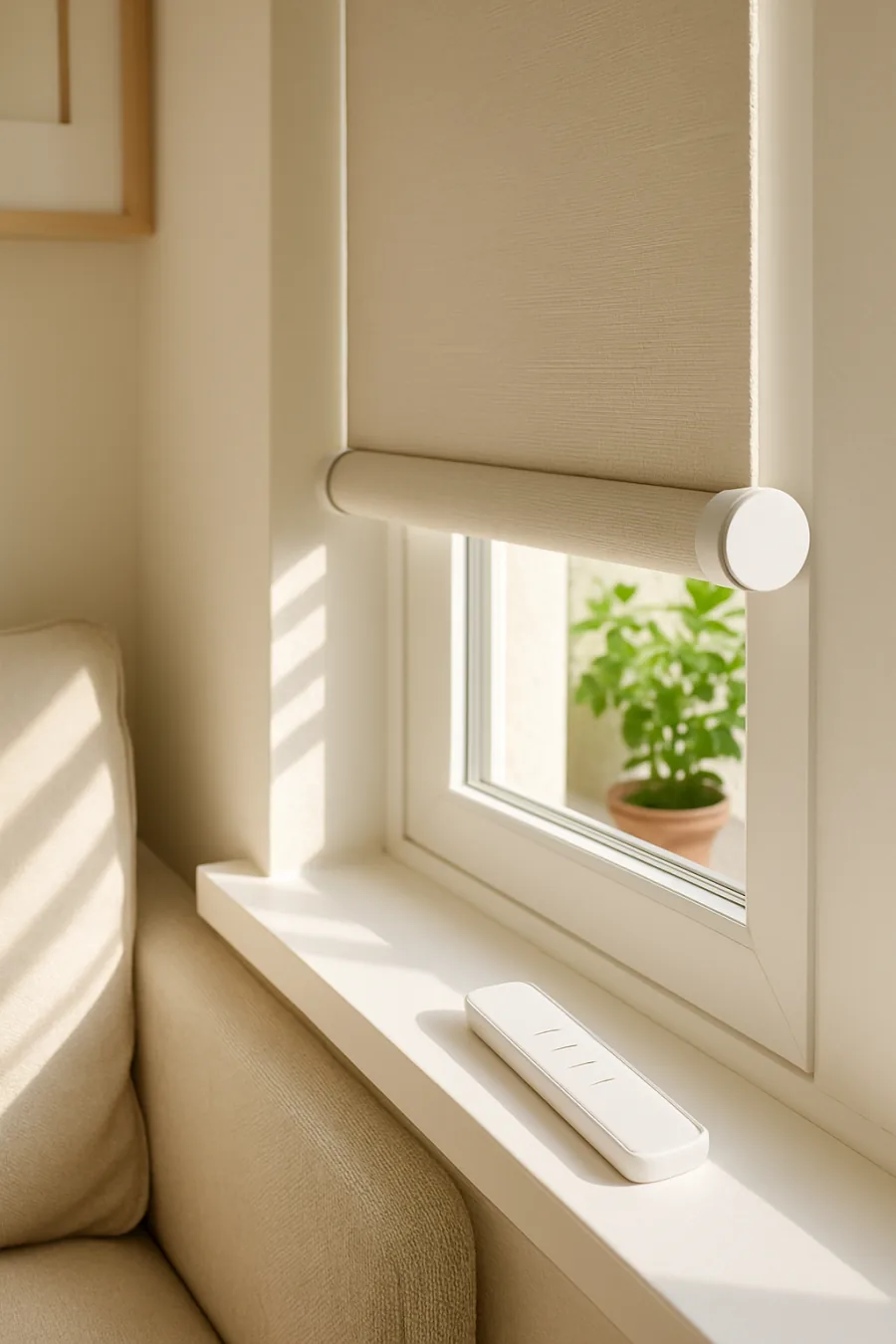
The cassette system changes the price by a factor of ×1.28. This is a closed housing in which the fabric and the tube are hidden — on a white window such a blind looks neater, because neither the tube nor the roll is visible. An electric motor changes the amount by factors of ×1.85, and an electric one with a remote control by ×2.1. A chain is the most modest option: a factor of ×1.06. Manual control is taken as one.
What affects the price
Four things drive the final price: the size of the opening, the fabric group, the type of control and the mounting. The area is multiplied by the price per m² directly. Control coefficients: manual — ×1, chain — ×1.06, electric motor — ×1.85, electric with remote — ×2.1. Mounting: wall-mounted ×1, frame-mounted ×1.05, no drilling ×1.1, cassette system ×1.28.
The coefficients are multiplied together, so combining a motor with a cassette makes a noticeable difference from the base option. My advice: if the window is not tall and you can easily reach the blind by hand, a chain fully covers the task, and a motor makes sense on tall windows or where the blind hangs far from your hand.
Installation and lead times
Installation costs 4,500 ₸ per item. For orders from 150,000 ₸ we install free of charge. Manufacturing time for roller blinds is 4–6 days. Measurement and delivery in Almaty are free, and our measurer arrives with samples and calculates the cost on site.
We do not keep ready-made items in stock — we are a manufacturer with our own workshop, and every blind is made for a specific opening. That is why we cannot give an installation date before the measurement: first the dimensions, then the workshop.
White blackout or white dim-out: how they actually differ
White blackout and white dim-out differ not in shade but in fabric density. White dim-out is a medium-density fabric: it diffuses light and softens it, but does not give full darkening. White blackout darkens the room completely while staying white on the window side.
From outside, both fabrics look equally light. The difference shows from inside: through dim-out you can make out the light of the sky and the outlines of branches, through blackout — nothing. That is why they sit side by side in the catalogue but behave like two different things on the window. A mistake in choosing density cannot be fixed by shade or by the type of control.
White dim-out is more often chosen for the living room, the kitchen, the study — where you need soft light during the day without the feeling of a closed box. White blackout is installed in the bedroom and in a room where you watch movies during the day. If you are hesitating between them, in my view it is not the interior that decides, but how often you want to see the street outside the window.
Fabric density also affects how the frame looks. On a white frame both fabrics read calmly, while on dark lamination white blackout may look heavier than dim-out because of its denser structure.
Where light leaks through
With a free-hanging blind, light always passes along the edge — where the fabric does not sit against the frame. A narrow strip remains on the sides, at the bottom and at the top. The wider the gap, the more noticeable the glow around the contour, and this applies not only to blackout.
Guide rails help darken the room more tightly: the blind runs in side profiles, the fabric does not pull away from the frame, and the strips at the edges almost disappear. At the same time, guide rails do not turn dim-out into blackout — they only remove the side glow. For a bedroom on the ground floor or for a room where it is important to fall asleep under a bright sky, this option is worth discussing at the measurement.
And the fabric density itself remains the main factor: guide rails refine the darkening, but do not replace it.
Dim-out is a medium-density fabric that diffuses light, while blackout darkens the room completely.
How to choose a white fabric for the room, the floor and the frame
Choosing a white roller blind starts with two questions: what happens in the room and how the frame looks. Fabric density is chosen for the purpose of the room, while the shade and the fit are chosen for the colour of the window. There is no universal white blind that is equally good everywhere.
Here is how we usually break down the choice by situation.
- Bedroom. Density matters here: white dim-out or blackout, so that the light does not wake you in the morning. A milky semi-transparent roller blind is rarely chosen for the bedroom.
- Living room. A milky semi-transparent one is enough: there is plenty of light, and the soft outlines outside the window do not get in the way. If the light is on in the room in the evening and the window faces a neighbouring building, a denser fabric is chosen.
- Kitchen. White fabric with a dirt-repellent treatment stays neater next to the stove. A milky semi-transparent one is also appropriate here — during the day it does not cut the light.
- Kids’ room. A white textured “herringbone” fabric is often chosen: fingerprints are less noticeable on it, and the weave shows in slanted light. Density — medium.
Bedroom, living room, kitchen, kids’ room: density at a glance
The rule is simple: the higher the floor and the farther the neighbouring windows, the lighter the fabric you can choose. On the ground floor and at the level of other people’s balconies, the density is increased. And yes, the tube and the chain are visible on a white window — but with a white tube they read as part of the frame rather than as a separate detail.
Non-standard openings
A floor-to-ceiling window and a balcony door are a separate story. The blind there is long, and any inaccuracy in the measurement prevents the sash from opening. Both the mounting and the weight of the tube matter here. A cassette system covers the blind and the tube with a housing — on a white frame the housing almost merges with the profile, and only the chain is visible. For a floor-to-ceiling window Jalusso always comes with samples: the length and the mounting point cannot be calculated from a photo.
Frame: white or dark lamination
On a white plastic window, a white blind almost dissolves — the blind stops reading as a separate object and works for the light. On dark lamination of the frame, a white blind gives a graphic contrast: the window looks like a frame with a white field. Both options are a matter of taste, but for a dark frame we often recommend a warm shade of white so that the blind does not clash with the wood.
White roller blinds are chosen not by the name of the colour, but by the light and the background of a specific window.
A white blind dissolves on a white frame, while on dark lamination it gives a graphic contrast — this is the main guideline when choosing.
White or beige, day-night or regular, sheer or curtains
White roller blinds and beige ones behave differently on the same window. Light decides everything: next to a white frame, a warm beige reads more noticeably than a cool white, while beige looks calmer on dark lamination. At equal density, their practicality is the same — both white and beige show dust in their own way, and neither wins on wear. The choice here is about the interior, not about service life.
| What we compare | White | Beige |
|---|---|---|
| Next to a white frame | Almost dissolves | Reads as a separate shade |
| On dark lamination | Graphic contrast | Calmer, without harshness |
| Shade change in the evening | May shift towards grey | Stays warm |
| Wear and care | Dust shows in its own way | Dust shows in its own way |
The difference between day-night and a regular roller blind is not in the colour but in the cut. With day-night, two fabrics run in stripes, the stripes shift, and you can control the light right at the window: from soft and diffused to dense. A regular roller blind is one fabric, one density for the whole day. If a room serves as both day and evening space, day-night gives you more freedom. In a kitchen, where a milky semi-transparent roller blind is enough, there is no need to pay extra for a second fabric.
Sheer curtains and a white roller blind pair up calmly, and this is a workable option for a living room. Just don't mount the roller blind right up against the sheer — the fabric sits at the glass, the sheer is fixed to the frame or ceiling, and a gap remains between them. Curtains and a white roller blind are taken together when you need a dense curtain in the evening. During the day the blind is raised, in the evening the curtains are drawn — that way the light fabric isn't responsible for privacy at night.
For an office and a meeting room, the choice between a white screen and a white dim-out is decided by light, not fashion. Screen lets through more light, removes glare from screens, and keeps the room open from the outside. White dim-out diffuses light without giving full blackout, and faces on a video call don't fall into shadow. To a meeting room we usually bring both samples — people see the difference on the spot.
White and beige behave differently on the same window, and day-night and a regular roller blind solve different tasks.
Fading and care for light-coloured fabric
White fabric can fade over time — this is a natural process, and the warranty does not cover it. Ultraviolet gradually destroys the dye, so the fabric changes not in a week but imperceptibly. It is most noticeable on the sunny side: there white roller blinds change tone faster than on windows the sun rarely reaches.
Yellowing is not always fading. Sometimes it's dust settled on the fabric, sometimes soot from the kitchen. The difference is simple: faded fabric loses colour evenly, while soiled fabric shows patches at the edge and along the bottom. Our warranty — 3 years on the mechanism and 1 year on installation from the date the acceptance report is signed — does not cover natural fading, water and mechanical damage. So if you expect a snow-white fabric to stay the same after years, it won't. For the sunny side, the measurer will bring samples and show shades that hold up more evenly.
With heat, though, it's different: white fabric reflects part of the light and heats the room less than dark fabric. The difference feels more like the absence of a stuffy effect than like noticeable coolness.
Dust on white fabric
Dust shows on both white and dark — just differently. On white fabric it appears as grey streaks, on dark as a light film. So white isn't “dirtier” or “cleaner” — it just more honestly shows that it's time to wipe. On the bottom rail, fingerprints are more noticeable on a glossy surface than on a matte one.
What you can and can't do
- A soft brush or a vacuum cleaner on low power — basic care once every couple of weeks.
- Washable fabrics with a dirt-repellent finish are wiped with a damp sponge, without powder.
- Machine washing is not an option for white fabric; hand washing only if the collection’s label allows it, and our measurer will confirm this.
- Abrasives, alcohol and stiff sponges leave bald spots on light fabric that can no longer be removed.
- Drill-free mounting lets you take the roller blind down and clean the fabric separately.
A dirt-repellent finish makes caring for light fabric easier, but doesn't replace it.
How we make a white blind to measure in Almaty
You can order white roller blinds in Almaty only by measurement: we don't have ready-made products in stock, we are a manufacturer with our own workshop. You write on WhatsApp, a measurer comes with samples, calculates the cost on the spot, then the workshop and the installation team take over. Measurement and consultation are always free, and delivery within the city is free too.
Here is how it looks step by step:
- You send a request on WhatsApp and describe the window. You can send a photo of the frame and the opening.
- The measurer comes with samples of white fabrics. He looks at the profile, the sashes, the height of the windowsill and the side of the light.
- On the spot he calculates the cost: area, fabric group, control, mounting. He names the installation date right away.
- The workshop makes the order to individual sizes in 4–6 days.
- The Jalusso team brings the finished blind and installs it. Installation of one item costs 4,500 ₸, but if the order total reaches 150,000 ₸, the team installs the blinds at no extra charge.
Drill-free mounting is a standard option, not an exception. There are systems with Velcro, suction cups and a clip onto the glazing bead: the frame and profile stay intact, no marks are left. For rented housing, this is just what you need. For a permanent window, mounting on the frame or on the wall is more often chosen — it holds more reliably and doesn't interfere with the sash. The measurer looks at the profile and tells you what suits you specifically.
We travel to the suburbs: Kaskelen, Talgar, Issyk, Kapshagay. Outside the city the measurer travels for a fee — its size is determined by mileage, and we tell you the amount in advance, before he sets off. Within Almaty, the measurer's visit costs nothing.
Almaty's climate and white fabric
Almaty's climate is sharply continental. In winter there are frosts and a big temperature difference between day and night, in summer it's hot, sunny and dusty. White fabric on the sunny side changes faster: ultraviolet and dust do their work. For windows that are in the sun all day, the measurer will suggest a fabric with UV resistance or a warm shade instead of snow-white — it holds up longer.
Warranty and service
We give 3 years on the mechanism and 1 year on installation; the count starts from the day the acceptance report is signed. If a breakdown falls under the warranty, we do the work free of charge, and it takes up to 5 working days. After the warranty we also come: to tighten the roller tube, adjust the mechanism, replace the cord or chain. Not covered by the warranty: mechanical damage, reinstallation by your own hands, exposure to water and fading of the fabric over time.
We are a manufacturer with our own workshop in Almaty, everything is made to measure, there are no ready-made products in stock.
Examples from practice: how white fabric behaves on real projects
On different projects the same white fabric is chosen differently — for the light and the task of the room. Density here decides more than shade. Below are short observations from our projects: without addresses, because what matters is not the address but the type of window and how the light falls in the room.
Meeting room and office
In a meeting room, white dim-out is chosen for even light. A medium-density fabric diffuses the flow from the street, so faces on a video call don't fall into shadow from backlight sun. This is the case where a white screen only loses: it is softer and gives less contrast on camera. In an office with a two-sash window, white fabric on a white frame is almost invisible — the roller tube and chain blend with the profile. In my opinion, for a work room this is the best option: the blind doesn't argue with the furniture and doesn't distract.
Living room and country house
In a living room with a wide window, a milky semi-transparent roller blind lets light through and leaves soft outlines of branches behind the glass. The room seems taller because of it. In a country house, on floor-to-ceiling windows, white textured “herringbone” fabric is chosen: white textured fabric shows the weave in slanted light — in the morning and evening the pattern reads, during the day the fabric looks even.
Beauty salon
In a beauty salon with three sashes, white roller blinds with cool white fabric are installed. The stylist sees the dye colour accurately: white light without a tint doesn't mix a warm tone into the reflection on the hair. Sheer or sheer curtains would get in the way here — they give soft light but blur the colour.
These projects show the main thing: the same white fabric is chosen for the light and the purpose of the room, not by the shade name in the catalogue.
FAQ
Short answers to what people ask most often before ordering white roller blinds.
Privacy in the evening
Can the room be seen in the evening with the lights on? Yes, if the fabric is not dense. During the day, light fabric diffuses light and hides the room, but in the evening with a lamp on the picture changes: a milky semi-transparent roller blind shows silhouettes. Only white blackout or dense dim-out hides the room completely. For the ground floor we usually recommend exactly those.
No-drill mounting
Can a white blind be installed without drilling into the frame? Yes. Drill-free mounting comes with Velcro, suction cups, or a clip on the glazing bead. Such systems leave no marks on the profile — this is an option for rented housing. For a permanent window, mounting on the frame or on the wall is more common: it holds more reliably. A clip on the glazing bead does not fit every profile, so the measurer looks at the window on site and picks the option that will not block the sash.
Care and price
How to clean white fabric? With a soft brush or a vacuum cleaner on low power, and washable fabrics with a dirt-repellent coating — with a damp sponge. Dust is visible on both white and dark, just differently. A film of dirt on white reads as grey streaks.
What does the price per m² depend on? On the area of the opening, the fabric group and the type of control: chain, electric motor or electric with remote control. A cassette system also changes the amount. The base price position is from 5,400 ₸/m², and the cassette and motor are calculated as coefficients in the calculator.
White blackout darkens the room completely — it is the only option that hides it in the evening with the lights on.
Conclusion
White roller blinds in Almaty are chosen not by the colour name, but by the shade, density and design for a specific window — and this is the main takeaway from the article.
“White” is not one colour. The shade of the fabric only reads next to a specific frame in specific light: one fabric looks bluish against white plastic, another looks warm. That is why a sample is viewed on your own window, not in a catalogue on a screen.
During the day, light fabric diffuses light and hides the room from prying eyes. In the evening with a lamp on, any non-dense fabric shows silhouettes, and only dense dim-out or blackout hides you from the street. Guide rails help darken the room more tightly if the fabric hangs freely.
The money side is simple. The base price position is from 5,400 ₸/m², manufacturing takes 4–6 days, measurement and delivery in Almaty are free. A cassette system and a roller blind with an electric motor do not change the price of the fabric — they change the total through calculator coefficients. Installation costs 4,500 ₸ per item and is free for orders from 150,000 ₸.
White fabric can fade over time — this is a natural process, and the warranty does not cover it. We give 3 years on the mechanism and 1 year on installation, and after the warranty we come to tighten and adjust.
There is one practical step: call a measurer with samples and look at the shade and density on your own window in your own light — during the day and in the evening.

