















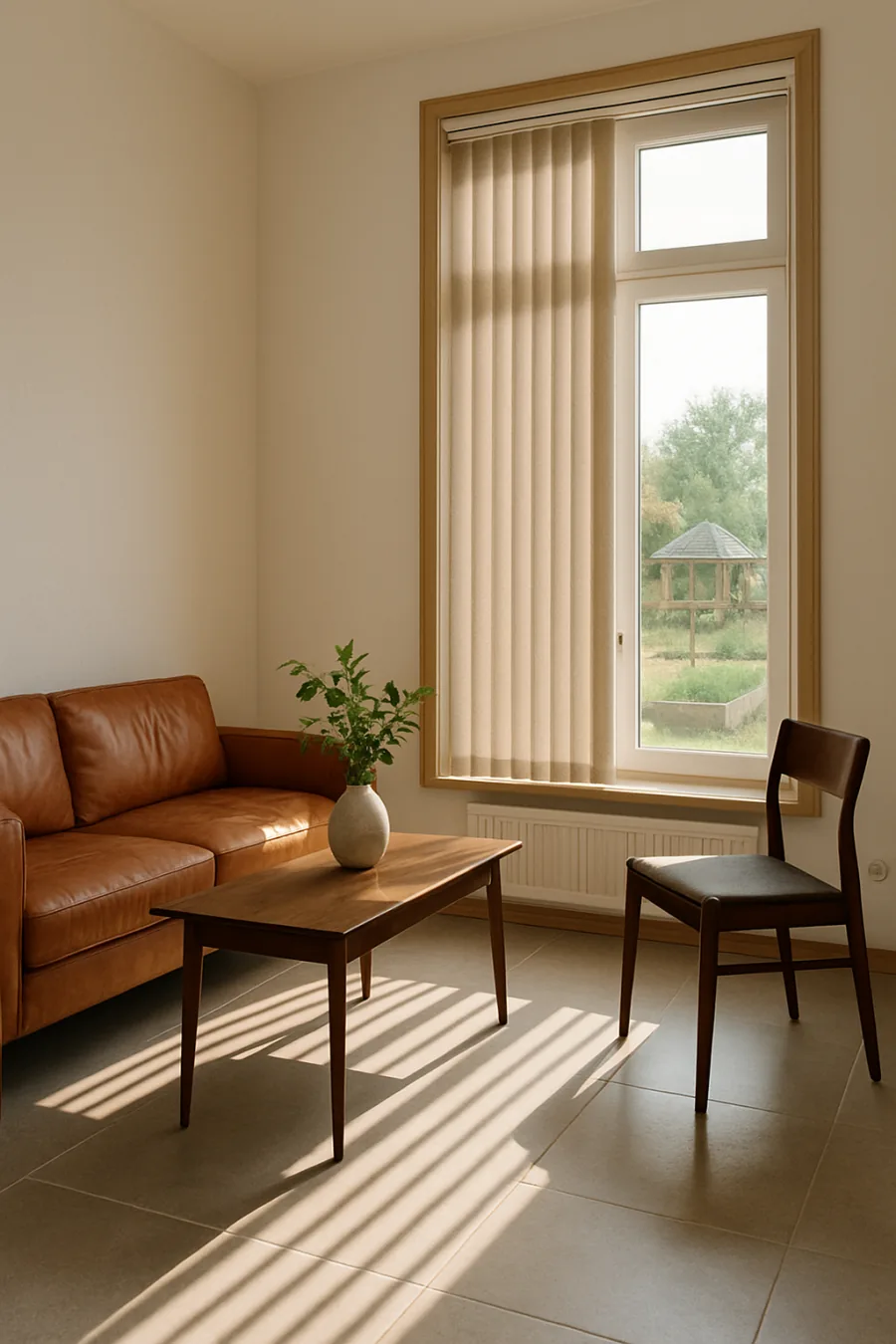


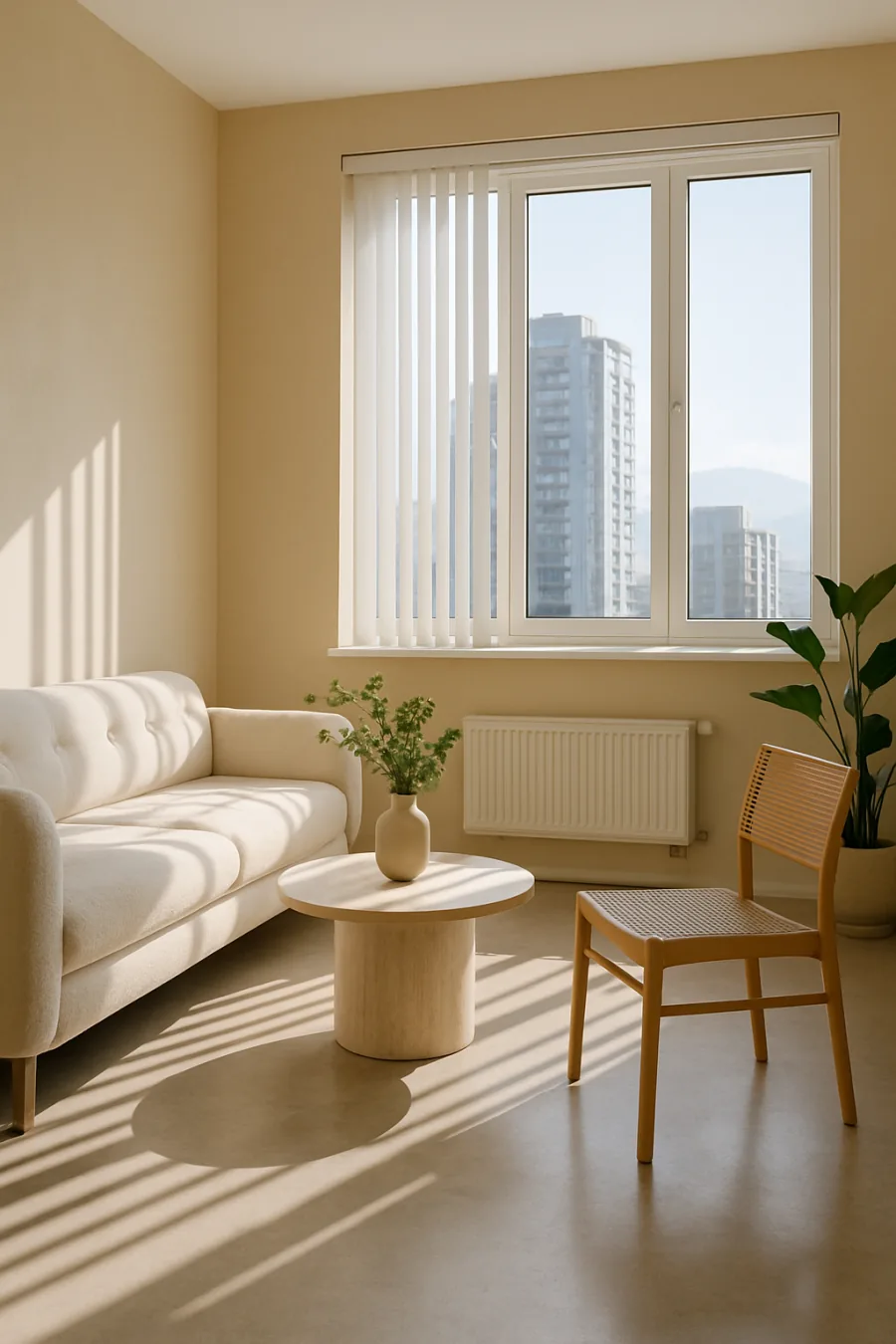


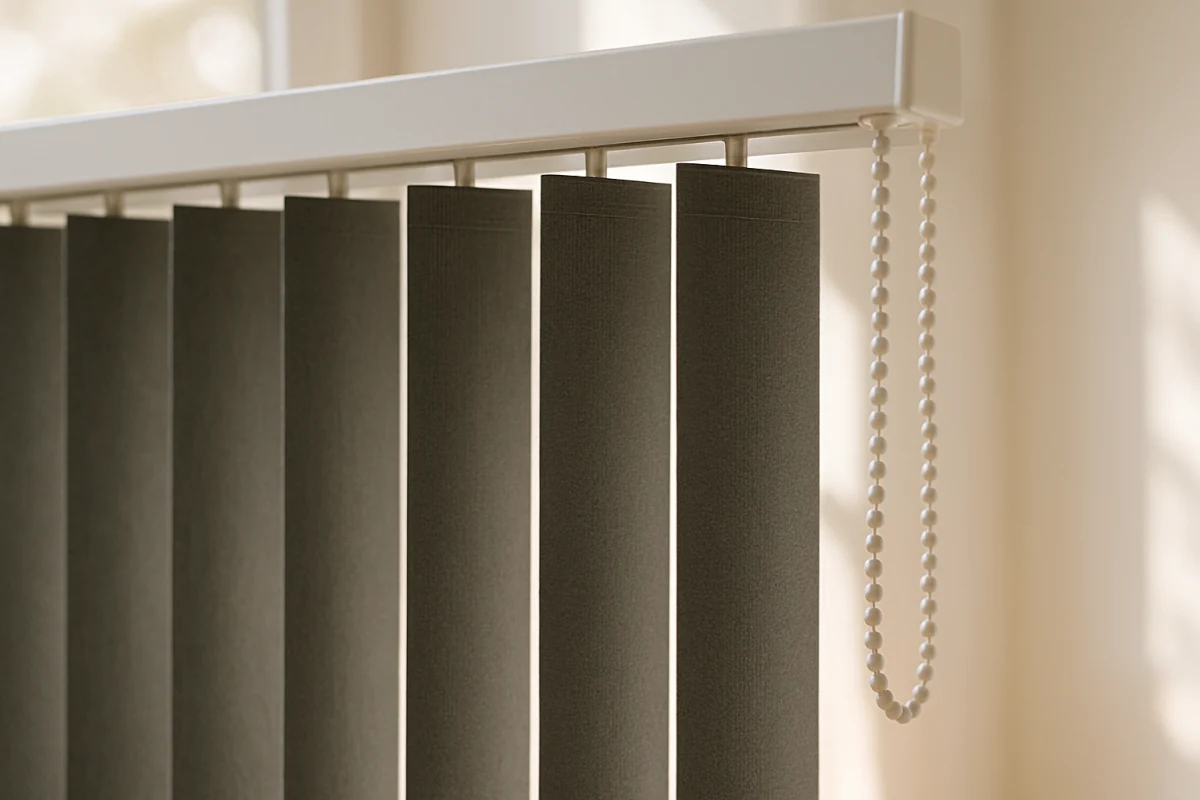











Vertical Blackout blinds cover the window with light-blocking fabric: light doesn’t pass through the fabric, during the day the room is dark. But along the edges, at the rail and at the joints between slats, some light still gets in. We manufacture such blinds to measure in Almaty and select the fixing so that this light leakage is reduced.
Where light comes from if the fabric does not let it through the blind
Vertical blackout blinds in Almaty do not let light through the fabric, but they do not give complete darkness: light goes past the fabric — along the side edges, at the top by the rail, at the bottom by the floor, and at the joints between the slats when they are not turned all the way. This is not a defect or a flaw in a particular fabric. It is how the design itself works: the fabric is lightproof, while the window and the mechanism have a geometry the fabric does not follow.
What darkens the room — the fabric or the design
Lightproof blackout fabric blocks light from passing through it. Put your palm against a slat — there will be no silhouette behind it; the fabric does not let light through, either in the daytime or in the evening from a switched-on lamp. That is exactly what is meant by lightproof: a property of the fabric itself.
Darkening a room comes down to two things: how dense the fabric is and how tightly the opening is closed. The fabric covers the glass, not the walls around it. So our job at the measurement is not only to choose the fabric, but also to understand where light will get around it along the perimeter.
The slat-turning mechanism adds a third layer. The mechanism turns all the slats around their axis: from a fully closed blind to narrow gaps between the slats. While the blind is fully closed, light only comes in along the window outline. Turn the slats and light comes in between them as well.
Four places where light will get through anyway
When a customer says a strip of light along the edge of the window wakes them in the morning, it is almost always one of four places:
- Side edges. A gap remains between the outermost slat and the window reveal — that is where the light leak along the side edges comes from. The wider the opening, the more noticeable the strip.
- Gap at the rail. At the top the blind is attached to the rail, and a strip remains between the fabric and the ceiling or the top of the opening that the fabric does not cover.
- Bottom of the blind at the floor. The slats keep their shape thanks to weights at the bottom, but they do not always reach the windowsill or the floor snugly.
- Joints between the slats. When the slats are not fully turned, gaps open between them and light comes through in strips.
Light does not pass through blackout fabric, but vertical blinds leave light leaks along the edges, at the rail and at the joints between the slats when they are not fully turned. That is why vertical blackout blinds do not give complete darkness in the daytime: a narrow light leak remains along the perimeter, and we reduce its size with the right mounting of the rail.
Mounting the rail: how to gain darkness at the edges
We almost always hang vertical blackout blinds in Almaty so that the fabric runs right up to the window reveals — and that gives more darkness than any increase in fabric density. The way the rail is mounted determines how much light gets through at the sides and the top. Light does not pass through the fabric, but it passes freely around it: between the edge of the slat and the window reveal, between the rail and the ceiling. That is the darkness we gain with the mounting. And it is chosen at the measurement, because every window has its own geometry: the reveals, the depth of the opening, the sash that has to open.
Let us compare three methods. Mounting inside the opening puts the rail inside the window opening, right up against the glass unit. It gives the least light leak along the side edges: the slats run along the reveals with a small gap, and light hardly gets through. Wall mounting with an overlap hangs the rail above the opening and wider than it at the sides — the fabric overlaps the wall and blocks light at the sides of the window. Ceiling mounting moves the rail forward and up from the window: it suits floor-to-ceiling windows and panoramic glazing, where there is no reveal above for the rail.
| Mounting method | Effect on light | Where it works well |
|---|---|---|
| Inside the opening | The slats run along the reveals, light leak at the edges is minimal | A standard window with even reveals |
| Wall mounting with an overlap | The fabric overlaps the wall and blocks the sides | A window without a deep reveal, a balcony block |
| Ceiling-mounted | The rail is moved forward, the top of the opening is covered | Floor-to-ceiling window, panoramic glazing |
Inside-mount fitting
The rail is placed inside the opening, closer to the glass unit in depth. The slats then run along the reveals almost snugly — this is the tightest option at the sides. It is important to leave room for the sash to open: if the frame has tilt-and-turn hardware, we move the rail deeper or mount it on short brackets.
Wall mounting with an overlap and ceiling mounting
Wall mounting with an overlap blocks light at the sides of the window: the rail is wider than the opening and the fabric overlaps the wall. The overlap at the top closes the gap between the rail and the ceiling. Ceiling mounting follows the same principle, but the rail is fixed to the ceiling and moved forward; for floor-to-ceiling windows and panoramas this is the usual choice, because there may be no wall above the window at all.
No drilling into the frame
Mounting without drilling the frame is a separate question, and the answer is simple: you can. The brackets are fixed into the glazing bead, the wall or the ceiling — the frame stays intact and the window warranty is not lost. For a rented flat and new windows this is a standard option. In the installation price list, mounting on the frame has a coefficient of 1.05, without drilling — 1.1.
For example, in a meeting room with panoramic glazing we fixed the rail to the ceiling with a forward offset: there was no wall above the glazing, and that was the only way the top of the opening was covered by the fabric.
The way the rail is mounted determines how much light gets through at the sides and the top, so it is chosen at the measurement for each specific window.
Vertical blackout, roller blackout or day-night: what to choose
Vertical blackout blinds in Almaty differ from roller blackout not in the fabric but in the design: with vertical blinds the blind is made up of separate slats on a rail, while with roller blinds it is a single blind on a tube. Roller blackout gathers the edges more tightly on a narrow window. Day-night blinds do not darken at all — they diffuse light with two layers of fabric. Let us look at the three designs by scenario.
| Situation | Vertical blackout | Roller blackout | Day-night |
|---|---|---|---|
| Wide opening, panoramic glazing | suitable | limited | suitable |
| Floor-to-ceiling window, balcony block with a door | suitable | inconvenient | suitable |
| Narrow window, small room | loses out | wins | loses out |
| Home cinema | suitable | suitable | not suitable |
| Bedroom for night-shift workers | suitable | suitable | not suitable |
When vertical blinds win
On a wide opening and panoramic glazing, vertical blackout wins for one reason: the blind is made up of slats and covers an opening of any width. A roller blackout on a panorama has to be installed as two or three separate blinds, and a vertical gap remains between them — light comes through it. In a home cinema with a floor-to-ceiling window, the vertical design is also more convenient: the screen doesn’t glare, and contrast holds up even during the day.
And what about a balcony block with a door? Here the score is even clearer. Vertical blinds slide to the side and don’t get in the way when you step out onto the balcony, while a roller blackout on a door is rarely installed — it covers the sash from top to bottom, and the passage has to be opened by hand every time.
When roller blinds win
On a narrow window and in a small room, roller blackout is stronger. It goes into guide rails at the sides and rests on the windowsill or in the bottom profile — there are fewer gaps than with slats. Vertical blackout loses out here precisely at the edges: a gap remains between the outermost slat and the window reveal, and in the morning a strip of light falls across the wall.
There’s a second case too — a sash left open for ventilation. If the window is often open, vertical slats sit in the opening, so for such a window we more often recommend roller blackout or mounting on the frame.
Day-night is not blackout
Day-night blinds diffuse light rather than block it: two layers of fabric alternate and create semi-darkness, but not darkness. They’re not chosen for a bedroom during night shifts or for a child’s daytime nap — in the morning the room will be lit. Even if the fabric seems dense, in the evening with the lights on it lets light through.
In my view, day-night blinds are overrated precisely because of the name: people expect a blackout effect but get soft dimming. For a kitchen, study or living room that’s enough; for a bedroom it isn’t.
Vertical blackout wins on a wide opening, a floor-to-ceiling window and a balcony block, while on a narrow window it gives way to roller blinds.
Slat width 89 and 127 mm: what it means in practice
For a narrow window we install a 89 mm slat, for a wide opening — 127 mm. The difference isn’t in the fabric: we make blackout vertical blinds in Almaty from the same light-blocking fabric, and the width only changes the geometry of the blind. The 89 mm slat is the standard option, flexible when adjusting to the width of the opening. The 127 mm slat is assembled from fewer panels, and on a large window that’s immediately visible. How many joints there are on the window and how the slats behave when the sash is open depends precisely on the width.
What slat width changes:
- The number of joints. A 89 mm slat on a wide opening creates more joints between panels — each gap lets a little light through when the slats aren’t fully turned.
- The stack at the edge. A 127 mm slat folds into fewer panels, so it takes up less space at the edge of the window.
- Behaviour in a draught. A wide slat flutters less when the sash is open: the panel area is larger, but so is the rigidity.
- Price. The price list calculates vertical fabric blinds by the 89 mm slat; the 127 mm slat is a separate item and has no price of its own in the list — the measurer calculates it on site.
Number of joints and the stack at the edge
A 89 mm slat on an office’s panoramic glazing turns into a dense row of panels. Each joint is a strip of light if the slats aren’t turned all the way. A 127 mm slat reduces the number of joints and stacks more compactly at the edge. On a wide opening this is noticeable both in appearance and in how well it blocks light.
Draughts and weights
Weights along the bottom of the slat keep the blind straight and stop it from flying about. But flapping when the sash is open depends not only on the weights: a narrow 89 mm slat is lighter and sways more in a draught, while a wide 127 mm slat is more stable. If the sash is often left open for ventilation, that’s exactly why a wide slat is chosen.
On a wide opening, a narrow slat creates more joints, while a wide one is assembled from fewer panels and flutters less when the sash is open.
South and west: heat, fading and treatment
Light-blocking blackout fabric blocks light but doesn’t cool the room. These are different things, and confusing them is costly: after paying for a dense blind, you can end up with a dark yet stuffy room on a south-facing window. Heat doesn’t only come from direct rays — the glass itself heats up, the windowsill heats up, and the warmth radiates inward from them. The blind stands in the way of light, not heat, so the air behind it warms up just as it would behind any other dense fabric.
A sun-protective treatment reflects some of the heat and slows fading. An antistatic treatment stops dust from sticking to the fabric — in the south, where windows are opened less often and there’s more dust in the air, this noticeably extends how long the slats stay looking neat. But here’s what the treatment definitely doesn’t do: it doesn’t turn blackout into air conditioning and doesn’t stop the room from heating up in the hot midday sun.
The slat turns around its axis, and the measurer sets which side faces the glass during installation — based on how the sun falls and how the sash opens. For heat this makes little difference: which side of the blind faces outward is secondary compared to whether the window is closed or not. What matters far more is the slats’ turning mechanism: while the blind is closed, light and some of the heat don’t get through, but as soon as you turn the slats for ventilation, the room starts heating up immediately.
What’s worth knowing about south and west:
- Blackout fabric fades on the sunny side with any treatment. The treatment only slows the process, it doesn’t stop it.
- The warranty doesn’t cover fading: this case isn’t included in the three-year warranty on the mechanism or the one-year warranty on installation.
- The slats that lose colour most noticeably are those at the very edge of the blind, closer to the glass and to the sash that’s kept open more often. The middle of the window, shaded by a cornice or a neighbouring building, holds up longer.
In Almaty the summer is hot and dusty, while winter brings frosts and a big difference between day and night — the blind works in both extremes, and what cracks here isn’t the fabric but the fasteners, if they’re chosen incorrectly for blackout. Yerlan, our sun-protection engineer, always starts by calculating how much sun hits the opening hour by hour on panoramic glazing, and only then suggests a fabric with a treatment.
Blackout blocks light but doesn’t cool the room by itself, and fabric on the south and west fades with any treatment — the treatment only slows this process.
What the treatment does and doesn’t do
The sun-protection treatment reflects some of the heat and slows down fading of the fabric — that is the extent of what it does. The anti-static treatment keeps dust from sticking to the fabric, so the slats stay an even colour longer and need cleaning less often. Both treatments are about the durability of the fabric, not the temperature in the room: you cannot use them to shut out the heat.
What a faded slat looks like
A faded slat loses colour along the edge of the fabric: the edge that faces the sun all day lightens first and becomes noticeably paler than the rest of the slat. The middle of the slat and the inner side hold their colour longer. A single faded slat can be replaced — slats come off whole, but the warranty does not cover this case.
How much vertical blackout blinds cost and what the price depends on
Basic vertical blinds made of fabric with a 89 mm slat start from 4,600 ₸/m², and blackout fabric costs more than ordinary fabric. How much more depends on the density of the fabric and the treatment, so there is no separate line for blackout in the price list — the Jalusso measurer calculates the total on site. This rate is the starting point, and then coefficients are applied to it.
Blackout always costs more than ordinary fabric, but four things set the size of that difference: the area of the opening, the density of the fabric, whether there is a treatment, and the type of control. The area of the opening is multiplied by the base rate — a wide floor-to-ceiling window and a panorama give more square metres than a standard bedroom window.
What makes up the price
The first multiplier is the area of the opening. The second is the density of the fabric: the denser the fabric, the higher both the light blocking and the price per metre. The third is the treatment: sun-protection and anti-static add to the cost of the fabric. The fourth is the control, from manual turning of the slats to an electric motor. The fifth is the mounting method: on the wall, on the frame, without drilling, or a cassette system.
Control and installation coefficients
Control is calculated like this: manual — ×1, chain — ×1.06, electric motor — ×1.85, electric with remote control — ×2.1. For installation the coefficients are: wall — ×1, frame — ×1.05, no-drill option — ×1.1, cassette system — ×1.28.
| What we change | Coefficient |
|---|---|
| Mechanical control | ×1 |
| Chain control | ×1.06 |
| Electric motor | ×1.85 |
| Electric with remote control | ×2.1 |
| Wall mounting | ×1 |
| Installation on the frame | ×1.05 |
| Installation without drilling | ×1.1 |
| Cassette system | ×1.28 |
Example calculation per price list
Let us take a window 1.4×1.6 m — that is 2.24 m². We multiply by the base rate of 4,600 ₸/m² and get 10,304 ₸ for fabric made of ordinary material. We add a chain: ×1.06 — that comes to about 10,922 ₸. This is the lower limit: blackout and treatment will raise the sum, and the measurer will work out the exact figure with the samples in hand.
An electric motor extends the manufacturing time to 7–10 days and removes the cord and chain — on a wide opening that is a noticeable difference in convenience. Installation costs 4,500 ₸ per item, but for orders from 150,000 ₸ we do it free of charge. The measurement and consultation themselves are always free, and the measurer comes with samples and calculates the cost on site.
The final price of vertical blackout blinds is made up of the area of the opening, the density of the fabric, the treatment and the control, while basic vertical blinds made of fabric start from 4,600 ₸/m².
Caring for blackout fabric
Blackout fabric cannot be machine washed or soaked. After water it loses its shape and stops blocking light: the fabric shrinks, the weights along the bottom pull the slat crooked, and the light blocking is gone. That is why caring for blackout fabric is based on dry dusting and a mild product without soaking — this way the treatment is not washed out.
The checklist we recommend for cleaning vertical blackout blinds:
- Remove dust with a vacuum cleaner on low power with a soft attachment — once every month or two, from top to bottom along each slat.
- No vacuum cleaner at hand — go over them with a dry sponge or a soft brush, without pressing.
- Remove a stain with a mild product applied to a sponge, and blot it straight away with a dry cloth. You must not rub the treatment.
- Machine washing and soaking in a basin are out of the question — this is not a precaution, it is a rule.
Dry dusting and spot stains
A coffee stain on the fabric is removed spot by spot. We apply a mild product to a sponge, go lightly over the stain, and blot with a dry cloth. There is no need to soak the whole area — water will travel along the fibres beyond the stain and leave a mark.
Replacing slats and an old rail
What to do if one slat has yellowed or torn? We replace them individually. Removable slats come off the brackets whole, and a new slat takes their place — in the same colour and the same width. We do not touch the rail.
An old rail is suitable for new blackout slats if it is ours and the turning mechanism works. We check it during the measurement: if the chain and the turning unit are in working order, it is enough to order just the fabric.
A sheer curtain on the same window
A sheer curtain on the same window can be combined with blackout — provided the rails are set apart. We hang the blackout closer to the glass and the sheer on a separate rail towards the room: then the fabric turns and lowers without catching the sheer, and during the day it is enough to slide the vertical slats apart and leave the sheer closed.
The main rule of care: no machine washing and no soaking, only dry dusting or a mild product applied spot by spot.
Who vertical blackout blinds are not suitable for
Vertical blackout blinds do not give absolute darkness and lose out to roller blackout blinds on a narrow window. But on a wide opening, a floor-to-ceiling window and a balcony block with a door, they have no equal.
Here is an honest list of limitations, which we mention during the measurement and not after installation.
- A narrow window. Roller blackout blinds cover the edges more tightly: the fabric lowers right up against the frame, and the light coming through along the side edges is almost unnoticeable. With vertical slats the edge always pulls away slightly, and on a small window this stands out.
- A sash on ventilation. When the window is slightly open in winter, the vertical slats catch on the frame. A roller fabric is gathered into a cassette, so it does not care.
- An open balcony. Moisture and wind will ruin the fabric, so we do not install blackout on an unglazed balcony.
- Full darkness. There will not be any: light will still come through along the edges and at the rail. Our job is to make this light leakage as small as possible with the mounting.
A narrow window and a sash on ventilation
The narrower the opening, the greater the share of light leakage in the total area of the window. On a narrow window roller blackout blinds win — there is no arguing with that.
A balcony: glazed and open
On a glazed balcony we install vertical blackout without hesitation. On an open one — no: rain and wind will kill it.
Evening privacy
In the evening you cannot be seen from the street — the opaque fabric does not let light through. But once you turn the slats, silhouettes can be made out: that is no longer privacy.
Now for a home cinema with a floor-to-ceiling window. This is where vertical blackout blinds really shine: a wide fabric cuts glare on the screen, and the contrast holds even during the day. For a meeting room with panoramic glazing, the same logic applies.
Vertical blackout blinds are not universal: on a narrow window, roller blackout blinds do better, and no option gives absolute darkness — the choice always comes down to the geometry of the opening.
How we work: measurement, workshop, installation
Measurement and consultation are always free. We make vertical blackout blinds in 3–5 days, with an electric motor — in 7–10 days. We don't make them in a warehouse but in our own workshop in Almaty: we don't keep ready-made standard products, every fabric is cut for a specific opening.
How we work
- You write on WhatsApp and describe the window: a wide opening, a floor-to-ceiling window or a balcony block.
- The measurer arrives with fabric samples, measures the opening and calculates the cost on the spot.
- The workshop cuts the slats and assembles the rail.
- We install the blinds and sign the acceptance report.
The measurer with samples calculates the cost on the spot — before the order, not after. He also selects the mounting: inside the opening, on the wall with an overlap or on the ceiling. This determines how much light remains at the edges.
Installation — 4,500 ₸ per item. But if the order is from 150,000 ₸, we make installation free. This is noticeable when a light-blocking fabric covers not just one window but an entire apartment or a meeting room with a panoramic view.
Coverage
Our main city is Almaty, so measurement and delivery within its limits are free. A specialist will also come to Kaskelen, Talgar, Issyk and Kapshagay, but the visit price depends on distance and is quoted in advance — before he sets off, not after.
Warranty and what it does not cover
The warranty on the mechanism of vertical blinds is three years, and on installation — one year, counted from the day the acceptance report is signed. If a case is recognised as a warranty case, we fix it free of charge within five working days. When the warranty period has already expired, we still come — to tighten the slats, adjust the mechanism, fit a new cord or chain.
Mechanical damage, reinstallation by yourself, contact with water and natural fading of the fabric are not covered by the warranty. We warn about fading on the south and west sides right at the measurement, so there are no surprises later. By the way, an electric motor removes the cord and chain but extends the manufacturing time to 7–10 days — this is worth planning in advance.
FAQ
Light-blocking blackout fabric differs from dense ordinary fabric in only one thing: light does not pass through the fabric. Everything else — the rail, the slats, the turning mechanism — is the same as for vertical blinds made of ordinary fabric.
How is blackout different from dense fabric? Dense fabric blocks some light, but in the evening with the lights on, silhouettes can be seen from the street. Blackout does not show through. If the fabric is turned, it will be visible — just like with any vertical blinds.
What is the manufacturing time? We make vertical blinds in 3–5 days. With an electric motor — 7–10 days: we select the motor for the weight and width of the slats and install it during assembly, not after.
Can we do without a cord and chain? Yes, but only with an electric motor. With a manual mechanism, a cord or chain is always there — it is part of the turning mechanism. An electric motor removes both the cord and the chain: control goes to a remote or a schedule.
What if one slat tears? We replace it individually. Slats are removed from the brackets entirely, so a new one takes the place of the old one without replacing the rail. For the same reason, the fabric is easy to clean thoroughly without removing the whole structure.
How often should the fabric be cleaned? We remove dust as it appears — with a vacuum cleaner on low power or a dry sponge. Machine washing and soaking are out of the question: the fabric loses its shape and light-blocking properties. We remove stains with a mild product without soaking; the coating must not be rubbed.
What to ask the measurer
At the measurement, three things matter. First — how the sash opens: if it opens together with the blinds, mounting inside the opening won't work, and if the window is under warranty, we select mounting without drilling the frame — brackets into the glazing bead, onto the wall or onto the ceiling. Such mounting preserves the window warranty.
Second — the width of the opening: it determines which slat will give fewer joints. Third — the side of light: for south and west we offer fabric with a sun-protective coating.
The measurer arrives with samples of light-blocking blackout fabric and calculates the cost on the spot. Measurement and consultation are free.
Each question above covers one practical aspect of vertical blackout blinds: measurement, mounting, control, care or manufacturing time.
The bottom line
Vertical blackout blinds cover the window with a light-blocking fabric, but they do not give absolute darkness: light leakage at the side edges, at the rail, at the floor and at the joints of the slats always remains. This is the main thing to remember before ordering.
There will be no complete darkness with any fabric. Light-blocking blackout fabric does not let light through the fabric, but it cannot get around the geometry of the window. That's why darkening is supplemented by mounting: a rail inside the opening, on the wall with an overlap or on the ceiling covers the edges and the top. If you need the maximum result, at the measurement we select mounting close to the glazing bead and an overlap at the edges.
The type of darkening is chosen by the window, not by the name of the fabric. On a wide opening, a floor-to-ceiling window and a balcony block with a door, vertical blinds win: one structure covers the whole opening. On a narrow window, roller blackout blinds cover the edges more tightly. Day-night blinds are not suitable for a bedroom with night shifts — they diffuse light rather than darken.
The width of the slat is selected for the width of the opening. A 89 mm slat is the basic version; a 127 mm slat assembles into fewer panels and flutters less when the sash is open, so it is chosen for panoramas and large windows. Bottom weights hold the shape of the slats, and this is noticeable when the sash is open.
For south and west we install fabric with a sun-protective coating. It slows down fading and reflects some heat, but it does not cancel fading completely and does not cool the room — blackout blocks light, it does not work as an air conditioner. Fading is not covered by the warranty, the mechanism is: 3 years on the mechanism and 1 year on installation.
There is one practical recommendation: start with a measurement. The measurer arrives with samples, shows the fabric in his hands, calculates the cost on the spot and immediately suggests mounting for your window — taking into account whether the sash opens, whether there is space above and whether you want to drill the frame. For orders from 150,000 ₸, installation is free; with an electric motor, the manufacturing time is 7–10 days instead of 3–5.
And the final word still belongs to the window, not the catalogue. The same fabric behaves differently on a narrow sash and on a panorama, and it is the measurement that decides, not the description on the website.

