


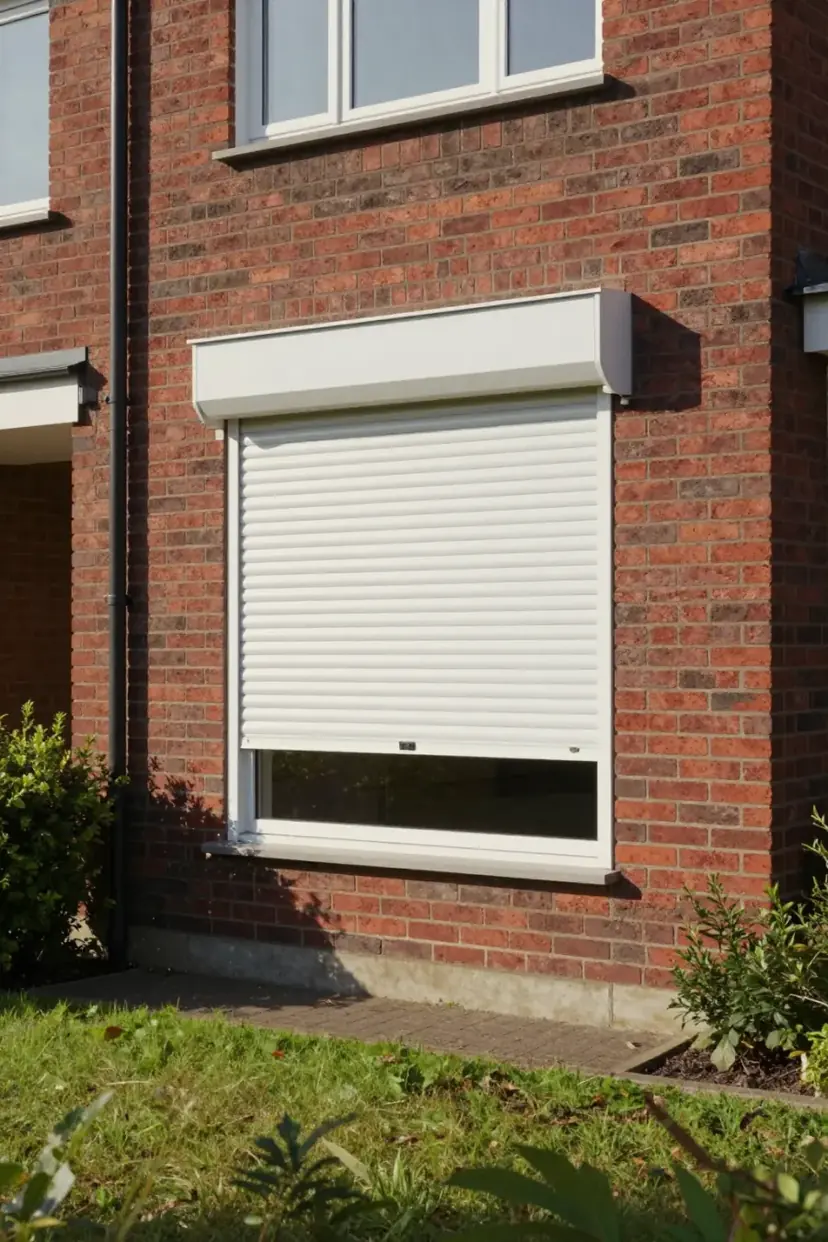


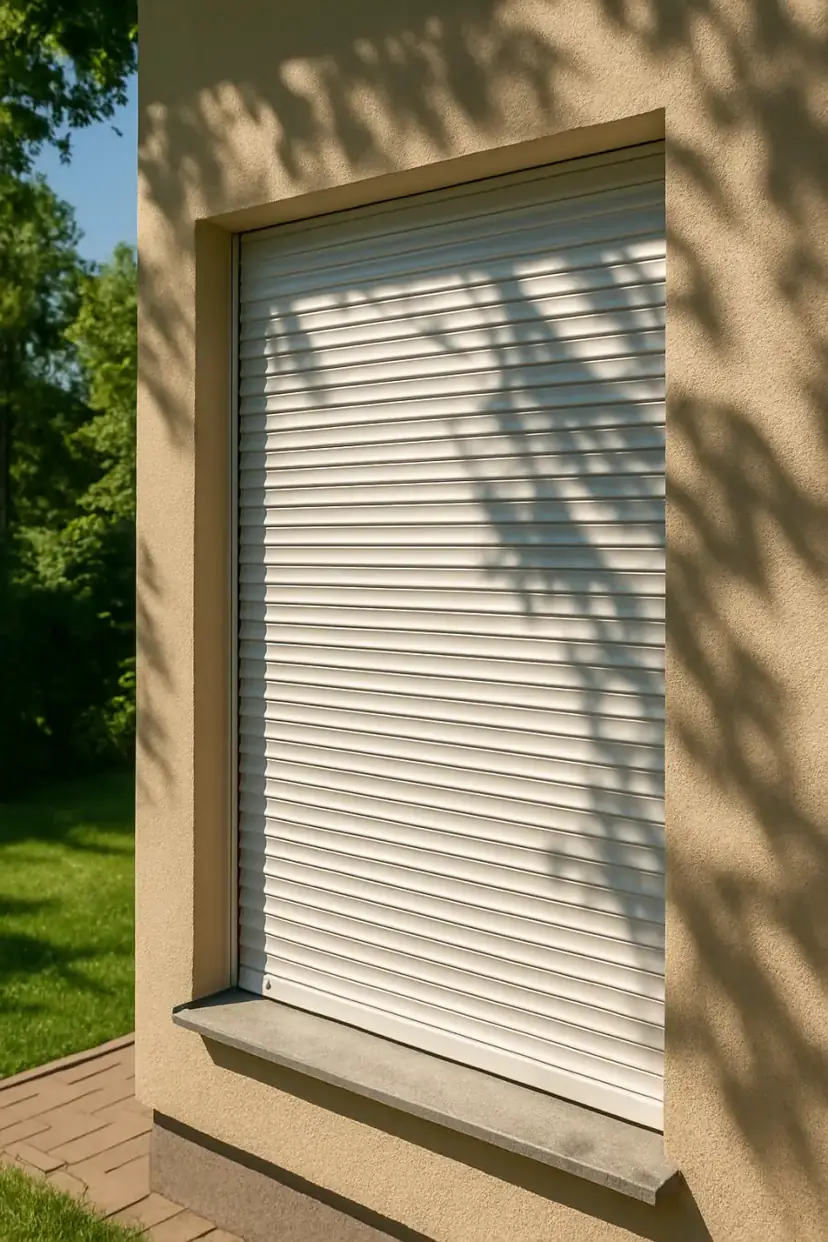
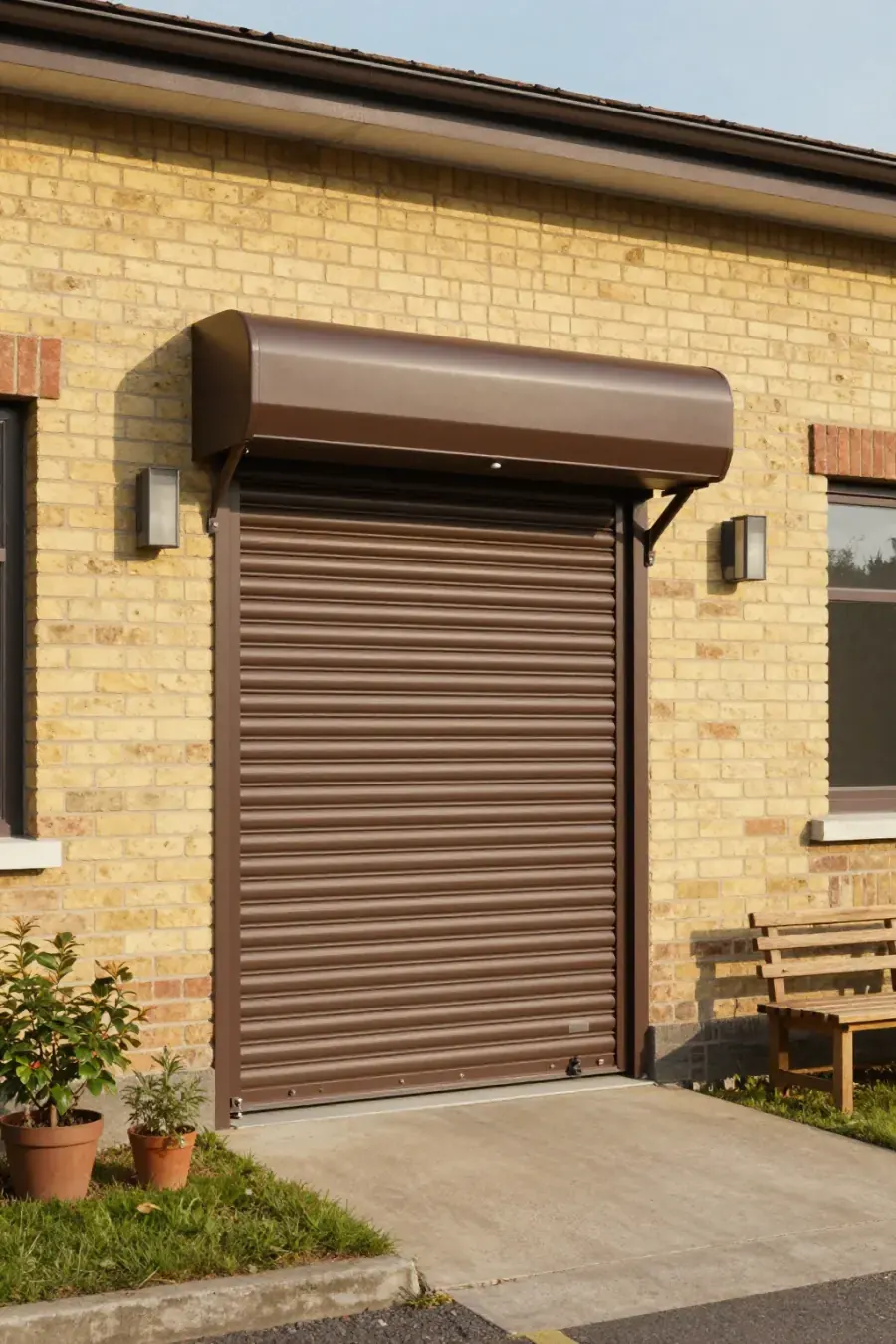

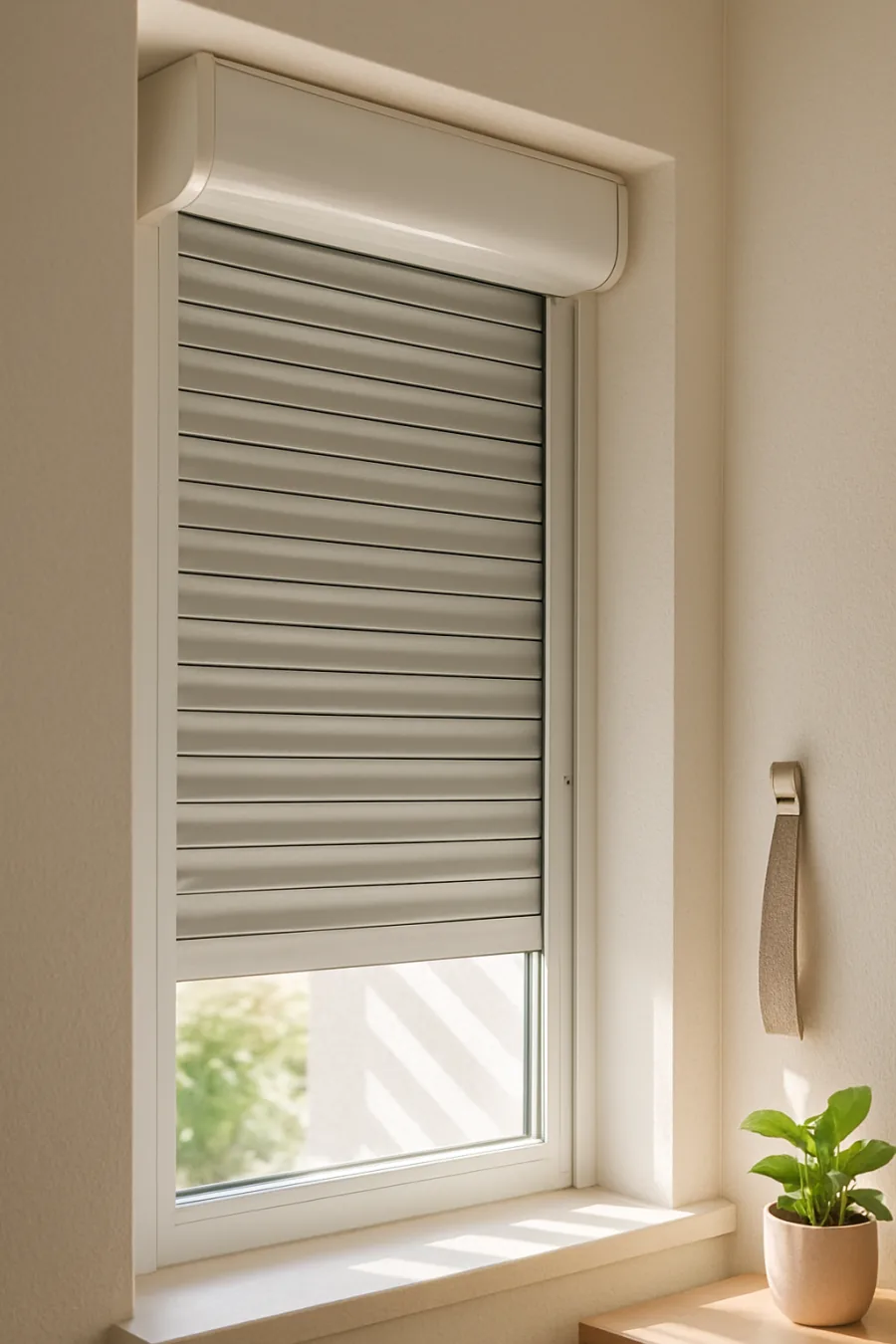











Insulated roller shutters in Almaty are a roller system with a foam-filled curtain that is fitted onto a finished window as a second contour. The curtain keeps an air gap between the shutter and the glass unit: in winter the glass cools down less, in summer it heats up less, and street noise drops by roughly 2–4 dB. They do not replace the glass unit.
What insulated roller shutters are and how they work
Insulated roller shutters are a roller system with a foam-filled curtain that covers the window from the outside and keeps an air gap between the shutter and the glass unit. The warmth comes not from the curtain itself but from this air gap: it reduces how much the glass cools down in winter and lowers heating in summer. The system is fitted onto a finished window, without reworking the frame.
A foam-filled profile is built like this: polyurethane foam is poured inside an aluminium slat, the slats interlock, and the curtain runs along the guide rails and rolls into the housing box. Polyurethane foam is rigid but light: it does not absorb moisture, does not shrink and does not pull the curtain down. That is why insulated roller shutters work for years, not “once a season”.
And now the main thing to understand before ordering. A foam-filled profile creates an air gap between the shutter and the glass unit, and the air gap reduces how much the glass cools down in winter. In summer the same gap keeps the glass from overheating on the sunny side — the effect works both ways. But this is an additional contour, not a replacement for the glass unit.
What the blind consists of
A roll-formed profile with polyurethane foam inside, interlocking slats, guide rails, housing box. The guide rails hold the blind at the sides and set the gap to the glass unit — the very gap where the air stays. The housing box takes the rolled-up blind. Four elements, and all four affect how well the warmth is kept in the end.
Why the roll-formed foam-filled one is considered standard
A roll-formed profile is light and quieter in operation. For apartments and homes this is enough: the foam-filled curtain in it gives the thermal effect that insulated roller shutters are bought for. An extruded profile with foam is chosen separately, when protection is added to warmth.
The thermal effect comes not from the curtain itself but from the air gap between the foam-filled shutter and the glass unit.
Do warm roller shutters replace a glass unit
No, insulated roller shutters do not replace a glass unit. They work as an additional contour: they cover the window from the outside and keep an air gap between the foam-filled shutter and the glass. The main resistance to heat loss comes from the glass unit, and the shutter adds a second layer to it.
The logic is simple. A glass unit by itself is already several panes and the chambers between them, and it is what determines how much heat leaves the room. Insulated roller shutters add nothing to this structure inside — they are fitted onto a finished window from the outside and work on top of it. The air gap between the curtain and the glass unit reduces how much the glass cools down in winter, but it does not turn a single-chamber window into a double-chamber one.
And this is where the line of expectations runs. If you have an old glass unit with draughts around the perimeter, no blind will solve that problem: gaps stay gaps. It is a different matter with a sound window on a noisy or sunny side, where you want to take the load off the glass itself. Here the second contour gives what the glass unit did not have.
Installation on a finished window takes one day precisely because the frame is not reworked, the sashes are not replaced, and the glass unit is not touched. We fit the housing box and guide rails over the existing window. Insulated roller shutters work as an additional contour and do not replace the glass unit.
How much warmth and quiet a foam-filled profile really gives
The effect of insulated roller shutters is real, but supplementary. They do not replace the glass unit. A foam-filled profile works as a second contour: it keeps an air gap between the shutter and the glass. Hence the result. In winter the glass cools down less, in summer it heats up less, and street noise drops.
On warmth we say honestly: the difference is felt by hand on the glass and in the overall feel of the room, but no manufacturer has seriously measured the percentage of heating savings. We have no such measurements. Anyone who names specific percentages is most likely transferring figures from Russian pages onto the Almaty market, and their winter outside the window is different. Our climate is harsher, the day-to-night difference is bigger. Thermal insulation here works not as a heater but as a buffer: the blind takes part of the temperature difference off the glass itself.
On noise there is one specific figure, and we do not hide it. A foam-filled profile reduces street noise by roughly 2–4 dB. This is not “it went quiet”. It got a little quieter to the ear if the window faces a noisy street. For a bedroom by the road this shift is usually what is needed: cars are heard, but they do not wake you. A horn right under the window, though, the blind will not remove. And this is not a flaw of the profile but physics — sound comes both through the frame and through the joints.
Sound insulation and thermal insulation in roller shutters come from the same air gap. If you want more quiet, you should look not at the curtain but at the window itself. If you want less cooling down, it is the same conversation. Hence a simple practice: before ordering Jalusso looks at what is going on with your glass unit. If it is old and draughty, no foam-filled profile will turn the picture around.
Our only quantitative figure in this section is a reduction in street noise of roughly 2–4 dB; everything else we describe in words, not percentages.
Almaty climate: winter cold and summer heat with dust
Yes, it works both ways: in winter the blind keeps warmth in, in summer it reduces heating of the glass. The sharply continental climate of Almaty calls for exactly this kind of work — frost and heat here do not replace each other smoothly but stand close together. Some may see this as a trifle, but the difference between a mild damp winter in central Russia and an Almaty winter is fundamental for an insulated profile.
Winter: frost and the day/night difference
Insulated roller shutters cover the window from the outside, and the air gap between the foam-filled curtain and the glass unit works as a buffer. During the day the air in the gap heats up even in frost if the curtain is raised and the glass is lit; at night the temperature drops, and the gap smooths out this difference. Why does this matter in practice? The curtain either contracts or expands with the temperature, and if the guide rails are clogged, the movement becomes stiff — especially in the morning, after a cold night. In the Jalusso workshop they always warn about this at handover: winter care of the guide rails is not a formality.
The dry Almaty frost is easier on the fabric than the damp winter of central Russia: no ice in the groove of the guide rails, less moisture on the slats. But the dust, which is present in Almaty all year round, does not go anywhere in winter either.
Summer: sun and dust
On the sunny side, insulated roller shutters give no less in summer than in winter. The air gap reduces the heating of the glass: the shutter takes the sun on itself, and the glass unit behind it heats up less. What this gives in the room depends on ventilation and on how long the curtain is closed. We advise keeping it closed during the hottest hours, not around the clock.
Dust is a separate Almaty story. It settles on the foam-filled profile, gets stuck in the slat lock and in the guide rails. Wiping the curtain with a damp cloth is enough, and the guide rails with a brush, and this should be done regularly, otherwise the curtain will start to jam. In my opinion, this is the most underrated part of roller shutter care in Almaty: people remember about it when the mechanism already moves with difficulty.
In Almaty, the effect of an insulated blind works both ways — in winter it keeps the heat in, in summer it reduces the heating of the glass.
When an insulated profile will not make a noticeable difference
Thermal roller blinds give a weak effect where the problem itself is already solved by the glass unit, and the window faces a courtyard. If you have a warm double-chamber glass unit, and outside the window there is a quiet courtyard without direct sun, the addition of a foam-filled curtain will hardly change the picture in the room. The logic is simple: insulated roller shutters work as an additional contour, not as the main one. The air gap between the shutter and the glass holds what the glass unit itself already holds.
When does the difference show clearly? On a noisy street, on the sunny side, on the ground floor. There the second contour covers what the glass unit cannot handle on its own.
Separately about insulating the window reveals and mounting foam. Insulated roller shutters are not a replacement for this work. If cold is coming from under the reveal, no curtain outside will block this draught — first you should deal with the seams and the junctions of the window to the wall, and only then think about the second contour. These are two different tasks, and they should not be confused.
For which rooms an insulated profile is justified
A bedroom on a noisy street is the first thing that comes to mind. A child’s room on the sunny side is the second. A study, especially if you work at a desk by the window and in summer the sun hits it until noon. In these rooms a person sits for a long time, and the difference between “the glass is scorching” and “the glass is warm to the touch” is felt every day.
But a kitchen facing a courtyard, a pantry, a guest room — here it makes sense to save on the profile. To be honest, I rarely advise putting a warm blind on all windows at once. People often come with the idea of “closing everything”, but in fact they need two or three windows.
If the glass unit is warm and the window faces a courtyard, the difference from an insulated profile will be weaker than on a noisy or sunny side.
Which profile to choose: roll-formed foam-filled or extruded with foam
A warm version of a roller shutter system comes in two types, and the choice here is not about “one being better than the other”. We consider the roll-formed foam-filled profile the basic warm version: it is light, quieter in operation and covers the task of an ordinary apartment or house. The extruded profile with foam is chosen when protection is added to warmth — primarily on the ground floor, where the curtain should also keep out intruders. Its price per square metre is higher, and here is why.
A comparison of the four types of blind that people come to us with most often.
| Profile | What it is chosen for | Warm effect | Price | Lead time |
|---|---|---|---|---|
| Roll-formed foam-filled | Apartment, house | Yes, the basic warm version | from 17,500 ₸/m² | 10–14 days |
| Extruded with foam | Ground floor, opening without security | Yes, warmth plus protection | from 24,900 ₸/m² | 12–16 days |
| Perforated | Shop window, ventilation needed | No | from 27,800 ₸/m² | 12–16 days |
| Insulated with electric motor | High and hard-to-reach windows | Yes | from 35,000 ₸/m² | 14–18 days |
An anti-vandal profile is essentially a reinforced extruded one. The difference between foam-filled and anti-vandal is not that one heats and the other does not: both hold an air gap. The difference is in the rigidity of the slat, which is extruded from aluminium without internal voids, and in the fact that such a sash bends less under impact. Putting an anti-vandal one on a fifth-floor window is money down the drain. Honestly, we talk people out of it in half of our orders.
And a perforated profile is a separate story. The holes in the slat let air through and keep the shop window visible, but they give no warm effect at all. This is the opposite task, and it should not be confused with insulated roller shutters.
If you compare a warm profile with an ordinary one, the difference is simple: the ordinary one has no foam inside, it only closes the opening. It is the filling of the slat that gives the thermal effect. But the extra cost for the basic roll-formed one does not go through the roof: the extruded one combines thermal insulation and protection and costs about one and a half times more than the basic one.
Manual control or electric motor on an insulated blind
The choice depends on whether you can reach the curtain with your hand. Manual control is suitable for windows within arm’s reach — it is a chain or cord that pulls the curtain up and lowers it down. An electric motor is needed for high and hard-to-reach windows: where you cannot reach the chain, the shutters are controlled with a remote. Moreover, an insulated curtain does not make manual lifting harder: a foam-filled profile weighs more than an ordinary one, but the difference on the chain is hardly noticeable. This is not an argument against manual control, but a reason to check the movement once during the measurement.
A short comparison across four parameters looks like this.
Manual control: base price, coefficient 1.0. Chain — 1.06. Repairability is higher: we can replace a cord or chain even after the warranty, we come, tighten, adjust.
Electric motor: coefficient 1.85, with remote — 2.1. An emergency lift is added to the drive part — it is used when the power is out, to open the window manually. Automation with a remote is convenient for panoramic glazing and windows above a canopy, where every lift is a separate operation.
A real example: on a balcony door-window, manual control covers the matter completely — you stand next to it, pull the chain, and that’s it. On a window above a canopy, where you cannot get close, the same insulated profile without a drive is simply not used.
Manual control is suitable for windows within arm’s reach, an electric motor — for high and hard-to-reach ones.
Installation on a finished window: housing box, guide rails, one day of work
Insulated shutters for windows are mounted on a finished window without reworking the frame — the frame, glass unit and reveals stay in place, only the outer side of the opening changes. Installation takes one day. It all starts with a measurement: the measurer comes with samples, takes the dimensions of the opening and calculates the cost on the spot — the width of the curtain, the length of the guide rails and the depth of the housing box all depend on these dimensions.
Then the order is as follows. Based on the measurement, the workshop makes the blind, the housing box and the guide rails for the specific opening. During installation, the housing box is fixed above the window, the guide rails run along the sides, the blind is threaded into them and closes the opening from the outside. The frame is not touched — the insulated profile works as a second contour over the existing glass unit, not instead of it. There are mounting options that do not drill the frame and leave no marks on the reveals: wall mounting, frame mounting and mounting without drilling. A cassette system hides the blind in a compact housing box — this is an option for a balcony door-window or a window above a canopy, where there is little space above the opening.
You can install insulated shutters on just some of the windows, not all of them at once. Say the window on the noisy side bothers you, while the rest face the courtyard — nobody is forcing you to close off the whole house. And yes, insulated shutters can be installed on a house clad in siding too: the fasteners are chosen for the base, not the cladding, so the siding isn’t damaged during installation.
Surface-mounted, built-in or concealed housing box
The type of housing box affects the thermal performance of the insulated blind. A surface-mounted box is fixed over the opening and doesn’t touch the wall — the simplest route if the facade is already finished. A built-in box is recessed into the opening and leaves fewer visible parts outside. A concealed box hides behind the finish, so from the street only the blind is visible. The tighter the box closes off the top of the opening, the less air leaks past the blind and the more evenly the air layer is maintained. In my view, chasing a concealed box purely for aesthetics isn’t worth it if the facade is simple: it’s the tightness of the fit that makes the difference in thermal performance, not the depth of the recess.
Caring for the guide rails in winter
To keep the blind from jamming in the cold, keep the guide rails clean. Dust and snow packed into the groove, together with Almaty’s day-to-night temperature swings, turn to ice — the blind stops and the chain pulls tight. It’s enough to clear the debris from the groove with a soft brush and not to pour water on the guide rails. Nothing complicated, but in winter this is the step most often forgotten.
The type of housing box affects the thermal performance of the insulated blind, while the installation itself takes one day and doesn’t require reworking the frame.
How much do insulated roller shutters cost in Almaty
The basic warm version starts from 17,500 ₸ per square metre, with a manufacturing time of 10–14 days. The figure is calculated from the area of the blind, so the exact order total can’t be given before the measurement.
| Version | Price | Manufacturing time |
|---|---|---|
| Roller shutters for windows, foam-filled roll-formed profile | from 17,500 ₸/m² | 10–14 days |
| Security roller shutters, extruded aluminium with foam filling | from 24,900 ₸/m² | 12–16 days |
| Perforated roller shutters | from 27,800 ₸/m² | 12–16 days |
| Motorised roller shutters | from 35,000 ₸/m² | 14–18 days |
Perforated roller shutters are in the table for completeness: perforation gives no warm effect, the shop window stays visible, and air passes through. It’s a different version, and it’s chosen for a different task.
We charge 4,500 ₸ for installing each item; if the order total reaches 150,000 ₸, installation is included at no extra cost. An electric motor raises the price per square metre noticeably — we covered mechanics and automation above, here only the difference in money matters.
The measurement determines the size of the blind and the cost of the order. Our measurer arrives with profile samples, calculates on the spot and shows how the blind will sit on your particular window. Measurement and consultation are always free — both in the city and outside it. In Almaty, measurement and delivery are free too.
Do we travel outside the city? Yes. Kaskelen, Talgar, Issyk, Kapshagay are our directions; the cost of the visit depends on the distance and is quoted before the visit, so there are no surprises. A window at a country house near Kaskelen is calculated the same way as one in the city, the only difference is the visit.
The warranty covers the mechanism for 3 years and the installation for 1 year from the date the acceptance certificate is signed. When a breakdown of insulated roller shutters is recognised as a warranty case, we don’t charge for the work and complete it within 5 working days. When the warranty period has already expired, we still come: we’ll tighten the mechanism, adjust the travel, and fit a new cord or chain. Mechanical damage, reinstallation on your own, water and natural fading of the fabric are not covered by the warranty.
Jalusso is a manufacturer with its own workshop in Almaty, and it doesn’t keep finished products in stock: every blind is made to measure. That’s why the price per square metre is a starting point, not the amount to pay.
The basic warm version of insulated roller shutters in Almaty starts from 17,500 ₸ per square metre, with a manufacturing time of 10–14 days.
Insulated roller shutters or insulating the window reveals and foam
These are two different tasks, and one doesn’t cancel out the other. Insulating the window reveals and foam removes draughts around the perimeter of the window — where the foam in the joint has shrunk and the reveal has frozen through. Insulated roller shutters cover a different spot: they maintain an air layer between the curtain and the glass unit. If cold air blows from the joint, the curtain won’t remove that cold — joint first, shutter second.
The order of work depends on this. When draughts around the perimeter have already been fixed, the additional outer contour delivers what it’s installed for: the glass cools down less in the cold and heats up less in the heat. When the joint hasn’t been touched, the money goes into the blind, and the cold keeps coming in from the side. During the measurement we look specifically at the perimeter — it shows whether foam is needed first.
And what about fogging? Glass doesn’t fog up because of a closed curtain. It depends on the ventilation of the room, not on the shutter: moisture from cooking, drying laundry and breathing settles on the coldest surface in the room, and if that’s the glass, it will fog up with any outer contour. A curtain closed for the night, by the way, doesn’t “seal” the glass — it doesn’t isolate the air in the room.
Hence a simple rule: insulating the window reveals and foam and insulated roller shutters solve different parts of the same task, and one shouldn’t be substituted for the other.
Glass fogging depends on the ventilation of the room, not on a closed blind.
A case from practice: windows where an insulated profile pays for itself
An insulated profile is justified where the window really suffers from the outside: a noisy side, a sunny side, the ground floor. There, thermal roller shutters for windows work as an additional contour, and the difference is felt from the first season.
A bedroom on a noisy street is the most common story. The blind dampens street noise by roughly 2–4 dB, and that’s enough for the cars under the window to stop being part of the night. A kids’ room on the sunny side is the second most common: in summer the air layer reduces the heating of the glass, and the room doesn’t turn into a greenhouse by midday. An office with a window onto the street is the same scenario as the bedroom, except the person sits there during the day rather than sleeping.
And can insulated roller shutters be installed on just some of the windows? Yes, and in practice that’s what’s done most often. We’ve installed curtains on one or two windows in an apartment more than once — where the street or the sun hits hardest — and left the rest as they were. The workshop calculates each item separately, by its own size, so a partial order is no problem.
Special cases are about warmth plus protection. A ground floor and a ground-floor office: here people choose an extruded profile with foam, which combines thermal insulation and protection from prying hands. A country house for seasonal living follows the same logic, just adjusted for the fact that in winter the house stands empty and in summer it’s hot inside.
An insulated profile pays for itself where the window faces a noisy or sunny side, not where a window simply exists.
FAQ
Below are the questions most often asked during the measurement and in messages. Short answers with no evasive wording.
Do insulated roller shutters really keep the heat in? Yes, but as an additional contour. A foam-filled profile reduces the cooling of the glass in winter and its heating in summer thanks to the air layer between the curtain and the glass unit. Don’t expect the wall to stop losing heat — that’s what facade and window reveal insulation is for.
How much quieter will it be on a noisy side? A foam-filled profile reduces street noise by roughly 2–4 dB. That’s noticeable if the street is really noisy, but it won’t turn a bedroom into a recording studio. The glass unit still does the main work.
will the blind jam in the cold? No, with proper care of the guide rails. They need to be cleaned of dust and not left with debris and snow inside — then the blind moves freely both in freezing temperatures and through the day-to-night temperature swings.
What is the price per square metre? The base price is from 17,500 ₸ per square metre for a roll-formed foam-filled profile. The extruded foam profile is about one and a half times more expensive, and an electric motor adds its own markup. The exact figure is calculated after measurement, because the size of the blind and the type of housing box affect the total.
What about manufacturing time and warranty? Manufacturing time is 10–14 days from the date of measurement. The warranty is 3 years on the mechanism and 1 year on installation, counted from the date the acceptance certificate is signed. After the warranty Jalusso still comes out: to tighten, adjust, replace a cord or chain.
Can I order for just one window instead of all of them? Yes. The measurer measures each window separately, and an order can be put together from one opening or from several — your choice.
The answers to the frequent questions come down to one thing: the effect is real, but supplementary, and it is worth assessing on your own window rather than by the promises in advertising.
Conclusion
Insulated roller shutters are a second contour on a finished window, not a replacement for a glass unit. They work thanks to the air layer between the foam-filled shutter and the glass: in winter the glass cools down less, in summer it heats up less on the sunny side.
First. It is not the curtain itself that provides the warmth, but the air between the shutter and the glass unit. The foam-filled profile merely holds that air layer and keeps it from being blown through.
Second. Insulated roller shutters do not replace a glass unit. If the window itself is cold, the difference will be weaker than you expect. And it is more honest to say this at the measurement than to promise an effect that will not be there.
Third. On noise, there is one real figure — a reduction of about 2–4 dB. Not silence, but a noticeable muffling of street background noise. For a noisy side, this is enough to sleep more peacefully.
Fourth. The basic warm option is a roll-formed foam-filled profile. It is chosen for apartments and residential houses: it is light and quieter in operation. The extruded foam profile is chosen when protection is added to warmth — a ground floor, an unguarded opening.
The practical recommendation is simple: call a measurer with samples. He will come free of charge, show you the blind in his hands, calculate the cost on the spot and tell you straight whether an insulated profile will make a noticeable difference on your particular window.

