
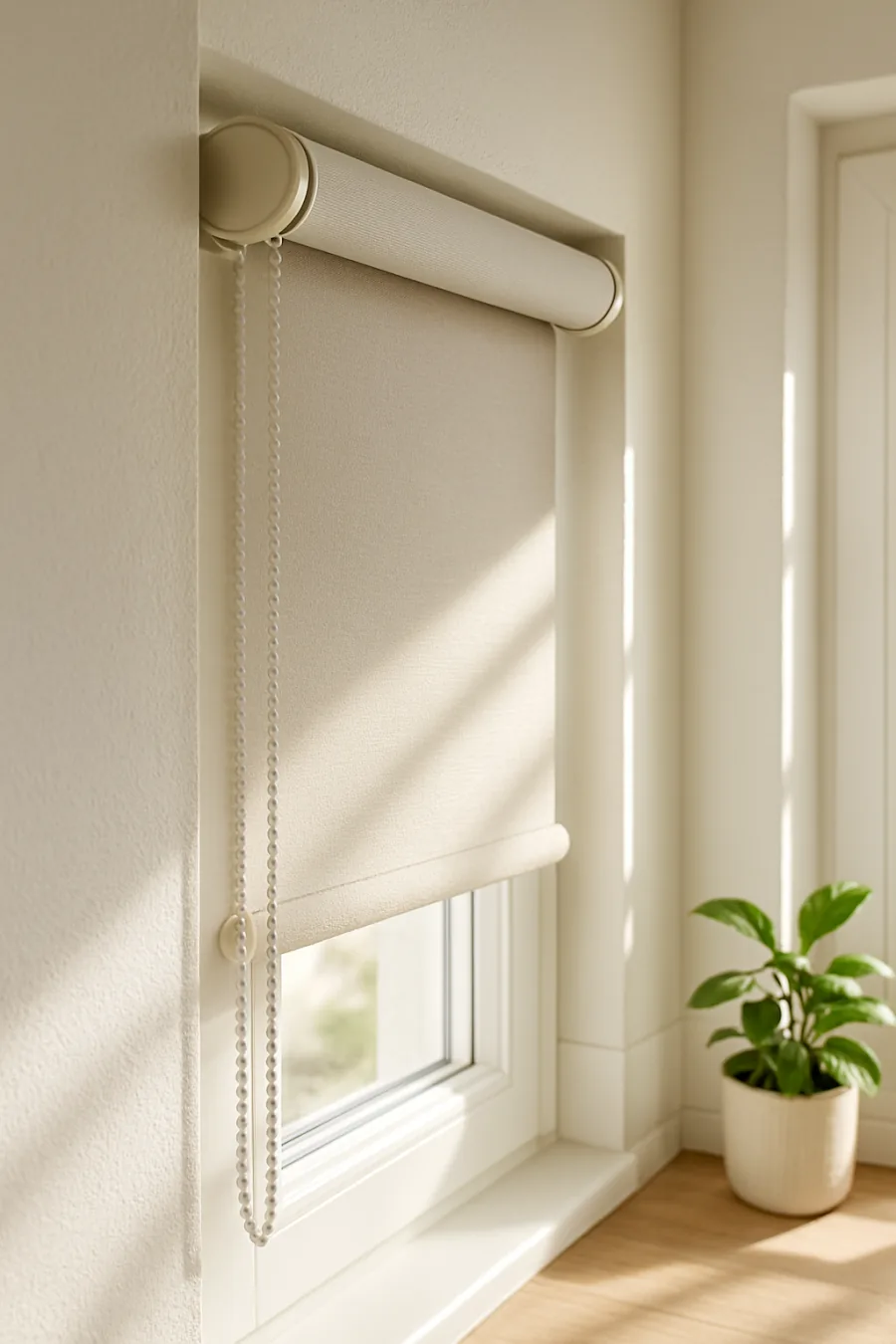

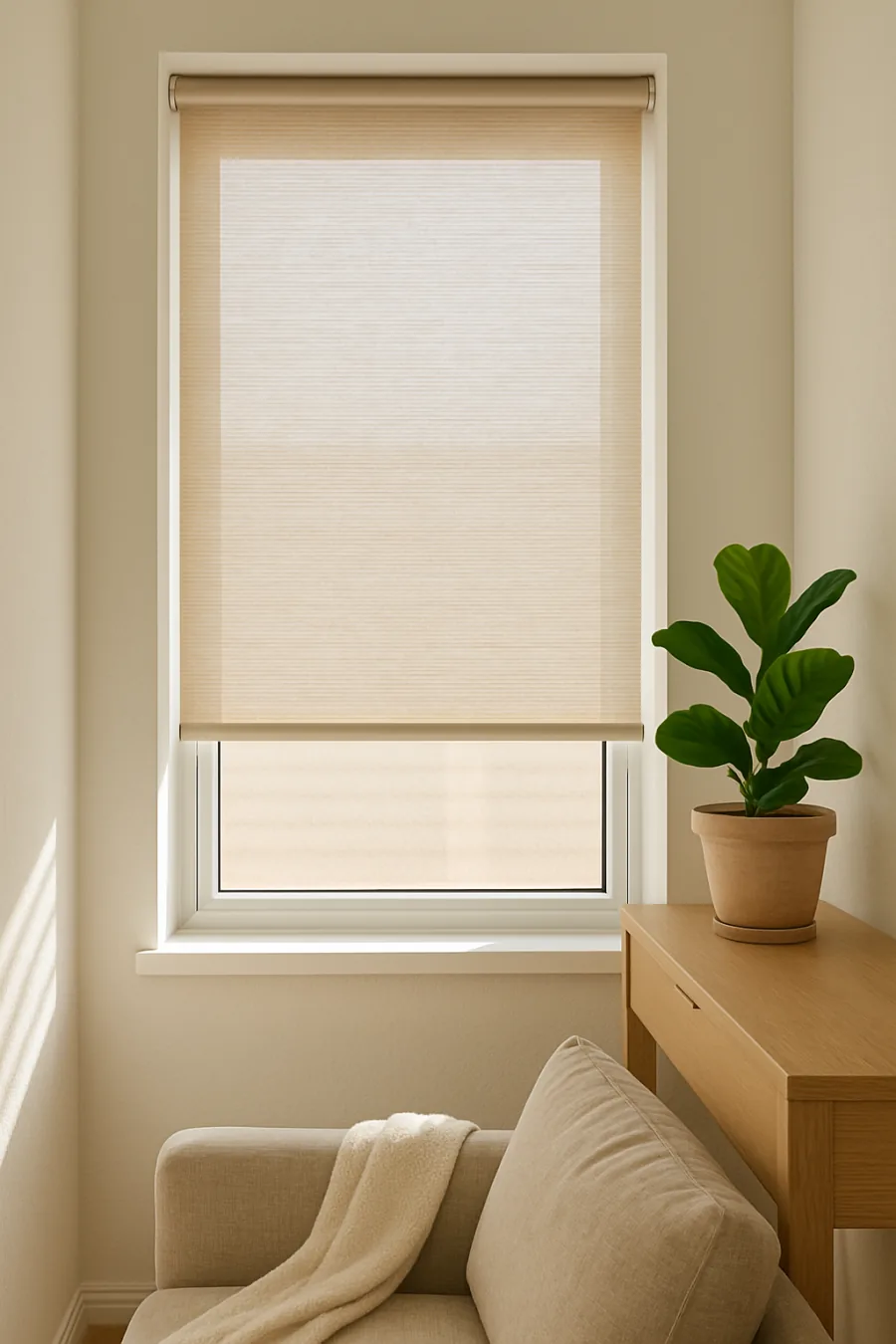


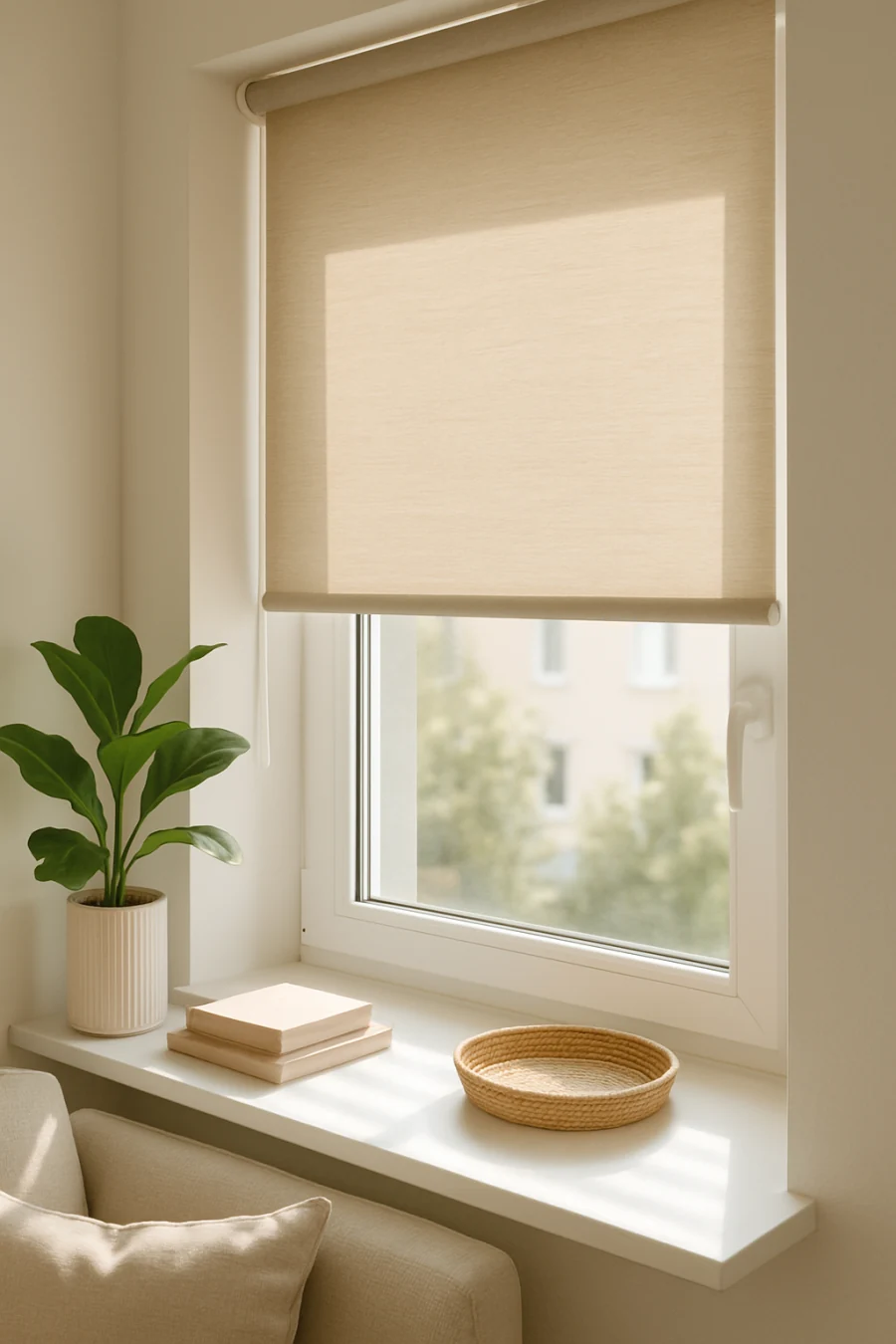


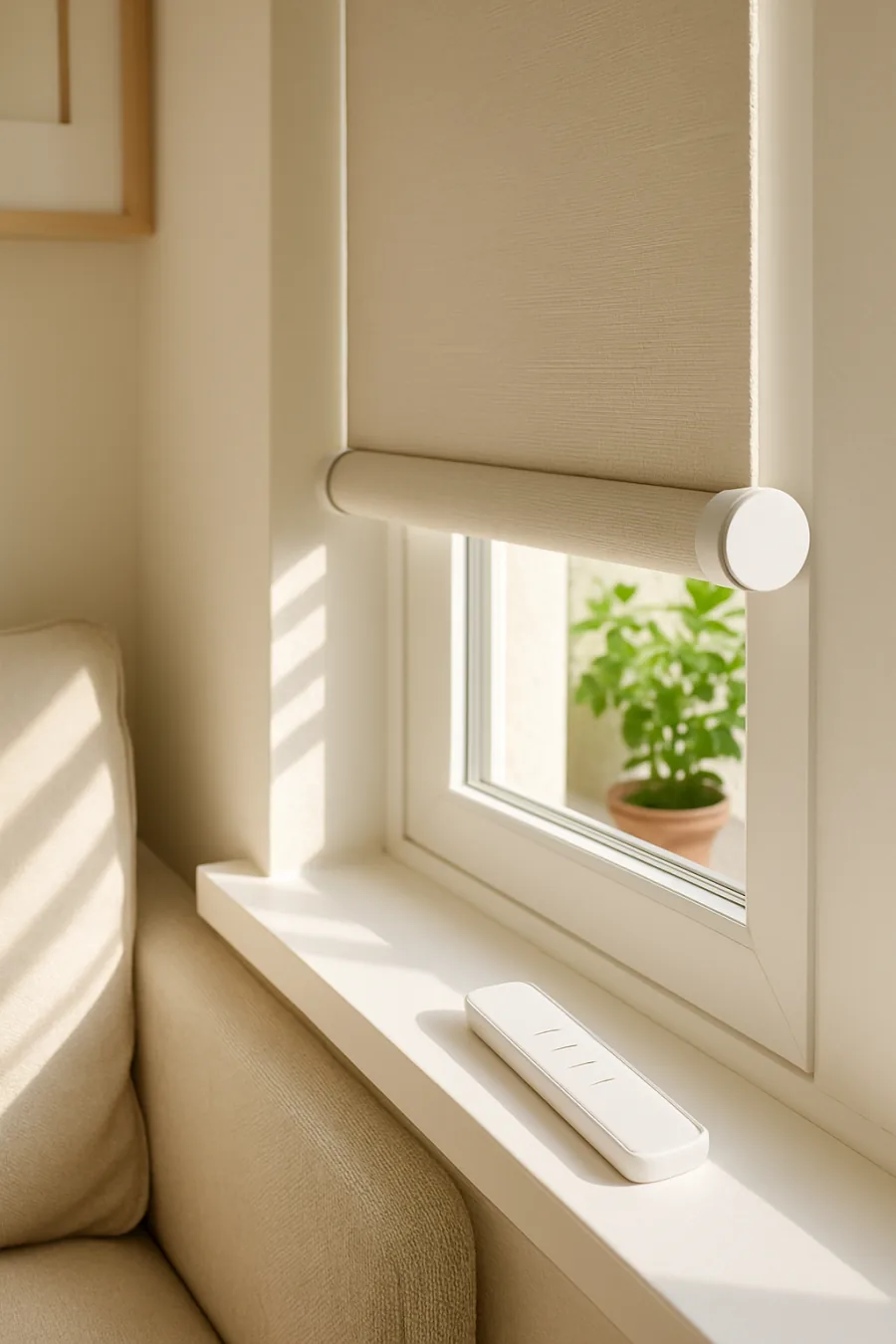


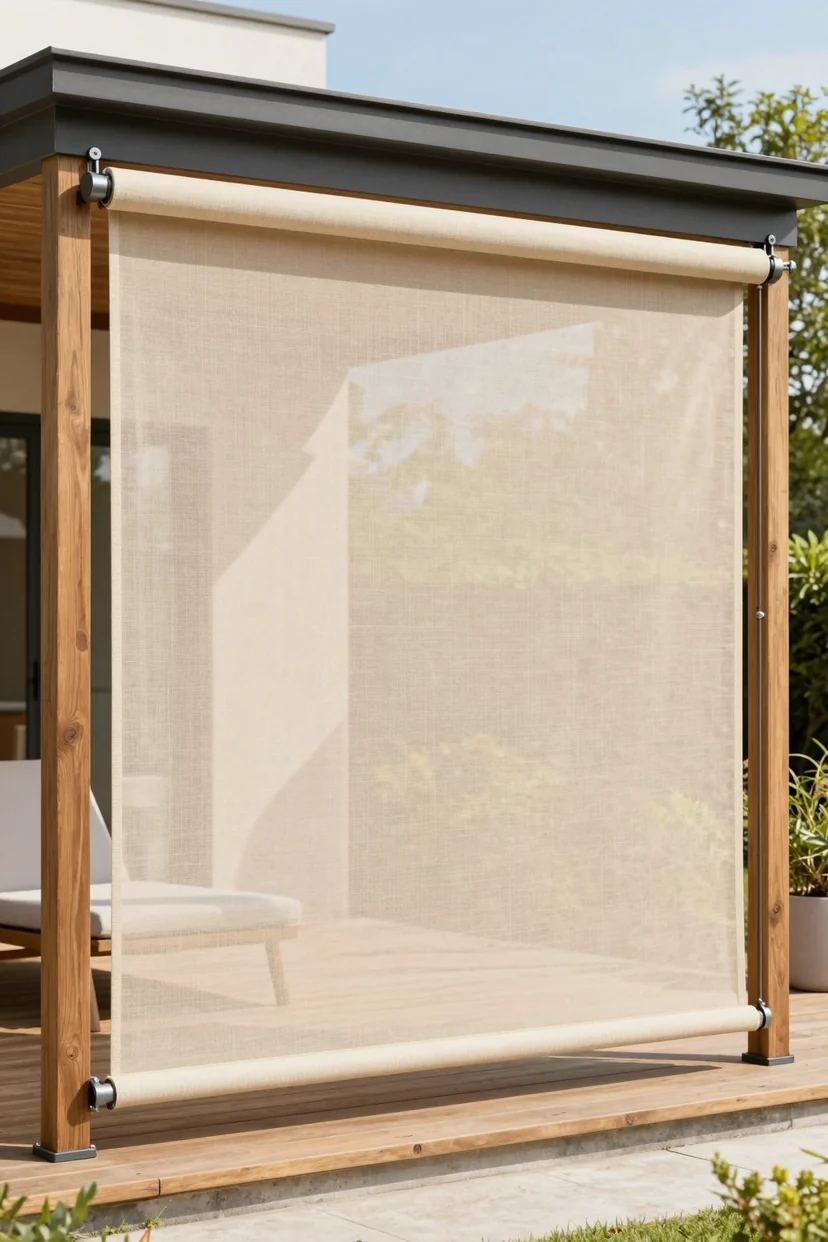


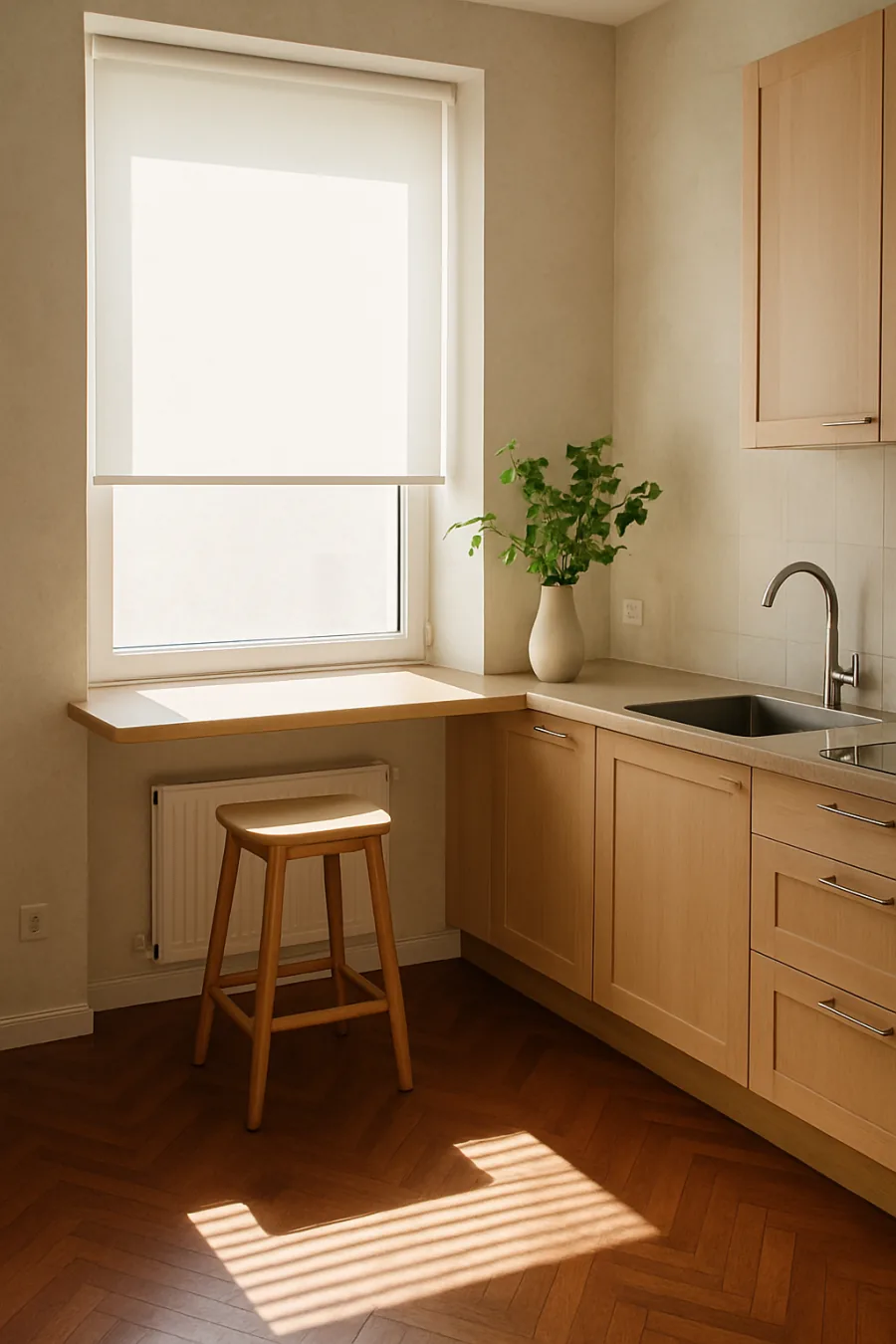
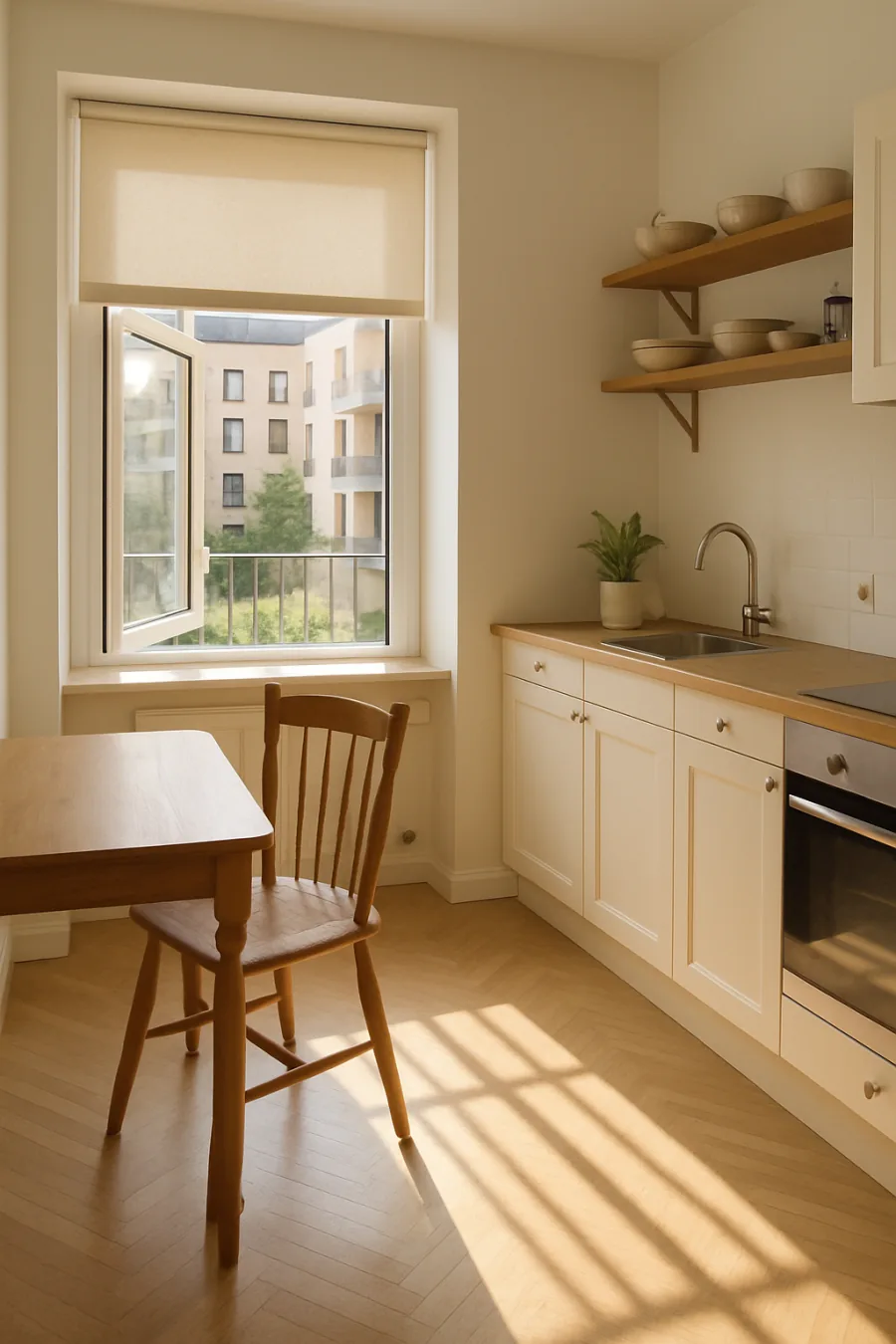
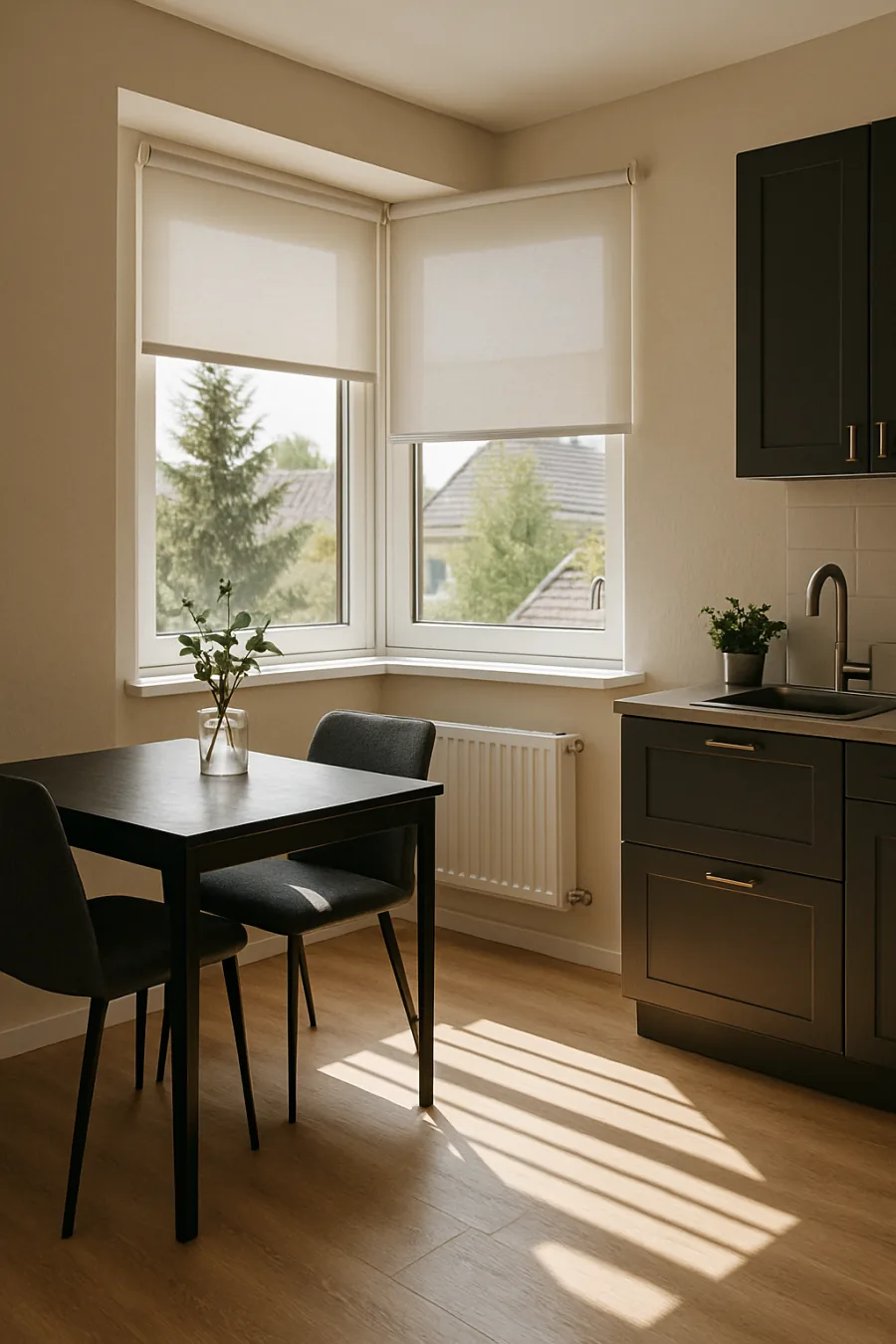
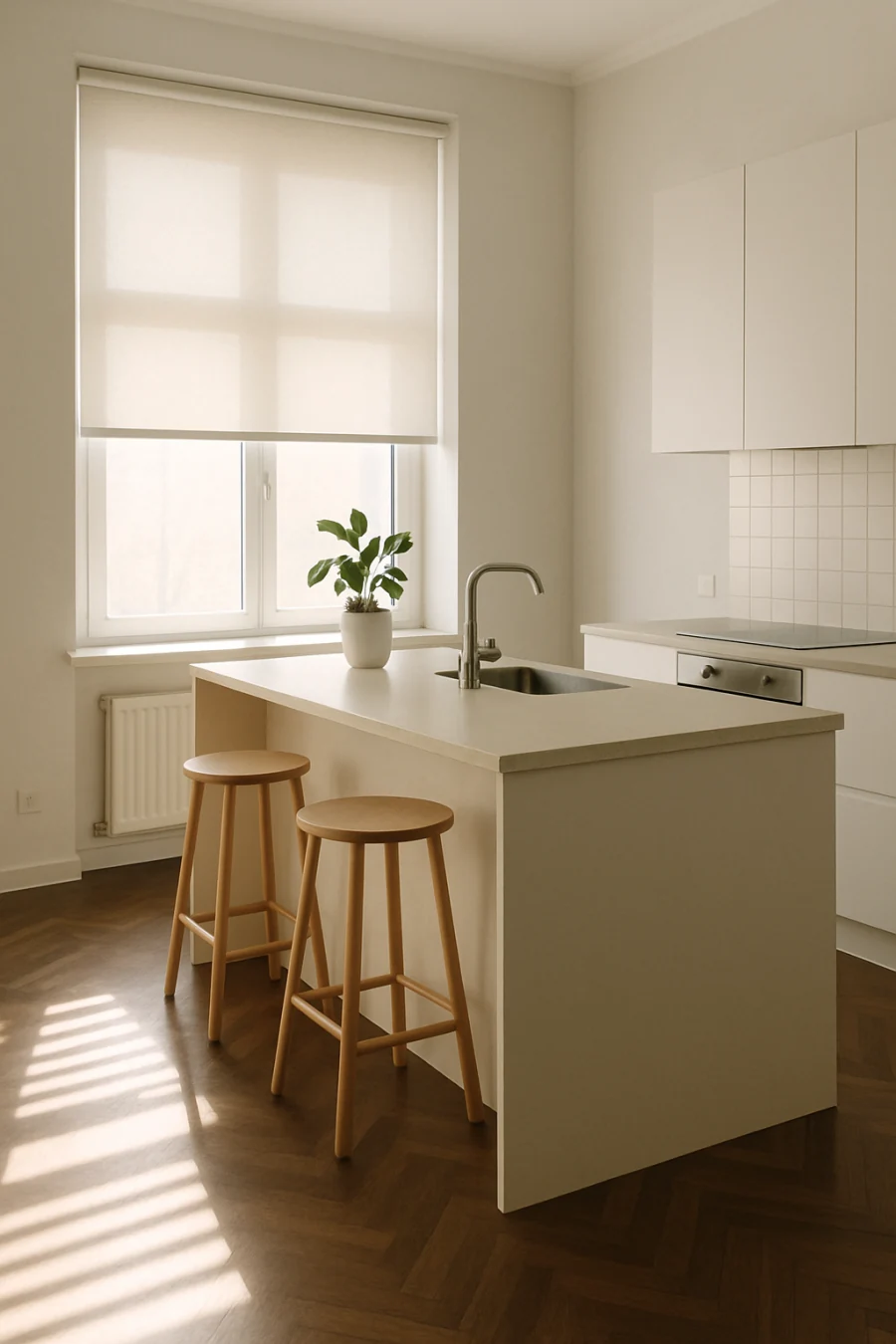


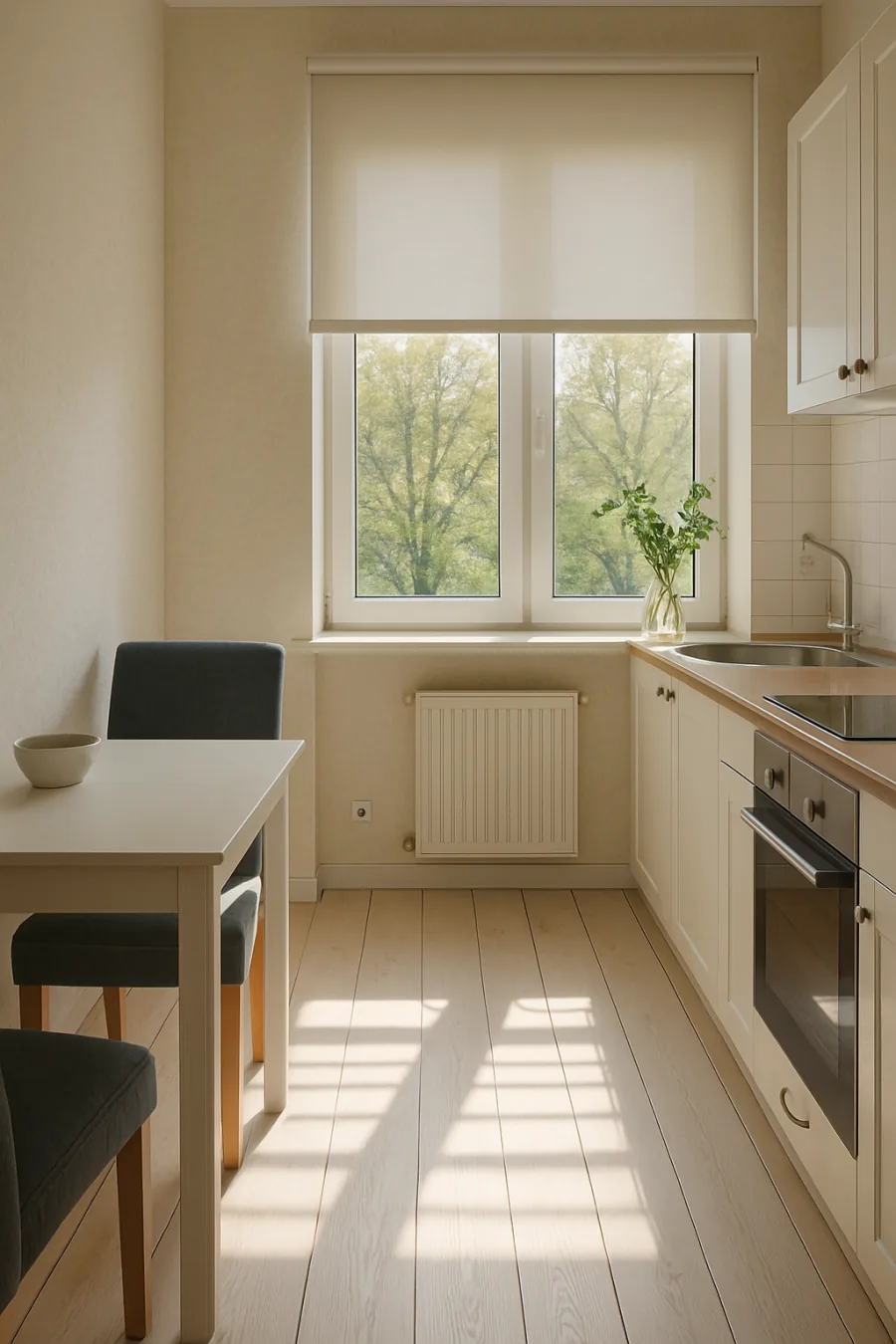











Kitchen roller blinds in Almaty are made to measure: the blind is fitted at the glass or on the sash, the windowsill stays free, and the light is adjusted with a chain or spring. The fabric is chosen to suit what stands by the window — the hob, sink or worktop. Price from 5,400 ₸/m², lead time 4–6 days, measurement is free.
What’s under your window: choosing fabric by kitchen zone
The fabric for a roller blind is chosen not by the size of the window, but by what stands under it. Splashes and steam fly up at the sink, grease settles at the hob, and at the countertop and windowsill it is important not to take up the workspace. That is why roller blinds for the kitchen in Almaty are mounted at the glass or on the sash, and the fabric group is chosen for the specific zone.
A sink by the window creates a risk of splashes on the fabric, and a hob creates a risk of grease settling on it. Both risks are removed not by the size of the product, but by the smooth surface of the fabric and the right length.
Sink and countertop under the window
Steam rises from the sink and settles on the fabric in a thin layer. Smooth fabric with a PVC coating wipes clean with a damp sponge without streaks. If the bottom of the fabric drops below the mixer tap, splashes reach the fabric constantly — during the measurement we check the height of the window reveal and the position of the mixer tap. For example, in a kitchen where the window is 2.1 m and the sink is next to it, we raised the bottom of the blind above the mixer tap: splashes do not reach the fabric, and the windowsill stays free.
Hob to the side or under the window
Next to the hob, grease settles on the fabric in a thin layer. Whether it soaks in or not depends on the treatment of the fibre. A dirt-repellent finish keeps grease and tea from penetrating the fibre: drops roll off, and the settled film is removed with a sponge. The more often you cook, the more important this layer is. In a kitchen with an island we installed exactly this fabric — after frying, stains do not soak in.
Windowsill with appliances and spices
Mounting to the sash or frame does not touch the windowsill. The microwave, jars of spices, and pots of herbs stay in place. The length to the windowsill solves a separate task: if you do not want to cover the window completely, the edge of the roll stops right at the windowsill. In a narrow kitchen, a mini system on the sash takes up not a single centimetre of wall, and the worktop by the window stays free.
One blind covers the window with the sink and the hob to the side, if the width of the opening allows a roller tube without sagging. The measurer checks the width and height of the window reveal and advises whether one fabric is enough or another scheme is needed.
| What is under the window | Which option fits |
|---|---|
| Sink by the window | Fabric with PVC coating, bottom above the mixer tap |
| Hob | Dirt-repellent treatment |
| Windowsill with appliances | Mounting on the sash or frame, length to the windowsill |
The risk to the fabric in the kitchen depends not on the size of the window, but on what stands under it: splashes and steam fly up at the sink, grease settles at the hob, and at the countertop and windowsill it is important not to take up space.
Finish or PVC: how the two fabrics differ
The choice between fabric with a dirt-repellent finish and fabric with a PVC coating is decided by what exactly lands on the blind at your window. The finish works inside the fibre, PVC — on the surface. Hence the difference in care.
A dirt-repellent finish protects the fibre of the fabric from grease: the solution is applied to the threads, and a drop does not go deep but rolls off. The fabric stays woven — you can see it and feel it, and see it in the light. Fabric with a PVC coating is built differently: on the front side there is a smooth layer that wipes clean with a damp sponge without streaks. Splashes and steam settle on it but do not pass into the fibre.
Dense polyester stands apart in this comparison. It holds its shape and does not let light through — in the evening such a roll hides the room from the courtyard. But dense polyester by itself protects against neither grease nor tea: without a finish or coating, the stain stays on the fibre.
| What is under the window | What people choose |
|---|---|
| Hob to the side, cooking every day | Dirt-repellent finish: grease does not soak into the fibre |
| Sink under the window, drops and steam fly up | Fabric with PVC coating: wipes clean with a damp sponge |
| South side, you need density in the evening | Dense polyester, with a finish if desired |
| The blind hangs over the countertop, hands reach for it | PVC: fingerprints come off in one movement |
Products similar in task — roller blinds for the kitchen — are made from the same fabric groups, the difference is only in the mechanism and in how the fabric moves. We assemble roller blinds for the kitchen on the same roller tube and with the same mounting as a regular roller blind, so the care tactics do not change with the name.
How to tell by touch
Run your finger over the sample. A finish leaves the fabric woven — your hand feels the weave of the threads, the surface is matte. PVC gives a smooth surface, similar to a thin film; in the light it shines slightly. The measurer brings both samples and a drop of water: on finished fabric the drop stands as a bead, on PVC it spreads as a film. Choosing from a photo in a chat is not worth it — the difference is visible in your hands.
What happens after cleaning
A dirt-repellent finish stays on the fibre, not on the surface, so care of the fabric excludes soaking: in a basin of water the finish washes out, and the fabric starts to absorb grease like ordinary fabric. The PVC layer is simpler — it is wiped many times, and it does not mind frequent passes with a sponge. Hence a simple rule: clean the finish spot by spot and quickly, PVC can be wiped regularly.
The finish protects the fibre of the fabric itself, while the PVC coating creates a smooth layer on the surface that wipes clean with a damp sponge without streaks.
Mounting on a kitchen window: sash, frame, cassette
So that the sash opens, the roller blind is mounted not to the wall but to the window. Mounting on the sash leaves the windowsill free and lets the blind move together with the window when it is aired. Mounting on the frame works differently: the fabric stays on the fixed part, and the sash moves next to it. A cassette system is installed right against the glass and covers the roller tube with a housing box. Mounting without drilling does without any holes in the profile at all.
What to choose for your windows:
- Mounting on the sash. The blind moves together with the sash, the windowsill stays free — the microwave and jars of spices stay in place. For a turn handle, the measurer leaves a gap, otherwise the fabric will catch it when opening.
- Mounting on the frame. The sash opens freely, the blind does not get in its way. Suitable when the window is opened often and the handle is positioned so that making a gap for it is inconvenient.
- Cassette system. The fabric and the roller tube are covered by a housing box that sits flush against the glass. It takes up the least space near the work area, but in the calculator it costs more — coefficient ×1.28.
- No-drill mounting. The brackets hold without holes in the frame. An option for a rented apartment or a new profile you don't want to drill into; coefficient ×1.1.
Tilt ventilation requires a gap under the sash handle. The sash tilts inward, and if the fabric is lowered all the way down, it catches the top corner of the frame. During the measurement we check the sash movement before installation and calculate the height so that the bottom of the fabric stops above the handle.
Sash or frame — which to choose
The answer depends on what matters more to you: a free windowsill or a free sash. On the frame, the sash opens freely and the blind hangs on the fixed part of the window. On the sash, the blind moves together with it — but the windowsill is completely free, and your appliances stay in place. The measurer checks the sash movement before installation: if the handle is close to the window reveal or the sash is heavy, sash mounting may not work, and we tell you this on site.
Cassette and no-drill mounting
The cassette system sits flush against the glass: the housing box covers the roller tube, leaving minimal space between the fabric and the glass. This solution is chosen when the windowsill is deep and cluttered, and the window is right above the countertop. No-drill mounting does without holes in the frame — the brackets are fixed differently. For a kitchen window above the sink, the bottom of the fabric is calculated so that the fabric stops above the faucet: then splashes don't reach it. The height is set by the chain, and the fabric locks at the desired position.
Sash mounting leaves the windowsill free and lets the blind move together with the window during ventilation — this is the basic option for a kitchen where the windowsill is taken up by appliances and spices. When choosing roller blinds for the kitchen, start with the question of what stands under the window, and then pick the mounting method to match. Roller blinds for the kitchen with frame mounting are chosen when free sash movement matters more; with a cassette — when the window sits flush against the work area.
Care that doesn't wash out the treatment
Fabric care in the kitchen comes down to one rule: remove and clean, but don't soak. The dirt-repellent treatment stays on the fibre of the fabric itself, not on top of it, so machine washing rinses it out of the fibre. Fabric with a PVC coating works differently: the smooth layer sits on top and easily survives repeated wiping with a damp sponge. Hence the difference in how often you can go back to cleaning.
Here’s how it works.
- Remove the fabric from the mounting. If the fabric is on a cassette, first remove the cassette, then the fabric.
- Vacuum the fabric with a soft brush attachment — it removes dust and kitchen film over the entire surface.
- Remove local stains with a damp sponge and a neutral cleaner.
- For stubborn grease marks — a soft brush without abrasives.
Cleaning order
A vacuum with a soft brush attachment is good because it touches neither the treatment nor the PVC layer. A damp sponge works spot by spot: you go over a stain near the stove without spreading water across the whole fabric. A soft brush without abrasives is needed where grease has already hardened into a crust — for example, if the blind hangs above the countertop and you cook every day. Abrasives and the rough side of a sponge scratch the PVC coating, and dirt then gets packed into the scratches, which a sponge can no longer remove.
What not to do
Fabric care rules out soaking and machine washing: water damages both the treatment and the roller tube. What if after a year the fabric has still turned yellow or become coated with film? Tell us — we'll tighten it, adjust it, and deal with the dirt on site. The mechanism and installation are covered by warranty: three years on the mechanism and one year on installation from the date the acceptance certificate is signed, while natural fading of the fabric and water damage are not covered.
And here's what's important to understand: a yellow film near the stove is no reason to throw out the blind and order a new one. More often it's a thin layer of grease on the surface of the fabric, and it comes off following the steps above. If a roller blind in the kitchen has darkened from grease rather than fading, cleaning restores its look without replacing the fabric. If the dirt doesn't come off and we can't sort it out on site — we'll offer a fabric replacement, while the roller tube and mechanism stay.
The fabric material determines how many cleanings it can take: PVC-coated fabric has a bigger margin, treated fabric has a more modest one. A vacuum and a damp sponge with a neutral cleaner remain the main care for kitchen fabric; the fabric can't handle soaking or machine washing.
Colour and fabric density in a sunny kitchen
The density of the fabric and its shade are chosen by the side of the sun. On the south and west, where the sun sits in the window for long periods, choose fabric with fade protection or dense polyester. Dense polyester holds its shape and blocks light. Thin sheer on that side loses colour faster — the sunny side accelerates fabric fading, and the pigment goes unevenly, in patches.
The difference between fabric groups is in how they work with light. Screen lets light through and keeps the street visible: during the day you can't be seen from outside, while inside the room looks bright. Dim-out softly diffuses light and removes glare on the table and countertop. Blackout blocks light completely. Sheer is the thinnest of all, it barely holds back the sun and resists fading less than the others.
What colour roller blind to choose for the kitchen? A simple rule applies here: on the sunny side, light shades heat up less, but near the stove they show dirt more. Grey, beige and melange hold the middle ground — everyday soot is less visible on them, and they don't darken the kitchen. A kitchen with dark fronts benefits from light fabric: it balances the cabinets. Saturated dark colours on a south-west window lose their depth first.
Roller blinds for the kitchen are chosen by both density and shade at once — one doesn't work without the other. For roller blinds on the south side, we usually recommend dense polyester or fabric with a light-resistant treatment.
Shades people choose for the kitchen
Grey, beige and melange are the three shades ordered more often than the rest. Light tones heat up less in the sun, but near the stove and sink they show every drop of grease. Beige and melange hide the film that appears from cooking. Dark shades on a sunny window fade most noticeably — if you really want dark, choose dense polyester, not sheer.
Do you need blackout
Blackout is rarely chosen for the kitchen. In the morning and during the day, the work area needs light, and a fully opaque fabric cuts it off. In the evening, dense polyester is enough. Screen and dim-out are more convenient in this sense: they diffuse light without glare on the table and don't turn the kitchen into a dark room.
For the sunny side, choose fabric with fade protection or dense polyester: the pigment lasts longer than on thin sheer.
How much does a roller blind for the kitchen cost in Almaty
You can buy roller blinds for the kitchen in Almaty from 5,400 ₸/m² for the “Polyester, open roller tube” option, with a manufacturing time of 4–6 days. The base price includes the fabric, roller, mechanism and mounting hardware, but the final amount for your window will be higher than the base: it's determined by the opening area, the control type and the mounting method. We charge 4,500 ₸ for installing one unit, but if the order total is from 150,000 ₸ — we install for free.
The open roller tube is the simplest design: the fabric winds onto a roller tube above the glass, without a housing box or guide rails. The cassette system covers the roller tube with a housing box and sits flush against the glass, so in the calculator it has a coefficient of ×1.28 — the most noticeable among mountings. An electric motor changes not the appearance but the control method. Is it worth the money in the kitchen? If the window is behind the countertop and you have to reach for the chain across the sink, the motor helps; in other cases the chain does just as well.
How the total is calculated
First, the window area is multiplied by the base rate of 5,400 ₸/m², then the control and installation coefficients are applied.
| Parameter | Coefficient |
|---|---|
| Manual control | ×1 |
| Chain | ×1.06 |
| Electric motor | ×1.85 |
| Electric + remote control | ×2.1 |
| Wall mounting | ×1 |
| Installation on the frame | ×1.05 |
| No drilling | ×1.1 |
| Cassette system | ×1.28 |
Here is an example calculation for a typical kitchen window: let's take an open roller tube with a chain, mounted on the frame. The base rate by area is multiplied by the chain coefficient ×1.06 and frame installation ×1.05, then installation at 4,500 ₸ per item is added to the total if the order didn't reach the threshold. The calculator on the website works the same way, but the final price is quoted by the measurer on site — based on the actual opening and the chosen fabric. The measurement determines the width of the opening and how much of the windowsill is occupied, which affects both the area and the choice of mounting. We are a manufacturer with our own workshop in Almaty, so there is no middleman markup in the quote, but there are also no ready-made items in stock — every blind is made for your window.
Measurement and trips outside the city
Measurement and delivery within the city are free: the measurer arrives with samples and calculates the cost on site. Jalusso also travels to the suburbs — Kaskelen, Talgar, Issyk, Kapshagay — but the trip fee depends on distance and is quoted before the visit, not after. Installation takes little time and is done once the item is ready, usually on the same visit as delivery. The mechanism is covered by a 3-year warranty, installation by a 1-year warranty, and both periods count from the date the acceptance certificate is signed.
The final price of a roller blind for the kitchen is made up of the window area, fabric group, control type and mounting method — the base rate of 5,400 ₸/m² only sets the lower limit.
Measurement, manufacturing and installation: how an order goes
Roller blinds for the kitchen are made to measure in Almaty by a manufacturer with its own workshop. We don't keep ready-made items in stock: every blind is assembled for a specific window. The order goes step by step.
- You message us on WhatsApp and give your address. We agree on a time when it's convenient for you to receive the measurer.
- The measurer arrives with samples of fabric and mechanisms. He looks at the window, asks where the stove and sink are, and calculates the cost on site.
- The workshop makes the item to the measurements taken. For the “Polyester, open roller tube” option, the lead time is 4–6 days from the measurement and confirmation of the fabric.
- The installer mounts the blind. Installation costs 4,500 ₸ per item, and from 150,000 ₸ in the order — no extra charge.
Measurement and consultation are always free with us. The measurer arrives with samples, so you choose the coating, PVC or heavy polyester for the kitchen not from a picture, but from the fabric in your hands.
What the measurer checks
The measurement determines the width of the opening and how much of the windowsill is occupied — the design of the blind depends on these two things. Then the measurer checks the height of the reveal, the window profile, the movement of the sash and the position of the handle. If the windowsill is taken up by a microwave or spices, he will choose a mounting that doesn't touch it. If the sash tilts for ventilation, he will leave a gap for the handle. Our lead measurer Kirill works with non-standard windows — arched, triangular, mansard — and on a kitchen window with a vent such cases come up more often than you'd think.
Warranty and what happens after it
We give a 3-year warranty on the mechanism and a 1-year warranty on installation; the count starts from the day the acceptance certificate is signed. We fix warranty cases free of charge within 5 working days. Once the warranty period has expired, we still come — tighten the mountings, adjust the mechanism, fit a new cord or chain. The warranty doesn't cover mechanical damage, reinstallation on your own, exposure to water and natural fading of the fabric. Installation is done by our team, and the foreman Zhenya handles electric motors and complex systems.
We are a manufacturer, so the lead time for roller blinds for the kitchen doesn't depend on warehouse supplies — the item is assembled in our workshop in Almaty to your measurements.
Next to the stove: what counts as “next to” and how the fabric behaves
“Next to” isn't about centimetres from the burner, but about where the steam goes and where the splashes reach. The hob is to the side or under the window — so some of the steam and grease will settle on the fabric. We deliberately don't give a distance in centimetres: the extractor draught, the height of the window and cooking habits are different for everyone, and a number here would only confuse. We count differently — by zones.
The extractor hood increases the movement of steam by the window. This is both good and bad at the same time: the airflow doesn't let grease settle in a thick layer, but drives it straight onto the sash. That's why by the stove Jalusso almost always recommends a dirt-repellent coating — a drop stays on it instead of soaking into the fibre, and it's enough to wipe it off with a sponge. Heavy polyester holds its shape and doesn't stretch, so the fabric won't “ripple” from constant airflows.
Tilt ventilation requires a gap for the sash handle — otherwise the blind hits it when it turns and blocks the window from opening. This is one of the reasons we insist on a measurement: the movement of the sash and the position of the handle can only be seen on site. A typical situation in a kitchen with a two-sash window: you want the blind right against the glass, but the handle hits the top roll when tilted. We recalculated the mounting — and it all worked.
A typical case: a kitchen window with a vent
The sash tilts, and the blind doesn't flap if the mounting is chosen for the sash movement. A sheer curtain in this situation flutters in the draught and sticks to the wet glass — a roller blind sits by the glass and stays in place. Tell the measurer how often you open the vent: this determines the choice between mounting on the frame and on the sash.
Panoramic glazing in a kitchen-living room
Several sashes and a floor-to-ceiling window: the length of the blind is calculated so the bottom doesn't get in the way of the balcony door. Here you can't get by with one roller blind — we count the items by sash separately. On the sunny side in a hot Almaty summer with dust, we keep the blind partly down: less dust settles on it, and you have to wipe it less often. In summer, dust in the kitchen flies in through the window constantly, and on a thin sheer it shows immediately, while on heavy polyester — much less.
The bottom line is simple: the movement of air and steam by the window is what determines both the choice of fabric and the mounting method in a kitchen where the stove is nearby.
Open, cassette or spring: what to choose
The open roller tube is the basic option in our price list, the cassette system sits right against the glass, and the control is chosen by the position of the window: a chain or spring near the countertop, an electric motor — if you want it. For the “Polyester, open roller tube” option, roller blinds for the kitchen start from 5,400 ₸/m², and the cassette assembly is calculated with a coefficient of ×1.28 to the base rate.
What changes with the housing? The open roller tube leaves the roll and fabric visible, mounts on brackets to the frame or wall and costs less. The cassette system covers the fabric with a box and guides it along rails right at the glass — dust settles more noticeably on an open roller tube, and in the kitchen you feel it. Choose the cassette if the window is above the countertop and you want the roll not to peek out from behind the fabric.
| Version | Where it fits | What to consider |
|---|---|---|
| Open roller tube | window above the sink, windowsill free | roll and fabric visible, dust shows more |
| Cassette system | window right against the countertop | sits against the glass, coefficient ×1.28 |
| Chain mechanism | blind above the work area | the chain fixes the fabric at the right height |
| Spring mechanism | narrow sash, little space on the side | controls the fabric without a chain |
| Electric motor | tall window, several sashes | coefficient ×1.85, with remote ×2.1 |
The chain mechanism fixes the fabric at the right height — handy when your hands are busy and you just need to give it a tug. The spring mechanism controls the fabric without a chain: pull the bottom rail and the blind moves. But on a wide window above the countertop I wouldn't recommend a spring: reaching for the rail across the sink is awkward.
How a roller blind beats a sheer curtain
A sheer curtain and a rail are replaced by a compact roller at the glass. A sheer curtain over the hob and sink collects grease, hangs down to the windowsill and blocks the shelves. A rail takes up wall space above the window. A roller blind, on the other hand, is taken off its bracket and cleaned, and the windowsill stays free.
Roller blinds or blinds
Blinds are a workable alternative on a kitchen window: the slats don't mind splashes, but dust and grease build up between them. Roman blinds and café curtains are less compact near the work area than a roller blind — they gather in folds and hang over the sink. For a kitchen window by the hob, a roller blind is more practical.
The main choice here isn't fashion but the housing and the mechanism: an open roller tube is cheaper and simpler, a cassette looks neater by the countertop, and the control is chosen to suit where the window is.
FAQ
We've gathered the questions most often asked at the measurement about roller blinds for the kitchen. The answers draw on the sections above — if you need a detail, it's there.
Questions about fabric and care
Does the fabric absorb grease and odours? Fibre with a dirt-repellent finish doesn't absorb grease: droplets settle on the surface and roll off, and fabric with a PVC coating simply wipes clean with a damp sponge. A thin sheer behaves differently — it collects film faster, so we don't recommend it for the kitchen. What matters more is what's under the window: by the hob the fabric gets dirty more often than by the sink.
How do you clean a roller blind? Take it off its bracket and go over it with a vacuum on a soft brush attachment. Spot marks are removed with a damp sponge and a neutral cleaner, stubborn ones with a soft brush without abrasive.
And what happens to the finish after several cleanings? It sits on the fibre itself, not on top of it, so wiping doesn't wear it away. Water is what starts to ruin it: soaking and machine washing wash out the compound, and the fabric loses its protection. The same ban applies to the roller tube.
Questions about mounting and price
How do you mount it so the sash opens? Mounting on the sash leaves the windowsill free: the blind moves with the window. On the frame, the sash opens freely because the fabric hangs on the fixed part. The measurement determines the width of the opening and how much of the windowsill is taken up, and also checks the movement of the sash and the position of the handle.
How much does it cost and what does the price depend on? Roller blinds for the kitchen — from 5,400 ₸/m², manufacturing time 4–6 days. The total is made up of the window area, the control and the mounting, and installation costs 4,500 ₸ per item. For orders from 150,000 ₸ installation is free.
Is there a warranty? The warranty covers the mechanism and installation: 3 years on the mechanism, 1 year on the work from the date the acceptance report is signed. Mechanical damage, re-installation on your own, water and natural fading of the fabric are not covered by the warranty.
And at the measurement you see everything at once — both how long manufacturing will take and which control option suits your window.
Conclusion
Roller blinds for the kitchen in Almaty are chosen not from a catalogue but by the window: first you look at what's under it — a sink, a hob, a countertop with appliances. The fabric depends on that. A finish protects the fibre from grease, a PVC coating gives a smooth surface that wipes clean with a damp sponge. These are different jobs, and one shouldn't be swapped for the other.
Mounting on the sash leaves the windowsill free: the microwave, spices and pots of herbs stay in place, and the blind moves with the window when you air the room. Mounting on the frame leaves the sash free to turn. A cassette system sits flush against the glass. Which of these suits your window is decided at the measurement, not from a photo.
Care in the kitchen is simple, but with one ban. The fabric is taken down, gone over with a vacuum on a soft brush attachment, and spot marks are removed with a damp sponge and a neutral cleaner. Soaking and machine washing are not allowed: water ruins both the finish and the roller tube.
The price is made up of three components: the window area at a base rate from 5,400 ₸/m², the control and installation. A chain adds a factor of 1.06 to the base, an electric motor — 1.85, electric with a remote — 2.1. A cassette system — 1.28, drill-free mounting — 1.1, on the frame — 1.05. We charge 4,500 ₸ for installing a roller blind in the kitchen, but if the order total reaches 150,000 ₸, this service comes at no charge.
There's one practical step: book a free measurement. The measurer arrives with samples, lets you feel the finish and the PVC, checks the movement of the sash and how much of the windowsill is taken up, and works out the cost on the spot. Manufacturing takes 4–6 days, the warranty is 3 years on the mechanism and 1 year on installation from the date the acceptance report is signed.

