


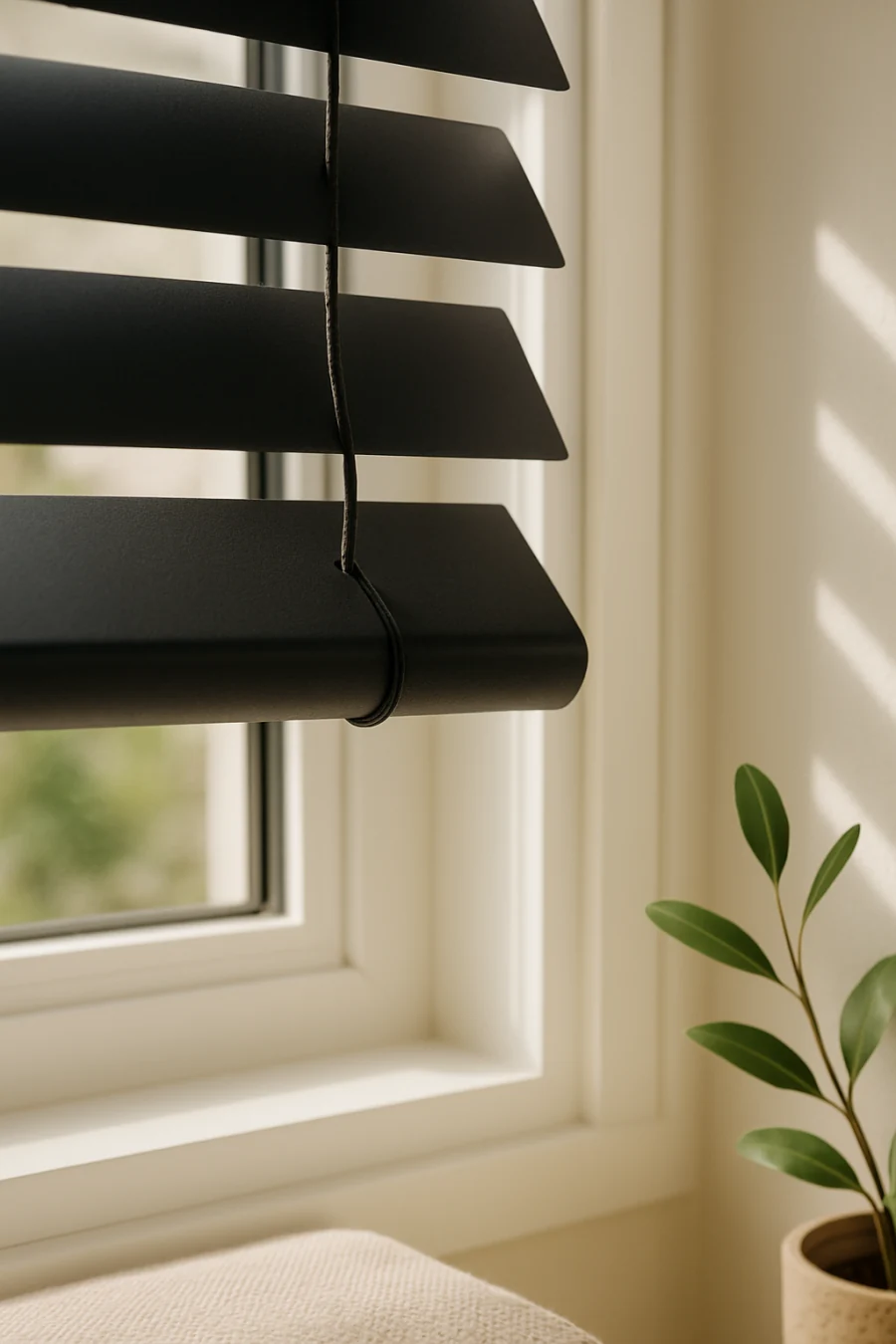















Grey blinds in Almaty are chosen not from a catalogue but for your own window: the measurer brings samples, and you look at the shade in your own lighting. Light grey keeps the room bright, graphite darkens it. The price depends on the type of construction, the fabric, the controls and the shape of the window. Measurement and consultation are free.
Why grey looks different on a sample and on the window
Grey blinds in Almaty are chosen for your own window, not from a picture online. The same shade of grey reads differently in a catalogue, in a showroom and on your windowsill: it doesn’t exist on its own, it’s defined by the light that falls into the room. That’s why the measurer comes with samples, not with a paper fan of colours.
The shade of grey sets the brightness of a room more than people think. Medium grey on a south-facing window looks almost white, while the same medium grey on a north-facing one turns into a cold shadow. And the other way round: what looked like calm graphite in the catalogue becomes almost black on a sun-filled window.
What changes how grey is perceived
Four things change how grey is perceived on a window:
- the light from the window — how much there is and from which side;
- the colour of the walls and wallpaper — a warm wall pulls grey towards warm, a cold one towards cold;
- the tone of the frame and windowsill — white plastic next to grey gives one shade, wood another;
- the floor covering — warm wood-look laminate next to a grey slat reads with more contrast than cold tiles.
All four of these factors work at the same time, and you can’t predict their combined effect from a photo. You can only see it.
How we show the shade
A measurement with samples shows the shade in your lighting — and that answers the question of how to choose a grey to suit your window, frame and walls. The measurer holds the samples against the frame and glazing bead, the wall and the windowsill, steps back a couple of paces and looks at how the fabric reads in that room. Light grey next to warm wallpaper looks livelier than cool grey, even though in the catalogue they sat side by side and seemed identical. In my view, arguing about which grey is the right one makes no sense at all until the sample is on your window.
So we use the catalogue as a starting point and make the decision on site. The shade of grey is judged in your own lighting, not from a catalogue, which is why the measurer comes with samples.
Light grey or dark: how the shade changes how light a room feels
Light grey with the blind closed keeps the room light, while dark grey and graphite really do darken it. The difference isn’t in the word “grey” itself, but in how close the tone is to white and how dense the fabric on the window is. What changes the lighting in a room is that pair — tone plus density — not the colour as such.
What to look at when choosing: your own window, not a picture. Light grey reads almost as whitewashed, lets light through calmly and doesn’t clash with the walls. Graphite behaves differently — it works as an accent and in a small room it takes away some of the daylight.
Shade table
| Tone | How it reads during the day | How it reads in the evening | Where it’s used |
|---|---|---|---|
| Light grey | Almost whitewashed, the room stays light | Soft, not overpowering | Living room, kids’ room, small windows |
| Mid grey | A calm neutral background | A little denser than during the day | Kitchen, study, living room |
| Dark grey | Noticeable, more contrast than the walls | Noticeably darker | Study, office |
| Graphite | Almost black, a strong accent | Dark, the window’s outline is sharp | Office, modern interiors |
We don’t promise specific palette names: we show the shades at the measurement using samples.
Why it’s not grey that makes a room gloomy
What makes a window gloomy is the saturation and density of the fabric, not the colour itself. Light grey with the blind closed keeps the room light, while graphite darkens it — that’s the whole fork in the road. If the walls and furniture are busy, grey is chosen precisely so the window doesn’t shout over them. In that sense grey fabric is softer than a slat: day-night blinds diffuse light gently, so the room doesn’t fall into shadow the way it does with a dense slat. But day-night doesn’t give you full darkness — that’s not its job.
Grey blinds also beat coloured ones for one more reason: the tone doesn’t pull attention to itself. Light or mid grey works as a background, while a dark tone is kept as an accent or for an office.
Light grey with the blind closed keeps the room light, while graphite really does darken it.
North and south: how the window’s orientation changes grey
The window’s orientation changes the temperature of grey on a window: on the north side a warm shade looks livelier, on the south a cool one doesn’t turn yellow. So grey is chosen not only to suit the interior but also to suit where the window faces. Warm grey with a hint of beige looks softer on a north-facing window than on a south-facing one. Cool grey in the south keeps a clean tone all day — it doesn’t yellow under direct light.
Light hits the slat at different angles throughout the day, and the shade feels it. In the morning an east-facing window floods the room with cool light, by evening a west-facing window shifts into the warm part of the spectrum. At the measurement Jalusso looks at the sample not only by the window but also on a table deeper in the room: on the table and on the frame grey reads differently. That’s exactly why the shade isn’t chosen from a photograph. It depends on how much light reaches the slat and what kind of light it is.
A short list of what we suggest looking at when choosing a tone:
- Where the window faces: north and east give even light, south and west give bright light that changes through the day.
- How the grey looks during the day with the blind closed and with it open.
- How the same sample reads in the evening, when the light in the room is on.
Almaty sun and dust
Almaty summers are hot and dusty, winters are cold, with frosts and temperature swings between day and night. A slat works in this mode all year round. Grey shows less on a slat than on a light colour, but not less than on a dark one: dust settles in a thin layer, and on a light colour it reads darker, while on a dark one it reads lighter. Aluminium and PVC are wiped with a damp cloth, and the mark comes off.
Grey fabric fades more slowly than light shades. Fabric under a south-facing window still changes from the sun over a season, and the warranty does not cover natural fading of colour. During the dusty season a slat collects a film of dust faster than at other times of the year.
We recommend looking at a sample twice: in daylight and in the evening. Grey changes with the lighting more than you would think until you hold it up to your own window.
Will it be gloomy: what actually darkens a window
It is not the grey colour itself that darkens a room, but the depth of the shade and the density of the fabric. Light grey with the slats closed keeps the room bright. Dark grey and graphite do take away some light, especially if the window faces north or is covered with dense fabric.
An office look appears where grey is taken too dark and glossy. In a living room, a light or medium shade with a matte surface works. A matte slat diffuses light softly, without glare, and the window reads as a background rather than an accent. Grey works as a background for the interior — that is its point.
What grey works with
- Grey and white. A calm pair without contrast. White walls keep the window from blending in, grey slats add depth.
- Grey and pastel blue. A cool pair. Suits a bedroom and a study, where an even tone is needed.
- Grey and ecru. A warm neutral background softens a grey window, and the room does not look cold.
- Grey and wood. Warm wood next to grey works without conflict, if the shade of the slat is not cooler than the wood itself.
Next to mustard, orange and rust, grey is not used: warm saturated tones pull the attention to themselves and the window looks a bit dirty.
How to avoid the office look
In a living room, a light or medium shade and a matte texture are used. Graphite is kept as an accent on one window or for an office, where a clear graphic pattern is needed.
Grey on grey is a separate case. If the walls and wallpaper are grey too, the window needs a different texture: a matte slat against flat paint or patterned wallpaper. Otherwise the fabric blends with the wall and the window loses its edge. At the measurement we hold samples right up to the wall — that way you can see whether the pair works or not.
Grey blinds against white walls do not look boring if you take a light or medium shade: the white background gives contrast in lightness, and the window stays readable. Grey on grey requires a different texture, otherwise the window blends with the wall.
Grey to the frame, windowsill and walls
Grey is matched to the frame and windowsill by the temperature of the window itself, not by the name of the colour. For warm wood, take a warm grey; for white and glass, a cool one. Grey blinds in this case read as a continuation of the window, not as a separate detail on it.
A plastic frame and a white windowsill give a cool base. A cool grey next to them looks put together, while a warm one, with a hint of beige, turns muddy against a white background. And the other way round: wood-effect laminate, a wooden windowsill or warm plaster call for a warm grey — a cool one looks bluish against such a background. Warm grey goes with wood and linen. Cool grey goes with white and glass.
What if the windowsill is grey and the frame is white? Look at what there is more of in the room. If the floor and furniture lean warm, take a warm shade — it will smooth over the difference between the windowsill and the frame. If everything around is white and glass, keep it cool.
One grey for the whole flat is possible. It holds different rooms together and does not fall apart into shades. But in the kitchen and bathroom the logic is different: there, what matters more is not the shade but the material — aluminium and PVC do not absorb steam and grease. In a child’s room and bedroom, the shade is matched to the light from the window.
The mistake we see most often: the shade is chosen by the wall, and the frame and windowsill are not looked at at all. At the measurement this shows up right away — a sample by the window reads quite differently from one by the wall.
Selection checklist
- Look at the frame and windowsill — decide whether they are warm or cool.
- Look at the floor: wood-effect laminate leans warm, tile and white stone lean cool.
- Look at the wall and wallpaper in daylight.
- Look at the light from the window — on the north side and the south side the same shade reads differently.
- Hold the samples up to the frame, windowsill and wall and choose the one that does not clash with anything.
For warm wood, take a warm grey; for white and glass, a cool one — and it is your window that decides this, not the catalogue.
One grey for the whole flat or different shades by room
You can take one shade of grey for all the windows in a flat, and for a flat in a new building in Almaty this is the calmest option. One shade keeps the different rooms of a flat in a single palette, and from the street the building reads as a whole, without patchy spots on the facade. If the neighbours have put in white blinds, grey on our window does not stand out from the row: it is neither lighter nor darker than the overall look of the facade. Different shades by room are taken less often and for a specific reason — for example, when the walls in the living room are warm and in the bedroom cool.
In our practice we more often do one grey range for the whole flat, and change not the colour but the texture to suit the room. See how this looks on different windows.
- Living room. Light grey or a medium shade, matte texture. The window works as a background for the furniture and does not clash with the wallpaper.
- Kitchen. Grey aluminium or grey PVC: the slats are washed right on the window, and grease and steam are not absorbed into the material.
- Bedroom. Dense grey day-night fabric: the light is adjusted smoothly, but day-night does not give full darkness — it is more honest to say this in advance.
- Child’s room. Light grey instead of graphite: the room stays bright, and the control is taken with a side handle so that the child does not pull on a hanging chain.
Where it is worth changing the shade or texture
We do not use graphite in a child’s room: it darkens the room, and a child needs light. For a bedroom, graphite is appropriate if you want to close the window more tightly and make it an accent. We put warm grey where the finish has wood and linen, and cool grey where there are white walls, glass and a grey windowsill. In the kitchen by the stove we do not use fabric at all: grease settles in the fibres, and grey ends up with stains.
If the windows face different sides, the shade is chosen with an allowance for the light: on north-facing windows a warm grey looks livelier, on south-facing ones a cool grey does not turn yellow. One shade can still be kept — the Jalusso measurer holds the samples up to each window and shows where the shade reads differently.
Grey aluminium or grey PVC: which is more practical in Almaty
In short: for the kitchen, bathroom and balcony, choose grey aluminium or grey PVC, and for rooms where you need soft light control, grey fabric. Grey aluminium is not afraid of moisture and steam, grey PVC does not absorb moisture or grease, and grey fabric diffuses light instead of cutting it. The choice here is not about how beautiful the sample looks, but about what happens at that window every day.
The difference between metal and plastic shows up in the details. An aluminium slat is stiffer and holds its shape, so it does not rattle in the draught from a slightly open sash. A plastic slat springs back when accidentally touched — a plus for a child's room. Grey PVC with a 25 mm slat is the most affordable of the durable options, while a narrow 16 mm slat gives a denser, neater pattern on small windows and narrow sashes. We rarely use a 50 mm fabric slat, and only where a fabric pattern is really needed: in a kitchen next to the stove it does not last.
Materials table
| Material | Where we install | Moisture and steam | Care |
|---|---|---|---|
| Grey aluminium, slat 25 mm | Kitchen, bathroom, balcony, office | Not affected | A damp cloth right on the window |
| Grey PVC, slat 25 mm | Child's room, kitchen, utility rooms | Does not absorb | A cloth without abrasives |
| Grey PVC, slat 16 mm | Small windows, narrow sashes | Does not absorb | A cloth without abrasives |
| Grey fabric: day-night, screen | Bedroom, living room, study | Requires dry dusting | Vacuum on low power |
We do not put prices in the table — they are in the cost section below, along with the lead times for each price list item.
Horizontal or vertical
The shape of the window determines the design, not the other way around. Horizontal blinds are chosen for the kitchen, office and standard windows: the slat lies across the sash, and the blind does not get in the way of opening the window. Vertical blinds are needed for panoramic glazing and shop windows — grey verticals hold their geometry on wide openings, where a horizontal slat would sag over the length. On a panorama in an office or coffee shop, this is the only option that reads as a smooth surface rather than a set of stripes.
Grey blinds or grey roller blinds
A roller blind rolls up in one piece and gives a solid grey surface on a wide opening. Blinds adjust light in steps — by turning the slat. Jalusso more often covers offices with panoramic glazing with verticals: the light is even all working day, not a patch from the edge of the fabric. In a bedroom the picture is the opposite: there, smooth adjustment matters more, and grey day-night fabric provides it.
Aluminium and PVC are not afraid of moisture and steam and can be washed right on the window, while fabric diffuses light and adjusts brightness smoothly — this is the criterion by which the material is chosen.
Care for grey slats and fabric
Caring for grey blinds depends on the material of the slat or fabric, and this is the main thing to understand before buying. Grey aluminium and grey PVC are washed with a mild product right on the window, while grey fabric is cleaned dry — we do not recommend washing. The reason is simple: water and soaking damage the structure of the fabric, and the warranty does not cover them.
As for dust, it is less visible on grey than on light colours. A paradox? No. Dust is grey, and on a grey slat it simply blends into the background, whereas on white it shows as a grey film, and on dark it shows as light. But not less than on dark: on graphite, dust is more noticeable than on medium grey. In this sense, medium-tone grey blinds are the most trouble-free option for a kitchen and office, where dust accumulates quickly.
Does grey fabric fade in the sun? More slowly than light colours. Almaty summers are hot and dusty, the sun stays for a long time, and light fabric turns yellow over a season, while grey holds up longer. But here too there is no guarantee: natural fading is not covered by our warranty, and we will not promise that grey will never fade. The fabric side that is in direct sun all day is better chosen in a darker tone right away.
Care checklist
- A mild product without abrasives — they leave streaks on a grey matte slat.
- A damp cloth along the slat: grey aluminium and grey PVC are wiped right on the window, no need to take the blind down.
- Grey fabric — a vacuum cleaner on low power, without soaking and without machine washing.
- Clean the mechanism of dust once a year — the chain, cord and turning unit.
Separately about the kitchen: next to the stove we do not use grey fabric at all — grease settles in the fibres, and the fabric ends up with stains that dry dusting can no longer remove.
Aluminium and PVC are washed with a mild product right on the window, fabric is cleaned dry, and the mechanism should be cleaned of dust once a year.
Grey blinds in Almaty: prices by material
Grey blinds in Almaty start from 3,600 ₸/m² for plastic and from 4,200 ₸/m² for aluminium. These are price list items per square metre, not per window: the total for your room is calculated by the measurer, because the area of the blind depends on the size of the opening.
The price depends on the type of design, the density and composition of the fabric, the controls and the shape of the window. A round or arched frame, a narrow sash, a panorama half a wall high — each of these shapes adds cutting and fitting, so windows that look the same in different apartments cost differently. Grey fabric itself does not raise the price: we have no separate surcharge for colour, grey, white and coloured material of the same item are on the same price list line.
Prices by price list items
| Position | Material | Price | Lead time |
|---|---|---|---|
| Horizontal blinds | Aluminium, slat 25 mm | from 4,200 ₸/m² | 3–5 days |
| Vertical blinds | Fabric, slat 89 mm | from 4,600 ₸/m² | 3–5 days |
| Day-night blinds | Two-layer fabric | from 7,300 ₸/m² | 5–7 days |
| Motorised blinds | 220 V motor or battery | from 7,800 ₸/m² | 7–10 days |
| Plastic blinds | PVC, slat 25 mm | from 3,600 ₸/m² | 3–5 days |
| Metal blinds | Steel, slat 25 mm | from 5,200 ₸/m² | 5–7 days |
Installation of grey blinds costs 4,500 ₸ per item, and on orders over 150,000 ₸ it is already included in the price. For comparison: grey fabric in verticals and day-night reads as more expensive than plastic, but it is exactly what gives smooth light adjustment.
What raises the cost
Controls change the price more than colour. Mechanical controls are the base — ×1, chain ×1.06, electric motor ×1.85. Mounting is calculated separately: wall ×1, frame ×1.05, no drilling ×1.1, cassette system ×1.28.
In my opinion, an electric motor on grey blinds is justified on wide panoramic openings — there a mechanical chain is simply inconvenient. And here is a typical case: an office with glazing in several sections, where grey verticals with a motor are hung on a schedule — here the price rises noticeably, but the controls become part of the building systems. A slat pitch of 16, 25 or 50 mm does not directly affect the price; it affects the look of the window and the shape of the frame.
The price depends on the type of design, the fabric, the controls and the shape of the window, and the exact amount is quoted by the measurer on site.
How we work: from measurement to installation
Measurement and consultation are always free: the measurer comes with samples of grey slats and fabric and calculates the cost on site. We also travel to the suburbs of Almaty — Kaskelen, Talgar, Issyk, Kapshagay — the cost of the visit depends on the distance and is quoted before the visit, not after. Within the city itself, measurement and delivery are free.
As for the facade — a grey window does not stand out as a patch. It does not clash with neighbouring white windows: grey blinds act as a background, not an accent, and from the street you see a calm, even rectangle. Moreover, from outside a dark tone is more noticeable than a light one, and if the building keeps a single light line, this point is worth discussing with the measurer in advance.
How ordering works
- Write to us on WhatsApp — briefly describe your windows and what you need.
- The measurer arrives with samples and holds them against your frame, wall and windowsill in your lighting.
- We calculate the cost on site according to the price list item.
- The workshop manufactures the product.
- Installation: 4,500 ₸ per item; free on orders from 150,000 ₸.
A measurement with samples shows the shade in your own lighting, and fixing into the glazing bead keeps your window warranty valid: the brackets slide into the glazing bead, the frame stays intact and there is no need to drill it. This is the usual choice for rented housing and for new windows that are still under the developer's warranty.
A real example
In an office with panoramic glazing we install grey vertical blinds: they hold their geometry on wide openings, and the light in the room stays even all working day — no variation from window to window. In a rented flat the picture is different: there it matters more not to touch the frame, so we go with brackets into the glazing bead. When you move out, such blinds come down without a trace.
Measurement and advice are always free, and you choose the shade of grey on your own window, not from a catalogue.
FAQ
Graphite is a dark grey with a cool undertone; on a window it reads almost as black. Black gives a hard contrast with a white window reveal, while graphite softens the border and works as an accent rather than a black hole. In a room graphite really does darken the space: during the day it keeps the light even, but in the evening the room is darker with it than with light grey. We install graphite where a crisp, graphic window pattern is needed: in offices, meeting rooms and modern interiors with glass.
Can the window be seen from the street in the evening? With the light on in the room, silhouettes are visible from outside if the fabric is not blackout. Grey aluminium and grey PVC darken moderately: during the day the room is light, and from the street it is almost impossible to make out what is going on inside. Day-night fabric adjusts the light smoothly but does not give full darkness. Only blackout closes the room completely. It is more honest to say this before installation than to explain it afterwards: if the window faces a neighbouring building or a car park, the difference between day-night and blackout will be noticeable for you.
Will a grey window stand out as a patch on the facade if the neighbours' are white? No. Grey does not clash with white slats next to it — it reads more calmly than a colour and does not shout over the facade. For the same reason grey is chosen for ground floors and for buildings where the windows run in one line: a single shade keeps the view from the street whole, while different colours on neighbouring windows break up the facade.
You do not have to drill the frame. The brackets slide into the glazing bead, and there are spring clips and tape mounting — the frame stays intact and the window warranty is not lost. This is what people do in rented housing and on new windows they would rather not drill. We make grey blinds in Almaty to measure: the measurer comes with samples, shows the shade in your lighting and calculates the cost on the spot.
Graphite darkens the room, while day-night does not give full darkness — these are two different scenarios, and the choice between them depends on what matters more to you: a crisp window pattern or dense darkening.
Conclusion
Light grey with the fabric closed keeps the room light, while graphite really does darken it. This is the main thing to take away from the article: it is not the colour itself that makes a window gloomy, but the depth of the shade and the density of the fabric.
The side the light comes from is taken into account when choosing between warm and cool grey. On a north-facing side a warm shade looks livelier; on a south-facing side a cool one does not turn yellow. Warm grey goes with wood and linen, cool grey with white and glass. If your walls and windowsill are grey, keep the window distinct with different textures, otherwise the fabric blends into the wall.
The material is chosen according to the room. Grey aluminium and grey PVC are not afraid of moisture and steam and can be washed with a mild product right on the window. Grey fabric is cleaned dry, with a vacuum cleaner on low power. According to the price list this is from 3,600 ₸/m² for plastic and from 4,200 ₸/m² for aluminium, and the price depends on the type of construction, the fabric, the controls and the shape of the window — the exact amount is quoted by the measurer on site.
And one practical tip to finish. Book a free measurement: the measurer brings samples and holds them against your frame, windowsill and wall in your lighting. A shade that looked good in a photo may read completely differently on the window — but on a sample next to your own wall it is seen honestly.
Key fact: a grey shade is looked at in your own lighting, not from a catalogue, so the final choice is made at the measurement with samples.

