



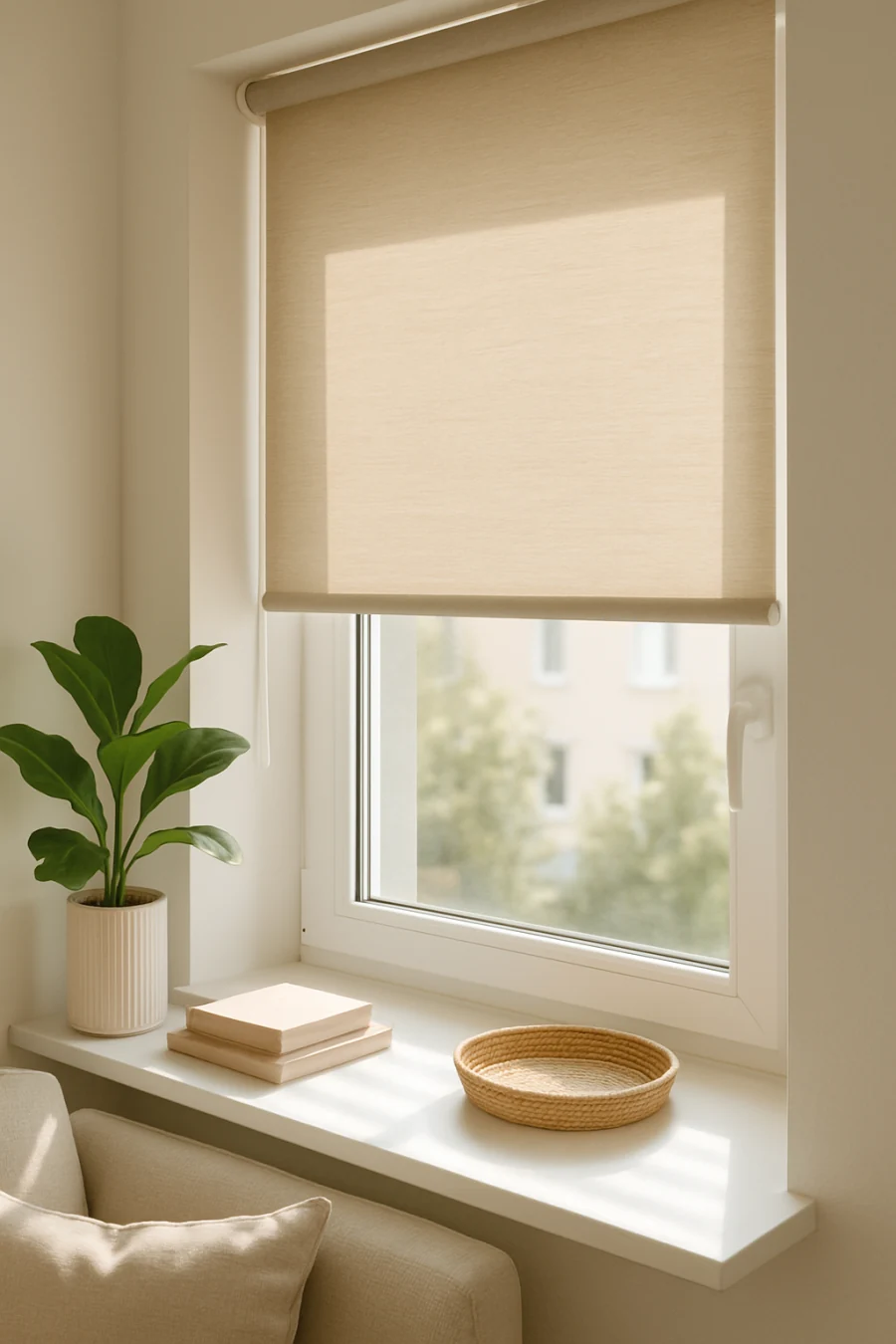


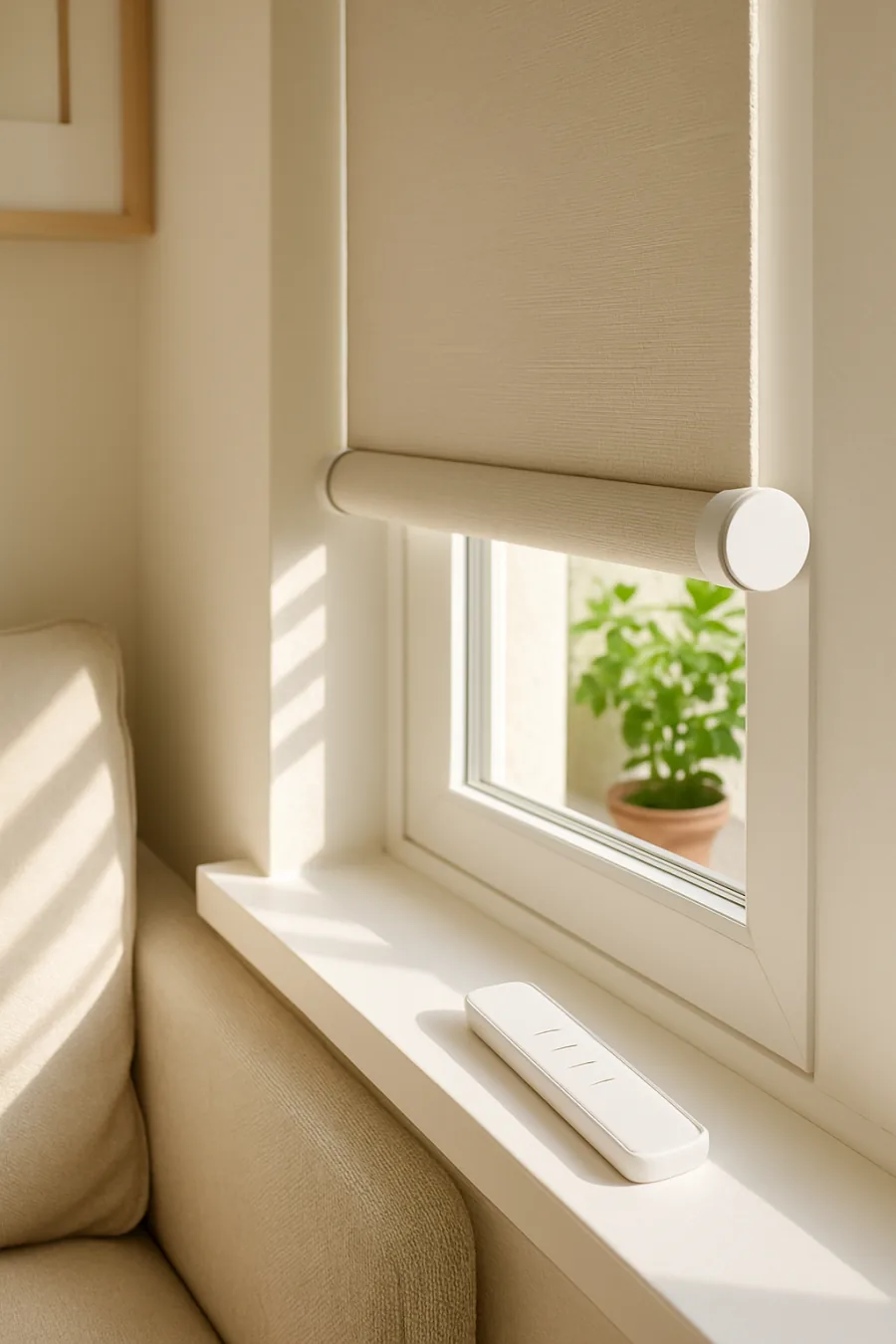


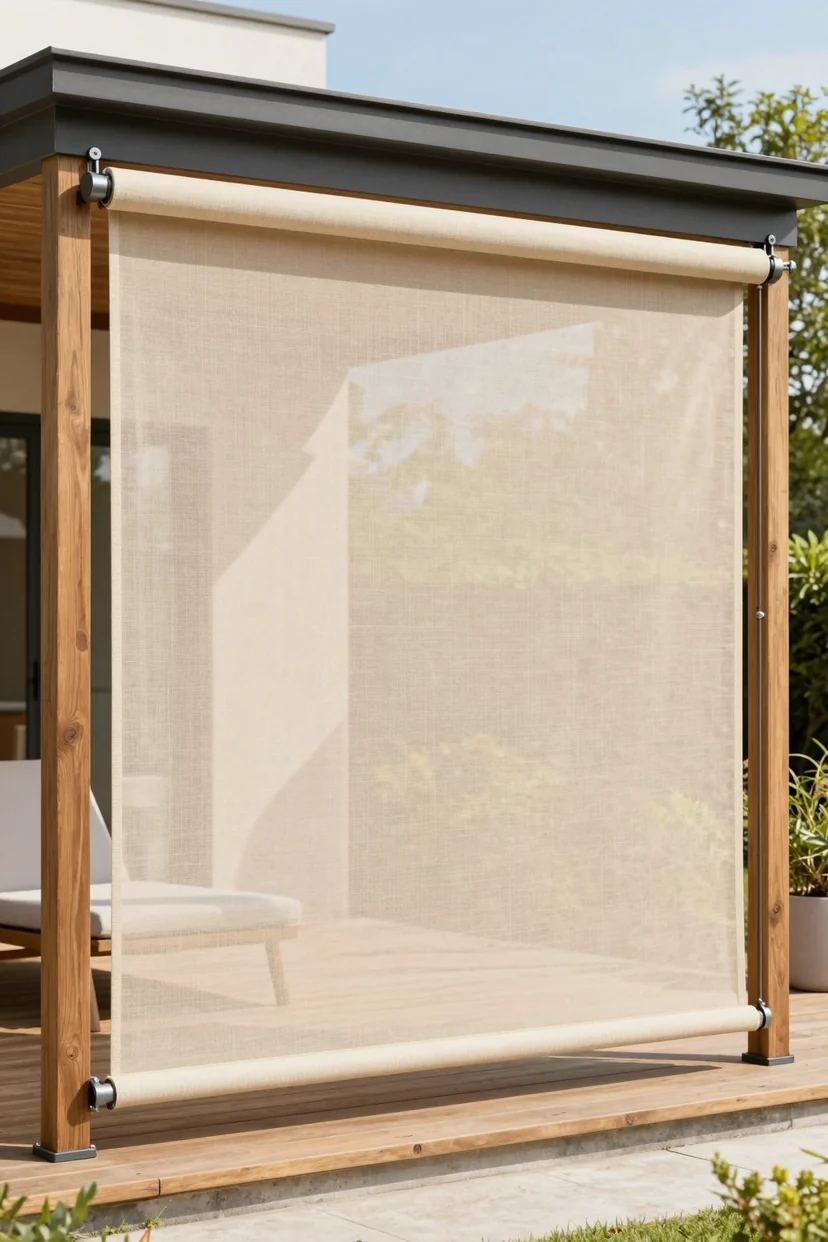











Day-night roller blinds in Almaty are a single fabric with alternating sheer and dense stripes: it wraps around the roller tube and hangs in two layers, so with the chain you smoothly change the light from diffused to strong shading. The “night” mode does not give full darkness: some light passes between the stripes and along the edges. Price — from 7,300 ₸/m², cassette, blackout and motorised drive are separate lines in the price list.
How a day-night roller blind works and what happens to the stripes when you shift them
A day-night roller blind consists of a single fabric with alternating sheer and dense stripes. The zebra fabric wraps around the tube and hangs in two layers with an offset, so shifting the stripes relative to each other changes the lighting from diffused light to strong shading.
Thin strips of light between the stripes in the “night” position remain because the dense stripes overlap the mesh rather than closing hermetically. Plus gaps along the edges of the fabric. It is worth saying this honestly before ordering: “night” mode is strong shading, not darkness like roller shutters.
In everyday speech the same products go by different names: day-night roller blinds, day-night roller shades, day-night rolls. It is all the same thing — fabric on a roller tube with alternating strips. I will separately mention tricolour day-night roletas: that is what a version with strips in three colours is called, rather than in two shades of one. Whether such fabric is in stock is checked against the samples at the measurement — the measurer brings them along.
One fabric, not two
People commonly call a zebra a double roller blind, and this creates confusion. There are no two separate fabrics on two tubes in the product. There is one zebra fabric that passes through the tube and hangs in front of the window in two layers: one layer goes from the tube down, the second goes from the tube up and back. That is why the sheer stripes of one layer can be aligned with the dense stripes of the other.
What this gives in practice:
- One tube instead of two mechanisms
- One fabric that does not need to be aligned along two guide rails
- Smooth light adjustment within one product
Jalusso comes out for a measurement and shows this shift live on a sample — the mechanics are hard to understand from a photo.
What the chain does
The chain mechanism drives the tube. The tube shifts the stripes relative to each other: pull the chain — the fabric goes up or down and at the same time changes the mutual position of the layers.
When the sheer stripes of both layers align, light passes freely — this is “day” mode. The room stays bright, but without direct sun spots on the desk or monitor. When shifted, the dense stripes overlap the mesh — this gives “night” mode. Intermediate positions give the brightness you need during the day, and the chain works more precisely here than lifting by the bottom rail.
A day-night roller blind is built so that the light level is set by the position of the chain, not by a second fabric or a curtain.
What you actually see on the window in “night” mode
In the “night” position, the dense stripes overlap the mesh, and the room darkens noticeably, but day-night roller blinds do not give full darkness. “Night” mode leaves thin strips of light between the stripes and gaps along the edges of the fabric. This is how the light transmission of a zebra works: the stripes shift but do not close into a solid light-blocking sheet.
The shifted stripes give what owners call evening darkening. In the morning on the east side, through such a fabric you can see that dawn has begun. During the day under the bright Almaty sun, the room stays in soft half-shade, not in a dark room. And this is a normal mode, not a defect of the product. The zebra fabric physically cannot close the window as tightly as roller shutters or blackout in a cassette.
What is visible from the street
In the evening with the light on, from the street the window reads as shaded: you cannot make out the silhouettes of people or furniture, but the glow itself remains. For a ground floor and for windows level with the pavement, this is enough — from the street you cannot see what you are doing. And the denser the fabric and the closer the stripes are to each other, the less light escapes outside.
Who “night” mode will not be enough for
- If there is a street lamp opposite the window or the neighbouring house shines straight into the room.
- If the window faces east and you have to sleep in the morning sun.
- If you need full darkness, not shading.
In these cases we steer the person towards a blackout effect: there the dense stripes are made of light-blocking fabric, the mesh remains, and the adjustment is preserved. The blackout effect is denser than a regular zebra, but it does not eliminate the gaps along the edge of the fabric: light still passes along the edges. I will not promise you full darkness in “night” mode — this is the most common source of disappointment when choosing day-night.
Day-night blinds are for those who need flexible light through the day rather than night-time blackout; in the evening these roller blinds close the window off from prying eyes and heavily shade the room rather than plunging it into darkness.
How day-night differs from a regular roller blind, blackout and horizontal blinds
The difference is in the fabric and in how it blocks light. A regular roller blind has one dense fabric and two states: open or closed. A zebra fabric has alternating stripes, so the light is reduced gradually. With blackout, light does not pass through the fabric at all. Below is a comparison by key features.
| Product | How it blocks light | Adjustment | Full darkness |
|---|---|---|---|
| Day-night roller blind | Transparent and opaque stripes in two layers | Smooth, with a chain | No |
| Standard roller blind | One opaque fabric | Two positions | No |
| Blackout | Blackout fabric | One position | Close to full |
| Day-night horizontal blinds | Slats on cords | By turning the slats | No |
Blackout effect in a zebra blind
Yes, such a blackout day-night roller blind is available. Its sheer stripes are replaced with dense ones made of opaque fabric, while the mesh between them stays. The dense stripes are made of opaque fabric, and the “day” mode is kept: when the stripes line up, light comes through the mesh. Chain adjustment works the same way. That said, light still gets in at the edges of the fabric — the gaps along the edge mean the blackout effect isn’t complete.
What does this give in practice? In the evening the room is darker than under a regular zebra blind, but the gaps along the edge remain. In a bedroom this is noticeable if a streetlight is on opposite the window.
Where day-night falls short
Two situations where a zebra blind is at a disadvantage. The first is a standard roller blind with a sheer curtain: if you need even, diffused light all day without adjustment, a pair of two familiar fabrics is cheaper. The second is a blackout cassette blind with guide rails: it is more opaque, because the cassette and side guide rails close the gaps. For a bedroom where you need darkness, blackout remains the better choice. So if the goal is complete darkness, don’t expect it from a zebra blind, even with blackout stripes.
Not to be confused with horizontal blinds
Day-night horizontal blinds are a different product: slats on cords that rotate around their axis. With them, the mode between light and shade is set by the angle of the slat, not by shifting the stripes. A roller blind winds onto a tube and has no slats. When choosing, this is the first thing to clarify with the seller: if the description mentions slats on cords, it is not a roller system.
A sheer curtain and a heavy drape versus one blind
A pair of a sheer curtain and a heavy drape solves the same task — light during the day and a closed window in the evening. But that is two fabrics, two curtain rails and two mechanisms. Day-night roller blinds replace both with one fabric on a tube: shifting the stripes gives both diffused light and shading. The only downside here is the density of darkening in the evening.
The bottom line is simple: a standard roller blind switches between light and shade, blackout does not let light through the fabric, and a zebra blind changes the lighting smoothly but does not give complete darkness — this choice is always a compromise between adjustment and opacity.
How to choose the stripe width and colour for your window
The stripe width sets how smoothly the light is adjusted, and the colour of the fabric determines how the window reads from the street and how the whole facade comes together into one picture. Both decisions are made not from a catalogue photo, but for a specific window: a narrow sash and a tall window behave differently.
Stripe to fit the window
On a narrow sash, a frequent stripe gives smoother adjustment: each step of the chain changes the lighting gently, without a jump from light to half-shade. The geometry also reads neatly — the short distance between stripes does not cut the sash into large blocks. On a tall window, on the contrary, a sparse stripe looks calmer: fewer horizontal lines, the eye is not overwhelmed. If the tall window is also narrow, that is a job for the measurer: they look at the proportions of the sash and suggest a spacing at which the zebra fabric does not turn into a picket fence.
A practical guideline: the smaller the window, the more frequent the stripe; the taller the opening, the calmer the pattern. This is not a hard rule, but a starting point for the conversation at the measurement.
Colour and facade
The colour of the fabric affects two things at once: how the window looks from inside during the day and how it reads from the street in the evening. Light fabrics — white day-night roller blinds — keep the room feeling light and the window doesn’t weigh on the interior. But with the lights on, white fabric is more noticeable from the street than dark fabric: it is lit up from inside more strongly. Worth keeping in mind on the ground floors. Grey day-night roller blinds behave differently: by day they look a little more formal, but in the evening the window recedes into shadow and looks calmer from the street.
If you have several windows facing the same side of the house, colour matters more than you’d think. Fabrics in the same shade line the windows up along the facade, while mismatched ones scatter it into patches. For those who want to move away from plain colours, there are day-night roller blinds with a pattern: the stripes still do their job rather than being decoration. Patterned day-night roller blinds are chosen more often for a child’s room or living room, where you want some character — but then the facade won’t look as strict.
With a corner window there is a separate subtlety: the two sides of the corner look like two different windows when the colour differs, even though it is one room.
How to choose for your window:
- Look at the proportions of the sash — narrow or tall.
- Decide what matters more: smooth adjustment or a calm pattern.
- Check how the window looks from the street in the evening with the lights on.
- Match all the windows on one side of the house by shade, so the facade reads as a whole.
- Take samples to the measurement and hold them against the glass in your own light.
The stripe width affects how smoothly the light is adjusted, and the colour of the fabric affects how the window looks from the street and the whole facade as a whole.
How to align the stripes on several sashes and on a corner window
Aligning the stripes on several sashes is a matter of height, not width. The fabrics are made to the same height and set so that the opaque stripe of one fabric continues the opaque stripe of the next. Then a window with two or three sashes reads as one whole, and when you close off the light, the line runs evenly across the whole window, not in a step.
Several blinds on one window require the stripes to match in height. We take measurements of each sash, compare them with each other, and only then send the fabrics to the workshop. If you take the width and height by eye or from memory, the adjacent fabrics will almost certainly end up offset by at least a couple of millimetres, and on striped fabric this offset is immediately visible.
If blinds are ordered in parts at different times, the stripes almost always diverge. A reorder a month or two later means a new fabric from a new batch, and the stripe pattern will sit differently. That’s why Jalusso recommends covering all the windows in one room in a single order: this way the stripes will match and stay matching.
Corner window
A corner window requires aligning the stripes in one line on the two sides of the corner. This is the most common task in new buildings, where the window turns the corner or occupies the entire corner. Here blinds are installed on two adjacent sides, and the stripes on them are set so that the line of dense stripes runs as a continuation: when you look at the corner, the stripes run in one line rather than breaking at the joint.
What helps:
- Separate fabrics on the sides of the corner rather than one wide fabric for the whole opening — each is mounted on its own frame.
- A common height for the fabrics, set to one level on both sides.
- Guide rails on the sides if the fabric is long and otherwise tends to drift sideways.
Day-night roller blinds on plastic windows are fitted without drilling the frame: the fixing goes on an adhesive base or into the glazing bead. Our measurer picks the fixing to suit the sash and the window reveal — one of the reasons we do measurements free and with samples in hand, not from a photo in a messenger.
Tilt-and-turn sash
On an opening sash, the fabric is mounted so that it doesn’t pull away when the handle is turned and doesn’t catch on the frame when opening.
A drill-free fixing or side guide rails help. When the sash opens, the fabric stays in place, doesn’t flap and doesn’t catch the handle. Day-night blinds with guide rails hold the fabric straight here and keep the stripes from drifting apart.
On a narrow sash that is opened often, we usually recommend drill-free mounting: it’s easier to remove when washing the window, and no extra holes are left on the frame. But if the sash is wide and the fabric is long, guide rails are more reliable — they hold the fabric across the whole opening, the stripes stay horizontal and don’t shift.
The zebra fabric on an opening sash should be slightly shorter than on a fixed one so that the bottom doesn’t catch the windowsill when opening.
Open roller tube or cassette with guide rails: which to choose
The choice between an open roller tube and a cassette comes down to one thing: how long and wide your fabric is. An open roller tube is the MINI system, where the roll is mounted on the sash or on the wall without a housing box. A cassette system includes a housing box and guide rails on the sides: the fabric runs inside rigid runners and doesn’t shift. For a single-sash window, the first option is usually enough. For a long or wide opening, a cassette solves two problems at once — fabric sagging and stripes diverging.
Let’s compare on four parameters.
| Parameter | Open roller tube (MINI system) | Cassette system |
|---|---|---|
| Housing box | no, the roller tube is open | yes, covers the roll |
| Guide rails | no | on the sides, hold the fabric |
| Sagging on a long window | possible | prevented by the runners |
| Installation | on the frame or on the wall | on the frame, mostly |
Our installation figures are as follows: wall mounting has a coefficient of ×1, frame mounting — ×1.05, drill-free — ×1.1, cassette system — ×1.28. The price difference is explained not by the “status” of the system but by the details: the housing box, the runners, additional hardware.
When an open roller tube is enough
Small windows and individual sashes where compactness and a neat look without a housing box matter. An open roller tube barely protrudes from the frame and doesn’t need to be fitted into the reveal. In a kitchen above the sink or in a hallway this looks cleaner — a box there would only add visual bulk. Day-night roller blinds on an open roller tube are what we most often fit on standard-height single-sash windows.
When a cassette is needed
A wide or long fabric: guide rails hold it on the sides, the stripes don’t diverge and don’t sag. On a fabric taller than standard, the roll on an open roller tube eventually starts to pull away from the sash — the runners prevent this. The second case is a window that is opened often: guide rails keep the fabric from catching the handle and touching the windowsill.
During the measurement we look at the width of the opening, the height of the fabric and how the sash opens, and based on this we suggest a system. The second argument is price: a cassette comes with a coefficient of ×1.28, and there’s no point paying extra for it where an open roller tube is enough. A cassette system includes a housing box and guide rails on the sides, while an open roller tube is mounted on the sash without a housing box — that’s the whole difference; the rest is decided by the size of the window and how often you air the room.
Chain, spring or electric motor
For zebra blinds, a chain mechanism is more convenient: the chain drives the roller tube, and the stripes align smoothly, with precise stopping in any position. A spring mechanism raises the fabric without a chain but doesn’t provide the same precision of stripe alignment. An electric motor does the same as the chain, only without hands.
Let’s go through the three options in order.
- Chain mechanism. The chain turns the roller tube, and the roller tube shifts the stripes relative to each other. The “day” position, the “night” position and any intermediate one you set with precision down to a chain link. This is the system we install most often — both on small windows and on long fabrics.
- Spring mechanism. The blind is raised by hand by the bottom rail, and the fabric locks in the desired position. It works smoothly, and there’s no cord.
- Electric motor. Controlled by a button or remote control, the fabric and stripes move on their own. In the calculator, this is the most expensive control option.
Where a spring is appropriate
A spring is chosen for small windows. There’s no hanging cord — this matters if there are children or cats in the house: they can’t reach the chain because there simply isn’t one. The fabric is raised with a light movement by the bottom rail.
But the spring comes at the cost of convenience. You won't be able to align the stripes as precisely as with a chain: the “night” position is set by eye, and the thin strip of light between the stripes may stay wider than you'd like. On a small window it's unnoticeable, on a large one it shows. If the geometry of the stripes matters to you, I wouldn't recommend the spring.
Electric motor
An electric motor is fitted on tall and hard-to-reach windows: where you'd have to reach for the chain past furniture or a windowsill, a button or remote control solves the problem. The stripes move on the same roller tube, the alignment precision stays, and you don't touch the fabric with your hand.
Is it needed in an apartment with ordinary windows? In my view, usually not: the price difference from a chain is noticeable — in the calculator the electric motor comes with the highest coefficient among controls, and you'll only feel the benefit on a window that's hard to reach.
The bottom line is simple: a chain gives precise alignment of the stripes and suits almost anywhere, a spring is convenient on a small window without a cord but is less precise, and an electric motor is for tall windows you can't reach.
Why the blind sags and the stripes run unevenly
A sagging fabric and misaligned stripes are not a property of zebra fabric but a consequence of how the system and the mounting are chosen. Zebra fabric hangs freely on the roller tube, and if it lacks support at the edges, the edge starts to drift from the vertical, and the stripes on neighbouring sashes shift relative to each other. Guide rails hold the fabric on a long window, so a cassette system with side guide rails solves most such cases already at the ordering stage, not after installation.
The reasons why stripes drift off the line repeat from order to order:
- A fabric that is too wide on an open roller tube without guide rails — the edge sags and the stripes lose their horizontal line.
- Different fabric heights on neighbouring sashes — the stripes don't match even with the same fabric.
- Mounting chosen without taking the sash and window reveal into account — the fabric skews already at the first adjustment.
Several blinds on one window require the stripes to match in height, and this must be planned before cutting. If the products are ordered in parts at different times, there will be almost no match: fabric from one batch and on-site marking give a predictable result, while an addition months later does not.
What we do at the measurement
The measurer looks at the sash and the reveal, chooses the fixing and suggests a system in which the fabric holds its line. On a wide or tall opening this is usually a cassette system: the housing box covers the roller tube and the guide rails hold the fabric at the sides — day-night roller blinds in Almaty fitted this way serve evenly and don’t need adjusting after a season. We prefer to name the right system at the measurement rather than redo a finished product.
Sagging and misaligned stripes are solved by a cassette system with guide rails, separate fabrics per window and a correct measurement.
Day-night in the bedroom, kitchen and on the balcony
Day-night roller blinds suit a bedroom if soft half-shade is enough for you — the dense stripes in the “night” position dim the light but don't block it completely. Zebra fabric doesn't give the full darkness that roller shutters or a cassette blackout give: some light passes between the stripes and at the edges. If you need to sleep in the dark, and there's a streetlight opposite the window or the east greets you with sun, look towards day-night with a blackout effect.
During the day the stripes in the bedroom are aligned, and the room stays bright. In the evening the chain shifts the stripes, and the window is closed off from street views. Here the fabric works as a soft filter, not as a curtain.
Kitchen
For the kitchen, day-night roller blinds are chosen most often — above the sink and the work area, where a sheer and a heavy curtain only get in the way. During the day the stripes are open, and the light doesn't glare while you cook. At lunchtime the stripes are shifted, and the sun doesn't dazzle above the countertop. Zebra fabric doesn't absorb odours the way textile curtains do: the fabric hangs on the roller tube rather than gathering in folds where grease settles. Dust is removed with a vacuum cleaner on minimum power or a soft brush, without pressing. By the way, the fabric can't be washed in a machine — water makes it lose its shape and coating.
Balcony and the south side
On a balcony and loggia, day-night roller blinds are fitted on a wide opening: the fabric covers the window entirely and doesn't block access to the frames. If there's a mosquito net on the sash, the measurer spaces the brackets so that the blind and the net don't get in each other's way.
The south side in Almaty means hot sun and dust. Dense stripes on the south fade over time, so lighter shades are chosen there more often. Replacing the fabric is handled in the workshop: the roller tube and mechanism stay, only the fabric is changed.
Zebra fabric can't be washed in a machine, dust is removed with a vacuum cleaner without pressing, and dense stripes on the south side fade over time.
How much day-night roller blinds cost in Almaty and how the price is calculated
Day-night roller blinds in Almaty cost from 7,300 ₸/m² in an open roller tube-tube system. The price depends on the area from the measurement, the control you choose and the installation method — each price-list item is calculated separately, not added as a surcharge to a base line. You can only buy double day-night roller blinds by measurement: Jalusso doesn’t keep ready-made products in stock.
What the total is made up of
The area is taken from the measurement — by the width and height of the future zebra fabric. Cassette, textured fabric, blackout and electric motor are separate lines in the price list. Control and installation are calculated as coefficients to the line: chain mechanism — 1.06; wall installation — no surcharge, frame installation — 1.05, no-drill mounting — 1.1. The cassette system is calculated by the “in cassette” lines, not by a coefficient.
| Position | Price from | Lead time |
|---|---|---|
| Day-night roller blinds | 7,300 ₸/m² | 5–7 days |
| Day-night blinds, textured fabric | 8,700 ₸/m² | 5–7 days |
| Day-night in a cassette | 9,400 ₸/m² | 5–7 days |
| Day-night blackout | 9,900 ₸/m² | 5–7 days |
| Day-night cassette blinds, brown profile | 10,200 ₸/m² | 7–9 days |
| Day-night cassette blinds, wood-effect or anthracite profile | 11,400 ₸/m² | 7–9 days |
| Day-night with electric motor | 13,500 ₸/m² | 7–10 days |
The line with an electric motor already includes the motor, so no separate coefficient for the drive is applied to it. The price of day-night blinds consists of three components: area, control, installation.
Example calculation
Let’s take a conditional 2 m² of fabric in an open system with a chain and wall installation. Base price: 2 × 7,300 = 14,600 ₸, the chain coefficient 1.06 gives 15,476 ₸. Installation — 4,500 ₸ per item; for orders from 150,000 ₸ we install free of charge.
Do you see where the difference goes? Not into the area, but into the system and control. At the measurement we first ask how you will use the blind. For a window that is opened every day, a cassette with guide rails is justified. For a fixed sash in the kitchen, overpaying for a cassette and motor is unnecessary — an open roller tube with a chain is enough. In my opinion, an electric motor is more often chosen not for convenience, but because of a high sash that you cannot reach by hand.
Warranty and timelines
The mechanism has a three-year warranty, installation — one year, counted from the day the acceptance certificate is signed. If the case is recognised as a warranty case, we do the work free of charge, and it takes no more than five working days. The warranty does not cover mechanical damage, self-reinstallation, exposure to water and natural fading of the fabric.
We also travel outside the city — to Kaskelen, Talgar, Issyk and Kapshagay; the cost of such a visit is determined by the distance to the site, and we tell you it in advance, before the measurer sets off. Within the city, measurement and delivery are free: the measurer comes with samples and calculates the cost together with you on site.
Day-night roller blinds cost from 7,300 ₸/m²; cassette, textured fabric, blackout and electric motor are separate lines in the price list.
How we work: measurement, workshop, installation
You can order day-night roller blinds in Almaty from us only by measurement. We are a manufacturer with our own workshop, and we don't keep ready-made products in stock: first the client writes to us on WhatsApp, then a measurer comes with samples, and after that the workshop gets to work and installation follows. Measurement and consultation are free, and the measurer calculates the price on the spot.
Then the order is:
- You write to us on WhatsApp and briefly describe the window.
- The measurer comes with fabric samples and systems.
- He selects the mounting for the sash and window reveal, and measures the opening.
- The workshop manufactures the product: open roller tube, textured fabric, cassette and blackout — 5–7 days. Cassette with a brown profile and with a wood-look or anthracite profile — 7–9 days, with an electric motor — 7–10 days.
- Installation: 4,500 ₸ per item, free for orders from 150,000 ₸.
The price depends on the area, control and installation method. Fabric and system are price list lines, while only the chain and the installation method are calculated as coefficients, so the total is visible already at the measurement, not after ordering.
Ready-made blinds vs. made-to-measure
Ready-made day-night roller blinds sold on marketplaces don’t take your sash and reveal into account. That’s where the crookedness comes from: the fabric catches the handle, and the stripes on neighbouring windows don’t line up in height. A made-to-measure product fits the specific window — with an open roller tube on a small sash, or a cassette system with guide rails if the fabric is long. Installation is covered by a 1-year warranty, the mechanism by 3 years; warranty cases are fixed free of charge within 5 working days.
Fabric replacement
If the fabric has faded or is heavily soiled, the blind is replaced in the workshop, while the roller tube and mechanism stay in place. We replace both a single blind and all of them at once, if the windows on the facade should look the same. And we come even after the warranty: to tighten, adjust, replace the cord or chain. Fading does not disappear with a fabric replacement — on the south side the fabric loses colour over time.
Mosquito net
Day-night roller blinds on a balcony and an insect screen can share the same sash. The measurer works out how to space the fixings so the screen and the fabric don’t get in each other’s way — the fabric goes on the frame, and with side guide rails it doesn’t block access to the screen.
We are a manufacturer with our own workshop in Almaty, so fabric replacement, system selection and installation all go through the same hands: everything is made to measure, and we don't keep ready-made products in stock.
FAQ
We've gathered the four questions asked most often after a measurement — they don't repeat the other answers in the article.
Can a zebra roller blind be installed on a tilt-and-turn sash? Yes. On an opening sash, the fabric is mounted so that it doesn't catch the handle when it turns. There are two options: drill-free mounting, where the base sits on the sash without holes, or a cassette system with side guide rails. The measurer looks at where the sash goes when it opens and selects the option to suit it.
What should I do if the stripes on neighbouring windows don't match in height? Aligning them after installation is pointless — the fabrics are already cut. The stripes match when all the blinds on a window are made to the same height and set along a common line during installation. If you order windows in parts at different times, the stripes will diverge: the second batch will have its own spacing.
How do zebra day-night roller blinds differ from blackout zebra? On a standard zebra the mesh is sheer, so “day” mode lets light through and “night” mode heavily shades it but doesn’t block it — light stripes remain between the bands and along the edge of the fabric. On a blackout zebra the dense stripes are made of opaque fabric: light doesn’t pass through the fabric, and chain adjustment is kept. Gaps still remain at the edges there too.
Do day-night blinds need an electric motor? It makes sense on tall and hard-to-reach windows that you can't reach by hand: control is via remote. In the calculator this is the most expensive control option, and for an ordinary window a chain solves the same task more cheaply.
The “night” mode doesn't give complete darkness, zebra fabric can't be washed in a machine, and the 3-year warranty on the mechanism and 1-year warranty on installation don't cover reinstallation on your own or fabric fading.
Conclusion
Day-night roller blinds in Almaty are a single fabric with alternating transparent and dense stripes that wraps around the roller tube and hangs in two layers. The zebra fabric is pulled by a chain, and the stripes shift relative to each other: this way you smoothly take the room from diffused light to heavy shading, and in the evening close the window from outside views. The “night” mode doesn't give complete darkness — light still passes between the stripes and along the edge of the fabric.
The stripe width and fabric colour are selected for a specific window and for the facade as a whole, not by eye. On a narrow sash, a frequent stripe gives smoother adjustment; on a tall window, a sparse one reads more calmly. Light fabrics keep the window feeling light from inside, while dark and grey ones bring the windows on the facade into a single line — this is noticeable if you have several windows along one wall.
If there are several windows or one of them is a corner window, the fabrics are made to the same height and set along a common line. When blinds are ordered in parts at different times, the stripes almost always diverge, so it's better to cover the whole opening with a single order.
On a long and wide fabric, an open roller tube sags and the stripes go out of alignment. A cassette system with guide rails holds the fabric at the sides, and the line of stripes stays even.
Day-night roller blinds — from 7,300 ₸/m² in an open system; in a cassette from 9,400 ₸/m², blackout from 9,900 ₸/m², with an electric motor from 13,500 ₸/m² (the motor is already included in the line price). Manufacturing takes 5–7 days, a cassette with a coloured profile — 7–9 days, with an electric motor — 7–10 days. We charge 4,500 ₸ per item for installation, and for orders from 150,000 ₸ it is free of charge.
There's one practical recommendation: call a measurer with samples. We are a manufacturer with our own workshop in Almaty, and we don't keep ready-made products in stock, so the stripe, colour, system and mounting are chosen on site — for your sash and window reveal, and the measurer gives the final price right there. Measurement and consultation are free, delivery within the city is free too, and we travel to Kaskelen, Talgar, Issyk and Kapshagay, with the travel cost quoted before the visit.

