































Industrial blinds in Almaty are a window system with a rigid metal slat and reinforced mounting for large glazing spans. We make them in our own workshop: powder-coated steel from 5,200 ₸/m², aluminium 25 mm from 4,200 ₸/m², with an electric motor from 7,800 ₸/m². Everything is made to measure, and measurement is free.
What we call industrial blinds and what they are not
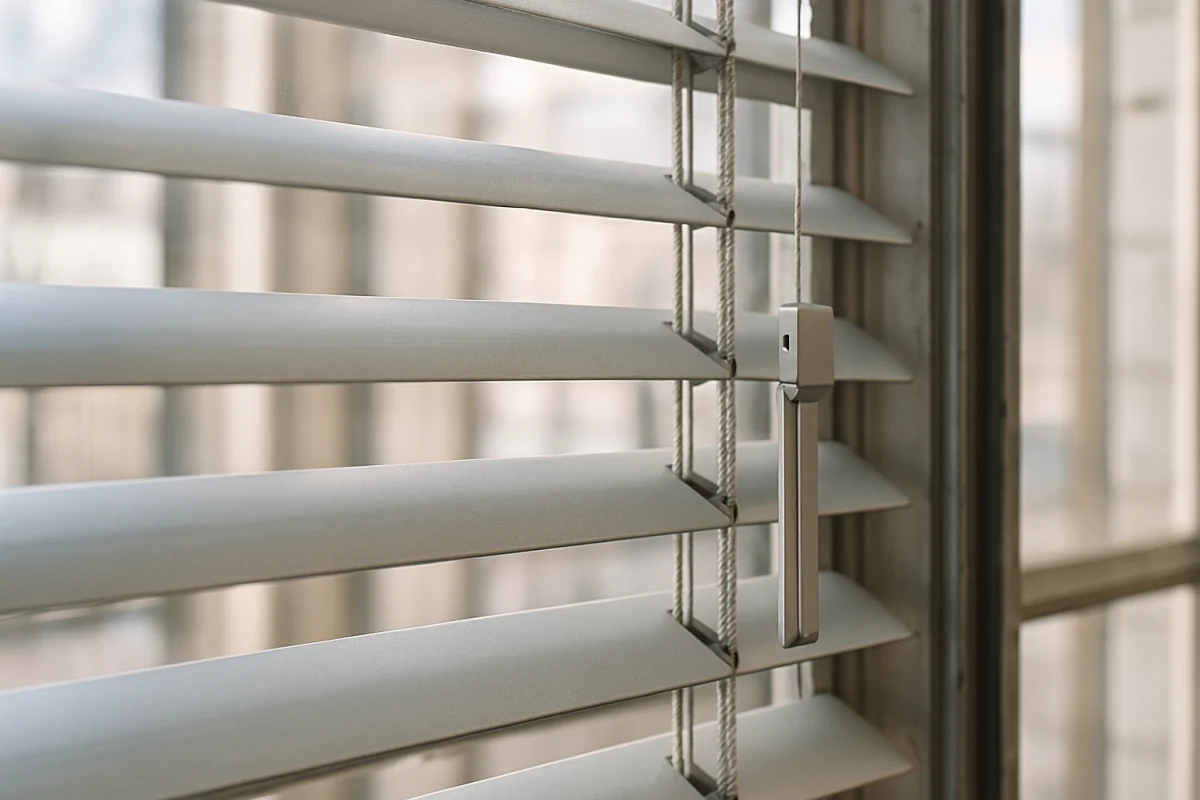
Industrial blinds are a window system with a rigid metal slat and reinforced mounting designed for the heavy weight of the blind and wide glazing spans. They differ from office blinds precisely in the slat and the mounting: a thin office system will sag on a wide wall, while a workshop system keeps its plane.
As a window system, industrial blinds are installed on the glazing of workshops, warehouses, repair shops and canteens at production sites. Here the metal slat is not a decoration but a working element: it is washed together with the walls, it gets hit by carts, it stands at gates where draughts blow through. That is why metal, not fabric.
Three products that hide under the same name
By name alone it is easy to confuse four different things. Let's separate them right away.
- Ventilation louvre grilles and valves close an opening in a wall or air duct for air. This is not a window and not sun protection.
- PVC strip curtains for gates are hanging strips that close the gate opening against draughts and dust. They have nothing to do with windows.
- Protective strip screens are mounted on grinding and sharpening machines to block sparks and chips.
These are different products, and we don't make them. We say so honestly right away, so as not to waste your time on a measurement.
How a workshop system differs from an office one
Industrial blinds differ from office blinds in three parameters: slat rigidity, the gearbox and the mounting. In a workshop system the gearbox is reinforced, the mounting is calculated for the weight of the blind, and the blind itself is assembled for the span without splitting into sections where an office system would sag. And the difference shows not in the showroom but after six months of use — in a sagging blind and a loose mechanism.
Where we manufacture
We have our own workshop in Almaty, and this changes the way we work: there are no ready-made products in stock, every blind is made to measure. You write on WhatsApp, a measurer comes to you with samples, then the workshop and installation follow. We make industrial blinds in Almaty as a full cycle — from measurement to handover, with no middlemen between production and the site.
Industrial blinds are a window system with a rigid slat and reinforced mounting, while ventilation grilles, PVC curtains and protective screens are different products that we don't make.
Which slat for which space: dust, moisture, impacts, draughts
The slat is chosen by the conditions of the space, not by colour or price: where the blind gets hit every day, we use galvanised steel with powder coating; where it doesn't get hit, anodised aluminium; and where you need light with the blind closed, a perforated slat. Below is the “condition → material” match we use to price a project.
| Condition of the space | Material and slat | Why so |
|---|---|---|
| Workshop, warehouse, high-traffic space: the blind gets hit by carts and forklifts | Galvanised steel with powder coating, slat 25 mm | Rigid than aluminium, doesn't dent from contact |
| Repair shop, office with large glazing: the blind doesn't get hit | Anodised aluminium, slat 25 mm | Runs quieter than steel, lighter in weight |
| Wet space, cleaning with detergent | Coated slat — anodising or powder coating | The coating withstands moisture, and we treat the edges |
| Meeting room next to the workshop, glare on the screen | Perforated slat | Light passes through when the blind is closed |
| High workshop bay, draught at the gates | Slat 50 mm | Blocks light less often, sags less in the wind |
| Workshop window where dust and shavings fly in | Any metal slat, not fabric | We don’t install fabric in production areas |
Aluminium: where the blind isn’t touched
Anodised aluminium suits bays that aren’t touched: workshops, storage areas, offices with large glazing. A 25 mm slat moves more quietly than steel and weighs less, so it’s chosen where quiet operation matters and where the blind is washed together with the walls. Anodising is a separate coating, and it must not be confused with powder coating: the anodised layer becomes part of the metal structure, while powder paint sits on top. A damp room requires a coated slat in any case; we don’t put bare metal there. This often surprises people: customers expect aluminium to be “weaker” than steel everywhere.
Steel: where the blind is touched every day
Powder-coated galvanised steel handles bays where the blind is touched daily — workshops, warehouses, walk-through areas. The slat is the same, 25 mm, but made of steel: it’s stiffer than aluminium and doesn’t dent on contact, so a trolley bumped against a corner won’t leave a crease in the blind. We treat the edges and cut points to prevent corrosion — this noticeably extends the life of the blind in a damp workshop. If you do metalworking and there’s oil mist in the air, powder-coated steel is also a workable option: grease and oil come off the coating without a trace. In such an area we install aluminium only on windows that no one comes close to.
Perforation and wide slats
A perforated slat lets light through when the blind is closed: the room doesn’t go dark, and glare on the screen is gone. We install it in meeting rooms next to the workshop and in offices where you need to cut the sun but keep readability. A solid slat works more bluntly in such a room — it cuts the light completely, and you have to keep the ceiling lights on full during the day. A 50 mm slat is the solution for high workshop and warehouse bays: a wide slat blocks light less often when opening and sags less from the draught at the gates. A narrow slat on floor-to-ceiling glazing looks choppy, while a wide one reads more calmly. Which to install — 25 or 50 mm — depends on the height of the bay and how often the blind is opened.
Fabric systems in production
We don’t install fabric on workshop windows: dust and shavings clog the blind, and washing it ruins it. Fabric systems are for the office part of the building and meeting rooms, but not for bays that get touched. And here’s what matters: in a warehouse with a forklift and in a workshop, metal blinds last for years, while fabric ones would have to be replaced, so metal here isn’t “more expensive” — it’s cheaper over its service life.
The material is chosen based on the conditions of the room: where the blind is touched every day — steel, where it isn’t touched — aluminium, where you need light with the blind closed — perforation.
Mounting and substrate: how the blind holds on a wide bay
Mounting is calculated for the weight of the blind, not the width of the window, and it’s fixed into the wall, not the frame. A frame can’t hold that weight — it’s designed for a glass unit, not a steel slat with a bottom rail. We check the substrate during the measurement: it determines which brackets to use and whether there are enough fixing points.
Concrete, solid brick and sandwich panels behave differently. An anchor goes into concrete and brick reliably, and there the only question is the number of points. A sandwich panel is thinner with insulation inside: we fix into the panel’s load-bearing frame or into a mounting block, not into the sheet itself. If there’s no mounting block, we say so right away — the fixing point needs to be reinforced before hanging the blind.
The width of a single blind and the number of sections are determined during the measurement based on the specific glazed wall. We don’t quote it in advance: on a wide bay, not only the size matters but also how the wall is assembled and where the frame posts are. If the opening is wider than one blind, we divide it into sections and join them in one plane so there’s no height difference. Are the blinds touched by trolleys? Then we make the sections with a stiffness margin, not tight to the limit.
A draught at the gates is a separate story. The housing box and side guide rails keep the slat in plane, and the bottom rail stops the blind from flapping when the gates are opened nearby. The slat sits in the guide rails, so it doesn’t rattle or twist in a draught. During installation we check that the blind doesn’t touch the frame or window reveals: contact causes rattling that can be avoided at the installation stage.
We check the substrate during the measurement on four points:
- Wall material — concrete, brick or sandwich panel.
- Whether there’s a mounting block for fixing if the wall is panelled.
- Where the brackets go — into the wall or into the frame.
- Whether window reveals, pipes and shelves by the window get in the way.
The order is simple. First we look at the substrate, then we calculate the mounting for the weight of the blind, and only then we determine the width of the blind and the number of sections. Wall mounting and calculation for the specific glazed wall are what distinguish an industrial system from an office one, which would simply sag on a wide bay.
Why not into the frame
A frame can’t hold the weight of the blind. For high openings we use reinforced brackets and bring the fixing points into the wall, not into the window profile. If the wall isn’t ready — crumbly, thin or without a mounting block — we say what needs reinforcing and don’t hang the blind on a hope.
Wide opening and sections
We calculate the width of a single blind during the measurement. If the opening is wider, we divide it into sections and join them in one plane: there must be no height difference, otherwise the glazed wall reads as broken up and the slats catch each other at the joint.
Draught at the gates
The housing box, side guide rails and bottom rail work together. The slat doesn’t leave its plane and doesn’t rattle when the gates are opened nearby, and the bottom rail keeps the lower edge of the blind straight. During installation we check the gap to the frame and window reveals.
Manual or electric motor: what to choose for dozens of windows
With dozens of windows, it’s not taste that decides but the height of the rail and the number of blinds. Manual control with a reinforced gearbox is cheaper and simpler to maintain. An electric motor is needed where you can’t reach the rail from the floor and there are several blinds: on a high glazed wall you’d be opening each blind by hand separately, and that’s already a question of time and people.
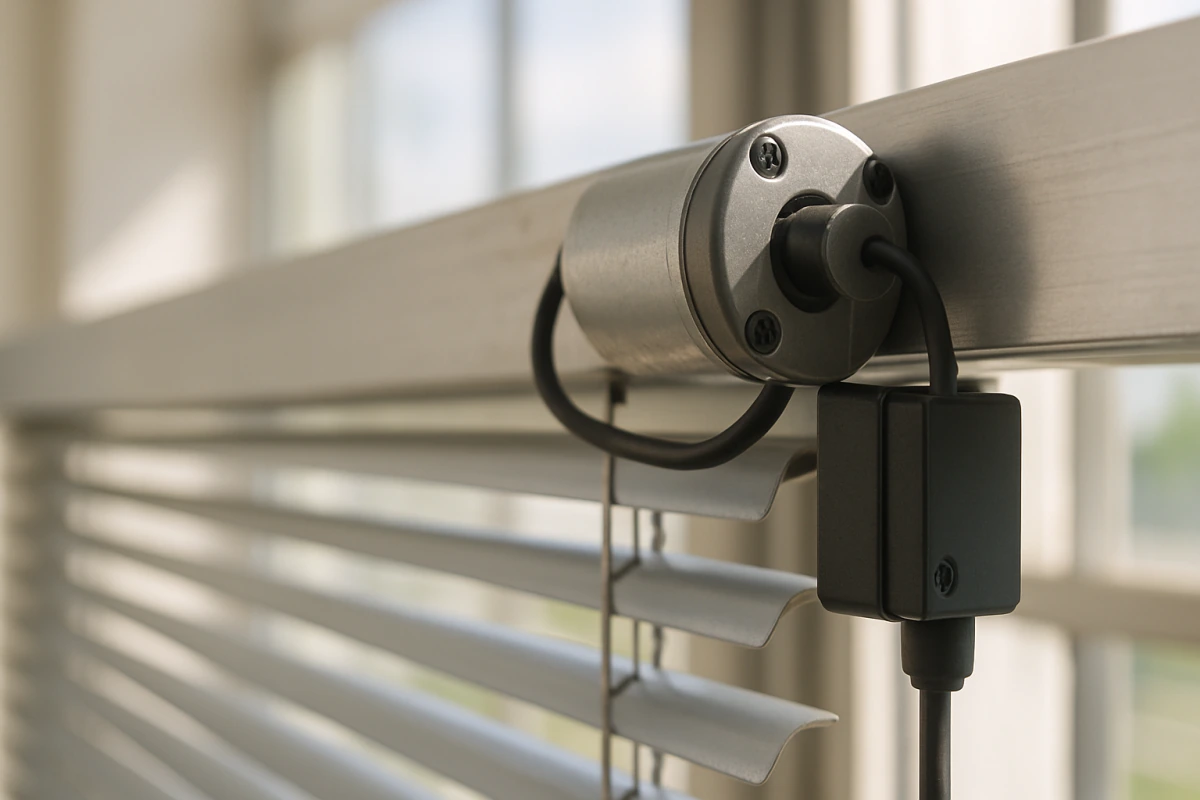
We use industrial blinds with an electric motor for high glazing in production buildings and for a group of blinds in a workshop. The motor in the rail raises and tilts the slat from a remote control, so you don’t have to pull a cord to reach a blind up high. The motor is powered by 220 V or a battery; we confirm the connection point and whether a separate electrician is needed during the measurement. Smartphone control is an option we also discuss on site, rather than promising it in advance.
Manual control makes sense where you can reach the rail by hand. Windows at arm’s level, single blinds, rooms where the blind is opened rarely: a reinforced gearbox runs without clicking, maintenance is simpler, and the price difference goes into the slat and mounting. Besides, on a low window a motor adds no convenience — only cost and an extra component that will eventually need attention.
| Criterion | Manual | Electric motor |
|---|---|---|
| Rail height | Can be reached by hand from the floor | Tall glazing, the rail is out of reach |
| Number of blinds | One or two | A group of blinds across the whole glazed wall |
| Control | A chain or cord on each blind | Remote control, one button per group |
| Power | Not required | 220 V or battery |
| Servicing | Gear reducer, cord or chain | Mechanism and power supply |
To combine several blinds on one button, the measurer counts not one window but the whole glazed wall. Blinds are grouped by height and side: a blind that is out of reach and a blind above a passage should move together, otherwise a button for each window solves nothing. How many blinds fit into one group depends on height, area and power supply — the measurer estimates this on site. And here is what matters: a group is assembled once and used every day, so a mistake in grouping is felt right away.
Let’s take two windows in a workshop. A window at arm’s level, a single blind: mechanical control, coefficient ×1, and that is enough. A glass wall up to the rail, where you cannot reach from the floor: here we suggest an electric motor with coefficient ×1.85 or a motorised system with a remote control ×2.1 for control. As for timelines, we make metal blinds in 5–7 days, motorised systems in 7–10 days: power supply and grouping need to be agreed before installation.
An electric motor is needed where the rail cannot be reached from the floor and there are several blinds; on low windows that you can reach by hand, mechanical control is cheaper.
When a motor is justified
Tall glazing of industrial buildings, floor-to-ceiling glazing, a group of blinds in a workshop — this is where a motor works not for status but for the job. If there is only one blind and it is high up, the issue is usually also solved with a motor, but there is nothing to group. Power supply 220 V or a battery: the choice between them depends on whether there is a line nearby and where to route it. A battery does not require wall chasing or an electrician, but it needs charging. A 220 V power supply is more convenient for constant use, but we clarify the connection point and whether a separate electrician is needed at the measurement — there is nothing to promise in advance here.
When mechanical control is enough
We install mechanical control with a reinforced gear reducer on windows at arm’s level and on single blinds. Rooms where the blind is rarely opened also do without a motor: mechanical control is cheaper, and maintenance comes down to tightening and replacing the cord or chain. I won’t argue, automation is convenient. But on a low window you will open the slat by hand in a second, and there is little point in paying for a motor, power supply and remote control.
A group of blinds on one button
A group of blinds is controlled by one button, and this is the main practical gain on site. At the measurement we count the whole glazed wall, not individual windows: this shows how many blinds it makes sense to combine and where a separate remote control is needed. If the glazed wall has different heights, the group is divided along the rail line. Smartphone control is an option that is clarified at the measurement.
How much it costs and how the budget for a site is calculated
Metal blinds cost from 5,200 ₸ per m², motorised systems from 7,800 ₸ per m². Installation is 4,500 ₸ per item, and for orders from 150,000 ₸ we do not charge for it at all. These are the three figures from which the budget for the whole site is then built.
The price per square metre is not the only component. Four things affect the total: the slat material, the span width, the number of sections and the type of control. Plus installation, which depends on where we mount — into the wall, onto the frame or without drilling at all. That is why the budget for a site is built from the price list with control and installation coefficients, not by multiplying one price by the total area.
Prices by price list items
| Position | Price | Manufacturing time |
|---|---|---|
| Metal, steel, slat 25 mm | from 5,200 ₸/m² | 5–7 days |
| Horizontal, aluminium, 25 mm | from 4,200 ₸/m² | 3–5 days |
| With electric motor, 220 V or battery | from 7,800 ₸/m² | 7–10 days |
For a 50 mm slat and a perforated slat we do not give separate figures: this is calculated at the measurement for a specific span. Industrial blinds are a category where area and width matter more than a price list line.
Control and installation coefficients
Control: mechanical — ×1, chain — ×1.06, electric motor — ×1.85, electric motor with remote control — ×2.1. Installation: onto the wall — ×1, onto the frame — ×1.05, without drilling — ×1.1, cassette system — ×1.28.
The difference between mechanical and motorised versions adds up to a noticeable amount. That is exactly why Jalusso always asks which windows a person can reach by hand and which they cannot — there is no point in overpaying for automation on dozens of low windows.
Example of a calculation for a site
Let’s take a glazed wall in a workshop: steel 25 mm, mechanical control, wall installation. We multiply the area by 5,200 ₸/m² and by the control coefficient 1, and add installation at 4,500 ₸ per item. If the order total goes over 150,000 ₸, we remove the installation line. And this is not a discount but simply a calculation condition — it is the same for everyone.
Frame mounting will add 1.05 to installation, without drilling — 1.1, cassette system — 1.28. An electric motor raises the total cost of the item 1.85 times, and with a remote control — 2.1 times.
Free measurement and documents
Measurement and consultation are always free with us. The measurer arrives with samples and calculates the cost on site — for a specific wall, not from a photo. Within the city, measurement and delivery are free. To the suburbs — Kaskelen, Talgar, Issyk, Kapshagay — we do travel, and we state the travel cost before the visit so that the person decides with open eyes.
For a legal entity we issue a contract, an invoice and an acceptance act. We give 3 years on the mechanism and 1 year on installation work; we count from the date the act is signed. For accounting this is a complete set: payment by invoice, closing documents after installation.
How measurement, manufacturing and installation work in Almaty
Measurement and consultation are always free: the measurer arrives with samples, inspects the glazed wall and calculates the cost on site. Within the city, measurement and delivery are also free, and to the suburbs — Kaskelen, Talgar, Issyk, Kapshagay — we travel with a travel cost that we state before the visit, so that the amount does not come up as a surprise.
Order stages
We have set up our work so that the customer at the production facility is not distracted unnecessarily. Everything goes step by step.
- Request via WhatsApp: you send a photo of the glazed wall and approximate dimensions.
- The measurer arrives with samples of slats and shows the difference between aluminium, steel and perforation right at the window.
- Calculation on site: material, mounting, number of sections and control — all of this is determined by the free measurement.
- Contract and invoice, for a legal entity — with a full package of documents.
- Our own workshop manufactures the item to your dimensions; there are no ready-made items from stock.
- Installation and signing of the acceptance certificate.
Timelines depend on the item. According to the price list, we manufacture metal blinds in 5–7 days, motorised systems in 7–10 days. Plus or minus a day for logistics within the city — this is normal practice for sites in an industrial zone.
Almaty's climate and choosing a system
Almaty's climate is sharply continental: hot and dusty summers, cold winters with frost and a noticeable day-to-night temperature swing. Dust settles on the slats in a thick layer, and the sun hits the glazing almost all day long.
What does that mean in practice? Slats are only taken with a coating — anodised aluminium or powder-coated galvanised steel, never bare metal. We add guide rails and a bottom weight to the blind: otherwise winter draughts will make it swing. This isn't being overly cautious — it's simply the difference between a system that works for years and one that gets taken down a month later.
Installation at an operating facility
We install on site without stopping the shop floor. Our foreman Zhenya agrees the fixing points and the motor's power supply with you in advance, so the installers don't wander around the workshop with questions. If the opening is tricky — a tall glazed wall, a sandwich-panel wall — we calculate the fixing for the weight of the blind and reinforce the base if needed.
At an operating facility, one glazed wall is usually covered in a single shift. The exact time depends on the number of sections and the type of control; the measurer gives it after the site visit.
A free measurement isn't a formality: it's what determines the material, the fixing and the number of sections, and it decides whether industrial blinds in Almaty will fit your opening or the fixings will need redoing.
How to clean the slats and service the mechanism
The slats are washed right on the window, without taking the blind down: wipe them with a damp cloth and a mild product, and for heavy soiling use a cleaning agent for commercial premises. There's no need to remove the blind, whether at height or in the workshop. Servicing the mechanism comes down to one operation a year — cleaning dust out of the gearbox. That's the whole of the upkeep.
The blind is built so that cleaning doesn't turn into a separate job. The slats hang in the guide rails and run the full height, and you can reach every one with the same mop or stepladder you use to wash the windows. Anodised aluminium and powder-coated galvanised steel stand up to moisture and cleaning: the coating doesn't mind water or household chemicals. We treat the slat edges and cut points in the workshop so corrosion doesn't start in a damp room. We don't fit bare, uncoated metal in wash bays or auto workshops — that's exactly where it starts to rust first.
Dust in a workshop clogs the mechanism and causes jamming. It packs into the gearbox, into where the cord runs, into the slat tilt lock — and the blind starts to run stiffly or skew. We put this first among the reasons a system stops responding. Once a year we clean dust out of the gearbox, tighten the fixings and adjust the tilt. Once the warranty period has passed, we still come out: tighten the fixings, adjust how the blind runs, fit a new cord or chain.
What's worth keeping in mind for upkeep:
- Wipe the slats with a damp cloth and a mild product, without taking the blind off the window.
- Remove heavy soiling with a cleaning agent for commercial premises — the coating stands up to it.
- Clean dust out of the mechanism once a year, especially if there's swarf or grinding nearby.
- Check the cord, chain and tilt lock together with the gearbox.
- A damp room isn't a reason to give up on the system, it's a reason not to take bare metal.
The slats are wiped with a damp cloth and a mild product right on the window without taking the blind down, and once a year we clean dust out of the mechanism — it's the most common cause of jamming.
Cleaning the blind
The slats are wiped right on the window, and for heavy soiling with a cleaning agent for commercial premises. Anodised aluminium and powder-coated steel stand up to moisture and cleaning, and we treat the edges and cut points so corrosion doesn't start. In a workshop with grinding or sharpening, dust and swarf settle on the slats in an even layer — they're wiped off with the same cloth you use for the dust on the walls. The blind itself stays in place.
Servicing the mechanism
Once a year we clean dust out of the gearbox, tighten and adjust. Once the warranty period is over, a call-out is still possible — we'll tighten the fixings, adjust how it runs, fit a new cord or chain. Industrial blinds suit a canteen at a production facility too: a window by a walkway is washed along with the walls, the slats don't absorb odours, and grease marks come off the coating without a trace. For a school or a catering kitchen the logic is the same — where the blind is touched every day, what matters isn't how often it's cleaned but that it's done without taking the system apart.
What the warranty covers and what to do if a slat is damaged
The warranty on industrial blinds is 3 years on the mechanism and 1 year on installation, counted from the date the acceptance report is signed. We allow 5 working days to fix a warranty fault on industrial blinds, and there's no charge for it. This covers the gearbox, the rail and the fixing points that our team installed.
What the warranty doesn't cover: mechanical damage, reinstallation by the customer, water and natural fading of the fabric. A slat crushed by a trolley or a forklift during unloading isn't something we cover as a warranty repair — that's mechanical damage. But even in that situation we come out and sort it: most often it's enough to replace one slat or straighten it on site.
And after the warranty ends we still visit the site: tightening, adjustment, replacing the cord or chain. A mechanism asks for attention over time, and that's normal — dust in a workshop is the most common cause of jamming.
What the warranty covers
The mechanism is the part of the system under the most load. Galvanised steel over a wide span weighs a fair amount, and the gearbox works with that weight every day. That's why the mechanism has a longer term than the installation: the fixings barely change after handover, while the gearbox and cord wear with use.
Noise when the gates open
The slats sit in the guide rails, so the blind doesn't flap in a draught. The bottom weight holds the blind steady when the gates are opened nearby. During installation we check that the blind doesn't touch the frame or the reveals — contact causes knocking and extra wear.
The warranty covers the mechanism and installation, while mechanical damage to a slat isn't included, though we still sort it out on site.
Case studies: workshop, warehouse, auto workshop, canteen at a production facility
Four typical situations show how the conditions of a room translate into the slat material. Let's go through them in order — from a workshop to a canteen at a production facility.
Workshop
In a workshop the blind gets caught by trolleys and forklifts, so we fit powder-coated galvanised steel. A rigid slat doesn't buckle on contact, whereas anodised aluminium under that kind of load would ripple within a month. A standard span width is covered by a single blind, but if the glazed wall is wider, we divide it into sections and join them in one plane. Manufacturing time for metal blinds is 5–7 days.
Warehouse
In a warehouse it's not impact that decides things but the scale of the glazed wall. Here we cover a wide span with a single blind, without dividing it into sections, so the whole wall reads as one plane with no step in height. We calculate wall mounting with a factor of 1, and the fixing for the weight of the blind, not the width of the window. What's needed isn't a fragmented grid but a calm, unbroken plane — that's how the opening looks.
Auto repair shop
In an auto workshop the windows are by the bays and in the wash area, so the slats' main enemy is moisture and oil mist. Anodised aluminium and powder-coated galvanised steel stand up to cleaning with a detergent, and we treat the edges and cut points so corrosion doesn't start. The coating doesn't absorb traces of oil or grease — the blind is wiped right on the window, without taking it down.
Staff canteen at a production facility
The window by the walkway in the staff canteen at a production facility takes the occasional hit from a cart. The slat springs back into place — this is where steel beats aluminium. The slats are washed right on the window without taking the blind down, and the coating does not absorb odours — that matters next to the serving counter. No special mounting logic is needed here: standard wall brackets handle the load.
Where the system is overkill
An industrial system is overkill in a living room, on a small office window, and in a space with no dust or impacts. There, anodised aluminium with a 25 mm slat or fabric systems are enough — they are quieter and lighter. For a wide panoramic window at home we use an aluminium slat, but not steel: the rigidity designed for carts is unnecessary at home.
The main takeaway from these cases: in a workshop or warehouse, where the blind gets hit by carts, we install galvanised steel with powder coating, while in an auto repair shop or a production canteen what matters is a coating that withstands washing and does not absorb odours.
FAQ
Below are the five questions asked most often during a measurement. The answers are short: the measurer gives the details for each site on location.
Do you work with sites in the suburbs?
We travel to Kaskelen, Talgar, Issyk and Kapshagay. The call-out fee depends on the distance — we quote it before the visit so there are no surprises on the invoice. Within the city, measurement and delivery are free. Industrial blinds for a warehouse outside the city are priced the same as for a city site: by glazing area and the chosen material.
Do I need a separate electrician for the motor?
The motor runs on 220 V or a battery. We confirm the connection point and whether an electrician is needed during the measurement: sometimes the line is already run to the glazing, sometimes it has to be pulled. Industrial blinds with an electric motor will not start without power, so we settle this before the order, not after installation.
Can blinds be installed without drilling?
Yes, this installation option is available, with a coefficient of 1.1 added to the installation cost. But it does not suit every blind weight: a steel slat over a wide span holds only on wall anchor points. If the base allows drilling-free installation, we will say so during the measurement.
What if the opening is wider than one blind?
We divide the glazing into sections and join them in one plane so there is no height difference. We calculate the number of sections during the measurement based on the specific wall. The span width affects both the choice of slat and the mounting.
What documents does a legal entity need?
A contract, an invoice and an acceptance certificate. We give a 1-year warranty on installation and a 3-year warranty on the mechanism; both periods start from the day the certificate is signed. Industrial blinds are purchased by bank transfer, so we prepare the documents for the organisation.
Industrial blinds in the suburbs, with or without a motor, are always priced by measurement: a site visit and inspection give answers that correspondence cannot.
Conclusion
Industrial blinds are a window system with a rigid metal slat and reinforced mounting for large glazing spans. Not a ventilation grille and not a PVC curtain for gates. Everything else follows from that: material, mounting method, type of control.
The material is chosen based on the conditions of the space, not the price list. In a workshop or warehouse, where the blind gets hit by carts and a loader, we install galvanised steel with powder coating — it is more rigid and does not dent on contact. Where the blind is not hit, anodised aluminium is enough: it is lighter and runs quieter. Perforated slats are chosen when light needs to be kept in the room with the blind closed.
Mounting is calculated for the weight of the blind and anchored into the wall, not the frame. A frame cannot hold that weight — on high openings this is the first thing the measurer checks. The width of a single blind and the number of sections are also determined on site based on the specific glazing wall: if the opening is wider, it is divided into sections and joined in one plane.
An electric motor is justified where the rail cannot be reached from the floor and there are several blinds: glazing of industrial buildings, a group of blinds in a workshop, control with one button. On windows within arm's reach, a mechanical system with a reinforced gearbox costs less and is simpler to maintain.
The budget is calculated from the price list with coefficients for control and installation: metal blinds from 5,200 ₸ per m², horizontal blinds with an aluminium slat 25 mm from 4,200 ₸ per m², with an electric motor from 7,800 ₸ per m². We charge 4,500 ₸ per unit for installation, but if the order total reaches 150,000 ₸, we install at no extra cost.
The practical advice is simple: photograph the entire glazing wall, not just a single window, and message us on WhatsApp. The measurer will come with samples, calculate the material, mounting and control on site, and quote the price right away — measurement within the city is free.

