




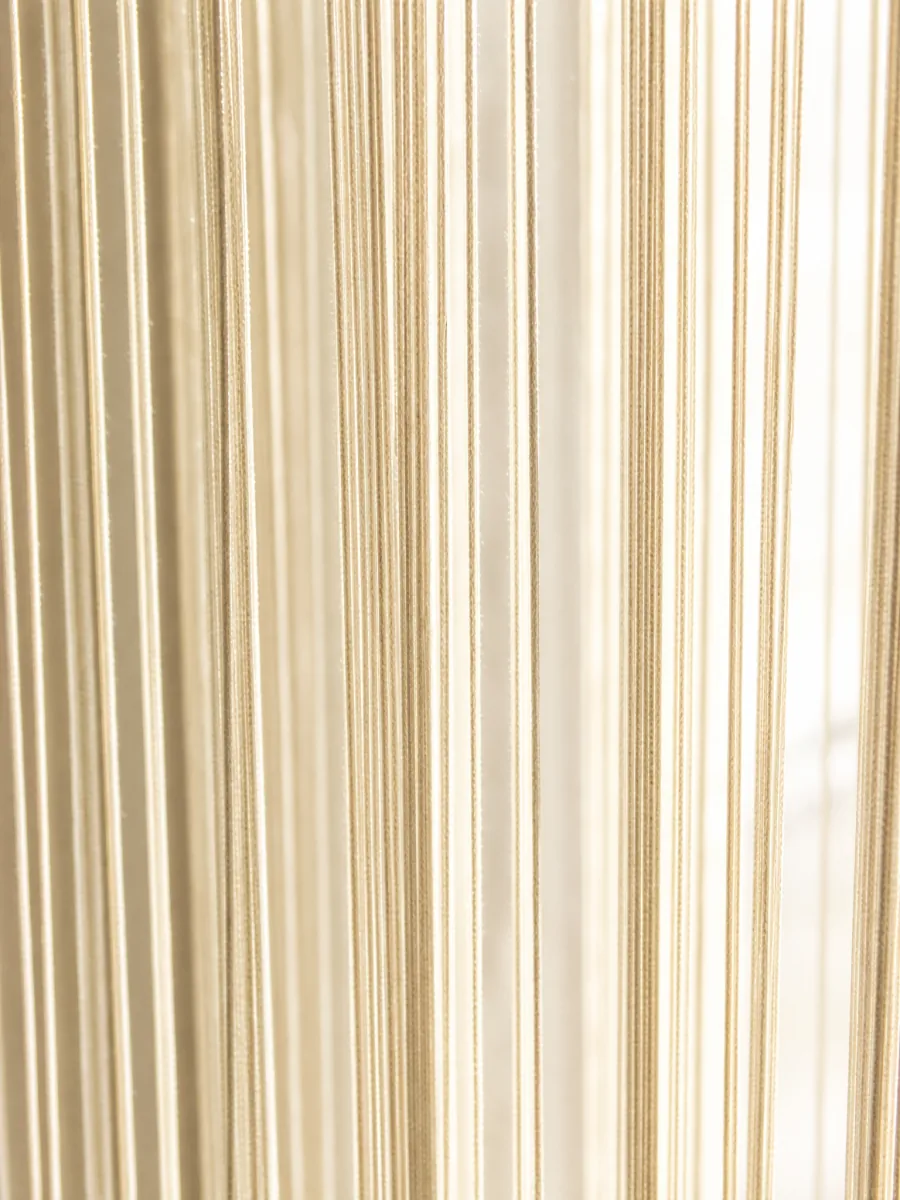







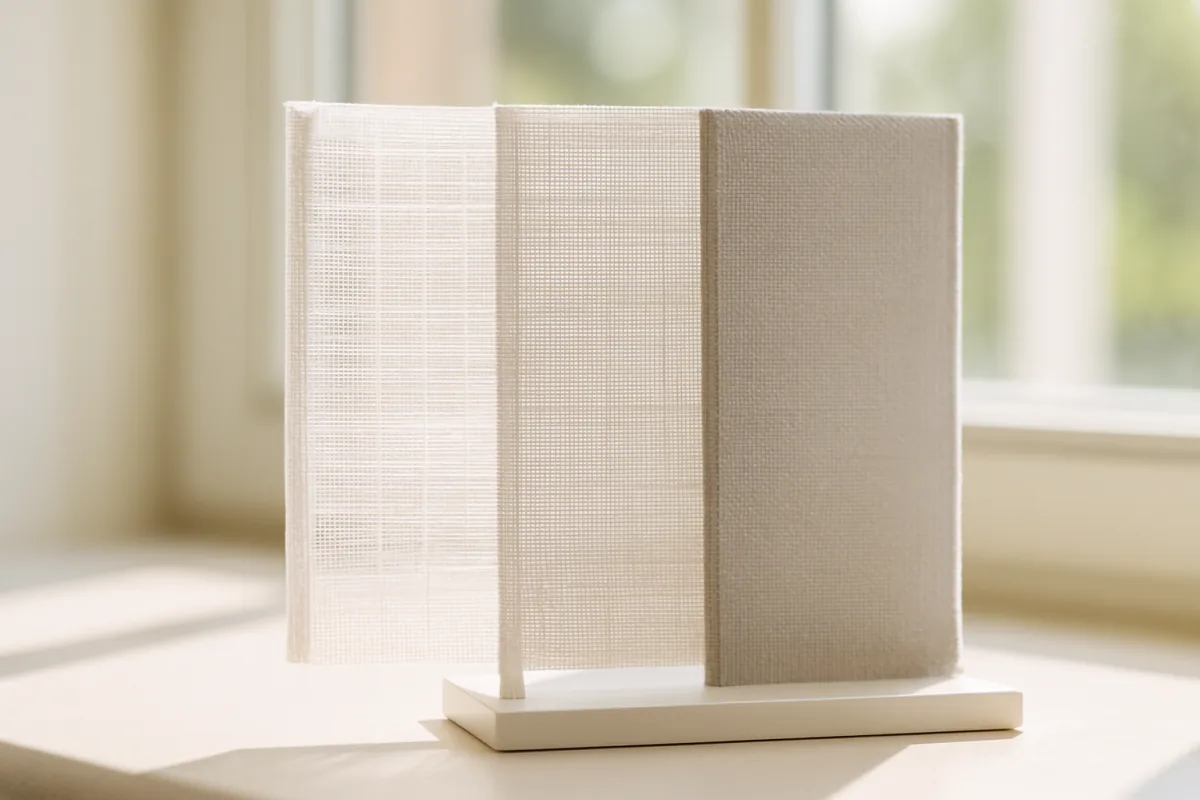











Vertical sheer blinds are a light-diffusing fabric made of sheer and set on vertical slats 89 mm wide. By turning the slats you control the light and how much you can be seen from the street: during the day the room stays bright, in the evening with the lights on the fabric becomes see-through. We make them to measure in Almaty, price from 4,600 ₸ per m².
What vertical sheer blinds are and what they consist of
Vertical sheer blinds in Almaty are sheer fabric set on vertical slats 89 mm wide. In this design the light is controlled not by drawing the curtain apart but by turning the slats: the fabric stays in place, only the angle of each strip changes.
That is where the main quality comes from. Sheer fabric diffuses light without darkening the room: harsh strips and glare from direct sun disappear, while the room itself stays bright. In the evening the slats close and cover the window completely — but we’ll be honest about that further on, in a separate section about day and evening.
One more thing worth saying right away. On the market, the word “sheer” covers different things: there is a hybrid where ordinary sheer with pockets and buttons is put onto plastic slats. We do it differently — sheer fabric on vertical slats, and at the measurement we show you samples so you can see exactly what you’ll get. We don’t keep ready-made products in stock; everything is assembled for your opening.
What the product is made of
The design consists of four parts:
- sheer fabric stretched over a slat 89 mm wide;
- a weight along the bottom edge of each slat;
- a bottom chain linking the slats into a single comb;
- the rail and mounting that hold the product on the window.
The bottom chain links the slats into a single comb, so they turn in sync rather than at random. The weight at the bottom adds mass: the fabric hangs evenly and doesn’t sway in a draught.
Why the slat holds its shape
The slat 89 mm wide is the load-bearing element of the whole design. Its width determines how the fabric gathers into a comb and how it behaves on a wide opening: the wider the slat, the fewer joints in the fabric and the more evenly it holds its geometry. The weight along the bottom adds stability, and together they keep the fabric from swaying when the sash is open.
Vertical sheer blinds are sheer fabric set on vertical slats 89 mm wide, where the light is controlled by turning the slats rather than by drawing the curtain apart.
How they differ from ordinary sheer on a rail
Sheer vertical blinds differ from ordinary sheer in that the light is controlled by turning the slats rather than by drawing the curtain apart. Ordinary sheer on a rail hangs as a single curtain: you can either close it fully or pull it to one side. Sheer fabric on vertical slats turns and slides — and those are two different movements, not one.
Comparison table
| What we compare | Ordinary sheer on a rail | Sheer vertical blinds |
|---|---|---|
| Light control | No: only close or open fully | By turning the slats, smoothly |
| Privacy during the day | Silhouettes are visible, the fabric hangs as a solid sheet by the glass | Slats at an angle: light is diffused, the room is closed off |
| Dust | Collects over the whole area of the curtain | Holds less on a vertical slat |
| Care | Take off the rail, wash, iron, hang up | Take off the runners, wash, hang back up |
| Space on the rail | Takes up the whole rail | Sits on its own rail, the second layer goes next to it |
| Second blind | Curtain next to it on the same rail | A dense blind on a separate rail, right up against it |
What this means in practice
During the day the slats are set at an angle — light is diffused, and from the street you can make out a silhouette. Dust in the sheer of an ordinary curtain builds up along the whole height of the fabric, while on a vertical slat most dust settles on the edge and is removed with a soft brush. The difference is noticeable.
In the evening the slats close, but the fabric stays semi-transparent, so evening privacy is handled by a second dense layer (more on this in the next section). What to choose — ordinary sheer with a curtain or sheer blinds: if you need light control during the day and less hassle with dust, blinds win; if you need a dense curtain for the whole evening, ordinary sheer stays paired with it.
You can slide the blind to the side with the control chain — the same chain also turns the slats. The chain keeps the blind from swaying in a draught and lets you move it to the edge of the opening in one motion. For tall windows an electric motor is used, but more on that later.
Ordinary sheer on a rail collects dust and does not control light — that is its main difference from vertical sheer blinds with rotating slats.
What the fabric gives you during the day and what it does not give you in the evening
Vertical sheer blinds give you a bright room during the day without being seen from the street, but in the evening they do not give you that privacy: with the light on, the fabric is see-through. Sheer fabric works to diffuse light, not to darken, and this is the main thing to know about it before the measurement. Harsh stripes and glare from direct sun disappear, while the room stays bright — you should not expect full darkness during the day from sheer fabric, and we say this right away.
How much you can be seen from the street depends on the density and texture of the fabric. Density is chosen for the room: from an almost transparent base to a fabric that is almost opaque in the evening. Texture matters too — a fabric with a denser weave hides the silhouette sooner than a loose one.
How much does the fabric darken the room? Almost not at all. Sheer fabric does not take away light, it softens it: the harshness goes, the room looks even, but you will not need to turn on a lamp during the day.
During the day
The slats are set at an angle, and light is diffused rather than cut. From the street during the day, with the slats closed, only a silhouette is visible, not the details of the room — that is what daytime privacy looks like.
In the evening
With the light on, the fabric is more see-through — this is the physics of the fabric, not a defect. Evening privacy requires a second dense layer on the same opening. The options are:
- Choose slats made of a denser fabric — they will not give you darkness, but less light will show through.
- Put a second dense blind on the same rail — a night curtain covers the window completely.
- Combine them: during the day the sheer slat does the work, in the evening you slide it to the side and close a dense curtain.
There is one trick: the right option is only visible on samples. At the measurement we look at the fabric against the light in your room with your lighting — that way the difference between an “almost transparent” and a dense base is clear right away, not after installation.
Bottom line
During the day sheer fabric diffuses light and hides the room from view from the street, while in the evening with the light on it is see-through — this is the physics of the fabric, and evening privacy needs a second dense layer.
How sheer blinds differ from fabric vertical blinds and from multi-texture blinds
Vertical sheer blinds differ from vertical fabric blinds in the density of the fabric: more light passes through sheer fabric, so during the day the room stays bright, and in the evening with the light on the fabric is more see-through than dense fabric. The mechanism itself is the same — slats 89 mm, rail, chain — and this is important to understand when you compare options. The density and texture of the fabric decide how much shade the room gets in the evening.
Sheer versus dense fabric
Vertical fabric blinds made of dense fabric work like a shading curtain: they cut off part of the light and hide the room from the neighbouring house already at dusk. Sheer fabric works differently — it does not cut light, it diffuses it, and that is its point. If the window faces south or west and the room gets hot from direct sun during the day, dense fabric will give more shade, while sheer will give more even light without harsh stripes and glare. The choice here depends on what matters more to you: soft lighting or depth of shade.
Sheer versus multi-texture and day-night blinds
Multi-texture blinds are two fabrics joined in one blind: one part is denser, the other more transparent, and on the window such a blind reads as combined. Vertical sheer blinds differ from multi-texture ones in the composition of the fabric — ours is a single sheer fabric along the whole height of the slat, with no alternating textures. For an office with panoramic glazing, multi-texture blinds are chosen more often: the dense stripe removes glare from the monitor, the transparent one keeps the view. For a living room, where light should come from the window but you do not want a second layer of curtains, sheer fabric wins.
And what about the day-night system? It is a roller blind made of two sliding layers, and it does not apply to vertical slats: a slat has no second layer that can be shifted relative to the first. If you need smooth light control by shifting layers, that is day-night, but it is installed as a roller system, not as vertical blinds.
Fabric on vertical slats controls light not with layers but with the angle of the slat — and this is what determines the difference between sheer and dense fabric, not the design of the rail.
How to take down and wash the fabric: step by step
Vertical sheer blinds are designed so that the fabric comes off the runners completely, together with the slats, and is washed separately from the rail and the mechanism. The rail stays in place — you do not need to touch it. Take the fabric down with two people: there are many slats, and one by one they get tangled.
Steps
- Take the fabric off the runners without touching the rail. The slats come out of the runners one by one.
- Remove the slats and take the weights out of the bottom pocket. The weight is pulled out by hand, it is inserted loosely.
- Wash the fabric separately from the slats and the mechanism, on a delicate cycle, without high-speed spinning.
- Dry it laid out flat, without hanging it wet on the rail.
- Reassemble and check how the fabric hangs along the bottom.
Where washing is not an option
Coated fabric and screen fabric do not survive machine washing. The dust-repellent treatment protects against both dust and sun — washing removes it, and the fabric loses what it was chosen for. For such blinds we recommend dry dusting and a soft brush. And yes, about shrinkage: sheer may shrink after washing, so the length along the bottom is checked on the assembled blind and adjusted if needed — tightening a slat in the runner is easier than re-sewing.
How often to wash
In the kitchen by the stove the fabric gets dirty faster than in a room: grease and steam settle on the fabric, so it is washed more often there. In a city apartment the guideline is how the fabric looks and how much dust there is, not the calendar. Between washes, going over the slats with a soft brush is enough.
The removed fabric is washed separately from the slats and the mechanism, and treated fabrics and screen do not survive machine washing.
Caring for the fabric between washes
Between washes, sheer vertical blinds need nothing complicated: the fabric just needs dry dusting and a soft brush. Dust settles on sheer constantly, but on a vertical slat it does not get pressed into the fabric the way it does on a curtain that hangs in folds and collects it along its whole length. Every few weeks we go over the slats with a soft brush or a vacuum attachment — and the fabric looks even again. There is no point wetting the fabric without need: the more often you wash it, the faster it shrinks.
What if a slat pops out of the pocket or catches on something? We take it off the runner, straighten it and put it back — a couple of minutes' job. Replacing one slat does not mean replacing the whole structure: a slat is sold and fitted separately, while the rail and the controls stay untouched. In my opinion, this is the main practical advantage of a vertical system over a one-piece roller blind — the repair is local, not for the whole blind.
Can you replace just the fabric and keep the rail and slats? Yes, if the fabric is what is being changed, not the mechanics: the new length of sheer is threaded onto the same slats, and the rail with runners keeps working. This is done when the fabric has lost its look or you want a different density.
Warranty on the mechanism and installation — 3 years on the mechanism and 1 year on installation from the date the acceptance certificate is signed; a warranty case is fixed free of charge within 5 working days. Once the warranty period is over, you can still call us: we will put the mechanism in order and replace the cord or chain. Note that natural fading of the fabric and mechanical damage are not covered by the warranty — worth keeping in mind.
Between washes the fabric just needs dry dusting and a soft brush, and a single slat that has come out is replaced on its own, without replacing the whole structure.
Drill-free mounting: how it works and what limits it
Drill-free mounting preserves the window warranty: the brackets are fitted so that the frame and the window reveal stay intact. But it has a limit — the weight of the fabric. The wider the opening and the denser the sheer fabric, the heavier the comb turns out, and not every window will take such an installation. We check the limit during the measurement, before calculating the price.
Vertical sheer blinds on a tilt-and-turn sash are fixed to the frame, not to the window reveal, and the fabric is drawn aside together with the opening. The sash opens freely, the fabric does not catch on the reveal or the handle. If the window is narrow, we fit a mini system so the mounting does not cover the handle. Everything is calculated from the measurement; there are no ready-made items in stock.
Where this kind of installation makes sense
A rented flat is the first scenario: the frame is not touched with a single hole, and when you move out the fabric comes down without a trace. The second is new windows under warranty, where any drilling voids the window manufacturer's warranty.
On a balcony unit, where a window and a door sit side by side, drill-free mounting lets the fabric be drawn aside, and the balcony door opens freely without catching the threshold. Jalusso also fits this kind of installation on plastic windows that you do not want to spoil.
What to check during measurement
The weight of the fabric comes first. Then we look at four things.
- Clearance to the windowsill: when the slat turns, it must not catch the windowsill.
- The radiator under the window: we check that the fabric does not catch the radiator when the slat turns and the sash opens.
- The travel of the tilt-and-turn sash: the fabric is drawn aside and does not get in the way of opening.
- The balcony door: how it opens and whether there is enough room for the fabric at the threshold.
Measurement and consultation are always free with us: the measurer arrives with samples and calculates the price on the spot, and within the city measurement and delivery are free.
Drill-free mounting preserves the window warranty, but is limited by the weight of the fabric — the limit is checked during the measurement.
Controls: chain, electric motor, slat replacement
Sheer vertical blinds are drawn aside with a control chain, not a cord or a wand — these are two different mechanisms, and it is the chain that works on vertical slats. You turn the chain — the slats rotate in sync; you pull it along the rail — the fabric gathers to one side. The wand and the cord do not belong to vertical systems, although in conversation these words are sometimes mixed up.
There are two types of controls.
- Mechanical: a control chain on the side of the rail. It both rotates the slats and draws the fabric aside. The bottom chain, meanwhile, joins the slats into a single comb and holds the geometry — do not confuse it with the control chain, they are different elements.
- Electric motor with a remote control: the slats rotate and gather at the push of a button, no need to reach up to the rail.
An electric motor with a remote control is chosen for panoramic glazing, tall windows and openings you cannot reach by hand over the windowsill. It is controlled from a remote, with an option for an app and a schedule; power comes from the mains or from a battery if you do not want to run a socket. The button on the remote rotates the slats just as synchronously as the chain, only without the effort.
In price, an electric motor is noticeably more expensive than mechanical: in the quote it comes with a coefficient of ×1.85, and electric with a remote — ×2.1 to the base cost of the fabric. The mounting method also affects the total: wall mounting comes with a coefficient of ×1, frame mounting — ×1.05, drill-free — ×1.1. And an electric motor lengthens the manufacturing time: with a motor the item takes 7–10 days instead of 3–5 for mechanical vertical blinds.
A single slat is replaced on its own — the chain is unclipped from it, the slat is taken out of the runner and a new one is fitted, without touching the rest of the fabric. For a warranty case on the mechanism, we come out and do this free of charge.
The control chain rotates the slats in sync, while an electric motor with a remote is chosen for tall and panoramic windows you cannot reach by hand.
Downsides and awkward windows: where sheer fabric behaves worse
Sheer vertical blinds do have downsides, and we name them during the measurement, not after installation. Sheer fabric billows in a draught, gets dirty faster in the kitchen by the stove and fades on the sunny side. Below are four situations where sheer vertical blinds behave worse than you would like.
- A draught and an open sash. A draught makes the fabric billow: the slats move away from the vertical and sway. This is normal for fabric, but on a wide opening with the window wide open the fabric sways noticeably. The bottom chain and the weight hold the geometry, but in a strong draught the slats still have to be straightened by hand after the sash is closed.
- The kitchen by the stove. Grease and steam in the kitchen by the stove speed up soiling of the fabric: sheer fabric absorbs them more readily than a dense one. We place the fabric away from the stove and advise washing it more often than in a room. If the window sits right above the hob, we say honestly: sheer here will last less and will need attention.
- A child's room. A child pulls the fabric by the bottom edge, and a slat can come out of the runner or stretch. The fabric does not tear, but it hangs crooked until the slat is put right. In a child's room it is better to have the controls on the side, so the chain does not hang within reach.
- The sunny side. South and west get the most sun, and the sunny side speeds up fading of the fabric: it loses its richness, light shades turn yellow. For such windows we use screen with a treatment — fabric with a sun-protective treatment holds its colour longer than ordinary fabric. But even it is not eternal.
Another downside is evening privacy, which we mentioned above: when the lights are on, the fabric is see-through. This is not a defect but a property of sheer fabric, and it is solved with a second, denser layer. And remember the main thing: fabric fading is not a warranty case — the warranty covers the mechanism and installation, not the natural change of colour under the sun. We say this before the order so there are no surprises later — in my opinion, it is more honest to name the downside right away than to promise a universal fabric.
Panoramic glazing facing south or west is the situation where we most often suggest not pure sheer fabric but a combination: sheer fabric for rotation and a denser fabric on a second rail. We bring samples to the measurement and look at them against the light in your lighting.
How much do sheer vertical blinds cost and what the price depends on
Vertical sheer blinds in Almaty start from 4,600 ₸ per m² for fabric with a 89 mm slat, manufacturing time is 3–5 days. The total is made up of three things: the density and texture of the fabric, the type of control and the mounting method. It is impossible to give an exact sum before the measurement, and we say this directly: a price range from the list is a range, not an estimate.
Vertical fabric blinds get more expensive with the density of the fabric. A transparent sheer base comes at the base price, while a denser fabric that is almost opaque in the evening costs more — but it also solves the privacy issue without a second layer. Texture matters too: fabric with a treatment costs more than smooth fabric, but on the south and west sides it holds its colour longer.
A chain control adds a coefficient of 1.06 to the base price, an electric motor with a remote control — 1.85, and with smartphone control — 2.1. An electric motor with a remote is chosen for tall and panoramic windows that you cannot reach by hand. Manufacturing time with a motor is 7–10 days versus 3–5 days for mechanical ones.
Drill-free mounting is calculated with a coefficient of 1.1 to the installation. The same logic applies to the other options: wall-mounted — 1, frame-mounted — 1.05, cassette system — 1.28. Here is the full table:
| What changes | Coefficient |
|---|---|
| Control: manual | ×1 |
| Control: chain | ×1.06 |
| Control: electric motor | ×1.85 |
| Control: electric + remote control | ×2.1 |
| Installation: wall-mounted | ×1 |
| Installation: frame-mounted | ×1.05 |
| Installation: no drilling | ×1.1 |
| Installation: cassette system | ×1.28 |
What's included in the price
Measurement and consultation are always free. The measurer arrives with samples and calculates the cost on site — this is the answer to the question of what a free measurement includes: the visit, examining the window, the calculation and choosing the fabric. Within the city, measurement and delivery are free. Installation of one item costs 4,500 ₸, but if the order total is from 150,000 ₸, we install it free of charge. In my opinion, it is this threshold that most often decides whether to take motorisation for the whole apartment at once or start with one window.
Out-of-town visits
We travel to the suburbs — Kaskelen, Talgar, Issyk, Kapshagay. The visit price depends on the distance, and we state it in advance — before the technician sets off to you, not after the fact. There are no ready-made items in stock: everything is made to measure.
A measurement with samples lets you see the fabric in your own lighting — the same sheer fabric reads differently in different light. The base price of vertical blinds is from 4,600 ₸ per m² for fabric with a 89 mm slat, manufacturing time is 3–5 days, and the total depends on the density of the fabric, the type of control and the mounting method.
How we work: measurement, workshop, installation in Almaty
We manufacture sheer vertical blinds in Almaty ourselves, in our own workshop. We have no ready-made items in stock — every blind is assembled for a specific opening, so an order starts with a measurement. You write on WhatsApp, we agree on a time, and a measurer arrives with samples of fabrics and rails. Measurement and consultation are free: within the city, measurement and delivery are also free; we travel to the suburbs — Kaskelen, Talgar, Issyk, Kapshagay — and state the visit cost before the visit.
The process is simple.
- A request on WhatsApp and agreeing on a time.
- Measurement with samples: we look at the window, calculate on site, show the fabric.
- Workshop: the fabric and slats are made to your size.
- Installation: 4,500 ₸ per item, free for orders from 150,000 ₸.
A measurement with samples is not just a formality: only at your own window can you see how the sheer fabric behaves in your lighting. Manufacturing time for vertical blinds is 3–5 days, with an electric motor — 7–10 days. Motorisation is chosen for panoramic glazing and tall openings that you cannot reach by hand; the motor comes with a remote control, powered by mains or a battery.
Climate and fabric choice
Almaty’s sharply continental climate means cold winters with frost and day-to-night temperature swings, and hot, dusty summers. For a window facing south or west, we recommend fabric with a treatment: it holds its colour longer than ordinary fabric and collects less dust. This is advice, not a commitment on service life — we do not promise colour fastness in years.
Warranty
Both the mechanism and the installation are covered by the warranty: 3 years for the mechanism, 1 year for the installation, counted from the date the acceptance certificate is signed. For warranty repairs on vertical sheer blinds we allow 5 working days, and we do not charge for it. And after the warranty period ends, we are ready to come: tighten the mounts, adjust the movement, fit a new cord or chain. Warranty obligations do not apply if the slats of vertical sheer blinds are mechanically damaged, repositioned by yourself, got wet, or the fabric has faded over time.
FAQ
Three things become clear at the measurement, not in a chat: how the colour of the sheer fabric will behave in your lighting, what the gap to the windowsill will be, and how the fabric stands up to a draught. We answer them in order.
Which colour of sheer fabric to choose so the light does not turn yellow or grey?
The colour of the sheer fabric changes the shade of light in the room, and you cannot predict this from a picture. Warm shades give a yellow cast, cool ones a grey cast. And white is not just one colour either: milky, snow and linen behave differently, and the difference is only visible at your own window. We do not choose sheer vertical blinds from a catalogue — the measurer brings samples, and the fabric is looked at in your own lighting, in the room, not on a phone screen. In daylight alone, and in the evening under a lamp.
What gap is needed to the windowsill?
The gap is checked at the measurement together with the rotation of the slats. A 89 mm slat swings out to the side when rotated, and if the fabric sits too low, the edge catches the windowsill or the radiator. We measure not only the opening but also how the sash opens, how the windowsill runs and where the radiator is. On panoramic glazing with a low windowsill, the issue is solved by the height of the rail, not by trimming the slats.
How does the fabric behave in a draught?
A draught causes the fabric to billow — this is normal behaviour for fabric, not a defect. The fabric sways when the sash is open but does not come out of the comb. The bottom chain and the weight hold the geometry: the slats stay in place and do not tangle with each other. On a narrow window with a mini system the movement is smaller, and the billowing is barely noticeable — we look at this at the measurement too.
Conclusion
Let us briefly sum up what we covered section by section.
Vertical sheer blinds in Almaty are sheer fabric threaded onto vertical 89 mm slats. Not sheer fabric on a rail and not a hybrid with pockets and buttons, which is also called sheer on the market: the hybrid is a different design, we do not make it.
In the daytime, rotating the slats diffuses the light: the room stays bright, and from the street only a silhouette is visible. In the evening, when the lights are on, the fabric is see-through — this is the physics of sheer fabric, not a defect. For evening privacy, a second, denser layer is fitted on the same opening.
The fabric is removed from the runners entirely and washed separately from the slats and the mechanism. But treated fabrics and screen do not survive machine washing — only dry dusting and a soft brush. For the kitchen by the stove, this is worth keeping in mind separately.
The price of vertical blinds with fabric slats is from 4,600 ₸ per m², manufacturing time 3–5 days. The final figure depends on the fabric density, the type of control and the mounting method. You will hear the final number from our measurer on site — beforehand it is only an approximate range.
We keep the mechanism of vertical sheer blinds under warranty for 3 years, installation — 1 year, and we count the term from the day the acceptance certificate is signed. Natural fading of the fabric is not a warranty case, and we say this before the order, not after.
Our advice is simple: book a free measurement with samples. Sheer fabric needs to be seen in your own lighting — in the light you have in the room during the day and in the evening. On a sample you can see how the fabric behaves against the light, and right there it becomes clear whether one sheer layer is enough or whether you should plan a second, denser fabric.

