





















We make bamboo blinds in Almaty to your window measurements: natural or tinted slats, woven straw, price from 9,400 ₸/m², lead time 7–14 days depending on the material. Bamboo gives soft dappled light and a natural texture, but it is not for bathrooms, and it lightens in the sun.
How bamboo straw differs from a slat
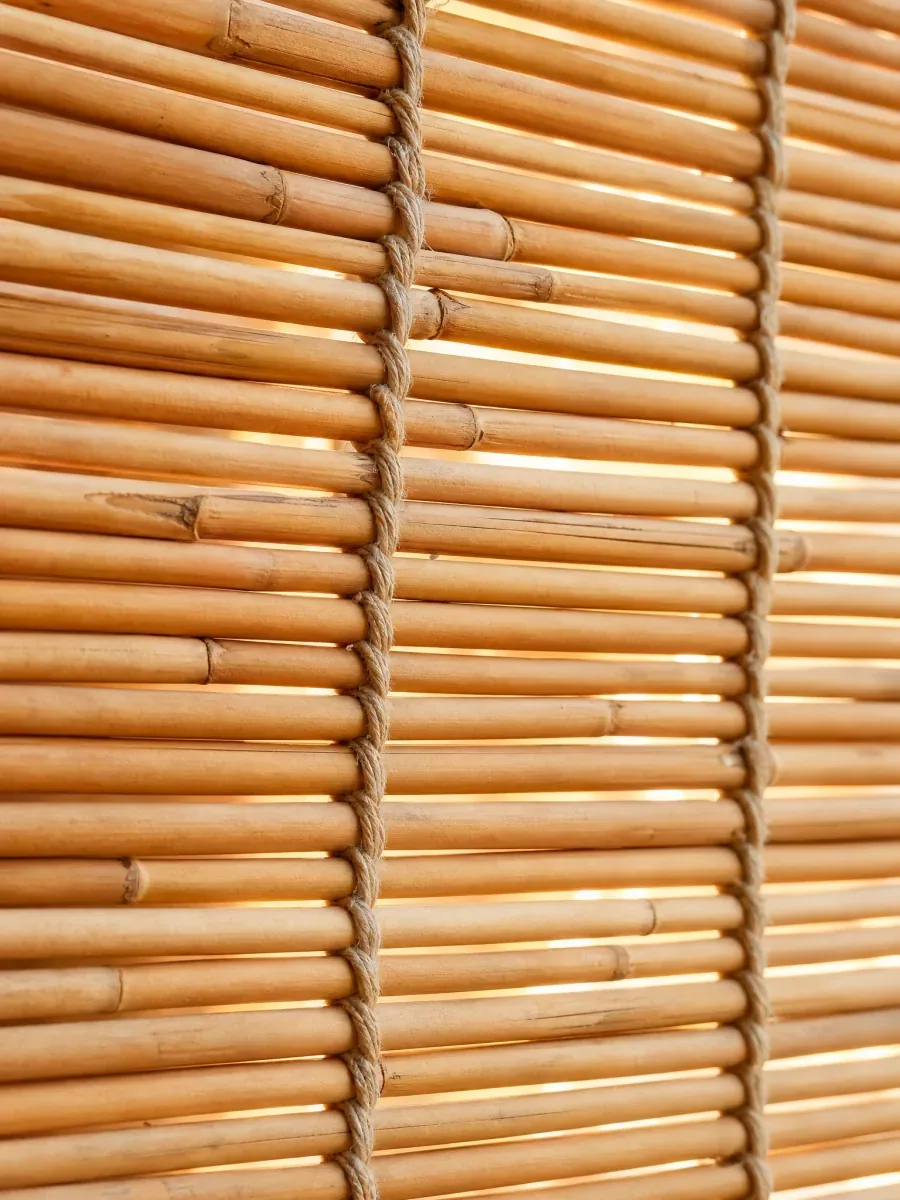
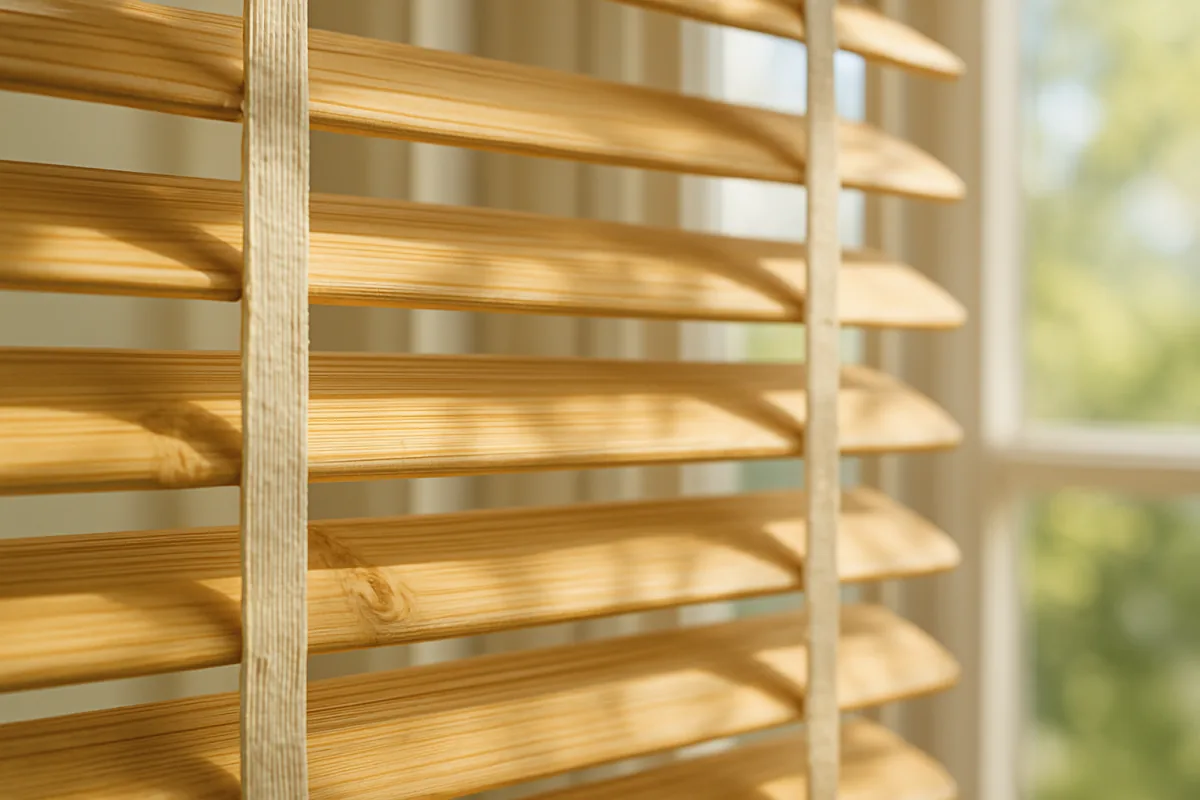
Bamboo straw is thin rods stitched with thread into a roll-up blind, while a slat is a solid strip 25 or 50 mm wide. Everything else follows from that: the system, the light, the purpose.
The difference is visible on the sample. Hold the blind up to the window — and the straw lets light through in patches, because the rods lie unevenly, with gaps. A slat made of a solid strip cuts the light in an even band. And this is not cosmetic, but a different geometry of the blind: with straw the rods run lengthwise and are stitched with thread, with a slat it is a rigid strip that holds its shape on its own.
Straw
Roller blinds made of straw work gently: the blind rolls up, light passes through the weave diffusely, without sharp edges. A loose weave gives a light shade and plenty of light — that is exactly what straw is about. We most often install it on a veranda and terrace, where you need not darkness but the feeling that the window breathes. In the evening sun the rods cast warm stripes across the wall — the effect straw is chosen for.
Slat
A slat made of a solid strip is already full-fledged blinds: a turning mechanism, angle adjustment, two slat sizes. We keep natural bamboo light, in the tone of linen and rattan. Tinted bamboo is the same strip under stain: walnut, wenge, coffee. The fibre remains visible through the tone, and the tone itself lasts longer and changes more slowly in the sun. It is the one chosen for dark furniture.
One clarification on meaning: both straw and slat are bamboo, the only difference is how it is cut and how the blind is assembled. Straw is thin rods stitched with thread into a roll.
In short: bamboo straw blinds differ from slat blinds in that they don’t turn the strip but roll up entirely.
Types of bamboo blinds: horizontal and vertical
Horizontal blinds gather light into soft patches between the stems, while vertical ones give an even band of shade and are more often used in wide openings. The choice between them is decided not by fashion but by the shape of the window and how much light you are willing to give up.
In horizontal bamboo blinds the blind is made up of strips turned to the room with the edge of the stem. Light passes through the weave in patches, the joints of the stems are visible — it is this lively texture that draws the eye. Such models call for a rectangular window of medium width. A wide loggia or shop window can’t be covered with a single blind: it will sag, so we divide such openings into sections. If you have decided to buy horizontal bamboo blinds, start with the width of the window, not with the catalogue.
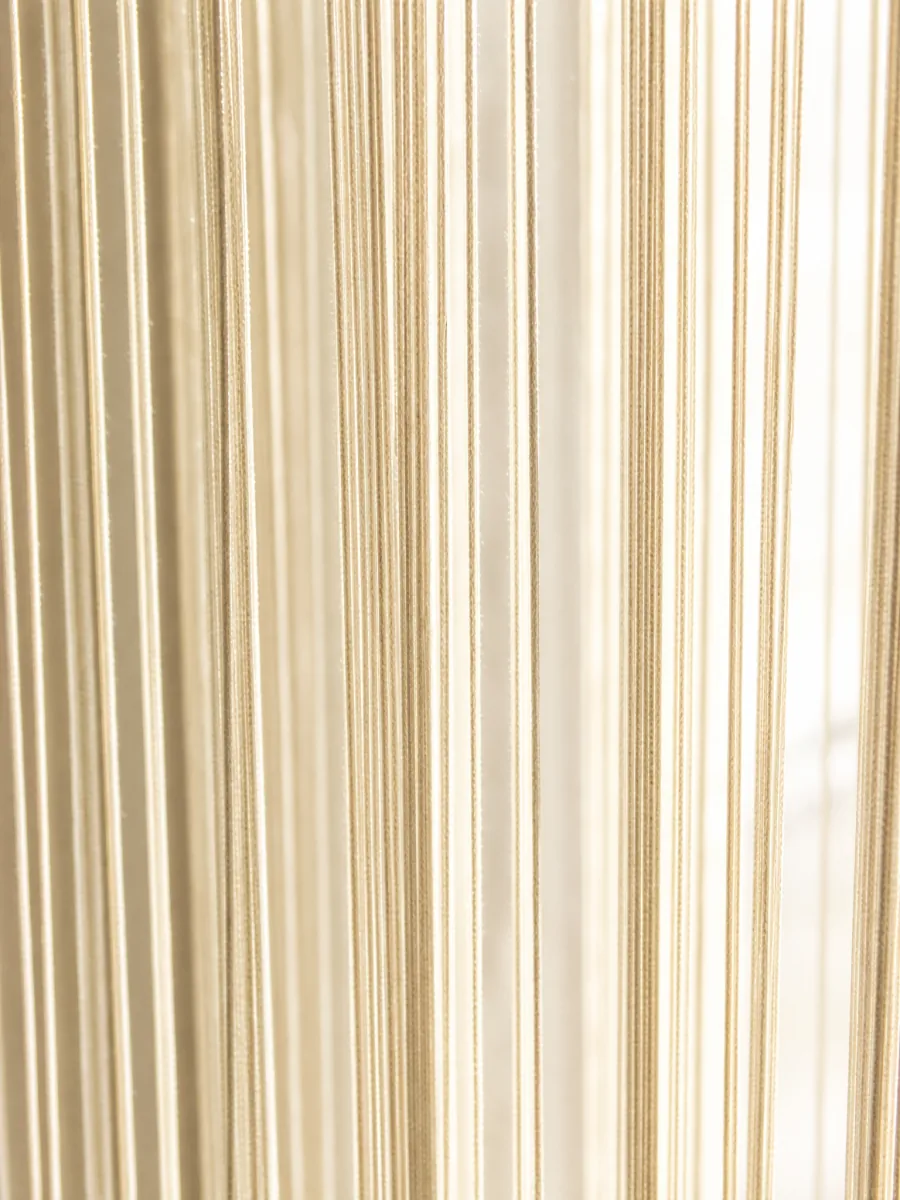
Vertical bamboo blinds are the same bamboo vertical curtains, where the strips hang along the stem. Light through them falls in an even band, without the play of patches, but the shading is more predictable. They are chosen for panoramic glazing, for floor-to-ceiling windows and for openings where a horizontal blind would have to be split up.
Comparison table
| How the light falls | For which window | For which room | What the fabric looks like | |
|---|---|---|---|---|
| Horizontal | Light in patches between the stems | A medium-width rectangular window | Bedroom, study, kitchen away from the stove | Stems edge to edge, the weave pattern is visible |
| Vertical | An even band of shadow | A wide opening, a floor-to-ceiling window, a panorama | Living room, balcony, office | Slats along the stem, the fabric is even and strict |
Weave density is considered separately from slat orientation — it affects the light more than anything else. A loose weave gives a light shadow and plenty of light; a dense weave reduces the light passing through, and the room is noticeably darker. So a loose weave suits a south-facing room, while a window that gets sun all day needs a dense weave or a lining.
The easiest way to check this choice is on site: our measurer brings samples, and you can compare two or three weaves side by side, at your own window. Slat orientation is a question of window shape, while density is a question of light and the room.
Weave density: how much light passes through the fabric
Weave density is the main light control in bamboo blinds, and you choose it for the window’s orientation and the room. A loose weave gives plenty of light and a light shadow. A dense one is noticeably darker: the stems are packed closer together, with fewer gaps between them. A fabric lining adds shading and stiffness, but even it does not give full darkness.
A loose weave is chosen for windows that get sun all day — it scatters the flow into patches of light and does not turn the room into a dark corner. A dense weave reduces the light passing through and suits a living room or study where you need soft half-light without harsh glare on a screen. The middle options are a compromise: less light than a loose weave, but the texture reads more clearly.
What bamboo does not give is full darkness. A bedroom where you need to sleep in the morning with the blinds closed is covered differently: a fabric with a lining, or bamboo paired with a blackout roller blind.
How to check on a sample
We check the light gaps on a sample that our measurer brings along — you cannot see this in a photo or a catalogue. We hold two or three weaves side by side and look at the light: how the shadow falls, how much of the street you can see. The selection method is simple: hold the sample against the glass in your room at the time of day when you are there most often. The price rises with density: a loose weave — from 9,400 ₸ per m², a dense one — from 10,600 ₸, with a lining — from 13,200 ₸.
Where bamboo lasts for years, and where it does not
Moisture is the main enemy of bamboo, even though photos do not show it. Wet straw darkens in patches, and you will not be able to remove them. That is why we do not even consider a bathroom as an option. In the kitchen bamboo survives, but only away from the stove and with a working extractor hood. Steam and direct water — no.
Natural bamboo fears moisture noticeably less than wood. This is an important difference, because many people equate bamboo with wood, while the material behaves differently. At the same time, you should not be glad about completely dry walls: heating in winter dries out the air, and the fabric dries faster than in a coastal climate. The weave handles this regime, but dust gets packed into it more actively.
Where it works
- Bedroom — if you need darkness, bamboo goes together with a lining.
- Living room, study — they behave well, the light is soft.
- Balcony, veranda, terrace — straw shows itself best here.
- Kids’ room — with a tensioner instead of a hanging chain.
Where it does not work, or with a caveat
- Bathroom — no.
- Kitchen — only away from the stove with a working extractor hood.
- A bathroom with a constantly running extractor hood — still no.
Smells are a separate question. Ordinary bamboo absorbs kitchen aromas weakly, but when cooking without an extractor hood, grease settles on the weave and stays there. Wet straw absorbs smell more strongly — another reason not to put it near the sink.
Now about the sun. Natural bamboo lightens in the sun and becomes more golden — this is not a defect but a property of the material. Tinted bamboo changes more slowly: the stain slows down the change in tone. Bamboo holds up on south-facing windows for years, it just lightens faster.
Many customers consider the golden tone a plus, and we agree with them. Moisture is more dangerous for bamboo than it seems from photos: wet straw darkens in patches, so we do not put it in a bathroom, and in the kitchen — only away from the stove with a working extractor hood.
Bamboo in the Almaty climate: dust, dry air, sun
Bamboo handles the Almaty climate more calmly than it seems: sharply continental — hot dusty summers and cold winters with a day-to-night temperature swing — tests the fabric not with moisture but with dust and dry air. Rain and drizzle are no threat to bamboo blinds on a window, they hang indoors. But dust and winter dryness from the radiators get to the fibre every season — it is they, not precipitation, that determine how long the weave looks fresh.
South-facing windows
On a window that sits in the sun all day, natural bamboo lightens: the fibre gradually loses its original tone and shifts to a golden, warm one. Tinted bamboo changes more slowly — the stain slows this process down, but does not cancel it. In winter, by the radiator, the air is dry instead — and dry air from the radiators in winter tests the durability of the weave: the fabric gives up residual moisture and dries faster than in a coastal climate, where the air is humid all the time. In our business this is more of a plus. Dry fibre does not darken in patches, does not get mouldy, holds its shape. Low humidity is what suits bamboo better than dampness.
Dust in the weave
In summer Almaty is dusty, and the weave collects it — this is the main feature of local use. But it collects it not like fabric but like a sieve: dust settles between the stems, in the cells, rather than soaking into the fibre, and it is easy to clean out from there. A vacuum cleaner with a soft brush along the stems is the main tool, and that is enough if you go over the fabric regularly. A dense weave traps dust more noticeably than a loose one: the cells are small and clog faster. A loose one is aired out more easily.
We tell clients straight: dust on bamboo in Almaty is a matter of habit, not a property of the material. Dust settles evenly on the weave, and a vacuum cleaner with a soft brush brings the fabric back to a neat look.
Almaty's sharply continental climate is not a risk for bamboo blinds but a working environment: the weave collects dust, but it is easy to clean, and the dry air from radiators in winter preserves the fibre better than humid air.
How to care for bamboo blinds
Caring for the weave comes down to one tool — a vacuum cleaner with a soft brush — and you need to clean along the stems, not across them. Dust in the weave settles in the grooves between the rods, and moving the bristles across only drives it deeper. Along the stems — it pulls it out.
The routine is simple:
- A vacuum cleaner with a soft brush on minimum power — along the stems, regularly, before dust clogs the cells.
- A damp cloth — if the weave is clearly dusty and the vacuum is not enough. Dry only and without pressing.
- Wet straw darkens in spots, so we never leave a damp cloth on the fabric for even a minute.
Wet wiping is not the main procedure but a rare one. Dry dusting is usually enough for the weave in a room. In the kitchen, greasy film from cooking is added, and there the cloth is needed more often — but still without pressing and dried immediately.
What wears out first
The thread and the cord or chain of the control mechanism give out first — the straw lasts longer than them. The thread stitching the rods together weakens over time, the cord stretches and starts moving in jerks. Replacing the cord or threads is a repair, not a reason to change the fabric.
Under warranty, the mechanism is covered for 3 years, installation — 1 year. Once the warranty ends — we still come: tighten, adjust, replace the cord or chain. A minor repair is cheaper than a new product, and we do not touch the fabric during it.
A vacuum cleaner with a soft brush along the stems remains the main cleaning method, and any wet treatment is acceptable only dry and without pressing — otherwise the straw darkens in spots.
How to hang bamboo blinds without drilling the frame
You do not need to drill the frame. Installation without drilling preserves the window manufacturer's warranty, and the measurer selects the mounting method on site — based on the texture of the frame and how the sash of the plastic window opens. There is no universal option here, and that is not a drawback: windows are all different, and a mounting chosen on site holds the fabric more reliably.
We mount on the sash so that it opens freely. The mounting must support the woven fabric and not interfere with the sash's movement. Measuring to the window size is the first step to this: it shows whether the fabric will fit the opening and how much space remains for the mounting hardware itself.
Installation procedure
- Measurement. The measurer arrives with samples and calculates the cost on site — free measurement with samples is our standard, not a separate service.
- Choosing the mounting. We look at the frame, sash and glazing bead, and decide which method will support the woven fabric on this particular window.
- Installation. We mount without drilling the frame, and set the fabric level.
- Check. We open and close the sash — it should move freely without touching the fabric or the control chain.
The measurer names the mounting method for the specific window on site: promising one option for all windows in the text would be wrong, and choosing blindly is a sure path to rework. So do not buy the fasteners in advance: measurement first.
We do not drill the frame: the measurer selects the mounting method on site so that the window manufacturer's warranty is preserved and the sash opens freely.
Bamboo or wood: weight, price, light, moisture
Bamboo is botanically a grass, not a tree, and this explains almost everything else: weight, price, how it handles light. Wood is a trunk with growth rings that grows slowly. Bamboo is the stem of a herbaceous plant that gains height quickly and therefore costs less. With comparable strength, bamboo is lighter than wood, and in price it comes out about a third cheaper than linden. For a window, this is not a trifle. A bamboo fabric puts less load on the mounting, and the sash opens more freely.
Wooden blinds are made from coated slats, and compared to them, bamboo blinds behave differently on several axes at once. Less weight. Lower price. Bamboo lets light through in spots between the stems — wood gives an even band of shadow because the slat is opaque. But both are wary of moisture: wet straw and swollen wood spoil equally, so we do not install either in a bathroom.
Now about the interior neighbours that are often confused. Bamboo is the stem of a grass. Rattan is a climbing palm stem, more often used for weaving furniture. Jute is a fibre from a herbaceous plant, used for rope and fabric. Vine is a flexible shoot of willow or grape. We make bamboo blinds only from bamboo. Straw is thin bamboo rods stitched with thread; it is bamboo, just cut differently.
And here is what matters for choosing: bamboo fits into an interior next to linen, rattan and plants without strain. The natural texture with visible joints of the stems works with them in the same tonality. If you are looking for blinds for such an interior — look at bamboo, not jute or vine.
Comparison table
| Bamboo | Wood | |
|---|---|---|
| Weight | Lighter than wood with comparable strength | Heavier, more load on the mounting |
| Price | About a third cheaper than linden | More expensive due to material cost |
| How the light falls | In spots between the stems, soft diffused light | An even band of shadow, the slat is opaque |
| Moisture resistance | Fears less than wood, but does not go in a bathroom | Swells and warps when wet |
| Texture type | Live joints between the stalks, a natural tone | An even slat with a coating |
Bamboo is botanically a grass, not a tree: with comparable strength it is lighter than wood and about a third cheaper than linden.
Balcony, veranda, bedroom, kids’ room: what to put where
The same woven fabric behaves differently in different rooms, and what decides is not the material but how much light and moisture the window gets. On a balcony and veranda bamboo goes boldly, in the bedroom — with an addition, in the kids’ room — with a safety device instead of a chain, and in the bathroom we don’t put it at all: wet straw darkens in spots. Let’s go through it place by place.
- Balcony and terrace. This is where the straw shows itself best.
- Bedroom. If you need darkness, we take bamboo with a fabric backing or pair it with a blackout roller blind.
- Kids’ room. We install the blind with a tensioner instead of a hanging chain.
- Living room and study. A loose weave gives soft diffused light, no backing needed here.
Now more on the two extreme cases.
Balcony and terrace
Bamboo blinds for a balcony are ordered often, and the reason is simple: a balcony and terrace are places where natural texture works for itself, and dense darkening is not required there. The sun passes through the stalks in patches and doesn’t burn the space into a white stripe. Rain on an open terrace, though, is dangerous: wet straw darkens in spots, so the blind should hang where slanting spray doesn’t reach. We don’t cover water damage under warranty: the warranty does not extend to water or natural fading.
A bedroom works differently. Bamboo on its own gives moderate darkening, and you shouldn’t expect full darkness from a single blind: taking bamboo into the bedroom for darkness means being disappointed later. So here we either add a fabric backing to the weave or combine bamboo with a blackout roller blind: the blinds hold the texture and daylight, the roller blind removes what’s left.
In the kids’ room the main thing is no chain. A hanging cord or chain is dangerous for a child, and a tensioner instead of a chain settles this: the blind is fixed, there is no loose end. The material stays the same.
On combinations, briefly: bamboo sits well next to linen, rattan and plants — they share the same logic of natural texture, and the joints between the stalks read as its continuation, not as a defect. With linen curtains and sheer, bamboo matches in tone and in light: sheer softens the background, linen adds density, and the blinds give the texture that fabric doesn’t have.
Balcony and terrace, bedroom and kids’ room are three different tasks, and what solves them is not the choice of “bamboo or not bamboo” but a tensioner instead of a chain, a backing, or a pair with a blackout roller blind.
Wide windows and floor-to-ceiling windows: sections and sagging
We divide a wide opening into sections because a blind sags over a large width. This is not an installation defect and not a feature of a particular material — any woven blind made as one wide panel behaves this way. The wider the product, the more the bottom edge drops, and the more noticeable the skew between the left and right edges. Dividing into sections removes the sagging: each part is held in its own frame or on its own rail, and an even joint remains between the sections.
A rectangular window of medium width is held by bamboo as a single blind. That is its working format. As soon as the width goes beyond that format — a shop window, panoramic glazing, a floor-to-ceiling window — we calculate the sections and show the customer how they will sit on the opening. Panoramic glazing and floor-to-ceiling windows require a blind for the full height, and across the width we cut it into equal parts so that the rhythm of the joints reads as intended, not random.
With the shade it’s simpler than it seems. For the whole house we take one batch of straw — then the colour matches on all windows, and it doesn’t matter that the windows are of different widths and face different sides. One batch of straw ensures the same shade on all windows of the house. If you buy the blind later, as a separate batch, the tone may drift: a natural material breathes and changes, and the second batch will sit next to it as a noticeable patch. We warn about this upfront, not after installation.
- A shop window 3.5 m wide — we divide it into sections, each calculated separately.
- A floor-to-ceiling window — a blind for the full height, cut across the width into equal parts.
- The whole house — one batch of straw, so the shade doesn’t drift.
A ready-made product from a classifieds board doesn’t fit into this at all: it has a fixed width, and it simply won’t be enough for a wide opening. A made-to-measure product is worth its money exactly here — in calculating the sections, in selecting one batch, and in the fact that each part sits in its place.
Floor-to-ceiling window
We take the blind for the full height of the window, down to the floor, and divide the sections across the width. It looks like an even row of woven blinds separated by thin joints. The bottom edge at the floor should not lie on the flooring — we leave a gap, otherwise the blind will start catching and collecting dust from the floor.
What bamboo blinds cost and what you pay for
Bamboo blinds in Almaty start from 9,400 ₸ per square metre. This is a loose weave: plenty of light, light shade, the price of bamboo is the lowest here. Beyond that everything depends on the density of the weave, the tinting, the backing and the installation. You can buy bamboo blinds from us only by measuring the window, not in a ready-made size — and this is the first thing that sets our price apart from the price of a ready-made panel.
- Loose weave — plenty of light, light shade: from 9,400 ₸, 7–10 days. Dense weave — noticeably darker: from 10,600 ₸, 7–10 days.
- Tinted bamboo — the tone lasts longer: from 11,800 ₸, 10–12 days. With a backing — darkening and stiffness: from 13,200 ₸, 10–14 days.
- Installation — 4,500 ₸ per product; for orders from 150,000 ₸ installation is free. Drilling-free installation adds a factor of 1.1 to the price of the product — we don’t drill the frame, and the window manufacturer’s warranty is preserved.
Bamboo is more expensive than plastic and aluminium for one reason: you pay for the material and the texture, not for a smooth strip of metal. Tinted bamboo slows the change of tone in the sun, a fabric backing adds darkening and stiffness, and you set the density of the weave yourself. In our experience, the extra cost of a backing is justified only where darkness is needed: in the bedroom and in a room with a TV — while in the kitchen or on the balcony a dense weave is more than enough.
What makes up the price
By the way, so you understand what we charge for. The weave sets the base price: the denser the blind, the more expensive the square metre. Tinting is work with the slat under stain and a longer cycle in the workshop, so tinted bamboo is more expensive than natural and takes 10–12 days instead of 7–10. A blind with a backing is the most expensive: a fabric layer is added to the weave. Installation is a separate line, and it is calculated by the number of products, not by area.
When installation is free
Within the city of Almaty, measurement and delivery are always free, the measurer arrives with samples and calculates the cost on the spot. Installation costs 4,500 ₸ per product. For orders from 150,000 ₸ we install free of charge — for a home with several windows this threshold is reached quickly. To the suburbs — Kaskelen, Talgar, Issyk, Kapshagay — we travel, and the cost of the visit depends on the distance and is quoted before the visit. Warranty: 3 years on the mechanism, 1 year on installation from the date the acceptance report is signed.
Bamboo blinds in Almaty cost from 9,400 ₸/m², installation — 4,500 ₸ per product, and from 150,000 ₸ installation is free.
Why a ready-made product from a classifieds board won’t fit a window
A ready-made product has a fixed size, while a window has its own. Buying ready-made straw blinds from a classifieds board seems easier, but they, like any ready-made bamboo blinds, were made for someone else’s opening, and they can match yours only by chance. Measuring to the size of the window is not a formality but the only way to get a blind that will sit in place.
The money difference here is not in the ad's favour. At first glance, a ready-made one seems cheaper, but do the math to the end: the fabric that doesn't fit will have to be trimmed, brackets bought separately, and some sellers don't even include fasteners in the kit. What's more, a trimmed fabric loses its even edge, and the weave starts to fray along the cut. It's frustrating when the savings turn into a second order.
What happens when you try to install a ready-made one
The sash of a plastic window stops opening. The mount doesn't line up with the frame — someone else's product has its own installation points, and they don't fall on your glazing bead. Moving the mount to fit your window on a ready-made fabric usually doesn't work.
Let's leave out the extreme case — the blind is wider than the opening, so it can't be hung at all. More often the picture is milder, but the result is the same: the blinds hang crooked, catch on the windowsill, and the sash jams against the bottom edge. We've seen such attempts more than once, and it almost always ended in a new order.
A free measurement with samples removes this problem in advance: the measurer comes, takes the dimensions along the window and the glazing bead, and calculates the cost on the spot. Bamboo blinds are made to the measurement of the window, not to a ready-made size, so they open properly and last without rework.
How we work: measurement, workshop, installation
Bamboo blinds in Almaty are ordered from the manufacturer rather than picked from ready-made stock: we make the fabric to the measurement of the window, so the size, mount and installation method are calculated for the specific opening. Measurement and consultation are always free — the client writes on WhatsApp, the measurer comes with samples and calculates the cost on the spot. We don't keep ready-made products in stock.
Order steps
- The client writes on WhatsApp and describes the window.
- The measurer comes with samples: shows rare and dense weave, tinted bamboo, backing.
- Based on the window measurement, calculates the cost on the spot and selects the mount — we don't drill the frame.
- The workshop makes the fabric, then comes installation and a check that the sash opens freely.
Measuring to the size of the window is not a formality. Both the width of the sections and which weave will lie evenly depend on it.
Visit and installation
Within the city, measurement and delivery are free. To the suburbs — Kaskelen, Talgar, Issyk, Kapshagay — we do travel, and we quote the visit cost before the visit so it doesn't come as a surprise. Installation costs 4,500 ₸ per product, and is free for orders from 150,000 ₸. Installation without drilling is listed in the calculator with a ×1.1 coefficient: the measurer selects the specific mounting method on the spot.
Warranty and after the warranty
The warranty on the mechanism is 3 years, on installation — 1 year from the date the acceptance report is signed. If the case is recognised as a warranty case, we'll do the work at no charge within 5 working days. It does not cover mechanical damage, reinstallation on your own, water and natural fading. And after the warranty ends, a technician still comes out to tighten, adjust or replace the cord.
Measurement and consultation are always free, within the city measurement and delivery are free, to the suburbs we do travel, and we quote the visit cost before the visit.
FAQ
Does a new fabric smell? A new fabric has a light grassy smell, and it airs out within a couple of weeks. Natural bamboo smells of dried grass — this is not a defect but a property of the material. A sharp chemical smell, though, is a reason to ask the supplier a question rather than wait for it to go away on its own.
Which windows is bamboo not suitable for? Sloped and roof windows — no. The fabric doesn't stay even there, and the mechanism works under a load it isn't designed for. Bamboo blinds fit best on a rectangular window of medium width: on such openings the fabric doesn't sag and the sash opens freely.
How does bamboo differ from wood to the touch and in the sun? Bamboo is a grass, not a wood, so it's lighter and lightens in the sun, turning a golden tone.
Can it be installed over the full height of the window? Yes, if the opening isn't too wide.
What is the “straw” in the name? These are thin rods stitched with thread — that's what a woven roller fabric looks like.
How do I know which option is mine? We always bring samples with us: the measurer brings several fabrics, and you can hold them up to the window and compare in real light, not from a photo.
A new fabric has a light grassy smell that airs out within a couple of weeks; a sharp chemical smell is a reason to ask the supplier a question.
Conclusion
We make bamboo blinds in Almaty to the measurement of the window — we don't keep ready-made products in stock. The material is chosen for the task: bamboo straw gives soft diffused light and is good on a veranda and terrace, a slat made of a solid plank 25 or 50 mm wide goes in rooms, and tinted bamboo under stain is installed to match dark furniture. The density of the weave is the main light control: a rare weave lets in a lot of light and a light shadow, a dense one is noticeably darker, and the backing adds shading and rigidity.
Briefly about the main points. Moisture is more dangerous for bamboo than it looks in photos, so we don't install it in bathrooms, and in the kitchen — only away from the stove with the extractor hood running. We don't drill the frame: the measurer selects the mounting method on the spot so the window manufacturer's warranty is preserved. Care is simple — a vacuum cleaner with a soft attachment along the stems, a damp cloth only wrung dry and without pressure. In the sun, the natural fabric lightens and becomes more golden, and the tinting slows this change. We divide a wide opening into sections, because the fabric sags over a large width, and for a whole house we take one batch of straw so the shade doesn't differ.
The price starts from 9,400 ₸ per square metre, the lead time is from 7 to 14 days depending on the material, installation costs 4,500 ₸ per product and is free for orders from 150,000 ₸. The warranty is 3 years on the mechanism and 1 year on installation, and after the warranty we still come out: to tighten, adjust, replace the cord or chain.
There's one practical recommendation: before ordering, compare two or three weaves side by side on the samples. The measurer comes with them and calculates the cost on the spot — that way you can see how much light will actually pass through the fabric on your window.

