











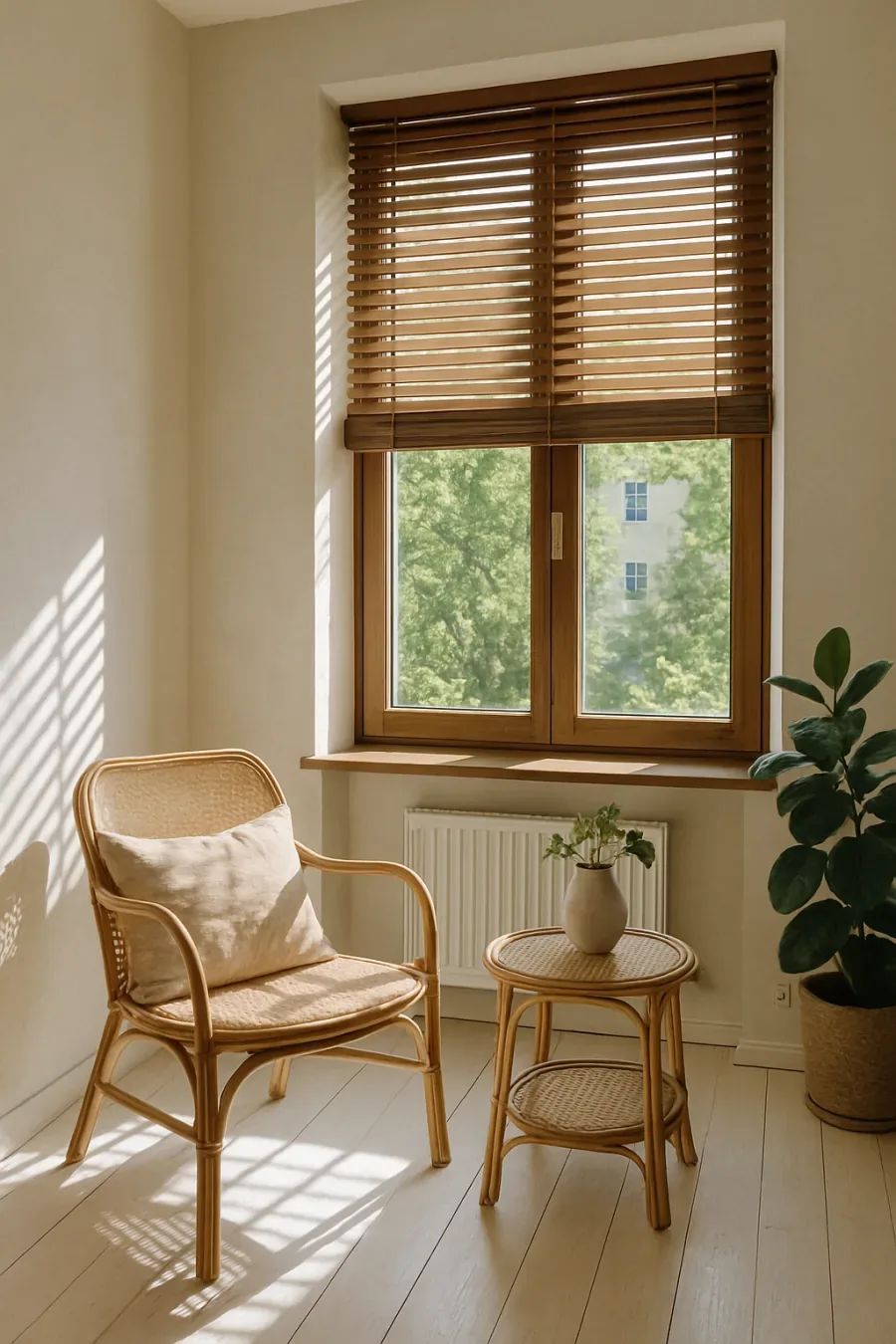











We make wooden blinds from solid linden slats, 25 or 50 mm, made to measure — from 12,400 ₸/m², lead time 7–12 days. In a dry room with a steady temperature they last for years, but on an unheated balcony, in a bathroom or near a stove the wood will warp. Measurement is free, and our measurer comes with samples.
Why wood costs almost three times more than aluminium and plastic
Wooden blinds cost more than aluminium and plastic because every slat goes through a long manual process rather than coming out of a machine ready-made. We make wooden blinds in Almaty from solid linden slats — 25 or 50 mm, and the price per m² is calculated on this blank. Plastic and wood-effect MDF only imitate the texture — with printing or film. Natural grain cannot be reproduced that way.
What exactly you pay for in the price per m²:
- selection of blanks without knots or warping;
- drying to working moisture content;
- calibration and sanding;
- painting or tinting in several coats;
- assembly of the blind with the hardware.
Rejecting blanks is also part of the price. Everything that cracked or warped during drying is removed from the batch. With aluminium, a rolling mill replaces this stage: the metal is rolled and cut. Rolled metal is not dried or sanded.
The difference is clear from the price list. Horizontal aluminium blinds — from 4,200 ₸/m², PVC plastic — from 3,600 ₸/m², linden wood with a 50 mm slat — from 12,400 ₸/m². And it's not just the raw material — the price includes the whole journey of the blank up to installation.
A wooden slat goes through drying, calibration, sanding and painting in several coats, while an aluminium slat is made by a rolling mill — hence the price difference.
Where wood will last for years in an Almaty apartment, and where it will warp in a season
Wooden blinds in Almaty last for years in a dry room with a steady temperature and won't survive a heating season on an unheated balcony or in a bathroom. It's not about the wood species, but about what happens to moisture on both sides of the slat.
Almaty's climate is sharply continental: cold winters with frosts and a big difference between day and night, hot and dusty summers. For wood, that's two extremes in one year. A linden slat holds its shape well through normal humidity fluctuations, but no species can withstand constant damp.
Winter with heating and condensation on the glass
A radiator under the window dries out the air in the room, while the glass stays cold. Condensation collects on it — the very moisture you see on the windowsill in the morning. The slat gets it on one side, by the glass, and gives it up to the dry air on the other, by the radiator. That difference is exactly why wood warps: the grain alternately swells and shrinks, and the blind loses its shape.
You can soften the effect: don't mount the rail right against the glass, leave a gap above the windowsill, and don't block the radiator completely with the blind. This doesn't remove the cause, but it noticeably reduces the swing.
Rooms where wood lasts for years
A dry living room, bedroom or study with a steady temperature — we fit wooden window blinds here without hesitation. A living room in an apartment, lime 50 mm, three windows: the room is dry, the temperature is steady, and the wood has been there for years. This isn't a promotional case, it's a typical situation — orders like this are our most common.
The kitchen is a separate conversation. Here you can, but with caveats: wooden window blinds next to the stove are a bad idea, while with a working extractor hood and at a distance from the hob the wood holds up fine. Jalusso doesn't fit wood in bathrooms at all: constant humidity swells the grain, and the slat warps within a season. Aluminium goes there.
Balcony and kitchen — with caveats
A glazed, heated balcony is fine: lime 50 mm, four sashes, a standard order for us. An unheated balcony warps the slat in the first winter — there's no heating there, but there is damp and frost, and we don't recommend wooden window blinds for a room like that. We don't fit wooden blinds on an unheated balcony.
| Room | The verdict | Why |
|---|---|---|
| Dry living room, bedroom, study | We fit them | Steady temperature, normal humidity |
| Kitchen | With caveats | Away from the stove, with a working extractor hood |
| Heated glazed balcony | We fit them | Heating removes the damp |
| Unheated balcony | We don't fit them | Damp and frost warp the slat |
| Bathroom | We don't fit them | Constant humidity, aluminium goes there |
The main fact is simple: lime copes with changes in humidity, but not with constant damp.
Lime, bamboo, ash and oak: what we cut the slats from
The main species for our slats is lime. It's light, holds its shape evenly through changes in humidity, and takes tinting well. Bamboo isn't wood but a grass, and wooden blinds made from it behave differently: the texture is more pronounced, the fibres denser. Ash and oak are harder, but we use heavy species only with caveats.
Lime — the base species
Lime barely warps from changes in humidity and doesn't overload the rail even on a wide window. It's from lime that we cut 50 mm slats for living rooms and 25 mm slats for smaller windows. We paint and tint lime to a sample — to match the floor, doors or furniture front.
Bamboo isn't wood, but the texture is more pronounced
Bamboo is technically a grass, and that's its advantage: dense fibres barely absorb moisture. Bamboo's texture is more pronounced than lime's, so it's chosen where the slat should be noticeable from a distance. One clarification: don't confuse bamboo straw in a roller blind fabric with a bamboo slat — they're two different products.
Ash and oak — hard species
Ash and oak have a large grain pattern and are heavier than lime. On a wide opening we split such a blind into sections so it doesn't sag. But we don't make oak slats at all — the mechanism is too fragile for that. In my view, it's more honest not to promise an oak slat than to explain later why the blind doesn't fold evenly.
Painted slats and tinting
Under thick paint the wood texture disappears, leaving an exact shade and a matte surface. This is the solution for interiors where the colour matters, not the species. We tint blinds with wooden slats to a sample: the colour of the floor, doors, furniture front. We bring colour samples to the measurement — to see the tone in your own lighting, because wood looks different under a lamp and in daylight.
The main species for the slat is lime: it's light, holds its shape evenly and takes tinting well; oak doesn't go into slats, because the mechanism can't take the weight of the blind.
Slat 25 or 50 mm: how to choose the width
In short: 50 mm is the classic width for a living room and study, 25 mm is chosen for smaller windows and where the blind should be more compact when raised. A wide slat gives a large pattern and, when open, barely covers the window. A narrow one looks more modest on a small opening, but when raised it folds into a neat narrow block.
Table “slat width — where it fits”
| Width | Window | Room | What it gives |
|---|---|---|---|
| 25 mm | Small, with a vent pane | Bedroom, kids' room, study | Compact block when raised, small even pattern |
| 50 mm | Medium and wide | Living room, study, meeting room | A large pattern that barely covers the window when open |
We cut both widths from linden. It is the same wood, only the geometry of the slat changes — and with it, how the blind reads on the window. On a wide opening, a large slat looks calmer: fewer horizontal lines, the window is not broken up.
How slat width relates to the weight of the blind
Slat width is directly related to the weight of the blind: the larger the slat, the heavier the whole structure. A narrow slat is more compact when raised, a wide one gives a large pattern, but on a wide opening it requires splitting into sections. This is not about aesthetics, but about mechanics: a wide solid wooden blind sags, so we calculate the sections based on the actual width of the window.
This is immediately clear at the measurement. I come with two samples, hold them up to your window — and the decision is usually made in a couple of minutes, without catalogues or persuasion.
We make wooden blinds for windows in two slat widths, and the choice between 25 and 50 mm is determined by the size of the window, not by fashion.
How to tell wood from plastic and wood-effect MDF
The end face gives away a natural slat from a fake: on wood you can see the grain in the cut, while on film and MDF you see an edge and a repeating pattern. This is the first thing worth looking at in your hands, before any measurement and calculation.
Plastic and wood-effect MDF imitate the texture with printing or a laminating film. It looks similar if you look at the slat from a distance, in daylight from a metre away. But try taking it in your hand — and the difference shows. On an imitation, the front side and the end faces are finished differently: the cut remains bare plastic or exposed board, whereas on linden the grain runs continuously across all faces.
Here are three signs we always check at the measurement.
- The end face of the slat. Natural wood shows longitudinal grain in the cut. On film and MDF there is a smooth edge with no pattern, or a thin strip of film at the joint.
- The weight of the slat in your hand. Wood is heavier than plastic and MDF at the same width. Linden has a moderate but noticeable weight — not hollow.
- The grain pattern from slat to slat. In natural wood every slat is unique: a knot here, a change of shade there. In an imitation the pattern repeats from the same matrix.
Bamboo is formally not wood but a grass. Its slat is pressed from dense fibres, and these fibres are visible on the end face — short, parallel, sometimes with dark spots at the joints. It is hard to confuse with a linden or ash slat if you know what you are looking at in the cut.
Linden gives a uniform light cut with soft grain on the end face — without the sharp resinous stripes that conifers have.
Come to the measurement with a sample of your floor or door — the measurer will bring slats with him, and you will compare the cuts at home, in your own lighting. A photo in a messenger works too, but the end face and the weight in your hand are what a camera cannot convey.
We arrived at this order of checking because clients who used to buy wood-effect blinds in a shop often told the same story: it looked like a match, but in the second year the film on the end face peeled off. You can buy wooden blinds with a guarantee that they are really linden and not MDF with film only by looking at the cut before ordering.
The key reference point: an imitation is always given away by the end face of the slat, not the front side.
Weight of the blind, wide windows and splitting into sections
A wooden blind is heavier than an aluminium one, so on a wide opening it is split into sections, and on a drywall reveal we install it with reinforced fastening. We do not make a solid wooden blind without splitting on a very wide shopfront — it sags.
The weight of the blind depends on the wood and the slat width, and at the measurement we calculate it for the specific opening, not “by eye”. Wooden blinds for windows made of linden with a 50 mm slat put a noticeable load on the rail and brackets — this is the first thing the measurer checks. Hence the rule: the wider the opening, the more likely a split.
Why a solid blind sags
The slats hang under their own weight, and on a wide opening the middle sags. A wide blind does not sag at once — first it is a barely noticeable bend, then the slats stop gathering evenly into a stack.
Example: a clothing shop’s shopfront — split into three sections, because a solid blind of that width sags. Each section got its own mechanism, and the blind rises evenly along its whole length.
- Splitting into sections takes the load off a single rail.
- Each section is controlled separately or synchronously.
- The tint and the wood stay the same across the whole shopfront.
Fastening to drywall
On a drywall reveal we install only with reinforced fastening: an ordinary dowel in the board does not hold the weight of wood. We fasten into the load-bearing profile or go right through to the wall — the measurer decides which on site.
Example: a hallway with a tall window — we reinforced the brackets, because a wooden blind is twice as heavy as an aluminium one. In such cases we calculate the installation separately, so that the fastening matches the load.
Horizontal wooden blinds on a wide window are always checked for sag before ordering, not after installation.
Wood on plastic windows, on a window with a vent and on a balcony
We install wooden blinds on plastic windows just as on any others: the frame of a modern glass unit is even, and fastening to it is well established. The window material does not affect at all how a linden slat lies.
The difficulties start not with the frame but with the sash. If the window opens outwards or to the side, the rail is offset so that the blind does not interfere with its movement. And on a fixed window this unit is not needed at all.
We do not consider fastening to plastic anything special. Holes are drilled into the frame, the screws come with a seal — the entry point is airtight, and the window does not fog up around the fastening.
A window with a vent and a tilt sash
We hang blinds on wooden windows with a vent not on the vent itself but on the frame above it. The blind rises above the level of the sash — otherwise, when airing, it bumps into the slat.
With a tilt sash the logic is the same, but the offset is added. In the “vent” position the sash comes out of the plane of the window, so the rail is moved away from the glass. By how much exactly — the measurer calculates on site, looking at the angle the handle opens to.
A simple rule works here: first we look at how the window lives, then we draw the fastening. Our measurement is always free, and within the city measurement and delivery are free too. We also travel out of town, to Kaskelen, Talgar, Issyk or Kapshagay, and we tell you the call-out price in advance.
What to raise a heavy blind with
Wood is heavier than aluminium, so the control is chosen to match the width of the blind, not “whatever works”. A cord and a chain are the usual options, and a chain gives a smoother movement on a long slat.
For blinds on wooden windows with a wide blind, we more often use a ladder tape. It is not decoration: the two tape cords hold the slats more evenly, and the blind does not skew when raised. An ordinary cord at that width pulls the bottom to one side.
On wooden blinds we use a mechanical control — a cord or a chain. We do not include an electric motor in wood quotes: that option is not available for our slat.
Installation costs 4,500 ₸ per item; for orders from 150,000 ₸ we install free of charge. A window with a vent does not change either the installation price or the way it works — only the mounting unit changes.
Fading, care and Almaty dust
The shade of natural wood changes slightly over several years — this is a property of the material, not a defect. It is most noticeable on dark stains. On light tones the fading is barely visible, because the contrast between the original and the faded shade is small.
Wooden blinds are not afraid of the sun. They are afraid of constant damp. The difference is fundamental: ultraviolet light slowly lightens the slat, while moisture warps it and the blind stops gathering evenly.
South-facing windows and shade change
Direct southern sun speeds up the change of shade, because ultraviolet light breaks down the pigment in the coating. If the window faces south, it is wiser to choose a light tone — the process is the same, but the eye has nothing to catch on.
On a dark stain, especially black, the difference between the closed and the open part of the slat becomes visible over time. That is why we try not to recommend black wooden blinds for south-facing windows. Still, the customer decides: if the interior calls for black, we stain it black.
Dust after wind
In Almaty, after wind, dust settles noticeably on the slats, and this is the main reason people ask for wood to be cleaned. Dust lies in an even layer and quickly shows itself on a dark tone.
We clean with a dry brush or a vacuum cleaner on the lowest power. A soft attachment, minimum setting, movement along the slat — that is enough. Once a month, more often with the windows open.
Water and wet cleaning
You can go over it with a damp cloth, but dry it immediately and without delay. When you air the room in the rain, water lands on the slat constantly — wipe it off at once, do not leave it until the next cleaning.
Wet cleaning, steam and household chemicals are bad for wood: the paint goes cloudy and the fibre absorbs moisture. This is not the place to save time. Half an hour spent on careful wiping is cheaper than replacing the blind.
Restoring the slat
Repainting and refreshing the coating are possible. If after a few years you no longer like the shade, Jalusso can take the slats down, refresh the coating and put them back — this is noticeably cheaper than a new set.
We also come after the warranty period: to tighten the mechanism, adjust the movement, replace the cord or chain. The wood stays the same — it does not need to be replaced.
Wooden blinds last a long time not because they are hard to care for, but because the care is simple and regular: a dry brush, careful wiping, no chemicals and no steam.
Price, lead times, measurement and installation: how ordering works
Linden with a 50 mm slat — from 12,400 ₸/m², manufacturing time 7–12 days. Measurement and delivery within the city are free. Installation — 4,500 ₸ per item, and for orders from 150,000 ₸ we do not charge for it at all.
Steps from request to installation
- You write on WhatsApp or call.
- The measurer comes with slat samples and colour swatches and calculates the cost on the spot.
- The workshop manufactures the product.
- Installation.
Within the city, measurement and delivery are free. To the suburbs — Kaskelen, Talgar, Issyk, Kapshagay — we do travel, and we quote the call-out cost before the visit, not after. Kirill, our lead measurer, is the one who most often goes to such addresses: arched and triangular windows are exactly what you find in country houses.
Why the wait is longer than for aluminium
Wood is more expensive than aluminium because it takes longer. The slat is dried, calibrated, sanded and painted in several coats, while an aluminium slat is made by a rolling mill — it comes out ready. Seven to twelve days versus five for metal is not the workshop being slow, but a difference in technology.
Warranty and what it does not cover
On the mechanism — 3 years, on installation — 1 year from the date the acceptance report is signed. If a warranty case occurs, the work will be done free of charge — it will take no more than 5 working days. What the warranty does not cover: mechanical damage, reinstallation on your own, water and natural fading. We also come after the warranty period — to tighten, adjust, replace the cord or chain.
One batch of wood for the whole house
The shade of natural wood differs from batch to batch. If there are windows in several rooms, we take one batch so that the shade matches. In a country house with seven windows that is exactly what we did: the whole house came from one batch, and there is no difference in shade between the rooms.
Manufacturing wooden blinds is a process where every stage adds time and cost, while measurement and delivery within the city remain free.
Where we do not put wood: vertical, roller, outdoor
There are three things people ask about wooden blinds most often, and we do not make any of them. We do not offer vertical wooden blinds, wooden roller blinds or outdoor wooden blinds for terraces, gazebos and unheated balconies. The reason is the same: it is either a different product or conditions in which wood does not survive.
Vertical wooden blinds are a different product, not a variant of what we make. A vertical wooden slat requires its own rail design, its own turning mechanisms and a different manufacturing technology. We work with a horizontal linden slat, 25 and 50 mm, and we do not make vertical wooden blinds. Naturally, people ask for them regularly — usually those who have seen fabric vertical blinds and apply that logic to wood.
Wooden roller blinds are also a separate product, not our product under a different name. A wooden slat does not roll up the way fabric does: a rigid material requires a different blind and different lifting mechanics. We do not manufacture or promise a wooden roller blind.
We also do not install outdoor wooden blinds, wooden shutter blinds or wooden blinds for a terrace. Outdoor installation is not suitable for wood: moisture and temperature changes warp the slat, and there is nothing outside to protect it. For a gazebo and an open veranda, as well as an unheated balcony, aluminium is the choice — it is not afraid of damp or frost. A bathroom rules out wood for the same reason: constant humidity swells the fibre and the blind stops gathering evenly. An unheated balcony warps the slat within the first winter, so we also skip a glazed but unheated balcony. The exception is a heated balcony: wood holds up fine there, and we have such a project with four sashes.
Let me be direct: it is easier to say no at the measurement than to come back a season later and replace the blind. We do not offer vertical, roller or outdoor wooden blinds — in damp conditions and outdoors wood warps, so we use aluminium there.
FAQ
A quick rundown of what customers most often ask before ordering: the wood species, the slat width, care and installation on plastic windows. We make wooden blinds from solid linden slats — this is the base species for our workshop, and all the answers below refer to it.
What wood do you make the slats from? The base is linden: it is light, holds its shape evenly through changes in humidity and takes staining well. Heavy species like oak are not used for slats — the blind turns out so heavy that the mechanism cannot support its own weight.
Slat 25 or 50 mm — which to choose? 50 mm gives a bold pattern and, when open, hardly covers the window, so it is chosen for living rooms and studies. A 25 mm slat is more compact when gathered — it is used on small windows.
How much does it cost and how long is the wait? The price per m² starts from 12,400 ₸ for linden with a 50 mm slat, manufacturing time 7–12 days. Measurement and delivery within the city are free.
What about care? A dry brush or a vacuum cleaner on the lowest power. A damp cloth is fine, but wipe dry right away: wet cleaning, steam and household chemicals are bad for wood.
Are there white and black wooden blinds
Yes, we stain in any shade, including white and black. White hides fading better than dark, while black on a south-facing side changes more noticeably — that is where the colour goes first.
Can wooden blinds go in the kitchen
Yes, but with caveats: away from the stove and with the extractor hood running. We do not put wood in bathrooms at all — constant humidity raises the grain, and the blind stops gathering evenly.
What to do if the window faces south
If the window faces south, it is wiser to choose a light tone: on it the colour change is barely noticeable, whereas dark staining fades noticeably faster.
Can wooden blinds be fitted on plastic windows
Yes, we fit them on plastic windows just like on any others: the frame around a glass unit is even, mounting to it is well established, and for a window with a vent we calculate the rail offset separately at the measurement.
The mechanism is covered by a 3-year warranty, installation — 1 year from the date the acceptance report is signed. We make linden wooden blinds with a 25 or 50 mm slat to measure — there are no ready-made items in stock.
Conclusion
We make wooden blinds in Almaty from solid linden slats 25 or 50 mm wide, all to measure, from 12,400 ₸/m², manufacturing time 7–12 days. We keep no stock of ready-made items — every blind is assembled for a specific window after the measurer has taken the dimensions and agreed on the tone.
Wood lasts for years where it is dry and the temperature is steady: in a living room, bedroom, study. But an unheated balcony, a bathroom and the kitchen area right by the stove are things wood cannot take — there the slat warps, and we say so honestly before the order, not after. In the kitchen we fit it with caveats: away from the stove and with the extractor hood running.
Slat width decides different things. A 25 mm slat is chosen for small windows, where the blind should be compact when gathered. A 50 mm slat is the choice for a living room or study: a bold pattern, and when open a wide slat hardly covers the window.
Wood is more expensive than aluminium and plastic not because of fashion. The stock is selected without knots or warping, dried, calibrated, sanded and painted in several coats, and before assembly some slats are rejected. An aluminium slat is made by a rolling mill, a wooden one by a workshop.
What we do not have, we do not promise: we do not make vertical wooden blinds, wooden roller blinds or outdoor wooden blinds for terraces and gazebos. We also do not fit wood on roof or sloping windows.
Before ordering, photograph the window and the floor and send them to WhatsApp — the measurer will come with samples and colour swatches and calculate the cost on site. Measurement and delivery within the city are free: the tone of wood reads differently under a lamp and in daylight, and it is better to decide this at the window, not from a picture.

