




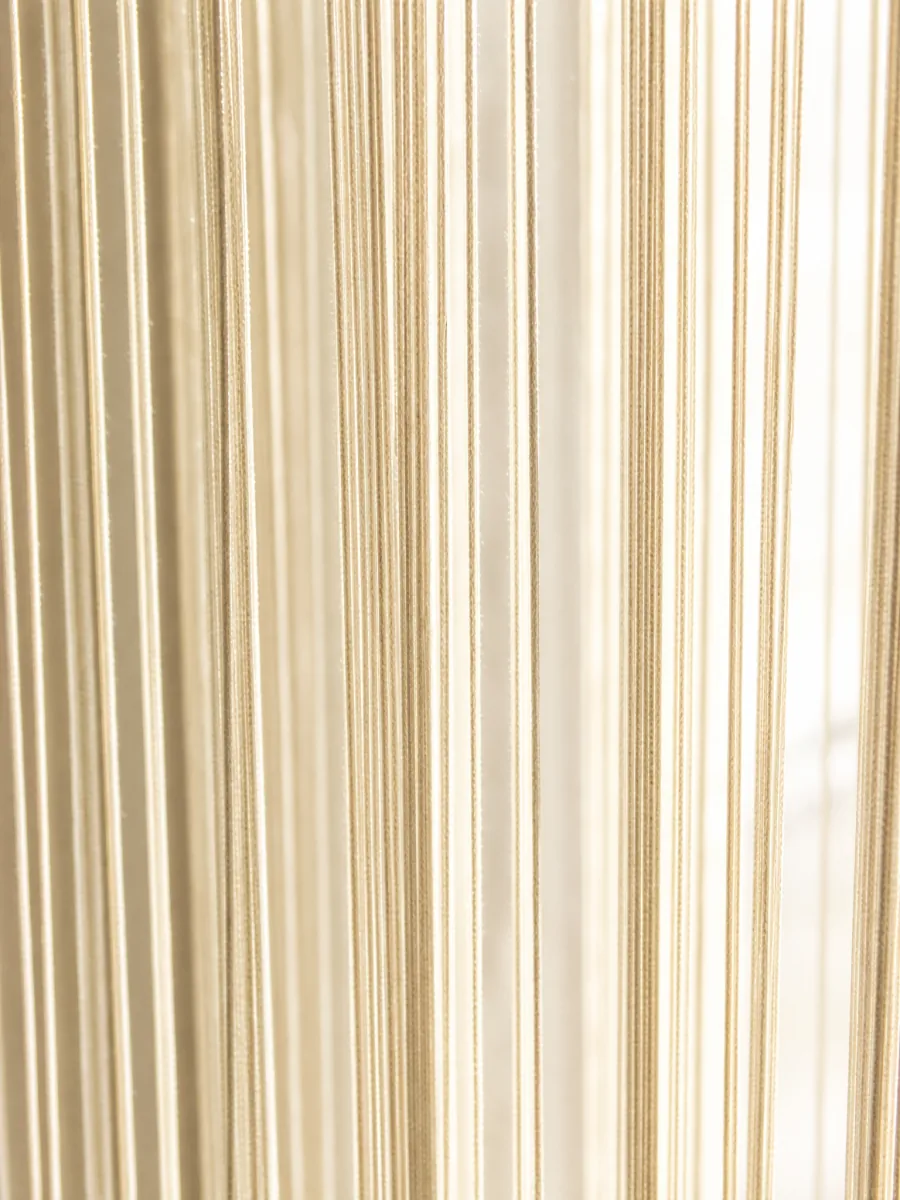
















We make fabric blinds in Almaty by measurement: our measurer brings samples, and you look at the fabric in your own room under your own light. Density is chosen for the task — sheer for daytime privacy, standard for most rooms, blackout for the bedroom. The fabric with treatment cannot be washed, so we clean it locally.
What fabric blinds are and how they differ from metal ones
Fabric blinds are a system of fabric slats or a single fabric panel that controls light through the density of the material rather than through reflection. The Jalusso catalogue has more than two hundred textures and densities: from almost transparent sheer to multi-layer blackout. Fabric diffuses light instead of cutting it into stripes, and that is exactly what sets it apart from metal.
Aluminium blinds reflect light more sharply. A metal slat gives a directed glare, and even bright stripes appear in the room, repeating the shape of the slats. Some people like it — a graphic pattern, clear geometry. But in a bedroom that kind of light reads as cold, and on a monitor in a study it causes glare. Fabric blinds and aluminium blinds solve the same task in different ways: one regulates how much light the material lets through, the other regulates the angle of reflection.
Plastic blinds are the third option. They are not afraid of moisture and are easy to wash, so they make sense in a bathroom, on an enclosed loggia, in a utility room. For a living room the feel is different: plastic doesn’t diffuse light the way fabric does and doesn’t give that soft glow that people usually buy fabric blinds for.
Where the difference shows in a room
In a living room with three windows the difference is immediately visible: metal breaks the light into stripes, fabric evens it out across the whole room. In a bedroom, where what matters is not so much darkening as even lighting without harsh contrasts, fabric blinds clearly beat aluminium ones.
A metal slat reflects light and gives sharp bright stripes; fabric diffuses it into soft, even illumination.
Vertical, roller or pleated: which one you actually need
Fabric blinds are most often made vertical: slats 89 or 127 mm wide slide to the side, and this system fits a wide or panoramic opening best. Roller fabric blinds, also called fabric roller blinds, are a single panel that rolls up at the top. Pleated blinds fold up like an accordion along the height. Three different mechanisms for three different tasks.
The difference is felt as soon as you start talking about the geometry of the window. Vertical fabric blinds cover the opening exactly as much as needed, and the slat can be turned to any angle — light comes in soft stripes rather than a solid wash. Vertical fabric blinds don’t get in the way of opening the sashes if they are mounted in the opening or on the ceiling. Roller fabric blinds leave the window fully open when raised, but on a wide opening a very wide panel starts to sag along the bottom edge over time — the wider the roll, the more noticeable it is. The fabrics for vertical blinds can be the same texture as for a roller blind — the difference is in the construction, not the material.
Horizontal fabric blinds in the usual sense are rare. A fabric slat doesn’t hold its shape the way an aluminium one does, so horizontal fabric blinds usually come as a single panel, and that is already a roller system or pleated blinds. The horizontal fabric blinds you find in catalogues almost always turn out to be roller or cassette panels rather than a set of separate slats. You can buy horizontal fabric blinds, but look carefully at what construction is actually behind the name.
What to choose for a wide opening and a balcony door. For a panorama and an opening of more than a metre — vertical: a narrow slat looks fragmented on a large window, while a wide one keeps the proportion. On a balcony block, where the door and window stand side by side, vertical blinds are more convenient: one part of the slats can be slid aside and left open as a passage, instead of raising the whole panel. Roller fabric blinds are also installed on balconies, but when you open the door the panel has to be fully raised every time.
Pleated blinds win in a different situation. A narrow window, a slanted sash, an attic — where there is no room to turn slats and a roller won’t fit. Pleated blinds fold into a thin strip and are almost invisible when raised. But on a large opening pleated blinds lose to both vertical and roller ones.
Comparison table of the three systems
| System | How it blocks light | Where it moves | For which opening |
|---|---|---|---|
| Vertical fabric blinds | By turning the slat — from soft diffused to almost closed | Slats slide to the side, towards the jamb | Wide and panoramic opening, balcony door, opening from a metre |
| Roller fabric blinds | With the panel from top to bottom, smooth height adjustment | The panel rolls up at the top | Standard window, narrow opening, where a clean rectangle is needed |
| Pleated blinds | Folds along the height, from sheer to dense | Folds up like an accordion | Sloped, arched, roof windows, narrow sashes |
Vertical fabric blinds are the main format for panoramic glazing and wide windows, because a slat 89 or 127 mm wide slides to the side and keeps the proportions of the opening.
Which fabrics we use: polyester, jacquard, screen, blackout
We work with four groups of fabrics, and each one solves its own task: coated polyester covers most windows, jacquard is chosen for its look, screen for sun and glare, blackout for darkening. More than two hundred textures and densities: from almost transparent sheer to multilayer fabric. The difference between the groups is not in colour, but in how much light passes through the material and how it behaves at the edge.
Coated polyester is the base fabric for fabric blinds. It lets through 30–50% of light, holds its shape, and does not stretch at the edge. The dust-resistant coating is part of the fabric itself, not a film on top. This is the group we most often show at the measurement: it suits both a kitchen away from the stove and an office where you need even light without harsh stripes. One caveat: because of its density, the light spreads softly through the room, but it does not create complete darkness even in deep colours.
Jacquard is different in that the pattern is woven in, not printed. It does not rub off or fade separately from the base — that is its main practical quality. The density of jacquard is 180–220 g/m², which is enough for a living room and a bedroom. In terms of light transmission it is closer to the middle range: it darkens by about half, but stays alive against the light. We install it where it matters that the fabric reads as part of the interior, not as a technical detail. And — yes, jacquard on a south-facing window loses its richness over time, more on that below.
Screen is a sun-protection mesh with micro-perforation. The openness of the weave is 3–10%, so the view from the window is preserved while the sun and glare on the monitor are gone. This is the choice for offices and panoramas where you cannot lose the view. If your desk faces the window and you catch a glare on the screen all day, screen will solve the problem without heavy curtains. In density it is light, but it is the weave, not the thickness, that does all the work.
Blackout is a multilayer fabric with an opaque layer, density from 200 g/m². It darkens up to 99%. Bedroom, kids’ room, projector — those are its scenarios. In a room it looks like a dense matte fabric, not like a “darkening film”: from outside the window you can see neither silhouettes nor outlines. For those who sleep during the day after a shift, it is not a convenience but a necessity.
The density of the fabric determines how much light enters the room. The higher the density, the less light and the better the slat holds its shape in a draught.
Jacquard has a woven pattern that does not rub off or fade separately from the base. Screen preserves the view from the window and removes glare on the monitor. Blackout blocks almost all light — that is its one and main function.
Are dense blinds and blackout the same thing?
No, they are two different classes. Standard density darkens by about half: the room stays light, but the sun does not hit your eyes. Blackout blocks almost all light. When someone asks for “dense blinds” at the measurement, it is important to clarify what exactly is needed: comfortable dimmed light or full darkening. The answer determines both the fabric and whether it fits the budget. Standard density is cheaper than blackout, and that is not an accidental difference, but a different material with a different construction.
Coatings: what each one does and what happens when you wash them
A coating is what turns ordinary fabric into blinds made of a material suitable for a window. Without it, the fabric collects dust, absorbs stains, and loses colour in the sun noticeably faster. We apply the coating at the manufacturing stage, and it is exactly what distinguishes fabric blinds from a piece of cloth stretched on a rail.
There are four types of coatings, and each one solves its own task.
- Sun-protection coating reflects heat and extends the life of the fabric in the sun. It is chosen for south- and west-facing windows, where the window takes direct rays for most of the day.
- Antistatic coating reduces dust settling on the slats. In Almaty it is dusty in summer, and for windows facing a street with busy traffic this is not a small thing.
- Dirt-repellent coating makes stains easier to remove: a drop from the kitchen counter or splashes from watering plants do not soak in immediately but stay on the surface.
- Fire-resistant coating is chosen for shops and public spaces — for example, for a shop window.
Sun-protection and antistatic coatings are often applied together. We rarely install fabric blinds in a living room without these two layers — unless the window faces a courtyard and the sun barely reaches it.
As for washing, it is honest and strict. Fabric with a coating cannot be washed: the coating will wash out, the fabric will shrink and will no longer roll or fold evenly. After washing, the slat will wave along the bottom edge, and it will not be possible to restore its shape. That is why we remove stains locally — with a damp sponge without household chemicals and straight away, while the stain is fresh.
If washing is essential
Then we take fabric without a coating and immediately in a removable version. You can take the fabric off, wash it by hand, and hang it back — but such fabric collects dust more readily than fabric with a treatment. If washing is a must for you, say so at the measurement — the measurer will bring suitable samples and calculate the removable option.
Density and the side of light: choosing for the room
The density of the fabric determines how much light enters the room. This is the first parameter we start from at the measurement, and it is more important than colour and pattern. For a bedroom, blackout is usually chosen — where people sleep during the day or watch a projector. For a hall and living room — standard density. On the south side we add a sun-protection coating.
| Density | What happens to the light | Where we use it | Manufacturing time |
|---|---|---|---|
| Transparent and sheer | Give privacy during the day, hardly change the light level | Windows where privacy is needed without darkening | 3–5 days |
| Standard density | Darkens by about half | Hall, living room, most rooms | 3–5 days |
| With sun-protection coating | Reflects heat, extends the life of the fabric in the sun | South and west side | 5–7 days |
| Blackout | Blocks almost all light, darkening up to 99% | Bedroom, kids’ room, room with a projector | 5–7 days |
East-facing bedroom and west-facing living room
An east-facing bedroom gets the sun early in the morning, which is no problem in winter but a real issue in summer for anyone who works nights. For a bedroom we usually quote fabric blinds in blackout rather than standard density. A multi-layer fabric blocks almost all light.
A west-facing living room is the opposite story. The sun arrives in the afternoon and sits low, flooding the room with warm light at a sharp angle. For fabric blinds in a living room we go with standard density: it darkens by roughly half, and in the evening the room keeps a soft diffused light rather than going dark. If the living room doubles as an office with a monitor, we fit screen fabric — the micro-perforation cuts glare while keeping the view out of the window.
The side of the building — south, east, west — affects the choice of density more than the size of the window. Dark, saturated colours fade faster on the south side, so there we recommend not only a treatment but also a lighter tone.
Almaty’s climate and fabric
Almaty has a sharply continental climate: cold winters with frost and a noticeable temperature swing between day and night, and hot, sunny summers with dust. What does that mean for the fabric on your window?
The temperature swing between day and night causes condensation on the glass and frame. Fabric handles this well, but a heavy multi-layer fabric pressed right up against cold glass is best not pushed tight — we leave a gap. Hot, dusty summers are why we almost always recommend an antistatic treatment: vertical slats collect little dust anyway, but in the dusty months the difference is noticeable.
Dry heat and strong sun on the south side are a direct argument for a sun-protection treatment. It reflects heat and extends the life of the fabric in the sun. In our experience, for fabric blinds on south-facing windows this isn’t an option but standard equipment. For fabric blinds on north-facing windows, standard density without extra treatment is enough. For fabric blinds on east- and west-facing windows, the choice between standard and screen comes down to what matters more: privacy or the view.
For a bedroom, blackout is usually chosen; for a living room or lounge, standard density; for the south side, with a sun-protection treatment.
Slat width 89 or 127 mm
A 89 mm slat is chosen for ordinary apartment windows, a 127 mm slat for large and tall windows. It’s not about fashion but about how the opening looks as a whole. A 127 mm slat is needed where the window is wide or panoramic: on a wide opening a narrow slat looks fragmented, the fabric breaks up into frequent stripes, and this is noticeable even during the day. In a room with a single-sash window, 89 mm is more than enough — there’s simply nothing for 127 mm to cover.
Slat width affects the price of the product. In the calculator on our page, going from 89 to 127 mm uses a coefficient of 1.06 against the base cost, because more fabric goes into the product. On a small area the difference in money is barely noticeable; on a wide shopfront or floor-to-ceiling glazing it’s significant, and we quote both options at the measurement so you can see the difference in numbers.
How the system works
Vertical fabric blinds hang from a rail. Inside the rail is the mechanism that turns the slats and slides them to the side; from the outside you only see a strip in the colour of the ceiling or wall. The slats hang freely, and each has a weight at the bottom. This detail seems like a small thing until you open a window wide. The weights keep the slats from flying apart in a draught, and the fabric stays even instead of flapping against the windowsill.
Vertical systems are operated manually or with a chain. Turning the slat changes the angle of the fabric to the light — from a fully open view to soft diffusion. On tall windows, 127 mm works precisely because of this: the slat is wider, there are fewer turns, and the room gets just as much light.
In our view, slat width is better chosen from measurements of the opening rather than from a catalogue photo: the same fabric on a narrow and a wide slat looks like two different products in a room.
Fading: honest talk about sun and the south side
Fabric fades in the sun. This isn’t a defect of a particular texture or the result of cheap material — gradual colour loss happens to any fabric that sits in direct light for years. We won’t promise that the fabric you choose will stay exactly as you saw it on the sample.
Dark colours lose their saturation fastest. The south side in Almaty is the hardest place for fabric: in summer the sun is hot and lasts a long time, and the window gets light almost all day. Deep blue, burgundy, chocolate on a south-facing window go first, while light and neutral tones fade noticeably more slowly. That’s exactly why we don’t recommend dark fabric on a south-facing window if colour matters more to you than anything else: after a few seasons it will stop matching your wallpaper and furniture. On the east and west sides there’s more margin, and on the north side fading is almost unnoticeable.
A sun-protection treatment reflects heat and noticeably extends the life of the fabric in the sun. It isn’t permanent protection, but precisely an extension: the fabric lasts longer than without treatment and holds its colour more evenly. No fabric can be made completely fade-proof — that’s a limitation of the material itself, not of a particular model.
What to do if this happens to you? You don’t have to replace the whole fabric. When the colour has faded unevenly — the slats on the window side have faded more than those by the wall — they can be replaced individually rather than redoing the whole system. Fading isn’t covered by the warranty: it’s a natural process, and we tell you about it at the measurement, not after installation.
Our conclusion for this section is simple: fabric blinds on the south side are best chosen in light tones and with a sun-protection treatment, and a dark, saturated colour only if you’re prepared for it to change.
Care: dust, stains, washing
Fabric care comes down to three actions: remove dust with a vacuum cleaner on minimum power every couple of months, deal with a stain locally with a damp sponge without household chemicals and straight away, and don’t wash fabric that has a treatment. Everything else is either extra work or a way to ruin the product.
Why there’s little dust. On vertical slats the surface hangs vertically, and dust doesn’t settle on it the way it does on a horizontal shelf. Most fabrics we fit come with an antistatic and dirt-repellent treatment: the first reduces dust settling on the slats, the second makes stains easier to remove. The treatment isn’t a varnish on top of the fabric but a treatment of the fibre, and it works as long as it’s intact.
The fabric care checklist looks like this:
- Every couple of months, go over the slats with a vacuum cleaner on minimum power with a soft brush.
- Blot a fresh stain with a damp sponge, moving from the edge towards the centre, without rubbing.
- Household chemicals, bleach and stain removers — no. Chemicals leave streaks and strip the treatment.
- A grease stain in the kitchen — the same damp sponge, but the sooner the better, the less of a mark it leaves.
- Machine washing, soaking, spinning — no. More on why below.
Washing fabric that has a treatment washes the treatment out. There are two consequences: the fabric shrinks, and after drying it no longer rolls up evenly. On vertical slats this is less noticeable than on roller fabric, but no amount of drying will bring the treatment back. If washing is essential for you, Jalusso makes the fabric without treatment and in a removable version right away: it can be taken down, washed and hung back up, but it will collect dust more readily and won’t hold back the sun the way treated fabric does.
About the cost of care. A vacuum cleaner and a damp sponge cost nothing. The mechanism is a separate story: if the chain has stretched or a slat has stopped moving along the rail, we come out after the warranty period and tighten, adjust or replace the cord and chain.
In a bedroom with blackout and in a living room where fabric blinds made of dense fabric hang, the care is the same. Density changes how the fabric holds light, not how you care for it.
Once every couple of months, a vacuum cleaner on minimum power and spot cleaning with a damp sponge without household chemicals covers almost all the care for fabric blinds.
Kitchen and balcony: where fabric works and where it doesn’t
Fabric blinds for the kitchen are suitable with reservations, and for a balcony and balcony door — almost without them. Fabric absorbs odours and grease, and this is the main limitation for the kitchen: the closer the fabric is to the stove, the faster it will pick up kitchen odours. We advise not hanging fabric near the stove at all. It’s a different matter for a window away from the work area and a working extractor hood: there fabric blinds in the kitchen are fine, especially if you choose fabric with a dirt-repellent treatment. It doesn’t make the fabric invulnerable, but it makes it easier to remove stains and greasy film.
There’s a separate detail about vertical fabric blinds in the kitchen. The slats on the rail don’t come into contact with the work surface, but an open window vent pulls air with odours straight onto the fabric. With an extractor hood, the flow goes the other way. A water-repellent treatment is also useful here: the wet zone has higher humidity, and such a treatment keeps the fabric from soaking up moisture from a steaming pot nearby.
Balcony door and window unit
A balcony and balcony block are a more honest scenario for fabric. Fabric blinds for a balcony we most often make vertical with a 89 mm slat: it slides to the side and doesn’t get in the way of opening the sash. For draughts, a simple thing works — slat weights. These are small weights in the bottom edge. The weights keep the slats from flying apart in a draught when the windows and door on the balcony are open. Without them, the slats flap and tangle with each other, especially on a walk-through balcony.
Fabric roller blinds for a balcony and fabric roller blinds for a door are the second most common option. The fabric rolls up and takes up minimal space when open. On a balcony door, such a fabric rises above the door handle, so the door opens freely. We choose between slats and a roller during the measurement — we look at the width of the opening, the side the sashes open and where the light goes.
We make fabric blinds for a balcony and a balcony door from the same fabric so the block looks unified.
The kitchen limits the choice of fabric due to odours and grease near the stove, while a balcony is solved with slat weights and proper mounting.
Mounting and installation: without drilling and with it
Fabric blinds can be installed without drilling into the frame. We don’t touch the frame: we attach to the glazing bead with brackets, spring clips or adhesive tape. The window manufacturer’s warranty is preserved — this is the main argument for those who have doubts. The installation options in the page calculator come with a coefficient: without drilling ×1.1, on the wall ×1.02. The price difference is small, and the choice depends on what kind of window it is and where you want to hide the system.
There are several mounting methods, and each suits its own case:
- into the glazing bead with brackets — the neatest option for a plastic window;
- with spring clips — when the frame allows the fastener to be clamped without marks;
- with adhesive tape — for lightweight fabrics and small openings;
- cassette system — when you want to hide the fabric in a housing box, but a cassette is rarely found with vertical fabric.
Vertical fabric blinds we more often hang in the opening, on the wall or ceiling — here there is drilling, but not in the frame, rather in the window reveal or the ceiling slab. The window profile stays intact. What exactly to choose, we decide during the measurement: the measurer looks at the window block, the depth of the opening and how the sashes open.
An office is a separate story. A monitor screen catches glare from the sun, and people reach for dense fabric to darken the room. You don’t have to do that. We install screen: micro-perforation cuts the sun and glare while the view from the window is preserved. If the system is vertical, turning the slat is enough — the light goes away from the desk, and the room stays bright. Screen and slat rotation are our go-to combination for offices, and you can buy vertical fabric blinds for an office in the same design as for home: only the fabric changes.
Replacing fabric on old blinds
The fabric on old vertical blinds can be replaced if the rail and mechanism are still working. We look at three things: how the carriers move along the rail, the condition of the chain and whether a suitable slat is still available. If the rail works, we replace only the slats and weights — it comes out cheaper than a new system. If the mechanism is worn, it’s easier to install a new one. We come out, take a look and name the option; we can also sell fabric blinds separately from the system — it’s a regular made-to-measure order.
The main rule stays simple: installation without drilling preserves the window manufacturer’s warranty, and turning the slat removes glare from the monitor without darkening the office.
How much fabric blinds cost and what makes up the price
Fabric blinds in Almaty cost from 4,600 ₸/m². The price depends on four things: fabric density, treatment, slat width, colour and pattern. Plus installation — 4,500 ₸ per item, and free for orders from 150,000 ₸. Measurement and delivery within the city are always free.
Let’s go through it in order. Fabric density is the first thing that moves the price: almost transparent sheer is cheaper, standard density is more expensive, and fabric with sun-protective treatment and multi-layer blackout is higher still. Second is treatment: anti-static and dirt-repellent don’t change the fabric class, but sun protection and fire resistance move it into a different category.
Slat width also affects the price of the item. A 127 mm slat uses more fabric for the same opening area than a 89 mm slat, and in the calculator it comes with a coefficient of 1.06.
Colour and pattern increase the cost relative to the base fabric: a coloured option — coefficient 1.08, and with a pattern — 1.35. This is most noticeable when the pattern covers the whole fabric rather than a single slat.
Manufacturing time depends on the density and treatment of the fabric. Sheer and standard price-list lines take 3–5 days, sun-protective and blackout — 5–7 days. The more complex the fabric, the longer the workshop takes.
A mini calculation example
We calculate vertical fabric blind prices from one base: from 4,600 ₸/m². The exact lines by density are in the price list on this page, and in this article we’ll break down how the base turns into the total.
Next are the calculator coefficients. A 127 mm slat instead of 89 mm — ×1.06. White, beige and grey stay without a surcharge, a coloured option — ×1.08, with a pattern — ×1.35. Wall mounting — ×1.02, without drilling the frame — ×1.1. The window area is multiplied by the base and the selected coefficients, and the measurer calculates the exact figure on site based on your dimensions.
What the free measurement includes
The measurer comes with fabric samples and calculates the cost right on site. Within Almaty, measurement and delivery are free. To the suburbs — Kaskelen, Talgar, Issyk, Kapshagay — we also travel, but the call-out cost depends on distance and is quoted before the visit so it doesn’t come as a surprise.
And the main thing: the price on the page is from 4,600 ₸/m², installation 4,500 ₸ per item, and free for orders from 150,000 ₸; measurement and delivery within the city are free, to the suburbs — by distance.
How we work: measurement with samples, workshop, installation
We are a manufacturer with our own workshop in Almaty. There are no ready-made products in stock — every item is made to measure. An order goes through four steps.
- You message us on WhatsApp.
- A measurer arrives with samples.
- The workshop manufactures the product.
- Installation on site.
Measurement and consultation are always free. The measurer calculates the price on the spot, based on your window and the fabric you choose, so you see the amount before you order, not after. Within the city, measurement and delivery are free. We also travel outside the city — to Kaskelen, Talgar, Issyk, Kapshagay; how much the visit costs depends on the distance, and we tell you that amount before the measurer sets off.
Manufacturing time depends on the density and the coating. Sheer and standard-density fabrics — 3–5 days, sun-protection and blackout — 5–7 days.
Choosing the colour under your own lighting
Which fabric blinds for windows to look at in the catalogue is half the decision. The other half is how the fabric behaves in the room.
Fabric changes tone between daylight and a warm lamp. A grey-beige sample that looks neutral in a photo turns cool at a south-facing window, and in the evening under a warm lamp it turns yellow. That shift can’t be guessed from a catalogue, so we bring samples to the measurement: you look at them in your own room, under your own lighting and next to your own walls. In our view, this is the only way not to get the colour wrong.
Measurement with samples lets you match the fabric to the wall colour and the lighting of a specific room, rather than to a picture on your phone.
Warranty
We give 3 years of warranty on the mechanism and 1 year on installation, counted from the day the acceptance certificate is signed. If a case is recognised as a warranty case, we fix everything within 5 working days and charge nothing for it.
Once the warranty period is over, we still come — we tighten the fabric, adjust the mechanism, fit a new cord or chain. Mechanical damage, reinstallation on your own, exposure to water and natural fading of the fabric are not covered by the warranty.
We make fabric blinds in Almaty to measure: the client writes on WhatsApp, a measurer arrives with samples, then the workshop and installation follow.
FAQ
Below are short answers to what people ask most often during a measurement. Each answer is a separate fact, without repeating the main text.
How long does the fabric hold its colour at a south-facing window?
Less than at a north-facing one: over time any fabric loses colour, especially dark and rich shades on the sunny side. Fabrics with a sun-protection coating hold up noticeably longer — the coating reflects heat and extends the life of the fabric. No fabric can avoid fading completely, and the warranty does not cover natural fading.
Can fabric blinds be washed?
Fabric with a coating cannot be washed: the coating will wash out, the fabric will shrink and will no longer roll up evenly. We remove stains locally with a damp sponge, without household chemicals, and straight away. If washing is essential for you, we use fabric without a coating and in a removable version from the start.
Are there horizontal fabric blinds?
Horizontal fabric blinds as a separate system are rare. Usually a horizontal fabric panel is already roller fabric blinds or pleated blinds: the fabric runs as a single panel and rolls onto a tube or folds into pleats. A slat system made of fabric is vertical blinds. If you need roller fabric blinds, that’s a different mechanism, and we select it separately.
Are fabric blinds suitable for a kitchen?
With reservations. Near the stove the fabric absorbs smells and grease — we don’t advise it there. On a window away from the work area, with a working extractor hood, it can be fitted, preferably with a dirt-repellent coating.
Can they be fitted without drilling?
Yes. We don’t drill the frame — we fix into the glazing bead with brackets, spring clips or adhesive tape, and the window manufacturer’s warranty stays valid. Vertical fabric blinds, though, we more often hang in the opening, on the wall or on the ceiling — we decide that during the measurement.
How do fabric blinds differ from pleated blinds?
Pleated blinds are a single panel gathered into pleats, and they move vertically: from bottom to top. Vertical fabric blinds are separate slats that slide to the side, and they can be turned to the right angle to remove glare from a monitor. Pleated blinds are chosen for non-standard windows — arched, sloped, attic — where a slat system won’t fit.
Bottom line
Fabric blinds in Almaty are chosen by three criteria at once: fabric density, slat width and which way the window faces. Density decides how much light stays in the room. A 89 mm slat suits an ordinary apartment window, a 127 mm slat suits a large, tall one. A south-facing side requires a sun-protection coating: without it, a dark, rich colour loses its look faster.
The second conclusion is about the format of the system. Fabric blinds are more often made vertical: the slats slide to the side and sit well on a wide and panoramic opening, on a balcony block and in a meeting room. What is sometimes called horizontal fabric blinds turns out in fact to be a roller system or pleated blinds — there a single panel works, not separate slats.
The third conclusion is about care, and here we speak plainly. Fabric with a coating cannot be washed: the coating will wash out, the fabric will shrink and will no longer roll up evenly. We remove a stain locally with a damp sponge, without household chemicals, and straight away; we remove dust with a vacuum cleaner on the lowest power once every couple of months. If washing is essential for you, we use fabric without a coating and in a removable version from the start — there’s no other way here.
The fourth conclusion is about mounting. The frame doesn’t need drilling: we fix into the glazing bead with brackets, spring clips or adhesive tape, and the window manufacturer’s warranty stays valid. Vertical fabric blinds, though, we more often hang in the opening, on the wall or on the ceiling.
One recommendation. Don’t choose fabric from a catalogue — book a measurement with samples and look at the fabric in your own room under your own lighting: fabric changes tone noticeably between daylight and a warm lamp. The measurer brings samples and calculates the price on the spot; within the city, measurement and delivery are free, and we travel to Kaskelen, Talgar, Issyk and Kapshagay, and we tell you the cost of the visit before we set off.
The price on the page is from 4,600 ₸/m², installation 4,500 ₸ per item, and for orders from 150,000 ₸ installation is free. We are a manufacturer with our own workshop in Almaty: there are no ready-made products in stock, everything is made to measure.

