




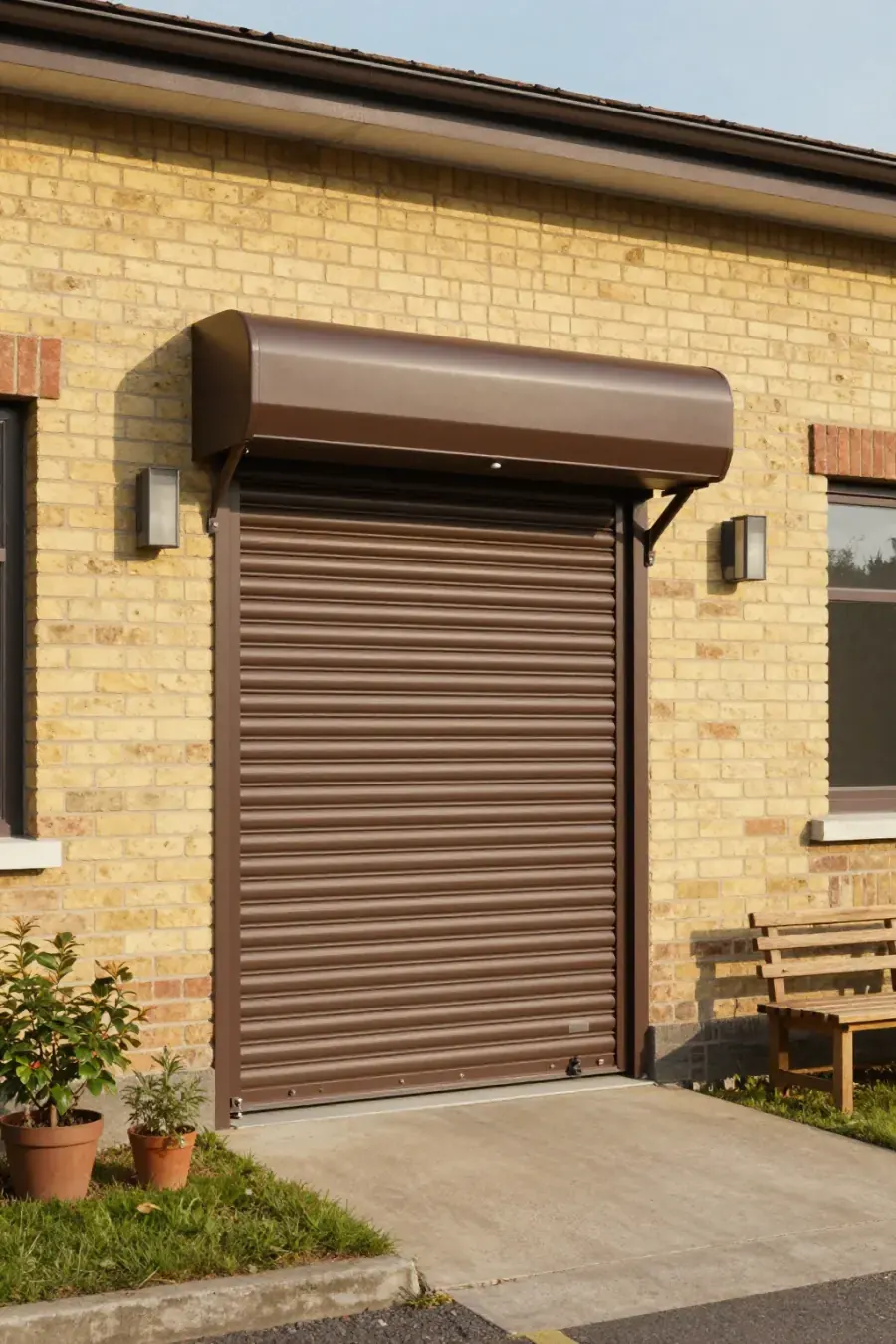

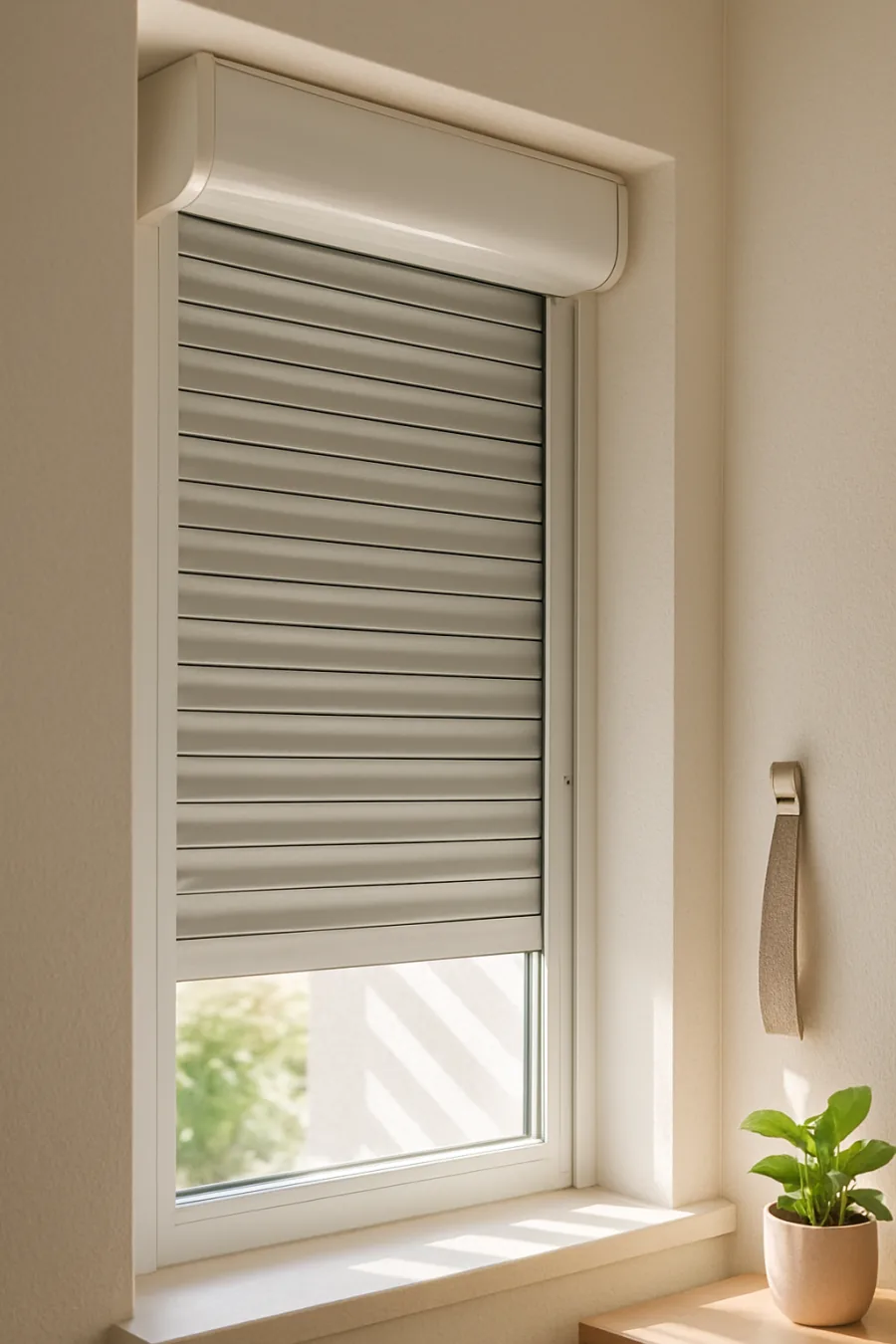


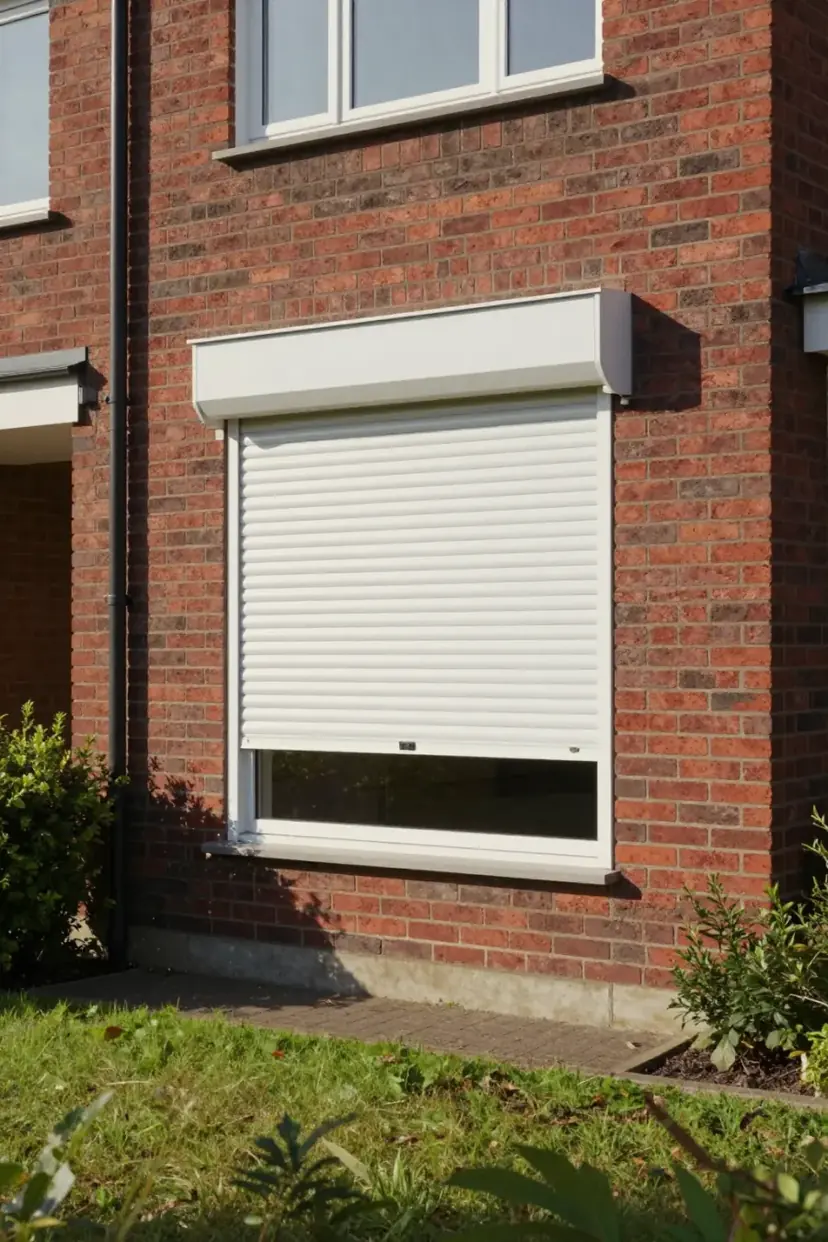


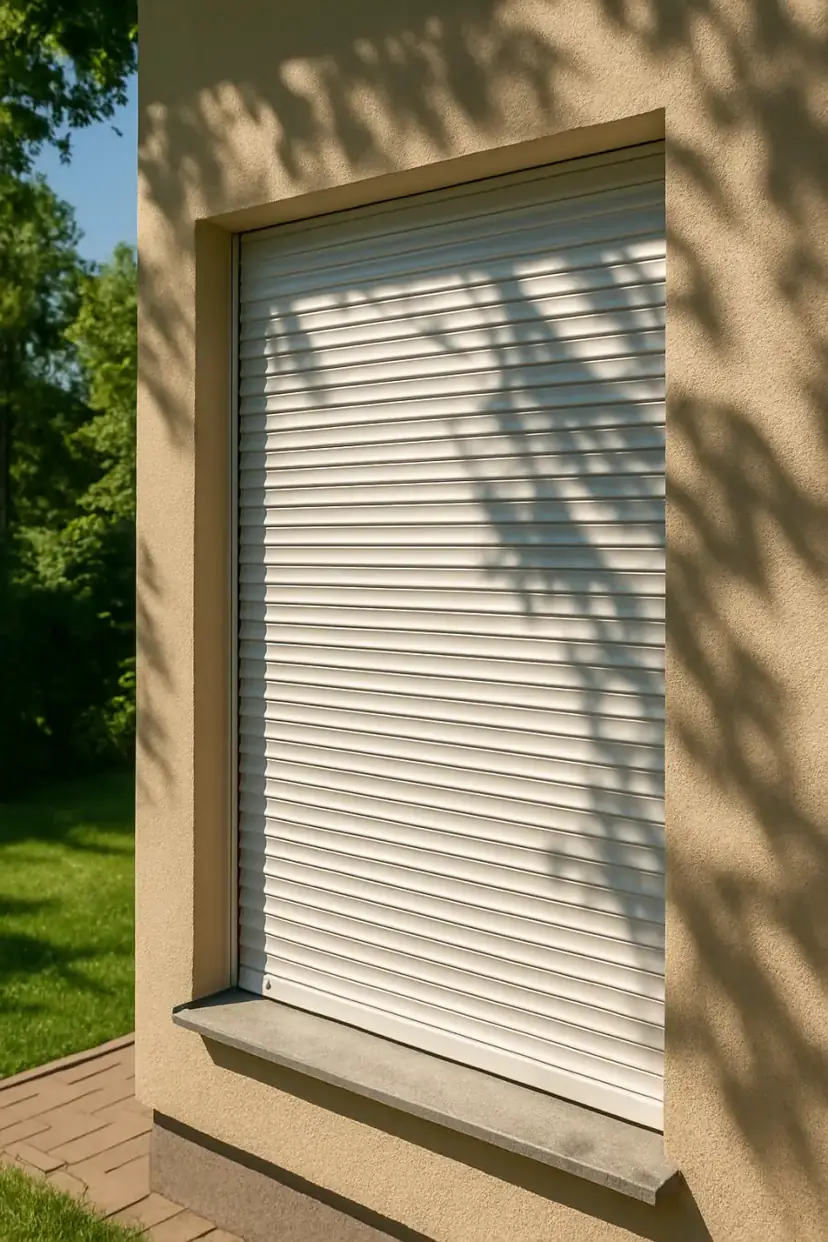











Automatic roller shutters in Almaty are a curtain in a housing box that is raised by an electric motor: with a button, from a remote, on a schedule or on a signal from a sun sensor. The kit starts from 35,000 ₸ per m², manufacturing takes 14–18 days, and if the power goes out the curtain is raised with a removable crank handle.
What automatic roller shutters are and how they differ from electric and motorised roller shutters
Automatic roller shutters are a curtain made of profile that is moved by an electric motor: it sits in the housing box above the opening and raises the curtain with a button, a remote control or a preset scenario. Electric roller shutters, motorised roller shutters and roller shutters with an electric motor are the same product. The difference between the names is not in the design but in the control unit package.
Three names for one product
Electric window shutters, electric roller shutters and an automatic roller shutter are not three different products. They are the same construction: curtain, housing box, guide rails and motor. Only the set of control functions changes.
Simple models have a motor and a wall button. Automatic roller shutters add a remote control, a time schedule and sensors. When a customer asks about an automatic roller shutter, they usually mean the extended package, although the hardware is the same product.
One detail we always point out at the measurement: in everyday speech, people mix up the words “automatic” and “electric”. It doesn't affect the selection, but it does affect the quote if you decide that automation is a separate line item.
What makes the construction automatic
The electric motor is installed in the housing box above the opening and moves the curtain along the guide rails through a roller tube. Mechanical roller shutters differ by exactly one component: instead of a motor they have a control chain, and you raise the curtain by hand.
A chain is cheaper and doesn't depend on electricity. An electric motor is more convenient when there are several openings and you don't want to walk up to each one. The choice between them is a matter of habit, not quality: both options are made in our workshop from a single measurement.
Automatic, electric roller shutters and motorised roller shutters are one construction, and the only difference is the control unit package.
How much automatic roller shutters for windows cost and what goes into the price
Automatic roller shutters for windows start from 35,000 ₸ per m² — this is the price list item for a set with an electric motor, remote control and emergency lift. The mechanical base starts from 17,500 ₸ per m². The gap is almost twofold, and it's no accident: the motor, control unit and crank handle cost money.
The price per square metre is made up of four things: the type of profile, the size of the blind, the type of housing box and the automation functions. The type of profile is the main one. Foam-filled roll-formed profile is the base. Extruded aluminium is denser and heavier, so the blind weighs more. A perforated profile adds light transmission on top of the weight. The heavier the blind, the more serious the motor needs to be, and that's another line of expense.
Price list items
| Profile | Price from, ₸/m² | Manufacturing time |
|---|---|---|
| Roller shutters for windows, roll-formed profile, foam-filled | 17,500 | 10–14 days |
| Security roller shutters, extruded aluminium | 24,900 | 12–16 days |
| Perforated roller shutters, perforated profile | 27,800 | 12–16 days |
| Roller shutters with electric motor, motor, remote control, emergency lift | 35,000 | 14–18 days |
Manufacturing time is strictly tied to the item: the workshop delivers mechanical ones in 10–14 days, a set with an electric motor in 14–18. The housing box and guide rails for a motor are made with the weight of the blind in mind, hence the extra days.
Calculator coefficients
A separate story is the coefficients. These are Jalusso calculator multipliers, not final prices, and the two shouldn't be confused.
Control: mechanical ×1, chain ×1.06, electric motor ×1.85, electric plus remote control ×2.1. Installation: on the wall ×1, on the frame ×1.05, without drilling ×1.1, cassette system ×1.28.
A simple example. Take the mechanical base of 17,500 ₸ per m² and multiply by 1.85 — you get about 32,000 ₸ per m². But the price list for a set with an electric motor starts from 35,000 ₸. The numbers diverge because the calculator counts a surcharge on the base, while the price list already includes a different profile and a different housing box. Go by the price list item: the exact amount is always quoted by the measurer after inspecting the openings.
What's included in the price per m² and what's charged separately
The motor, remote control and emergency lift are already included in the price per m² — they are not listed as a separate line. Installation is charged separately: 4,500 ₸ per item. For orders from 150,000 ₸, installation is free. Measurement and delivery within the city are always free.
The cassette system is the most expensive installation option, ×1.28: the blind goes into the housing box together with the guide rails, and a neat box remains on the outside. On the wall is cheaper, on the frame a little more expensive, without drilling — a little higher still.
What's cheaper in the end — mechanical with a chain or an electric motor? Mechanical. The difference is only in the way it's controlled, not in the protection of the opening: the blind, housing box and guide rails are the same. An electric motor is chosen when there are several openings and you don't want to walk up to each one.
A set with an electric motor starts from 35,000 ₸ per m², the mechanical base from 17,500 ₸ per m², and the price per m² already includes the motor, remote control and emergency lift.
What happens if the power goes out: emergency manual lift with a crank handle
When the power goes out, the blind doesn't stay closed: the electric motor has an emergency output for a removable crank handle, and the opening is raised by hand. The handle comes in the set, no need to call a technician. This is the answer to the main fear about automation.
The emergency lift is done with a removable crank handle — it is inserted into the output on the housing box and manually raises the curtain together with the roller tube. Electric roller shutters work like ordinary mechanical ones in this case: the motor doesn't get in the way, it just has no power. Jalusso puts an emergency lift in every set with a motor — not as a paid option, but as part of the construction.
What to do without power
- Find the manual override on the housing box — it faces down or to the side; the measurer will show it to you at handover.
- Insert the crank handle all the way in so the splines seat in the roller tube.
- Turn the handle and raise the blind to the height you need.
- Lock the blind in place and pull the handle out.
One small thing. If the blind has been in place for years and dust has built up in the guide rails, the handle turns harder — that’s normal, don’t yank it.
Where emergency manual operation is essential
For a garage in a private house and for an office entrance, emergency manual operation is essential: these are openings that are closed at night and opened in the morning on a schedule, and you can’t leave them locked. A shop window is also closed with a motor, and without a manual override the salesperson would be stuck in front of a lowered blind.
Motors with a battery do exist, but they’re rarely chosen for windows — overkill. The motor has an emergency override for a removable crank handle, so the opening can be raised without calling a technician.
Electrical wiring on site: do you need a separate supply point to the housing box, and when to run it
Yes, electric roller shutters for windows require a separate supply point to the housing box. Power to the electric motor is supplied by a cable, and it needs to be laid before finishing — while the walls are open and the run can be hidden. After renovation, the cable will have to be run along the wall, which is a different look and a different set of hassles.
The housing box is mounted above the opening, and the electrical supply point is brought out in the area it will cover. The cable is run to the housing box with some extra length — the excess is tucked inside, so no wire is left hanging outside. The electrical supply point is laid before finishing: it’s cheaper and neater than coming back to it after the final finish.
The measurer comes with samples and determines the configuration and cost on site: checks the housing box height, the power point, access to the circuit breaker. Who actually runs the cable — the site’s electrician or our installation crew — is clarified at the measurement, because the scope of work depends on whether the run is ready.
What to prepare before ordering
- the location of the supply point for the housing box above the opening;
- the height of the housing box — it determines where the cable comes out;
- the power point and convenient access to the circuit breaker;
- an understanding of who runs the cable before installation.
A short list, but each point saves time during installation.
If the renovation is already done
Nobody wants to chase fresh finishes — and you don’t have to. The cable is run along the wall in a cable duct, matched in colour to the finish; sometimes the run goes behind furniture or in a corner. The routing option is discussed on site: where the cable goes, how to hide it and how noticeable it is. Chasing is also possible, but that’s a separate decision, and it’s made after an inspection.
The cable to the housing box is laid before finishing, because after renovation it has to be run along the wall.
Can mechanical roller shutters be converted to an electric motor
Mechanical roller shutters can be converted to automation, but not always: the housing box and guide rails must be sized with extra room for the motor. A tight housing box designed only for a chain won’t fit an electric motor — and then the whole structure is replaced, not just one part. Mechanical roller shutters differ from automatic ones in the control unit: the place where the chain sits is taken by the motor. If the housing box and guide rails allow for that space, the replacement can be done on a finished opening.
The main difficulty is the weight of the blind. The motor is selected for the weight of the blind of a specific profile and opening size, and the housing box must be designed for that weight in advance. A housing box chosen for a motor differs from one for a chain — that’s the extra room you should agree on before ordering. The measurer on site checks the housing box, guide rails and blind weight and says whether an electric motor will fit.
What is decided at the measurement
At the measurement we ask directly: do you plan to add automation in the future. If yes — the housing box and guide rails are chosen for a motor from the start, not for a chain. This doesn’t make the order noticeably more expensive, but later you won’t have to take apart a finished opening. It’s better to decide before ordering, not after installation — redoing is cheaper on paper than on the wall. Automatic roller shutters in this sense come without rework: the structure is built for a motor from the very beginning.
Moving
The motor is removed together with the blind — it’s part of the product, not a separate piece of metal in the wall. The housing box and guide rails are dismantled, and the set is installed again at the new place. Reinstallation is discussed separately: the opening in the new apartment or house may not match in size, and then some parts will have to be reworked.
What’s included: motor, remote control, control unit, sensors
The basic set of an automatic roller shutter is a motor, a wireless remote control and a wall button. Schedules, a sun sensor and a smart home module are not part of the basic set: these are separate functions that the measurer adds according to your scenario. The electric motor is installed in the housing box, the remote control sits in your hand, the button is mounted by the opening. This set covers the daily “raise and lower”. Everything beyond that is about the curtain moving without you.
What exactly goes into your automatic roller shutter is decided at the measurement. Some people take just the button and don’t want anything else. Some ask for a schedule and a sensor. And the conversation isn’t about different products, but about different control units for the same curtain.
One control point for several openings
The remote control groups several windows into one control point — this is the main reason people choose automation in an apartment with a group of openings. You press a button in the hallway, and the curtain rolls up into the housing box on all windows at once. A time-based scenario imitates someone being home: the schedule raises and lowers the curtains by the clock, and in the evening the openings close on their own, even if you’re running late. A wireless remote control for several openings doesn’t require running a cable to each roller shutter — control is via radio signal.
A control unit with a module connects to an app and smart home. Then the openings can be operated from your phone, and scenarios are set up together with the rest of the home automation. What a specific unit supports is clarified at the measurement, because the set of modules varies.
What can be added to the basic set
- Schedule: the blind lowers and raises at set times.
- Sun sensor: monitors light levels on the side of the opening and shades automatically.
- App module: control from your phone and integration with smart home.
My advice from experience: don’t take the whole list at once. If you have one opening and you’re home during the day, you don’t need a schedule, and a remote control and buttons will be more than enough. On a panoramic shop window it’s the opposite — there a sun sensor pays for itself on every sunny day.
The basic set is a motor, a remote control and a wall button; schedules, a sun sensor and a smart home module are separate functions.
Inline and external motors: how they differ and which one you need for the weight of the blind
Roller shutter motors are divided by where they are installed: an inline motor is hidden inside the roller tube, an external motor is mounted on the outside of the roller tube, and this determines what is visible on the facade and which housing box you will need. The inline version goes into the roller tube inside the housing box, and nothing is visible from the outside. The external one stays outside: it is visible, but it is easier to reach when you need to remove or replace it.
An external motor is convenient where the roller tube is short and the motor physically will not fit inside it. An inline motor is the usual choice for windows and shopfronts, because the housing box covers the roller tube, the guide rails hold the blind, and the facade stays clean. That said, on non-standard openings with an arched top the choice is no longer so obvious, and the measurer decides it on site.
Inline and external motors look completely different from the outside: the first is not visible at all, the second hangs on the roller tube next to the housing box.
Comparison table
| Motor type | Where it sits | For which openings | What is visible from outside |
|---|---|---|---|
| Inline | Inside the roller tube, in the housing box | Windows, shopfronts, entrance groups | Nothing, the roller tube is hidden by the housing box |
| External | Outside the roller tube, on the housing box | Short roller tube, non-standard opening, ready-made structure | Motor body on the roller tube |
How the weight of the blind affects the choice
The torque of the motor is matched to the weight of the blind. The measurer calculates the weight from the profile and the size of the opening — a foam-filled profile is lighter, extruded aluminium and perforated profiles are heavier for the same area. The power is taken with a margin: a motor running at its limit wears out faster, and the blind moves harder in the cold.
We do not quote monthly electricity consumption or the service life of the motor in figures — we do not have that data, and we will not promise it. If someone gives you these figures in a message before the measurement, be wary: without inspecting the opening there is nowhere to get them from.
Motorised roller blinds and motorised roller shutters are mounted on the same roller tube, so the choice is a question of the housing box, not of the product.
An inline motor is hidden inside the roller tube, an external one is mounted on the outside; the power is matched to the weight of the blind and taken with a margin.
Sun sensor and schedule: when the automation works on its own
The sun sensor monitors the light level on the side of the opening and lowers the curtain itself when the sun starts to beat down. It works from the control unit: the unit receives a signal from the sensor and gives the command to the motor. The trigger threshold is set for the facade — so that automatic roller shutters on windows do not twitch at every little cloud. Towards evening, when there is less light, the curtain goes back up.
The schedule is simpler. It is a time-based scenario: the control unit remembers at which hours to raise and lower the blind, and then repeats the cycle on its own. You do not need to touch a button or a remote control. On a shopfront, such a schedule is tied to the opening hours, so that in the morning the blind goes up into the housing box before the salesperson arrives.
Both functions live in one control unit, but are switched on separately. The sensor can be turned off with a button or removed from the scenario — then only manual control from the remote remains. The question is not which function is better, but how you use the opening.
Who needs the sensor and who does not
A shopfront and an apartment on the sunny side are a clear case for the sensor. The goods behind the glass do not fade, the room heats up less, the air conditioner does not run at half power. In my opinion, it is on a shopfront that the sensor pays for itself fastest: the blind is in the sun all day there, and no one goes up to it.
A window in the shade or an opening under a canopy is another matter. Here the sensor will trigger rarely, and there is little point in paying for it. I will say it straight: this is an option that is taken not “just in case”, but for a specific side of the compass. If you are unsure, the measurer will look at which way the openings face and tell you whether the automation will work.
Voltage surges
The control unit is designed for a household power supply, and during a short power cut the settings are not reset. But if there is no electricity for longer, the blind still goes up — with the removable crank handle, as in any other situation without power. The automation does not block the opening here.
The sun sensor reacts to the light level at the opening and lowers the blind without human involvement; the schedule does the same by time, and both functions are switched off from the control unit.
Winter in Almaty: how the motor behaves in frost and temperature swings
Automatic roller shutters in Almaty work in winter too: the electric motor is designed for frost and, with proper installation, runs in any season. Almaty winter is not an even cold, but a swing: a thaw during the day, frost at night, and after such a swing ice builds up on the guide rails. The motor has nothing to do with it. The problem appears when snow or ice freezes to the curtain, and the motor tries to pull the curtain through the ice.
The main rule: a frozen blind must not be raised with the motor. The motor is designed for the weight of the blind, not for ice in the guide rails, and pushing against it is an overload. First the guide rails are cleared, and only then is the blind raised. Pulling the button before clearing means risking the mechanism.
If the blind has stopped, we act like this:
- Do not press the button again — repeated starts heat up the motor, and the blind does not move.
- Take the crank handle off the housing box and insert it into the emergency output.
- Raise the blind by hand and secure it.
- Clear the guide rails of snow and ice.
- Check the gap between the blind and the frame: if there is none, the blind will freeze again.
Outdoor openings
For an outdoor opening, the blind is installed with a gap and is not left pressed against the frame — that way ice does not grip the edge. This applies to a garage in a private house and to any openings that face outside without a vestibule. There is no point in cutting power to the motor for the winter: it is designed to work in freezing temperatures, and cutting the power only leaves you without control. At a country house where no one stays in winter, the question is solved differently — there the opening is simply closed and left, and on arrival the first thing to do is inspect the guide rails.
The motor is designed for freezing temperatures, but you must not lift a frozen blind: first clear the guide rails, then lift the blind with the crank handle.
Installation, manufacturing times and trips outside the city
We work in Almaty and make roller shutters to measure — we do not keep ready-made products in stock. So the only way to buy roller shutters with an electric motor from us is: measurement, manufacturing in the workshop, installation. Measurement and delivery within the city are free, the installation team fits the product for 4,500 ₸, and on orders from 150,000 ₸ installation is free of charge.
How ordering works
- You message us on WhatsApp — we ask how many openings there are and where they are located.
- The measurer arrives with samples of profiles and remote controls, and inspects the openings.
- On site, they calculate the cost: the measurement determines the configuration and the price.
- The workshop manufactures the product.
- The installation team fits the structure and hands over the remote controls.
Manufacturing time depends on the price list item: a set with an electric motor takes 14–18 days. Mechanical roller shutters for windows are quicker — 10–14 days. And the difference is noticeable right from the start: perforated and security items take 12–16 days.
Installation is done on the wall, on the frame or as a cassette system. The cassette system covers the housing box with a decorative casing — it is chosen for shop windows and entrance areas where it matters that the mechanism is not visible.
Trips to the suburbs
We travel to Kaskelen, Talgar, Issyk and Kapshagay. The cost of the trip depends on the distance, and it is quoted before the visit, not after. Manufacturing and installation are the same as in the city.
Measurement and delivery within Almaty are free, installation costs 4,500 ₸ per product and becomes free on orders from 150,000 ₸.
A real example: how a set is calculated for specific openings
Automation pays off in convenience, not in savings: you pay for not having to go to each opening separately. The set is calculated by the price list item — from 35,000 ₸ per m², and then everything is decided by the profile, the size of the blind, the housing box and the automation functions.
Ground-floor apartment
A ground floor is when you want to keep every window closed, but do not want to go to each one. For a property like this we fit a set with an electric motor and one remote control: all the openings in the apartment close from a single control point, and in the evening you just press one button instead of walking around the rooms. The price is calculated by the price list item for a set with an electric motor, plus an installation coefficient if the mounting is not on the wall.
Shop window and office
A shop window follows different logic: the blind should shade during the day but not block the view. A sun sensor monitors the light level on the side of the opening and lowers the blind itself when the sun starts to beat down. For a group of windows in an office, the same remote control grouping works: several openings on one control point. An office entrance area closes on a schedule — in the evening the blind lowers itself, in the morning it rises. For a shop window with a sun sensor, the price starts from 35,000 ₸ per m² plus an installation coefficient. A terrace with a tall opening is calculated the same way, only the blind is larger, and this is reflected in the profile and the housing box.
About noise
I will be honest: you can hear the motor when it runs. In a bedroom this is noticeable if the opening is next to the bed — we have had clients who moved their bed because of this. We do not quote exact noise figures; we do not have that data.
FAQ
Under warranty, the motor is repaired by our own team, not by a third-party service. The warranty on the mechanism is 3 years, on installation — 1 year, counted from the date the acceptance certificate is signed. If the case is covered by warranty, the visit and the work are free, and we carry out the repair within 5 working days. What the warranty does not cover: mechanical damage, reinstallation on your own, water and natural fading of the fabric. After the warranty we still come out: to tighten, adjust, replace a part.
Phone control depends on the control unit. The basic set works from a remote control and a wall button — that is enough when there are few openings. A unit with a module is connected to the app and to a smart home system, and then the blind follows a scenario and opens from your phone. Which set of modules a particular electric motor supports is clarified at the measurement — there is nothing we can promise blindly here.
Has the blind stopped halfway? Do not press the button a second time. First remove the crank handle and lift the blind manually, then inspect the guide rails: most often there is snow, ice or debris there. Once you have cleared it and checked the gap, only then try the motor again. If the blind stopped for a reason other than the guide rails, call us and we will sort it out on site.
At a country house there is no point in cutting power to the motor for the winter — it is designed to work in freezing temperatures. It is enough to close the opening and leave the automation alone.
When you move, the motor is removed together with the blind. The housing box and guide rails are dismantled, and we discuss reinstallation at the new place separately — there everything depends on the opening.
The warranty covers both the mechanism and the installation: 3 years and 1 year respectively, and a warranty case is resolved free of charge within 5 working days.
Conclusion
Let us sum up the main points briefly: what is important to know when you order automatic roller shutters in Almaty. Automatic roller shutters, electric roller shutters and roller shutters with an electric motor are one and the same product. The only difference is the configuration of the control unit. Some people take a motor and a button, others add a remote control, a schedule and a sun sensor. In terms of construction, it is the same curtain in a housing box with guide rails. Even transparent automatic roller shutters — with a polycarbonate profile — are controlled by the same motor.
A set with an electric motor starts from 35,000 ₸ per m². The mechanical base costs from 17,500 ₸ per m² — hence the feeling that automation is expensive. Manufacturing a set with a motor takes 14–18 days. Longer than mechanical, and that is normal: the motor is fitted into the housing box at the assembly stage, not afterwards.
A power cut does not lock the opening. The motor has an emergency output for a removable crank handle, and it comes in the set. You can lift the blind yourself, without calling a technician.
The electrical supply to the housing box is laid before finishing — after renovation the cable is run along the wall or in a cable duct. The housing box is chosen with room for the motor in advance. Fitting mechanical shutters into a tight housing box and then wanting automation means replacing the whole structure.
The practical recommendation is simple: before ordering, decide whether you plan to add automation in the future, and call a measurer. They will calculate the set on site and give you the manufacturing time.

