










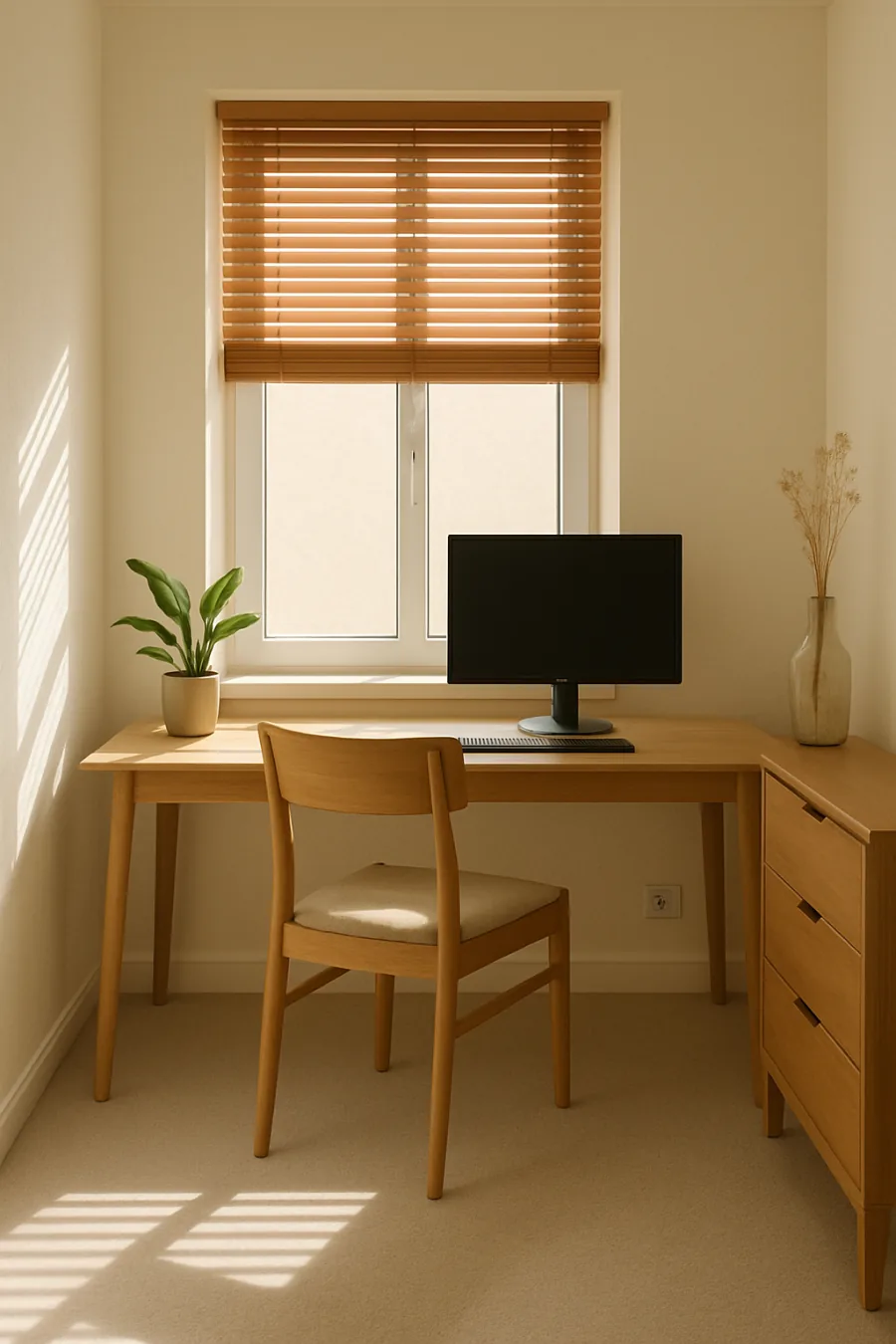











We manufacture orange blinds in Almaty to measure in our own workshop: our measurer brings samples and matches the shade under your lighting. The shade depends on the material — orange comes out differently on fabric, aluminium, PVC and wood. On the sunny side, choose metal or plastic: fabric fades, and the warranty doesn’t cover that.
What kind of light orange fabric gives
Orange fabric diffuses daylight rather than cutting it off: the room stays bright, but everything in it takes on a warm tint. The light that passes through the fabric changes the colour of objects — you notice it right away if you compare the window with the next one, where neutral blinds are installed. That’s exactly the effect we match orange blinds in Almaty by: you either like it or you don’t, and it’s impossible to predict from a catalogue.
What you see on faces, food and screens
The warm tone of the fabric softens contours, but noticeably shifts the colour of skin, food and everything on the table. In the kitchen it’s felt most of all — food under orange light looks different from what you’re used to. The same goes for a monitor: a white document page takes on a warm tint, and your eyes tire faster.
Metal and plastic work differently. An aluminium slat reflects light rather than letting it through, so the room stays closer to its usual colour, and the orange reads on the slats themselves. Fabric is, in this sense, the only material that actually repaints the room.
When you want to tone it down
A small room reacts to a saturated tone more sharply than a spacious one: the smaller the area, the more the orange fills the space. If there’s one window and the room is small, a saturated tone is chosen for one room and one window, and the density and texture are matched so there’s enough light for everyday tasks.
Day-night helps here: a two-layer fabric with alternating sheer and dense stripes lets you change brightness gradually, rather than on an “open-closed” principle. And the density of the fabric matters more than the shade itself — it’s what determines how much light reaches the room.
Light passing through an orange fabric tints the room, the objects and the faces in it with a warm tone, while aluminium and PVC slats reflect it differently from fabric.
Fading in the sun: fabric, aluminium, PVC, wood
On the sunny side, orange blinds behave differently depending on the material. Fabric loses its saturation under direct sun faster than the rest: the pigment in the fibre breaks down under ultraviolet light. An aluminium slat with a polymer coating and a PVC slat hold their colour because the colour layer sits on top of the base rather than soaking into it. Tinted wooden slats sit in the middle: the tint on the linden protects the wood, but under constant sun it changes too.
Table “material and sun”
| Material | How it behaves in the sun | Where we install | What’s important to know |
|---|---|---|---|
| Fabric | Loses saturation from ultraviolet light | Living room, bedroom, study with soft light | Fading is a natural process and is not covered by the warranty |
| Aluminium slat, polymer coating | The colour is held in the coating, not in the base | Kitchen, balcony, south and west windows | Can be washed right on the window, unaffected by moisture and heat |
| PVC slat | The glossy surface reflects part of the light | Kitchen, bathroom, balcony | Unaffected by steam and grease, wipes clean with a sponge |
| Wooden slats, tinted | The tint changes more slowly than fabric dye | Living room, study, a window without constant sun | Wide slats 50 mm, we match the tint to a sample |
Fabric fades on the sunny side more noticeably than anything else — this is the main reason Jalusso rarely recommends fabric in a rich orange for a south-facing window. A south-facing window calls for a material that stands up to the sun: aluminium or PVC handle this better.
The climate of Almaty adds its own specifics: summers are hot and sunny, with dust, while winters bring frost and a temperature swing between day and night. Aluminium and PVC slats take heat, cold and temperature swings equally well. It’s important to understand: natural fading of fabric is not covered by the warranty. The warranty — 3 years on the mechanism, 1 year on installation from the date the acceptance report is signed — does not cover mechanical damage, re-installation on your own, water, or natural fading of fabric. This isn’t us being difficult: we can’t be responsible for the effects of the sun, which we don’t control.
What to do if one blind does change
Over time, the shade of an individual slat or blind may differ from the original — especially if part of the window was shaded more heavily. We replace a slat or blind to a sample, but we don’t promise an exact shade match: even a new batch in the same shade may come out slightly different. In my view, if the window faces south or west and you want a rich orange, it’s more honest to go straight for aluminium with a polymer coating or PVC — then the question of replacement won’t come up.
Natural fading of fabric is not covered by the warranty, so for south- and west-facing windows in Almaty we more often recommend aluminium with a polymer coating or PVC.
Shade and material: how to choose the tone
The same orange looks different on fabric, aluminium, PVC and wood — the difference is noticeable even if you put the samples side by side on the windowsill. The orange shade depends on the material: fabric gives a soft, slightly muted tone, because light passes through the fibres and scatters. An aluminium slat with a polymer coating reflects light from the surface, and the colour reads cleaner and denser. A PVC slat usually leans warmer and slightly glossier. Wooden slats show the tone differently — the texture of the linden shows through it.
That’s why choosing orange blinds from a catalogue picture or a phone screen makes no sense: a monitor has its own colour rendering, and your room has its own lighting. Matching the tone to a sample solves this in five minutes on the spot.
Shades and where they work
By the character of the tone, we go by this:
- Peach and light sand — the calmest. They’re chosen for small rooms and for windows where the colour shouldn’t pull attention.
- Coral — warmer and more noticeable, goes well with light furniture and a white background.
- Terracotta — muted, earthy. A frequent choice for a living room next to wood and linen.
- Pumpkin — richer than terracotta, reads as a deliberate colour accent.
- Rich orange — the brightest. We recommend it for one window, not a whole wall.
The names here are a guide to the character of the tone, not a guaranteed set of options. What can actually be made in your material is clear from the samples.
What it goes with
Pairing with the interior is simple: white, grey, beige, linen and wood stay a calm background on which an orange window works as an accent and doesn’t clash with the rest. If the walls are already coloured, choose a muted window — terracotta or sand. Things get busy not from orange, but from three competing accents in one room.
Wood: paint or tinting
We make wooden slats by tinting linden rather than painting it densely: the wood grain stays visible, and the orange goes on in a layer instead of hiding the fibre pattern. On a sample this is immediately noticeable — a tinted slat changes tone in different light, while a painted one keeps a single shade. In my opinion, tinting looks more honest in an interior that already has wood.
The same orange looks different on fabric, aluminium, PVC and wood, so the tone is chosen from a sample under your own lighting, not from a screen or a catalogue.
System types: horizontal, vertical, day-night, pleated
Orange blinds come as horizontal, vertical, day-night and pleated, and the system type is chosen for the shape and size of the window, not for the colour. Colour comes second here: first we look at the opening, then we pick the slat.
Horizontal and vertical
We install horizontal blinds with an aluminium slat of 25 mm in kitchens, bathrooms and on balconies. Metal is not afraid of moisture or heat, and the slat can be washed right on the window — there is no need to take the blind down. Operation is mechanical, by chain or electric motor. Orange on aluminium reads evenly, without the shimmer that fabric gives.
Vertical blinds with a fabric slat of 89 mm hold their geometry on wide openings and panoramic glazing. The fabric blind diffuses light softly, and the room stays bright. We install them in living rooms, offices and coffee shops where the window is large or composed of several sections.
For a rented flat and new windows still under warranty, both systems can be installed with no-drill mounting — the frame stays intact.
Day-night and pleated blinds
Day-night is a two-layer blind with alternating sheer and dense stripes, and the light level changes smoothly rather than on an “open — closed” principle. In the morning you shift the stripes and catch soft light, during the day you overlap them and remove glare from the screen.
Pleated blinds are cut for arched, triangular and sloping windows where regular systems do not fit. This is a separate product with its own price and lead time — from 9,800 ₸/m² and 7–10 days.
Glossy slat or matte
Gloss gives more reflection and reads brighter. A matte finish softens the tone and catches less glare — in my opinion, matte orange is calmer for a bedroom and a study. We look at the choice on a sample under your own light: the difference is visible when the slats lie side by side on the windowsill.
Table: system type — where we install it — lead time per the price list.
| Type | Where we install | Lead time |
|---|---|---|
| Horizontal, aluminium 25 mm | kitchen, bathroom, balcony | 3–5 days |
| Vertical, fabric 89 mm | living room, office, coffee shop | 3–5 days |
| Day-night | bedroom, study | 5–7 days |
| Pleated blinds | arched, sloping windows | 7–10 days |
| Vertical, panoramic | office with glazing | 3–5 days |
| Horizontal, no drilling | rented flat | 3–5 days |
The system type is chosen for the shape and size of the window, not for the colour.
Orange on a south-facing and a north-facing window
No, it does not look the same. A south-facing window gets direct light almost all day, and the orange tone there reads brighter and warmer than on a north-facing one, where there is little sun and the very same sample seems calmer and, as it were, lighter. The difference is not in the colour of the product — it is in the lighting.
What this means in practice. A south- or west-facing window also means ultraviolet and high temperatures at the glass. That is why a south-facing window requires a material resistant to the sun: Jalusso recommends an aluminium slat with a polymer coating or PVC, not a fabric blind. A north-facing window gets almost no direct sun, and there fabric lasts noticeably longer — you can go for vertical or day-night without reservations.
The density of the blind works separately from the tone. On the south side a dense blind helps hold back the heat and remove glare from the monitor and the worktop; on the north side medium density is enough: the room does not overheat anyway, and extra darkening will make it gloomy. A sample lets you choose the tone under your own lighting, not from a picture in a catalogue — the measurer lays the slats out right on your windowsill, and you watch how they behave in the morning and in the evening.
A separate question is whether you can cover just one window in orange. Yes, and most often that is what we do. We once had a flat with three windows facing different sides: on the sunny one we installed orange aluminium, on the two north-facing ones neutral blinds, and the room did not fall apart because of it. One bright window holds the accent, the rest stay in the background. If, however, the windows face the same side and stand next to each other, it is better to take orange for all of them — otherwise the difference in lighting will work against you, and the blinds will look like different colours.
The colour of the window depends not on the colour of the slat, but on how much light passes through it and at what angle.
The window from the street and orange in commercial spaces
From the street an orange blind reads as a warm patch on the facade of a high-rise, not as a bright sign. During the day orange blinds diffuse light and the facade looks more even than with open windows. In the evening the picture changes.
The density of the blind determines what is visible from the street when the light is on in the room and how closed the room is. A dense blind blocks the view, while on horizontal slats and light fabric silhouettes may be visible — here it is better not to promise complete invisibility. Hence the rule: first we decide what matters more — soft light during the day or privacy in the evening — and only then choose the material.
In an office and a café, orange works differently than in a flat. Here it is not the accent of one room but part of the brand palette: the tone is repeated on several openings and keeps the facade whole. Does such a colour get tiring over a working day? In our experience, no, if the blind covers the windows and not the walls. When we did glazing in offices, employees complained not about the colour but about glare from monitors. An orange slat removes that glare and does not darken the room.
Vertical blinds with a fabric slat of 89 mm hold their geometry on wide openings and panoramic glazing — where horizontal ones would have to be joined in sections. The fabric density is chosen for the task: for a hall that is looked into from the street, a denser blind is used.
Case: a coffee shop on a main street
Orange is part of the brand palette, and vertical blinds cover several openings in one tone: during the day the hall stays bright, in the evening it is closed off from passers-by. Lead time per the price list item is 3–5 days.
During the day an orange blind diffuses light and reads from the street as a warm patch; in the evening, with the light on, silhouettes may be visible — only a dense blind closes the view completely.
How much orange blinds cost
Colour does not change the price. Orange blinds cost the same as any other per the price list: the price follows the type of product, not the shade of the slat. The total is affected by the material and density of the blind, the operation, the shape of the window and the mounting. The final price will be given by the measurer on site, because without a visit we can only talk about a preliminary range.
Price table by type
The type of product determines both the price and the manufacturing time.
| Type | Price from | Lead time |
|---|---|---|
| Horizontal aluminium, 25 mm | from 4,200 ₸/m² | 3–5 days |
| Vertical fabric, 89 mm | from 4,600 ₸/m² | 3–5 days |
| Plastic, PVC 25 mm | from 3,600 ₸/m² | 3–5 days |
| Metal, steel 25 mm | from 5,200 ₸/m² | 5–7 days |
| Day-night, two-layer fabric | from 7,300 ₸/m² | 5–7 days |
| Motorised blinds | from 7,800 ₸/m² | 7–10 days |
| Pleated blinds | from 9,800 ₸/m² | 7–10 days |
| Wooden, linden 50 mm | from 12,400 ₸/m² | 7–12 days |
Each figure is an “from” price for its own type. Don’t read the top line as the minimum for all of them: PVC has a lower threshold, wood a higher one.
What adds to the price
The control type is counted as a coefficient. Mechanical — ×1, chain — ×1.06, electric motor — ×1.85, electric with remote control — ×2.1. A remote control is handy on a high window, but you pay almost twice the base rate for it.
Mounting is also a multiplier: wall-mounted — ×1, frame-mounted — ×1.05, no drilling — ×1.1, cassette system — ×1.28. The difference between wall mounting and glazing bead mounting is small, but it’s worth seeing in the quote in advance, not after the fact.
Installation and the suburbs
Installation — 4,500 ₸ per item. For orders from 150,000 ₸ we install for free: if you take blinds for several windows at once, this line disappears from the quote.
Within the city, measurement and delivery are free. We travel to Kaskelen, Talgar, Issyk and Kapshagay, and we tell you the travel cost before we set out.
Colour doesn’t change the price — the cost of orange blinds in Almaty is calculated by product type from the price list, and free installation starts with an order from 150,000 ₸.
How the measurement works and what the measurer brings
Measurement and consultation are always free. The measurer arrives with samples, looks at the orange tone in your lighting and gives you the price on the spot, rather than sending it later in a message.
Here’s how it looks, step by step.
- Вы пишете в Jalusso в WhatsApp и описываете окно: сколько створок, куда оно выходит, есть ли рядом плита или рабочий стол. Этого достаточно, чтобы договориться о времени.
- The measurer arrives with samples — orange slats of different densities and fabric swatches. You hold them up to the window in your own light: during the day, and if the room faces the sunset side, look in the evening too.
- He measures the opening, checks how the sashes open, where the windowsill will sit and which mounting will work — wall-mounted, frame-mounted, no drilling or a cassette system.
- The cost is calculated right there: product type from the price list, plus a coefficient for the control type and mounting. The price for each type is a “from” range; we give the exact amount for your window after measuring.
The suburbs of Almaty — Kaskelen, Talgar, Issyk, Kapshagay — are within our travel zone. The travel cost depends on the distance and is quoted before we set out, so there are no surprises later. Within the city, measurement and delivery are free.
An orange sample on the windowsill settles what a catalogue can’t: you see how the tone sits next to your wallpaper, furniture and floor. That’s why we suggest ordering orange blinds after the measurement — by then the shade, the system type and the mounting are already chosen for your specific window.
No-drill mounting
Yes, we install orange blinds on a plastic window without drilling the frame. Glazing bead mounting keeps the frame free of holes: the bracket slots into the gap between the glass unit and the profile and stays there thanks to the fit. The second option is spring clips that grip the sash on both sides. The third is adhesive tape on a degreased surface; we use it for lightweight horizontal systems where the blind doesn’t weigh much.
Who cares about this? Renters and owners of new windows that are still under warranty. The landlord doesn’t pay to restore the profile after you move out, and the window manufacturer’s warranty isn’t lost with this kind of installation — there are no holes in the frame, so there’s no reason to refuse a claim either.
One thing you only notice on site: with no-drill mounting, a gap remains between the frame and the blind, and some light comes through along the edge. We don’t recommend this option for a bedroom, but in a kitchen or an office it usually bothers no one.
According to our calculator, no-drill installation has a coefficient of 1.1, frame-mounted — 1.05, wall-mounted — no surcharge.
Glazing bead mounting, spring clips or adhesive tape keep the frame free of holes, which is why they’re chosen for rented housing and windows under warranty.
Caring for orange slats and fabric
Aluminium and PVC are wiped with a damp cloth and a mild product right on the window. There’s no need to take the blind down and carry it to the bathroom. Dust is less visible on an orange slat than on a white or black one: the warm tone masks it rather than highlighting it. Splash marks are more noticeable on a glossy finish — the same damp cloth helps there.
As for fabric blinds, the rules are different.
- Fabric blinds are cleaned with a vacuum cleaner on low power with a soft brush attachment, or with a sponge without soaking.
- Machine washing is out: the treatment is lost, after which the fabric shrinks and holds its shape worse.
- We remove stains from fabric spot by spot, without rubbing and without harsh products.
- An aluminium slat handles moisture, heat and washing on the window — that’s what makes it convenient for the kitchen and balcony.
- A PVC slat suits the kitchen, bathroom and balcony: steam and grease don’t bother it, and the surface wipes clean with a sponge.
About sheer and white curtains, I’ll say it straight: they go with orange blinds just fine. The sheer stays a neutral background, and the orange on the window reads as the only colour accent. The one thing to avoid is a white curtain with a bright pattern: two active spots start to compete with each other. In my view, a heavy white linen next to an orange slat looks more put-together than a semi-sheer curtain with a pattern.
Aluminium and PVC are wiped with a damp cloth and a mild product right on the window, fabric is cleaned with a vacuum cleaner on low power or a sponge without soaking, and machine washing is out for fabric blinds.
We make orange blinds to measure, so the fabric is cut for your opening, and when replacing a single slat we match it by sample — but we don’t promise an exact colour match with the fabric already on your window.
If you need a cord, chain or a single slat replaced, we come out even after the warranty period: to tighten, adjust, fit a new part.
FAQ
Does orange go with wooden furniture and a dark floor? Yes, if the rest of the room is calm. The orange shade depends on the material: on fabric, aluminium, PVC and wood the tone comes out different, and for a dark floor with wooden furniture it’s better to choose a muted terracotta or a warm sandy tone rather than a saturated orange. Our lead measurer Kirill has seen more than once how the same sample sits differently against furniture in overhead and side light. A sample lets you choose the tone in your own lighting: the measurer lays out the slats by your windowsill, and you see how the orange reads next to the wood and the floor. If you’re unsure, go for matte orange blinds — they catch fewer reflections and don’t compete with the warm texture of the furniture.
If one slat fades after a couple of years, will you match the same tone? We replace it by sample from the same price list position, but we don’t promise an exact colour match. Sun fading affects the whole window surface, so we replace the slat or the whole blind, not just one strip. Natural fading isn’t covered by the warranty, and that’s fair: fabric on a south-facing window changes tone faster than aluminium or PVC.
Which orange is calmer for a child’s room? A muted one: peach, light sandy or soft terracotta. A saturated tone is tiring in a small room, while a calm warm accent stays noticeable without being oppressive. For a child’s room we usually take horizontal aluminium blinds with a side handle — no hanging chain in the room.
Orange on the window gets along with wood and a dark floor, and we replace a faded slat by sample without promising an exact match.
The bottom line
Choosing orange blinds comes down to four decisions: material, shade, type of system and mounting. Colour is the easiest of them.
The shade depends on the material. On fabric, aluminium slats, PVC and wooden slats the same orange comes out differently — on wood it goes into a warm depth, on glossy PVC it reads brighter, fabric gives a soft diffused tone. That is why the tone is chosen from a sample in your own lighting, not from a catalogue screen. Our measurer brings samples — that is the real check.
For a south or west window in Almaty, aluminium with a polymer coating or PVC is more practical. Fabric on the sunny side fades, and natural fading is not covered by the warranty. If the window faces a courtyard and there is little sun there, fabric holds up more calmly.
The type of system is chosen for the shape and size of the window. Horizontal and vertical cover standard openings, day-night changes the light smoothly, pleated blinds are cut for arched and sloping windows. Mounting is a separate decision: into the glazing bead, on spring clips or on adhesive tape the frame stays without holes, and this is the usual choice for rented housing and new windows still under warranty.
Colour does not change the price. The cost follows the type of product from the price list: horizontal aluminium — from 4,200 ₸/m², vertical fabric — from 4,600 ₸/m², PVC — from 3,600 ₸/m², wooden — from 12,400 ₸/m². Installation — 4,500 ₸ per product, free for orders from 150,000 ₸.
A measurer visit and a consultation on orange blinds are free, as is delivery within Almaty. We quote the cost of a visit to Kaskelen, Talgar, Issyk or Kapshagay before the visit, not after the fact.
The practical advice is simple: message us on WhatsApp, call a measurer with orange samples and decide on the type, material and shade on the spot. Before measurement any price remains a range. We make orange blinds in Almaty to measure in our own workshop, so the final sum is given by the measurer — with your dimensions and chosen mounting.

