









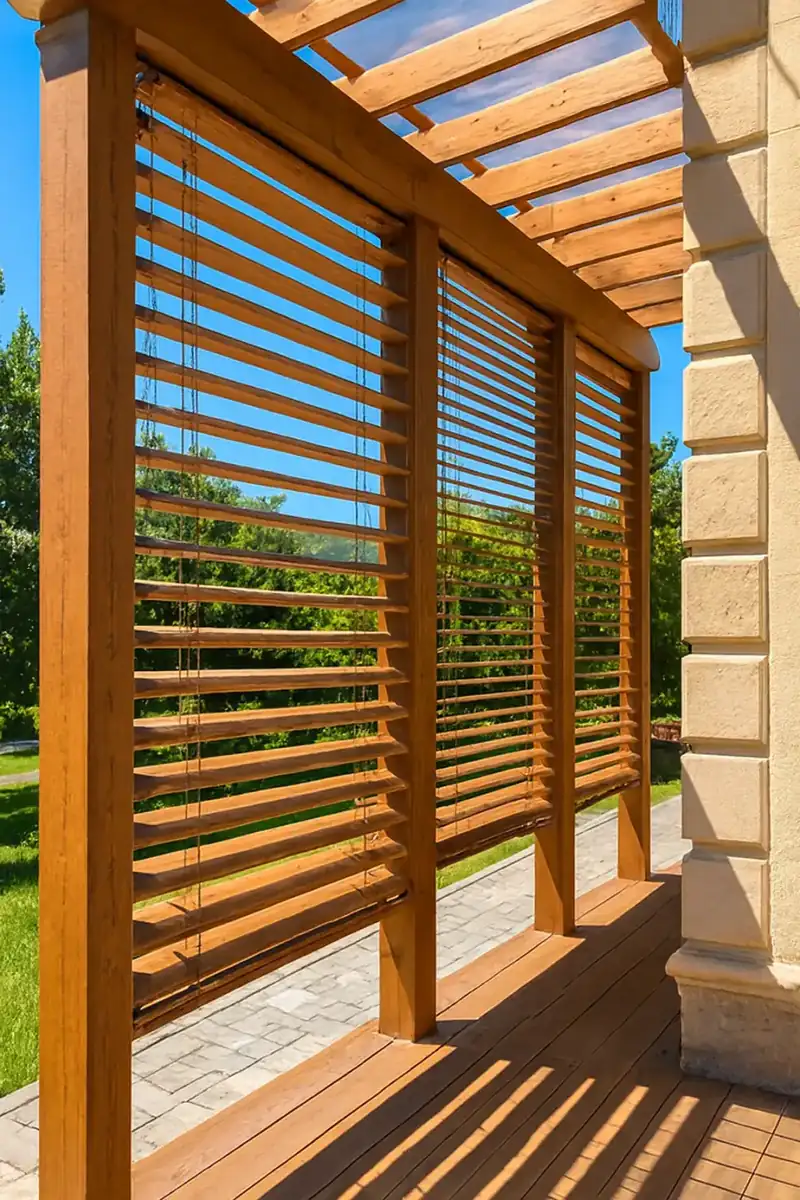
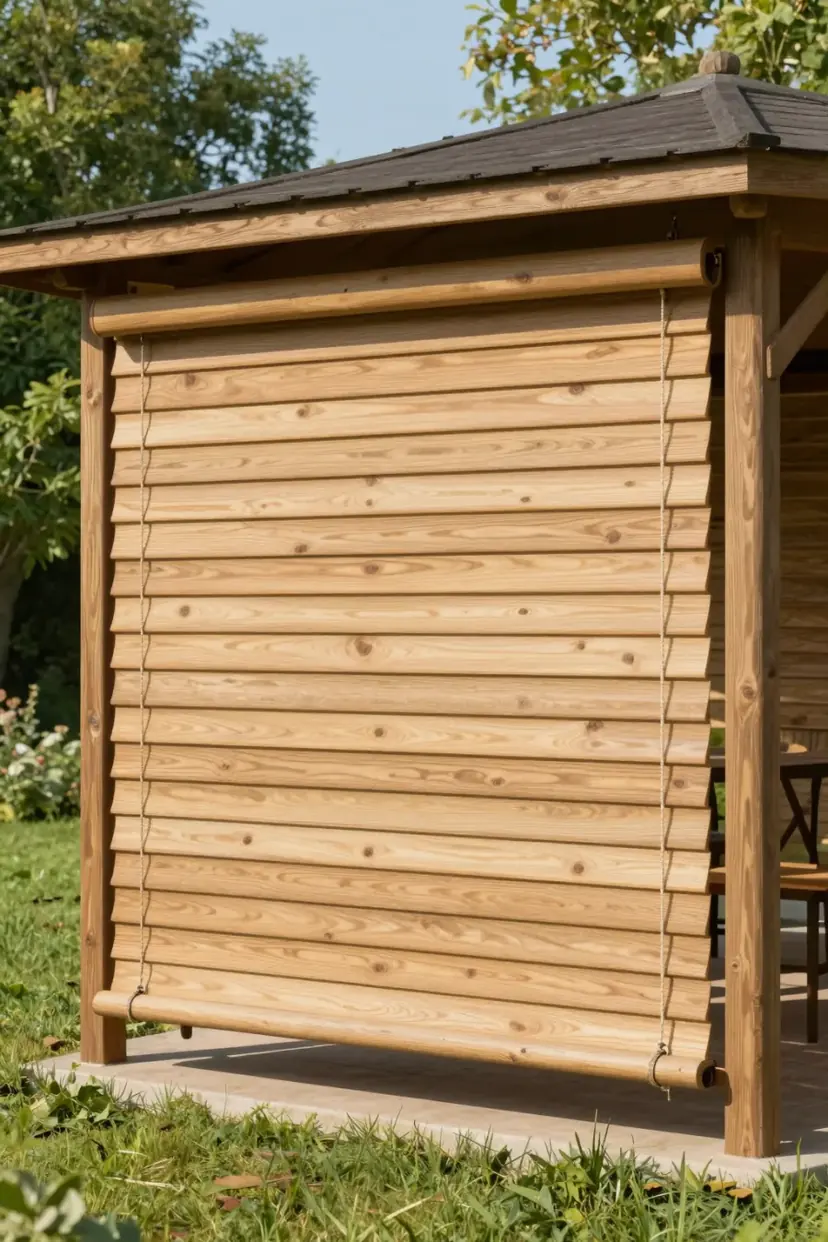











Blinds for a gazebo are attached not to the frame but to the posts, the frame timber or a metal frame: they give shade, reduce wind blowing in and screen the opening from view. Only a solid blind protects against heavy rain, and we don't offer one in our price list. We work by measurement, prices from 4,200 ₸/m².
What gazebo blinds are and how they differ from interior blinds
Blinds for a gazebo in Almaty are horizontal blinds that are attached not to a window frame but to the structure itself: to a gazebo post, a framing beam or a metal frame. The fabric is the same as indoors, but it is held on a structure that has neither frame nor glass.
In horizontal blinds the slat turns around its axis. Turning the slat changes how dense the shade is in the opening: in one position the light comes through in stripes, in another the opening is almost fully closed while the view of the garden stays readable. That is why gazebos get tilting slats rather than solid fabric.
We make such fabrics in our own workshop in Almaty and work to measurement — we do not keep ready-made products in stock.
How outdoor installation differs from window installation
The difference is not in the fabric but in three things. Fixing: the bracket sits on a post or framing beam, because a gazebo has no frame. Load: wind outdoors pushes on the fabric harder than a draught in a flat, so there are guide rails on the sides and a weight bar at the bottom. Care: dust and leaves settle outdoors, and the fabric has to be wiped more often than at home.
Gazebo blinds differ from interior blinds not in the fabric but in the way they are attached: they sit on the gazebo frame, not on a window frame.
Which products suit a gazebo and which are a different class
Horizontal blinds suit a gazebo: they give shade and reduce wind blowing into the opening. There are no transparent blinds. A transparent panel is soft PVC windows or polycarbonate, a separate class of products that is not in our price list. Raf shutters and soft PVC windows differ from blinds for a gazebo in Almaty not in price but in purpose: blinds regulate light and air, while a transparent panel puts up a solid wall.
People often ask about transparent blinds for a gazebo — they want both shade and a view of the garden at the same time. That combination does not exist in one product. Horizontal blinds darken exactly as much as the slat is turned, while soft PVC windows and polycarbonate let light through but do not regulate it. The choice is between two different things, not between two grades of the same fabric.
Blinds for an outdoor gazebo always mean our workshop and measurement: we do not keep ready-made products in stock, and the size of the opening determines everything else.
Comparison table of five classes of products
| Product | What it covers | From heavy rain | What it does not give |
|---|---|---|---|
| Horizontal blinds | Shade, wind blowing in, eyes from the street | No, the fabric has gaps between the slats | Transparency |
| Raf shutters | The whole opening, with a solid fabric on cables | Partly, depends on the fabric | Transparency and tilting slats |
| Roller shutters | The opening solid, like a shutter | Yes, when fully lowered | Light when closed |
| Soft PVC windows | The opening with transparent film | Yes, the film is solid | Light control |
| Polycarbonate | The opening with a rigid transparent sheet | Yes, the sheet is solid | Removability and rotation |
Roman blinds and soft windows are a different class of product: they have no slat that can be rotated, and no control coefficient of ours. Roller shutters for a gazebo are also a different class — they close the opening solid, and when closed it is dark inside. Polycarbonate is rigid; you cannot take it off for the winter without dismantling the fasteners.
On the windy side, horizontal blinds give what a transparent fabric cannot: the airflow passes through the rotated slats instead of hitting a solid film. But fabric with gaps will not save you from a downpour — more on that below, in the section on rain and wind.
Of the six types in our price list, for gazebos we most often install aluminium, wood and bamboo. We attach them to the gazebo post, the framing beam or the metal frame — the window frame has nothing to do with it.
The conclusion is simple: we do not make transparent blinds — transparent fabric belongs to PVC soft windows and polycarbonate, which is a different class of product.
Will blinds protect from rain, wind and neighbours’ eyes
Blinds for a gazebo in Almaty will not save you from a downpour. We say this straight at the measurement, because half of all enquiries start with the expectation that the fabric will close the opening solid, like a wall. Horizontal blinds are slats with gaps: they cut the wind blowing in and screen you from prying eyes, but in slanting rain water passes between the slats. Our price list has no solid outdoor fabric that would hold a downpour — that is a separate class of product, and it is worth knowing in advance, before ordering.
What blinds for a gazebo really do give you against rain and wind is protection from draughts and from neighbours’ eyes. The fabric covers the opening, a gust is damped by the slats instead of hitting the people sitting inside. Plus the density of shade is adjusted by rotating the slat: in the daytime you let the light in, in the evening you close the room off from the street. For a café terrace this works especially well — our project with a 4 m opening on aluminium is exactly about that: bright by day, closed off from prying eyes in the evening.
How the fabric behaves in a draught
Side guide rails keep the fabric from flapping against the post. Without them the slats swing in a draught, knock against the wood and quickly lose their looks — on an open windy side this is the first reason people come back for a redo. Guide rails are fitted on both sides, the fabric runs inside and does not come away from the post even in a gust.
A bottom weight bar presses the slats down in a draught. It is a strip in the bottom edge: it keeps the fabric taut and stops the lower slats from fanning out. A cheap part compared with the fabric, but without it the structure on a windy side behaves quite differently.
A separate note on the windy side. There we recommend aluminium with a polymer coating rather than bamboo straw: bamboo in constant wind and damp behaves worse, and a PVC slat flexes in strong wind. Almaty wind and frosts are handled calmly by aluminium with a polymer coating — the material is afraid of neither moisture nor heat.
Briefly, what to remember:
- only solid fabric protects from a downpour, and we do not have it in our price list;
- blinds do protect from draughts and prying eyes;
- side guide rails and a bottom weight bar are essential parts on a windy side;
- on a windy side you choose aluminium, not bamboo and not PVC.
Blinds reduce draughts and screen the opening from prying eyes, but only solid fabric protects from a downpour, and we do not have it in our price list.
How to attach blinds to a gazebo when there is no frame
Blinds for a gazebo are attached to the load-bearing part of the structure itself, not to a window — there is simply no frame in an open opening. The anchor point is the gazebo post, the framing beam or the metal frame. Where the bracket sits determines both the rigidity of the fabric and how it behaves in the wind.
The order of work on a finished gazebo looks like this.
- We inspect the opening and the load-bearing elements. We look at what the post is made of, whether there is a top crossbeam, whether the corners are set level.
- We choose the attachment point. The bracket goes onto the post, the framing beam or the metal frame of the gazebo — wherever the structure takes the load.
- We fit a top rail if there is no load-bearing crossbeam. It is a beam or profile that ties the posts together and takes the weight of the fabric.
- We set the side guide rails. They run vertically and keep the fabric from flapping against the post.
- We hang the fabric and adjust the bottom weight bar so the slats do not fly apart in a draught.
Guide rails and the weight bar are not decoration but working parts. Without side guide rails the fabric in a draught knocks against the post and quickly loosens the bracket. Without the weight bar the slats swing and ride up. On a windy opening we always fit both.
And the measurement determines not only the size of the opening but also the material and the fasteners. You cannot see this from a photo: the same gazebo is built from dry timber, from square steel tube, from wrought metal — and the bracket is different every time.
Fasteners for wood, metal and wrought frames
Into a wooden post the bracket goes on wood screws, and here it is important to hit the body of the beam, not thin cladding. Into the metal frame of a gazebo we fasten through holes or onto rivet nuts — depending on the profile. On a wrought frame, where there is no flat area, we first set an adapter plate under the bracket and hang the fabric on that.
On installation anything can happen: the post looks level, but under the cladding there is a void. That is why the Jalusso measurer checks the fastening before the workshop gets the dimensions.
The bracket goes onto the post, the framing beam or the metal frame; if there is no load-bearing crossbeam, the top rail takes its role.
Wood, aluminium, PVC or bamboo: what to choose by side and wind
The material for a gazebo is chosen not by looks but by side: on a windy side and near water, aluminium blinds with a polymer coating; under a canopy and away from direct rain, wooden blinds made of linden; in the garden for soft shade, bamboo blinds.
The window’s orientation sets the mode for the fabric. South and west in Almaty hold the sun for most of the day in summer and heat the slat until it is hot to the touch. There what matters is not the species but how the material handles heat: aluminium with a polymer coating handles moisture and heat without consequences, while tinted linden dries out in summer and needs the cool of a canopy. North and east are cooler, but that is exactly where the draught from the mountains most often comes from, and the fabric on that side works like a sail.
A windy side calls for aluminium instead of bamboo. Bamboo straw is not a slat but a solid weave; in a draught it sails, and fasteners hold it worse than a rigid slat. Aluminium blinds behave more evenly: the polymer coating is afraid of neither moisture, nor temperature swings, nor the dust that flies in with the wind.
The table helps narrow the choice down to one or two options even before the measurement.
| Material | Strength | Weak spot | Where we install |
|---|---|---|---|
| Wooden blinds, linden, slat 50 mm, tinted | Texture, colour to match the frame | Not an outdoor species | Under a canopy, away from direct rain |
| Aluminium blinds, slat 25 mm | Moisture, heat, wind | Less warmth in the texture | Windy side, by the water |
| PVC plastic blinds, slat 25 mm | Damp, easy to wash | The slat sways in the wind | Enclosed gazebo, opening with dust |
| Bamboo blinds, straw | Soft dappled shade | Reacts to damp | Garden, quiet side |
Wood and bamboo: where the line is
Linden is an indoor species, and we don’t pass it off as an outdoor one. Tinted linden wood blinds suit a canopy and a spot away from direct rain: there the texture lasts a long time and the slat keeps its shape. Wooden blinds for a gazebo we more often install on the side where the frame itself is wooden and you want to match its tone. Tinting does this better than paint.
Bamboo reacts to constant damp more than wood does. Bamboo blinds are an option for the garden, on the quiet side, where rain rarely reaches the opening. Light through the straw comes in soft patches rather than stripes, as when a slat is turned. Wooden blinds for a gazebo in Almaty on the windy side and bamboo by the water — we advise against both and suggest aluminium.
Aluminium and PVC: moisture, heat, wind
PVC plastic blinds and aluminium blinds fear neither damp nor heat — the difference is in rigidity. A PVC slat sways in strong wind, so its place is where the opening is sheltered by the frame or an adjacent wall. An aluminium slat is stiffer, and on an open side the blind stays level.
This is the choice for outdoor blinds for a gazebo: an open side and water — aluminium with a polymer coating, an enclosed side — PVC. Wooden blinds for a gazebo we leave for under a canopy, not for a windy side. If there are several openings, it’s worth starting with the side the wind and sun come from: once you close it, you’ll immediately feel the difference sitting inside.
Aluminium with a polymer coating withstands moisture and heat, linden wood suits a canopy and a spot away from direct rain, bamboo reacts to constant damp, and a PVC slat sways in strong wind — this is the line worth keeping in mind before the measurement.
How much blinds for a gazebo cost and what the price is made up of
The price of blinds for a gazebo is calculated per square metre according to the price list. Horizontal aluminium — from 4,200 ₸/m², bamboo — from 9,400 ₸/m², wooden — from 12,400 ₸/m². Coefficients are added to the base rate: for the control type and for the mounting. The size of the opening, the material, the type of control and the mounting method — these are what move the total.
| Type | Price per m² | Lead time |
|---|---|---|
| Horizontal, aluminium, 25 mm slat | from 4,200 ₸/m² | 3–5 days |
| Plastic, PVC, slat 25 mm | from 3,600 ₸/m² | 3–5 days |
| Metal, steel, slat 25 mm | from 5,200 ₸/m² | 5–7 days |
| Bamboo, straw | from 9,400 ₸/m² | 7–10 days |
| Wooden, linden, slat 50 mm | from 12,400 ₸/m² | 7–12 days |
For control: manual comes with a coefficient of ×1, chain — ×1.06, electric motor — ×1.85, electric with remote control — ×2.1. For mounting: on the wall ×1, on the frame ×1.05, without drilling ×1.1, cassette system ×1.28. The electric motor runs on 220 V or a battery — if there’s no electricity in the gazebo, the battery solves the problem.
Installation costs 4,500 ₸ per item. For orders from 150,000 ₸ it’s free. If there are several openings and their sizes differ, the price is calculated for each blind separately and then added up; that’s fairer than taking an average rate for everything.
Example calculation per price list
An opening 3 m on a wooden gazebo. Let’s take a blind about a metre high — for the example that’s three square metres. Aluminium from 4,200 ₸/m² gives a base of about 12,600 ₸, linden wood from 12,400 ₸/m² — about 37,200 ₸. Then we multiply by the coefficients: for a chain ×1.06, for mounting to a post ×1. If you add an electric motor ×1.85 instead of a chain, the gap between materials only grows.
The measurement determines the size of the opening, the material and the fasteners — without it the rate can’t be fixed. The exact amount is given by our measurer on site: they see what the gazebo is made of and calculate based on the facts. Want to estimate it yourself — message us on WhatsApp and we’ll work it out together.
The price of blinds for a gazebo is the rate per square metre according to the price list with coefficients for control and mounting, and installation costs 4,500 ₸ per item and isn’t charged at all for orders from 150,000 ₸.
Which side to start with and how to split a wide opening
It’s worth starting with the side of the gazebo where the wind most often comes from and the sun shines. In Almaty this is usually the western and south-western side of the plot — after lunch the sun sits low and hits the opening almost horizontally. Shade from such sun doesn’t help: it falls inside, onto the benches and the table, rather than staying outside. Jalusso closes the windy side first, then the one facing the neighbours, and only then the remaining openings.
The window’s orientation determines not only the order but also the material. On the windy side we install aluminium blinds with a polymer coating, because wood and bamboo behave worse there. And this isn’t about aesthetics — it’s about the structure having to withstand it.
We don’t take a wide opening of 3–5 m as a single blind. One long blind behaves worse in the wind: it flaps, sways along its whole length and puts load on the brackets. We split it into several blinds:
- an opening of 3 m — two blinds of 1.5 m each, each running in its own guide rails on the sides;
- an opening of 4 m — four blinds of a metre each, so it’s easier to control the light separately by zone;
- an opening of 5 m — four to five blinds, each with its own bottom weight.
Guide rails on the sides and a bottom weight are the two parts that hold the blind in a draught. The guide rails keep it from moving away from the plane and banging against the post, the weight presses the slats down from below. Without them a long sash behaves unpredictably in a gust.
What happens if you forget to raise the blind in a hurricane? In a strong gust it flaps and tears the fasteners — the mechanism and the slats suffer first. On the windy side it’s worth raising the blinds when the gazebo is empty: a simple rule that saves on repairs.
A wide opening is split into several blinds, because one long blind behaves worse in the wind and flaps.
A mangal, smoke and open fire next to the blind
You can install blinds for a gazebo next to a mangal, but the opening by the fire is kept slightly open. Horizontal blinds here work not as a solid wall but as an adjustable damper: turning the slat sets how much smoke goes outside and how much heat stays inside.
The logic is simple. A mangal needs ventilation, not a tightly closed opening — if you curtain off the fire area completely, smoke gathers under the gazebo ceiling and drifts to the sides where people are sitting. We usually leave the slats by the mangal turned a third or half open: there’s draught, but sparks and heat don’t burst out the way they do with a fully open opening.
The blind itself stands at a distance from the firebox. A slat — aluminium, wood or PVC — heats up from nearby heat and loses its look; the warranty does not cover mechanical damage or water, so the measurer checks the gap to the fire separately. On one project with a gazebo next to a mangal, we made two blinds at the edges of the opening and left the middle open — the smoke went up and to the side without touching the slats.
In winter, when the mangal is not in use, the question goes away by itself: the blind is taken down or raised. In summer it is enough not to lower it right up against the fire.
Next to a mangal, horizontal blinds are kept slightly open with the slats tilted so the smoke escapes instead of gathering under the ceiling.
Winter in Almaty: take the blind down or leave it on the frame
For the winter, it is better to take the blind down and store it indoors. The mechanism will last longer if it is not left out in the frost, and the seasonal removable installation is made exactly for this: the brackets let you take the product down in minutes and just as quickly put it back in spring.
Almaty winters mean frost and a big temperature swing between day and night. In summer, blinds face heat, sun and dust; in winter, cold and moisture. Outdoor blinds for a gazebo are made for this kind of outdoor use, but each material behaves differently.
- Aluminium blinds with a polymer coating handle moisture and heat more calmly than the rest: the slat is afraid of neither damp nor temperature swings. If the gazebo stands by water or on a windy side, such an opening gets through winter without losses — the blind can be left in place, but taking it down is still more reliable.
- Wooden linden blinds under a canopy hold up well, but direct snow and rain do them no good: the tinting holds, but the slat itself takes on moisture. Such a blind must be taken down and kept in a dry room.
- Bamboo blinds made of straw react more than any other to frost and constant damp: the weave absorbs moisture. We take these down first.
The winter season also settles one more thing: in spring, when the blind goes back on the frame, the mechanism should be checked — turn the slats and see whether the cord is jamming.
So the answer to whether blinds will withstand Almaty wind and frost is simple: the material will, but the mechanism is happier in the warm — a blind taken down for the winter lasts noticeably longer.
Caring for the blind and mechanism outdoors
Blinds for an outdoor gazebo get dirty faster than indoor ones: dust, leaves, traces of rain. Caring for the blind takes a few minutes and does not require harsh chemicals. The mechanism is a separate story — it is the thing people forget most often.
- Dust and leaves are brushed off with a brush or a dry cloth — from top to bottom, along the slats.
- The slats are wiped with a damp cloth and a mild product. Aluminium with a polymer coating can be washed without ceremony, and the coating does not suffer.
- Wooden linden blinds and bamboo straw only need wiping with a dry cloth, without soaking. Water does them harm.
- Once a year, the mechanism is cleaned of dust: it packs into the turning unit and becomes a common cause of jamming. No lubricant is needed there — just remove the dust.
Blinds do not protect against mosquitoes and wasps. A blind with gaps between the slats does not stop insects, and mosquito nets are not in our price list. If the opening is in a garden and mosquitoes keep you from sitting outside in the evening, that is solved with a different product, not blinds.
Photo printing on the blind fades over time in direct sun. This is not a defect but a property of printing, and the warranty does not cover natural fading of the fabric. That is why we recommend printing for openings that are in shade for most of the day — for example, for a gazebo in a garden under trees.
In my view, the main mistake in care is reaching for a pressure washer. The jet drives water into the mechanism and bends the slats. A cloth is enough.
A mechanism that is wiped free of dust once a year lasts noticeably longer than one that is left untouched until the first jam.
How measurement and installation work on a finished gazebo
Measurement and consultation are always free. The measurer arrives with samples, looks at what the gazebo is built from, and calculates the cost on the spot. We do not keep ready-made products in stock — first the measurement, then the workshop.
The process is as follows:
- You write on WhatsApp and arrange a visit. Within the city, measurement and delivery are free.
- The measurer takes the dimensions of the opening, checks the material of the posts, the framing and the crossbars, and works out where the bracket will go and where a top rail will be needed.
- Right there on the spot, they give the price from the list — including the control option and the mounting.
- The workshop makes the blind: the time depends on the material, from 3 to 12 days.
- The crew arrives for installation. The work takes a few hours — provided, of course, that the frame is already finished and access to the posts is not blocked.
We charge 4,500 ₸ per product for installation, but if the order total reaches 150,000 ₸, we install it free of charge. As for the fastening: blinds for a gazebo are attached to a post, a framing beam or a metal frame — the window frame stays untouched. The measurement is exactly what determines the size of the opening, the material and the fastening, so that the blind sits tight and holds up in the wind.
Outside the city we work the same way. We travel to Kaskelen, Talgar, Issyk and Kapshagay, but the cost of the visit depends on the distance — we quote it before the visit so there are no surprises. After that, everything follows the same pattern: measurement, workshop, installation.
The bottom line is simple: measurement and consultation are free, the measurer arrives with samples and calculates the cost on the spot, and for the suburbs the visit is paid by distance, which we tell you before the visit.
Case studies from our work
Open gazebo at a country house. Opening 3 m, wooden blinds, time 7–12 days. We closed the opening from rain and wind, and the view of the garden stayed clear.
Gazebo by a pool. Opening 2 m, aluminium, time 3–5 days. Moisture and splashes do not bother the material, and the blind is washed along with the furniture.
Gazebo on a windy side. Opening 3 m, aluminium, time 3–5 days. Guide rails on the sides hold the blind — it does not flap and does not pull away from the post.
Gazebo on a café terrace. Opening 4 m, aluminium, time 3–5 days. It is bright inside during the day, and in the evening the space is closed off from the street.
Gazebo with a panoramic opening. Opening 5 m, aluminium, time 3–5 days. Each opening is closed with its own blind — we talked about this above when we looked at wide openings.
FAQ
There are no transparent blinds for a gazebo — and we do not make them. Transparent fabric belongs to soft PVC windows and polycarbonate, which is a different class of product. Rafshory and roller shutters for outdoor use are also a different class: rafshory come with a wide slat on cables, roller shutters are a rigid cassette system. Blinds give shade, reduce wind blowing through and close the opening from prying eyes, but they do not save you from a downpour: a downpour is blocked by a solid blind, which is not in our price list.
If there is a mangal in the gazebo, the opening by the fire is kept slightly open with the slats tilted so the smoke goes outside instead of gathering under the ceiling. Horizontal blinds on the side opposite the fire can be closed without worry. The blind is not made for the heat of the mangal itself — we do not put a slat next to an open flame.
The blind withstands Almaty wind and frost: aluminium with a polymer coating and tinted wood stay outdoors all year round. Bamboo straw on a windy side reacts to damp more strongly, and we do not recommend it there. We calculate the fastening for the load during the measurement.
For a summer kitchen the choice is simple. You need protection from heavy rain and full transparency — that means soft PVC windows, but we don't have those. You need shade, an opening closed off from the street and a fabric that can be washed along with the furniture — people go for aluminium blinds, slat 25 mm, from 4,200 ₸/m².
Conclusion
Blinds for a gazebo are fixed to a post, a frame beam or a metal frame, not to the window frame. This is the first thing that determines the whole construction: the blind sits on the structure itself, so the window frame stays untouched, and our measurer selects the fasteners to match the frame material.
What does such a blind give you? Shade, less wind blowing through and privacy from prying eyes. Blinds for a gazebo won't save you from heavy rain — rain is blocked by a solid blind, which isn't in our price list.
The material is chosen by side. On a windy side, near water and in direct sun — aluminium with a polymer coating. Under a canopy and away from direct rain — linden wood. In a garden, for soft dappled shade — bamboo. And in strong wind a PVC slat flutters, so we don't recommend it there.
The price is calculated per square metre according to the price list, with coefficients applied for the control type and mounting. Installation costs 4,500 ₸ per item, but for orders from 150,000 ₸ this service is no longer charged. On a wide opening you get several blinds — that way the construction behaves more evenly in the wind.
In winter the blind is taken down and stored indoors. This makes the mechanism last longer — the removable brackets come off in minutes.
The practical recommendation is simple: to buy outdoor blinds for a gazebo, message us on WhatsApp and arrange a measurement — our measurer will come with samples, look at your gazebo frame and calculate the cost for your opening on site. If your gazebo is outside the city — in Kaskelen, Talgar, Issyk, Kapshagay — we'll come too, and we'll tell you the call-out price in advance. We work by measurement: we don't have ready-made items in stock.

