




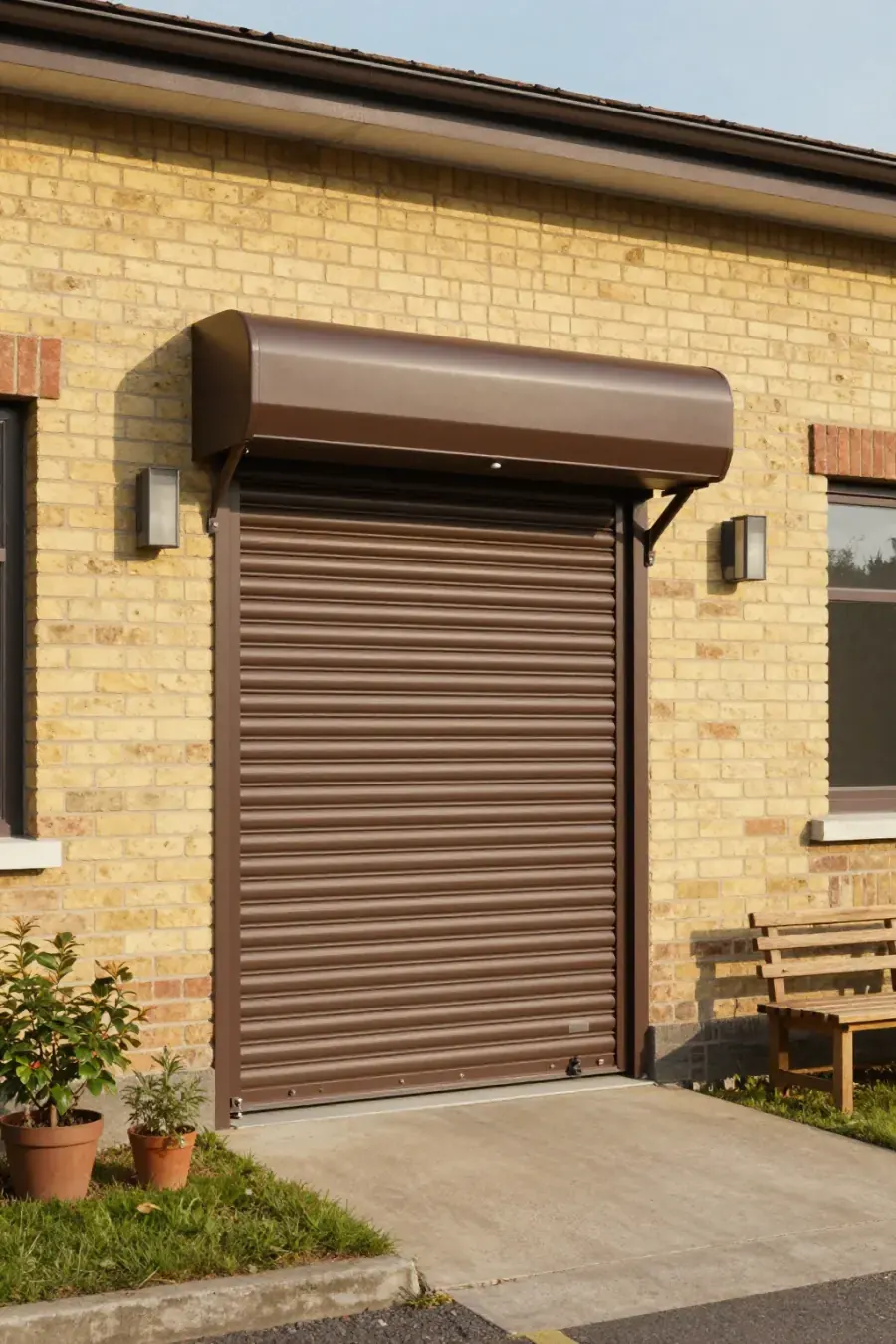

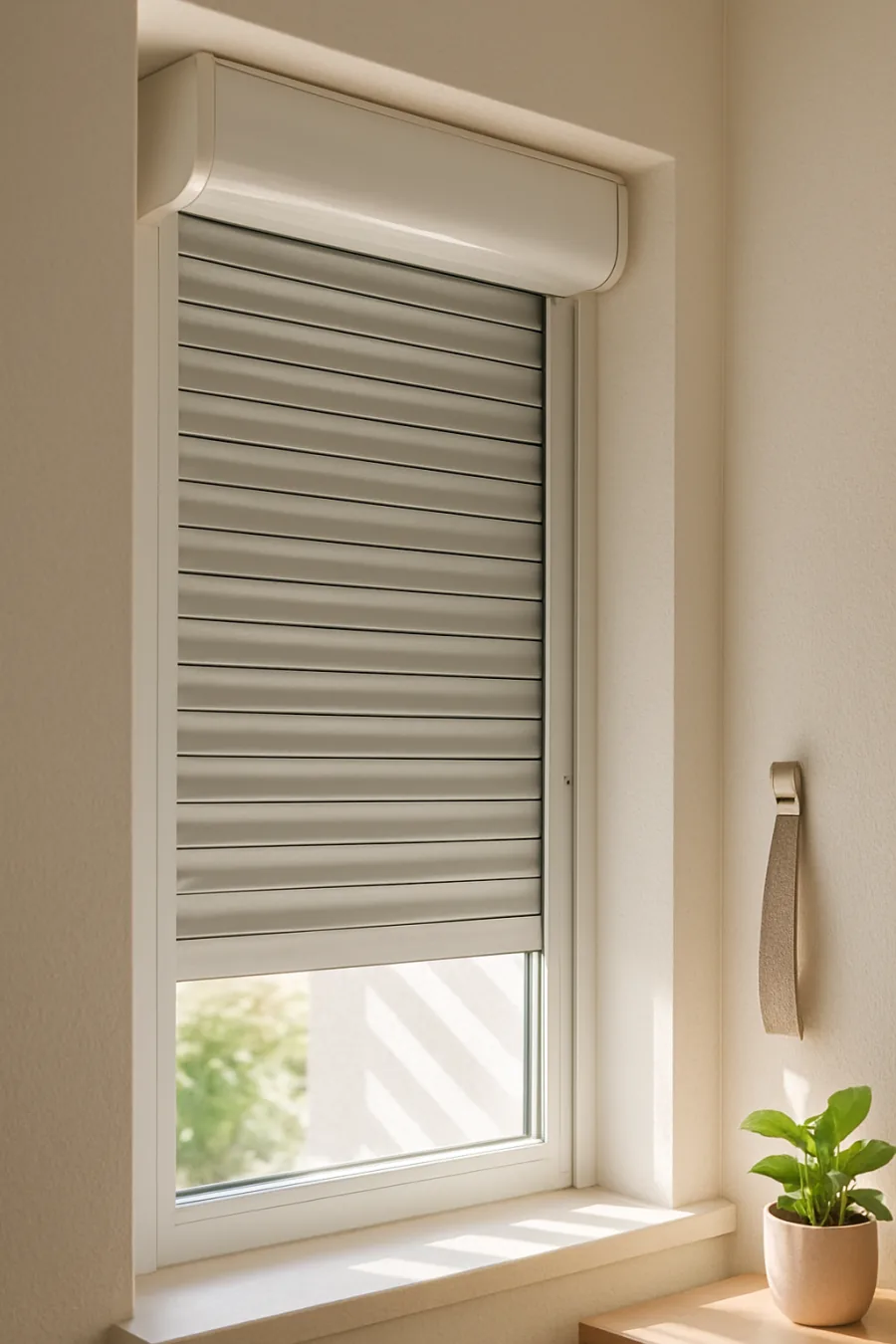


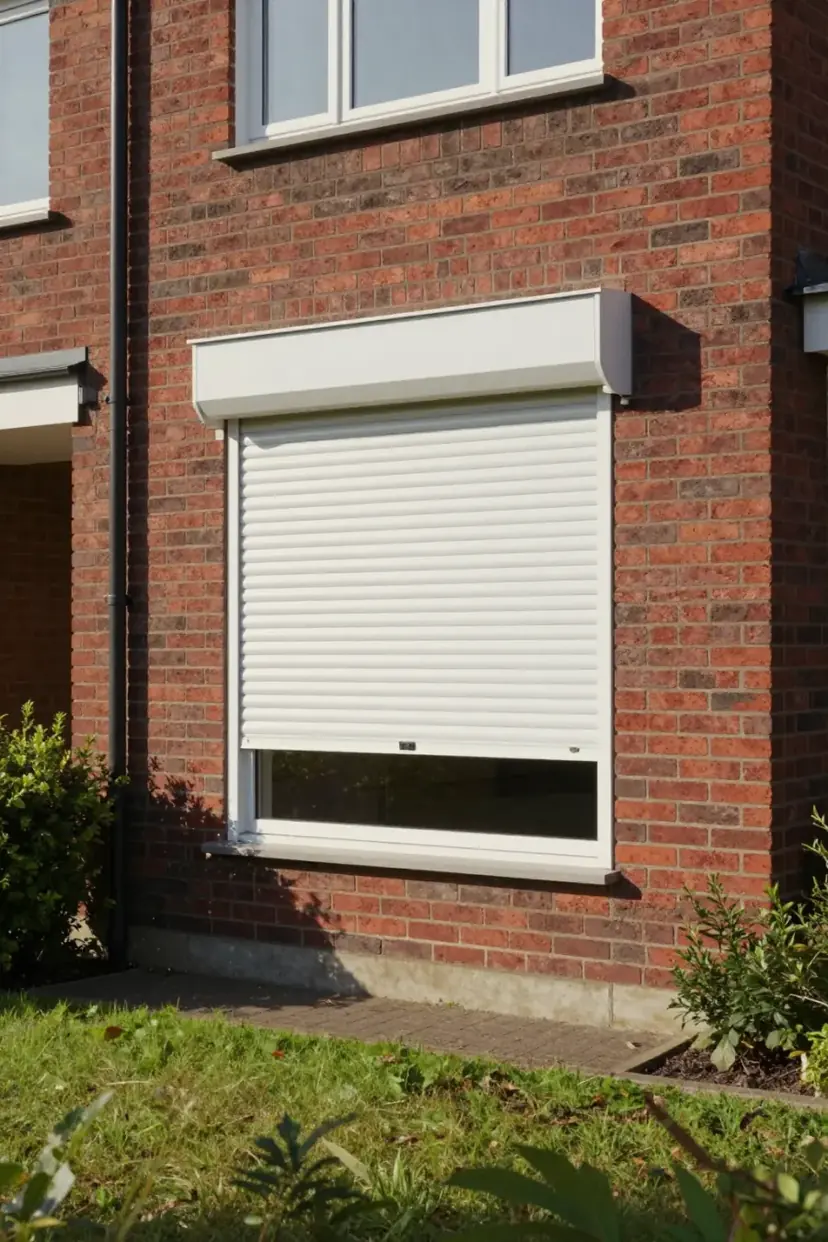


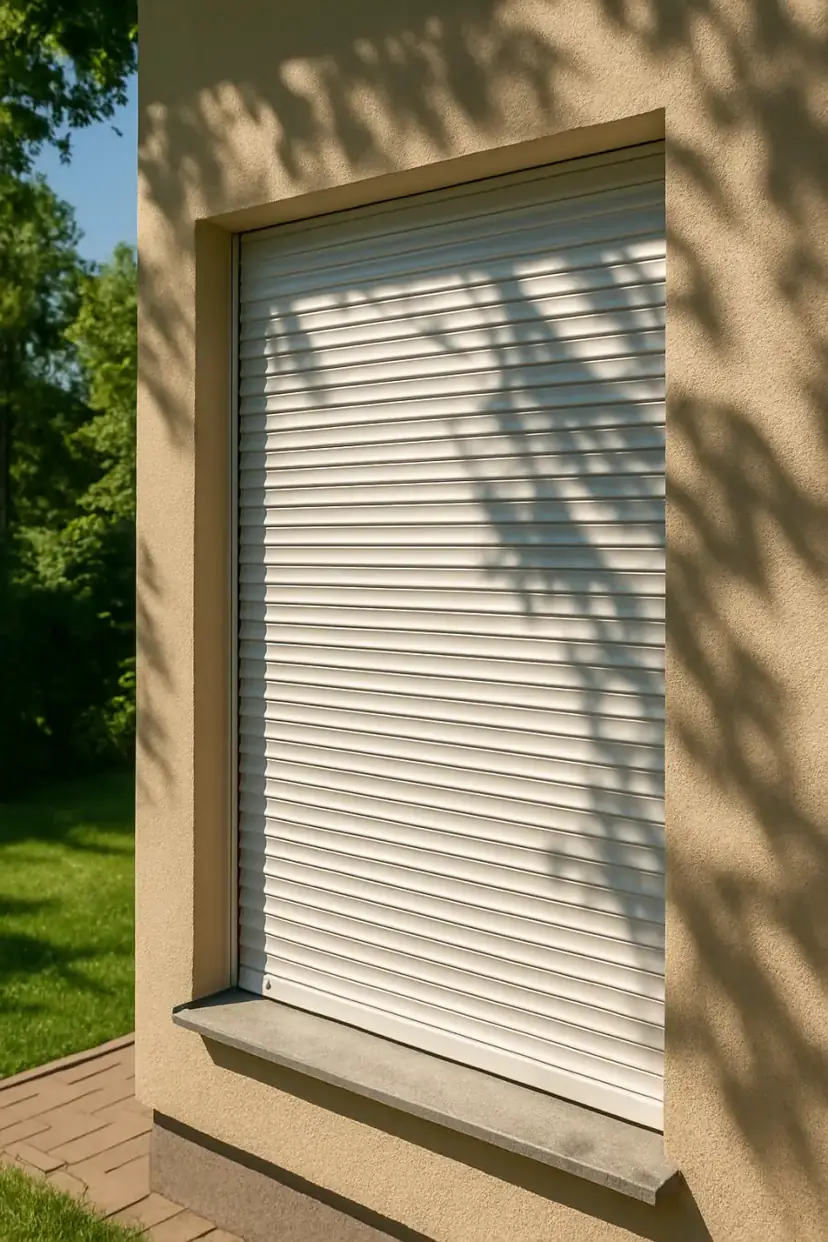











Vertical roller shutters in Almaty close a tall opening with a curtain that rises up along the guide rails and goes into the housing box above the opening: floor space and the windowsill stay free. We manufacture such systems to measure — from 17,500 ₸/m², lead time 10–14 days, measurement and consultation are free.
Vertical roller shutters are a way of working, not a separate option
Vertical roller shutters are a roller shutter system in which the curtain rises up along the guide rails and goes into the housing box above the opening. Roller shutters never move sideways: a sliding structure, which people sometimes imagine by analogy with sliding doors, doesn't exist in retail in Almaty. And this isn't a feature of a particular manufacturer — it's how the product type itself is designed.
Vertical roller shutters are assembled from slats — narrow strips linked to each other into a single curtain. The slats are stacked in height, not in width. The edges of the curtain run along the guide rails — vertical profiles fixed on the sides of the opening. The roller tube is a tube in the roller shutter housing box, onto which the curtain is wound when raised. The roller shutter housing box sits on top and covers the roller tube together with the wound curtain. Our sun-protection engineer usually explains it like this: the curtain doesn't slide to the side, it rolls up overhead.
Jalusso installs such systems to measure — and almost always on a tall opening: a floor-to-ceiling window, a shop window, an entrance.
What the structure consists of
Slats are what you see from outside: strips joined into a single blind.
The roller tube is the axle inside the housing box onto which the blind is wound when raised.
Guide rails are two vertical profiles along the edges of the opening; the blind moves up and down along them.
The roller shutter housing box is the casing above the opening where the roller tube with the wound curtain is hidden.
Why “vertical” is about the movement, not the look of the product
The word “vertical” in the name describes the direction the curtain moves, not the appearance of the product. Vertical movement of the curtain is the only way a roller shutter system works: the curtain rises up along the guide rails and rolls into the housing box. That's why sliding roller shutters don't exist — neither from us nor from other manufacturers.
Vertical movement of the curtain frees up floor space and the windowsill: nothing slides to the side, blocks the passage or bumps into furniture by the window. For a tall opening, this is often the very reason for choosing a roller shutter system rather than hinged or sliding sashes.
Which openings vertical roller shutters close: floor-to-ceiling window, shop window, entrance, panoramic glazing
Vertical roller shutters are installed on openings taller than two metres — on a floor-to-ceiling window, a shop window, an entrance, panoramic glazing. An opening of that height requires vertical movement of the curtain: the slats go up along the guide rails into the housing box, not to the side, and don't bump into a wall, a shelving unit or the neighbouring glazing section. The measurer looks at the specific site and says how the curtain will behave at that height.
Residential scenarios: floor-to-ceiling window, balcony block, panoramic glazing
In a private house, a floor-to-ceiling window and a balcony block from floor to ceiling are the same task as a shop window: from below, the blind goes up, not to the side. Panoramic glazing sets us two tasks at once — protection from the sun and dust in summer and keeping the heat in winter. In such an opening, the guide rails run the full height, and the blind must move in them smoothly, without jerking in the middle. We work with panoramic glazing and at the measurement stage we check how the guide rails will sit. A case from practice: on a floor-to-ceiling window in a living room, it was important to us that the housing box didn't cover the top line of the glazing — the owner wanted to keep the view of the street.
Commercial scenarios: shop window, entrance, café terrace
A shop window and an entrance are openings of different shapes, and the weight of the blind in them is different. A shop window is usually a wide opening, so the blind is made up of more slats and is heavier. An entrance is more often narrow and tall — the weight here is less, but the height requires a sturdy guide rail so the blind doesn't sway. On a café terrace and veranda, wind load also matters: the blind stands outside and works all day. At the same time, the view has to be kept — that's why a shop window almost always uses a perforated profile rather than a solid blind.
Non-standard geometry: arched and sloped windows
An arched window and a sloped window are a separate category, and here we first come out to measure rather than quote a price over the phone. In an opening like this the blind can’t move in a straight line — some sections of the guide rails run along a curve or at an angle, others are straight. Our lead measurer Kirill handles non-standard windows: arched, triangular, mansard. We do make these openings, but the design is calculated only after the measurement.
Vertical travel of the curtain is needed where there is no room for a side roll: a floor-to-ceiling window, a shopfront, a terrace, an entrance, panoramic glazing are all closed with roller shutters that rise up into the housing box instead of moving sideways.
Height and weight of the blind: how they relate to the choice of mechanism
The taller and wider the opening, the heavier the blind, and it is the weight that determines whether a manual mechanism is enough or whether a crank winch or an electric motor is needed. The height of the opening and the width of the opening work as a pair: the blind is built up from slats in height and at the same time stretches across the width, so both dimensions add up to the total mass. There are no kilograms in the facts on this page — we give the final weight figure after the measurement, when we see the profile and the dimensions of the site.
Why a tall blind is heavier and what that changes
A roller shutter curtain is a set of slats, and each slat across the full width of the opening weighs the same, no matter what level it sits at. Add height — add slats. Widen the opening — each slat becomes longer and heavier. The weight of the curtain determines the choice of control mechanism: a light curtain on a floor-to-ceiling window in a living room is fine with a manual control, while a heavy curtain on a shopfront or terrace requires a crank winch or an electric motor.
Our selection logic is this:
- The measurer takes the height of the opening and the width of the opening and looks at which profile suits the task — foam-filled, extruded or perforated.
- From these two dimensions and the type of profile, the weight of the blind is calculated.
- The weight of the blind sets the mechanism: manual control with a strap, cord or chain, a crank winch for a heavy blind, or an electric motor with a remote control.
And the order is exactly that. First the size, then the weight, then the control — not the other way round. If a client asks for a motor right away, but by weight a manual mechanism is enough, we say so straight away at the measurement. In my view, a motor on a light residential window is an unnecessary expense that adds nothing to convenience.
Skewing and jamming: why guide rails and straight slats matter
The guide rails hold the blind at the sides and set its vertical travel. When they are set level and the slats are straight, the blind moves up and down without play. Skewing appears where the guide rails are not in the same plane or a slat has been bent. What happens then? The blind jams halfway up — forcing it up is useless, and on a tall opening this is especially unpleasant, because you can’t reach the jam point by hand.
This gives two requirements for installing a tall opening. The guide rails are fixed into a load-bearing wall, not into cladding or insulation — otherwise they will shift under load. And the blind is assembled from straight slats without bends, because one crooked slat drags the whole travel with it.
When one tall window is split into two independent blinds
A tall opening doesn’t have to be closed with a single blind. If a floor-to-ceiling window or shopfront allows it by design, Jalusso splits the opening into two independent blinds: each gets its own roller tube, its own guide rails and its own mechanism. The point is simple — the weight of each blind drops, and manual control is again enough for them instead of a motor.
People also choose this option for another reason. In the morning in a kitchen or a café only the lower part is opened — light and air come in, the top stays closed. The second blind works on its own. The only thing to keep in mind: an intermediate post appears between the blinds, and it is visible on the façade. This solution is a compromise, not a free win.
The taller and wider the opening, the heavier the blind, and it is the weight of the blind that determines whether manual control is enough or whether a crank winch or an electric motor will be needed.
Where the blind goes when it rises and how much space the housing box takes
When raised, the curtain of vertical roller shutters winds onto a roller tube that is fixed in the housing box above the opening. Nothing is left at the bottom: no guide rail on the floor, no folded slats off to the side. The roller shutter housing box is the roller shutter cabinet, a metal enclosure with the roller tube and the wound curtain hidden inside.
On a tall window this is far more noticeable than on an ordinary one. The taller the opening, the more slats wind onto the roller tube and the bulkier the housing box. It takes up space at the top of the façade — above the frame, under a canopy or at ceiling level. The windowsill and the floor space stay free, and that is the main reason a vertical system is chosen for a floor-to-ceiling window.
Does the housing box press on the opening? The box itself presses on nothing: it is fixed to the wall or to the frame, not resting on the window. The question is different — whether it will visually eat up part of the façade. That is decided by the installation method.
How the blind winds onto the roller tube
The slats are joined to each other into a single blind and rise from the bottom up — one by one, lock by lock. On the roller tube they lie in turns, layer after layer. The roller tube rotates in bearings inside the housing box, so the whole lifting mechanism is hidden in the upper part of the structure.
When raised, the blind slides along the guide rails that hold it at the sides. The guide rails keep the slats from spreading sideways and take part of the load off the roller tube.
Surface-mounted or built-in housing box: what to choose on a finished site
On a finished window or shopfront, a surface-mounted housing box is more often installed — it is fixed on top of the wall, without opening up the façade or touching the insulation. Simple, fast and no window reveal repairs.
Built-in and concealed installation puts the housing box inside the wall or into a niche under the ceiling: only the blind is visible from outside. This option is planned at the design stage or when there is already a ready niche above the opening. On a finished site it requires chasing and finishing, so we tell the customer straight away: first the measurement, then the decision. A built-in housing box doesn’t remove the blind — it only hides the cabinet from view.
The blind winds onto a roller tube in the housing box above the opening, so the windowsill and the floor space stay free, while the housing box takes up space at the top of the façade.
Profile for the task: roll-formed foam-filled, extruded aluminium, perforated
The material of the slat determines the weight of the blind, and the weight of the blind determines which mechanism will be needed and whether the profile suits the specific opening. Jalusso works with three types of profile, and the difference between them is not in colour or price, but in the rigidity of the slat and in what it lets through.
| Profile | Fabric weight | Task | Control |
|---|---|---|---|
| Roll-formed foam-filled | light blind | windows, residential openings, floor-to-ceiling windows | manual, chain |
| Extruded aluminium | rigid heavy slat | shopfronts, garages, ground floors, terraces | crank winch or electric motor |
| Perforated | medium | a shopfront where visibility is needed, bathrooms | manual, chain, motor |
What to choose for a window and what for a shopfront
The roll-formed foam-filled profile is a lightweight curtain for windows and residential openings. Inside each slat there is an air layer, so this roller shutter runs quieter and does not overload the roller tube on a tall sash. For a floor-to-ceiling window in a living room we usually fit exactly this one.
Extruded aluminium is heavier than the roll-formed foam-filled profile: it is a rigid slat that holds its shape on a large vertical opening. A shopfront, a garage and a ground floor without security are closed with a security blind — and almost always with a deadbolt lock: it locks the slats to each other and stops the blind from being lifted from below. Such a blind cannot be lifted by hand, so here you need either a crank winch or an electric motor.
And if the shopfront has to stay a shopfront during the day? Then a perforated profile is chosen. A perforated profile keeps the shopfront visible and lets air through — for a café with floor-to-ceiling glazing this is noticeable: heat does not build up inside, and passers-by can see the room.
There is no universal profile — there is the task, the weight of the blind and the place where it is fitted.
Manual mechanism or electric motor: how to choose the control
An electric motor is not essential on a tall opening. Vertical roller shutters can be raised by hand too — with a strap, a cord, a chain or a crank winch, and all of these work without electricity. A motor is needed when the weight of the curtain becomes such that pulling it every day is inconvenient. The control is chosen by the weight of the curtain, not by the height of the opening alone.
The logic is this. The heavier the blind, the more effort the lift requires and the more often the manual option gives way to a motorised one.
Manual options: strap, cord, chain, crank winch
A strap, a cord and a chain are the simplest mechanical control. No electrics, no remote controls, you raise and lower by hand. A chain is more convenient where the blind is light: on a floor-to-ceiling window in a living room, on a balcony unit from floor to ceiling.
A crank winch is fitted on a heavy blind. It is a manual drive with gearing that reduces the effort on the hand, and on a large vertical opening it genuinely helps. We usually offer it exactly where a light chain no longer copes, but the owner is not yet ready to install a motor.
When a motor is really needed and when it is money wasted
An electric motor includes a remote control, emergency lifting, a schedule and a sun sensor. And the schedule and sensor are not decoration: on a shopfront the blind lowers by itself at closing time, and on panoramic glazing it goes down when the sun starts to beat. In my view, money wasted is a motor on a light floor-to-ceiling window in a living room that is raised once a day.
A power cut requires emergency manual lifting, and this is provided for in an electric motor — almost everyone asks about it.
Vertical roller shutters can be raised by hand without electricity, a crank winch is chosen for a heavy curtain, and an electric motor adds a remote control, emergency lifting, a schedule and a sun sensor.
Installation on a tall opening: surface-mounted, built-in and concealed
Roller shutters on a finished window or shopfront are fitted surface-mounted: the housing box is fixed onto the wall, the wall is not opened up, and the window reveals and insulation stay untouched. Built-in and concealed installation require a niche for the housing box, which is provided for at the stage of masonry or framing. On a finished site there is no such niche — and we do not advise making one after the fact: dust, chasing, repairing the reveals.
On a tall opening the guide rails are fixed into the load-bearing wall through the insulation. Exactly like that, and not into the cladding. A tall blind presses on the guide rails along their whole length, and the fixing point must sit in the structural base, not in the decorative layer. This point is the main difference between installing a tall opening and an ordinary window, where fixings at the edges are enough.
The order of work: measurement, manufacturing, installation
- Measurement. The measurer arrives with profile samples, looks at the opening, the wall and the space for the housing box, and calculates the cost on the spot.
- Manufacturing. The product is made to the dimensions of the site — we do not keep ready-made ones in stock.
- Installation. We fit the housing box and guide rails, set the blind, and check that it runs over the full height.
Measurement comes before calculating the cost by size: until the height, width and wall type are known, there is no point in naming an exact sum. We give an approximate price straight away — it is enough to make a decision.
How installing a tall opening differs from an ordinary window
A tall opening requires intermediate fixing points for the guide rails along the height, not just at the top and bottom. A blind on a tall guide rail works like a lever, and without intermediate fixings the bottom drifts to the side. Plus the weight itself: it is easier to fit the housing box and feed the blind with two people.
Surface-mounted installation is fitted onto a finished opening without opening up the wall, and the guide rails are fixed into the load-bearing wall through the insulation — on a tall opening this is the main condition for the blind running straight.
How much vertical roller shutters cost in Almaty and how the price is calculated
The price of vertical roller shutters is calculated by the area of the opening and the type of profile. We multiply the height by the width, get the square metres — and then everything depends on which curtain you have chosen and which mechanism you are going to raise it with.
| Fabric type | Price per m² | Manufacturing time |
|---|---|---|
| Roll-formed foam-filled profile, mechanism included | from 17,500 ₸ | 10–14 days |
| Protective, extruded aluminium — shop windows, garages, ground floors | from 24,900 ₸ | 12–16 days |
| Perforated, perforated profile — the shop window stays visible, air passes through | from 27,800 ₸ | 12–16 days |
| With electric motor — motor, remote control, emergency lift, schedule and sun sensor | from 35,000 ₸ | 14–18 days |
How the area of the opening turns into a price
The taller the opening, the larger the area and the heavier the blind. The weight of the blind brings the mechanism with it: a light one is fine with a strap or a chain, a heavy one needs a crank winch or an electric motor, and that is already a different coefficient. For an electric motor it is 1.85, for the version with a remote control — 2.1. Installation is also included in the calculation: onto a wall ×1.0, onto a frame ×1.05, without drilling ×1.1, cassette system ×1.28.
Let us work it out on our fingers. A shopfront with a blind made of extruded aluminium and an electric motor is the base rate for a security profile multiplied by the control coefficient. That way the customer immediately sees where the total comes from, instead of getting a single figure with no explanation.
The height of the opening affects the price not by itself, but through the weight of the blind and the choice of control. That is exactly why Jalusso does not quote a price over the phone “by eye”, but first calculates the square metres.
Measurement and delivery in Almaty and to the suburbs
Measurement and consultation are always free. The measurer arrives with profile samples, shows them on site and calculates the cost right there, to your dimensions. Measurement comes before calculating the cost by size — without it any figure remains a guess.
Within the city, measurement and delivery are free. We also travel to Kaskelen, Talgar, Issyk and Kapshagay: the price depends on the distance, and we tell you it in advance, before the visit.
Installation costs 4,500 ₸ per product. For orders from 150,000 ₸ installation is free. We keep the roller shutter mechanism under warranty for 3 years, and the installation work for 1 year, and both periods count from the day the acceptance certificate is signed.
You can order vertical roller shutters to your own dimensions directly from us: we are the manufacturer, we have our own workshop in Almaty, and there are no middlemen between measurement and installation. The client writes on WhatsApp, describes what needs to be closed — a window, a shopfront, a door or a tall opening — and we give an approximate price straight away.
The price of vertical roller shutters is made up of the area of the opening, the type of profile and the control coefficient: from 17,500 ₸/m² for the roll-formed foam-filled one, from 24,900 ₸/m² for the security one made of extruded aluminium, from 27,800 ₸/m² for the perforated one, from 35,000 ₸/m² with an electric motor.
A shop window and a floor-to-ceiling window: how the two scenarios differ
A shop window is closed with a protective or perforated curtain with a deadbolt lock, while a floor-to-ceiling window in a home gets a lightweight profile. The roller shutter housing above a shop window is mounted on the surface and often brought out to the street; above a floor-to-ceiling window the housing is hidden in the ceiling or in a recess under the slab. The controls differ too: a shop window almost always gets an electric motor, while on a floor-to-ceiling window a manual mechanism is often enough.
A shop window faces the street. Its blind takes the wind load across its whole surface, so the slat is a rigid one — extruded aluminium. A perforated profile is kept where you need to preserve the view and let air through: by day the shop window stays visible, at night it closes tight. A deadbolt lock adds protection for ground floors and shop windows — it holds the blind in the guide rails, and it can no longer be shifted from outside.
A floor-to-ceiling window is a residential scenario. Here what matters more is not protection from break-ins but sun, dust and the view from the window. A lightweight blind on such an opening rises up along the guide rails without effort, and the opening itself reads as part of the wall. Panoramic glazing sets the same task of protection from sun and dust, only there are several blinds — one per glazing section.
A case from practice: a shop window and a floor-to-ceiling window in a living room
I’ll go through two typical situations that people come to us with most often.
A shop window on the ground floor. The opening is wide and tall, the glass faces the street. What changes: the profile is a protective one made of extruded aluminium or a perforated one, the roller shutter housing is surface-mounted outside, the controls are an electric motor, because the salesperson opens the shop window every day and lifting a heavy curtain by hand is inconvenient. We add a deadbolt lock: it holds the curtain and adds protection from break-ins.
A floor-to-ceiling window in the living room of a private house. The opening is tall too, but it faces the courtyard. What changes: the profile is a lightweight roll-formed foam-filled one, the housing goes into the ceiling or into a recess above the window, the controls are a chain or a manual mechanism. A motor isn’t needed here: the blind is light, it rises smoothly, and the window is opened less often than a shop window.
The same vertical travel of the blind solves two different tasks: a shop window is closed against break-ins, a floor-to-ceiling window against sun and dust.
In winter, in frost and in dust: how the system behaves in the Almaty climate
In winter a tall blind behaves differently from an ordinary window: the slats and guide rails cool down in the frost, the metal contracts, and the blind moves more stiffly. It doesn’t jam any more than a blind on an ordinary window — it’s the travel itself that gets harder, not the weight. The difference is felt on a long blind: the greater the height of the opening, the more noticeable the resistance in the guide rails.
Frost changes how the blind moves in the guide rails, and this is the first thing to consider in use. The rule is simple: in the cold, raise it smoothly, without jerking. A sharp movement in the frost causes the slats to skew, and the blind can stop halfway up. You must not pull it out of the guide rails by force — the mechanism doesn’t benefit from that.
The dust and sun of Almaty are the second load. Our guide rails are closed, so dust and snow hardly get inside the mechanism. In summer the slats heat up and fade: light colours hold their colour longer, dark ones on the sunny side lose it faster. What’s more, the fabric fades along the whole height, not only where the curtain stands open. Caring for roller shutters comes down to three actions: wipe the slats with a soft cloth, don’t pour water into the guide rails, and call us once a year for tightening and adjustment.
For example, on a terrace and on a floor-to-ceiling window on the south side we recommend a light profile not because of the price but because of the heating: a dark slat heats up more in the sun, and the blind becomes stiffer to move.
The guide rails are closed, so dust and snow hardly get inside the mechanism, and in winter the curtain is raised smoothly, without jerking — these are the two conditions under which vertical roller shutters in Almaty last the whole season without trouble.
Warranty, care and what to do after the warranty
On vertical roller shutters we give a 3-year warranty on the mechanism and 1 year on installation from the date the acceptance report is signed. If the roller shutters break through our fault, we’ll repair them within 5 working days and won’t charge for the repair. Caring for roller shutters comes down to a few simple actions, and that’s enough for the system to work for years.
How long vertical roller shutters last depends not so much on the profile as on the conditions at the site. Smooth travel in the guide rails, an even curtain without scratches, careful raising — that’s what extends the service life. A balcony block from floor to ceiling in a city apartment is serviced just like a shop window or a floor-to-ceiling window in a private house.
What the warranty covers and what it doesn’t
- The warranty covers the mechanism and installation: the roller tube, guide rails, lock, and the operation of the motor.
- It doesn’t cover mechanical damage — impacts, snags, marks from attempts to take the system apart.
- It doesn’t cover reinstallation on your own: if the product was removed and put back by yourself, the installation warranty is void.
- It doesn’t cover water and natural fading of the fabric: the colour of the blind lightens over time in the sun, and this isn’t considered a defect.
Service after the warranty: tighten, adjust, replace the cord
After the warranty we still come out. Tightening loose fastenings, adjusting how the blind moves, replacing the cord or chain — we do this kind of work years after installation too. In my view, that’s more honest than promising it will work forever without servicing.
The warranty is 3 years on the mechanism and 1 year on installation from the date the acceptance report is signed, and we fix a warranty case free of charge within 5 working days.
FAQ
Vertical roller shutters rise up along the guide rails and go into the housing above the opening — that’s their main difference from systems with side travel. Below are short answers to what people ask most often.
Are there roller shutters that move sideways?
In Almaty retail — no. The difference between vertical and horizontal travel is only in the direction the curtain moves: with vertical roller shutters it’s built up from slats in height and goes up and down along the guide rails, rather than rolling off to the side. That’s exactly why such a system suits a tall opening where there’s no room for a side roll: a floor-to-ceiling window, a shop window, a terrace, an entrance. There’s no sliding, horizontal design as a separate product on the market — it’s a different way of working, not a different type of roller shutter.
Where does the blind go when it’s raised?
The curtain winds onto a roller tube fixed in the roller shutter housing above the opening. The floor space and the windowsill stay free. The housing does take up space at the top of the façade, and the taller the opening, the bigger the housing — this is worth planning for in advance.
Do you need a motor on a tall opening?
Not necessarily. An electric motor is needed when the blind is heavy or has to be raised often — for example, on a shop window. On a residential floor-to-ceiling window a manual mechanism is often enough: straps, a cord, a chain, and on a heavy blind a crank-and-cardan. A motor with a remote control, a schedule and a sun sensor is chosen when you want to control the system without leaving the house.
Can roller shutters be fitted to a finished opening without reworking the wall?
Yes. On a finished site we most often do surface mounting: we fix the housing on top of the wall, leave the window reveals and insulation untouched, and run the guide rails into the load-bearing wall through the insulation. Recessed and hidden options are possible, but they’re planned before finishing.
How is the price calculated?
By the area of the opening and the type of profile. Roll-formed foam-filled — from 17,500 ₸/m², protective extruded aluminium — from 24,900 ₸/m², perforated — from 27,800 ₸/m², with electric motor — from 35,000 ₸/m². We give the exact price after the measurement: our measurer comes with samples and calculates on site, and the measurement and consultation are free.
What happens during a power outage?
A system with an electric motor includes an emergency manual lift — the blind can be opened while there is no power. This is one of the reasons we install the motor together with an emergency lift, not instead of it.
The colour of the blind is matched to the facade or window frame: this is a matter of the order, not of how the mechanism works, and it is decided at the measurement.
Conclusion
Vertical roller shutters are a curtain that rises up along the guide rails and goes into a housing box above the opening. The floor space and the windowsill stay free, and that is exactly why this system suits a tall opening: floor-to-ceiling windows, shopfronts, entrance areas, panoramic glazing.
The weight of the blind is the main limiting factor when choosing the mechanism. The taller and wider the opening, the heavier the blind, and the more often a crank drive or an electric motor is needed instead of ordinary mechanics. At the same time, a motor is not obligatory: it is worth going for it when the opening is used often or the blind is too heavy for manual lifting. If you are unsure where this line falls, the measurement gives the answer — based on the actual size, not by eye.
The profile is chosen by the task. Roll-formed foam-filled — for windows and residential openings. Extruded aluminium — for large vertical openings, shopfronts and ground floors without security, often with a deadbolt lock. Perforated — where the shopfront should stay visible and air should pass through.
The price is calculated by the area of the opening and the type of profile: from 17,500 ₸/m² for roll-formed foam-filled, from 24,900 ₸/m² for protective, from 27,800 ₸/m² for perforated, from 35,000 ₸/m² with electric motor. Installation — 4,500 ₸ per unit, free for orders from 150,000 ₸. Manufacturing time — 10–14 days for the basic profile and 12–18 days for the other options. Warranty — 3 years on the mechanism and 1 year on installation.
Our advice is simple: message us on WhatsApp, describe what you need to cover — a window, a shopfront or a tall opening — and what kind of control you want. We will give you an approximate price right away, and we come for the measurement free of charge in Almaty, and to the suburbs — Kaskelen, Talgar, Issyk, Kapshagay — with a call-out fee based on distance.

