










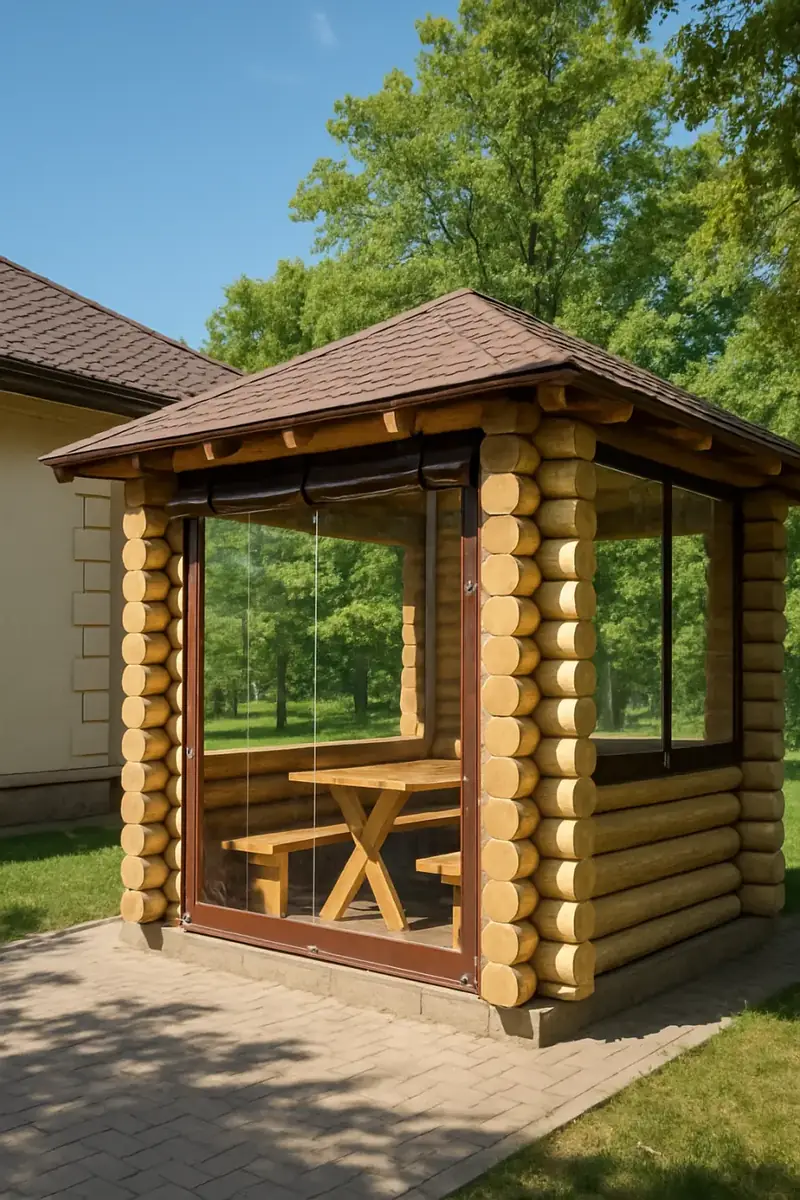

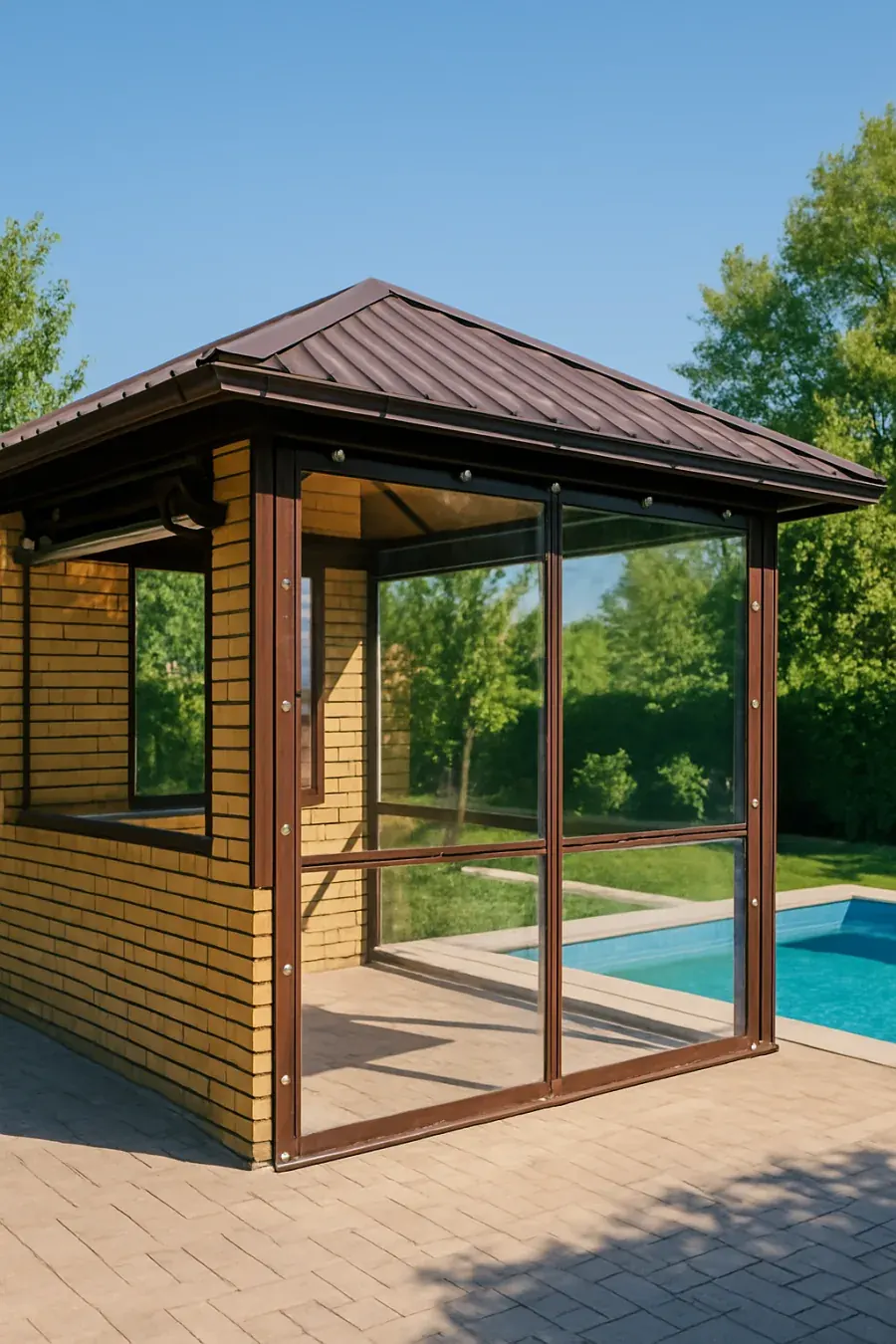











Roller blinds for a gazebo in Almaty are either fabric on a tube in a cassette with guide rails, or transparent PVC film with eyelets that is rolled up by hand and tied with straps. We make both designs to measure in our own workshop: outdoor option — from 14,500 ₸/m², manufacturing in 10–14 days.
What a roller blind for a gazebo is and why these are two different constructions
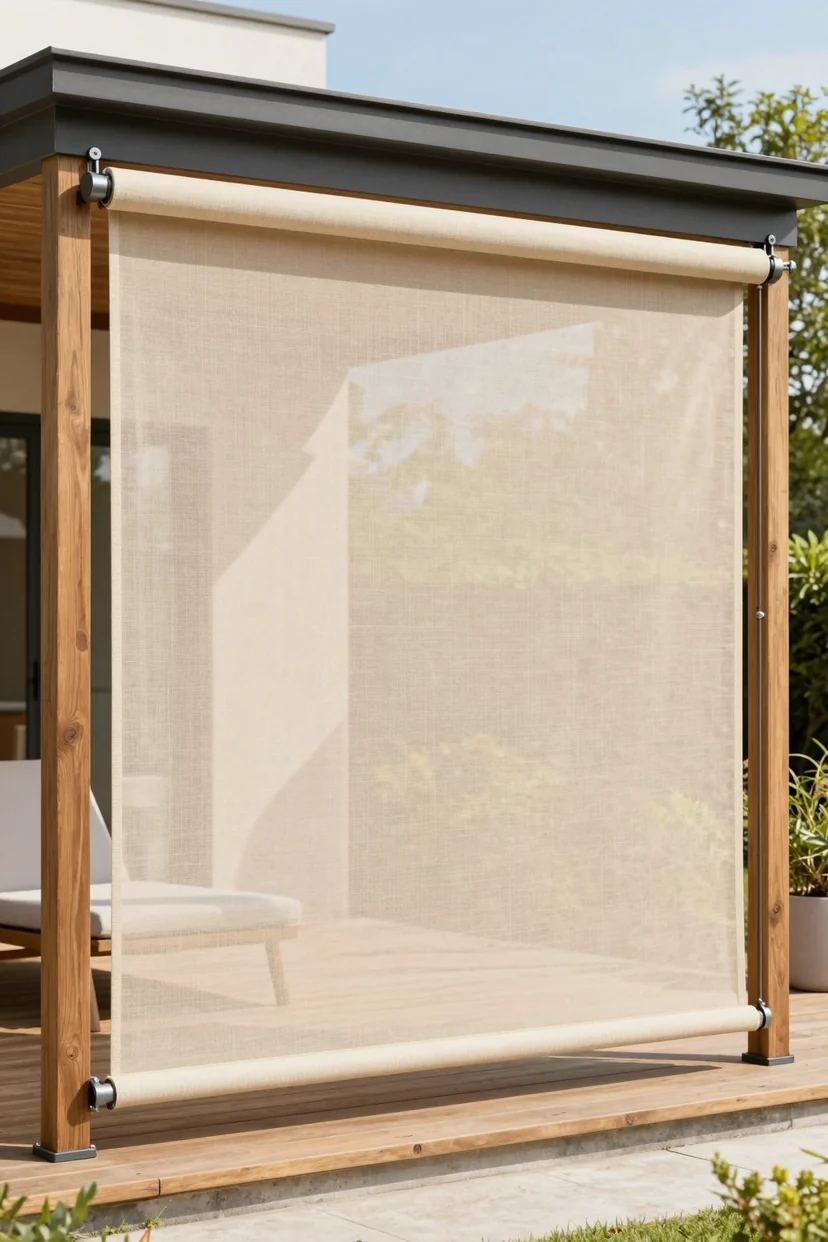
A roller blind for a gazebo is a fabric panel that closes the opening between the posts and rolls up when the gazebo is open. Under this name we make two different constructions: a fabric panel on a roller tube in a cassette, and a soft window made of PVC film. The first is raised with a chain, a spring or a motor. The second is rolled up by hand and tied with straps. They should not be confused — the type of construction determines the fixings, the price, and how you will use it every day.
The difference comes from the gazebo itself. A terrace or veranda has a wall or at least a flat surface to which the blind cassette is fixed. A gazebo has no solid wall: everything rests on the posts and the frame, and there can be six or eight sides, each needing its own blind. That is why roller blinds for a gazebo in Almaty are most often made in the two versions described below.
- A fabric panel on a roller tube — screen, dim-out or a ZIP system in a cassette with guide rails at the edges.
- A soft window — transparent PVC film with fabric edging and eyelets, without a roller tube or cassette.
Fabric panel on a roller tube: screen, dim-out, ZIP
A fabric panel on a roller tube is wound onto a roller tube inside a cassette, with guide rails at the edges, and is raised by a chain or a motor. Two types of fabric are used: screen lets air through and softly shades, dim-out shades densely and hides the gazebo from view. A ZIP system is the same blind on a roller tube, but the fabric runs into the guide rails at the edges and is held in them. Because of this, a ZIP system requires a flat surface for the guide rails: if the posts are warped, the fabric will not run in them.
Soft window made of PVC film on straps
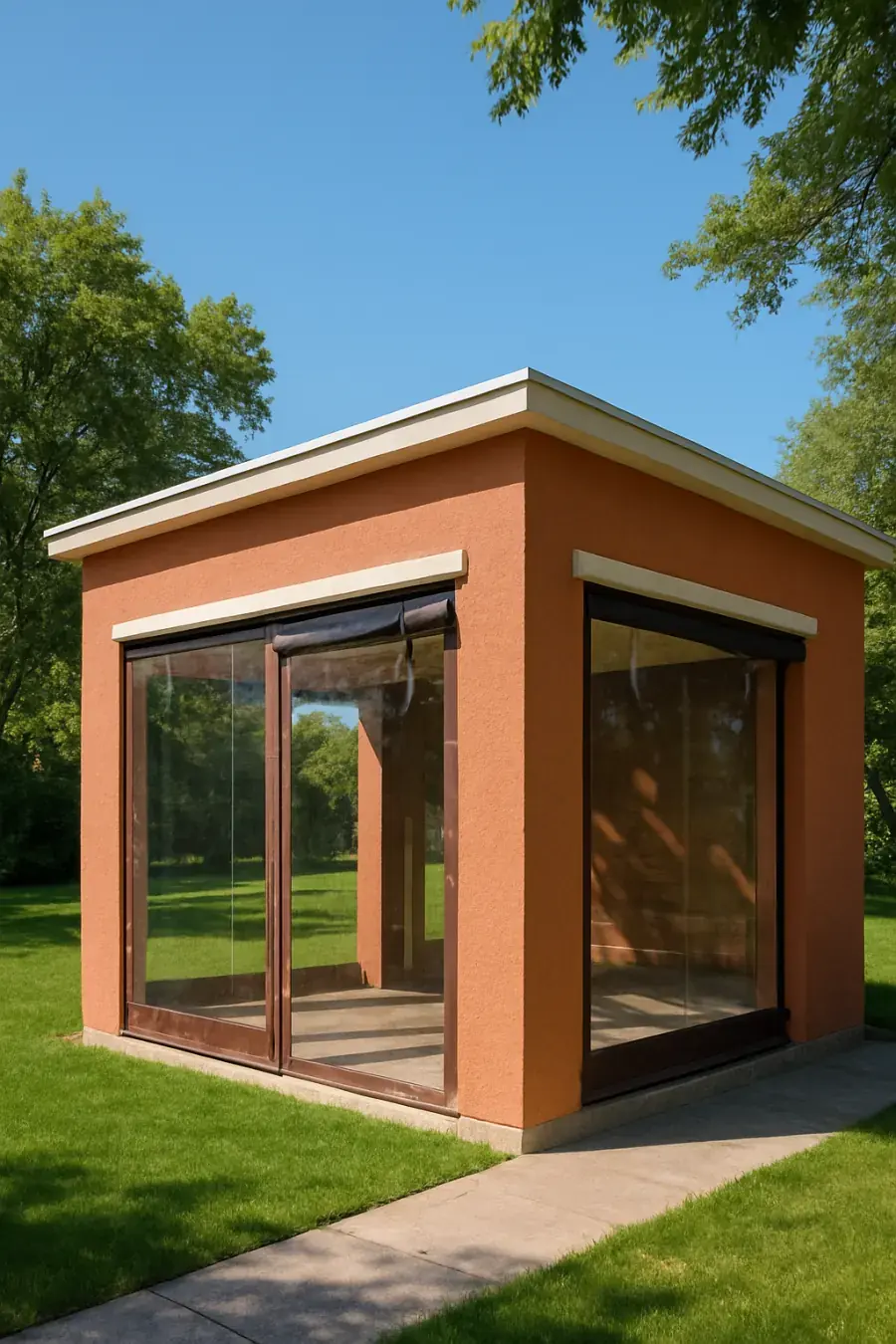
A soft window is transparent PVC film with fabric edging and eyelets along the edge. The panel is fixed to the frame along its entire edge through the eyelets, and the rolled-up blind is held by two straps with buckles. This is not a blind on a roller tube: there is no roller tube or cassette here, and it is raised by hand. The film stops the wind and does not block the view, so it is chosen for evenings and the shoulder seasons.
We make both constructions to measure in our own workshop: the measurer looks at the posts, the frame material and the number of sides and suggests what goes where. A gazebo has no solid wall to which the blind cassette is fixed, so everything rests on the posts and the frame, and each side gets its own panel.
What to choose for a gazebo: PVC film, mosquito net or dim-out
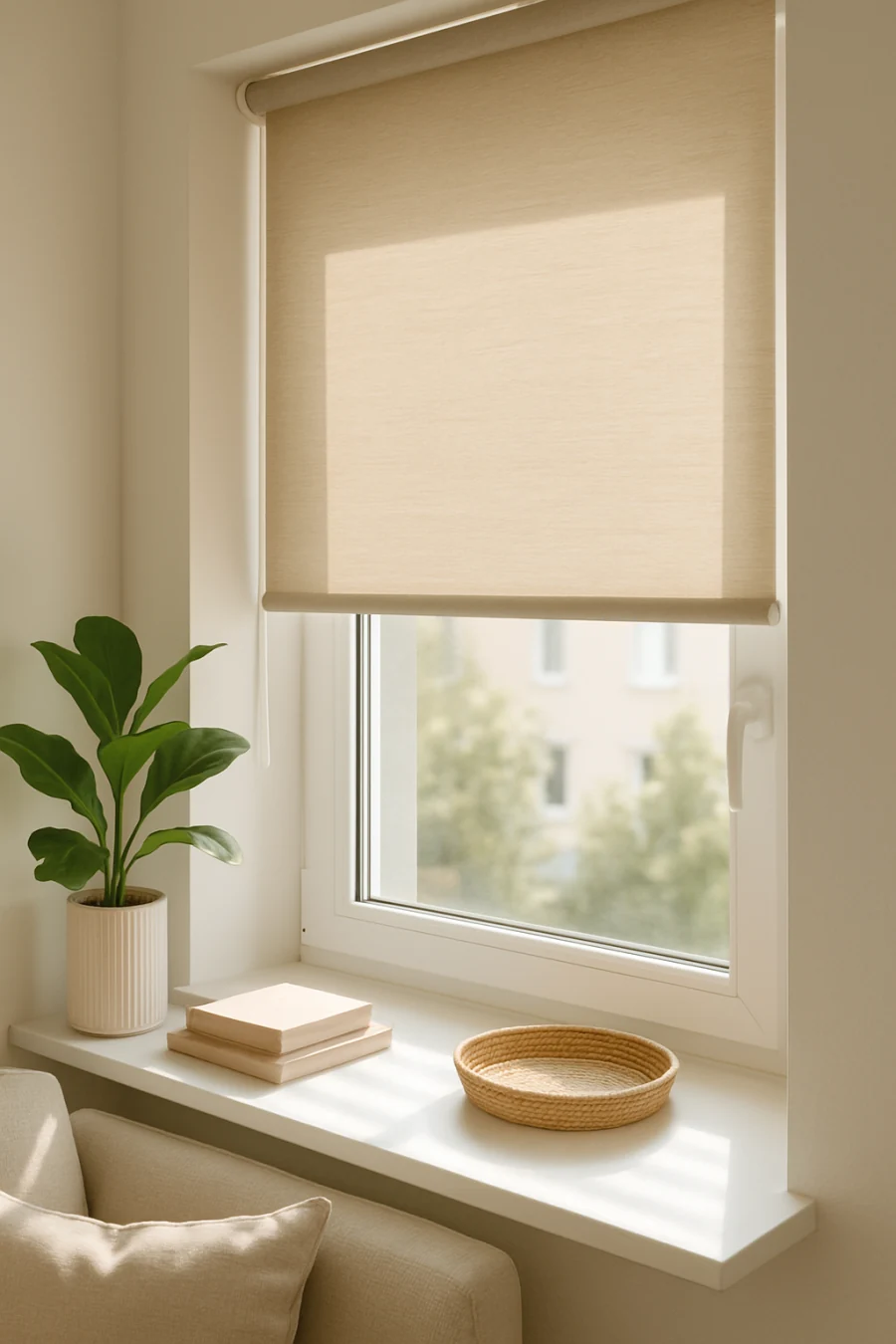
The choice for a gazebo is not decided by “which material looks nicer” but by what exactly is stopping you from sitting there: wind, mosquitoes or sun. PVC film stops the wind and does not block the view of the garden, a mosquito net keeps out mosquitoes and midges and lets air through, dim-out fabric shades heavily and hides the gazebo from prying eyes. Screen fabric is a different kind of shading: it is semi-transparent, the garden is visible through it as if through a haze, and in the outdoor price list screen is one of the fabrics for the cassette system.
For clarity — four fabrics side by side:
| Fabric | What it does | What is visible from outside | Control |
|---|---|---|---|
| PVC film | Stops wind and splashes | Garden as if through glass | By hand, straps and eyelets |
| Mosquito net | Keeps out mosquitoes and midges | Garden visible, air passes through | Rolled onto a roller tube |
| Dim-out fabric | Shades heavily | Garden almost invisible | Rolled onto a roller tube |
| Screen fabric | Shades moderately | Garden as if through a haze | Rolled onto a roller tube |
Look at the table by the “what is visible from outside” column: that is what separates the materials. Dim-out fabric shades the dining area so that from the street the gazebo looks closed — it is chosen by those who need to hide from the neighbours’ eyes. A mosquito net lets air through, but does not fight the wind at all: it does not stop it. PVC film is the only one here that stands as a wall against the wind.
The mangal needs a separate discussion: its place is moved outside the transparent wall. If you put the mangal outside, smoke does not drift into the gazebo, heat does not reach the fabric, and the transparency is preserved. If the mangal is already inside, dim-out fabric should not be hung right next to it — I say this not as a theorist but from measurement experience: the measurer looks at where the smoke goes before suggesting a panel for that side.
What to install by a pool and by a river
By the water it is cool towards evening, and splashes from the pool reach the table — PVC film stops both wind and splashes, and the view of the water remains. A mosquito net is chosen less often by the water: it does not protect from the evening chill at all.
Can the fabric be changed by season
On one opening, film and net can be swapped by season, but these are two separate products and two sets of fixings, not one “two-in-one” panel. The measurer looks at the opening and says what can realistically be hung on it: sometimes the post construction allows both panels, sometimes only one.
PVC film stops the wind and does not block the view, a net keeps out mosquitoes and lets air through, dim-out shades heavily and hides the gazebo from view.
Which sides to close: wind, sun, neighbours, mangal
You do not need to close every side one after another. First we look at where the cold drifts in from in the evening and where the mangal stands, and only then decide which side of the gazebo gets a panel. Roller blinds for a gazebo solve three different tasks: stopping the wind, shading the dining area and hiding the yard from prying eyes. These are three different places on one structure.
The choice follows four steps.
- The windward side. It is closed first: that is where the wind puts load on the wide panel and where the cold drifts in from in the evening. On this side we install a system with guide rails or a bottom tensioner so that the panel does not flap.
- Sun. We look at where the shadow moves during the day and cover the side where the sun stays longest — usually the south or west side. A dim-out or a dense screen fabric works well here.
- Neighbours and the street. The side facing a neighbour’s yard or the road is covered with a dense fabric. Clear PVC film doesn’t solve this — you can see through it just as well as without it.
- The mangal. The side with the mangal is a separate matter, more on that below.
Now about saving. Closing all sides won’t come cheaper: each side is its own product, its own fasteners and its own installation. It’s more sensible to start with two or three sides: the windy one, the sunny one and the one facing the neighbours. The rest can be added later — Jalusso works by measurement, and a repeat visit to a gazebo it has already measured is charged as it is.
On a hexagonal gazebo each of the six sides gets its own blind — you can’t run a single rail all the way around. You open it from the leeward side: then there’s still airflow in the gazebo, but no draught. With eight sides the logic is the same. We install wide openings exposed to wind as a pair of fabrics, so each one is narrower.
Should you raise the blinds at night or leave them down? If it’s windy at night, it’s better to raise the fabric — that way it wears less. On a warm, windless night a lowered blind keeps the mosquitoes out and doesn’t let the cool air in from outside.
Gazebo with a mangal
The mangal is left outside the clear wall — then the smoke doesn’t drift into the gazebo and the heat doesn’t reach the fabric. The side with the mangal isn’t covered with fabric right next to the heat: dim-out and screen fabrics are damaged by close fire. If the mangal is inside the gazebo, that side is left open or fitted with PVC film with a gap from the firebox. The measurer looks at where the smoke goes and suggests a solution for each side.
How to attach a blind to a gazebo: timber, metal profile, without drilling
The bracket for outdoor roller blinds for gazebos is attached to the gazebo’s post or beam — the housing box and guide rails hang on the frame, not on a wall, which an open gazebo doesn’t have. The fasteners are chosen for the post material: timber takes one type of fixing, metal profile another. The measurer looks at what there actually is to screw into, and suggests the system based on that.
- Timber gazebo. Wood takes an anchor well, but moisture warps it: a post can go out of vertical. We put the bracket into the body of the timber, not into the thin trim, and check the plane along the whole height of the opening.
- Metal profile gazebo. Here you need fasteners for metal, otherwise a self-tapping screw won’t hold the wind load on a wide fabric. We drill the post according to the markings and fix the bracket right through.
- Without drilling. There are clamp-on fasteners: clamps and collars that hold the structure on the post without holes. It’s a workable option if you can’t drill — but an outdoor system with wind load is more reliably fixed with an anchor. A collar on a smooth post will twist in a gust, an anchor won’t.
- Soft window. PVC film is fastened by eyelets all around the edge: the fabric sits on the opening frame as a whole, without a roller or housing box. Here the fastening runs along the perimeter, not at two points.
What to choose? In my opinion, saving on fasteners is the most expensive kind: redoing the fastening on a finished gazebo is inconvenient. In one order the customer asked us to do without drilling because of the fresh cladding — we installed on collars, but on the windward side we still went with anchors.
Brackets are attached to the gazebo’s post or beam; without drilling you can get by with collars and clamps, but for an outdoor system with wind load, anchor fastening is more reliable.
If the posts have warped
Wood warps from moisture, and there may be no flat plane on the post for ZIP guide rails. Then a soft window with eyelets sits on the frame more easily than a system on a roller tube: the film has no rigid guide rails that need a straight line. We align exactly to the opening and tighten the fabric on site.
And this isn’t a compromise, it’s a normal choice for an old timber gazebo: first we look at the geometry, then we name the design.
Won’t the fabric flap and bang in the wind
It’s not the fabric that bangs, it’s the unfastened edge. We fasten a soft window made of PVC film by eyelets all around the edge, so it has nothing to flap with: the fabric sits on the frame like a second wall. With a blind on a roller tube it’s different — there the fabric hangs freely between the posts, and the whole wind load falls on it.
An open gazebo is exposed to draughts: on a hexagonal side, three or four neighbouring sides act like a sail, even if you’ve closed only one. Foam pads and “pulling it tighter” don’t help here. Guide rails at the edges keep the fabric from flapping, and a bottom weight stops the fabric banging — these two details solve almost the whole problem.
What actually works on the windy side:
- ZIP guide rails: the fabric is sewn into a rigid profile, the edge runs along the rail and doesn’t come out of it. This is the most stable design, but it needs a flat plane along the whole height of the opening.
- Bottom weight: a bar in the bottom edge adds weight, and the fabric stops swinging.
- Side tensioners: thin cables from the bottom edge to the post, used on wide openings.
- Standard system: suitable if the gazebo is sheltered by a house, fence or trees. It shouldn’t be installed on a windy side.
The housing box and ZIP guide rails are one design: the box covers the rolled-up fabric at the top, and the guide rails run along the sides and hold the edge along the whole height. In catalogues they’re often shown together, and in the calculator they’re already included in the outdoor option.
So only the fabric whose edge isn’t fastened will flap. At the measurement Jalusso looks at where the wind comes from and decides for each side separately: where a standard blind with a bottom weight is enough, and where guide rails are needed.
How to operate the blind: chain, spring, electric motor and remote control
The fabric on the roller tube is raised in one of four ways: mechanically, by chain, by electric motor or electrically with a remote control. There’s also a spring mechanism, but it stands apart. The choice depends on the width of the side, the height of the opening and whether a person can reach the cord.
Chain — the simplest option. You pull it, the roller tube turns, and the fabric goes up or down and locks in any position. On low openings this is more than enough. In the calculator the chain comes with a coefficient of 1.06 to the base.
The spring mechanism works without a cord and without electricity: a light movement of the hand, and the fabric stays at the required height by itself. We install it only on a narrow side sheltered from the wind. A wide fabric on a spring won’t hold in gusts. The measurer quotes the price of this mechanism on site.
An electric motor requires electricity in the gazebo. The motor sits in the roller tube: it can be a 220 V line or a battery that isn’t tied to a wire. If you’re laying wiring in the gazebo, run it to the post or beam before the blinds are installed. In the calculator the electric motor comes with a coefficient of 1.85.
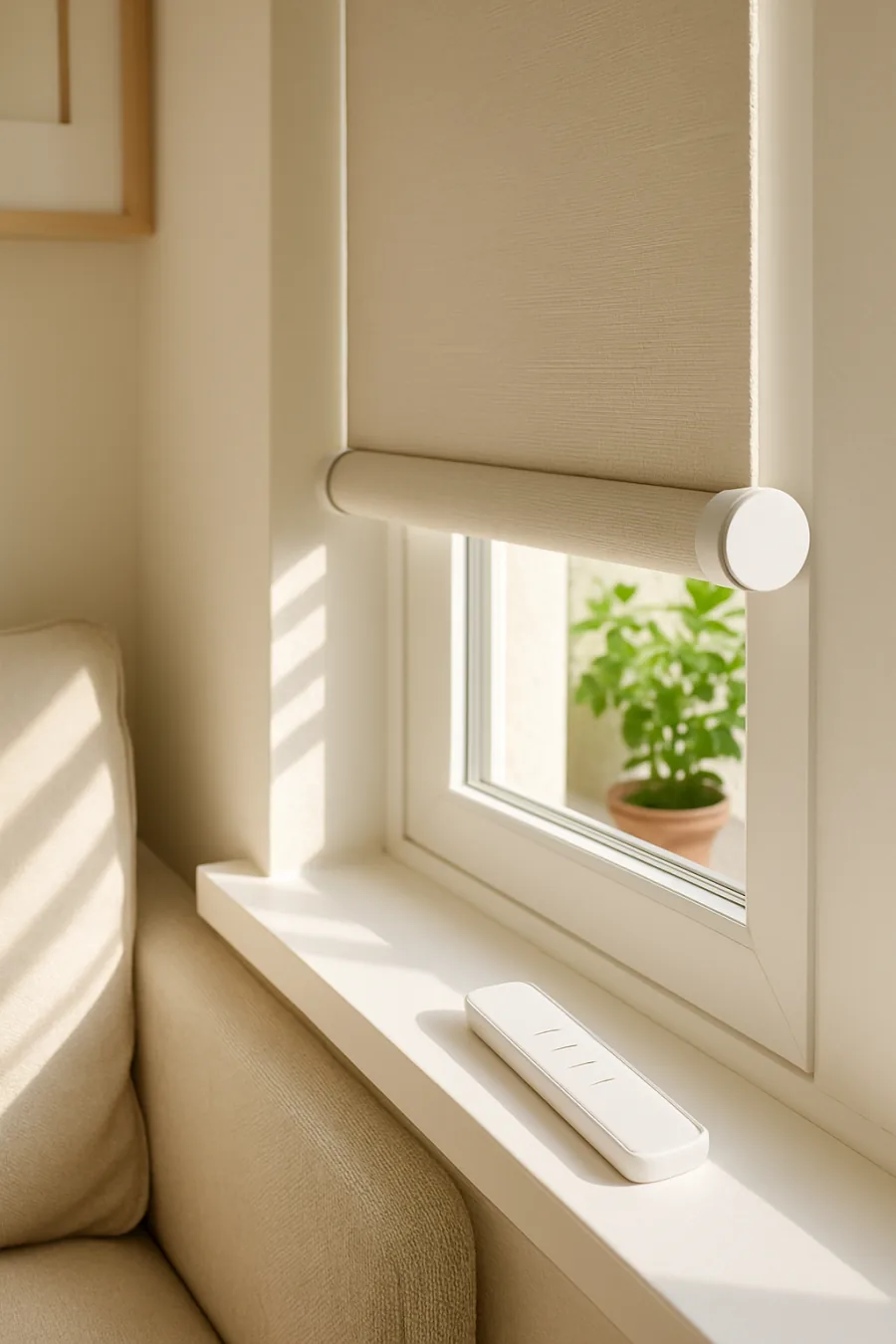
Electric with remote control — the same motor plus hand-held control. The remote lets you lower and raise several fabrics separately, rather than the whole gazebo at once. For wide fabrics and height this is more convenient than reaching for a chain. Coefficient — 2.1.
How this looks in practice. On a hexagonal gazebo with wide sides we installed electric motors: from the remote we opened the sides we needed without walking around the gazebo. On the narrow side, on the leeward side, a spring remained — there the design itself holds it.
We equip roller blinds for gazebos in Almaty with the control that makes sense for a particular side, not a motor on every opening “just in case”.
On low openings a chain is convenient; a spring is only fitted on a narrow side sheltered from the wind, while wide fabrics need an electric motor or a motorised one with a remote control.
How much a roller blind for a gazebo costs and what the price is made up of
Outdoor roller blinds for a gazebo start from 14,500 ₸ per m². This figure already includes the outdoor screen or PVC, the housing box and ZIP guide rails — that is, the whole system, not just the fabric. But the price per m² is not final: installation, carried out by Jalusso installers, is added on top, and when it comes to controls and the mounting method, the range is wider than it seems at first glance.
| Price list item | How it differs | Price from | Lead time |
|---|---|---|---|
| Outdoor roller blinds | Outdoor screen or PVC, housing box, ZIP guide rails | 14,500 ₸/m² | 10–14 days |
| Outdoor roller blinds, dense screen fabric | Denser than the basic fabric, blocks the sun better | 16,700 ₸/m² | 10–14 days |
| Outdoor roller blinds, opaque fabric | Opaque: the garden cannot be seen through it | 19,600 ₸/m² | 10–14 days |
| Outdoor roller blinds with electric motor | The motor is already in the price of the line | 26,900 ₸/m² | 12–16 days |
| Outdoor roller blinds, opaque fabric with electric motor | Opaque fabric plus motor | 36,300 ₸/m² | 12–16 days |
What the total is made up of
The total for a gazebo is made up of the opening area, the controls and the mounting method. The measurer calculates the area and the number of units on site — each side separately. The control coefficient applies only to the basic outdoor item: mechanical control ×1, chain ×1.06. An electric motor is not counted as a coefficient — those are separate price-list lines where the motor is already included in the price, so no multiplier is applied to them.
The installation coefficient depends on where the system goes: on the wall ×1, on the frame ×1.05, without drilling ×1.1, cassette system ×1.28. Installation as work is charged separately — 4,500 ₸ per unit, and for orders from 150,000 ₸ it is free. The measurer gives the exact cost on site: the line of 14,500 ₸/m² includes the screen or PVC, the housing box and the guide rails, and how many sides there are and how wide they are is decided by the measurement.
Example calculation
Let’s take a wide side on the windy side — there you need a housing box with guide rails and a chain. The measurer gives us the area after walking the site, and then the logic is simple: the base of 14,500 ₸ per m² is multiplied by the control coefficient 1.06 (chain) and by the installation coefficient 1.10 (without drilling), and the per-unit installation charge is added to the result. For a side where you want a motor, we take the ready-made line with an electric motor — it is more expensive than the base one, but the motor coefficient is not applied to it. The measurer gives the exact area and total on site — we do not calculate from a photo or “by eye”.
Measurement is always free: both the consultation and the visit within the city, and delivery. We also travel outside the city — to Kaskelen, Talgar, Issyk and Kapshagay, but we tell you the price of such a trip in advance, before the measurer sets off. The measurer brings samples of fabrics and film and calculates the cost on site, so the argument “film is more expensive than fabric” is settled at the table, not in messages.
The total for roller blinds for a gazebo is made up of the opening area, the control coefficient (chain only) and the installation coefficient, plus the per-unit work; the outdoor item starts from 14,500 ₸ per m² with the housing box and ZIP guide rails, while the electric motor comes as separate lines with the motor included in the price.
Winter in Almaty: what to do with film and fabric
Blinds can spend the winter in a gazebo, but they must not be rolled up in the cold. PVC film loses flexibility in frost and can crack at the fold — that’s exactly why it is rolled up in advance, while it’s warm. Winter in Almaty is sharply continental: frosts last a long time, and the temperature swings a lot between day and night, and the night cold finishes off what thawed during the day. We install outdoor roller blinds for gazebos on the assumption that for part of the year the structure will stand without moving.
Fabric on the roller tube spends the winter differently. Dim-out and screen fabric on the roller tube in a housing box is best raised and secured for the winter: that way it doesn’t collect snow, doesn’t flap in the wind and doesn’t pull the roller tube with extra weight. If the blind is left hanging, at least brush the snow off it — don’t scrape, but gently knock it off.
Ultraviolet light is a separate story. In the sun fabric and film age: fading of fabric is not covered by the warranty, and we say this at the measurement straight away, not afterwards. For outdoors we use fabrics stabilised against ultraviolet — they fade more slowly, but no fabric can avoid fading altogether. Film also becomes cloudy over time, and we won’t promise that it will stay as clear as on the first day.
What we do by season:
- While it’s warm — PVC film is rolled up and tied with straps, fabric on the roller tube is raised.
- Before the first frosts — check that the roll is secured and won’t unwind in the wind.
- In winter — snow is knocked off the housing box and fabric, and no one touches the film in frost.
- In spring — the fabric is unrolled, inspected, and the mechanism is tightened if needed: we also come after the warranty to tighten or adjust.
Kirill usually asks at the measurement whether anyone will sit in the gazebo in winter. If yes — the film is lowered for the cold season and left hanging, rather than being moved back and forth every evening: fewer movements — less risk to the fabric at the fold.
PVC film is rolled up while it’s warm: in frost it loses flexibility and can crack at the fold, so all seasonal movements with it are planned before the cold.
Fabric care: dust, pollen, mould under the roll
Mould under a rolled-up fabric appears when the roll is put away wet. After rain, let the film dry in place — and only then raise it. Washing clear film requires a mild product without abrasive: powder, the rough side of a sponge and acidic solutions leave matte scratches on the surface, and through them the fabric becomes cloudy faster.
Almaty dust and pollen settle on the film in an even layer, and this becomes noticeable against the light when the gazebo is closed on two sides. Wiping it dry with a cloth is a bad idea: the dust works like sandpaper. First wash it off with water, then go over it with a soft cloth. This kind of fabric care takes a few minutes per side — in our experience, that’s enough for the fabric to stay clear.
Does film become cloudy on its own? Over time — yes, the top layer gradually loses clarity under ultraviolet light and from air with dust. It’s most noticeable on the sides that face the sun all day, and almost unnoticeable on the leeward side. Fabric fades in a similar way: natural fading goes across the whole area, not in patches. Neither is covered by the warranty — we warn about this before the measurement, not after.
Here’s the order in which it’s worth caring for the fabric:
- Wash off the dust with water from a hose at low pressure.
- Wipe the film with a soft cloth and a soapy solution without abrasive.
- Rinse off the solution with clean water and let it dry.
- Roll the fabric up only when it’s dry.
- Once a season, inspect the eyelets and guide rails — the same dust collects on them.
- Clean screen and dim-out fabric with a dry soft brush, and avoid pouring water on it if possible.
The main rule is simple: a wet fabric in a roll means mould under the rolled-up film after a few hot days.
PVC roller blinds for gazebos stay clear not because of the material, but because they are washed gently, dried before being raised and not left wet in the roll.
How measurement and installation work in Almaty and the suburbs
The order is this: you write on WhatsApp, the measurer comes with samples and calculates the cost on site, the workshop makes the fabric, then we install. Manufacturing an outdoor item takes 10–14 days — that’s the time from measurement to the finished product, not from the call.
Within the city, measurement and delivery are free. To the suburbs of Almaty — Kaskelen, Talgar, Issyk, Kapshagay — we do travel, the cost of the trip depends on the distance, and it is quoted before the trip, not after. For us the suburbs are not a “remote zone” with a surcharge added retroactively: you hear the price of the trip in advance and decide whether it suits you or not.
Five steps from request to a finished gazebo:
- Request on WhatsApp — you describe the gazebo, the number of sides and what stops you sitting there in the evening.
- Measurement — our measurer brings fabric and film samples, holds them up to the opening and works out the price.
- Order and manufacturing — the workshop makes the blind to fit your opening; for an outdoor item this takes 10–14 days.
- Installation — 4,500 ₸ per item; for orders from 150,000 ₸ installation is free.
- Acceptance report and warranty — 3 years on the mechanism, 1 year on installation from the date the report is signed.
Installation takes less time than manufacturing, but it is here that you see whether the right fasteners were chosen: a bracket on the post holds the cassette, the guide rails run along the edges of the opening, and a roller blind for a gazebo covers the space between the posts evenly, without skewing. If the posts have warped, that comes out at the measurement, not on installation day.
What the measurer checks
The posts and the framing — what they are made of and whether they will hold an anchor. The place for the mangal: we do not put the blind right up against an open fire or a stove. The windward side — that is where guide rails or a tensioner are needed. And the number of sides: in a hexagonal gazebo each side gets its own blind, and therefore its own price.
The samples are held right up to the opening. That way you can see what PVC film gives you and what dim-out gives you, and you do not have to choose from a photo.
Within the city, measurement and delivery are free; for the suburbs we travel at a call-out fee that is quoted before we set off, and manufacturing an outdoor item takes 10–14 days.
FAQ
We have collected the questions most often asked after the measurement — about wear, fasteners and the warranty.
Does PVC film go cloudy? Its clarity drops over time: Almaty dust settles on the blind, and ultraviolet does its bit. The film should be washed with a mild product, and then it stays clear longer. The warranty does not cover loss of clarity.
Can a mosquito net and dim-out be fitted on the same gazebo? Yes, and it is common practice. The sunny side gets dim-out, the opening facing the garden gets a net, and where wind needs to be blocked, PVC film is fitted. The measurer looks at each side separately.
How does a ZIP system differ from an ordinary blind on a roller? A ZIP system requires a flat plane for the guide rails, so it is chosen for gazebos with a geometrically precise frame. A soft PVC window has no such requirements — it fastens by eyelets.
Is wiring needed in the gazebo for an electric motor? Yes, if the gazebo is unheated and has no wiring, a line will have to be run separately. The electric motor runs on 220 V or from a battery. The second option is convenient when there are few blinds and no lighting has been run in the gazebo.
Is fabric fading a warranty case? No. Water and natural fading of fabric are not covered by the warranty, and we say so at the measurement. The mechanism is another matter: three years, and if something happens to it through no fault of yours, we will come and fix it.
What should I do if the blind does jam? Write to us on WhatsApp. If the case is recognised as a warranty one, we do the work free of charge — it takes no more than 5 working days. Once the warranty period has passed, a call-out is still possible: we will fix the mechanism, adjust the travel, and fit a new cord or chain.
Can roller blinds be fitted to a metal frame in a gazebo in Almaty? Yes, the fasteners are chosen for the post material, and the measurer checks it on site. Metal profile and timber need different solutions — this is covered in detail in the section on fastening.
Conclusion
Roller blinds for a gazebo in Almaty come in two designs, and everything else follows from that. A soft PVC window is rolled up by hand and tied with straps; a blind on a roller tube in a cassette with ZIP guide rails is raised by a chain or a motor. The two should not be confused: fastening, price and care are different for each.
The second point is about the blind itself. PVC film stops the wind and keeps the view of the garden, a mosquito net keeps mosquitoes out and lets air through, and dim-out shades heavily and hides the gazebo from prying eyes. There is no need to fit all of this on every side at once.
The third point concerns the sides. The wind hits from one direction, the sun comes from another, the neighbours look from a third. In a hexagonal gazebo each side gets its own blind, and it is opened on the windward side — that way there is still air movement in the gazebo but no draught. The side with the mangal should not be closed with fabric right up against it: the smoke needs to escape.
The fourth point is about money and timelines. An outdoor item starts from 14,500 ₸ per m², and manufacturing takes 10–14 days. Installation is 4,500 ₸ per item; for orders from 150,000 ₸ we do it free of charge. Measurement within the city is always free; for the suburbs — Kaskelen, Talgar, Issyk, Kapshagay — we travel out and quote the call-out fee before we set off.
Now a recommendation. Before choosing between film and fabric, think about what you are hiding from: the cold evening air from the mountains, mosquitoes, or the sun in the dining area. The answer narrows the choice down to one or two blinds, and the measurer only has to confirm it on site.

