











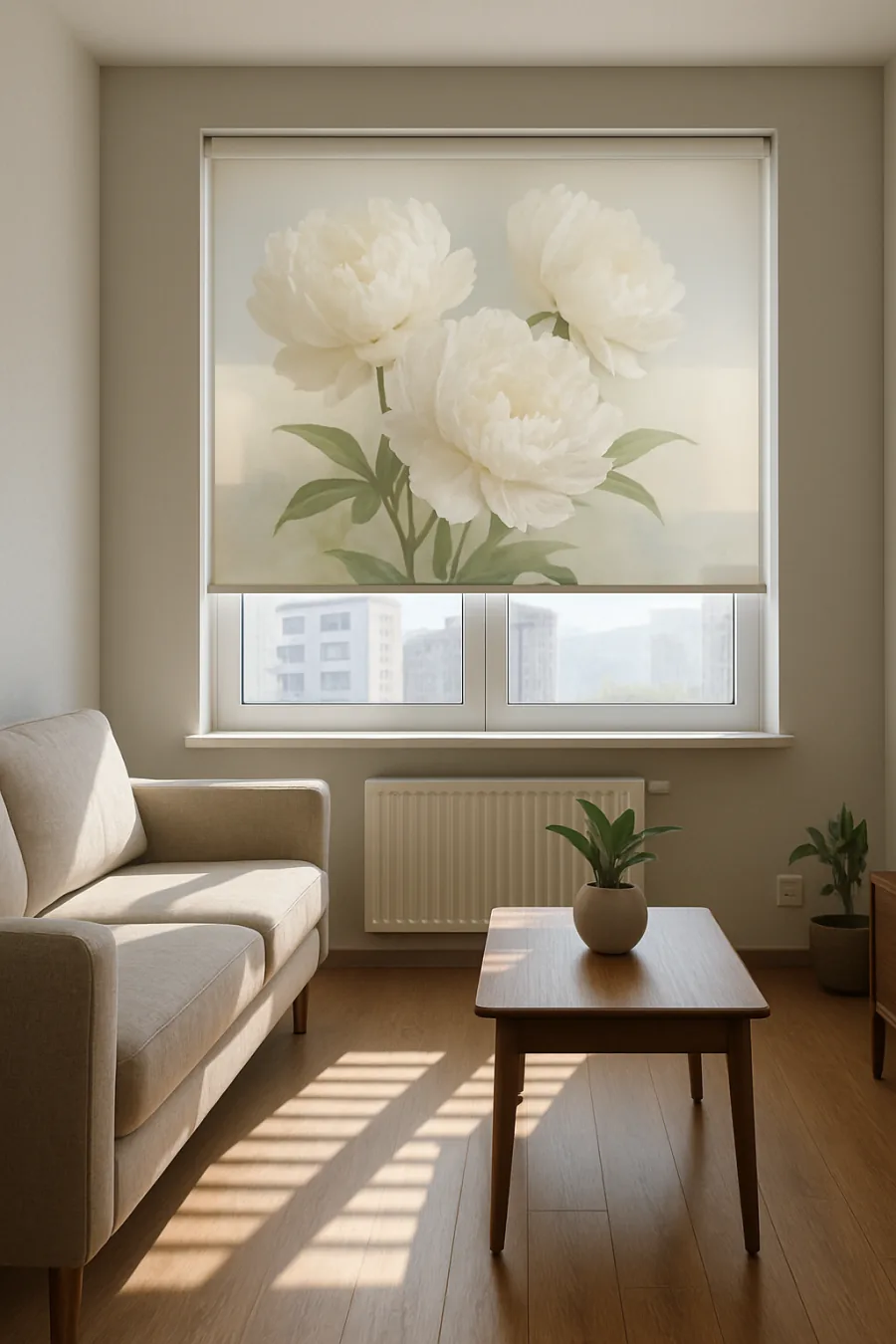
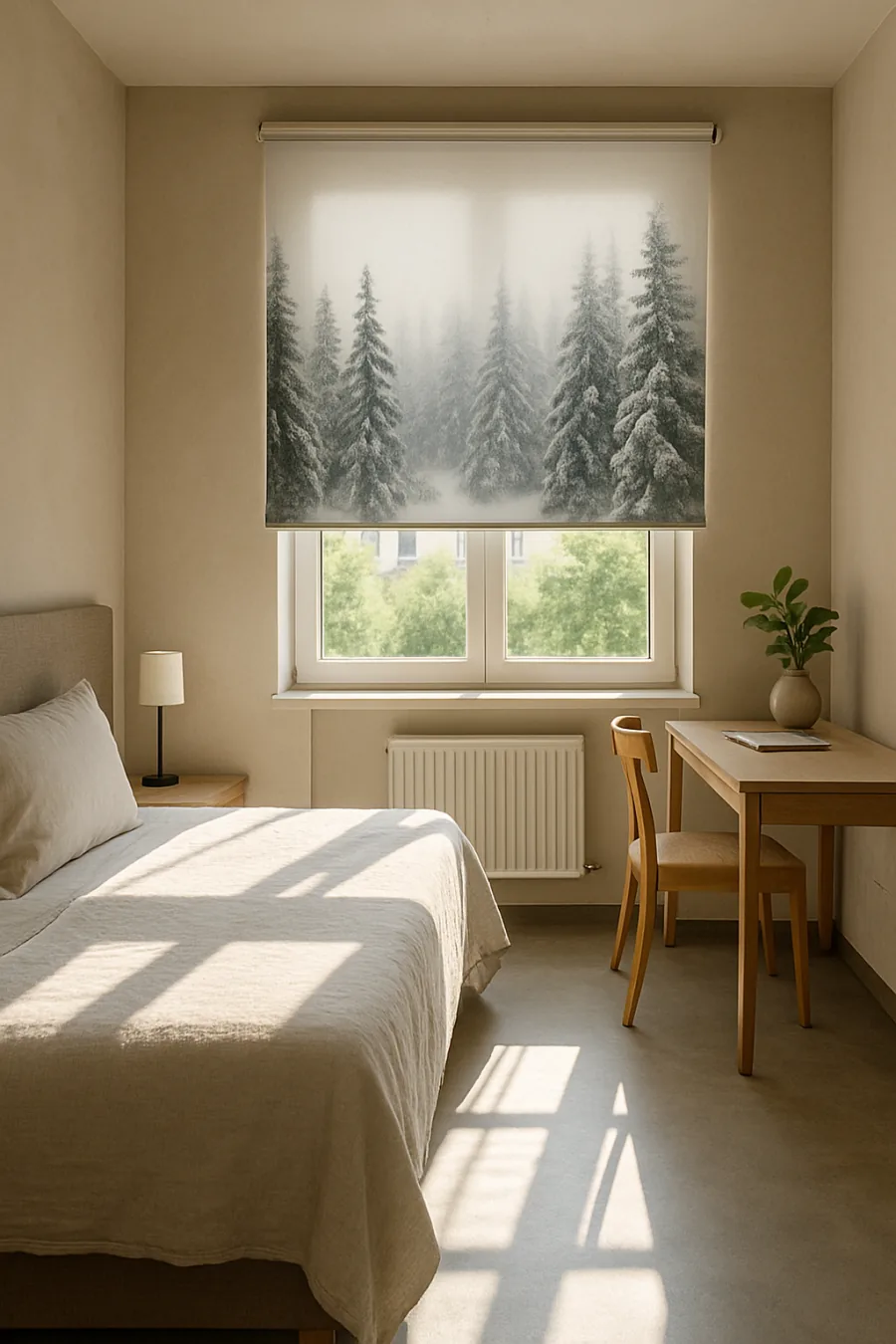

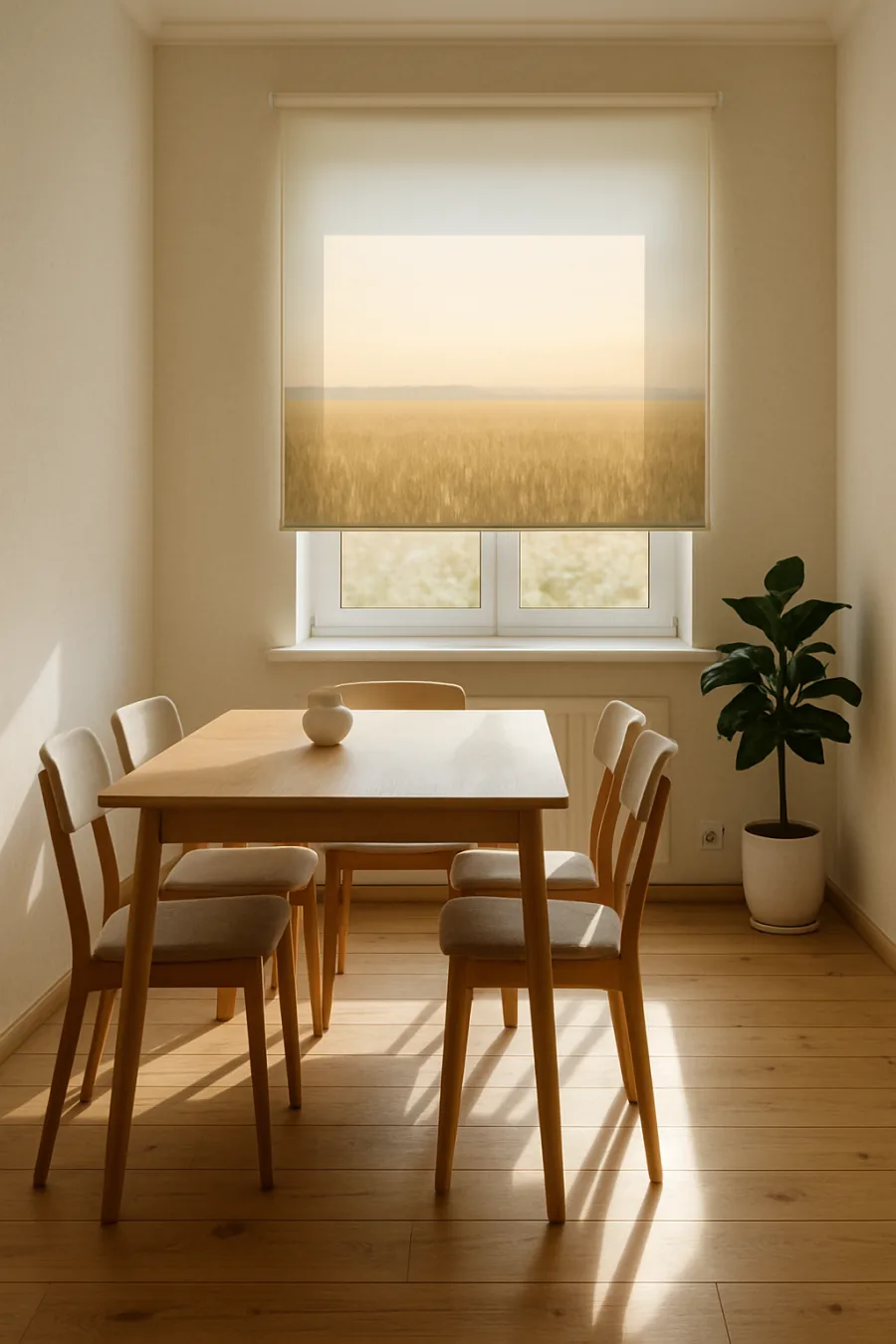











We make roller blinds with photo printing in Almaty to the size of your window: we print your photo, drawing or corporate print on the fabric and assemble the product in our own workshop. Price — from 5,400 ₸/m², manufacturing 4–6 days, measurement is free, and the measurer comes with fabric samples.
How the picture behaves on a window, not on a screen
A roller blind with photo printing is a fabric with an image applied to it, and it is made to the size of your window rather than chosen from ready-made dimensions. It differs from an ordinary roller blind in that the image lives in the light: it is backlit from the street, darkens under a lamp, rolls up. On a phone screen you see the picture in reflected light, on a window — in transmitted light. These are two different images, and both have to be taken into account before printing.
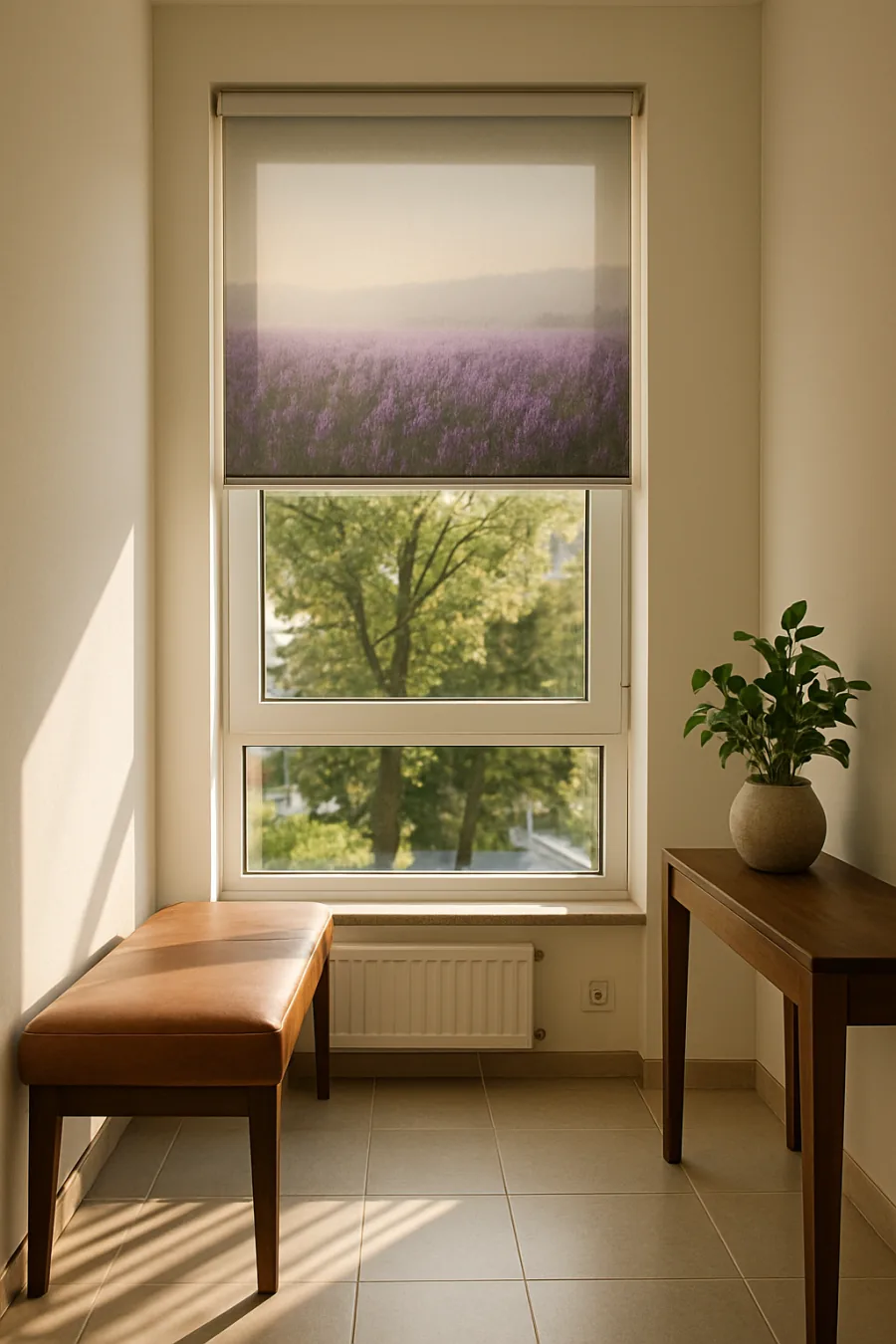
The light transmission of the fabric determines how the photograph looks during the day. Light-permeable fabric lets part of the light through the fibre, and the picture starts to glow from within.
And then fine details read more softly than on a monitor. On dense fabric light does not pass through the cloth, and the image is visible only thanks to the lighting in the room.
The proportions of the shot and the proportions of the window almost never match. It is worth keeping this in mind from the very start.
What goes under the bottom bar and into the roll is the question asked most often.
What goes under the bar and into the roll
A horizontal shot on a vertical window is cropped at the sides. The lower part of the image goes under the bottom bar, the upper part is wound onto the tube. The proportions of the shot dictate what exactly will be lost.
From our practice: someone brings a shot with a sea and a sailboat at the left edge — after fitting to a vertical window the sailboat stays beyond the edge. That is why we show in advance on a sample which part of the image will be lost and which will stay in the visible area.
Three things determine what you will see on the window:
- How the shot relates to the opening in proportions
- How far the fabric comes down in the working position
- How much fabric stays in the roll when raised
With the blind raised halfway, only the lower part of the picture is visible. Many people keep it that way during the day — and the scene should be chosen with this in mind.
During the day, in the evening and from the street
During the day the light-transmitting fabric is backlit from the street, and the image reads like stained glass — rich and bright. In the evening, when a lamp is on in the room and it is dark outside, the same picture becomes more muted and darker. This is expected, and it is worth getting used to it in advance.
From the street, the image depends on which side the fabric faces. When printing on light-transmitting fabric, the reverse side is visible from outside, not the image itself.
The side from which the image reads correctly is chosen when you order. For ground floors and shop windows we do mirror printing — then the correct picture reads from outside. The image cannot be seen from both sides at once; this is a compromise, not a defect.
We do not see the image on the fabric the way we see it on a screen: during the day the light-transmitting fabric is backlit from the street, and in the evening with a lamp on the image reads differently. That is exactly why the layout is approved before printing — what looked good on your phone will look different on the window, and it is better to see the difference on a sample in your own room.
If you want to understand how your picture will look, find roller photo blinds online with a similar image and look at them in daylight, then imagine the same shot under an evening lamp. The difference will be noticeable.
Blackout or light-transmitting fabric: what to choose for your window
You can print on both blackout and light-transmitting fabric — the choice depends on what you want from the window: darkness or light. Dense blackout does not let light through the fabric, so a photograph comes out in rich colours. Light-transmitting fabric is backlit from the street, and the room stays bright.
If you need to darken a room, this is solved by the choice of fabric, not by the thickness of the blind. Blackout gives an even dark background on which the colours of the print read with contrast. It is chosen for bedrooms and south-facing windows, where the sun shines straight in during the day. Light-transmitting fabric lets light through the fibre, and the printed image looks three-dimensional — like stained glass, only softer. It is more often used in living rooms and kitchens, where it is important to keep daylight and still block the view from the courtyard.
| Comparison | Blackout | Light-transmitting fabric |
|---|---|---|
| Light transmission | Light does not pass through the fabric | The fabric is backlit from the street |
| How the print reads | Rich, contrasting colours | Three-dimensional, backlit |
| Typical room | Bedroom, south-facing side | Living room, kitchen |
| What stays in the room | A darkened background | Daylight |
The difference in light transmission is the only thing that really changes how the picture looks. Thin fabric multiplies light by the image, and where the colours are light, the fabric is almost transparent. Dense fabric works like a screen: light is held on the surface, and the print shows its true colour. Hence a simple rule — if it matters that the image looks the same at any time of day, choose blackout.
Orientation and the climate of Almaty
Almaty has a sharply continental climate — hot sunny summers, dust, and winters with frost and temperature swings between day and night. For south- and west-facing windows, blackout is chosen more often: it both blocks the sun and darkens the room in the heat. Orientation affects how the print fades — the more direct sun, the faster the colours lose their brightness, and we cover how to extend their life in the care section.
Which way the picture faces
The side from which the image reads correctly is chosen when you order. Standard printing faces the room: you see the image, and from the street the reverse side of the fabric is visible. For ground floors and shop windows the picture is printed in mirror — the correct image reads from outside, and from inside it looks reversed. The image cannot be seen from both sides at once, and this is worth understanding in advance.
You can see how the image sits on each fabric in person: our measurer brings samples, and you decide to buy roller photo blinds based on the actual fabric, not a picture on a screen.
Dense blackout does not let light through the fabric, so a photograph comes out in rich colours, while light-transmitting fabric is backlit from the street and keeps the room bright.
How to prepare your photo for ordering without any equipment
We accept files in any format, and how sharp the picture looks on the window depends on the quality of the photo itself. This is the main thing to understand before calling: no special preparation is needed, but the source image must be sharp. Our custom roller blinds with photo printing are made to the size of the opening, so the same shot looks crisp on a small window and blurry on a wide one. Stretching does its work: what fit on a phone screen is enlarged to a metre or more.
We build the layout from your file and approve it with you before printing. You do not need to learn any graphic software — that is our job. All we need from you is one thing: look at the layout and say it is all correct.
What to check in the photo before calling
Five points that require no equipment:
- Open the photo on a large screen — a TV or monitor — and see whether the image breaks up into squares. If it breaks up on a monitor, it will be worse on the window.
- Enlarge the shot to screen size and check the main details: a face, if it is a portrait, or small leaves and veins, if it is a plant. There should be no visible blur.
- Check whether important parts of the image are cut off at the edges. A horizontal shot on a vertical window loses its sides — we have already mentioned this, but it is worth checking in advance.
- Assess whether the image suits the format: a sea panorama on a narrow window will be squeezed, while a vertical portrait will fit exactly.
- Think about what will remain visible when the blind is lowered halfway — the top of the image will roll onto the tube.
Is a photo from a phone suitable? Yes, if the shot is sharp. A photo from a camera gives more detail to work with, but a modern phone often shoots well enough. We do not look at the device — we look at the file itself.
Colour on screen and on fabric
A phone screen is backlit and reproduces colour differently from fabric. On blackout the shades come out denser and more muted; on light-transmitting fabric they are lighter, because the fabric works backlit. The exact shade cannot be predicted from a picture on a display — neither by you nor by us. That is why the measurer comes with samples: put the fabric against the table, the wall, the furniture and see how the colour behaves in your lighting. The exact shade is only visible on a sample.
Someone else’s image
Image rights are checked before printing. We only take an image from the internet into work if the rights to it are yours or you have the author’s permission. This is not a formality: printing is reproduction, and we don’t want to be responsible for someone else’s photo. Your own photo or a drawing bought with a licence raises no questions.
Small details blur when enlarged to the size of the opening — the larger the window, the higher the demands on the source file.
An image across several sashes: how the picture lines up
One picture on a window with several sashes requires matching: the image is transferred to each blind separately, but so that the lines coincide, and the gap between the blinds remains. A roller blind with a picture on three sashes is an ordinary task for our workshop, and it is solved before printing, at the layout stage.
It all starts with a measurement. The measurer takes the dimensions of the opening and of each sash separately, because sashes on the same window are almost never identical. Using these dimensions, we split the image: it is divided into as many parts as there will be blinds on the window. Each part is printed on its own blind of its own width. At the same time, the edges of neighbouring blinds do not meet flush — there is always a gap between them for the mechanism and guide rails. The picture still reads as a single whole if the lines coincide.
Where the joint falls
Jalusso does the split so that the joint falls on the mullion — the vertical post between the panes. This is both logical and practical: the mullion itself divides the view into parts, so the break line on it does not catch the eye. The mullion falls on the joint between the blinds, and the eye has nothing to catch on.
If it happens the other way round: an important element of the picture, a face or a tree trunk, lands exactly on the joint, we suggest shifting the frame at the layout stage. Shifting is easier than reprinting. On wide windows and balcony blocks we don’t stretch one picture across all the blinds, but choose a subject that divides into parts by itself: a horizon, a field, a forest. Then the joint is not visible at all.
Fabric replacement
If you tire of the subject, we replace only the blind. The mechanism, the tube and the mounting stay in place — we don’t touch them. We come, take down the old blind, hang the new one with the new print, if the fitting dimensions match. The measurer gives the exact cost of replacement during the inspection.
The layout is agreed with the customer before printing — this is a mandatory step. We show how the image will fall across the sashes, where the joint will run, what will go under the bottom bar, and we ask you to confirm. Only after your “yes” does the workshop start work.
On a window with several sashes, the image is transferred to each blind taking the joints into account so that the lines coincide, and the gap between the blinds remains.
A subject for the task: what to print if there’s a construction site or a wall outside the window
The subject of the image is chosen to suit the view outside the window. If a construction site, a crane or the blank wall of a neighbouring building is visible from the window, the print has a simple task — to cover that view with a rich landscape. A dense blackout with a forest, mountains or the sea removes the unwanted view, because light does not pass through the blind and what is behind the glass does not show through. On light-transmitting fabric this won’t work: during the day it works by transmitted light, and the silhouette of the neighbouring building will read together with your picture. In our experience, this is the most common reason people come for a photo blind at all: not decoration, but the wish to cover an ugly view.
I want to give one example from practice separately.
A real example
A yoga studio, the window looks onto a construction site. The customer needed an even, calm background — on dense fabric we printed misty mountains across the full height of the window, and the view outside stopped reading. And here the dimensions, the split of the blind and the timelines are given by the measurer: he sees the opening, the window’s orientation and how the picture will fall along the height. The same mountains on light-transmitting fabric would give a different result — the outlines of the construction site would show through the print.
Kitchen and kids’ room
For a kids’ room, choose a calm subject. Simple logic applies here: the larger and brighter the picture, the more it holds attention, and in the evening under a lamp such a print reads as an active spot in the room. There’s no need to make a night light out of the blind, so for a kids’ room Jalusso advises soft subjects — without sharp contrasts and acid colours. And don’t forget about the window’s orientation: on the sunny side the brightness of the print fades over time, and that’s a separate conversation below.
The kitchen is a separate story. Here steam and grease settle on the fabric, and the print needs careful care: dust is removed with a soft brush, stains with a damp sponge, and more on that in the care section. For the kitchen it’s better to choose a subject so that it doesn’t draw attention to every mark — a large spot of colour forgives more than a fine pattern.
Will you tire of the subject in a year? Honestly — you might. But the blind in a roller blind is replaced separately from the mechanism and mounting, so a subject you’ve tired of can be replaced without redoing the whole system.
Office and business premises
A logo is printed for an office or business premises just like any photo: a branded print, a logo or a restrained graphic subject. In commercial spaces the picture often works as navigation or a brand carrier — in a meeting room they choose a calm subject without logos, while in a coffee shop they put a recognisable image on the shopfront. The most honest way to put it: the subject of the image is chosen to suit the view outside the window and the task of the room, not the other way round.
We make roller blinds with photo printing to your layout, and you approve it before printing — at this stage the subject can still be changed without losses.
How much it costs and how the order works
The base price of a roller blind with photo printing is from 5,400 ₸ per m² for the “polyester, open roller tube” option. Manufacturing takes 4–6 days, installation costs 4,500 ₸ per item, and for orders from 150,000 ₸ we do it free of charge. The total depends on the area of the opening and the type of control, so the measurer calculates the exact amount on site.
What the total is made up of
The price depends on the area of the opening, the type of fabric, the control and the installation method — each option is multiplied by its own coefficient.
| Parameter | Option | Coefficient |
|---|---|---|
| Control | Mechanical | ×1 |
| Control | Chain | ×1.06 |
| Control | Electric motor | ×1.85 |
| Control | Electric + remote control | ×2.1 |
| Installation | Wall-mounted | ×1 |
| Installation | Frame-mounted | ×1.05 |
| Installation | No drilling | ×1.1 |
| Installation | Cassette system | ×1.28 |
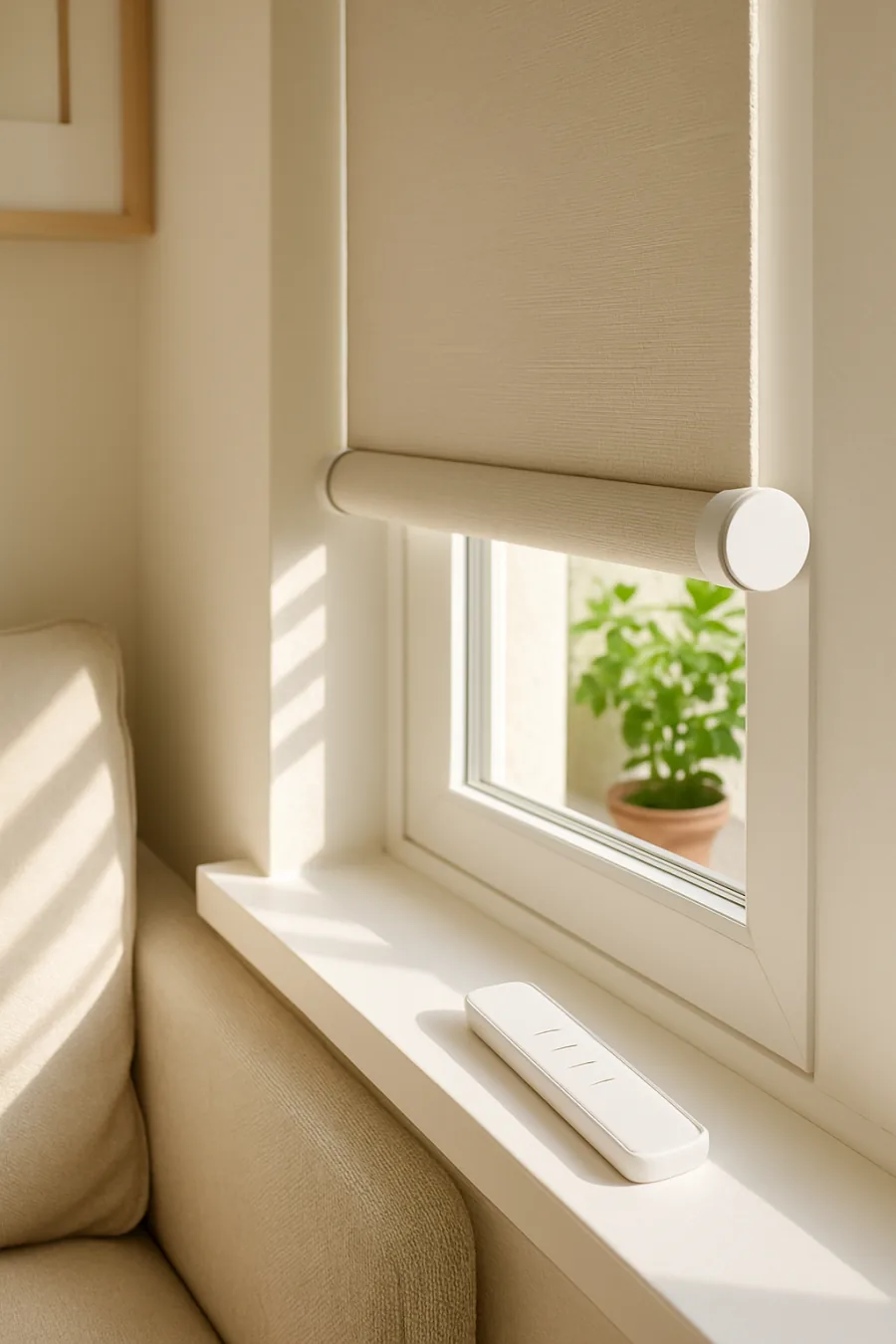
A chain is suitable if the window is opened rarely and you’re ready to operate the blind by hand. An electric motor is chosen for tall windows and panoramic glazing: reaching for the tube across the full height is inconvenient. Electric with a remote control is the option for several blinds in one room, when you want to lower them with one press.
Drill-free mounting is a separate option, not a property of the product: we mount on the wall at the base coefficient, while installation with hook-and-loop tape, suction cups or clips on the glazing bead costs more, but leaves no marks on the frame. This option is chosen for rented housing and plastic windows where the profile cannot be drilled. A cassette system covers the blind and the tube with a housing box and costs more than the other methods.
How ordering works
- You message us on WhatsApp.
- The Jalusso measurer arrives with fabric samples, takes the dimensions and calculates the cost on site.
- You approve the layout.
- The workshop manufactures the item and installs it.
Measurement and consultation are always free, and the measurer brings samples with him so that you can see how the print falls on blackout and on light-transmitting fabric. You approve the layout — before printing, not after. From the file you send to installation, the manufacturing time is: 4–6 days from the moment of measurement and approval of the layout. Production is our own, so printing and assembly are done in one workshop, without sending the blind out.
Almaty and suburbs
We are a manufacturer with our own workshop in Almaty: measurement and delivery within the city are free. We travel to Kaskelen, Talgar, Issyk and Kapshagay, and we quote the call-out fee before we come so that it is not a surprise. We do not keep finished products in stock: every fabric is made to your opening, so roller blinds with photo printing in Almaty can only be ordered through a measurement. You cannot pick such a blind from ready-made ones in an online store — we print to your size and your photo.
Warranty — 3 years on the mechanism and 1 year on installation from the date the acceptance certificate is signed; we fix warranty cases free of charge within 5 working days.
Base price — from 5,400 ₸ per m² (polyester, open roller tube), manufacturing takes 4–6 days, installation costs 4,500 ₸ per item, and it is free for orders from 150,000 ₸.
Care, fading and warranty
Caring for a roller blind with photo printing is simple: dust it with a soft brush or a vacuum cleaner on low power, without pressing the nozzle against the print. Stains are removed with a damp sponge and a mild detergent — and then blotted straight away, without soaking the fabric. Machine washing and harsh chemicals are not suitable: the print may fade. Jalusso always mentions this at the measurement, because printed fabric forgives less than ordinary sheer fabric.
Three rules that cover almost all the care:
- Dust — with a soft brush or a vacuum cleaner on low power, without rubbing the image.
- Stains — with a damp sponge and a mild detergent, without soaking the fabric.
- Machine washing and harsh chemicals — no.
Care removes dust and stains from the print. Fading is different: it is not dirt, but the dye reacting to light.
The window’s orientation directly affects how the print fades. Almaty is a city with hot sunny summers, and in winter there is frost and a sharp temperature difference between day and night; on south- and west-facing windows the fabric gets more ultraviolet than on north-facing ones. For printing we use fabric and dyes that are resistant to ultraviolet. But even that is not permanent colour. Natural fading on the sunny side is possible over time, and it is not considered a warranty case. A simple habit helps prolong the brightness: during the day, keep the blind not fully lowered but slightly raised, so the sun does not hit the same part of the fabric all day long.
Will the design get boring after a year — that is a fair question. Practice suggests: a landscape and an abstract image stay on the window longer than a large portrait or a passing trend. And there is a way out. If the picture has grown tiresome, we replace only the fabric — the mechanism and the mounting stay in place. Such a replacement costs less than a new blind, and the window can be refreshed to match your mood.
What the warranty covers
The warranty covers the mechanism and installation: 3 years on the mechanism, 1 year on installation from the date the acceptance certificate is signed. If the case is recognised as a warranty case, we do the work free of charge — within 5 working days. If the printed fabric was torn, re-hung by hand, soaked, or faded from the sun — that is no longer a warranty case. After the warranty ends we still come out — to tighten, adjust, replace the cord or chain. We make roller blinds with photo printing in Almaty in our own workshop, so we also service them ourselves afterwards, rather than sending you to a third-party contractor.
FAQ
Here are short answers to what people most often ask about custom roller blinds with photo printing, before the measurer has even arrived.
Will a photo from a phone work?
It will work if the shot itself is sharp. We accept the source file in any format, and the camera has nothing to do with it: what matters is not what it was taken with, but how clear the shot came out. The resolution and sharpness of the shot determine how sharp the picture will be on the window — the finer the details, the higher the risk that they will blur when enlarged to the size of the opening. A phone shot where a face or a leaf came out sharp, we will print without loss.
How can I tell in advance that the picture will not be blurry?
Open the shot on a large screen — a laptop or a TV — and zoom in. If the outlines stay sharp, all is well. The trick is simple and needs no equipment: what blurs on a large screen will blur on the fabric too. Personally, I advise checking any shot on a full-size screen, not as a thumbnail on a phone.
How will the colours match on the fabric and on the screen?
Exactly — they will not. A screen is lit from within and shows the shade differently from fabric, and light-transmitting fabric is also lit from the street during the day. The exact shade can be seen on the sample the measurer brings: that is what the photo should be compared against. But the joint across several sashes and the side of the print we agree with you before production: you approve the layout, and only after that does the workshop start printing.
Is the image visible from the street?
It depends on which side the fabric faces. The side from which the picture reads correctly is chosen when ordering: for ground floors and shop windows we print mirrored, so that the correct image reads from outside. The image is not visible from both sides at once.
The window’s orientation affects how the print fades: on a south- or west-facing window the image dims over time, and this is not a warranty case. The price does not depend on the side — the measurer calculates the total on site.
Conclusion
We make roller blinds with photo printing in Almaty to the size of your window: we print your photo, drawing or company artwork on the fabric and assemble the item in our own workshop. We have no ready-made items in stock — everything is made to measurement, so the picture fits the opening exactly, rather than being adjusted to the nearest standard size.
Briefly, what is important to remember.
An image on a window behaves differently from one on a phone screen. During the day, light-transmitting fabric is lit from the street; in the evening, under a lamp, the image reads darker; and the side from which the picture reads correctly is chosen when ordering.
The fabric determines the result. Dense blackout does not let light through the fabric and gives rich colours; light-transmitting fabric keeps the room bright.
We accept the file in any format — but the sharpness on the window depends on the quality of the shot itself.
Price — from 5,400 ₸ per m² for the “polyester, open roller tube” option, manufacturing takes 4–6 days. The total is made up of the area of the opening, the fabric, the control and the installation method: chain, electric motor or electric with remote control, mounting on the wall, on the frame or without drilling. The exact amount is quoted by the measurer on site.
There is one practical recommendation: call a measurer with fabric samples. You will see how the print sits on the fibres of your particular fabric, approve the layout before printing and get a quote on site — for your window, not for an average figure from the internet. Measurement and travel within the city are free.

