



















We make fabric roller blinds in Almaty to your sizes: a single fabric on a tube instead of a sheer and a rail, mounted to the frame or the wall. The fabric is chosen for the room’s purpose — sleep, sun, dust, evening silhouettes. Measurement is free, and our measurer comes with samples. Price — from 5,400 ₸/m², manufacturing in 4–6 days.
What a fabric roller blind is and why the fabric is stiff
A fabric roller blind is a single fabric on a tube that mounts to the frame of a plastic window or to the wall above the opening and rolls up into a compact roll right at the glass. The fabric here does not work the way curtain fabric does: the fabric is made of polyester and treated with a compound that gives it stiffness and even rolling. Without the treatment, the edge would curl and the fabric would wind onto the tube unevenly.
Fabric roller blinds are about the shape of the fabric, not the softness of the material. To the touch, the fabric can be matte, slightly rough, with the texture of uneven threads — but it holds its shape like a sheet, because otherwise the mechanism would not work: the fabric has to roll into a tight cylinder and not crease at the edges. That is why roller blinds rarely use natural linen and cotton in pure form. These fabrics stretch, shrink when wet, and need ironing — on a tube they behave unpredictably.
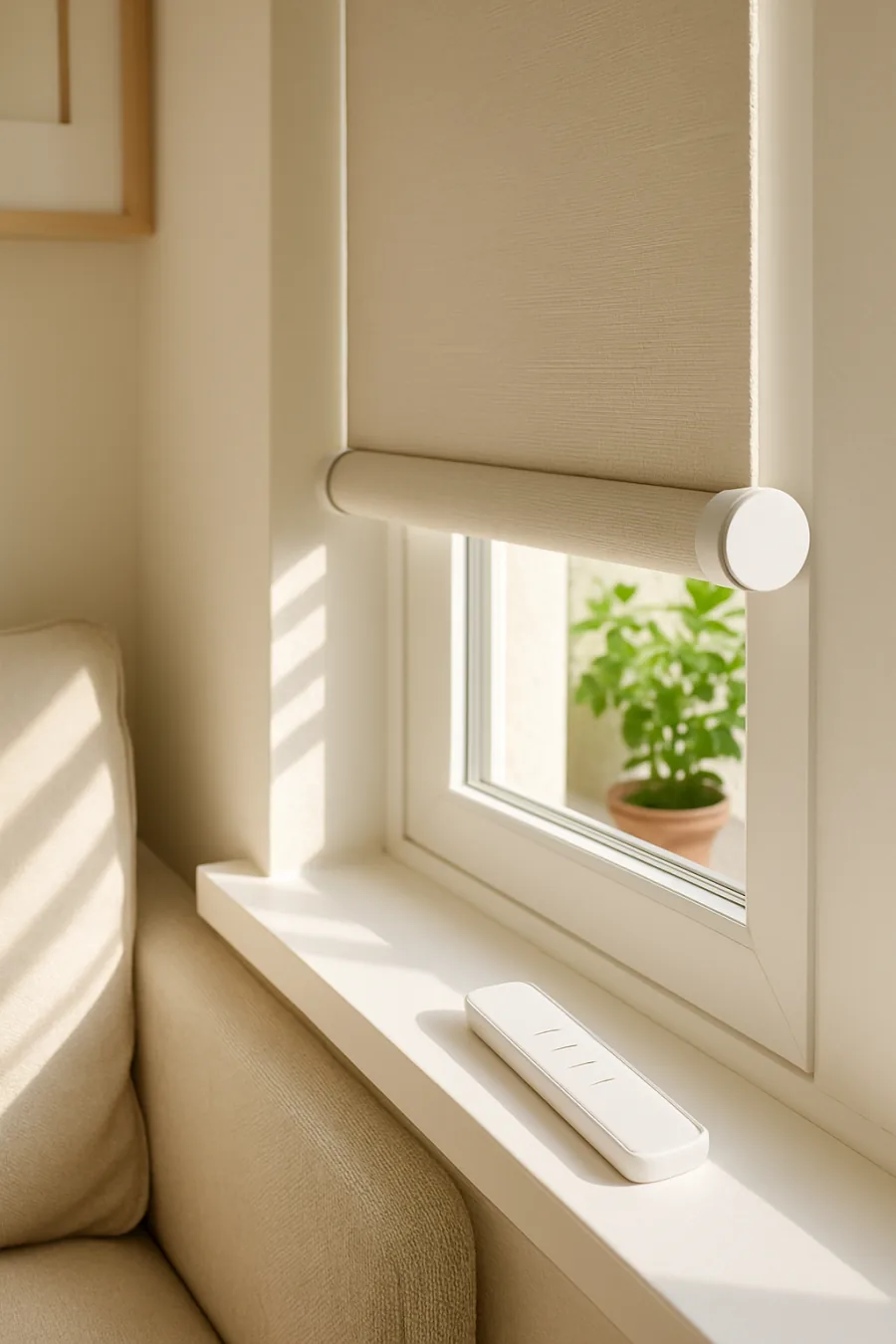
The open roller tube is the simplest system: the fabric rolls onto the tube without a cassette, so the mechanism stays open. This option is fitted when you need access to the glass and glazing bead.
How roller blind fabric differs from curtain fabric
A curtain hangs in loose folds; its job is drapery and volume. The fabric of a roller blind rolls into a tight roll at the glass, so it has a different weave density and a different surface treatment. Curtain fabric is soft and pliable; roller blind fabric holds a flat surface.
What a roller blind changes in a room
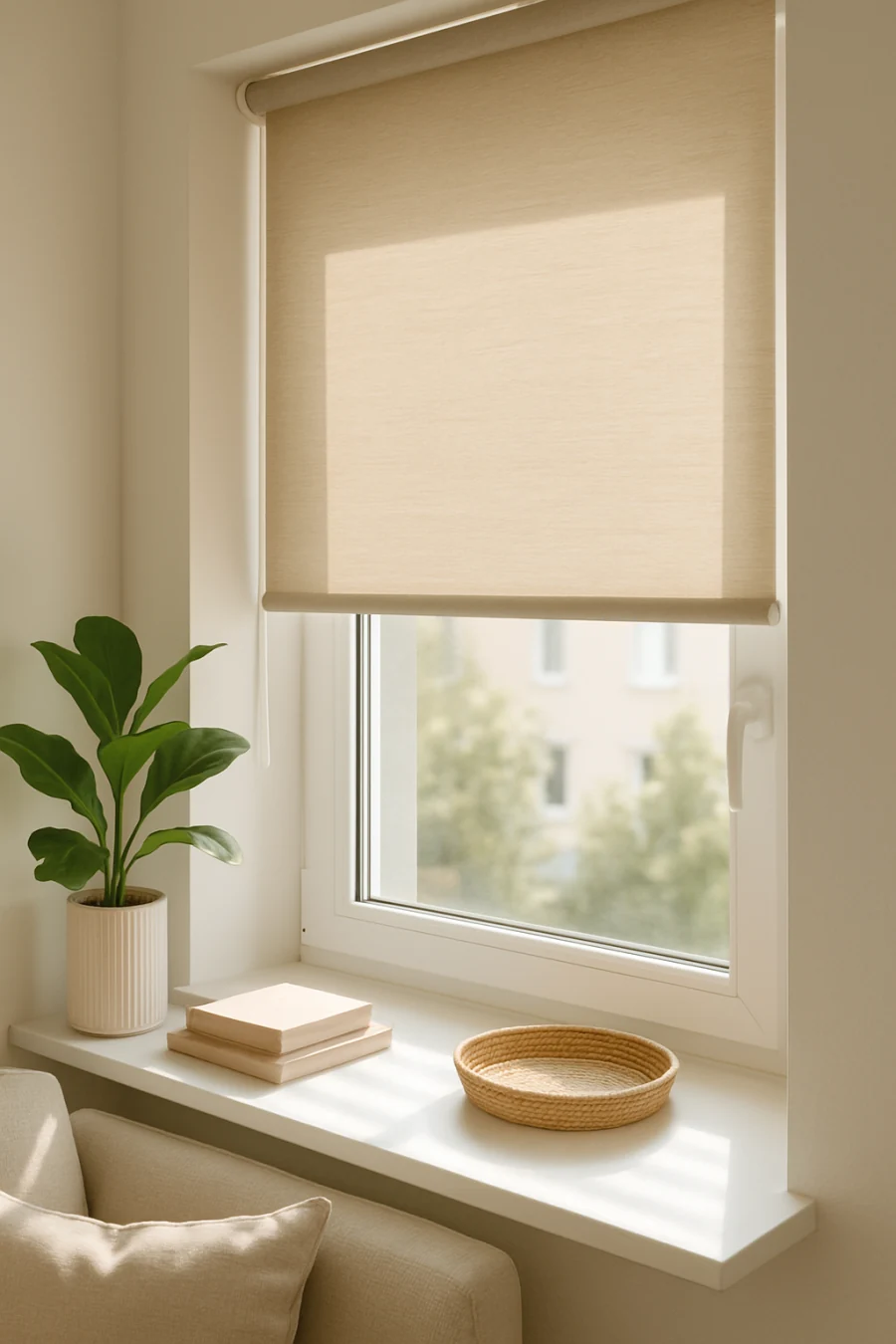
A single fabric at the glass takes the place of a sheer and a rail. The windowsill stays free — you can put flowers or appliances on it. The light becomes soft, and the room is not visible from the street.
Roller blind fabric is made of polyester and treated so that it rolls evenly onto the tube and does not curl at the edges.
“Linen” in roller blinds: texture or real fabric
“Linen” in the name of a roller blind is about texture, not composition. A linen-like texture imitates natural linen: uneven threads, a slight roughness, a matte finish. The same principle applies to the “semi-transparent linen” option: the word describes how the fabric behaves in the light, not what fibre it is made of. We do not state the composition — it is not in the price list, and at the measurement we talk about what you can see and feel on the sample.
What you can see on the sample
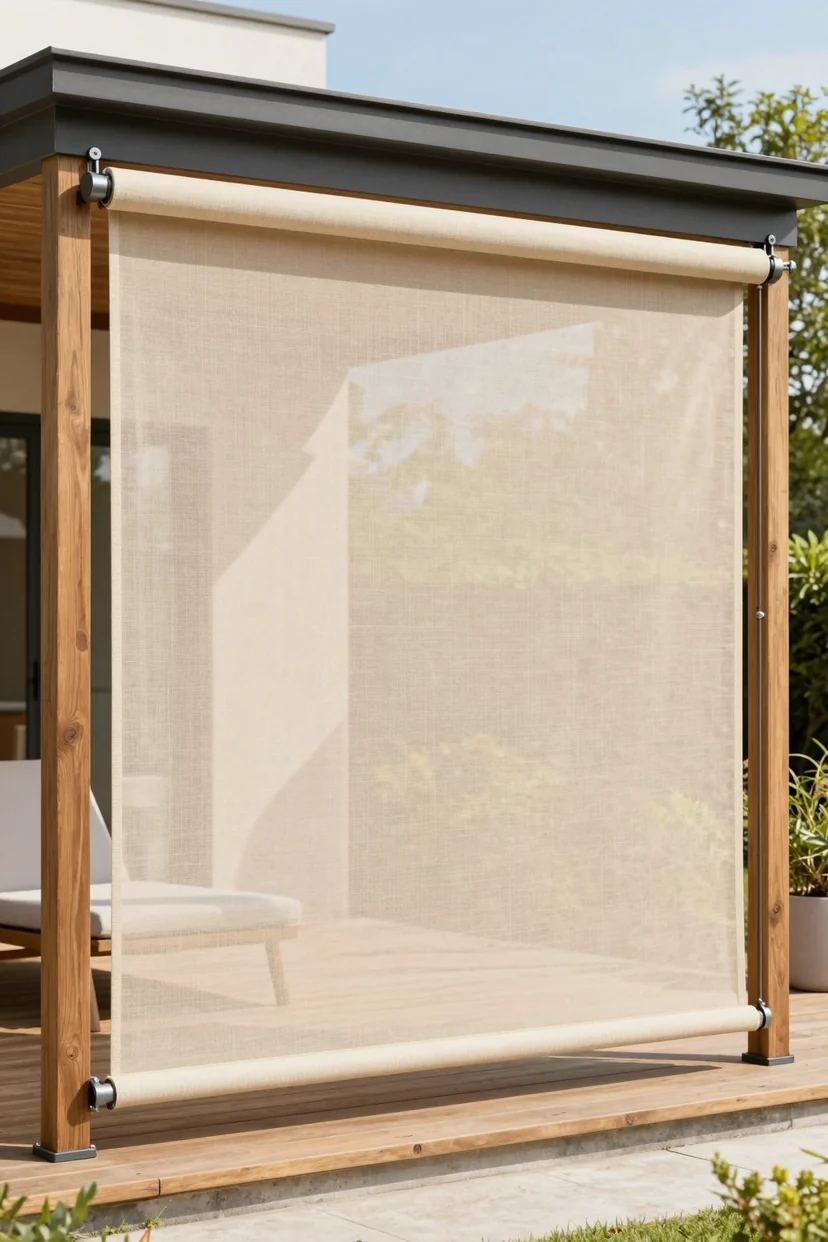
You hold a linen-like sample in your hands and feel the unevenness of the weave — the thread does not run perfectly straight, in places thicker, in places thinner. In the light this unevenness reads as a warm weave; in the shade the fabric looks more even and darker. Semi-transparent linen held against the light shows the structure of the threads but does not let you see what is happening outside the window. The difference between the two versions is visible in the density: one lets through more diffused light, the other less. Hold both up to the glass — and you will understand it without any terms.
Why roller blinds more often use a texture rather than natural fabric
Natural linen on a tube behaves differently from a linen-like texture: it shrinks when wet. Cotton fades in the sun — this is a property of the fibre, not a defect of a particular fabric. Roller blind fabric needs to roll evenly, turn by turn, and hold its shape — natural fabric requires additional treatment or a lining for this. This is not “better” or “worse”. These are different tasks: a curtain made of natural linen hangs in loose folds, while a roller blind rolls into a tight roll at the glass. By the way, we show this at the measurement: we put two samples side by side, and the difference is immediately visible.
Almaty has a sharply continental climate: hot and sunny summers, cold winters with frost and a temperature difference between day and night. At the glass, the fabric works in both modes all year round.
The names “linen-like” and “semi-transparent linen” describe the texture and properties of the fabric, not its composition: natural linen shrinks when wet and fades in the sun, while roller blind fabric has to hold its shape.
How to choose fabric for a room: kitchen, bedroom, kids’ room, living room
The logic of choice is simple: first the main purpose of the room — sleep, sun, dust, evening silhouettes — then the fabric for it. We make fabric roller blinds in Almaty to your sizes, and we select the fabric for each opening individually, not by the name of a shade you liked. Semi-transparent linen lets through diffused light: the room is bright during the day, and from the street only a silhouette is visible. Dense blackout removes the sun and glare completely. Melange hides dust and slight unevenness of the weave — in the kitchen and the study this helps noticeably.
Table: fabric → light during the day → view from the street in the evening → room
| Fabric | Daylight | View from the street in the evening | Where we install |
|---|---|---|---|
| Linen-like texture | Soft, diffused | A silhouette is visible | Living room, bedroom in calm tones |
| Semi-transparent linen | Bright, without direct rays | Only a silhouette is visible | Living room, kitchen where daylight matters |
| Cotton blend | Even, matte | The room is closed off | Kids’ room, bedroom |
| Melange | Even, slightly muted | The room is closed off | Kitchen, study |
| Dense blackout | Dim light, glare is gone | Nothing is visible | Bedroom, home cinema |
We don’t give light transmission in percentages: on a sample you can read it with your eye, and in a table a number without a measurement at your own window means nothing anyway.
Bedroom and kids’ room
Here the main thing is even light and privacy. A cotton blend gives a smooth matte fabric without shine: in the morning the light is soft, in the evening the room is closed off from prying eyes. A dense blackout removes sun and glare — in summer in Almaty this matters, because an east-facing side floods the room from early morning.
But does a dense fabric hold heat in winter by a cold pane? The fabric sits right by the glass and works as an extra barrier between the room and the cold surface, but it won’t become a heater. Almaty winter with frosts and temperature swings between day and night is a story about heating and the window profile, not about fabric.
Kitchen and living room
What’s better for the kitchen — semi-transparent or dense fabric? Most often people choose semi-transparent linen: it keeps daylight, and by the stove there’s never too much light. Melange is second in popularity: the uneven weave of threads in two shades of grey hides splashes and dust better than a smooth fabric.
At a kitchen window the fabric sits by a hot surface and in the sun at the same time — we keep an eye on this. Stains from tea and grease are removed with a damp sponge without rubbing, not by washing. Fabric roller blinds on a window that is often open are mounted so that the sash moves freely: the measurer looks at the profile and picks the right option.
When you need blackout
A dense blackout removes sun and glare, but on an open roller tube light still comes through along the edges of the fabric. For complete darkness we have a separate blackout page — we don’t promise that here.
In my view, fabric choice is overrated as a matter of taste. It’s a matter of the task: a bedroom needs privacy and a dense fabric, a kitchen needs light and a hard-wearing texture, a living room needs something in between that doesn’t eat up the day.
How to read a fabric sample against the light and get the density right
The density of fabric on a window can’t be judged from a sample on a table — a fabric sample needs to be looked at against the light at your own window, during the day in the sun and in the evening with the lights on. That’s how the measurer comes with samples, and you check the fabric where it will hang. On a table the sample lies on an opaque surface. At the glass, behind it there’s sky, courtyard, the neighbouring building — and the fabric behaves differently. That’s exactly why we don’t advise choosing from a photo or from your memory of how a similar blind looked at someone you know.
Four steps to checking a sample
- Hold the fabric sample against the glass and look towards the light. You immediately see how much light passes through the weave and whether the outline of objects outside the window is visible. Thin fabrics become almost transparent against the light, dense ones keep the picture solid.
- Look at the fabric during the day in the sun. Here in Almaty the sun is harsh, and a loose weave in the light takes on a slight yellow tint, while a dense one keeps an even tone.
- Look at the same fabric in the evening with the lights on in the room. This is the main test for silhouettes: if in the evening your figure can be made out from the street, the fabric is too thin for a bedroom or living room.
- Compare two or three samples side by side at the same window. The density and shade of neighbouring fabrics only show up in a pair.
A linen-like texture on a window looks more expensive than in your hand, not the other way round. Uneven threads and a slight roughness give a depth that smooth polyester doesn’t have — but only when there’s light behind the fabric. On panoramic glazing this is especially noticeable: several fabrics joined edge to edge, and any unevenness in the fabric reads from edge to edge.
A fabric sample affects colour choice no less than density. A small swatch on a table seems dark, but at the glass, where light comes from both sides, it lightens. Because of this, a dark sample chosen in the room can give a patchy wall at the window — the fabric will seem to vary in tone across its area. At the measurement we hold samples against your window, not against the table, and you make the decision looking at your own light and your own courtyard.
A fabric sample checked against the light at your own window during the day and in the evening is the only way to understand how the fabric’s light transmission will affect a particular room.
What makes up the price of a fabric roller blind
The cost of a fabric roller blind starts from 5,400 ₸/m² — that’s the Jalusso base price list: roller blinds, polyester, open roller tube. It’s calculated not by fabric alone, but by four things at once: the area of the opening, the system, the type of control and the mounting.
The base already includes the fabric, roller tube, control mechanism and mounting hardware. That’s why the price per metre doesn’t jump depending on which fabric you chose from the sample: there’s no separate surcharge for a particular fabric in the price list. The total is driven by the area of the opening, an open roller tube or a cassette system, chain or electric motor control, and the mounting method. Fabric roller blinds for plastic windows and fabric roller blinds for windows are calculated by the same logic — only the sizes and hardware for your profile change.
Table: what makes up the total
| What is counted | Option | How it affects the total |
|---|---|---|
| Base | Roller blinds, polyester, open roller tube | from 5,400 ₸/m², manufacturing 4–6 days |
| Control | Mechanical | ×1 |
| Control | Chain | ×1.06 |
| Control | Electric motor | ×1.85 |
| Control | Electric + remote control | ×2.1 |
| Mounting | Wall-mounted | ×1 |
| Mounting | Frame-mounted | ×1.05 |
| Mounting | No drilling | ×1.1 |
| Mounting and system | Cassette system | ×1.28 |
| Installation | per item | 4,500 ₸; free on orders from 150,000 ₸ |
The coefficients are multiplied, not added: a cassette system hides the tube in a housing box, and that is already ×1.28 to the base, not some amount added on top.
Example calculation per price list
Take a window with a chain and frame mounting. The base of 5,400 ₸/m² is multiplied by the chain coefficient 1.06 and the frame-mounting coefficient 1.05. We do not plug in the window dimensions here — the measurer measures the area at your place, and the total depends on it. Installation is calculated separately: 4,500 ₸ per item, and on orders from 150,000 ₸ we do not charge for it.
What changes the price and what does not
An open roller tube leaves the mechanism exposed, while a cassette system hides the tube in a housing box and costs more. An electric motor controls the fabric with a remote and raises the price most noticeably — it makes sense on a tall window you cannot reach by hand. Drill-free mounting leaves no marks on the profile and also comes with a coefficient. The choice of fabric does not affect the figure in the price list. This is what we are asked about most often — whether linen costs more than melange or not. In our price list, all roller blind fabrics are listed at one price.
Measurement and visit
Measurement and consultation are always free. The measurer comes with samples and calculates the cost on the spot — based on your windows, not on average figures. Within the city, measurement and delivery are free. We travel to Kaskelen, Talgar, Issyk and Kapshagay, and we quote the call-out cost before the trip so it does not come as a surprise on the day of measurement.
The base for any fabric roller blind is from 5,400 ₸/m², and the total is made up of four things: the area of the opening, the system, the control and the mounting.
Fabric care: dust, stains, getting wet, fading
A fabric roller blind cannot be washed in a machine. The fabric is treated and holds its shape only as it was assembled on the tube, and soaking and spinning strip the treatment and the fabric shrinks. Fabric care comes down to four actions, and all of them take less time than taking a sheer down from the rail.
- Dust is removed from the fabric with a soft brush or a vacuum cleaner on low power, with a furniture attachment. Once a month, along the full height, without pressing.
- Local stains are removed with a damp sponge without rubbing — blot from the edge towards the centre, do not rub across the fabric.
- Tea and grease stains from a kitchen window come off the same way: a sponge, warm water, no chlorine or abrasive chemicals.
- A wet fabric is raised and left to dry stretched out. A hairdryer and a radiator only do harm here.
The smell after manufacturing is a question we are asked at the measurement. Treated fabric smells faintly, and the smell fades within a few days with the blind raised; if the window is open, it happens faster. A sharper smell is a reason to call us, not to spray the fabric with air freshener.
What to do if it gets wet
Do not wipe or rub the water off the fabric: the treatment holds the shape precisely thanks to the even surface. Raise the blind so the wet part does not lie in a fold on the windowsill, and leave it to dry stretched out. A few hours is enough. If it got wet right at the tube, do not turn the mechanism back and forth — call us and we will tell you what to do next.
Fading and warranty
Fabric fading is not covered by the warranty — we say this honestly both at the measurement and here. The sun in Almaty is bright, south-facing windows get more of it than others, and any textile changes tone over time. We do not hide this risk in the fine print. Our warranty is 3 years on the mechanism and 1 year on installation from the date the acceptance report is signed. If a case is recognised as a warranty case, we fix it free of charge within 5 working days.
Why the edges curl
The edge of the fabric is held by the treatment and the shape set during cutting. If the edge has started to curl, it is usually due to the tube being skewed or to the blind being pulled by the fabric rather than by the chain. Do not straighten it yourself — we come and adjust it. Once the warranty period has expired, you can still call us: we will tighten it, adjust it, and fit a new cord or chain.
On a plastic window with a sash that opens inwards, the fabric is taken down during repairs or a move and put back afterwards — this is also work, and we do it.
Dust is removed from the fabric with a soft brush or a vacuum cleaner, local stains with a damp sponge without rubbing, and it cannot be washed in a machine: the treatment and the shape of the fabric are lost that way. Natural linen behaves differently in this respect — it shrinks when wet, and that is exactly why we work with treated fabrics.
Open roller tube and cassette system: how they differ and which to choose
An open roller tube leaves the mechanism exposed: the fabric winds onto the tube without a housing box, and the tube is visible by the glass. A cassette system covers the tube with a housing box — the mechanism and the edge of the fabric are hidden inside. The difference is not in the fabric, but in how the unit by the window looks and how much it costs.
Table: open roller tube and cassette
| What we compare | Open roller tube | Cassette system |
|---|---|---|
| Type of mechanism | Tube and mechanism exposed | The roller tube is covered by a housing box |
| Where it is mounted | In the opening or on the sash, on the frame or on the wall | On the frame or in the opening, the housing box sits against the profile |
| Access to the glass and glazing bead | Free: nothing blocks it | Partly covered by the housing box |
| Coefficient in the price | ×1 | ×1.28 |
An open roller tube is chosen when it is important to keep access to the glass and glazing bead — for example, to wash the window or adjust the seal. On a plastic window it is mounted both on the frame and on the wall above the opening. A cassette system wins on looks: the housing box neatly follows the line of the profile, and no open roller tube is left at the top. But you pay for this — a coefficient of ×1.28 to the base.
In practice, the choice is more often dictated by the window than by taste. If the sash opens inwards and there is little space above, the cassette housing box may catch on the window reveal — then the measurer will suggest an open roller tube. If the window is fixed or the sash is tilt-only, the cassette fits without any issues.
Jalusso manufactures both options in its own workshop: fabric roller blinds for windows are assembled for a specific profile, so it cuts the housing box to the size of the frame rather than adjusting a ready-made one.
The base according to the price list is roller blinds, polyester, open roller tube, from 5,400 ₸/m² and 4–6 days; a cassette system multiplies this amount by 1.28. The measurer will tell you on the spot what exactly will fit your window — measurement is free.
Mounting on plastic windows and non-standard openings
We mount fabric roller blinds on plastic windows in two ways: mounting on the frame or on the wall above the opening. There is also a third option — drill-free mounting, on adhesive strips or a spring. It leaves no marks on the profile, so it is often chosen for rented housing. The measurer looks at the window profile and checks whether the blind will prevent the sash from opening.
You can't cover panoramic glazing with a single fabric panel: a wide opening is divided into several panels joined edge to edge. For a mansard window we install a system with guide rails — without them the fabric sags on the slope. A mansard window requires such a system by design, not by preference.
What to choose for a non-standard opening:
- Arched and sloped windows: a roller fabric winds onto a straight tube, it doesn't roll up along an arc. The decision for such a window is made by the measurer on site — we don't promise a blind shaped like an arch.
- Tall windows and panoramic openings: an electric motor is used, mechanical control at such a height is inconvenient.
- A window with two sashes and a vent: the mounting is chosen so that the fabric doesn't block the opening.
Combining with a sheer and a curtain
A fabric roller blind and a sheer can be in the same room. The blind goes by the glass, the sheer stays on the rail. In terms of light this gives two layers: during the day the roller fabric is enough, in the evening the sheer softens the light from a lamp. As for mounting, the systems don't get in each other's way — the blind is fixed to the frame or wall, the rail lives its own life. In my view, this is what people most often do: they don't take down the sheer, they add a blind to it.
Replacing only the fabric
The fabric can be replaced while keeping the tube and the mechanism. The mounting and the tube stay on the window, only the fabric itself is changed. Such a replacement is priced by measurement: the measurer checks the dimensions of the opening and the condition of the mechanism. The 3-year warranty on the mechanism is kept.
Non-standard windows
Arched and sloped openings we cover with fabric cut to the contour — but not with a roller blind shaped like an arch, rather with a solution suited to the specific window. Mansard and panoramic options are described above. One rule is common: the measurer looks at the shape of the window on site, before naming a solution and a price.
Drill-free mounting leaves no marks on the profile, and we always divide panoramic glazing into several panels joined edge to edge — these are the two solutions most often asked about for non-standard windows.
How a fabric roller blind differs from pleated and Roman blinds
A fabric roller blind winds as a single panel onto a tube. Pleated blinds are a corrugated fabric that gathers like an accordion, while a Roman blind rises in folds. The difference is not in the fabric, but in how the panel moves away from the glass.
The mechanism determines everything else. A roller blind when raised is a compact roll right by the glass, it takes up no space at the sides of the opening. Pleated blinds fold into a narrow strip and are held on guide rails, which is why such a system is chosen for sloped windows. A Roman blind hangs on a rail and when raised leaves a strip of fabric above the opening.
Pleated blinds differ from a roller blind in construction: a fabric with a permanent crease is harder to pull into a straight line, while on the tube the fabric lies turn by turn. A Roman blind has cords and rings as its mechanics, a roller blind has a tube and a chain.
Table: roller, pleated, Roman
| Parameter | Fabric roller blind | Pleated blinds | Roman blind |
|---|---|---|---|
| How the fabric rises | winds onto a tube | gathers like an accordion | falls in folds |
| Where it is installed | on the frame or wall | on the opening, including a sloped one | on a rail |
| What to choose for the task | minimum space by the glass | complex window geometry | textiles needed on a rail |
For a mansard window we more often install pleated blinds, for a standard plastic one — a roller blind. In a living room where there is already a rail and a curtain, a Roman blind will fit into the composition, while a roller blind stays by the glass and won't touch the rail.
About patterns on fabric
If you need a pattern or print, that's a separate page “With a pattern” — it covers fabric roller blinds with a pattern, and we don't mix them with a plain roller blind. A pattern on the fabric lives by its own rules: a large repeat on a narrow window reads differently than on a wide one, and it's better to choose it from a sample at your own opening, not from a catalogue.
Examples from practice: how the fabric worked at different sites
We are a manufacturer with our own workshop in Almaty: the fabric is cut and assembled for your opening, there are no ready-made items in stock. You can order fabric roller blinds in Almaty to your own dimensions only through a measurement — there is no other way with us, because every roller blind is assembled for a specific window. The measurer comes with fabric samples, shows the panels on your window and calculates the price on site.
Sites from our practice
Here is how the fabric behaved at specific sites — without retouching and without advertising promises:
- Meeting room: melange, 2 floor-to-ceiling windows, 6 days. Melange hides dust better than a smooth fabric: the windows face the road, and a fabric of threads in two shades of grey doesn't look dusty even by the end of the week.
- Beauty salon: a cotton blend to match the chairs, 2 windows, 5 days. The smooth matte fabric in a dusty pink shade matched the upholstery, and the room stopped falling apart into “furniture” and “window”.
- Guest room: linen-look fabric, a corner window, 5 days. The uneven threads and slight roughness made the room homely rather than hotel-like.
- Living room in a panel building: dense texture, 3 sashes, 4 days. The dense fabric blocked the view of the neighbouring balcony — before, the whole room was visible from there.
- Country house: linen texture against wooden walls, 1 window, 4 days. No gloss and no shine — the fabric didn't compete with the wood.
- Loft: coarse weave supports the brick and metal, window 2.6 m, 6 days. What worked here was not the density but the character of the texture.
We didn't install dense blackout on these projects. If you need full light blocking, tell the measurer right away: we have a separate blackout page for that, and on an open roller tube light still comes in at the edges.
How it works with us
A fabric roller blind replaces a sheer and curtains on a rail: a single panel hangs by the glass, and the windowsill stays free. The client writes to us on WhatsApp, a measurer comes with fabric samples, then the workshop and installation take over. Manufacturing time for roller blinds is 4–6 days from the measurement and confirmation of the fabric, with a warranty of 3 years on the mechanism and 1 year on installation.
There are no ready-made products in stock — and that's not a marketing argument but a technical necessity: the fabric is cut to your opening, not a ready-made blind adjusted to fit.
FAQ
Trips outside the city are charged separately.
Measurement and consultation are always free, and within the city the measurement and delivery are free too. We travel to Kaskelen, Talgar, Issyk and Kapshagay, and the cost of the trip depends on the distance and is quoted before the visit — before the measurer gets in the car. No surprises at the end.
The measurer comes with fabric samples and calculates the cost on the spot. It's best to look at the fabric at your own window: on a table and on glass the same fabric reads differently, especially if the window faces the sun.
Manufacturing time for roller blinds is 4–6 days from the measurement and confirmation of the fabric. We are a manufacturer with our own workshop, so the fabric is cut and assembled to your opening.
We give 3 years on the mechanism and 1 year on installation from the date the acceptance report is signed; both are covered by the warranty. If the case is recognised as a warranty case, we do the work free of charge — it takes up to 5 working days. Even after the warranty has expired, we are ready to come: tighten, adjust, replace the cord or chain.
Does dense fabric keep the heat in winter
Dense fabric works as an extra barrier by the glass: it covers the opening and reduces the movement of cold air from the window into the room. But it is not insulation. Winter in Almaty is cold, with frosts and a big difference between day and night, and if there is a draught from the window, it's best to deal with the window itself first — fabric doesn't solve that.
No-drill mounting and electric motor
We install no-drill mounting on the frame: no marks are left on the profile, and this option suits rented housing. The price coefficient is ×1.1 to the base.
An electric motor is chosen for tall windows and panoramic glazing, where the chain is inconvenient. Chain control — ×1.85, electric with remote control — ×2.1.
We make fabric roller blinds to your dimensions and for your profile.
Conclusion
Fabric roller blinds in Almaty are chosen not by the name of the fabric but by the task of the room. This is the main conclusion the whole article comes down to.
The fabric of a roller blind is stiff because it is impregnated: without the impregnation the fabric won't lie flat on the roller tube and will ripple at the edges. Soft curtain fabric doesn't work here.
The word “linen” in the name describes the texture, not the composition. Uneven threads and a slight roughness on the sample are the look of the fabric; natural linen shrinks when wet, and the fabric needs to hold its shape on the roller tube.
The fabric is chosen for the room. For a bedroom and a child's room, a cotton blend or dense blackout is used; for a kitchen and living room, semi-transparent linen and melange, which hides dust and is stain-resistant by a window that is often open.
Look at a fabric sample against the light at your own window — during the day in the sun and in the evening with the lights on. On a table and on glass the same piece reads differently, and the colour at the window almost always looks different.
The base price list — roller blinds, polyester, open roller tube — is from 5,400 ₸/m². The final price is driven by the area of the opening, the system, the type of control and the mounting: a cassette system comes with a coefficient of ×1.28, an electric motor — ×1.85, frame mounting — ×1.05. Manufacturing roller blinds takes 4–6 days.
There is one practical recommendation. Call a measurer with samples and look at two or three fabrics at your own window: one semi-transparent, one dense, and a third — melange or a linen-like texture.
A measurer's visit and consultation cost nothing: he brings samples with him and calculates the price right on the spot.

