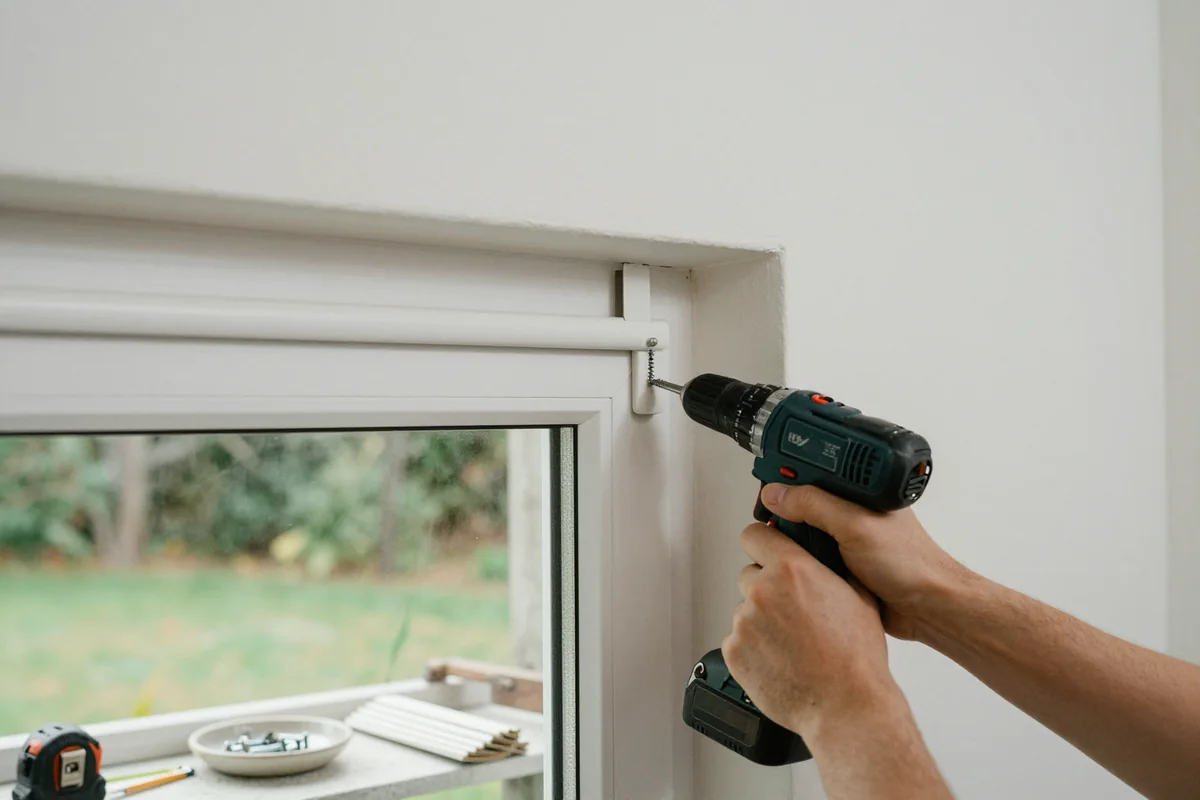
We make Roman blinds in Almaty to measure: a soft fabric on an aluminium rail rises in even horizontal pleats held by rods in the fabric pockets. Basic manufacturing is from 8,100 ₸/m², lead time 7–10 days. Measurement and consultation with fabric samples are free across the city, installation is 4,500 ₸ per item.
What a Roman blind is and how it differs from a roller blind and blinds
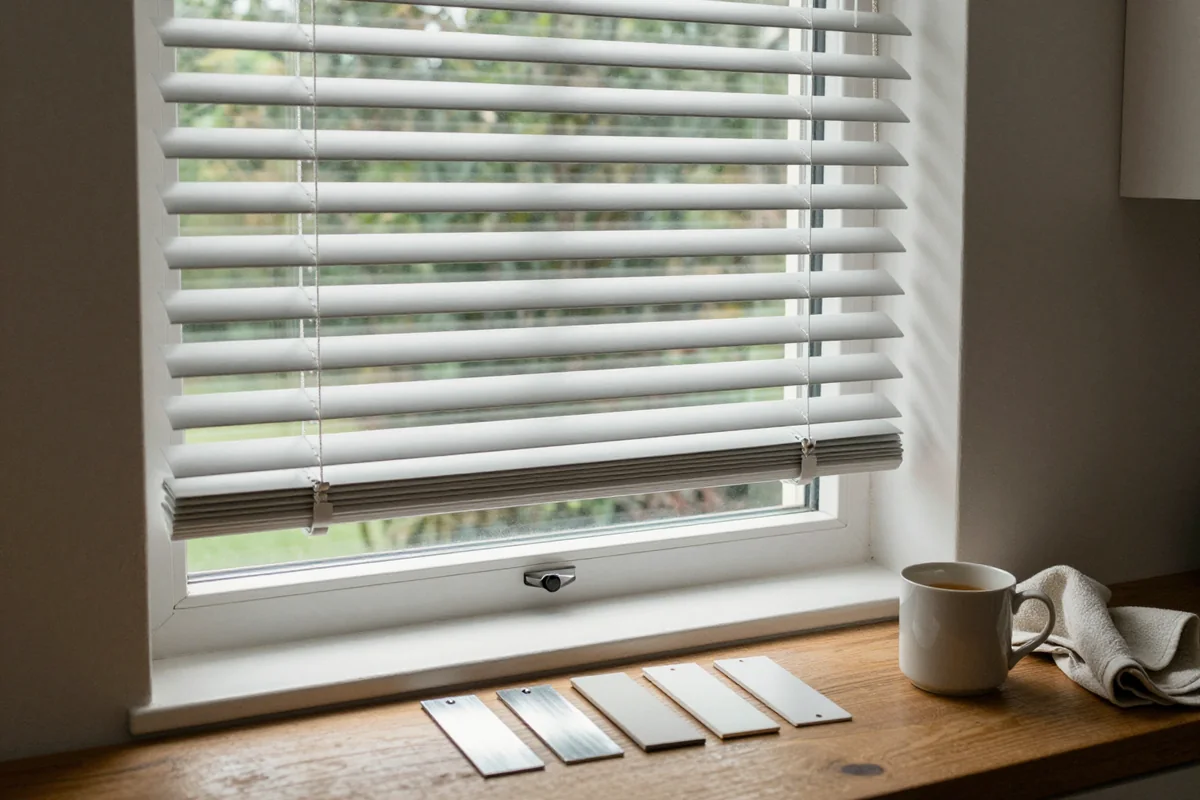
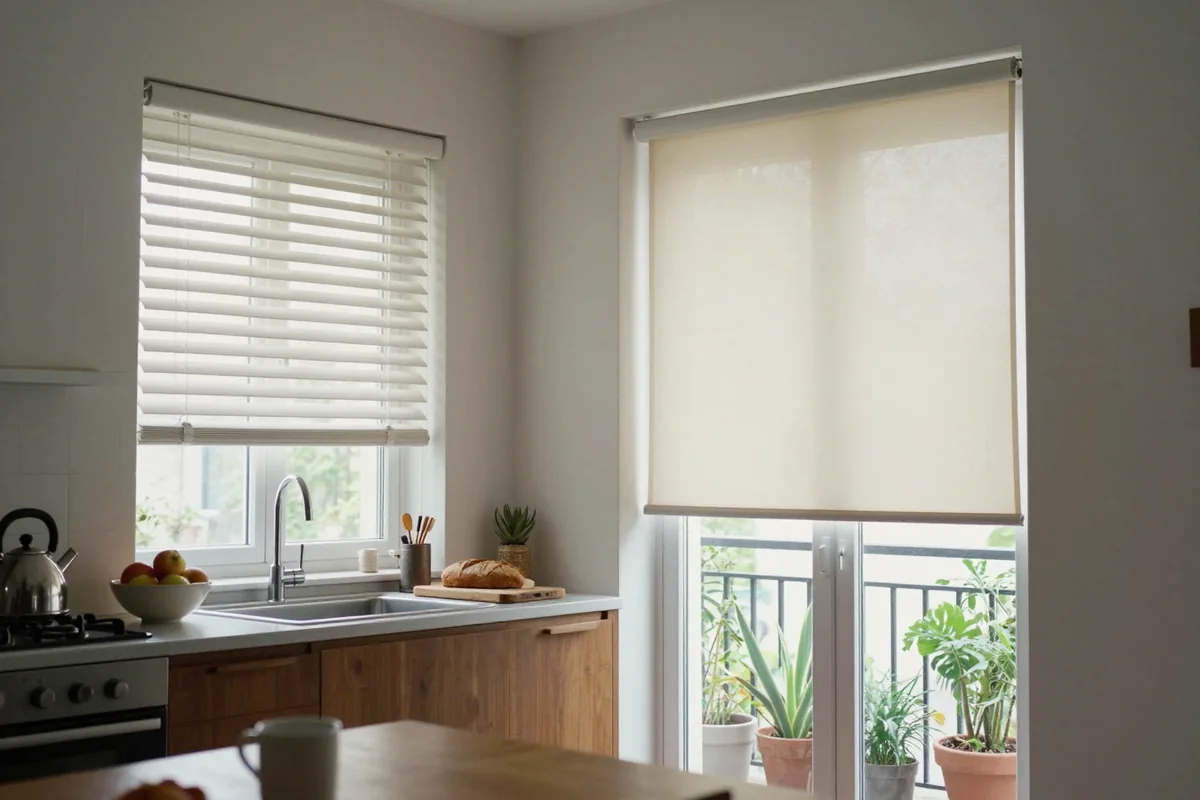
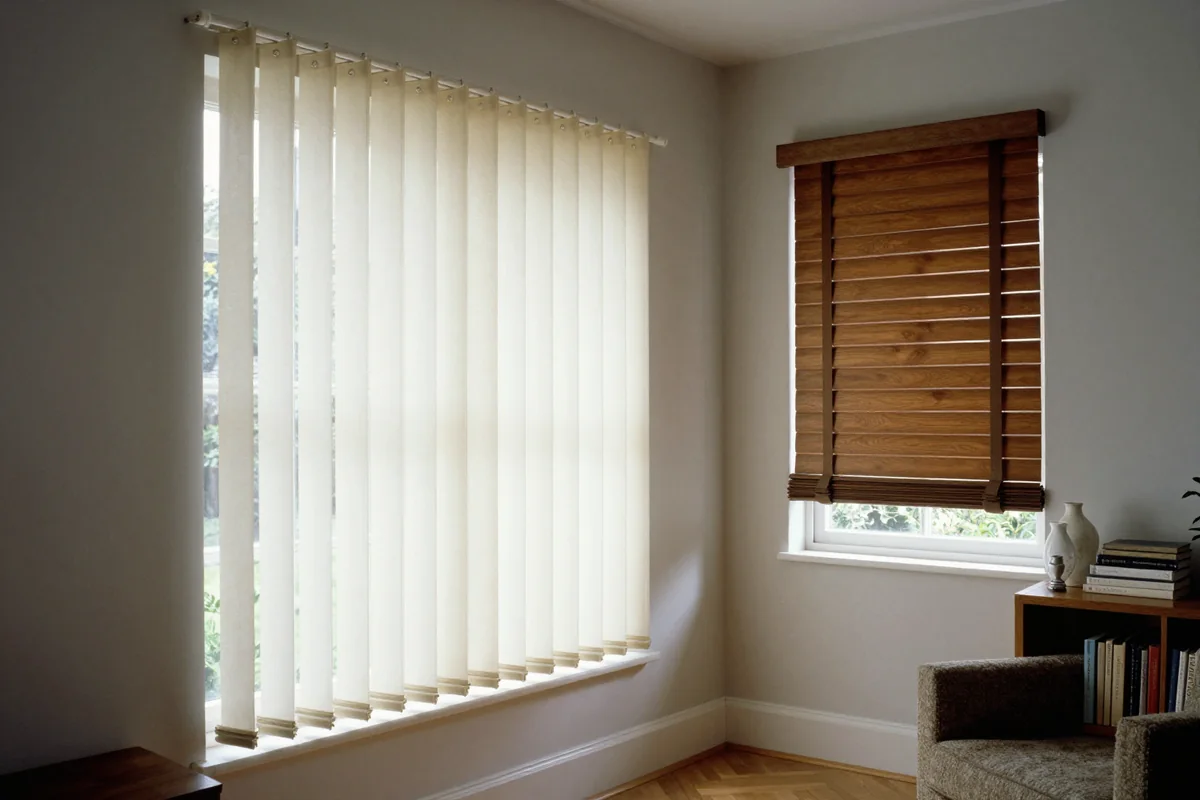
A Roman blind is a soft fabric panel that rises in even horizontal pleats. It differs from a roller blind in the way the fabric gathers: with a roller blind the fabric rolls into a compact roll at the window, while with a Roman blind each pleat line is held separately. Blinds, in turn, give even light with rigid slats — there is neither fabric nor pleats there.
In search, a Roman blind is sometimes called a Roman roller blind, a roll blind or a roleta — but that is a different product: roletas and roller blinds wind onto a roller tube, while a Roman blind is gathered into folds. The window opening stays the same. Only the way the product looks and works changes.
How a Roman blind differs from a roller blind
Roman and roller blinds are often mentioned together — and rightly so: both take up minimal space. But while a roller blind rolls into a neat roll, roller Roman options give a fabric look in pleats. A short strip at the top of the window versus a flat plane — that is the whole difference in how the room feels.
What to choose? If you want cosy textiles — a Roman blind. If you want a clean flat plane and to save space on the windowsill — a roller blind. For the kitchen and loggia, roller blinds for windows are often chosen, while for the bedroom and living room — a Roman blind or a curtain.
How a Roman blind differs from blinds
Blinds work with slats: rigid plates are easy to clean and give even, predictable light. A Roman blind is fabric, and it softens the light and reduces glare. It is for this effect that people look for Roman blinds for windows when slats seem too “office-like”.
Roman blinds do not replace blinds in one thing: in the kitchen under the extractor hood, slats are more practical, while a fabric panel there requires attention to cleanliness.
Why we make the product as a whole, rather than sewing from your fabric
We are a manufacturer with our own workshop in Almaty: the fabric, rail, lifting mechanism and installation all come from the same hands. A sewing studio will quote you for the sewing separately from the fabric, while we have one price — per m² of the finished product. This also explains why our 8,100 ₸/m² should not be compared with a single “sewing” line from someone else’s price list: the fabric and frame are not yet included in that figure.
A Roman blind gathers in even horizontal pleats, a roller blind rolls into a compact roll at the window, and blinds give even light with rigid slats — this is the main difference between the three products.
How a Roman blind is built: pleats, rods and the lifting mechanism
Pleats do not form on their own. Each horizontal line is held by a rod inserted into a pocket in the fabric, and the lifting mechanism is selected according to the weight of the fabric. This is exactly why two blinds of the same height behave differently: one rises evenly and softly, the other tilts to one side if the mechanism turns out to be weaker than the fabric.
A Roman blind consists of a fabric, an aluminium rail and a lifting mechanism. The rods in the pockets set the fold lines, the velcro along the top edge holds the fabric on the rail, and the cord or chain pulls the fabric up. When you pull the control, the bottom rod rises, then the next one — and the fabric folds into even tiers.
A cord mechanism suits fabric weighing up to 3–4 kg. Heavy fabrics need a chain-and-rotor mechanism: it has more load capacity, and lifting is smoother. Heavy velvet on a cord control will quickly stretch the cord, while a chain with a rotor holds that weight without jerking. At the measurement a Jalusso specialist weighs a sample and calculates the area — these two figures show which mechanism to install.
The difference between the two types of control is shown in the table.
| Parameter | Cord mechanism | Chain-and-rotor mechanism |
|---|---|---|
| What pulls the fabric | Cord through pulleys | Chain on a rotor |
| Fabric weight | Up to 3–4 kg | Heavy fabrics |
| For which fabrics | Linen, polyester, light blackout | Velvet, dense blackout |
| Fixation | Stop on the cord | Lock on the chain |
What the product consists of
Fabric, aluminium rail, rods in the pockets, lifting mechanism, cord or chain, and velcro for removing the fabric. Velcro is the detail most often asked about during the measurement. The fabric is held on it across the full width, so it comes off entirely: the rods are pulled out of the pockets, the fabric goes for washing or dry cleaning, and the rail stays in place. The rail is narrow, it hides behind the top fold and does not protrude above the opening.
Cord or chain-and-rotor
For a narrow sash with light fabric we install a cord mechanism — it is more than enough. For a wide fabric made of dense material, a chain-and-rotor is used. If the window is tall and reaching the control is difficult, we discuss an electric motor, but that is a separate item by coefficient.
What about repairs after the warranty
We replace the cord and chain separately, without touching the rail and fabric. We service the mechanism after the warranty period too: tighten, adjust, and replace the pulleys if necessary. The warranty on the mechanism is 3 years, on installation — 1 year from the date of signing the act, and after that we still come.
The main thing to know about the design: the folds are held by the rods in the fabric pockets, and the choice between a cord and a chain-and-rotor mechanism is determined by the weight of the fabric.
How much a Roman blind costs in Almaty and what the price consists of
The base price of Roman blinds is from 8,100 ₸ per square metre. This is the price of the finished product to your dimensions, not the work separately from the fabric: the fabric, rail, rods and lifting mechanism are already included. Measurement and consultation with samples are always free.
What is already included in the price per m²
The price of the item is made up of the fabric, the frame with rails, the lifting mechanism and the cord or chain. We do not price the fabric separately. If you are looking for where to buy Roman blinds in Almaty at one clear rate, that is exactly what we offer: one figure per metre of the finished item, with no separate line for sewing. Roman blinds in linen, velvet or a dense blended fabric are all calculated on the same base — the coefficient changes, not the principle of the calculation.
Control and mounting coefficients
A coefficient is applied to the base rate per m². It depends on how you will raise the blind and how it is mounted to the window.
Control:
- Mechanical — ×1
- Chain — ×1.06
- Electric motor — ×1.85
- Electric with remote — ×2.1
Mounting:
- On the wall — ×1
- On the frame — ×1.05
- Without drilling — ×1.1
- Cassette system — ×1.28
The control coefficient raises the base price per m² because a chain mechanism, and especially an electric one, is more complex than a cord mechanism and costs more in itself.
Example calculation per price list
We work out the area of the fabric and multiply it by the base with coefficients. Take a fabric of 2 m² on a chain with frame mounting: the base gives 16,200 ₸, the chain coefficient 1.06 raises it to 17,172 ₸, the frame-mounting coefficient 1.05 — to 18,030 ₸. An electric motor on the same area changes the picture noticeably: 16,200 × 1.85 = 29,970 ₸. Installation is paid separately, per item: 4,500 ₸, and on orders from 150,000 ₸ we do it free. For a fabric under a metre for the kitchen the total comes out more modest, for a wide opening in the living room it is higher, but it is still calculated by the same formula.
Why a sewing studio charges per job, while we charge per m²
A sewing studio quotes the cost of the work and asks you to bring your own fabric — that is why “sewing a Roman blind” in an ad looks cheaper. But to that figure you add the material, the rail, the mechanism and installation, and the total is then compared with our price per m². We are responsible for the item as a whole: if the mechanism cannot handle a heavy fabric, that is our problem, not yours.
You can find inexpensive Roman blinds in an online shop too, but there they sell standard sizes, while we sew every blind to your opening. As for discounts, we will say it straight: there are none in the price list, we do not promise Roman blinds at a discount, the price is calculated by area and coefficients. Ready-made Roman blinds are someone else’s size, so we calculate by your window.
About curtains on a rail: the fabric for them is calculated by the same area, but the rail, rings and tiebacks are separate items, and there is no lifting mechanism in them at all.
The cost of Roman blinds in Almaty is calculated not per job but per square metre of the finished item, and that rate already includes everything except installation.
Measurement, manufacturing and installation: how we work in Almaty
We make Roman blinds to measure: first we measure the opening, then we sew them in our own workshop in Almaty and install them on the window. We do not keep ready-made fabrics in stock — and not because it is more convenient for us. It is simply that each opening needs its own number of folds, and the rail and mechanism are selected for the weight of the specific fabric.
Here’s how it works.
- You message us on WhatsApp and give the address.
- Замерщик Jalusso приезжает с образцами тканей.
- On site we calculate the fabric dimensions, the number of folds and the cost.
- The workshop sews the item.
- The installer mounts the rail and fabric on the window or frame.
Measurement and consultation are always free, and within the city we do not charge separately for measurement with delivery. The client pays nothing to see the fabric in their hands and hear the price before ordering.
How the measurement works
The measurer arrives with fabric samples and calculates the cost on site. This is the key point: the measurement determines the fabric dimensions and the number of folds, not the other way around. The same window can be covered with a fabric with frequent folds or with sparse ones — both options work, but they look different.
Even during the measurement it is clear which mounting will suit: wall, frame or no drilling. And whether two fabrics make sense if the window is wide.
Workshop and timelines
The item is sewn in our workshop in Almaty. The timeline according to the price list for the “Roman blinds” item is 7–10 days. We do not buy ready-made products or re-sew someone else’s: the fabric, rail, rods and mechanism come from a single manufacturer.
You will not get ready-made Roman blinds in an online store — they simply do not exist. But ordering Roman blinds to individual sizes covers an opening that does not fit a standard size grid.
Installation and warranty
Installation costs 4,500 ₸ per item. For orders from 150,000 ₸ we install free of charge.
We give a 3-year warranty on the Roman blind mechanism and 1 year on installation; the count starts from the day the acceptance certificate is signed. If the case is recognised as a warranty one, we will fix everything within 5 working days and will not charge for it. And after the warranty we still come: to tighten, adjust, replace the cord or chain. The warranty does not cover mechanical damage, self-reinstallation, water and natural fading of the fabric — it is more honest to say this in advance.
Suburbs
We travel to Kaskelen, Talgar, Issyk and Kapshagay. The cost of the visit depends on the distance and is quoted before the visit — that is, you know the amount in advance, not after the fact.
By the way, Roman blinds for the kitchen in Almaty are ordered from us just as for the bedroom: the only difference is the fabric. For the kitchen, a wear-resistant fabric is chosen so that it can be wiped more often.
According to the price list, Roman blinds are manufactured in 7–10 days, measurement and delivery in Almaty are free, installation is 4,500 ₸ per item.
What happens to the opening when the blind is raised and how many folds there will be
A raised Roman blind takes up 15–20% of the window opening height — this is the band of gathered folds at the rail. Everything below is open: the frame, the glass, the windowsill. The height of this band is not taken from a catalogue; it is calculated during the measurement.
The number of folds depends on the height of the window opening. Each line is held by a rod inserted into a pocket in the fabric, so the taller the opening, the more rods and the more lines. Width does not affect the number of folds — only the fabric consumption. A Roman blind for tall windows is gathered into more folds than Roman blinds for a wide window with the same fabric area.
How much fabric is needed for a Roman blind? Exactly as much as gives the required number of folds by height, plus hems. We do not add extra allowance: it makes the fabric heavier and forces the mechanism to work overloaded.
What is visible on the window when the fabric is raised
- The top band — gathered folds, 15–20% of the opening height.
- Below — open glass and frame.
- The windowsill stays free: the fabric goes up, not to the side.
This applies equally to Roman blinds for windows — both plastic and wooden. The only difference is the mounting, which is covered below.
Clients often ask about a Roman blind on a window with a narrow sash: will it block access? No. Roman blinds on a window sash are installed so that the fabric rises above the tilt line.
Ventilation and tilt sash
The blind does not prevent opening the window if its rail is set out above the sash. The measurer looks at where the sash goes when tilted and includes this clearance in the size. With wall mounting there is always a clearance; with frame mounting it is calculated separately, because there every centimetre counts. In our experience, for a wide window and a large window with two sashes, two fabrics are more convenient than one — then each sash can be opened independently.
The number of folds and the clearance for ventilation are determined by the measurement, not by a table from the internet. This is the main fact of the section: a raised blind takes up 15–20% of the opening height, and we quote the exact figure for your window only after the visit.
Mounting: wall, frame, no drilling and cassette system
Mounting is chosen according to the opening, not by habit. On the wall above the opening, the rail is installed where there is something to drill into and where the blind does not interfere with the tilt sash. Frame mounting is used on a narrow sash — for example, when the windowsill is occupied or the reveal is too thin for a bracket. Roman blinds without drilling are hung on an adhesive or hook-and-loop profile: this option suits plastic windows and rented apartments where the reveals cannot be touched. The cassette system hides the rail in a housing box — it is chosen when you want to keep the mechanism itself out of sight.
The rail holds the fabric with hook-and-loop tape. The fabric is removed from the hook-and-loop rail entirely, without unscrewing the brackets or disassembling the mechanism — the rods are simply taken out of the pockets. This is enough for dry cleaning or washing, and the fabric goes back onto the same tape.
Mounting table
| Mounting | Coefficient | Where it fits |
|---|---|---|
| Wall-mounted | ×1 | Reveal or wall above the opening, standard window |
| Frame-mounted | ×1.05 | Narrow sash, occupied windowsill |
| No drilling | ×1.1 | PVC window, rented apartment |
| Cassette system | ×1.28 | When the rail needs to be hidden in a cassette |
The coefficient is multiplied by the base price per square metre — from 8,100 ₸. The difference between wall and frame installation is small, but a cassette system is noticeably more expensive: you pay separately for the hidden housing box.
Wide window: one blind or two
We usually split a window wider than two metres into two blinds. One wide blind is heavier — which means more load on the rail and mechanism, and it is awkward to lift by hand. Two blinds rise in sync if their rails are set on the same line. By the way, for panoramic, French and floor-to-ceiling windows we often install several blinds — one per glazing section.
A tall window is a separate matter. When the top of the opening is above arm's reach, a cord or chain becomes a nuisance, and that is when an electric motor is chosen for tall and panoramic windows: a button instead of a tug on the cord. It is no longer about convenience, but about whether you can reach it at all.
The blind comes off the Velcro rail as a whole, and drill-free mounting suits PVC windows and rented apartments — these two features of the design cover most everyday limitations.
Fabric for the job: linen, velvet, blackout, day-night and bamboo
The fabric for a Roman blind is chosen for the room, not for a picture in a catalogue: blackout for the bedroom, linen or velvet for the living room, a durable, easy-to-clean fabric for the kitchen. The same design behaves differently depending on what is put on it — both the weight of the blind and its behaviour at the folds depend on the fabric.
Linen and velvet
Linen gives a texture that is visible precisely at the folds: a linen blind gathers into soft horizontal pleats, the fabric breathes and does not glare in the sun. We install this option in the living room and bedroom — where the blind works as textile, not as a technical screen. Velvet behaves differently: the pile catches the light at every fold, the blind is dense, holds its shape and darkens well. If you need a white Roman blind, linen in a light shade will give an even tone without shine, while velvet in a deep emerald will hang heavier and darker. Sheer Roman blinds are a separate story: a semi-transparent blind softens the light but does not darken, and we do not recommend it for the bedroom.
Blackout and day-night
Blackout is a dense fabric that does not let light through; it is used in the bedroom and in an attic room where you need darkness in the morning. For the bedroom it is the most common choice. Day-night is a blind with alternating dense and sheer stripes: during the day it regulates how much light enters the room, but it does not give full blackout. Simply put, blackout solves the task of “so the sun does not wake you”, day-night solves the task of “so it is not too bright during the day”. We also make Roman blinds with photo printing — the pattern is applied to the blind and works as an accent in a child's room or living room.
Bamboo and jute
A bamboo blind suits a loggia and places where a natural texture is needed: the blind holds its shape and is not afraid of the sun. Jute works on the same logic. But there is a nuance in care: both bamboo and jute are not washed at all — dry dusting only. If the blind shrinks after the first wash because the settings were wrong, it will no longer be possible to restore its original height, so we warn about this at the measurement.
The kitchen and the Almaty climate
Roman blinds do suit the kitchen, but the fabric here needs to be durable and easy to clean: in summer Almaty is hot, sunny and dusty, in winter there are frosts and a sharp temperature difference between day and night. Polyester is more practical than linen in this situation: it absorbs odours less, wipes clean more easily and reacts less to temperature swings. For a kitchen we recommend ordering Roman blinds in dense polyester or a blended fabric, and leaving linen and velvet for living rooms. The logic is similar for an office: Roman blinds for an office are chosen in a neutral dense fabric, because what matters there is wear and a calm look, not the texture of the fold.
The fabric is chosen for the room: blackout for the bedroom, a durable easy-to-clean one for the kitchen, linen or velvet for the living room.
Care for the blind by fabric type
A Roman blind cannot always be washed, and this depends on the fabric, not on the design. Care for the blind is built around one rule: linen and polyester are washed at 30–40 °C without spinning, bamboo and jute are not washed at all — only dry dusting suits them. The mechanism and rail stay on the window: they do not need to be removed.
How to take the blind off
The blind comes off the Velcro rail as a whole — pull the fabric away from the tape with one hand, and it comes off together with the rods. Then the rods are taken out of the pockets, and only after that is the blind prepared for cleaning. The order is as follows:
- Lower the blind to the bottom position and release the tension of the cord or chain.
- Separate the blind from the Velcro along the entire length of the rail.
- Take the rods out of the pockets — they are metal, so they are not put in the wash.
- Mark the top of the blind with a pin so you do not turn it upside down when reassembling.
What can be washed and what cannot
Linen and polyester — yes, but gently: water no hotter than 40 °C, a cycle without spinning, the fabric is dried laid out flat. Bamboo and jute do not tolerate washing — the fibre loses its shape in water, and the texture can no longer be restored. For a roof window a Roman blind is almost always made of dense fabric, and there the question of care is settled at the measurement: at an angle and under heat from the sun the fabric behaves differently than on a vertical opening. For the same reason, ordering Roman blinds for roof windows is worth planning around dry dusting rather than washing. And for linen and polyester, the rods go back into the pockets after washing before the fabric is completely dry.
- Linen, linen with polyester — gentle wash, 30–40 °C, no spinning.
- Polyester — the same, but dries faster and hardly creases.
- Bamboo, jute — dry dusting only, water damages the fibre.
Care for the mechanism and rail
The rail is wiped with a dry or slightly damp cloth, without abrasives — dust settles quickly in Almaty in summer, and it is noticeable on aluminium. The movement of the cord and chain is checked once a season: if lifting has become stiff, the mechanism is lubricated or adjusted. We replace the cord and chain separately, without replacing the whole product, including after the warranty period.
The main fact of this section: linen and polyester are washed at 30–40 °C without spinning, while bamboo and jute are not washed at all.
Non-standard openings: balcony door, panorama, attic, arch
A Roman blind does suit a balcony door — but only if it is made to the measurement of that opening, rather than taking a ready-made product for a standard window. The blind above the door is longer than usual, and the mounting here is different: on a narrow sash, frame mounting is used, because the wall above the door unit is often covered by finishing or too thin for a dowel. On a loggia, the drill-free option is more often chosen. A window opening with a balcony door is two different sections: the fixed part and the sash, and the blind behaves differently when the door is opened.
Balcony door and loggia
What matters here is where the blind goes when raised and whether it catches the handle. We install the rail so that the bottom edge of the gathered blind stays above the door's swing. For a loggia and balcony, where it is cold in winter and dusty in summer, a dense fabric is more often used, as it holds its shape and collects less dust in the folds. For Roman blinds on a balcony door and window, two blinds are made at once — one for the door and one for the window, and they rise independently.
Attic, arch and sloped opening
We sew a Roman blind for a roof window using a template of the opening: the surface is sloped, and an ordinary rectangular blind won't sit evenly on it. For an arch and a sloped corner, the template is taken during measurement — the top of the fabric is cut from it. Blackout is installed in the bedroom and in the attic: there it blocks early light from the room. For Roman blinds on arched windows and triangular windows, this is the only workable way — adjusting a ready-made product to such a contour makes no sense.
Panoramic glazing and office
On panoramic glazing and in an office with tall windows, Jalusso usually makes several panels on a shared rail: one wide panel is heavy, and the mechanism for it is selected separately. For tall openings, an electric motor is used — pulling a chain above arm's reach is inconvenient, especially in a meeting room. A Roman blind goes well with a sheer and a curtain: the layers are separated along the rail, and the fabric works together with them, not instead of them.
For a balcony door, loggia and attic, we select the mounting and fabric for the specific opening, rather than adjusting a ready-made product.
Roman blind, sheer and curtain: how to combine them and what to choose
A Roman blind sits comfortably on the same rail as a sheer and a curtain — these are three layers that solve different tasks and don't interfere with each other. The sheer holds soft diffused light during the day, the Roman blind gathers into folds and softens the light with soft fabric, and the curtain covers the opening at the edges and adds volume to the interior.
But there's a nuance with the depth of the rail. Three panels need space: the sheer goes on the far row, the Roman blind sits on the middle one, the curtain — on the front. If the rail is narrow, the layers will start catching on each other when raised. During measurement, we measure not only the opening but also how much space there is above it — this determines whether all three layers will fit or something will have to be sacrificed.
And here's what's important: in terms of cost, a Roman blind compares with a curtain not by the number of layers, but by the area of the fabric. Our basic sewing starts from 8,100 ₸/m², and the price is calculated from the size of the opening. A curtain made of dense fabric for a wide window will cost more: it takes several times more fabric because of the gathering into folds along the entire height.
Three layers on one window
You can separate three layers on one rail if the rail is triple-row. The sheer goes on the far row, closer to the glass; the Roman blind on the middle one; the curtain on the front, with an overlap at the edges.
If the rail is double-row, there are options: a sheer plus a Roman blind, or a Roman blind plus a curtain. Which combination is more appropriate depends on whether you need diffused daylight or evening darkening.
What to choose: Roman, roller or curtain
The three products differ in care, space taken up and appearance. A roller blind rolls into a compact tube at the window and takes up almost no space, but it's a laconic flat surface without texture. A curtain gives deep folds and volume, but requires more fabric and space on the rail. A Roman blind occupies the middle ground: soft fabric that rises in even horizontal folds, and when raised leaves 15–20% of the opening's height.
Roman blinds are also chosen for offices — there they replace blinds where a soft fabric look is needed instead of rigid slats. By the way, Italian blinds are exactly Roman blinds, the second name came from Europe. If you were looking for them under that name, it's the same product.
A Roman blind goes well with a sheer and a curtain on one rail, and the choice between the three products comes down to how much space there is above the window and what look you need.
FAQ
We've gathered what's most often asked during measurement and in messages. Briefly — to the point.
How much fabric goes into a Roman blind?
The fabric is cut wider and taller than the opening: there's a hem at the edges, pockets for the rods at the bottom and along the fold lines, and a margin at the top for attaching to the rail. You don't need to calculate the consumption yourself, the measurer includes it, and it's already accounted for in the price per square metre.
Can the blind be rehung on another window when moving?
Only if the new opening matches in width: the fabric is cut for a specific window, and it can't be narrowed without re-cutting. In height there's sometimes a margin — the rods can be repositioned, the bottom hemmed. The rail itself can be removed and moved without loss, it's attached with brackets.
How long to wait for the product?
According to the price list, we manufacture Roman blinds in 7–10 days from the moment of measurement. We sew in our own workshop in Almaty, so the timeframe doesn't depend on supplies of ready-made products — we don't have any.
What about the warranty?
Three years on the mechanism and one year on installation from the date of signing the acceptance report. If the case is recognised as a warranty one, we'll do the work free of charge — we allow 5 working days for this. When the warranty ends, a technician will still come out: tighten the cords, adjust the lift, replace a worn chain.
Can the fabric be removed without disassembling the rail?
Yes, the fabric is removed from the Velcro rail entirely — the rods are taken out of the pockets. This is convenient when the fabric needs to be dry-cleaned.
Are Roman blinds suitable for the kitchen?
They are, if you choose a durable fabric that's easy to clean: in summer the kitchen has dust and sun, in winter — temperature changes. A Roman blind consists of fabric, a rail and a lift mechanism, and you won't have to replace it in the kitchen more often than in a room — it's more important to choose the fabric and not wash it on an unsuitable setting.
Conclusion
We make Roman blinds in Almaty to measure: soft fabric gathers into even horizontal folds, each line is held by a rod in a pocket in the fabric, and the lift mechanism is selected according to the weight of the fabric. Below is what's worth remembering when you choose the product.
Conclusion one. Folds don't appear by themselves. They're held by rods inserted into pockets in the fabric, so an even line depends not on the fabric, but on how the product is cut and assembled. During measurement you can see where the blind will rise above the windowsill and how many bands will remain at the rail.
Conclusion two. The mechanism is chosen by the weight of the fabric, not by habit. A corded one suits fabric up to 3–4 kg, for dense fabrics a chain-and-rotor one is needed. A mistake here doesn't show up immediately — at first the blind moves stiffly, and then the cord breaks.
Conclusion three. The mounting is determined by the opening, not the other way around. On a narrow sash, installation on the frame is appropriate, in a rented apartment — without drilling, on a panorama — an electric motor. Our job is to suggest what will actually fit that window.
Conclusion four. The price is one and is calculated per square metre of the finished product — from 8,100 ₸/m², with coefficients for the control and mounting. We don't calculate sewing separately from the fabric: the fabric, rail, mechanism and installation come from one manufacturer.
And lastly, a practical point: start with a measurement, not a picture. The measurer arrives with fabric samples, calculates the cost on the spot — and you see how linen or blackout will fall into a fold on your specific window. Measurement and consultation within the city are free, installation is 4,500 ₸ per product, free for orders from 150,000 ₸. We're a manufacturer with our own workshop in Almaty, so we're responsible for the product with a single warranty: 3 years on the mechanism and 1 year on installation.