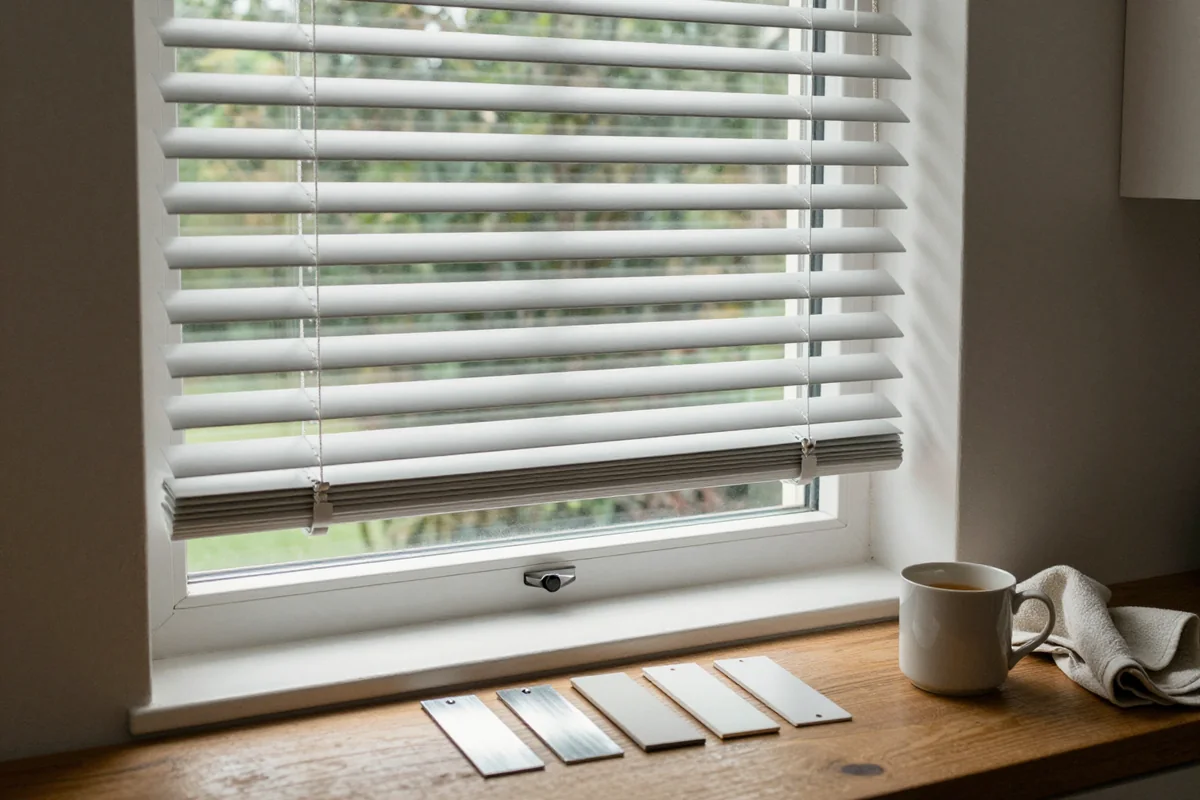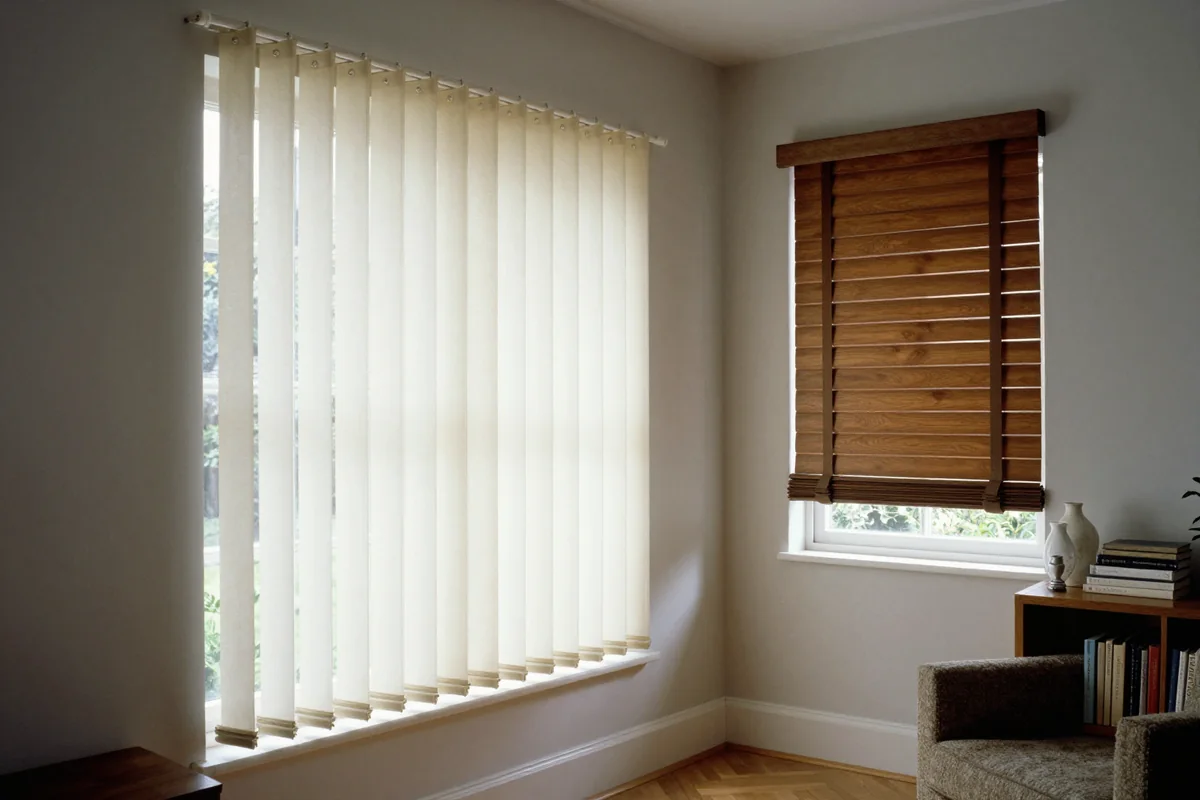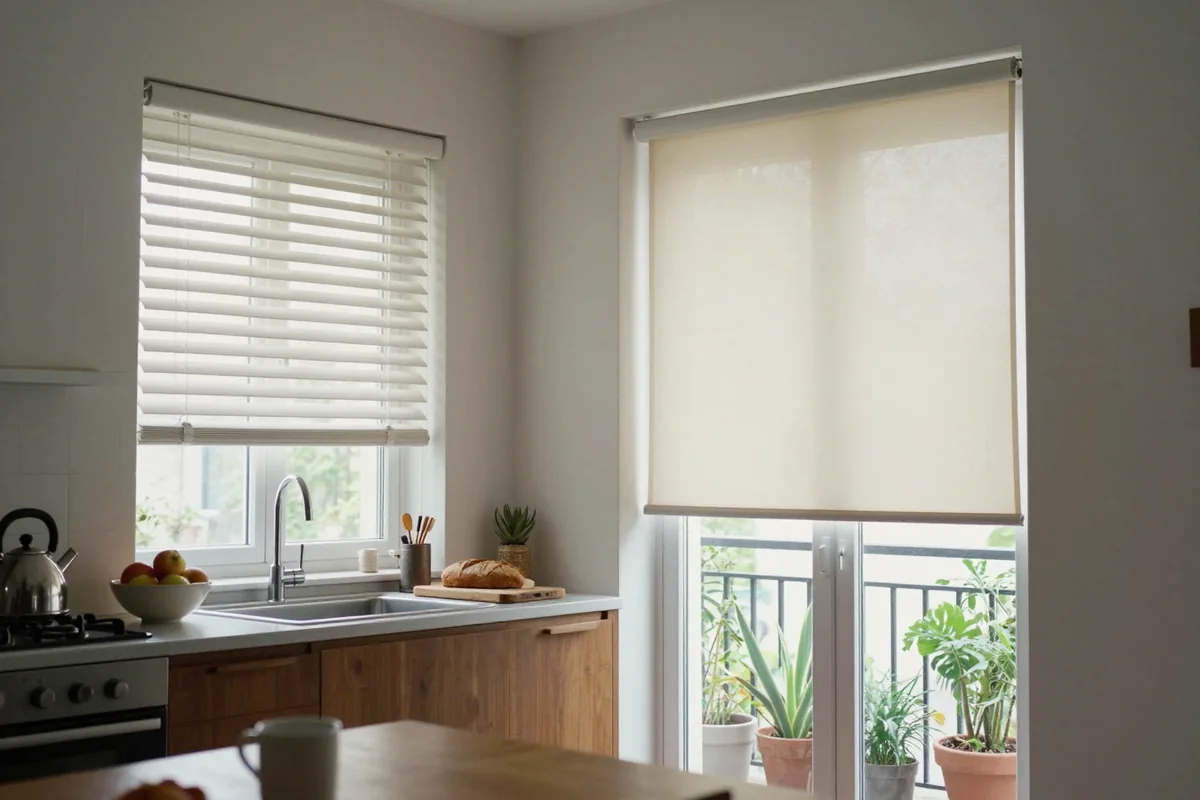
Blinds or roller blinds — the choice is decided not by fashion but by what stands by the window. By the stove and the sink, horizontal blinds are more practical: the slats can be wiped with a damp cloth and a cleaning product. By the dining table, on a warm loggia and in a sleeping area, a roller blind is cosier. Day-night blinds are a third option, for when you want soft light without tilting the slats.
What to hang in the kitchen: blinds or roller blinds
In the kitchen, you choose blinds or roller blinds not for the whole kitchen but for the window area. What stands under the window — a stove, a sink or a dining table — is what decides. Sometimes one kitchen with a window over the sink and a window in the dining area needs two different products, and that’s normal.
The window’s zone directly affects the choice. Grease and dust settle both on the slats of horizontal blinds and on the fabric of a roller blind. The difference is in how they are cleaned off the surface. Slats can be washed with a damp cloth and a cleaning product; fabric with a coating is only wiped carefully with a sponge — it must not be soaked or washed in a machine. Almaty’s hot, dusty summer adds its own argument: on the sunny side, dense fabric blocks the light completely, while slats let you turn the direct rays away and keep the view from the window.
When choosing blinds or roller blinds for the kitchen, it’s easiest to go by zones.
- A window over the stove or sink — horizontal aluminium or PVC blinds. Splashes and grease stay on the slats and are wiped off with a cloth.
- A window by the dining table and in the lounge area — roller blinds. Soft diffused light, fabric looks homely.
- A kitchen with floor-to-ceiling glazing or a wide opening — first look at both options at your window, then decide.
You can hang a roller blind next to the stove, but we’ll be honest: right by the flame, fabric gets dirty fastest, so the bottom of the blind is kept above the work surface. How this is solved with fabric and mounting is covered in detail on the “Roller blinds for the kitchen” page.
A window by the stove and over the sink
Here the slats handle splashes and grease. Horizontal aluminium or PVC blinds win: wipe and forget. An honest downside — there are many slats, and wiping them takes longer than a single blind.
A window by the dining table and in the lounge area
Here roller blinds are more appropriate. The light is soft and diffused, the fabric looks homely. An honest downside: you can’t direct the light the way you can with slats. The blind is either raised or lowered, with no intermediate brightness settings.
In the kitchen, the choice between blinds and a roller blind is decided by the area by the window — stove, sink or dining table — not by the kitchen as a whole.
Balcony and loggia: warm, cold, sliding
On a balcony, the more practical choice is the product that suits your glazing and loggia heating, not the one that looks prettier in photos. A warm loggia with heating or insulation is roller blind territory: there the fabric survives winter calmly, and soft light is more appropriate than a row of slats. A cold loggia places higher demands on the fabric and mechanism: an Almaty winter brings frost, while during the day the glass heats up in the sun, so here horizontal aluminium or PVC blinds are more often installed — metal and plastic don’t mind the cold. We wrote in detail about condensation and wintering on a specific loggia in the materials on the catalogue pages.
We’ll be honest: both fabric and slats on a balcony last longer when the glazing is closed tightly for the winter. Here’s how the options break down.
| Balcony type | What’s more practical | Honest downside |
|---|---|---|
| Warm loggia | Roller blinds | The fabric is not soaked or machine washed; it is cleaned with a vacuum and wiped spot by spot |
| Cold loggia | Horizontal aluminium or PVC blinds | There are many slats, wiping takes longer than a single blind |
| Sliding glazing | Blinds or a roller blind for each sash | Mounting is calculated per sash, not for the whole opening |
| A balcony door in the kitchen or room | Vertical fabric blinds or a blind for the door sash | The fabric gets in the way if the mounting is calculated incorrectly |
In summer, on the sunny side, aluminium slats heat up in the sun — that's normal for metal, but it's still worth touching a sample in the heat. And a dusty summer in Almaty means a balcony product will need cleaning more often than a kitchen one. What's more, sliding glazing changes the mounting method: the product is hung on the sash, not on the whole opening, otherwise the window won't open. A balcony door and a sash each need their own mounting calculation — we discuss this during the measurement.
On a balcony, the choice between blinds and roller blinds is set by the type of glazing and whether the loggia is heated, not by the owner's taste.
Grease and dust: what gets dirty faster and what's easier to wash off
Slats collect visible dirt faster: near the stove, grease and dust settle on them in a thin layer, and it shows when light passes through. Fabric gets dirty more slowly if the blind has a dust- and dirt-repellent finish. But these are different care stories, and they shouldn't be confused.
Horizontal blinds are built so that each slat is exposed to air on all sides. Almaty's summer dust, which blows in from the street through an open sash, settles on the top surface; cooking grease settles on the bottom, closer to the stove. Both need wiping, and here's the honest downside: there are many slats, and each one needs a hand. On the other hand, they wash easily — a damp cloth, a mild product, no restrictions. That's exactly why slats are easier to wash than fabric.
With a roller blind it is the other way round. The fabric’s coating makes the blind easier to care for: dust does not work its way in, and drops of grease stay on the surface and can be removed. But the fabric must not be soaked, scrubbed or washed in a machine — the coating will wash off, and the fabric will start collecting dirt far more readily. The main care is dry dusting; a stain is removed spot by spot with a soft sponge, and gentle hand washing is only acceptable if the fabric’s care label allows it.
Let's compare line by line:
| Criterion | Blind slats | Roller blind fabric |
|---|---|---|
| What settles | Grease and dust on both sides of the slat | Dust and occasional splashes on the front side |
| How often to wipe | As it gets dirty, more often near the stove | Less often, with a dry cloth or a vacuum cleaner |
| What to wash with | A damp cloth and a mild product | Surface only, with a damp sponge and no pressure |
| What you can’t do | Bending the slats and pulling them off | Soaking, machine washing and spinning the fabric |
So the products in the kitchen differ not only in appearance but also in how much effort the care will take. Grease and dust show up on slats immediately, but they wash off; coated fabric gets dirty more slowly, yet it must not be soaked or washed in a machine.
Which day-night roller blinds are best and when a simple blind is enough
Day-night differs from an ordinary roller blind in its two-layer fabric with alternating sheer and dense stripes. From horizontal blinds — in that light is controlled not by turning a slat but by shifting the layers relative to each other: the stripes align — light passes through, the stripes overlap — the room darkens. At the same time it remains fabric with all its properties. In everyday speech, roller blinds are called “rolety”, so the question about day-night roller blinds is a question about the same system.
Which day-night roller blinds are best for a kitchen and a balcony? The ones chosen for the window area, not for a picture in a catalogue. Near the stove, day-night gets dirty like any fabric, so people choose a dense fabric in light neutral tones where splashes don't show, or give up fabric altogether in favour of slats. On a balcony, day-night gives a “half-closed” mode and doesn't rattle in a draught like slats. How the stripes are arranged and how the systems differ is described in detail on the “Day-night roller blinds” page; we bring samples to the measurement, and the difference is immediately visible at your own window.
The design sets the second decision. An open roller tube is simpler and cheaper than a cassette system. A cassette covers the roll with a housing box and looks neater, but it's not always worth paying for — for example, in a kitchen a housing box is useful if the window is opened often and the blind rubs against the sash.
It's worth paying extra for day-night if:
- you need to change the lighting during the day without raising and lowering the blind;
- the window faces the sunny side, and you want to soften the light rather than block it completely;
- in the kitchen or on the balcony you need a second mode — “half-closed”, not just open and closed.
A simple roller blind is enough if:
- there's only one task: open it in the morning, close it in the evening;
- there's furniture under the window and the blind hangs down to the windowsill anyway;
- budget matters more than smooth light control.
About chain control: both day-night and a simple blind with a chain stop at any height, so the difference between them is in the fabric, not the mechanism.
Day-night is a roller blind made of two-layer fabric with alternating sheer and dense stripes: it gives smooth light like blinds, but remains fabric.
Which blinds to buy for a kitchen and a balcony
If the choice has already fallen on blinds, for a kitchen and a balcony people usually choose horizontal aluminium or PVC ones. Such systems consist of slats on a turning mechanism: the slats rotate around their axis, and light is controlled more precisely than with fabric. Roller blinds are built differently — it's fabric wound onto a roller tube, and you can't direct the light to the side with them. Hence the difference in which blinds to buy for a kitchen and a balcony: we look not at the colour but at what's by the window and what the window opening is like.
Here are the three materials we install most often, and the honest downside of each.
- Horizontal aluminium blinds, slat 25 mm. Suitable near the stove, above the sink and on the sunny side: metal isn't afraid of splashes, and the slats can be wiped. The downside — with a wide window there are many slats, and wiping them takes longer than raising a single blind.
- PVC plastic blinds, slat 25 mm. The same scenario in a kitchen where saving matters: splashes and grease wipe off the smooth surface. The downside is that a thin dark PVC slat on a sunny window may warp over time, so a light colour is better for south-facing windows.
- Vertical fabric blinds, slat 89 mm. They are chosen for a wide opening and a balcony door that has to be opened and closed: the slats slide to the side and do not block the way. The downside is that fabric by the stove absorbs grease more than metal and plastic.
The window configuration matters no less than the material: on a narrow sash horizontal blinds look neat, while on a balcony door with a window next to it vertical blinds are more convenient, because they can be pulled apart and free up the passage.
Blinds are not the right choice when you need soft diffused light and the homely look of fabric — that is where roller blinds come in.
How much each option costs and what changes the price
Our price per square metre depends on four things: the type of product, the fabric, the control and the mounting method. The base line in the price list is a lower bound, not the final order total: multipliers for control, fabric density and mounting are applied on top of it, so the total for a specific window only appears after the measurement.
| Option | Price from, ₸/m² | Manufacturing time |
|---|---|---|
| PVC plastic blinds, slat 25 mm | 3,600 | 3–5 days |
| Horizontal aluminium blinds, slat 25 mm | 4,200 | 3–5 days |
| Vertical fabric blinds, slat 89 mm | 4,600 | 3–5 days |
| Roller blinds, polyester, open roller tube | 5,400 | 4–6 days |
| Day-night, two-layer fabric | 7,300 | 5–7 days |
What pushes the line up is clear from the calculator multipliers: the base price is multiplied by each of them.
| What you choose | Options and multiplier |
|---|---|
| Control | mechanical ×1.0; chain ×1.06; electric motor ×1.85; electric motor with remote control ×2.1 |
| Fabric | standard ×1.0; sun protection ×1.15; blackout ×1.35 |
| Mounting | wall-mounted ×1.0; frame-mounted ×1.05; no drilling ×1.1; cassette system ×1.28 |
Installation of one product costs 4,500 ₸, and once the order reaches 150,000 ₸ or more, installation is no longer charged. The measurer comes free of charge, brings samples, advises and works out the estimate on the spot; delivery within Almaty is also free, and we tell you the price of a trip outside the city in advance.
The cheapest for the kitchen and balcony are PVC and aluminium blinds, a roller blind costs more, day-night blinds cost more still; the total is changed by the control, the fabric and the mounting method.
Blinds in the kitchen, a roller blind on the balcony: can you mix them
Yes, and it is handled as a single order: one measurement, one estimate, the products are calculated together, and one team comes to install. Blinds or roller blinds do not have to be the same throughout the flat. And the reason is not the workshop’s convenience, but that the window area itself determines the choice between blinds and a roller blind.
A typical situation is a kitchen with a door onto the balcony. At the work area where the stove is, horizontal blinds are installed: the slats are easier to wipe. On the balcony door and on the sash that opens onto the loggia, a roller blind is more often wanted — it does not get in the way of opening and looks softer in the living part. The unified look of the windows does not suffer: we select the fabric and the colour of the slats so that they echo each other rather than clash.
A measurement with samples lets you check both at your own window before ordering. The measurer comes with samples of fabrics and slats and holds them up to your sash in your light. And if you want to compare day-night blinds on the door with blinds on the kitchen window — go ahead and compare, there is nothing strange about it. Identical products on every window in a flat are not always needed: a kitchen window and a balcony window do different jobs.
Different products in one flat are normal practice: one measurement, and installation is free on orders from 150,000 ₸.
If you cannot drill: a rented flat and new windows
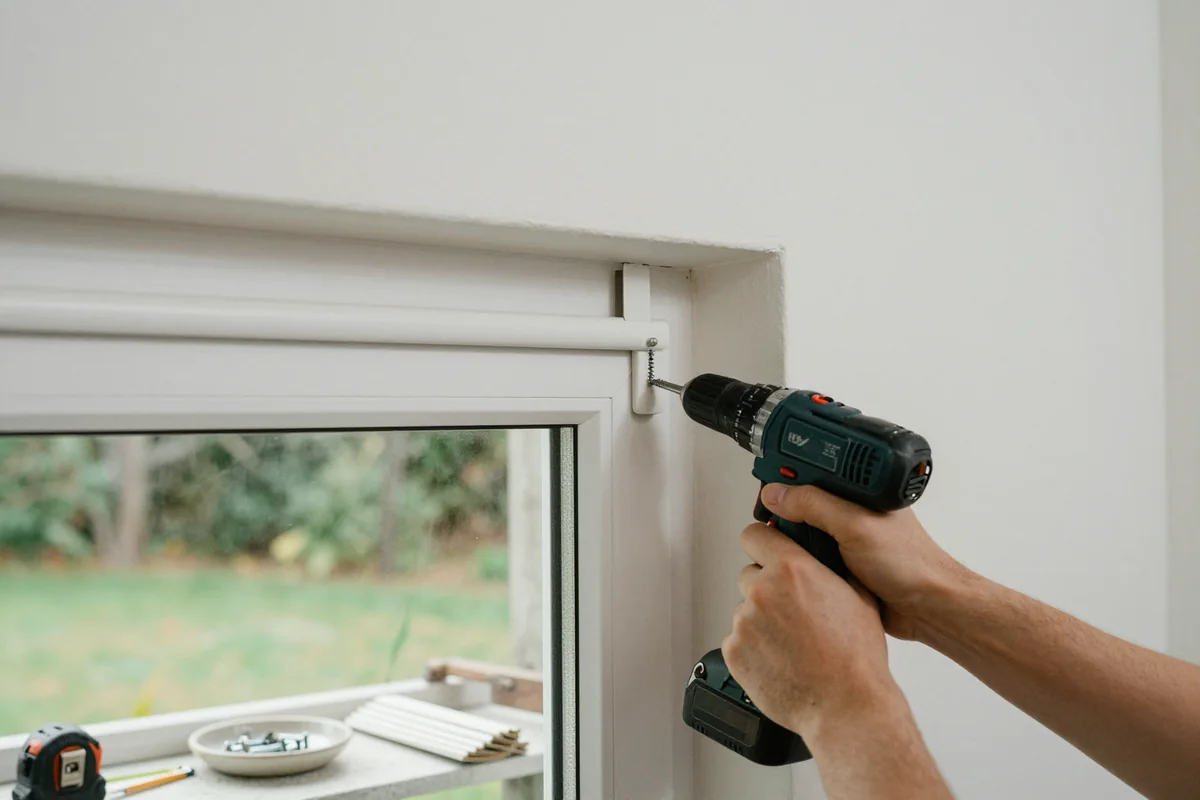
In a rented flat and on new windows we install both blinds and roller blinds without drilling into the frame. Drilling-free mounting preserves the window manufacturer’s warranty: no holes appear in the profile, and when you move the product is taken down and comes with you. For a rented flat this is often the deciding argument — you do not want to alter someone else’s window, and the landlord is usually against holes in the frame.
There are three methods, and all of them work:
- brackets into the glazing bead — the fastener goes into the glazing bead of the glass unit, leaving the profile untouched; suitable for both horizontal blinds and roller blinds;
- spring clips — the bracket clips onto the sash over the profile, fitted and removed without tools;
- adhesive tape — the simplest option for lightweight models, but the surface needs preparing: dust and grease on the profile hold poorly.
On new windows, drilling-free mounting preserves not only the window manufacturer’s warranty but also the neat look of the frame: after the blind is taken down, the profile is clean. There is one honest downside: which method will hold a specific product is decided at the measurement — a lightweight blind is fine with tape, while a heavier system needs brackets.
Both blinds and roller blinds can be mounted without drilling, the frame stays intact, and the window manufacturer’s warranty is preserved.
Care and minor repairs yourself: when to call a specialist
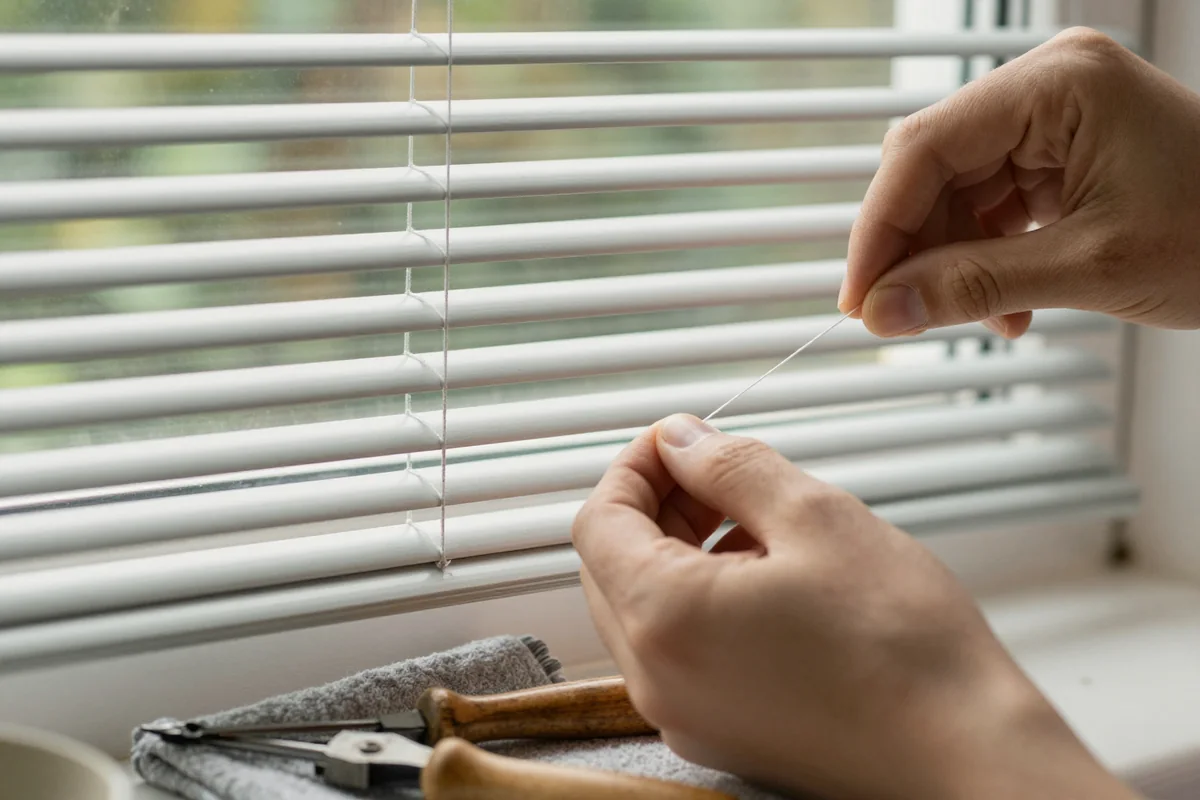
You can wipe the slats, vacuum the fabric and straighten fabric that has slipped yourself. A skewed roller tube, a torn chain or cord is better left to a specialist — we come out even after the warranty. That is how the division of labour works in caring for blinds and roller blinds: part of the work needs neither tools nor a call-out.
What you can do yourself:
- Wipe the slats with a soft cloth and soapy water — no abrasives, so as not to leave scratches. Aluminium and PVC slats handle this kind of wiping easily, and they are exactly where grease and dust show up at once.
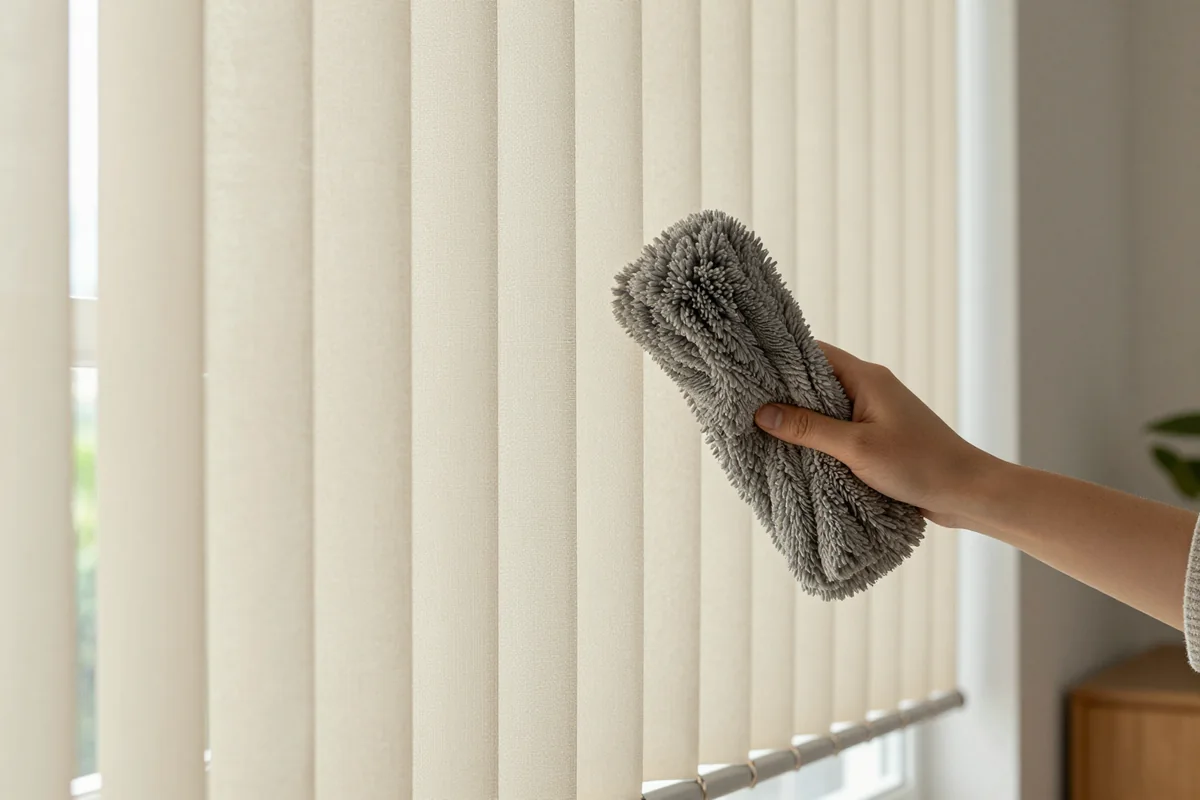
- Vacuum the roller blind fabric with a soft brush attachment on the lowest power. The fabric treatment does not suffer from this, and it removes dust well, especially the summer Almaty dust.
- Straighten fabric that has slipped on the roller tube by hand — carefully, without jerking. If the fabric has shifted on the tube, lower it all the way, check that it is not catching on the sash or handle, and raise it slowly — usually the fabric settles evenly. Do not take the mechanism apart: reinstalling it yourself voids the warranty.
- Minor adjustment of the chain length or tightening the fasteners is also easy work to do yourself.
When to call a specialist:
- A skewed roller tube: the fabric rises crookedly, one edge higher than the other — this requires taking the mechanism apart, so it is best not to tackle it yourself.
- A torn chain or cord: this is a part replacement, not a tightening.
- Any breakdown during the warranty period on the mechanism — 3 years, and on installation — 1 year. If the case is covered by warranty, we repair it free of charge within 5 working days.
The warranty does not cover fabric faded by the sun, water, damage from a blow or a sharp pull, or the consequences of rehanging the product yourself — that is wear and tear or the result of handling, not a defect in the product. During the measurement we show you how the chain and the roller tube are put together, so you understand where care with your own hands ends and calling a technician begins.
How to check your choice before ordering
You can check the fabric and slats at home before ordering during a free measurement: the measurer comes with samples, and you look at them at your own window in your own light. Photos in the catalogue don’t convey this. We have often seen how fabric that looked good on screen looked completely different at the window — denser, darker, or, conversely, paler.
The process is as follows:
- Request a measurement — it’s free, and within the city it includes delivery.
- Hold the fabric sample against the glass during the day: on the sunny side of Almaty the same fabric looks lighter than on a cloudy day.
- Look at the sample in the evening with the light on — that’s how you see how much light it holds back and how it looks from the street.
- Open the sash with the sample attached: check whether the fabric gets in the way and where the control will sit.
- Compare the slats with the fabric on the same window — the difference in how they let light through becomes obvious.
- Ask the measurer to calculate the cost on the spot: they give you the price right away, including the control, fabric and mounting.
A measurement with samples lets you check the fabric at your own window before ordering — that is the most reliable check. One tip from us: hold the sample in your hands rather than looking at it from a distance.
FAQ
What stays looking neat longer in the kitchen — blinds or a roller blind?
A roller blind with a coating holds up more neatly. Dust and grease settle on the fabric more slowly than on slats, and the blind itself does not collect splashes from the sink. But there is an honest downside: a coated blind is not soaked or machine washed, so an area that has gone shiny can no longer be washed back to its original look. With horizontal blinds it is simpler in this sense — you just wipe them, and they look new again.
Can day-night blinds be hung right above the sink?
You can hang one, but fabric next to water gets dirty faster, and it must not be soaked or washed in a machine. So above the sink itself, PVC or aluminium slats are more practical, while day-night blinds are better suited to the neighbouring window by the table. If you still want fabric, show the sink to our measurer: they will advise where to bring the chain out so it does not get in the way of the tap.
What is quieter in a draught on the balcony?
Roller blinds are quieter. Horizontal blinds in a draught from an open balcony door tap their slats against each other and against the frame, while a taut fabric stays calm. If your balcony is always ajar, this is a strong argument in favour of a roller blind with an open roller tube or in a cassette.
What to choose if there’s a cat or small children in the kitchen?
Choose what is mounted above reach, not what is cheaper. A freely hanging chain is the first thing both a cat and a child pull on; so keep the cord and chain out of reach and fix them to the frame or wall with a tensioner. We choose the chain length during the measurement. Also bear in mind that mechanical damage is not covered by warranty.
Conclusion
Blinds or roller blinds are chosen not for the kitchen or balcony as a whole, but for a specific window zone. Point by point it looks like this.
- At the stove and above the sink, aluminium or PVC blinds are more practical: splashes and grease are wiped off the slats rather than absorbed into fabric. At the dining table and in the lounge area, a roller blind is more appropriate — the light is softer, the look more homely.
- On the balcony, the glazing and whether the loggia is heated are what decide. Sliding aluminium, a cold contour and a balcony door lead to different mountings and different systems.
- Slats get dirty more noticeably, but they wash off; coated fabric holds dirt longer, but it must not be soaked or washed in a machine.
- Day-night blinds are a surcharge for smooth light adjustment. When you only need “open — closed”, a simple roller blind does the job.
- Both options can be mounted without drilling the frame: both blinds and roller blinds.
There is one practical recommendation. Before ordering, look at samples at your own window during a free measurement: the measurer comes with fabrics and slats, and you compare them in your own light, during the day and in the evening. A small thing, but it removes half your doubts.
If you want to dig into the details for your own kitchen or balcony, we have separate in-depth articles on these topics — they’re handy to open alongside this article.