All window blinds differ by one main feature — how the product controls light. With horizontal blinds the slat turns, with vertical blinds the slats slide to the side, with roller blinds the fabric rolls up onto the tube, with pleated blinds the fabric folds like an accordion. By this feature the type is identified in a minute, even if the name in the catalogue is unfamiliar to you.
What feature actually distinguishes window blinds
Before reading catalogues, look at the moving part of the product. The type of blinds is determined not by material or colour, but by how that moving part controls light. Hence the four big families — one method each.
Four ways to control light
Horizontal blinds control light by tilting the slats: the slats stay in place, only their angle changes. Vertical blinds also tilt their slats, but their main difference is that the slats slide sideways: the blind opens from the centre to the edges of the window or gathers to one side. Roller blinds control light by lifting the fabric onto the roller tube: a single piece of fabric rolls upwards. Pleated blinds control light by folding like an accordion — the fabric gathers into tight pleats at the top or bottom.
Remember these four mechanisms, and further in the article you will recognise them in any description. What kinds of window blinds there are is a question not about names, but about what happens to the product when you pull the cord or chain.
Why catalogues have so many names
Roller blinds, roller shades, roller blinds, zebra, Venetian — behind different names are the same mechanisms. Venetian blinds are ordinary horizontal blinds with a narrow slat. Roller blinds are the same roller blinds, just named by analogy. Zebra is a day-night roller system. The confusion arises because sellers give one product their own name, and the buyer looks for separate types in that.
At measurements I often hear: “I want zebra, but I already have roller blinds.” And that is, in essence, one family. The only difference is the fabric — striped or plain.
The type of blinds is determined by the light-control mechanism, not by material or by the name in the catalogue.
Horizontal blinds: types, slats and mounting
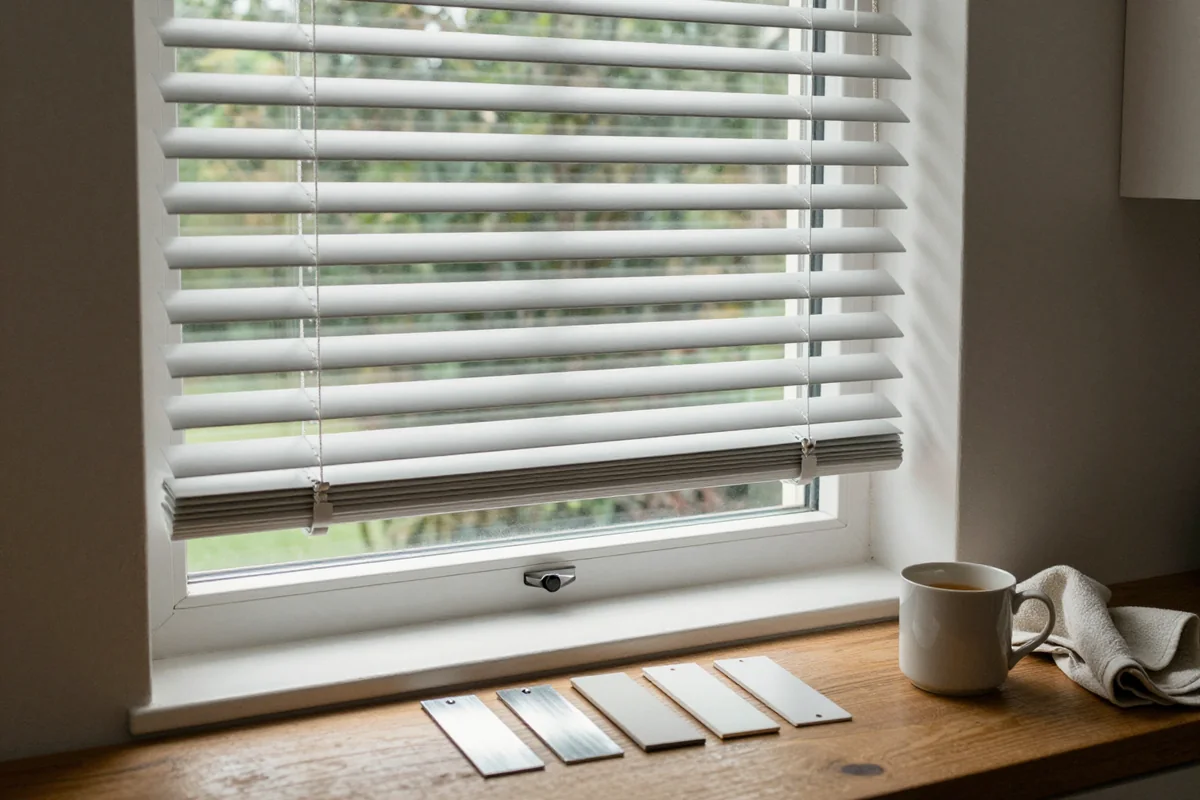
Horizontal blinds differ from vertical ones in that their slats lie across the window and turn around their axis, rather than sliding to the side. Here the light is regulated by the tilt angle of the slat: turn the chain a little — and the room is already in soft half-shade. Types of horizontal blinds are distinguished by two features — the width and material of the slat, and also by the mounting method.
Slat 25 and 50 mm
The width of the slat affects the look of the system and its price. A narrow slat of 25 mm gives a frequent lining of the window and looks neater on small sashes. A wide slat of 50 mm draws a calmer, larger rhythm: there are fewer slats on the window, and the system itself looks more massive and costs more. There is also a practical difference. A narrow slat is harder to care for — more dust settles on it, and wiping every slat takes longer. The material of the slat decides the rest: aluminium and steel hold their shape, PVC plastic is cheaper and not afraid of moisture, linden gives a warm wood pattern and noticeably raises the price.
Where they are mounted: on the wall, on the frame, without drilling
Horizontal blinds are hung on the wall or ceiling above the opening, on the frame itself and inside the opening — these are the main types by mounting. Mounting on the sash stands apart: the product moves together with the window, and here mounting on the sash requires checking whether the product interferes with the handle when turning and tilting.
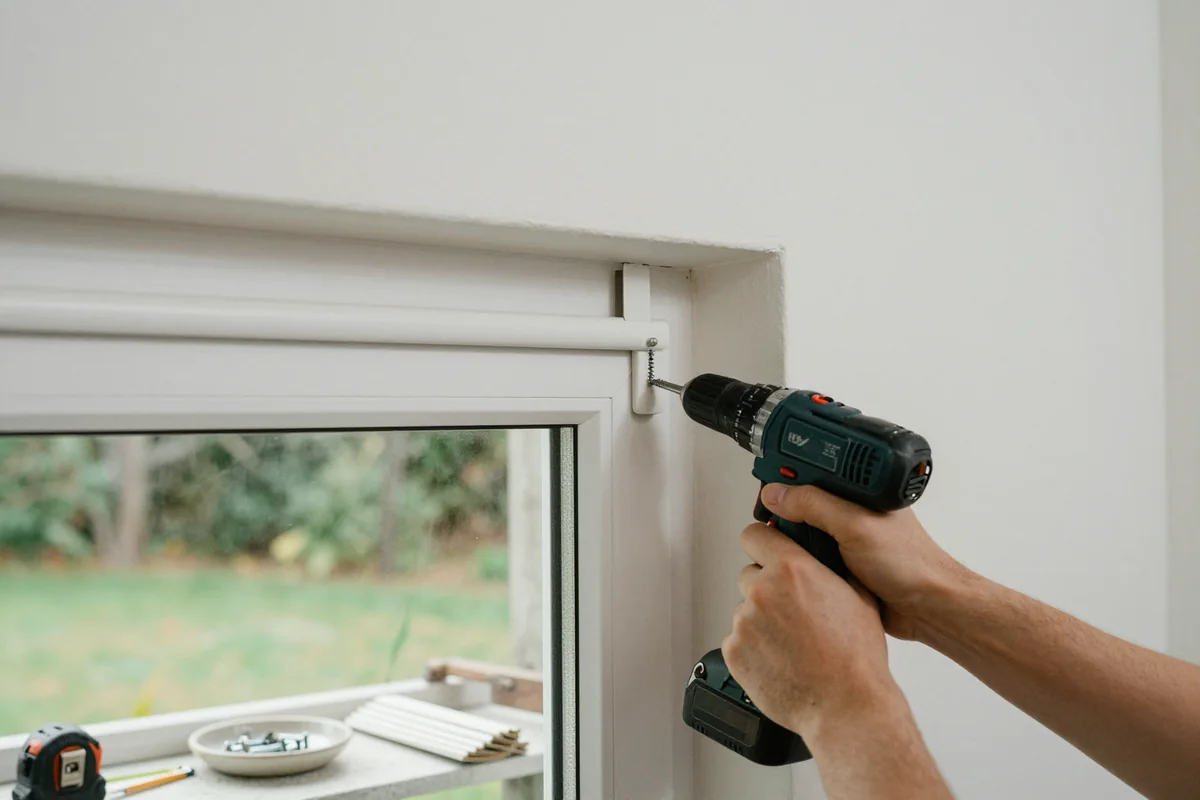
We do not drill the frame. There are three ways to do without holes: into the glazing bead on brackets, on spring clips and on adhesive tape. With such installation the window manufacturer keeps their warranty — and that, in my view, is the main argument for plastic windows in a rented flat.
- On the wall or ceiling — when you want to cover the whole opening.
- On the frame — the most common option for the kitchen and bedroom.
- Without drilling — into the glazing bead, on clips, on tape; the frame stays intact.
Between-the-glass blinds
Between-the-glass blinds are installed between the panes, in the gap of two frames. This is a separate subtype of horizontal blinds: the slats are the same, but they are hidden between the panes, and only the control handle is brought outside, so dust hardly gets on the slats. They do not suit every window — a gap between the frames is needed, so they are not installed on an ordinary single glass unit.
Horizontal blinds control light by turning the slat, and differ from each other by the width and material of the slat and the mounting method.
Vertical blinds: types of slats and large windows
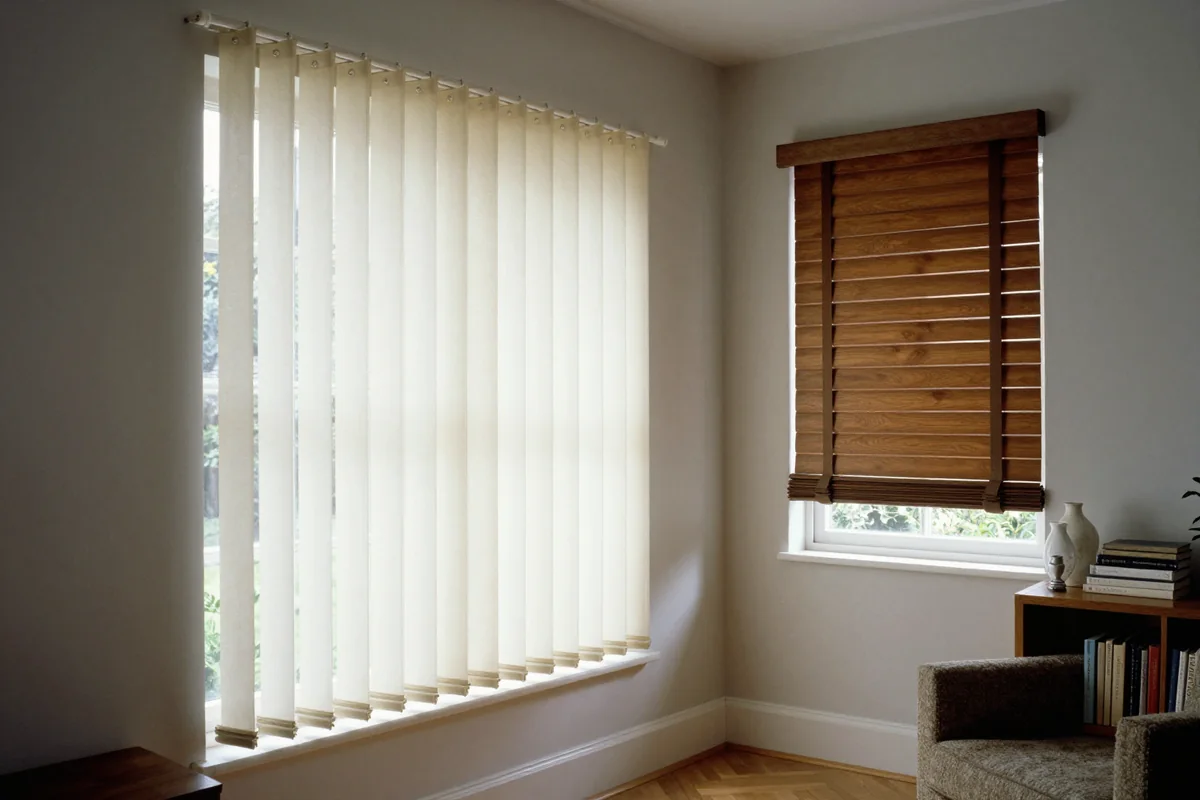
Vertical blinds differ from horizontal ones in the direction of the slat and in where the blind goes. The slat hangs vertically and turns around its own axis with the control chain — just as a horizontal slat turns around a horizontal axis. With the cord the slats also slide towards the edge of the window or open from the centre. That ability to move the blind sideways rather than lift it up is the main difference: horizontal blinds clear the opening from the bottom up, vertical blinds from left to right.
Types of slats by material
Types of vertical blinds are distinguished primarily by the material of the slat — it decides how much light remains in the room and what is visible from the street in the evening.
- Fabric slats 89 mm wide give soft, diffused light and read from outside during the day as an even surface.
- PVC and aluminium are denser against light and easier to wipe clean, but from the street they look like rigid plastic or metal, not fabric.
- Multi-textured blinds combine dense and transparent slats: the transparent ones let light through, the dense ones block the view.
- Sheer slats are semi-transparent and work like a light curtain: they let light through while hiding the details of the room from the street.
Slat 89 mm
In our price list, vertical fabric blinds come with 89 mm slats — from 4,600 ₸/m², manufacturing time 3–5 days. The slat width affects the look of the system and its price, and on a tall, wide window a wide slat looks calmer than a narrow one: the fabric doesn’t ripple. And the wider the opening, the more noticeable the advantage of a vertical system over a horizontal one — fewer ribs, and the opening is revealed in a single movement.
Large and non-standard openings
Floor-to-ceiling glazing, arched windows, windows of complex shape — here vertical blinds are more suitable than horizontal ones. The reason is simple: the slat is made to the height of the opening without cross joints, and sliding sideways does not get in the way of opening the sashes. We measure arched and roof openings with a template — otherwise the shape of the opening cannot be matched.
Vertical blinds control light by tilting the slats and sliding them sideways, which makes them convenient for wide and floor-to-ceiling windows.
Roller blinds: what types of roller blinds there are
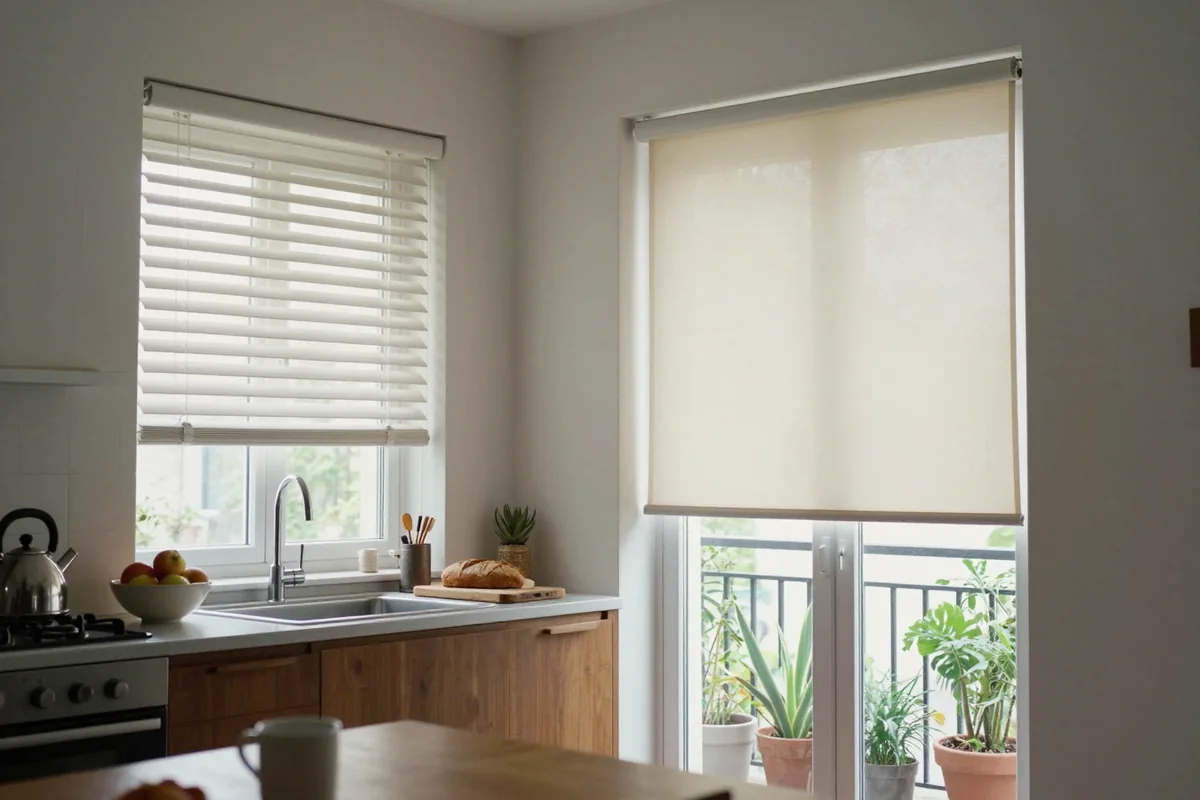
Roller blinds differ from blinds in that light is controlled not by tilting a slat but by raising a single piece of fabric onto a roller tube. There are no slats at all — there is one piece of fabric that hangs in the opening and rolls onto the tube at the top. This also means different behaviour: blinds let light through between the slats, while a roller blind covers the glass with a solid fabric exactly to the height you lower it. Light is adjusted only by the height of the fabric and its density; there is no tilt angle like with slats.
Roller blinds are often called roller blinds, and this is a case where the name doesn’t describe the design precisely. But since people ask what types of roller blinds there are, here’s a straight answer: the systems differ primarily in whether the roller tube is visible or hidden.
Open roller tube
An open roller tube leaves the fabric and the tube in view. The system is simpler in design: the tube with the fabric is mounted above the window, a bottom bar holds the fabric down, and it’s operated by a chain or cord. It can be mounted both on the wall and on the frame. The downside is that the tube and the top edge of the fabric are exposed, and dust settles on them and needs to be brushed off. But this system is cheaper in its basic version: polyester roller blinds start from 5,400 ₸/m², manufacturing time 4–6 days.
Cassette system
A cassette system covers the roller tube and the fabric with a housing box. The box is attached to the sash or to the frame, the fabric comes out of a slot and slides along guide rails — it doesn’t dangle or catch on the handle. On a sash, a cassette looks neater than an open roller tube, and we usually recommend it for plastic windows: the design doesn’t interfere with closing. In the calculator, the cassette system comes with a coefficient of 1.28 to the base price.
Fabrics: standard, sun protection, blackout
The fabric determines what happens to the light. Standard is ordinary polyester: it dims the light during the day, but in the evening with the lights on, silhouettes are visible from the street. Sun protection reflects some of the heat and cuts brightness but stays semi-transparent. Blackout doesn’t let light through, and the neighbouring option is dimout: a dense fabric that dims the room almost to darkness, but not completely. That’s why blackout is usually chosen for bedrooms. The three options in the price list come with different coefficients, which is why blackout is noticeably more expensive than standard.
Roller blinds differ from blinds in that light is controlled by raising a single piece of fabric onto a roller tube, not by tilting a slat.
What day-night roller blinds are and how roller blinds differ from roller shutters
What are day-night roller blinds? It’s a roller system in which the fabric is made of two layers of striped fabric. The stripes alternate: dense and transparent. By shifting the layers relative to each other, you change the degree of shading — from diffused light to dense shading. The mechanism is the same as with regular roller blinds: the fabric is raised onto a roller tube and operated by a chain or cord.
Day-night blinds are also called zebra blinds — because of the alternating stripes. In Almaty, the word “rolety” has taken hold in everyday speech. And that’s where the main confusion begins.
How the two layers of stripes work
When the stripes of one layer align with the transparent stripes of the other, light passes through freely. Shift the fabric by half a step and the dense stripes cover the transparent ones, and the room darkens. This isn’t two different products but one system with smooth adjustment. That’s its strength: you don’t choose between “light” and “dark” but hold the boundary you need.
What day-night blinds don’t do
Day-night roller blinds don’t give complete darkness. Not in any position of the stripes. If you need a bedroom that’s dark as night during the day, that’s blackout fabric, not day-night.
The second limitation we honestly mention right away: in the evening, when the lights are on in the room, the stripes are visible from the street. Not silhouettes, but the pattern of the striped fabric — yes. For ground floors and windows right next to neighbours, this is worth keeping in mind.
Rolety, roller blinds, roller shutters
Rolety and roller blinds are colloquial names for roller blinds. The same product that hangs inside the room.
Roller shutters are a different product. They are an external protective system made of roll-formed profile that is installed outside the window and covers the opening completely. Their job is protection and complete blackout, not adjusting light with stripes.
Day-night blinds are a roller system made of two layers of striped fabric that doesn’t give complete darkness; while “rolety” in Almaty is a colloquial name for roller blinds, not roller shutters.
Pleated blinds, multi-textured blinds, photo printing and electric motors
We’ve already covered four families, but catalogues throw in a few more names. Pleated blinds differ from roller blinds in that the fabric doesn’t roll onto a tube but folds up like an accordion from bottom to top or top to bottom. The fabric of pleated blinds hangs taut, so the folds keep their shape even on the sash of an open window. That’s why pleated blinds are chosen for non-standard openings where a roller blind won’t fit.
Pleated and cellular blinds
Pleated blinds are fabric set in even pleats that compress like an accordion when raised. Cellular blinds (also called honeycomb) are a neighbouring class of sun protection, not blinds: there are air cells inside the fabric, and slats have nothing to do with it.
Multi-textured blinds and photo printing
Multi-textured blinds combine dense and transparent slats in one product: the dense ones provide sun protection, the transparent ones let light through in stripes. It looks like an alternation with a different effect from the street and from inside. Photo blinds are the same slats but with a photo-printed design: the image is applied to the slat, so the window turns into a panel.
Electric motor
An electric motor replaces manual operation with a cord or chain: a 220 V motor or a battery, controlled by remote. We install it on tall windows and floor-to-ceiling glazing where you can’t reach by hand.
Venetian blinds is the familiar name for horizontal blinds with a narrow slat, not a separate type. Pleated blinds control light by folding the fabric like an accordion, multi-textured blinds combine dense and transparent slats, and an electric motor replaces manual operation with a cord or chain.
Comparison table of types: light, ventilation, care, price
Roller shutters and systems with dense blackout fabric let in the least light — that is external protection and a roller blind that covers the whole window opening. Vertical sheer slats and light-coloured paper blinds give the most light: they scatter the flow rather than block it. All the other types sit between these two extremes.
| Product type | What it does with light | Ventilation | Care | Price from, ₸/m² | Lead time |
|---|---|---|---|---|---|
| Horizontal aluminium, slat 25 mm | Turning the slat changes the flow from open to dense | The tilt-and-turn sash opens if the slats are not caught by the handle | Wipe the slats | from 4,200 | 3–5 days |
| PVC plastic, slat 25 mm | Slat rotation, as with aluminium | Same | Wipe, no need to fear moisture | from 3,600 | 3–5 days |
| Metal, steel, slat 25 mm | Like aluminium, but the slat is stiffer and does not bend from an accidental touch | Same | Wipe | from 5,200 | 5–7 days |
| Wooden, linden, 25 mm | Dense coverage, warm light | Same | Dry dusting, no water | from 10,900 | 7–12 days |
| Wooden, linden, 50 mm | Wide slat, denser than a narrow one | Same | Dry dusting, no water | from 12,400 | 7–12 days |
| Vertical fabric, slat 89 mm | Slats slide to the side, light is scattered | The sash opens freely | Remove the slats and wash according to the instructions | from 4,600 | 3–5 days |
| Multi-textured | Dense and transparent slats alternating, light comes in stripes | Same | Wipe both types separately | from 7,200 | 7–10 days |
| With a pattern, photo print | Dense coverage plus a picture | Same | Wipe carefully, do not rub the pattern | from 8,900 | 7–12 days |
| Roller blinds, polyester, open roller tube | The blind lowers to the height you need, the fabric sets how dense it is | The sash opens if the blind does not catch the handle | Vacuum or wipe the blind | from 5,400 | 4–6 days |
| Day-night | Striped fabric, does not give full darkness | Same | Vacuum with a soft brush attachment | from 7,300 | 5–7 days |
| Pleated blinds | Folds like an accordion, light is scattered by the folds | Same | Vacuum, spot-clean stains with a damp cloth, do not wash or soak | from 9,800 | 7–10 days |
| Paper, pleated paper | Light scattering, no dense darkness | Same | Dry dusting | from 3,200 | 2–3 days |
| Bamboo | Warm scattering through the straw | Same | Dry dusting | from 9,400 | 7–10 days |
| With electric motor | Like the basic system, plus control with a button | Same | Like the basic system | from 7,800 | 7–10 days |
| Roller shutters | Almost complete coverage of the opening | Mounted outside, the sash is not touched | Wipe the profile | from 17,500 | 10–14 days |
Blind care depends on the material of the slat or fabric: wood and paper cannot stand water, fabric slats are removed and washed, while aluminium and PVC are wiped with a damp cloth. The hardware — cords, chains, runners — needs attention in a child’s room: a child can pull on a freely hanging cord.
Why the price in the table is only the beginning
The “from” price is per square metre of the basic version: manual control, standard fabric, wall mounting. A cassette system multiplies the cost by 1.28, and an electric motor by 1.85, because it adds a cassette and a motor. What else goes into the price and how non-standard sizes are calculated, we covered in the article on the “Blinds” page; one thing matters here: the control method and the mounting type affect the cost no less than the size of the window. The most affordable items in the table are paper and PVC plastic, the most expensive are roller shutters.
How to tell which type you have hanging and whether it suits your window
The type of product is identified in a minute. Pull the cord or chain and watch what happens to the moving part: the slats turn around their axis — you have horizontal blinds; the slats move sideways — vertical blinds; the fabric goes up and winds onto a roller tube — roller blinds; the fabric folds up like an accordion — pleated blinds.
If the control is a chain rather than a cord, the principle is the same. The chain turns the roller tube, the tube pulls the slats — the mechanism is still recognisable by the movement of the moving part. Below is an identification table that answers the question of what types of window blinds exist for any product in your home.
| What you see when you pull the cord or chain | Which type it is | What to check on the window |
|---|---|---|
| The slats turn, they lie across the window | Horizontal blinds | Whether the product gets in the way of the handle, the depth of the glazing bead |
| The slats slide sideways, they hang along the window | Vertical blinds | Whether there is enough room to slide them sideways |
| The fabric rises onto the roller tube | Roller blinds | The depth of the windowsill, the mounting method |
| The fabric folds up like an accordion | Pleated blinds | The depth of the glazing bead, how even the opening is |
Next we check the window itself. The tilt-and-turn sash, the handle, the depth of the glazing bead and the depth of the windowsill — four things that determine whether the chosen type will fit without modifications.
Ventilation when mounted on the sash
The sash can be opened if the product is mounted on it. But mounting on the sash requires a check: whether the product gets in the way of the handle when the sash is tilted.
A typical situation from a measurement: the blinds are mounted on the sash, when you turn the handle the bottom bar hits it and the sash does not close all the way. This is solved either by shifting the brackets or by using a different mounting method. This can only be seen on site.
No-drill mounting
There is no need to drill the frame. Into the glazing bead on brackets, on spring clips, on hook-and-loop tape — three ways to install the product without holes in the profile, and the window manufacturer’s warranty is preserved.
The measurement determines the mounting method and the size of the product. The depth of the windowsill and glazing bead is what decides it here: the same product will fit in one opening and will not fit in another.
The type of product is identified in a minute by the movement of the moving part, and whether it suits your window is decided by the sash, the handle and the depth of the glazing bead.
The weak points of each type: what to honestly take into account
Almost everything we make can be repaired, but each type has a spot that asks for attention sooner than the rest.
On horizontal blinds these are the control hardware and the slats themselves. The cord wears through where it passes through the stop, and a narrow slat bends if you catch it with your hand when opening the sash. We take apart and replace the tilt mechanism, and the slat too, so the product does not have to be thrown out entirely. The only thing is that a thin slat is easy to bend again.
With vertical blinds the weak point is the lower part of the slat. The heavy fabric strip swings from a draught and catches on the windowsill or on a person passing by, and a crease is left at the fold. The slat is replaced individually, and this, in my view, is the most repairable product of all.
With roller blinds the edge of the fabric suffers: it gets pulled out of alignment if the fabric hangs for a long time without tension. The fabric is taken off and re-hung on the roller tube.
With pleated blinds the folds lose their sharpness over time — the fabric straightens out in the places where it was most often pulled by hand.
A separate note on the safety of cords and chains. In a child’s room a long hanging chain is exactly the thing you want to pull on. A short cord or an electric motor with a remote control is calmer here.
In the kitchen the most practical are horizontal aluminium blinds and vertical PVC: grease and soot wipe off them with a damp cloth, whereas porous fabrics absorb odours. This applies not only to the kitchen — we wrote in detail about washing and cleaning in the article “Blinds Care”, and about replacing parts in “Repair of Blinds and Roller Shutters”.
Blinds care differs by the material of the slat or fabric. But between-the-glass blinds are the calmest in this sense: they sit between the panes, and neither street dust nor kitchen grease reaches the inner slat.
Every type has a weak point, and knowing that point is half the solution.
Glossary of names: what lies behind the words from the catalogue
Venetian blinds are the familiar horizontal blinds with a narrow metal, wooden or plastic slat; there is no separate mechanism behind this name. Isolight is the name for a horizontal system that mounts directly on the sash and moves with it. There are many names in catalogues, but few mechanisms behind them.
| Name from the catalogue or colloquial | What it actually is | Which mechanism it belongs to |
|---|---|---|
| Venetian | horizontal blinds with a slat | turning of the slat |
| Isolight | horizontal blinds on the sash | turning of the slat |
| between-frame | horizontal between the panes | turning of the slat |
| roller blinds, “rolety” | roller blinds | fabric rolls up onto the tube |
| roller blinds | roller blinds | fabric rolls up onto the tube |
| zebra | day-night, two-layer fabric | fabric rolls up onto the tube |
| cassette | roller blinds with a housing box, cassette system | fabric rolls up onto the tube |
| blackout | roller blinds made of dense fabric | fabric rolls up onto the tube |
| dimout | roller blinds made of medium-density fabric | fabric rolls up onto the tube |
| pleated, honeycomb | pleated blinds | folds up like an accordion |
| multi-texture | multi-texture blinds, most often vertical | slats slide and turn |
| roller shutters | an external protective system made of profile, not blinds | the profile rolls up onto a tube outside the window |
In Almaty, “rolety” means roller blinds, not roller shutters: they are two different products, and it is best not to confuse them. Between-frame blinds are installed between the panes — they are only chosen for windows with two frames and a gap between them; this product will not fit a single glass unit. For Almaty windows, this limitation is exactly what decides the choice: if there is only one frame, look at Isolight or regular horizontal blinds.
Most of the names in catalogues are not separate types but subtypes of four mechanisms or colloquial names for the same products.
When to call a measurer
You do not always need to call a measurer — you can sort out some questions yourself, right in the apartment. Measurement determines the mounting method and the size of the product, and these two things cannot be guessed from a catalogue photo.
There are cases where a visit is unavoidable. An arched, triangular or roof window — here you need a template taken on site. Choosing between two types that cannot be decided from a picture is also a reason to call someone with samples. The cassette and the depth of the glazing bead: a centimetre this way or that, and the housing box either fits or it does not. An electric motor — you need to see whether there is a socket nearby or whether a battery will do.
And if you simply want to understand which type you have hanging, the identification table earlier in the article is enough — you do not need a measurer for that. We do not keep a stock of ready-made products: our workshop in Almaty sews and assembles every product to the dimensions taken at a specific window. It all starts with a WhatsApp message, then a measurer with samples looks at the window, and after that the workshop and installers get to work.
We do not charge for the visit and consultation, and the measurer gives you the final amount right at the window. Delivery within the city is also free; if you live in the suburbs, we will tell you the price of the visit in advance, before the measurer sets off.
FAQ
Short answers to the questions people ask most often. If you want a breakdown with an example and the logic of choosing, it is above, in the sections on each mechanism.
What types of blinds are there for windows? Four families by the way they control light: horizontal with turning slats, vertical with slats that slide to the side, roller blinds with the fabric rolling up onto the tube, and pleated, which folds up like an accordion. Everything else is a subtype within these four.
How do horizontal blinds differ from vertical ones? By the direction of the slat. With horizontal blinds, the slat lies across the window and turns around its axis; with vertical ones, the slat hangs along the window and slides to the side. This is where the difference in use comes from: horizontal blinds are more compact on narrow sashes, vertical ones are more convenient on wide openings.
Which are best for plastic windows? The ones that do not get in the way of the sash and handle. On a tilt-and-turn sash, we most often install horizontal blinds in the glazing bead, without drilling the frame, or a roller cassette. What decides it is not the window material but how the product gets around the handle when the sash tilts — you can see this at the measurement.
What are day-night “rolety”? Roller blinds made of two layers of striped fabric. By shifting the stripes relative to each other, you control how much light passes through: stripes aligned — lighter, stripes overlapping — denser. This system does not give complete darkness, and in the evening the stripes can be seen from the street.
How do roller blinds differ from blinds? Light is controlled not by turning a slat but by raising a single piece of fabric onto the tube. The fabric can be raised completely or left at the height you need, but roller blinds have no separate slat that turns.
Are “rolety” and roller shutters the same thing? No. “Rolety” is the colloquial name for roller blinds that hang inside the room. Roller shutters are an external protective system made of roll-formed profile, a different product with a different purpose. In everyday speech these words are constantly confused, and at the measurement we sort this out first thing.
Conclusion
What blinds are available for windows is a question about the mechanism, not the name. Four ways of controlling light give four families: with horizontal blinds, light is controlled by turning the slat; with vertical ones, by sliding the slats to the side; with roller blinds, by raising the fabric onto the tube; with pleated, by folding the fabric like an accordion.
Within each family, subtypes differ by slat, material and mounting. Horizontal blinds come with narrow and wide slats, in aluminium, plastic, metal and wood, and they are mounted in different ways. Vertical ones differ by slat material, roller blinds by open roller tube or cassette. But every one of them has an honest limitation: horizontal blinds have cords and slats, vertical ones have slats in the walkway, roller blinds have the edge of the fabric, pleated have the folds.
One word is worth remembering separately. “Rolety” are roller blinds, not roller shutters, even though they sound similar.
The price depends on the type of system, the material, the fabric, the controls and the mounting — the size of the window is not the only thing on that list. Torn between two types? Ask a measurer to come with samples: they will show you both on your window and work out the cost on the spot.
The type of blinds is determined by the light-control mechanism, not by material or by the name in the catalogue.