Blind repair in Almaty starts with diagnosing the symptom: won’t go up — check the cord and the stop, hangs crooked — check the ladder and how the slats sit, won’t tilt — the tilt mechanism. Some faults the owner can fix alone, some need a technician and spare parts. Below is an honest breakdown by three product groups.
Symptom, cause, action: a diagnostic table for blinds, fabric roller blinds and roller shutters
The same symptom on different products means different faults. Horizontal blinds hang on a ladder of two cords, a fabric roller blind winds onto a roller tube, and a roller shutter moves along guide rails — the mechanisms are built differently, which is why blind repair in Almaty starts not with buying parts but with diagnosing the specific symptom.
Look at how the product behaves, not at how it looks. Won’t go up — it’s almost always the control cord or the stop. Hangs crooked — the ladder has slipped or a slat has come out of its slot. Slats won’t tilt — the tilt mechanism. Each symptom leads to its own likely cause, and the cause then tells you whether you can handle it yourself or need a technician.
| Symptom | Likely cause | Can you do it yourself | When to call a technician |
|---|---|---|---|
| Horizontal blinds won’t go up | The control cord has stretched or snapped, the stop has worn out | Check the cord’s travel, inspect the stop | The cord has snapped inside the headrail, the stop has fallen apart |
| Horizontal blinds drop down | The stop no longer holds the fabric | No | Replace the stop |
| The fabric hangs crooked | The cord has come out of its standard path, the ladder is skewed, the bottom bar has shifted | Straighten the cord and how the slats sit | The skew doesn’t go away after straightening |
| Slats won’t tilt | The tilt mechanism or the tilt wand | Inspect the wand, check whether it turns | The mechanism has jammed |
| Vertical blinds won’t tilt | The control chain has come off or stretched | Put the chain back on the sprocket | The chain is torn, the runners have worn out |
| Vertical blinds bunch up together | Slats have fallen out of the runners, the runner spacers are out of place | Put the slat back into the runner | Broken runners or runner spacers |
| Fabric roller blind rolls up unevenly | Roller tube is skewed, fabric winds unevenly | Try to rewind the fabric evenly | Roller tube is skewed, the edge of the fabric is damaged |
| Roller shutter does not reach the bottom | The limit switch end positions are out of adjustment | If the drive head is accessible from inside without taking the housing box apart and the drive is not under warranty | No access to the motor head, the motor is under warranty |
| Motorised roller shutter does not open | Power outage | Emergency lifting with a crank handle | The motor hums but the curtain does not move |
Security roller shutters and fabric roller blinds are different products
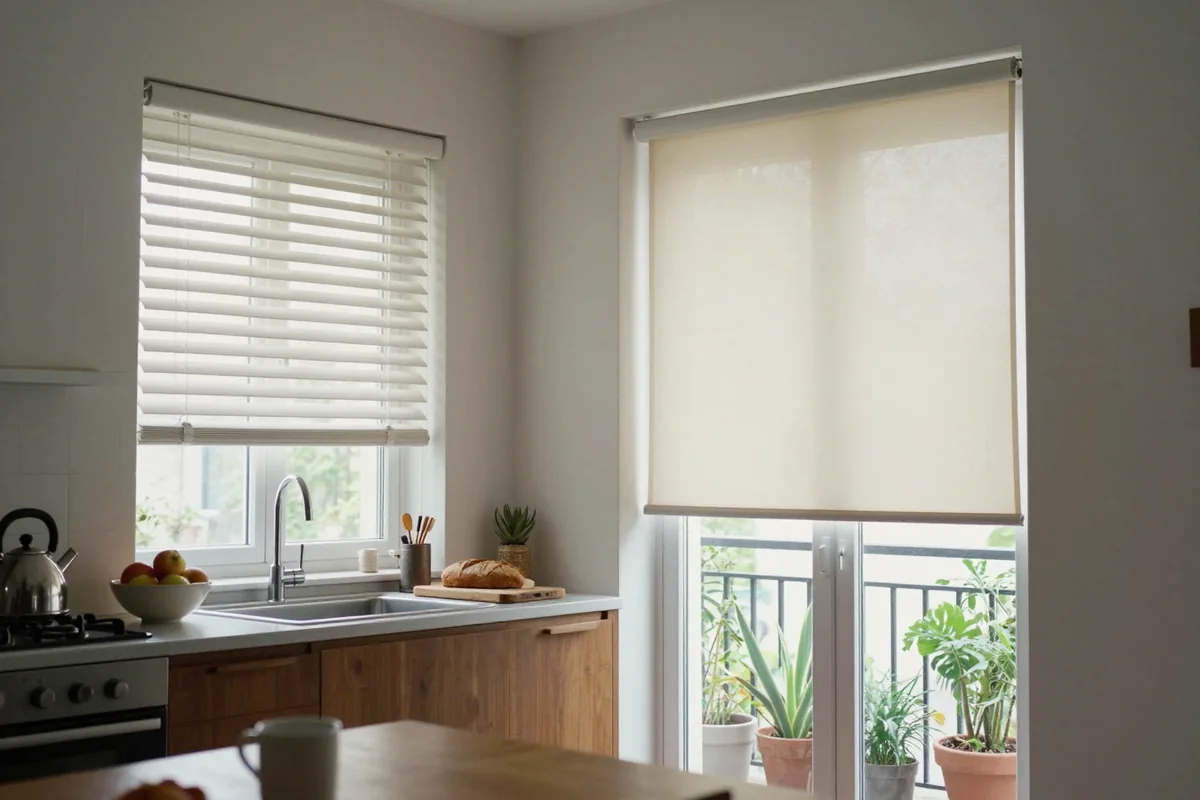
Security roller shutters and fabric roller blinds are often confused because of the similar name. Security shutters are external roller shutters with rigid slats that close off a window or opening and move along guide rails. Fabric roller blinds are an indoor product: the fabric winds onto a roller tube above the window. A rigid slat can be replaced individually, fabric cannot. Our experience: people call complaining that “the roller blind won’t turn” and describe both cases the same way, and on site it turns out they mean completely different mechanisms.
How to use the table
The table works like a route: a symptom leads to a likely cause, the cause leads to a solution. First find your row. Then honestly assess whether you are ready to get inside the mechanism. If the “can I do it myself” column says “no”, don’t waste time trying — you will only bend a part that is still intact. If it says “yes” but nothing changed after your attempts, call a technician: further disassembly usually ends in replacing the unit.
Horizontal blinds: what breaks and how to fix it
Repairing horizontal blinds most often comes down to one unit — the stop. The stop, also called the cord lock, wears out from the cord rubbing against it: the working edge wears down inside, and the blind stops holding in the raised position. When your horizontal blinds break and you don’t know where to start, start with this unit.
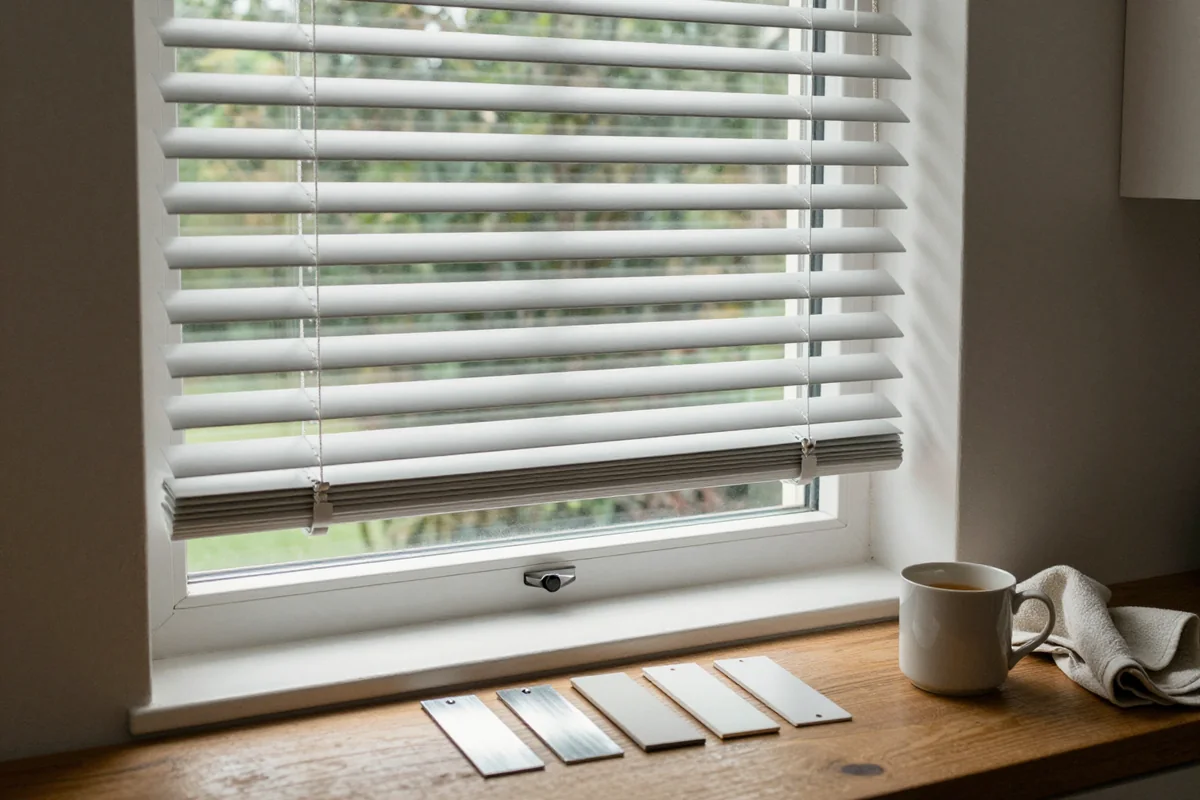
What are horizontal blinds made of? Slats, the ladder, the control cord, the stop, the tilt mechanism with a wand, and the bottom bar. The ladder is two vertical threads that hold the slats in rows. The control cord runs through all the slats and closes on the stop in the rail. The tilt mechanism tilts the slats around their axis, and the tilt wand is the handle you use to set that tilt. The bottom bar keeps the blind even.
They don’t go up and fall down
The blind won’t go up or slides down on its own — the stop is to blame. A worn stop doesn’t hold the cord, the cord slips, and the blind lowers under its own weight. It’s easy to check: raise the blind a third of the way and let go of the cord. If it slides down, the cord lock is the problem.
The cord itself is intact, the ladder is in place, the slats are even. So we replace only the stop.
The opposite happens too: the blind goes up in jerks, the cord jams. Here we check whether it’s frayed or has got between the slats.
They go up crooked
The blind skews when the control cord has come out of its proper route. The control cord should follow its proper route: through every hole in the slats, symmetrically on the left and right. If it jumps out of its track, one side goes up faster than the other.
The second cause is skewed ladder cords: one thread is tighter, the other has slackened. The third is the bottom bar sitting unevenly after it was removed.
Parts for levelling are usually not needed. If you’re not sure where exactly the cord has come out, send us a photo — it shows both how the threads sit and how the bottom bar is skewed.
The slats don’t tilt
The slats don’t tilt when the tilt mechanism gives out or the tilt wand pops out. The wand fits into the mechanism on the rail; if it comes out of its seat, the tilt isn’t transmitted — you turn the handle, but the blind stays put.
Check how the wand sits and how the mechanism moves. If the mechanism has spun and no longer returns the slats, it is replaced. Repairing horizontal blinds in Almaty usually comes down to replacing the stop or the tilt mechanism.
Replacing a single slat
On aluminium horizontal blinds the slats are removable, so we replace only the damaged one, not the whole blind. The work is painstaking, though. The order is:
- Take the blind off the brackets and lay it on a flat surface.
- Remove the end caps from the bottom bar.
- Untie or pull out the lift cords and draw them out of the slats below the damaged one.
- Free the bent slat from the ladder by spreading the threads, and fit a new one of the same colour and width.
- Thread the cords back through all the holes along the proper route.
- Tie the cords at the same length as before, put the end caps back and reassemble the blind.
You can do this yourself if you have a new slat of the same colour and width. But it’s easier to hand it to a technician: after reassembly the cords must sit at the same length, otherwise the blind will skew again. We replace only the damaged slat. A bent aluminium slat can’t be straightened evenly — the metal loses its shape, so it’s replaced. If several slats are damaged, slat replacement is done point by point: slat repair in Almaty is almost always replacement, not straightening the metal. If you like, the damaged slat can be moved to the top, less visible part, and an intact one put in the visible place.
A damaged slat is replaced point by point, without replacing the whole blind — that’s the main difference between repair and ordering a new product.
Vertical blinds: chains, runners, slat rotation
If your vertical blinds have stopped turning or the slats have bunched up, it is almost always one of two mechanisms at fault — the control chain with the rail sprocket, or the runners that hold the slats. Vertical blinds attach to the rail through runners, and the control chain turns the rail sprocket, so a problem with the chain shows up right away as “bunched up” or “not turning”. Repairing vertical blinds in Almaty in most cases comes down to replacing one or two small parts, not the whole fabric.
Let’s go through the symptoms.
The slats don’t tilt
The slats do not change angle, even though the fabric moves along the rail normally? That means the control chain is not transmitting rotation to the rail sprocket. There can be three reasons.
- The control chain has stretched and slips on the rail sprocket.
- The chain has come off the sprocket — often after it was pulled with force.
- The rail sprocket has worn down or spins on the mechanism roller tube.
In the first two cases, sometimes it is enough to put the chain back in place and tighten it. If the sprocket has worn down, the part is replaced — it cannot be restored.
Slats bunch up and come loose
Vertical blind slats fall out of the runners most often at the edges of the rail, where the runner takes the load when closing. Check these spots.
- The runner has worn out and no longer holds the slat’s top hook.
- The slat has popped out of the runner after a sharp tug.
- The runner spacers — the parts that keep the slats at an even pitch inside the rail — have loosened or broken.
- The rail is skewed, and the runners jam in one section.
We replace runners and spacers point by point, one at a time. You can put a popped-out slat back yourself — it slots into the runner by its top hook.
The bottom connecting chain has torn
The connecting chain runs along the bottom and links all the slats together. A torn connecting chain removes the link between the slats at the bottom, and the fabric starts to fan out — the slats sit at different angles, and the bottom edge looks ragged. The chain must be replaced: without it, each slat turns on its own, and the product looks untidy. The chain balls are matched to a sample — by diameter and colour — so do not throw the old chain away before the technician arrives.
Where is the line between doing it yourself and calling a technician? A popped-out runner and a slat that has come off its hook can be fixed by the owner. But vertical blinds more often need repair because of the rail, not the fabric: if the rail is long or has an electric motor, you cannot do without a technician — there is tension and disassembly of the mechanism involved.
Fabric roller blinds: skewing, the roller tube, the edge of the fabric
A fabric roller blind rolls up crookedly most often because of a skewed roller tube or incorrect seating of the fabric. Force will not help here. Fabric roller blinds, whatever the shop calls them, all work the same way: the fabric winds onto the roller tube, the roller tube is attached to the frame or wall, and guide rails limit movement at the sides. The fabric is soft, it does not have the rigidity of a slat, so the slightest displacement of the roller tube shows up immediately in the winding. If you want to understand who to contact for roller blind repair in Almaty — first look at what exactly is going wrong. Below are the two most common pictures.
Rolls up with a shift
The fabric lies on the roller tube unevenly: one edge winds tighter, the other hangs loose. There are usually three reasons. The first is a skew of the roller tube itself, when one bracket sits higher or deeper than the other. The second is uneven winding after the fabric was fed in by hand and an even line was not kept across the full width. The third is a crease or a snag on the edge of the fabric: it catches during winding and pulls the fabric to one side. Checking the roller tube is simple — look at the gap between the fabric and the brackets on the right and left. If it is different, the roller tube is crooked, and it is the mounting that needs aligning, not the fabric.
In our experience, a shift is more often fixed by adjusting the brackets and re-feeding the fabric than by replacing parts. Roller curtain repair in Almaty is most often hand work, not spare parts.
The fabric runs crooked along the whole height
If the shift is visible not only at the point of winding but runs along the whole height, the problem is how the fabric sits on the roller tube. The fabric tape is attached according to markings: even a small shift from the edge gives a noticeable slant along the whole length. It is also worth checking the edge itself — stretching, snags, traces of old feeding. Here is a short checklist of what you can check yourself:
- the roller tube brackets are on the same line, without skew;
- the fabric is fed evenly across the full width, without a shift from the edge;
- the edge of the fabric is clean, without creases or snags;
- the guide rails do not pinch the fabric at the sides;
- the roller tube turns freely, without jerking or squeaking.
Here it is worth answering a question we are often asked: individual slat replacement or full fabric replacement? A fabric roller blind has no slats — it has a single fabric on the roller tube, and you cannot cut one “strip” out of it. If the fabric is torn, faded or deformed at the edge, the whole fabric is replaced.
And here is something else important not to confuse. We are talking about indoor fabric roller blinds, also known as roller blinds. Protective roller shutters are external roller shutters with rigid slats and guide rails, they are built differently, and they are a separate conversation. A different mechanism means different repair, and these two products should not be confused even by name.
Roller shutters: adjusting curtain travel and emergency lifting
The roller shutter curtain moves along the guide rails, and almost all complaints about its operation come down to two things: the mechanism has lost its limit positions, or the roller tube is not pulling the slats. Adjusting roller shutters is most often solved by setting the limit switches, not by replacing parts. Roller shutter repair in Almaty starts exactly this way — by checking how the curtain travels on external window roller shutters, before any disassembly.
Roller shutters can be operated by a strap, cord, crank handle, spring-inertia mechanism or an electric motor with a remote control. The type of control determines what you can fix yourself and what requires a technician. And yes, the guide rails are fixed into the load-bearing wall — it is better not to touch the housing box and curtain without experience, there are parts under tension there.
The curtain does not reach the bottom or goes all the way into the housing box
The limit switch sets the upper and lower position of the curtain. If the roller shutter does not lower to the windowsill, and when raising, the slats go all the way into the housing box, the limit position settings are off. The procedure is as follows:
- Lower the blind and see where exactly it stops — whether it doesn’t reach the bottom or overshoots upwards.
- Get to the adjustment screws on the drive head: there are usually two, one for each direction, and they are marked with arrows.
- Turn the screw for the direction you need just a little, a small part of a turn.
- Run the blind with the button or remote control — that is, with the power on, otherwise you can’t check the travel.
- See where the blind stops and, if needed, repeat the turn of the screw. That’s how the limit switch is set, step by step.
- Set the upper position with a margin so the bottom slat doesn’t go fully into the housing box: otherwise the slats catch on the edge of the box and get bent over time.
The screws on the head aren’t always accessible — often only through the inspection cover of the housing box. And here the power is switched off: cut the power to the drive at the breaker before opening the cover, let alone touching the terminal box or wires. If the screws can’t be reached without taking the housing box apart from outside, if the work has to be done at height from a stepladder, or if the drive is still under warranty — that’s a technician’s job. Adjusting electric roller shutters while balancing on a stepladder easily ends with a stripped screw. And if the product is under warranty, it’s better to leave the adjustment of roller shutters with an electric motor to us: we fix warranty cases free of charge.
The motor won’t open — emergency lifting
Emergency lifting with the crank handle works when the power is out: the crank is inserted into the hole on the drive head and the curtain is raised by hand. Before that, the drive must be de-energised. The same is done if the drive hums but the roller tube stays still: cut the power first, then turn the crank. Urgent roller shutter repair in this case is exactly what the owner does before the technician arrives: cut the power, raise the curtain, don’t pull it by force.
Manual mechanisms
The spring-and-inertia mechanism is a unit under tension, and the owner doesn’t adjust the spring tension themselves. That’s a technician’s job. If the curtain lowers in jerks or won’t hold at the top point, all you can do yourself is check that nothing blocks its travel: dirt and ice in the guide rails, a skewed slat, a foreign object. On roller shutters with a strap or cord for manual control, the strap itself most often breaks — it wears against the roller, and the curtain skews. This needs roller shutter repair with strap replacement, and the technician will also check whether the roller tube has come loose.
What not to do yourself
Don’t take off a housing box with a spring mechanism under tension. The spring will release, and you’ll get injured and end up with a wrecked curtain. If flats have roller shutters with a roll-formed profile on their windows, window roller shutter repair is also best left to a technician: slats bend from careless handling, and bent aluminium can’t be straightened evenly. Protective roller shutters made of extruded aluminium are a separate story: if a slat has been bent or the curtain has jammed, that’s protective roller shutter repair, and you shouldn’t take the unit apart in the yard with your own hands.
Roller shutters hold the curtain on several units at once — limit switches, roller tube, spring, strap — and the end positions are set with the power on, while the drive is de-energised only before opening the inspection cover or raising the curtain with the crank.
Winter in Almaty: a frozen curtain, ice, dust and temperature swings
In winter, a roller shutter most often fails to rise for one reason: ice in the guide rails blocks the travel of the curtain. Metal contracts in the cold, moisture and condensation between the slats freeze overnight, and in the morning the curtain is stuck solid in the groove. Knocking on it, pulling the strap, or worse, driving it with the electric motor is a sure way to tear the strap, rip a slat off the lock or burn out the motor.
Roller shutter guide rails are fixed into the load-bearing wall, but the grooves themselves are open to moisture. During the day in the sun, even in frost, the ice in them partly melts, and at night it freezes again — and so on in a loop. The temperature difference between day and night here is large, so ice builds up in layers rather than melting away at once.
What to do if the curtain is frozen stuck? This is a case where the owner can manage before the technician arrives. First remove snow and ice from the guide rails — not with a metal scraper, so as not to scratch the profile, but with a plastic one or a brush. Then let the product sit: the ice in the groove melts from warmth faster than it seems. And only after that try to lift the curtain by hand, without jerking.
Frozen stuck — don’t jerk the motor
Roller shutters with an electric motor need extra care in frost. If the motor hums but the curtain does not move — stop immediately, otherwise the winding will burn out or the gearbox will break. The right action: cut the power to the motor with the remote control or the breaker, remove ice from the guide rails, and only then use emergency lifting with the crank handle. The same emergency lifting helps during a power outage too.
Urgent roller shutter repair in Almaty in winter almost always starts with the same advice — do not jerk a frozen curtain. This is what to do in any frost, and it really saves the mechanism before the technician arrives.
Dust and heat
In summer the load on the mechanisms is different, but no less. There is a lot of dust in Almaty, and the summer is hot and sunny: fine particles settle on the slats and clog the grooves of the guide rails. The lubricant in these places mixes with dust and turns into an abrasive paste. The control cord and strap begin to run tighter, the stop wears out faster, and the slat catches in the guide rail and moves in jerks.
Plus the temperature difference works both ways: during the day in the sun the metal expands, at night it contracts. These cycles loosen the fastenings and open up the joints.
Almaty has a sharply continental climate — cold winters with frosts and a temperature difference between day and night, hot, sunny summers with dust, so the mechanisms wear out both from dust and from temperature swings. One short procedure helps in both cases: wipe the guide rails and slats with a soft cloth and check that the cord runs along its proper path.
Repair or a new product: comparing against the manufacturer’s price list
Repair costs less than a new product when one part is replaced: a slat, a cord, a chain. A new product is better value when the whole curtain or the whole mechanism is replaced. These two options should be compared by money — and here is what each amount is made up of.
What roller shutter repair in Almaty will cost: the price is made up of three parts — the spare part, the technician’s work and travel to the suburbs. Within the city, measurement and delivery are free. To the suburbs — Kaskelen, Talgar, Issyk, Kapshagay — we do travel, and the cost of the visit depends on the distance and is quoted before the visit, before the technician gets in the car. Prices for roller shutter repair in Almaty depend on which of these three parts pushes the amount up: a common breakdown means an inexpensive part and a short job, a rare one means a custom part for a specific mechanism. At the same time, measurement and consultation are always free, even if you ultimately decide to order a new product rather than fix the old one.
A typical case. Horizontal aluminium blinds on a kitchen window with a vent light: two slats were bent by the sash. We replace just those two — instead of ordering a new product at the price in the table below. But an old fabric roller blind whose fabric has faded and torn along the edge — here a new product is more honest than repair, because patching faded fabric makes no sense.
Price table for a new product
These are prices per square metre from our price list — they are what the cost of repair should be compared against.
| Product | Price from, per m² | Manufacturing time |
|---|---|---|
| Horizontal aluminium, slat 25 mm | 4,200 ₸ | 3–5 days |
| PVC plastic, slat 25 mm | 3,600 ₸ | 3–5 days |
| Vertical fabric, slat 89 mm | 4,600 ₸ | 3–5 days |
| Roller blinds (fabric roller blinds), open roller tube | 5,400 ₸ | 4–6 days |
| Day-night, two-layer fabric | 7,300 ₸ | 5–7 days |
| Roller shutters for windows, roll-formed foam-filled profile, manual | 17,500 ₸ | 10–14 days |
| Security roller shutters, extruded aluminium | 24,900 ₸ | 12–16 days |
| Motorised roller shutters | 35,000 ₸ | 14–18 days |
| Installation of a new product (blinds and curtains) | 4,500 ₸ per product, free on orders from 150,000 ₸ | — |
When repair costs more than a new product
The line is simple: the more assemblies are replaced, the less sense it makes to repair. Replacing one slat versus replacing the whole curtain — repair wins. Replacing the mechanism versus a new product — the new one more often wins, especially if the old one has served its time.
Also don’t forget the warranty: a new product comes with three years on the mechanism. Repair is always compared by money against a new product at the price list, and the honest answer depends on how many parts have to be touched.
Do it yourself or call a technician: where the line is and what to prepare
The line is drawn where dismantling the mechanism begins. Checking how the control cord runs and whether the stopper works, putting a fallen vertical blind slat back into its runner, refitting a chain that has come off the sprocket, raising a roller shutter with no power using the crank handle, clearing ice from the guide rails — that is what the owner does themselves. Anything that means removing the rail, rethreading cords or getting into the motor is a job for our technician.
What you can realistically do yourself
The list is short, and that is honest. The most harmless jobs are those that do not require taking a unit apart: checking how the cord runs, putting a vertical blind slat back into its runner, emergency lifting and clearing ice from the guide rails. Replacing a slat in horizontal blinds is a borderline case. You can do it yourself if you have a new slat and the patience to take the blind off its brackets and rethread the lift cords through the slats following the standard pattern. If you would rather not bother with rethreading, give it to our technician and they will do it neatly.
And this is where people most often break more than was broken to begin with. They force a frozen curtain with the motor — tearing slats and bending the guide rails. They take apart a spring-and-inertia mechanism without releasing the tension — the spring snaps into their hand, and putting it back together without experience no longer works. They yank the cord when it is jammed — pulling the stopper out along with its mount. Repairing blinds in Almaty after that costs more than a calm diagnosis before the first sudden movement.
What to prepare before the technician's visit
To keep the repair to a single visit, it's worth gathering a few things before the technician arrives:
- A photo of the fault — a general view of the product and a close-up of the unit that isn't working. From a photo it's easier to understand what has broken and which part may be needed.
- The width and height of the product — at least roughly, with a tape measure along the window.
- The marking or name, if it has survived: on the rail, on the motor head, on the receipt.
- The contract or acceptance report, if the product is ours and still under warranty.
- Two or three photos, not one: from a single shot it's hard to understand exactly where the failure is.
We start blind repair in Almaty with the question of what can be seen in the photo. Clients message us on WhatsApp — it's convenient to attach a photo of the fault right away, and from it we can tell in advance which spare part may be needed. A photo of the fault helps us match the part before the technician sets out, so don't put off taking the shots until the call: first a couple of frames of the product, then the conversation about timing.
Warranty and paid repair: what we're responsible for
For products we assemble, we give 3 years on the mechanism and 1 year on installation, counted from the date the acceptance report is signed. If the fault is covered by warranty, we fix it free of charge within 5 working days of the request.
The warranty covers the mechanism and installation. It does not cover what happened through no fault of the mechanism: an impact or a crease, reinstallation by the owner, water getting in, and fabric faded by the sun. For these cases we also come out, but it's a paid repair, and we say so upfront, not after the invoice is issued. The difference is simple. A stopper worn down by the cord rubbing during normal use is our concern. A slat crushed by a hand or a curtain catching it — the part and the work are paid for by the owner. Blind repair in Almaty after the warranty follows the same rules: tightening the mountings, adjusting the travel of the slats or the fabric, replacing the cord or chain, swapping out a damaged slat.
We don't push a new product instead of a repair. On aluminium horizontal blinds the slats are removable — we replace only the damaged one, not the whole fabric.
The cost of a repair is made up of the part, the work and the call-out, if the address is in the suburbs. We tell you the terms for out-of-town call-outs before we set out, so the invoice doesn't come as a surprise.
Prevention: so the fault doesn't happen again
You can extend the life of the mechanism after a repair through habits, not parts. Prevention needs neither tools nor disassembly: it all comes down to how you handle the product every day.
The control cord should run the standard way — straight through all the holes of the ladder cord, without loops or snags. If it slips out of it, you'll get the fabric skewing, and then accelerated wear of the stopper. Check the cord's travel once a month, it takes a minute.
- Don't yank the fabric with your hands: a jerk loads the ladder cord and the runners harder than a smooth movement with the cord or chain.
- Pull the cord along its axis, not sideways. A sideways force bends the slats and wears down the stopper.
- Don't force a frozen curtain with the motor. First clear the ice in the guide rails, then raise it.
- In summer, dust off the slats and guide rails: in Almaty it packs into the mechanism and works like an abrasive. There's no need to wipe the fabric or wash the curtain — just remove the dust from the metal.
And the most common cause of a repeat fault is not wear, but habit. Stopping pulling on the fabric is the simplest thing you can do for the mechanism after a repair.
FAQ
Can you replace one slat instead of the whole fabric?
Yes, on aluminium horizontal blinds the slats are removable, so a damaged slat is replaced individually, without replacing the whole fabric. First the slat is released from the ladder cord, then a new one of the same colour and width is fitted and reassembled the standard way. A crushed aluminium slat can't be straightened evenly — the metal loses its shape and doesn't return to its original geometry. If you like, the damaged slat can be moved to the top, less visible part.
What to do if a fabric roller blind rolls up crookedly?
A fabric roller blind rolls up crooked when the roller tube is skewed or the fabric is not seated correctly on the tube. Check whether the fabric runs evenly along its full height: if the skew grows towards the bottom, it is the seating; if the offset appears right away, it is the roller tube. Force does not help here — the fabric will stretch and the skew will only become more noticeable. A slight skew can sometimes be corrected, but if the fabric sits unevenly on the roller tube, the fabric is taken off the tube and re-fed along the markings — that is a job for our technician.
Why does a roller shutter lower by itself?
A roller shutter lowers by itself when the mechanism stops holding the curtain: on manual systems the tension has most often slackened or the stopper has worn out; on roller shutters with an electric motor, the limit switch has gone out of adjustment. The limit switch sets the upper and lower position of the curtain, so when the setting fails, the curtain doesn't stop where it should. We usually check how the roller tube behaves under load, and only after that decide whether an adjustment is enough.
How long to wait if the fault is covered by warranty?
If the fault falls under the warranty, fixing it takes no more than 5 working days from the day of the request, and there's nothing to pay for it. The terms themselves are these: 3 years on the mechanism and 1 year on installation from the date the acceptance report is signed. The stopper, cord and limit switch are part of the mechanism, while mechanical damage, reinstallation by the owner, water and natural fading of the fabric are a paid repair — and for such cases we also come out.
Briefly on prices: the cost of roller shutter repair in Almaty depends on which part is being replaced and how much disassembly is needed — we give the exact amount once we see the product.
Conclusion
Blind repair in Almaty starts with a diagnosis by symptom, not with finding a technician. Five conclusions we've drawn from practice add up to a simple sequence of actions.
The first conclusion: on horizontal aluminium blinds almost all faults run along one line — the control cord, the stopper, the ladder cord, the tilt mechanism. The second: on vertical blinds the failure is immediately visible in the control chain and the rail's sprocket, and a slat that has fallen out almost always means a worn runner. The third: a fabric roller blind rolls up crookedly because of a skewed roller tube or incorrect fitting of the fabric, and here precision matters, not force.
The fourth point concerns roller shutters. The curtain moves along the guide rails, the end limits are set by the limit switch, and when the power goes out the crank handle emergency lift saves the day. Motorised roller shutters are adjusted with screws on the motor head, checking the travel with the button, and the motor is disconnected from power before opening the housing box or lifting the curtain with the crank handle. And the fifth point: most damage is fixed point by point. Aluminium blinds have removable slats, so we replace only the damaged one, not the whole blind.
The line between doing the repair yourself and calling our technician is drawn where dismantling the mechanism, releasing spring tension or working with the electric motor begins. Anything that does not require those operations — checking the cord and stopper, putting a slat back into its runner, emergency lifting — the owner does themselves.
There is one practical tip. Before you call, photograph the fault and send it to us on WhatsApp: from a photo it is easier to understand what has broken and which part may be needed. The warranty on the mechanism is 3 years, on installation 1 year from the date the acceptance report is signed, and after it expires we still come out: to tighten the mountings, adjust how the slats or the fabric run, or replace the cord or chain.