




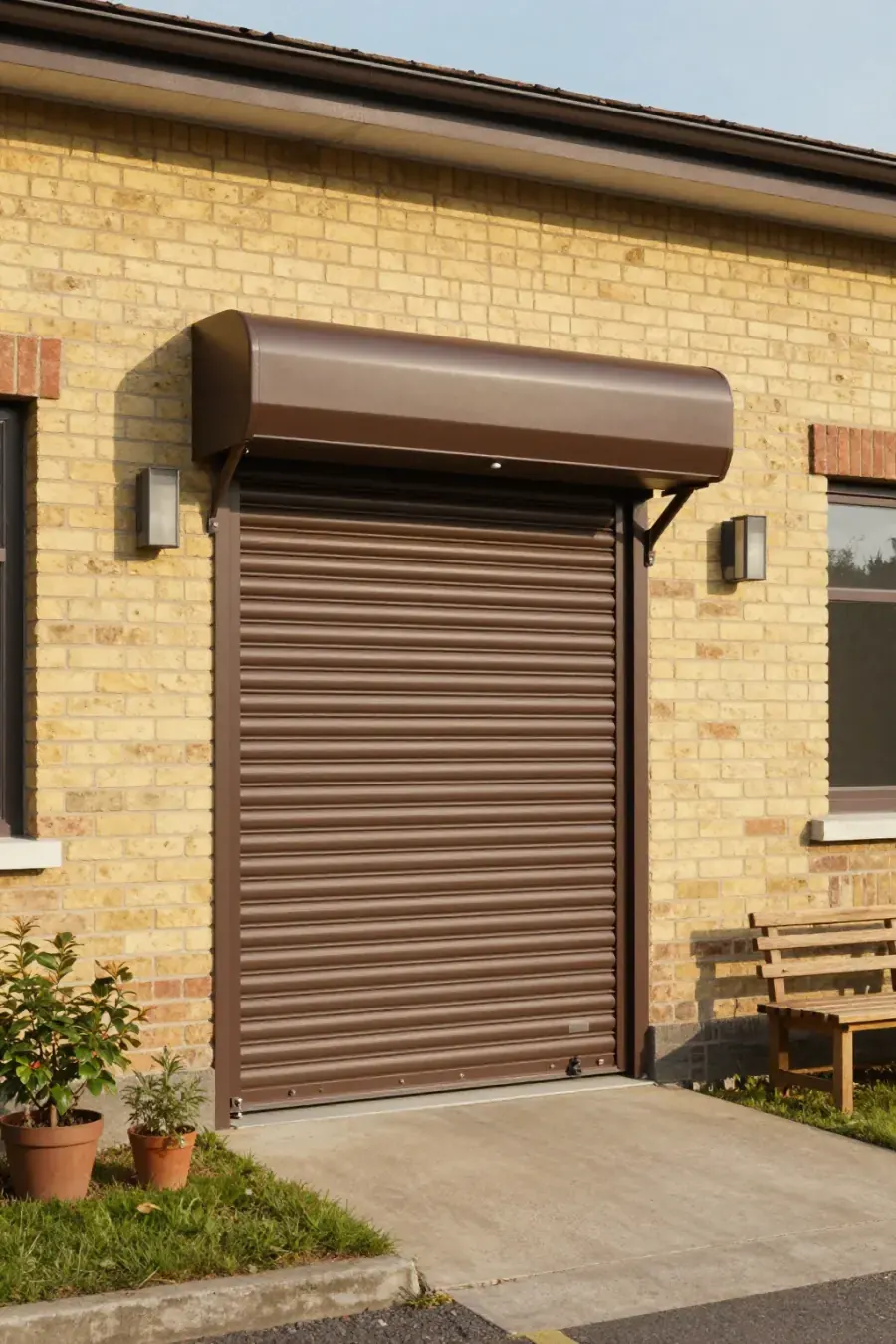

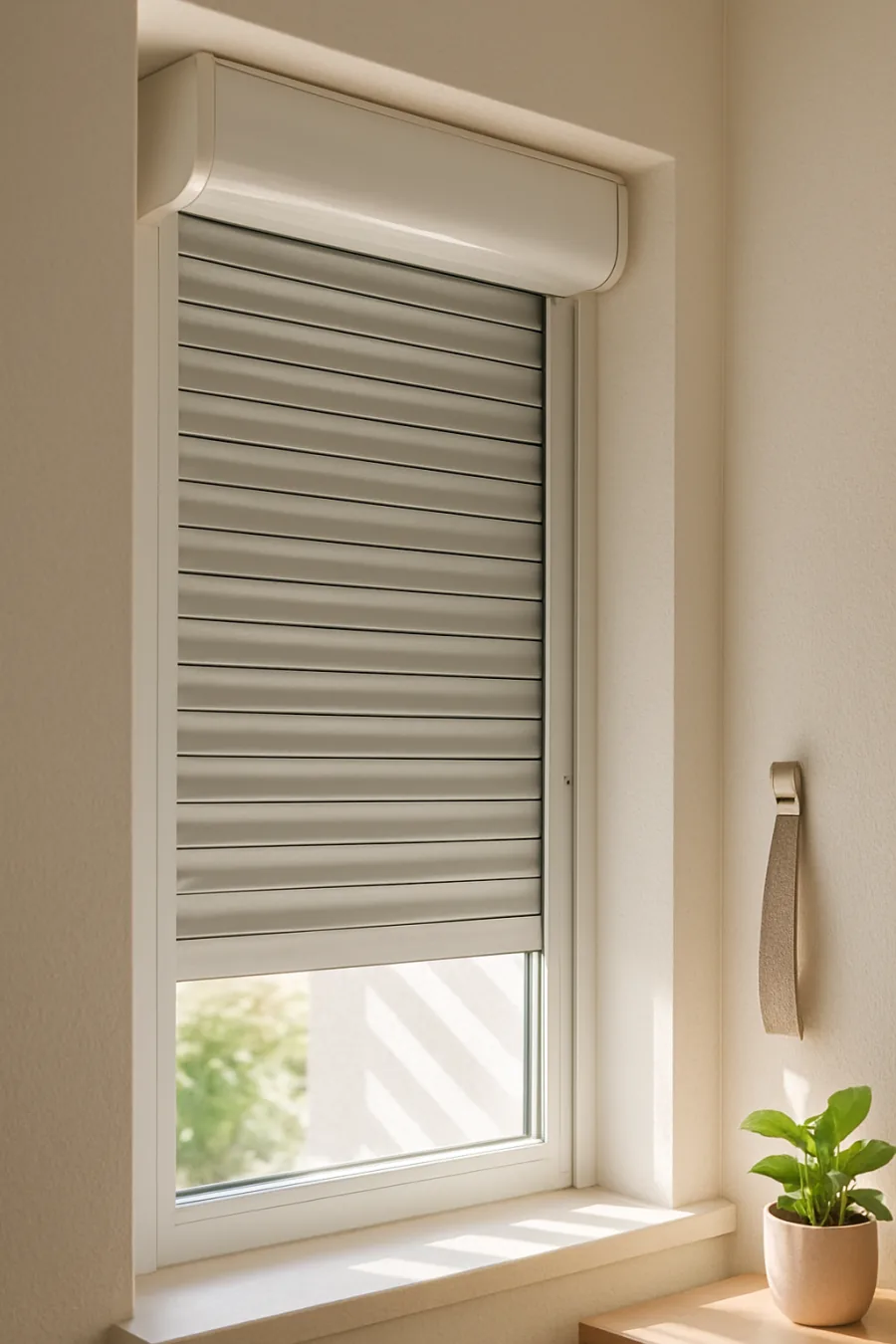

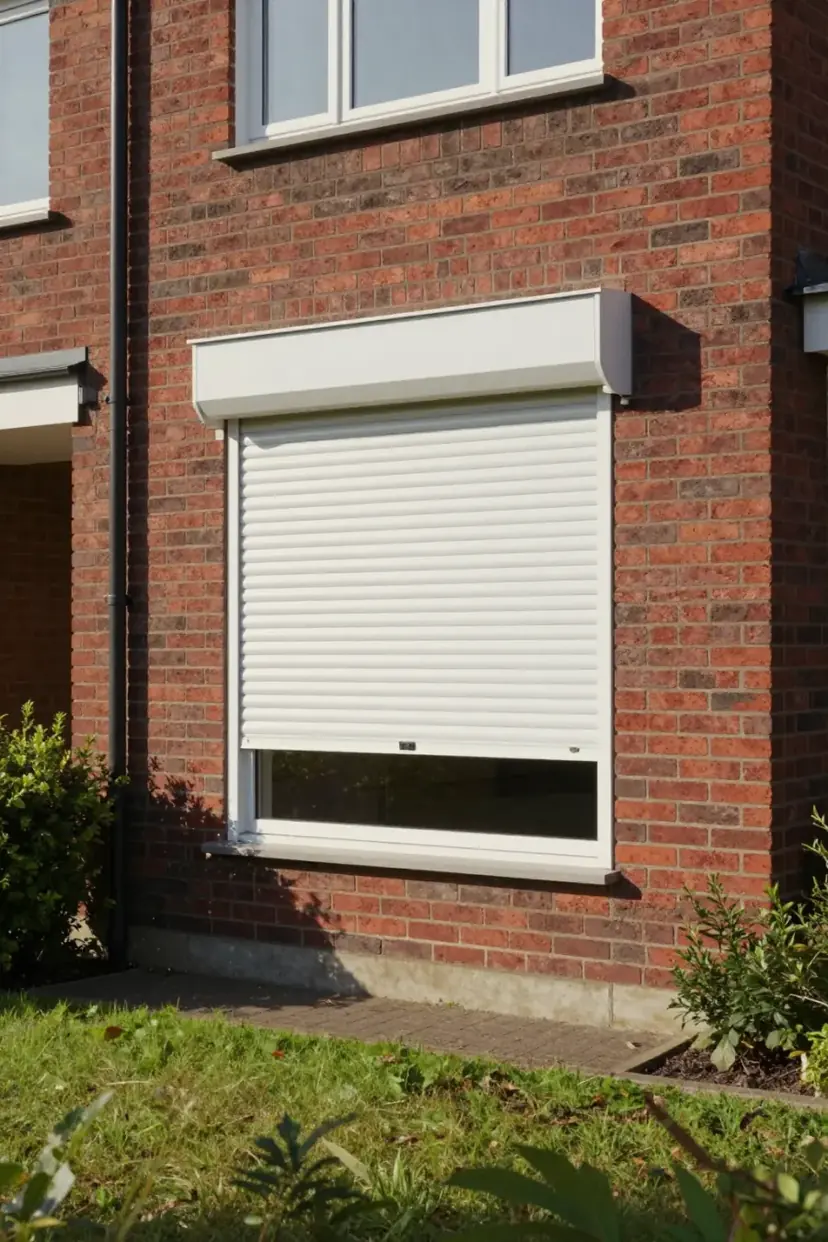


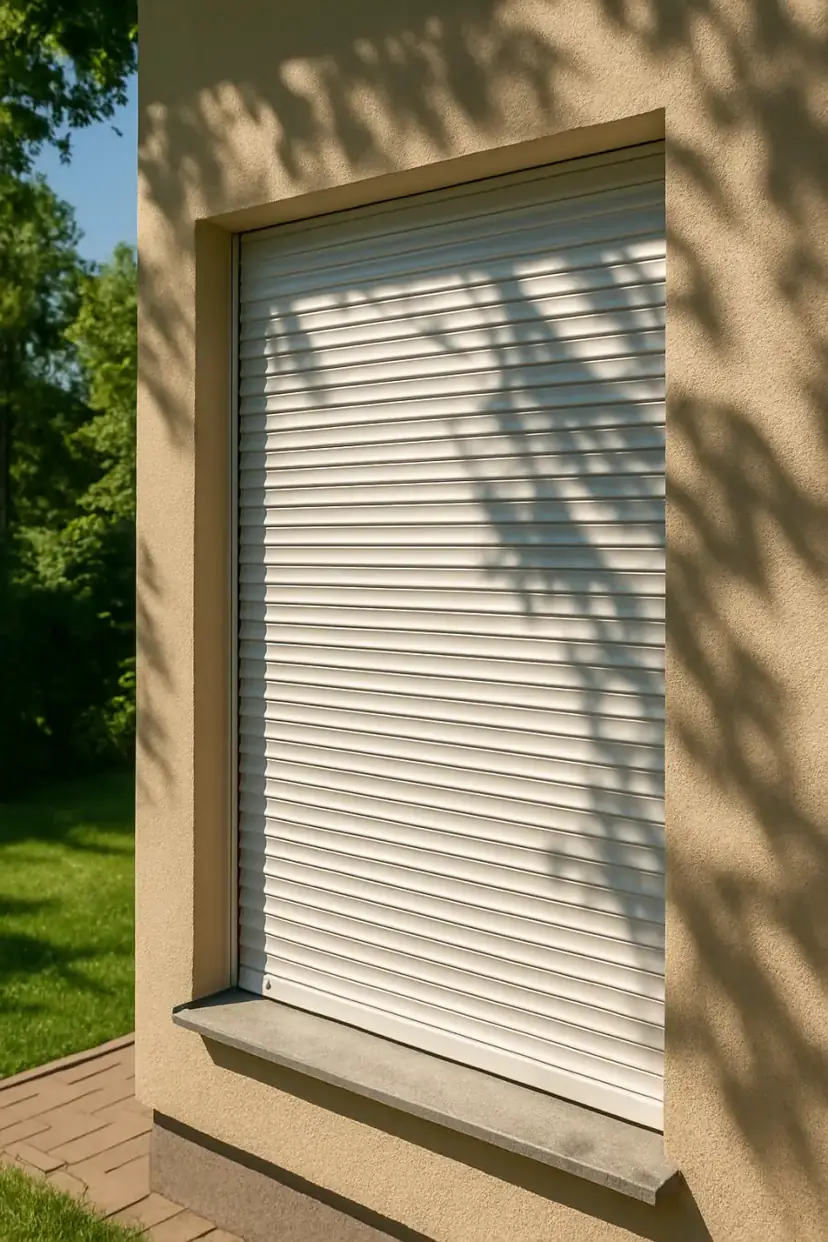











Roller shutters for a wardrobe are an aluminium curtain that lifts up and rolls into a housing box above the opening, so the space in front of the wardrobe stays clear. We make roller shutters for wardrobes in Almaty to measure: our measurer comes with samples, checks the carcass and calculates the price on the spot. Price — from 17,500 ₸/m².
What roller shutters for a wardrobe are and how they differ from hinged doors
Roller shutters for a wardrobe are an aluminium curtain made of narrow profiles that lifts up and rolls into a housing box above the opening. A roller shutter for a wardrobe closes a niche or a walk-in closet instead of hinged doors: the curtain runs along guide rails and does not swing out to the side. The same mechanism is also called a roller door for a wardrobe or roller doors for a wardrobe — the idea is the same: the sections are linked to each other and roll up under the top of the wardrobe.
A roller door for a wardrobe works instead of hinged doors, not in addition to them. The doors are removed, and their place is taken by the roller shutter housing box with guide rails on the sides of the opening. A second door is not needed — the same curtain closes the opening.
What changes every day? It opens and closes with one hand. The curtain lifts up and rolls into the housing box above the opening, so the passage in front of the wardrobe is completely clear instead of swinging out to the side like a door. There is no bottom threshold: no one trips over it, no mop catches on it. A rug in front of the wardrobe stays put. And in a narrow walk-in closet, where you used to have to press yourself against the wall to reach the top shelf, there is more room.
How roller shutters for a wardrobe differ from hinged doors:
- The curtain lifts up instead of swinging out to the side: the space in front of the wardrobe stays free.
- The opening is fully clear — you can reach the whole niche at once.
- There is no bottom threshold, nothing underfoot gets in the way.
- The doors do not slam in a draught and do not bang against each other when opened sharply.
- The aluminium curtain can be installed in a room with humidity, where hinged chipboard doors swell along the edge.
In my view, the main sceptic here is someone who is afraid the curtain will eat into the shelf height. It does, but only above the opening: the roller shutter housing box is mounted on top, and during the measurement we check whether there is enough clearance there. Installation is priced with a coefficient on the base price: on the wall — 1.0, on the frame — 1.05, without drilling — 1.1. The curtain itself takes up about a centimetre at the sides, rather than reaching into the room by the width of an open door.
Whether your wardrobe carcass can take the load of the guide rails and housing box
The wardrobe carcass does not carry the roller shutters as a whole, but at two points: the guide rails and the roller shutter housing box. The guide rails are fixed to the side panels or to the wall on the sides of the opening, and the measurer checks on the spot where to fix them so as not to weaken the wardrobe. We do not have a universal answer that “any wardrobe will hold it” — the decision is made for the specific carcass.
The weight is distributed along the guide rails, not on a shelf or on the bottom. Guide rails are vertical profiles that the curtain runs along; they take the load and pass it on to wherever the fixings go. The roller shutter housing box works differently: it does not hang on the bottom of the wardrobe, it is mounted above the opening and rests on the same side panels or on the wall on the sides of the opening. Hence the main point: a thin chipboard carcass affects the choice of fixings for the housing box and guide rails, not the very possibility of installation.
Why is a thin chipboard carcass a separate matter? Because fixings in a side panel do not hold forever: the thinner the board, the less reserve there is. But it is not a death sentence. If there is a wall next to the wardrobe, some of the fixings go into it rather than into the furniture board, and then less force is put on the side panel. We always check whether that wall is there — sometimes half a metre from the opening is enough.
What exactly is checked during the measurement
A measurement is not just measuring the height and width of the opening, but a review of the carcass. The measurer comes with samples and goes through the list on the spot:
- the material and thickness of the side panels: chipboard, MDF, solid wood — the type of fixing depends on this;
- the condition of the wardrobe carcass: whether there are cracks, delamination, traces of previous repairs, loose joints;
- where the fixings can go: into the side panel, into the back panel or into the wall on the sides of the opening;
- whether there is a solid wall nearby and at what distance from the edge of the opening;
- what is above the opening: a top cupboard, a shelf, the ceiling — the place for the roller shutter housing box depends on this.
Each point affects the next. If the side panel is thin and there is no wall nearby, the measurer looks for another solution rather than fixing at random.
If the carcass raises doubts
A thin chipboard carcass is not a reason to give up roller shutters, but a reason to choose a different fixing method. There are three options.
Fixing to the wall on the sides of the opening: the guide rails are held on a solid wall, and the wardrobe carcass is almost not loaded. A simple route if the wardrobe stands in a niche or right against a wall.
Reinforcing the fixing point: a mounting block or an extra support is added to the side panel, and the fixings get the reserve they need. A solution for ready-made wardrobes where you do not want to take the carcass apart.
Giving up the surface-mounted housing box in favour of a solution inside the niche: the roller shutter housing box goes into the opening instead of protruding outside, and the load on the front part of the carcass is reduced. This option does have its own requirements, though — more on that separately.
The guide rails and the roller shutter housing are load-bearing elements of the system, so how they are fixed is decided at the measurement, not picked from a catalogue in advance.
A ready-made sliding-wardrobe or a new carcass built for a roller shutter
A roller shutter door for a wardrobe can be fitted both to a ready-made sliding wardrobe and to a carcass built specifically for the system. The difference is that a ready-made sliding wardrobe needs to be checked at the measurement before the roller shutter is installed: it already has a formed opening, its own doors, and a top section or upper shelf. If there is enough clearance in height above the opening and the side panels are sturdy, we simply remove the hinged sashes or the sliding doors and fit the roller shutter. Nothing needs to be reworked.
Building a wardrobe for a roller shutter follows a different path. Here the wardrobe carcass is designed with the system in mind from the start: we know in advance how much space the guide rails will take, where the housing will sit, and which profile will fit into the opening. With this approach, the cassette housing is installed inside the wardrobe opening, and the facade stays clean — the curtain does not protrude outward and does not clash with the furniture. The measurer on site checks the carcass dimensions against the system parameters, and the roller shutter wardrobe comes out as a single structure, not as an add-on.
What decides in each case:
- Ready-made carcass: the clearance in height above the opening determines whether a surface-mounted housing will fit or a cassette one inside the niche is needed.
- Ready-made carcass: the condition of the side panels — if the chipboard is thin, the measurer looks for an alternative fixing and checks the wall on the sides of the opening.
- New build: the housing and guide rails are allowed for in the drawing in advance, so no conflicts with shelves arise.
- New build: the profile is chosen at the measurement together with the carcass, so exactly the blind you had in mind fits into the opening.
When a roller shutter on a small wardrobe is justified
A roller shutter seems excessive when the wardrobe stands in a spacious room and a hinged sash bothers no one. But on a small wardrobe it is more often justified than not. A narrow passage in the hallway — and the sash bumps into the apartment door. A bedroom where the bed almost touches the carcass — and an open door blocks access to the very back of the shelf. In such cases, a roller shutter door for a wardrobe removes the main problem: the curtain goes up, and you can get right up close to the contents.
Table for the two options:
| Ready-made sliding wardrobe | Wardrobe built for a roller shutter |
|---|---|
| The roller shutter is fitted after checking at the measurement | The system is allowed for in the carcass design |
| Clearance in height and the condition of the side panels decide everything | The dimensions of the housing and guide rails are known in advance |
| A cassette housing is possible if there is clearance in height | The cassette housing is installed inside the opening as standard |
| The furniture is already there, we only change the way it closes | The carcass and the blind are made as one whole |
We more often advise: if the wardrobe is already there and the carcass is sturdy, don’t touch it — the roller shutter will fit as it is. And if you are only planning the carcass, tell us at the measurement so that we allow for the space for the housing right away.
A roller shutter can be fitted both to a ready-made sliding wardrobe and to a carcass built for the system, but in the first case everything is decided by the clearance in height and the condition of the side panels.
Where the housing sits: surface-mounted outside or inside the niche
The roller shutter housing is installed above the wardrobe opening and comes in two types: a surface-mounted one is fixed outside, an internal one goes into the opening itself. Two things decide the choice between them — the clearance in height above the opening and how important it is to keep the shelf depth.
A surface-mounted housing is installed on top of the carcass, above the upper edge of the opening. It does not take away shelf depth: the shelves stay the same depth as they were, nothing gets cut down. But the housing protrudes slightly forward — a few centimetres beyond the facade plane. For a wardrobe in a niche this is usually unnoticeable, while for a freestanding carcass in a room the protrusion shows.
An internal housing hides in the opening — the facade stays clean, no parts above the wardrobe show outside. But an internal housing has a condition: you need clearance in height above the opening so that the housing and the raised blind fit inside the carcass. No clearance — the internal option is out, no matter how you look at it.
A cassette housing is the same internal option, only the housing is built into the wardrobe opening together with the carcass. With a cassette system the facade stays clean, and the whole mechanism is hidden. Such a housing is chosen at the measurement together with the carcass, because the height has to be allowed for in advance.
| Parameter | Surface-mounted housing | Internal housing |
|---|---|---|
| Where it sits | outside, above the opening | inside the opening |
| Shelf depth | does not take away | depends on the carcass |
| Protrusion forward | yes, slight | no |
| Clearance in height | not needed | required |
| Facade | housing box visible | clean |
Which to choose? If there is little space above the opening and you can’t lose shelf depth — go for the surface-mounted box. If you want to hide the mechanism and the height allows it — go for the built-in or cassette one. Our measurer looks at both options on site and shows what will actually fit your cabinet.
We install surface-mounted roller doors for wardrobes more often — they don’t require extra height, and on ready-made wardrobes this is usually the only workable option.
What to do if there is little space above
A mezzanine right under the ceiling is a common situation: only a narrow strip remains above the cabinet opening, and a built-in box won’t fit there. In this case the surface-mounted box is the option — it is fixed on the outside and requires almost no height. If even the surface-mounted box is a tight fit, the measurer checks whether the mezzanine can be moved or shifted in height. The surface-mounted box does not affect shelf depth.
The surface-mounted box does not take away shelf depth, but it protrudes slightly forward, while a box inside the niche hides in the opening and requires extra height.
How much a roller shutter for a wardrobe costs and what the price is made up of
A roller shutter for a wardrobe is priced by the area of the curtain, and the base price starts from 17,500 ₸/m². That is the price of a roll-formed foam-filled profile with manual control — the most popular option for a wardrobe in a room. A perforated profile costs from 27,800 ₸/m², and a set with an electric motor — from 35,000 ₸/m².
The price depends on four things: the type of profile, the control method, the area of the curtain and the type of installation. There is no single price for roller shutters for a wardrobe in Almaty and there can’t be: two wardrobes of the same width give different totals if one opening is taller. Measurement is not included in that sum — it is free, and more on that below.
| Profile | Price per m² | Manufacturing time |
|---|---|---|
| Roll-formed foam-filled, manual | from 17,500 ₸ | 10–14 days |
| Perforated | from 27,800 ₸ | 12–16 days |
| With electric motor | from 35,000 ₸ | 14–18 days |
A perforated profile is more expensive than a foam-filled one because a perforated blind is more difficult to assemble. An electric motor roughly doubles the price compared to manual control — this is no longer about saving money but about convenience, when the blind is tall or has to be opened often.
Installation costs 4,500 ₸ per item. For orders from 150,000 ₸ we do it free of charge — on a single wardrobe this sum is far from always reached, but on a walk-in closet with two or three openings it is easily exceeded. We calculate honestly at the measurement, not “roughly over the phone”.
What the total is made up of
Five components that the measurer adds up into one figure.
The area of the blind is the main value, so a narrow hallway wardrobe costs less than a wide walk-in closet niche with the same profile.
Type of profile. Roll-formed foam-filled, perforated or a set with an electric motor — the difference between them is visible in the table above.
Control. Manual control has coefficients: standard control is 1.0, chain — 1.06, electric motor — 1.85, electric with remote control — 2.1.
The type of installation also matters: on the wall — 1.0, on the frame — 1.05, without drilling — 1.1, cassette system — 1.28.
Trips to the suburbs. In Almaty measurement and delivery are free, while to Kaskelen, Talgar, Issyk or Kapshagay we travel for a fee that depends on the distance. We quote the trip cost before we set out, so it doesn’t come as a surprise at the end.
What the free measurement includes
Measurement and consultation are always free. The measurer arrives with profile samples so you can touch the blind and see it in real life, rather than choosing from a picture.
He examines the wardrobe body, the height clearance above the opening, the shelf depth and calculates the cost on the spot. The client writes to us on WhatsApp, we agree on a time — and that’s it, from there we work to your dimensions.
Want to estimate the approximate sum before calling? Multiply the area of the opening by the price of a suitable profile — that’s enough to understand the range. Only a measurement gives an exact quote.
Profile for a cabinet: foam-filled, perforated, cassette
We make roller shutters for cabinets from aluminium profile — we don’t use plastic in production. The curtain is assembled from narrow slats that interlock and run along guide rails. Three solutions are used for cabinets. A roll-formed foam-filled profile — a slat with foam inside, the curtain is light and runs quietly. A perforated profile — the same aluminium, but with holes in each slat, through which light and air pass. A cassette box is not a curtain profile but a way to pack the whole system inside the cabinet opening so the facade stays clean. The profile is chosen at the measurement together with the cabinet body, because the weight of the curtain and the height clearance are different for every cabinet.
Roll-formed foam-filled profile
The foam-filled profile is chosen for a wardrobe in a room, in a walk-in closet and in a hallway. The blind made from it is light, so it doesn’t overload the wardrobe body and doesn’t require heavy-duty fasteners. It runs quietly — for a bedroom this is a noticeable difference. The foam filling gives the slat rigidity, and the blind doesn’t rattle in the opening. In terms of price this is the base option: from 17,500 ₸/m², manufacturing time 10–14 days. We deliberately don’t give the figure for slat thickness and weight here — it depends on the specific item, and the measurer shows a sample in hand.
Perforated profile
The perforated profile lets light and air through, while the contents of the cabinet stay hidden. The holes in the slats are small, and you can only make out the shelves through them up close. Perforation reduces the effect of a closed dark space — inside the cabinet it is neither dark nor stuffy. That is why we install the perforated profile in an office, a kids’ room and niches where ventilation is needed. It costs more than the foam-filled one — from 27,800 ₸/m², time 12–16 days.
Cassette housing box
The cassette box is installed inside the wardrobe opening: the blind goes into the cassette, which hides in the wardrobe body, and only the slat is visible from the outside. The facade stays clean — no box above the opening, no protruding parts. There is one condition: the box needs height clearance inside the opening, so the cassette system is chosen at the measurement, when it is clear how much space the wardrobe body provides.
Foam-filled or perforated
| Profile | What it gives | Room | Price | Lead time |
|---|---|---|---|---|
| Roll-formed foam-filled | quiet light blind, solid slat | room, walk-in closet, hallway | from 17,500 ₸/m² | 10–14 days |
| Perforated | light and air inside, contents hidden | office, kids’ room, niche with ventilation | from 27,800 ₸/m² | 12–16 days |
Why not plastic
We don’t make plastic roller shutters for wardrobes — we work with aluminium. A plastic curtain on a wardrobe is inferior in rigidity and in how it holds its shape over a long span, and on a niche by the bathroom it has no advantages over aluminium. We say this honestly at the measurement, rather than choosing a softer wording. If someone offers you plastic for a wardrobe, compare the samples in your hands — the difference is felt immediately.
An aluminium blind is not afraid of damp, so the foam-filled and perforated profiles are equally suitable both for a niche in a bathroom and for a walk-in closet by the bathroom — the only question is whether you need light and air inside the wardrobe.
How measurement and installation work
Measurement and consultation are always free: you write to us on WhatsApp, the measurer arrives with profile samples and calculates the cost on the spot. There is no charge for a visit within Almaty, and delivery within the city is free too.
Here’s how it works.
- Message us on WhatsApp. Briefly describe the wardrobe — a ready-made carcass or a niche — and attach a photo of the opening. That way we know what we are working with before we even come out.
- The measurer arrives with samples. You hold the foam-filled and perforated profiles in your hands, compare the weight of the curtain, and see how it rolls.
- We look at the opening and the carcass. What exactly the measurer checks on a specific wardrobe — the material and thickness of the side panels, the condition of the carcass, the clearance above the opening, and whether there is a wall nearby.
- We determine the mounting. The guide rails are fixed to the side panels or to the wall on the sides of the opening — the measurer decides which option will not weaken the wardrobe. This is a key point for a ready-made chipboard carcass.
- We calculate the cost on the spot. The area of the curtain, the profile, the control type, the type of housing box — the figure is given right away, with no “we’ll confirm by phone.”
- Jalusso records the dimensions and sends the order to the workshop. Manufacturing is its own, in Almaty, with no middlemen between measurement and installation.
We travel to the suburbs — Kaskelen, Talgar, Issyk, Kapshagay. The call-out cost depends on the distance, and we quote it before the visit, not after the fact. Within the city itself, measurement and delivery are free.
We charge 4,500 ₸ for installing one unit, but if the order total is from 150,000 ₸, we install it at no extra charge.
What happens after the measurement
Manufacturing takes place in our workshop in Almaty. The time depends on the profile: 10–14 days for roll-formed foam-filled and perforated, 14–18 days for a set with an electric motor. Then installation at your place: the foreman mounts the housing box, feeds in the curtain, checks the movement and hands you the remote control or chain.
Acceptance is simple. Open and close it a few times, listen to how the curtain moves, and check the joint with the opening. If something is wrong, we fix it on the spot.
We make roller shutters for a wardrobe only after a measurement: the dimensions and mounting are determined on site, not from a photo.
Control: manual, chain, electric motor
A roller shutter door for a wardrobe is operated manually, by chain or by electric motor — there is no third option. We fit manual control by default: the curtain is pulled by a handle or cord, and the coefficient stays at the base level, one. A chain is more convenient if the curtain is tall and reaching the top edge is awkward — it gives a coefficient of 1.06, that is, six percent is added to the price. An electric motor is a different story: a button or remote control, the curtain rises by itself, but the coefficient is already 1.85, and a set with a remote control is 2.1.
What does this mean in practice? The curtain for a wardrobe costs the same as its area multiplied by the control coefficient.
The measurer shows all three options on samples, and the decision is made on the spot — based on the height of the opening and how often the wardrobe is opened.
| Control | Coefficient | When people choose it |
|---|---|---|
| Mechanical | 1.0 | the basic option, curtain up to waist height or slightly higher |
| Chain | 1.06 | tall curtain, reaching up is awkward |
| Electric motor | 1.85 | frequent use, a tall opening |
| Electric + remote control | 2.1 | automation plus remote control |
The electric motor comes with an emergency crank handle output. This is not a “just in case” option but a working part of the system: the crank handle lets you open the curtain during a power cut, when there is no electricity in the home. Jalusso always shows this output during the measurement and explains where it will be located.
When automation is justified
A tall curtain, frequent use, access for a person with limited mobility — these are the three situations where an electric motor is justified. First: a full-height opening, where pulling the curtain up manually is hard. Second: a wardrobe in a hallway or walk-in closet that is opened several times a day. Third: if a roller shutter door for a wardrobe covers a niche that a person in a wheelchair or with limited mobility approaches — a button and remote control remove the extra effort.
On a small wardrobe, an electric motor is often overkill. The curtain there is short, manual control handles it effortlessly, and automation adds almost double to the price — in my view, it is an overrated option for a narrow carcass in a child’s room or hallway.
Manual control remains the basic option for a wardrobe, a chain adds a coefficient of 1.06, an electric motor 1.85, and a set with a remote control 2.1, and the electric motor always comes with an emergency crank handle output.
A wardrobe in different rooms: living room, hallway, bathroom, child’s room, study
The room determines the profile: roll-formed foam-filled is chosen for a living room, walk-in closet and hallway, while perforated is for places that need air and light. Let us break it down by location, because the difference is not cosmetic.
In a walk-in closet and bedroom, roller shutters for wardrobes close the niche with a calm, solid curtain. No warehouse or workshop effect: the narrow slats run in even horizontal lines, no joints are visible, and there is no hardware on the front. That is why Jalusso more often recommends the foam-filled profile — it is light, rolls quietly and does not overload the carcass. It opens with one hand, and there is no bottom threshold. A separate note on noise: hinged doors slam, while a curtain in guide rails moves softly, and the sliding is almost inaudible.
In a hallway, roller shutters for a wardrobe are good because the curtain rises up and does not block the passage. In a narrow corridor, this matters more than it seems. The aluminium curtain is not afraid of damp — we fit it on a niche in a bathroom or in a walk-in closet next to the bath without concern, moisture does not harm the slats. In a child’s room, perforation lets in light and air, the contents stay hidden, and there is no bottom threshold — a child does not trip. Less dust comes out of a closed space than from hinged sashes with gaps, if the curtain reaches the guide rails.
The climate of Almaty adds its own point. Winters are cold, with frosts and a temperature difference between day and night, and summers are hot and dusty — behind the curtain, things gather less dust, and this is noticeable in the summer months. In a kitchen-living room, the opening is closed during cooking so that smells and splashes do not drift into the room. In a study, people choose the perforated profile: light passes inside, but folders and equipment on the shelves are not visible. For an office meeting room, the logic is the same — close the niche without losing the passage.
A practical case
A typical situation: a walk-in closet niche in an apartment where hinged sashes hit the bed when opened. During the measurement, we selected an overlay housing box and a foam-filled profile so as not to lose shelf depth. We fitted the latch so that the curtain stays closed and does not shift in the guide rails. The profile was chosen for the room, not for the price.
The perforated profile is suitable for a study and a child’s room, while the aluminium curtain can be installed in a bathroom and in a walk-in closet next to the bath, because it is not afraid of damp.
Care, maintenance and warranty
A roller shutter for a wardrobe requires neither lubrication nor disassembly of the housing box: just keep the curtain dry and do not let dust build up in the guide rails. The mechanism has a 3-year warranty, and installation has a 1-year warranty; the count starts from the day the acceptance certificate is signed. We allow 5 working days for warranty requests, and work on a roller shutter for a wardrobe will not cost you a single tenge. For a furniture system on a wardrobe, this is a rare situation — usually the mechanism outlasts several carcasses, but the warranty still applies.
What we do for maintenance:
- Wipe the aluminium profile with a soft damp cloth, without abrasives or solvents.
- Remove dust and small debris from the guide rails with a vacuum cleaner with a narrow attachment or a dry brush.
- Do not pull the curtain sideways when it is moving up: skewing the slats is the most common reason the mechanism starts to jam.
- Keep the chain taut: tighten a loose one yourself on the spot or call us.
We replace the cord and chain separately, without touching the housing box: these are consumables, they wear out faster than anything else. The curtain is also replaced as a separate item — if the mechanism is working, we take off the old one, fit the new one and keep the existing guide rails. We do this after the warranty period too. Fabric fading does not apply here: we use an aluminium profile, fabric is simply not used in the construction of a roller shutter for a wardrobe, so there is nothing to fade. The paint on the slats may dull over time — but that is a natural process, not a defect.
What the warranty doesn't cover
Mechanical damage — impacts, bent slats, a torn-off chain. Self-reinstallation: if the housing box was removed and refitted by hand, the warranty on the mechanism is void. Water — the curtain holds up in a bathroom, but a housing box flooded from outside is not our case. And natural fabric fading: this point is in the manufacturer's warranty terms, and it does not apply to aluminium.
Service after the warranty
Jalusso also comes out after the warranty period: to tighten the fasteners, adjust the travel of the blind, replace the cord or chain. This is a separate paid job, but the visit itself within the city is free. In most cases the whole repair is a new chain and a bit of tightening, while the housing box and guide rails stay in place for years.
What lasts longest is what is touched by hand the least: an aluminium profile paired with a working mechanism needs no scheduled maintenance, and our warranty covers the mechanism for 3 years and the installation for 1 year.
Questions and answers
Below are the four questions we are asked most often. We answer briefly and to the point.
Can I replace just the blind if the mechanism is still working?
Yes. The curtain of a roller shutter for a wardrobe is a replaceable element, and if the mechanism is alive we replace it separately, without the housing box and guide rails. The measurer checks the condition of the roller tube, guide rails and lock, and only then says what exactly needs replacing. We do not touch the housing box.
Does a roller shutter door keep out dust?
It holds back dust better than hinged sashes — the blind closes the opening with a continuous row of slats. But there is no airtight seal like in a fridge: gaps remain along the sides of the guide rails, and some dust gets through over time. Against a thick layer on the shelves it is not a panacea but a reasonable compromise — and for an office or a walk-in closet it is usually enough.
Is it worth fitting an electric motor on a small wardrobe?
Usually not. On a low blind, manual control works with one hand, and the extra cost for automation is noticeable — a factor of 1.85 versus 1.0. It is a different matter if the wardrobe is tall and the blind is heavy, or if it is used by a person with limited mobility. Besides, the electric motor comes with an emergency output for a crank handle — the blind can be opened even during a power cut.
Can roller shutters be fitted in a bathroom and a walk-in closet next to the bath?
Yes. The aluminium blind is not afraid of damp, so a niche in a bathroom or a walk-in closet next to the bath is a workable option. Near the sink and shower the blind behaves calmly, but the warranty does not cover pressurised water, mechanical impacts or self-reinstallation.
Roller shutters for a wardrobe take up no space in front of it: the curtain goes up into the housing box above the opening, and the passage stays clear.
Questions
Some answers are deliberately short. If your case is not on the list — write to us on WhatsApp, the measurer will come with samples and sort it out on site.
Conclusion
We manufacture roller shutters for wardrobes in Almaty to measure: the curtain goes up into the housing box above the opening and takes up no space in front of the wardrobe. This is the main reason for replacing hinged sashes.
The fastening of the guide rails and housing box is decided at the measurement. The fastening point is the side panels of the carcass or the wall on the sides of the opening; the measurer checks where to put the fasteners so as not to weaken the wardrobe, and only then gives the solution. If the side panels are thin, a solution is still found: reinforcing the fastening point or dropping the surface-mounted housing box in favour of a solution inside the niche.
The type of housing box is chosen based on the height clearance and the depth of the shelf. A surface-mounted housing box is fitted outside and takes up no depth, but protrudes slightly forward; a housing box inside the niche hides in the opening, but requires height clearance. We charge 4,500 ₸ per unit for installing roller shutters on a wardrobe, but if the order total reaches 150,000 ₸, installation is free.
The price depends on the profile: from 17,500 ₸/m² for roll-formed foam-filled, from 27,800 ₸/m² for perforated, from 35,000 ₸/m² for a set with an electric motor. Lead times are 10–14 days for basic items and 14–18 days for a set with a motor.
You cannot buy roller shutters for a wardrobe as a ready-made set, sized from the internet: the housing box, guide rails and curtain are cut for a specific opening, and the fastening point depends on what the carcass is made of.
There is one practical recommendation. Before ordering, measure the height clearance above the opening — from the top edge of the opening to the ceiling or to the mezzanine. If there is no clearance, we will tell you honestly at the measurement, not after signing. Write to us on WhatsApp: the measurer will come with profile samples and calculate the cost on site. Measurement and consultation are always free, and so are the visit and delivery within the city.

