




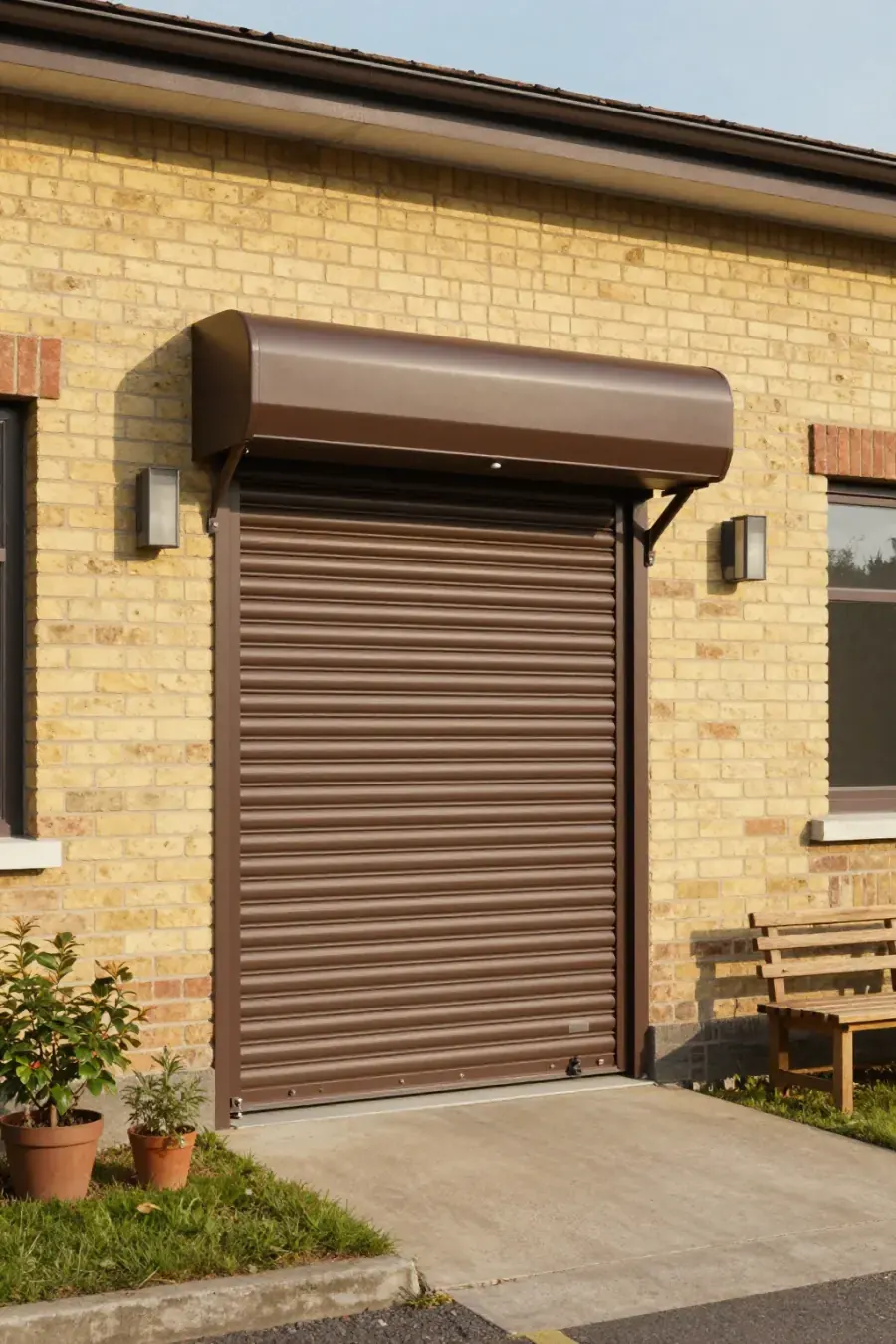

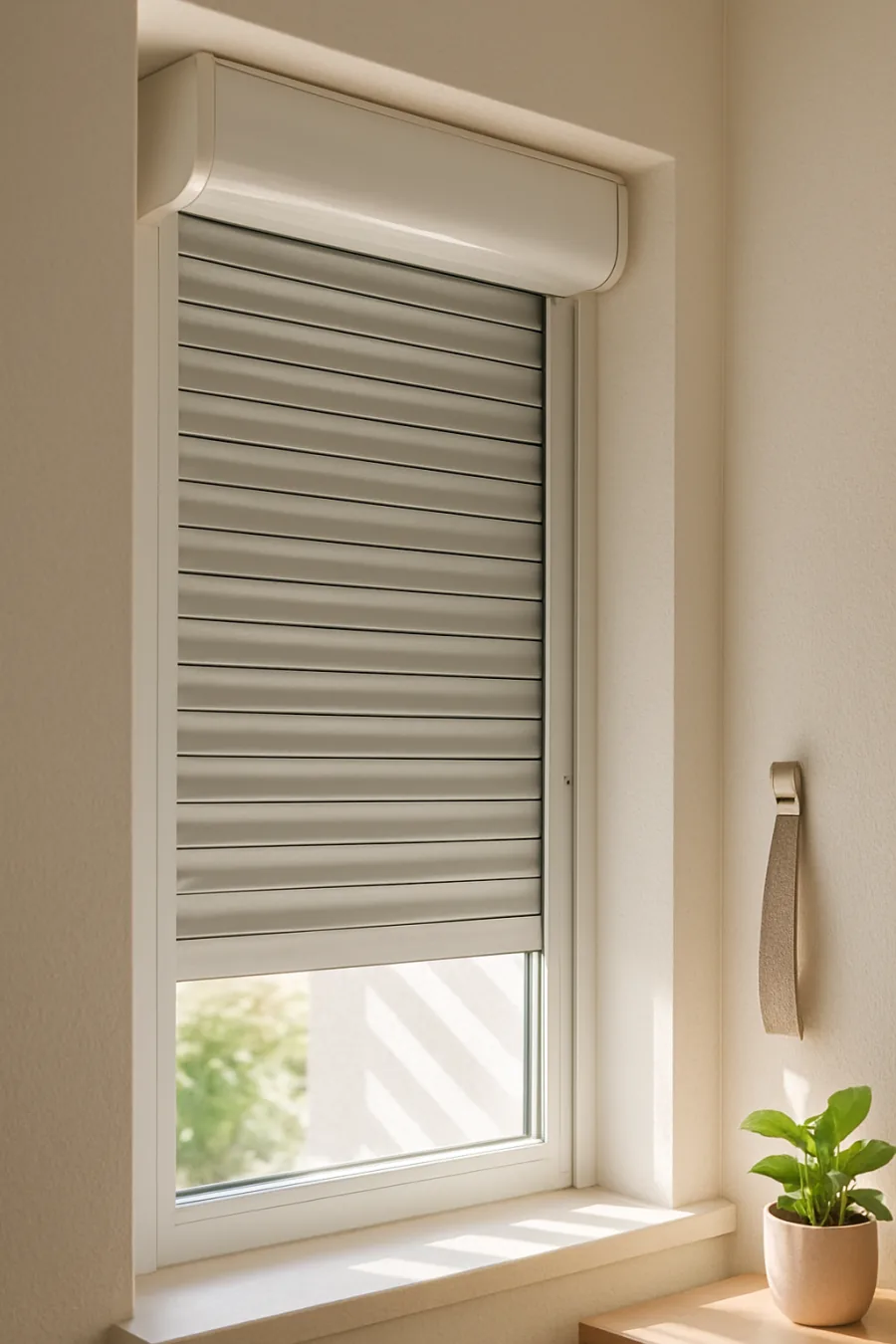


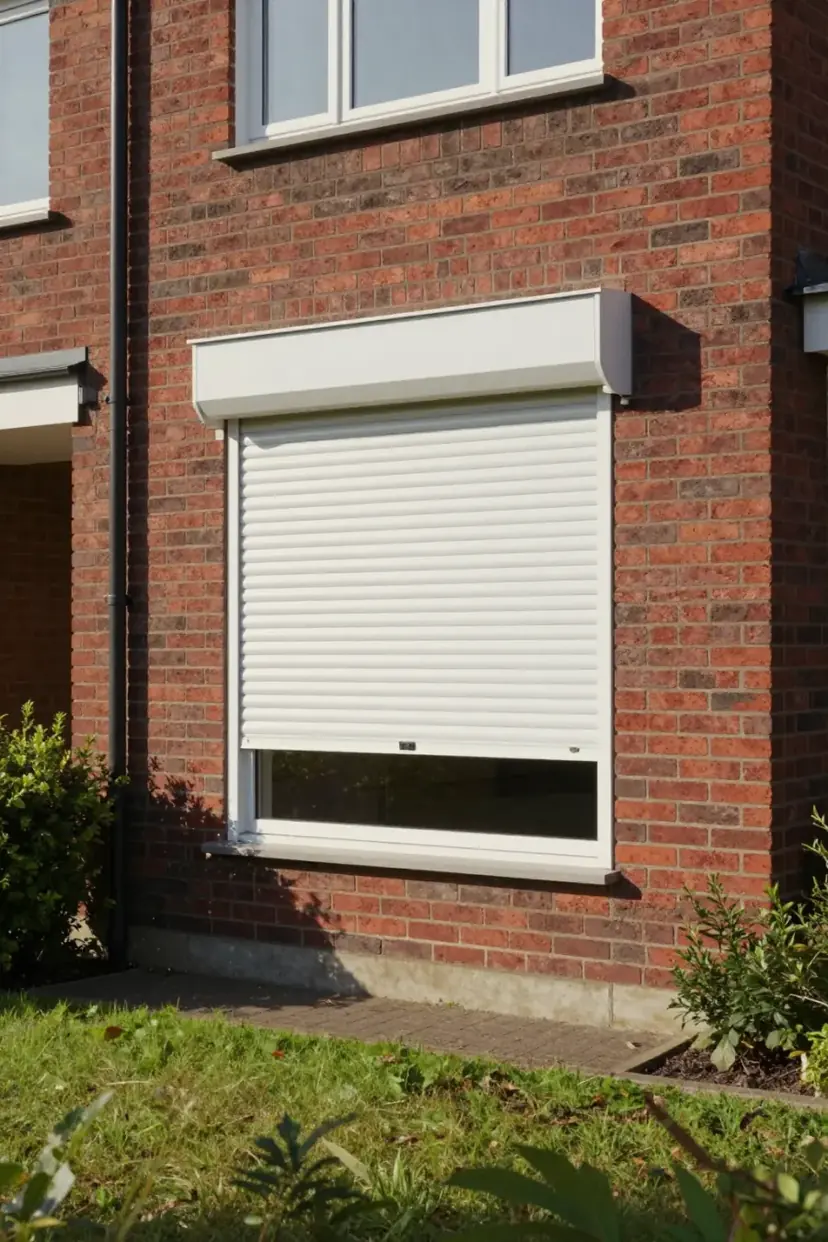


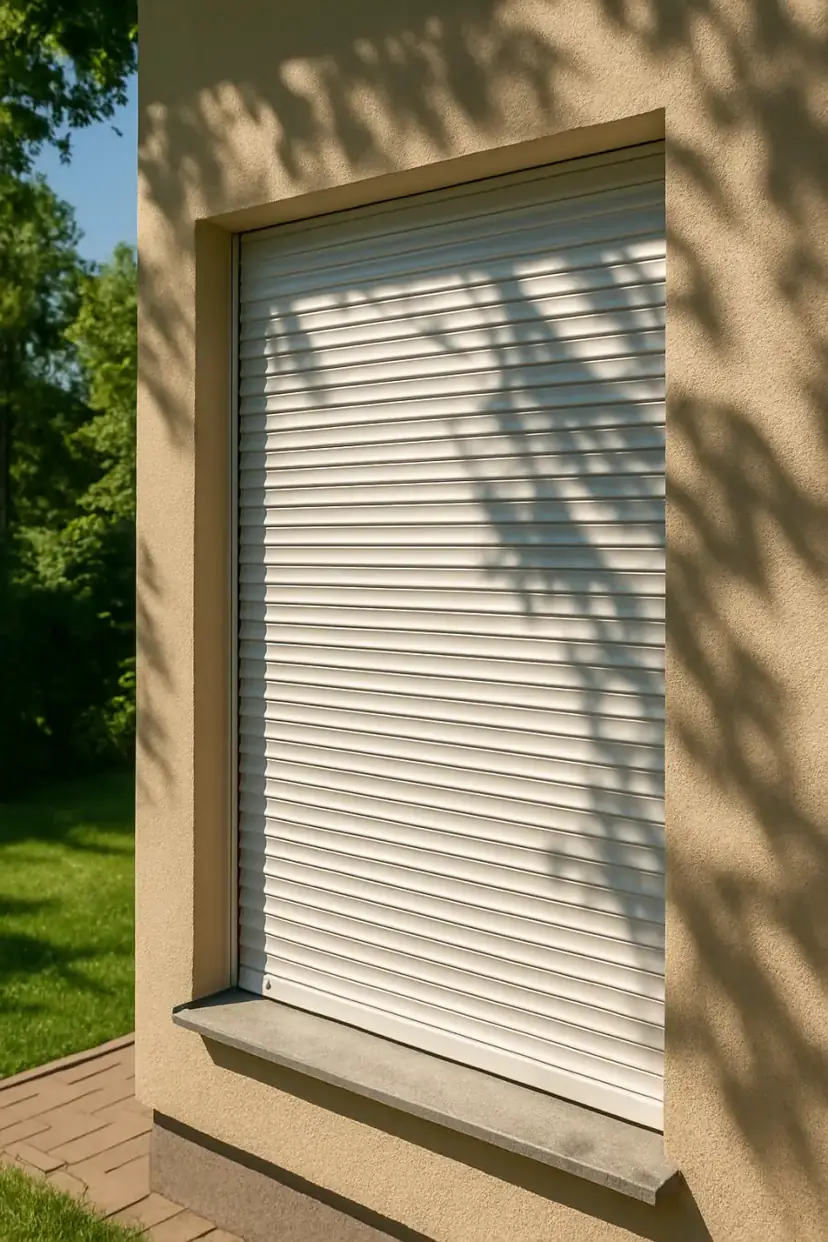











Horizontal roller shutters are a roller system in which the slats are arranged horizontally and linked to each other, and the raised curtain rolls onto a roller tube in the housing box above the opening. We manufacture and install such systems in Almaty by measurement, from 17,500 ₸/m², manufacturing time 10–14 days.
What horizontal roller shutters are and how they differ from vertical ones
Horizontal roller shutters are a roller system in which the slats are arranged horizontally and flexibly linked to each other into a single curtain. When the curtain is raised, it rolls onto a roller tube inside the housing box fixed above the opening. The slats slide along guide rails fixed on the sides of the window or door. The product works as a single shutter: lower it — the opening is closed off from the sun, dust and prying eyes; raise it — the opening is clear and the curtain is tucked away in the housing box.
Horizontal roller shutters are assembled from a small number of components, and each one does its own part of the job. The slat is an extruded profile from which the curtain is built up. The curtain is what closes the opening. The roller tube is the axis onto which the curtain rolls. The housing box is the casing above the opening where the roller tube lives together with the rolled-up curtain. The guide rails are two vertical strips on the sides along which the slats travel up and down. The guide rails also keep the curtain from being pushed sideways, which is why in a windy area they are fixed into the load-bearing wall, not into the insulation.
Where the curtain goes when it is raised is the question asked most often. The curtain does not slide sideways or fold up like an accordion: it winds onto the roller tube in the housing box above the opening. In the room, horizontal roller shutters take up almost no space — the windowsill, the approach to the window and the walls on the sides stay free. The housing box can be surface-mounted on the outside, built into the opening or concealed under the finish; what to install in a particular case is decided by Jalusso at the measurement.
How it differs from vertical
The difference between the two systems is in the orientation of the slats and in where the blind goes. In a vertical system the slats run along the opening, and the blind slides sideways along a guide rail. In a horizontal system the slats run across, and the blind rises up into the housing box. Hence the different behaviour on site: a vertical one takes up space on the side, a horizontal one frees up the sides and works on openings where there is nowhere to slide the blind sideways.
The slats of horizontal roller shutters are arranged horizontally and flexibly linked to each other, and the raised curtain rolls onto a roller tube in the housing box above the opening.
Why the word “horizontal” means different things in different catalogues
Under the word “horizontal”, sellers and manufacturers show three different products, so two pages with the same name can describe something quite different from what you are looking for. Let us go through these three meanings one by one — that way it is clear where you have landed and whether the system suits you.
The first meaning is an ordinary window roller shutter with horizontal slats. The slats lie across the opening, linked into a curtain, and the curtain rises up and goes into the housing box above the window. This is the option we manufacture and install in Almaty.
The second meaning is horizontal installation. Here the word describes not the orientation of the slats but the plane in which the system is mounted. Horizontal installation is used to cover stairwells, hatches, swimming pools and attic exits: the curtain closes the opening from above, like a hinged shutter or a sliding cover. Such a product has nothing to do with a window or shopfront.
The third meaning is a sliding system. A sliding system moves the blind sideways along a guide rail along the wall or opening, like a wardrobe door. The only similarity to a roller shutter is the look of the slats; the mechanism, fixing and tasks are different. Such systems are chosen for openings where there is no room for a housing box above.
- A window roller shutter with horizontal slats — the curtain rises into the housing box above the opening.
- Horizontal installation above a stairwell or hatch — the blind closes the opening in a horizontal plane.
- A sliding system — the blind goes sideways along a guide rail.
The same opening can be called roller shutters, shutters or a sliding system in different catalogues. Look not at the word in the name but at where the curtain goes.
What we do and what we don’t
We make the first option: window, door and shopfront roller shutters with horizontal slats, where the curtain rolls up into the housing box. Overhead systems for stairwell openings, hatches and attic access, and sliding systems where the curtain moves sideways, are not in our catalogue — if that’s your opening, we’ll tell you honestly at the measurement and won’t try to sell you a product that doesn’t solve the task.
The word “horizontal” in catalogues can mean three different products: an ordinary window roller shutter with horizontal slats, a system mounted in a horizontal plane above a staircase or hatch, and a sliding system where the curtain moves sideways.
Which profile you need for a wide window or shopfront
The profile is chosen for the task, not for the word “wide”. A roll-formed foam-filled profile suits windows in flats and homes: it blocks the sun, dust and prying eyes, and takes the edge off street noise — and that’s where its job ends. Extruded aluminium is built for protective load: a solid slat is thicker and heavier, the curtain can’t be pried open with a crowbar, so it’s used on shopfronts, garages and ground floors without security, often with a deadbolt lock. A perforated profile lets light and air through while keeping the view from outside closed — it’s chosen for bathrooms, walk-in closets and rooms where ventilation is needed.
This is exactly where the question of break-in resistance is decided. Horizontal roller shutters on their own are not an alarm and not a grille: a roll-formed curtain stops a glance, not a crowbar. If the opening faces the street and there’s no security, Jalusso recommends extrusion and fixing the guide rails into a load-bearing wall.
| Profile | What it handles | Where we install |
|---|---|---|
| Roll-formed foam-filled | sun, dust, prying eyes, takes the edge off street noise | windows in flats and homes |
| Extruded aluminium | protective load, resists prying, often with a deadbolt lock | shopfronts, garages, ground floors without security |
| Perforated | light and air pass through, the view from outside is closed | bathrooms, walk-in closets, shopfronts, rooms with ventilation |
The price difference between roll-formed and extruded is noticeable. There’s no point paying extra for a protective profile on a third-floor window — the task there is different. And the other way round: skimping on a shopfront that’s closed at night is a bad idea.
Where to fix the guide rails
The guide rails of a protective curtain are fixed into a load-bearing wall, not into insulation or cladding. This determines whether the system can take the load: a curtain that resists prying pulls the whole structure with it, and the weak point here is the fastening.
A shopfront without security and a shopfront against the sun
Two shopfronts look the same and need different things. The one closed at night against break-ins we build on an extruded profile. The one closed during the day only against the sun and passers-by can be built on a roll-formed one — and that’s noticeably cheaper.
A roll-formed foam-filled profile blocks the sun, dust and prying eyes, but isn’t built to resist forced entry; extruded aluminium takes the load and goes on shopfronts, garages and ground floors without security.
A wide opening: one curtain or two with a mullion
One curtain or two with an intermediate guide rail is a decision for a specific opening, not a feature of the system. We install horizontal roller shutters in Almaty on both panoramic glazing and shopfronts, but the width is chosen in each case to suit the profile and the controls. There’s no universal figure beyond which an opening must be split: that’s determined by the measurement.
A metre of wide curtain is no cheaper or more expensive than a metre of narrow — the price is calculated by area. What matters is that a wide curtain calls for a stiffer roller tube and a more powerful mechanism, and that affects the specification. A simple strap copes with a light curtain at moderate width. As soon as the curtain gets heavier, the strap stops being convenient — it’s replaced with a cardan drive or an electric motor.
What we check at the measurement:
- Roller tube stiffness — whether it can carry the curtain without sagging along its whole length.
- The width of the opening and whether there’s a load-bearing wall at the edges for the guide rails.
- The weight of the curtain — it depends on the profile and the height of the opening.
- The mechanism that will lift this curtain: strap, cardan or motor.
- The controls, if automation is planned for the future.
A wide opening requires matching roller tube stiffness and mechanism power, and there’s no way around it. If the strap can’t cope, we suggest a cardan or a motor. If that’s still not enough, the opening is split into two curtains with a mullion — an intermediate guide rail that takes part of the load and keeps a long slat from flapping in the wind. On panoramic glazing such a mullion sits on the mullion post and is barely noticeable.
A heavy curtain requires a cardan or an electric motor — and that’s where we stop. So the question “will one curtain be enough” isn’t decided by the catalogue, but by the measurement.
What we check at the measurement
Roller tube stiffness, the width of the opening, the weight of the curtain and the mechanism that will lift it. If the strap can’t cope, we suggest a cardan or a motor; if that’s still not enough, we split the opening into two curtains with an intermediate guide rail.
Controls: chain, cardan or electric motor
The choice of controls is determined by the weight of the curtain and the width of the opening. A light curtain is fine with a chain — it comes with mechanical controls and works by hand. A heavy curtain can’t be lifted with a chain: you need a cardan or an electric motor. Why is that?
The chain pulls the roller tube directly and is designed for a small force. A spring-inertia mechanism helps lift the curtain, but it too has a weight limit. When the curtain is long and the profile is heavy, a cardan drive is fitted: the handle is brought out to the side, and a person turns it standing on the floor, rather than reaching up to a short chain. It’s simple mechanics without electrics, and on sites without power it saves the day.
An electric motor adds a remote control, a schedule and a sun sensor. The curtain can be raised with one button from the room, and on a schedule it closes itself — handy for a shopfront that needs to be closed in the evening while the salesperson is counting the till. At the same time, an electric motor has an emergency output for a cardan handle: if the power goes out, the curtain is raised by hand, without calling a technician.
On a wide opening, a motor or cardan is almost always fitted, not a strap. The same rule applies here as with the profile: the bigger the curtain, the more serious the mechanism has to be. A strap on a long roller tube stretches quickly, and it’s hard to operate.
Can manual controls be changed to a motor later? Yes, but with a caveat. If the housing box and guide rails are chosen from the start for a future motor, the swap is done without reworking the opening. If not, the whole assembly has to be rebuilt.
Control coefficients
The cost of controls is calculated as a coefficient to the base price:
- Mechanical control — ×1
- Chain — ×1.06
- Electric motor — ×1.85
- Electric with remote — ×2.1
A set with a motor and remote control costs about twice as much as a mechanical one — this is clear from the coefficients. For an apartment window, such a difference is rarely justified, but for a shopfront that is opened and closed daily, it is quite reasonable.
Let's take a window with an area of 2 m² on a roll-formed foam-filled profile: the base is 17,500 ₸/m², that is 35,000 ₸. With a chain, it is 37,100 ₸, with an electric motor and remote control — 73,500 ₸. The difference is noticeable, and it is better to decide on it during the measurement, not from a picture in the catalogue.
If you plan to add automation later
We select the housing box and guide rails right away for the future motor. Then replacing the control will not require reworking the opening. Mention this during the measurement — the measurer will allow for the necessary unit dimensions in advance.
Housing box: surface-mounted, built-in or concealed
The housing box can be surface-mounted on the outside, built into the opening, or concealed under the finish. Inside the box there is a roller tube onto which the blind is wound. A surface-mounted box is fixed on top of the wall above the opening — this is a workable option for a finished facade when no one wants to chase walls or dismantle the finish. A built-in box goes into the opening: the blind and roller tube are hidden in the niche, and a clean line remains above the window. A concealed box is covered by the finish — it disappears completely, but this is a decision to be made at the stage of renovation or facade cladding, not after.
Which is better — surface-mounted or built-in? It depends on the condition of the facade and on whether you are ready for work around the opening.
- Surface-mounted box. We install it on top of the wall. No niche is needed, installation is faster, and the roller tube with the blind is accessible for maintenance. There is one drawback: the box protrudes above the opening and is visible on the facade.
- Built-in box. The box and roller tube go into the niche of the opening. The facade looks cleaner, and the blind is flush with the wall. The niche is prepared in advance according to our dimensions — redoing it later is more expensive.
- Concealed box. The box is covered by the finish: window reveal, panel, cladding box. The roller tube is inside, nothing is visible from the outside. An option for those who are doing facade finishing and want to hide the mechanism.
Is it bulky above a wide shopfront? The box runs along the entire width of the opening, so it is noticeable on a shopfront. Moreover, the wider the opening, the more massive the box and the roller tube inside it. On wide shopfronts, we more often suggest a built-in or concealed option — the facade stays clean, and the line above the glass does not cut across the signage. During the measurement, we look at the condition of the facade and tell you what can realistically be done in your case.
How the price is calculated and how much installation costs
Horizontal roller shutters for windows cost from 17,500 ₸ per m², manufacturing time — 10–14 days. This is the lower limit: beyond that, the price increases with the size of the curtain, profile, housing box, control and locks. Jalusso calculates by area, not “per set”, so a room with two identical windows and one wide shopfront with the same area come out differently.
| Position | Price | Lead time |
|---|---|---|
| Roller shutters for windows, roll-formed foam-filled | from 17,500 ₸/m² | 10–14 days |
| Security roller shutters, extruded aluminium | from 24,900 ₸/m² | 12–16 days |
| Perforated roller shutters | from 27,800 ₸/m² | 12–16 days |
| Motorised roller shutters | from 35,000 ₸/m² | 14–18 days |
The difference between the first line and the second is not “better or worse”, but different tasks. The roll-formed foam-filled profile is used for windows in apartments and residential buildings, while protective extruded aluminium is used for shopfronts, garages and ground floors without security. The perforated profile lets light and air through, so it is chosen for bathrooms, walk-in closets and shopfronts. And an electric motor adds a remote control, a schedule and a sun sensor to any of these options — hence the price and the longest lead time.
Installation coefficients
For the installation of one unit we charge 4,500 ₸; for orders from 150,000 ₸, installation is included at no extra cost. The mounting method changes the cost by coefficients: on the wall — ×1, on the frame — ×1.05, without drilling — ×1.1, cassette system — ×1.28. Control is calculated separately and multiplies the base: mechanical — ×1, chain — ×1.06, electric motor — ×1.85, electric with remote — ×2.1. A set with a motor and remote control costs about twice as much as a mechanical one, and this is the most noticeable item in the invoice. For example, a window with an area of 3 m² on a roll-formed profile with a chain and wall mounting is 3 × 17,500 × 1.06 plus installation; the same opening with a motor and remote control is already multiplied by 2.1.
Warranty
We give 3 years on the mechanism and 1 year on installation, counted from the date of signing the acceptance report: both are covered by the warranty. If the case is recognised as a warranty one, we will do the work free of charge — within a maximum of 5 working days from the moment of contact. When the warranty expires, a visit is still possible: we will tighten, adjust, and install a new cord or chain. Not covered by the warranty: water, mechanical damage, natural fading of the fabric, as well as reinstallation by yourself. The deadbolt lock on a protective system is part of the blind, not a separate service: it keeps the slats from being pried open, and its presence in the set is shown as a separate line in the estimate.
The price of a horizontal system is made up of the size of the blind, the type of profile, the type of housing box, control and locks — and these are the five points the measurer breaks down on site.
Winter in Almaty: freezing, snow and slat care
In winter in Almaty, an outdoor blind works in harsh conditions: winters here are cold, with frosts and a large temperature difference between day and night. Slats can freeze together — if moisture gets between them and the cold hits, the blind locks into a single block. That is why we install the guide rails with a gap and choose a mechanism with a power reserve: lifting should have a small margin, not run at the limit.
Dust and snow on the slats is the second winter story, and it is more noticeable on wide openings. A long slat collects more precipitation and street dust than a short one. It should be cleaned with a soft brush, sweeping snow and dust from top to bottom along the blind. Do not knock off ice: not with a scraper, not with a shovel, not by hitting the slat.
What to do if the blind is frozen
Do not yank it. This is the main rule, and it saves the mechanism from a broken cord and a damaged strap. Let the blind come free on its own — often the daytime warmth or sun on the facade is enough. If it does not come free, call a technician: we will come and carefully separate the slats without damaging the profile.
How do horizontal slats behave in the wind on a high floor? The wind zone in Almaty is noticeable: the higher the floor and the wider the opening, the stronger the wind load on the blind. Here the rigidity of the roller tube and the way the guide rails are fixed matter. On high floors with an open facade, during the measurement we check whether the mechanism can handle the blind, and if necessary we suggest a cardan or a motor instead of a chain.
Slat care in winter is simple: a soft brush, warm water without abrasives, no ice and no impacts. In winter, an outdoor blind can freeze if moisture gets between the slats and the cold hits, so guide rails are installed with a gap and the mechanism is chosen with a power reserve.
How to order: measurement, manufacturing, installation
Measurement is mandatory — without it we will not know where the box will go and how to fix the guide rails. Measurement and consultation are always free, within the city measurement and delivery are also free, and the measurer comes with profile samples and calculates the cost on site.
The process is as follows:
- You write to us on WhatsApp — we discuss the opening and the task: whether it is a window, a door or a shopfront, and what matters more — sun and prying eyes or protection from being pried open.
- A measurer comes with profile samples, looks at the opening, and calculates the cost on site.
- The workshop manufactures the set to your dimensions.
- We deliver and install.
The manufacturing time depends on the price list item: roller shutters for windows — 10–14 days, protective — 12–16 days, with an electric motor — 14–18 days. The count starts from the measurement, not from the messages.
What to prepare for the measurement
To get an idea of the price before you even call, measure the width and height of the opening with a tape measure — that's enough for a rough estimate. Then the details matter: which side the window opens to, whether there's a windowsill and an external sill flashing. We set the blind apart from them so it doesn't catch when lowering and raising. The windowsill often protrudes beyond the wall plane, and then we either raise the housing box or use a different type of mounting. Same with the external sill flashing. These little things aren't visible in a catalogue — only on site.
Suburbs
We travel to Kaskelen, Talgar, Issyk and Kapshagay. The cost of the visit depends on the distance and is quoted before the visit — no surprises on the invoice.
One thing, so you don't waste time: we don't make roller shutters in the horizontal plane — for covering stairwell openings, hatches and attic exits — nor sliding systems where the curtain moves sideways. We say this at the measurement, not after it. The measurement determines everything else: the profile type, the housing box type, the controls, and whether one curtain is enough for your opening.
FAQ
What's the difference between roller shutters for outdoor and indoor use? An outdoor curtain works outside: wind presses on it, in winter there's frost and snow, in summer dust and sun. That's why an outdoor system is built on a profile that can take the load, and the guide rails are fixed into a load-bearing wall. An indoor curtain is installed in the opening or in front of it, it faces neither wind nor precipitation, and its job is light, prying eyes and, if needed, dividing rooms. For an indoor version a lightweight profile is enough. In my view, the confusion here most often comes from the price: a person compares two quotes and doesn't notice that one is for the outdoors and the other for a room.
What's the difference between roller shutters and roller grilles? Roller grilles are a separate product: their slats are connected so that gaps remain between them, and the opening isn't closed tightly. Such grilles are installed on shop windows and counters, where it's important to see the goods while access is closed, and on technical openings. Jalusso makes horizontal roller shutters in Almaty with a tight curtain: the slats interlock, and a closed opening can't be seen through. If you need a grille specifically, that's a different order — say so right away, so the measurer quotes what you actually need.
Do you need a separate lock slat on a shop window? A deadbolt lock keeps the curtain from being pried open: the bolts extend from the end slats into the guide rails and prevent the curtain from being lifted from outside. We install it on security systems — unguarded shop windows, garages, ground floors. On a shop window that's closed at night against sun and prying eyes rather than against break-ins, the lock isn't needed: it makes the set more expensive without changing what it does. We don't have a separate slat for the lock — the lock is built into the system itself, and that's visible at the measurement on the sample. One thing remains decisive: a deadbolt lock keeps the curtain from being pried open and is installed on security systems, while a roller grille is a separate product that doesn't close the opening tightly.
The bottom line
Horizontal roller shutters are a roller blind with horizontal slats, whose curtain rolls up into a housing box above the opening. Everything else is details that are settled at the measurement. Here we've gathered the main things worth keeping in mind before you call.
Under the word “horizontal” in catalogues you'll find three different products: a window roller blind with horizontal slats, a system mounted in the horizontal plane above a staircase or hatch, and a sliding system where the curtain moves sideways. We make the first — window, door and shop-window roller blinds. Coverings for stairwell openings, hatches and attic exits, as well as sliding systems, are not in our catalogue; if you have such an opening, we'll say so straight away at the measurement.
The profile is chosen for the job, not for the width of the window. The roll-formed foam-filled one goes on windows of apartments and residential houses: it blocks sun, dust and prying eyes, but isn't designed to resist forced entry. Extruded aluminium takes the load — we install it on shop windows, garages and unguarded ground floors, often with a deadbolt lock. A perforated profile lets light and air through, so it's used for bathrooms, wardrobes and shop windows where ventilation is needed.
The width of an opening isn't unlimited: it's constrained by the profile and the controls. The stiffness of the roller tube, the weight of the blind and which mechanism will lift it — the measurer checks these against the specific opening: where a chain is enough, and where a cardan drive or an electric motor is needed.
Before you call, measure the opening and decide what matters more to you — sun and prying eyes, or protection against break-ins. With that, the measurer will pick the profile and controls faster.
We manufacture horizontal roller shutters in Almaty in our own workshop, everything is made to measure, so the final configuration is always calculated for your opening rather than taken from a catalogue.

