
















Motorised roller blinds in Almaty are a roller blind whose tube is turned by a tubular motor hidden inside the tube. Control is by remote, wall button, timer or smartphone. Power comes from the mains 220 V or from a battery. We make them to measure in our own workshop, measurement is free.
How a motorised roller blind works
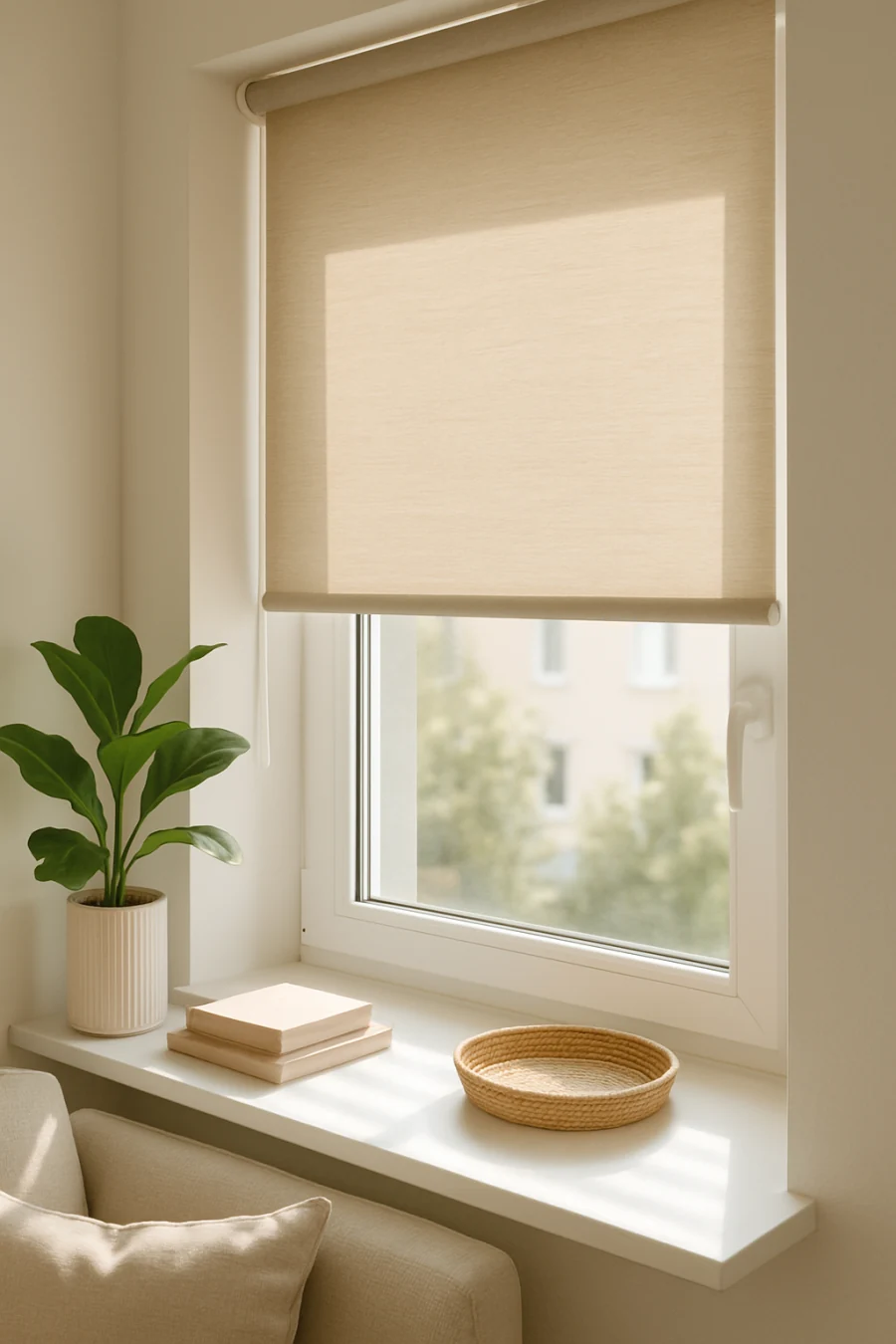
Motorised roller blinds in Almaty are the same roller system, only the tube is turned by a tubular motor hidden inside the tube. The electric motor is built into the tube of the roller blind, so only the fabric is visible from the outside. There is no chain to pull by hand at all. This is exactly how motorised roller blinds differ from the familiar roller blind.
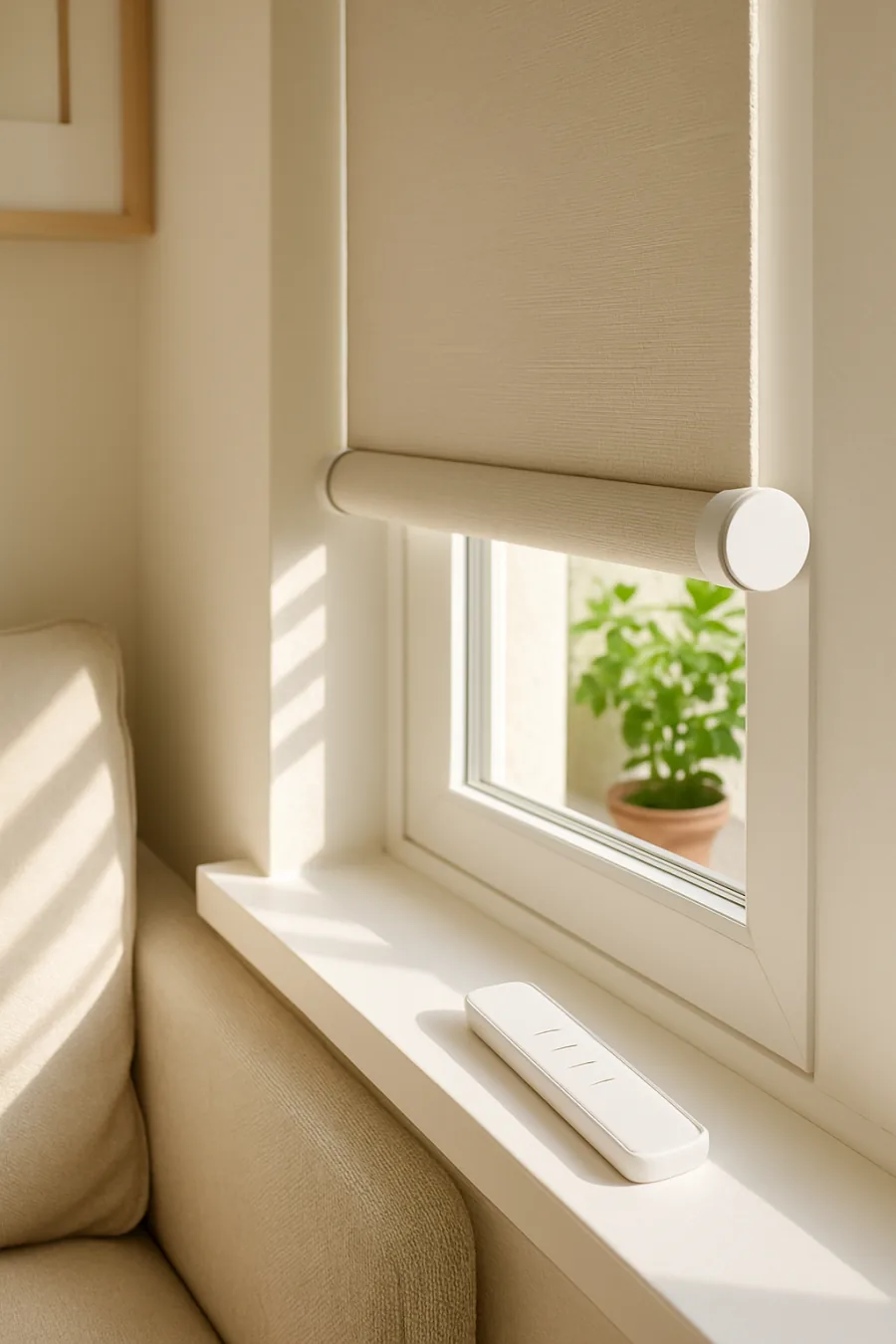
Control is by remote control. The remote sits on a table, in your pocket or on a bracket by the window. A wall button duplicates the remote at the window: it is fixed to the wall next to the blind so you can open and close the fabric without getting up and without searching for the remote around the room. A timer adds a schedule — the blind goes up in the morning and comes down in the evening by itself.
From the outside such a blind gives nothing away. The fabric, brackets and guide rails are all the same as on an ordinary open-tube system. The only difference is that instead of pulling a chain, a tube turns inside.
We make such blinds in our own workshop in Almaty and make them to measure. We have no ready-made items in stock: every fabric is cut for a specific opening, and the motor is chosen for the weight and width of the fabric. What suits your window, the measurer explains on site, with samples in hand.
How it differs from a chain-operated blind
The fabric stays the same — only the way the tube turns changes. On an ordinary roller blind you pull the chain and the tube turns by hand. On a motorised one, the tube is turned by a motor on a command from the remote or button. The fabric winds onto the tube in exactly the same way, in even layers.
On a tall window you cannot reach by hand, the difference is felt at once. And on a panoramic opening with several fabrics, too: each gets its own motor, and control comes down to one remote. No more walking around the windows one by one.
What the set consists of
One motorised roller blind set is a tube with a motor inside, the fabric, the mounting and the control device. The mounting is chosen for the window: wall, frame or a cassette system. Control — a remote control, a wall button or a timer. Power — either a mains 220 V unit or a battery.
The motor is built into the tube of the roller blind, so only the fabric is visible from the outside, and there is no chain.
Battery or mains 220 V: what to choose depending on the stage of your renovation
The stage of your renovation decides the choice between mains and battery. A battery motor needs no cable to the window, while a mains one needs 220 V wiring and space for the cable. We have only these two versions. We make motorised roller blinds in Almaty to measure: the tube with the motor is assembled in the workshop for a specific window, there are no ready-made items in stock.
Renovation in progress — we lay the cable
While the walls are open, the cable to the window is laid in advance and brought out to where the blind will be installed. A cable to the window and chasing at this stage add almost no trouble: the chase is cut for the electrics anyway, and the cable goes into the common bundle. The mains motor is then connected to the outlet point, and a wall button is placed next to the window. The measurer comes before the finishing work and agrees on the outlet point — so the blind goes up without rework. And our advice is simple: don't put this off until the plastering.
Renovation finished — battery
The motor runs on a battery, there is a small charging connector on the end of the tube, and there is no need to chase the walls. For an apartment owner who has just closed up the walls, this is the calmest option. For rented housing a battery suits no less: the blind comes off together with the mounting, leaving no marks on the wall. What's more, it can be installed where there is simply nowhere to run a cable — a window deep inside the room, a concrete wall, wiring already laid.
Comparison table
| Power type | Is a cable to the window needed | When it is chosen | Limitations |
|---|---|---|---|
| Mains 220 V | Yes | Renovation in progress, walls open, the cable can be laid in advance | An outlet point and space for the cable are needed; without power the blind stays put |
| Battery | No | Renovation finished, rented housing, nowhere to run a cable | A charging connector on the end of the tube — access to the motor is needed |
The fabric is your choice here, any of them, including dense blackout roller blinds with an electric motor: the fabric group does not affect the power supply. Electric roller blinds can run on mains power or on a battery — electric roller blinds differ by the way they are connected, not by the fabric.
A battery-powered motor needs no cable to the window, while a mains-powered one requires 220 V wiring and space for the cable.
Where to run the cable to the window
The cable to the window is run to the spot where the blind or the external power supply and signal receiver will be, and this is done before the finishing work. Roller blinds with an electric motor need more than just a socket in the room: the cable must reach the place where the tube with the motor or the control unit will sit. A roller blind with an electric motor also means a power point that has to be planned in advance. That is why roller blinds with an electric motor are ordered together with the renovation, not after it.
Checklist if the renovation is not finished
Five steps worth taking before plastering and painting.
- Decide where the blind goes: on the frame, on the wall, or as a cassette system.
- Agree on the cable outlet point — the measurer chooses it, not an electrician guessing.
- Lay the cable to the installation point while the walls are still open.
- Leave access to the power supply and signal receiver: you will need to reach it.
- Call the measurer before the finishing work so that they can calculate the mounting and the motor power.
A mains-powered motor requires 220 V wiring and space for the cable. If the renovation is underway, you won't have to chase the walls later — the cable will go into the wall together with the rest of the wiring.
If the renovation is finished
Few people want to chase a finished wall. Then the options without chasing remain: a battery-powered motor, or a cable run along the ceiling and hidden in a box. The measurer decides on site — they check whether there is a route to the power point.
And here is what matters on a plastic window: the wall button is mounted next to it, and the mosquito net and the window profile determine exactly where the blind will go and how the cable will run. I wouldn't advise deciding from a photo here, honestly. The measurement determines the motor configuration and the mounting, and only after that does it become clear where to run the cable.
The cable is run to the spot where the blind or the control unit will be, before the finishing work.
What happens if the power goes out
When the power goes out, a mains-powered blind stays in the position it was in when the power cut happened. You cannot raise it at that moment: tubular motors for roller blinds have no manual emergency lift, and we don't promise otherwise. But once the power comes back, the blind responds to the remote control again — nothing needs to be reconfigured.
A battery-powered motor behaves differently. It is not connected to the mains, so a power cut does not affect it at all: roller blinds on a remote control keep going up and down as long as there is charge in the battery. For apartments with frequent outages, this is a noticeable difference. Does your power go out often? If so, tell the measurer — they will suggest a motor with a battery.
The limit positions — the upper and lower points of travel — are set from the remote control after installation, and a power cut does not reset them. The blind remembers where to stop. It is a different matter if the fabric gets stuck mid-window: with a mains-powered model you will have to wait for the power, while roller blinds on a remote control with a battery will move right away.
A practical point: at the moment of a power cut, a mains-powered blind stays exactly where it was. There is no spontaneous unwinding — the motor simply receives no command.
A mains-powered roller blind without power stays in its current position and keeps working once the power is back, while a battery-powered motor works independently of the mains.
How much does an automatic roller blind cost
Roller blinds with an electric motor — from 9,800 ₸/m². The motor in the tube is already included in this figure: both the mains-powered 220 V version and the battery-powered one. The motor is not charged as a separate line item, and the manufacturing time for this item is 7–10 days.
What makes up the price
Five things move the final price. The area of the opening. The fabric group. The type of control. The mounting. The installation.
Motor power is calculated from the weight and area of the fabric. That is why a floor-length blind for a window and a blind for a kitchen sash are different motors and different costs. Blackout fabric is denser than ordinary polyester, and the motor for it is chosen with a reserve of pulling force. The remote control is a small extra charge on top of the base, and the measurer gives the exact amount.
The multipliers from the calculator help you compare options with each other: they show how many times more expensive the automation is than the manual version on the same base. Our price for automatic blinds is a ready figure from 9,800 ₸/m² from the price list, and it should be taken as it is, not assembled from multipliers. Clients often get confused here, and I understand them: calculating a coefficient is easier than believing that the motor is already included in the price.
| Position | Price | Lead time |
|---|---|---|
| Roller blinds, open roller tube | from 5,400 ₸/m² | 4–6 days |
| Roller blinds with an electric motor, motor in the tube | from 9,800 ₸/m² | 7–10 days |
| Installation | 4,500 ₸ per item | — |
| Installation free on orders from 150,000 ₸ | free | — |
The measurement determines the motor configuration and the mounting. The measurer comes with samples, holds them up to your window and calculates the cost on the spot — this is free.
Installation
Installation — 4,500 ₸ per item. On orders from 150,000 ₸ we do it free of charge. The motor of automatic roller blinds is covered by a 3-year warranty, and the installation by a 1-year warranty from the date the acceptance certificate is signed; if a case is recognised as a warranty case, we fix it within 5 working days at no charge.
You cannot buy automatic roller blinds off the shelf — we have no ready-made items, everything is made to measure for a specific window. That is why we do not give a single figure before the visit: the tube with the motor, the remote control, the mounting and the installation are calculated for your windows.
Can a hanging blind with a chain be converted to a motor
It is not always possible to convert a hanging roller blind with a chain to an electric motor. The motor is fitted inside a tube of a suitable diameter, so first you need to find out whether it will fit into the tube that is already hanging on your window. The tube diameter limits the very possibility of fitting a motor into a ready-made blind: the motor will not go into a thin tube, and it will have to be replaced together with the mounting.
The weight of the fabric determines the motor power. Heavy dense fabric on a wide opening requires a motor with a reserve of pulling force, while light fabric on a narrow window gets by with a weak motor. The torque is selected specifically for the weight and area of the fabric, and this is done by calculation, not by eye.
What else differs besides the tube:
- open roller tube — the fabric winds onto a tube that is visible from the end;
- UNI cassette system — the fabric and the tube are covered by a housing box, and this is a unit with a different geometry than an open roller tube.
This is where the answer about the cassette comes from. The cassette system limits the width of the fabric for a motor: there is less room inside the housing box than on an open tube, and not every fabric in a UNI cassette can be fitted with a motor. In such cases we calculate our automatic blinds for windows for a specific opening, not by a general formula. And automatic roller shutters for windows from the outside are a separate story, with their own cassette with ZIP guide rails.
In practice it usually works out like this: if your existing blind has exactly the roller tube diameter and fabric weight that suit the motor, it can realistically be retrofitted. If not, Jalusso replaces the roller tube and prices the product again.
What the measurer checks
Before promising anything, the measurer looks at three things. Roller tube diameter — whether the motor will fit into the existing tube. Fabric weight — what drive power to allow for. System type — whether you have an open roller tube or a cassette. These three parameters make it clear whether you will get away with a retrofit or need a new blind with a motor. The motor is fitted inside a roller tube of the right diameter and is selected by fabric weight, so no existing blind can be retrofitted without replacing the roller tube.
Controls: remote, button, timer, smartphone and voice
Wi-Fi is not needed for roller blinds on a remote. The remote sends the command straight to the motor; the internet and an app play no part in this setup at all. Voice control is a separate story: it is possible, but it depends on the specific drive model and on how the drive is connected to the smart home. Tell the measurer which scenarios matter to you, and he will select the controls for them. And if the remote gets lost, it is solved on the spot: the drive has a button on its housing or a wall button by the window, and the blind keeps responding to them. The most common thing we hear at a measurement: “what if the remote dies?” — it is not the remote that dies, but the battery in it, and that gets replaced.
A remote control is the basic option. One remote controls several blinds and groups, so a flat with three windows does not need three remotes. The button is mounted on the wall next to the window: you walk up and press it without hunting for the remote around the room. The wall button duplicates the remote, it does not replace it.
A timer raises the blind in the morning and lowers it in the evening. It is set up from the remote, with no app or internet. Automatic roller blinds with a timer are installed in bedrooms where you want to wake up in daylight: the fabric rises on its own while you are still in bed. And the schedule lives in the drive’s memory and is not thrown off by nobody being at home.
Wi-Fi control allows scenarios and voice commands: the drive connects to the home network, the blind can be switched on together with other devices and started with a phrase. Automatic roller blinds of this class are already a smart home, and here everything comes down to the drive model.
In practice we install automatic roller blinds in flats where Wi-Fi is not needed at all. In the bedroom a remote and a timer are enough.
One remote controls several blinds, while Wi-Fi and voice depend on the specific drive model.
Blind groups on one remote and scenarios in a flat
One remote controls several blinds and groups: automatic roller blinds are split into channels, and each group is assigned its own button. The bedroom is put on a separate one, the living room as a group, and the kitchen or hallway on a timer. The remote stays in one place, and you do not have to search for it around the rooms.
The logic is simple. The bedroom is the “quiet and dark” scenario: one blind, one channel, a separate button. The living room is a group of two or three fabrics that move together. The kitchen and hallway work on a schedule, because no one is there. A separate channel for each room is what makes the controls clear instead of turning the remote into a set of confusing buttons.
Case study
In a living room with two floor-to-ceiling windows we installed two blinds on one remote channel. They move in sync — both drives receive one command and stop in the same position. Panoramic glazing is divided into several fabrics with their own drives, and all of them are brought onto one remote: the blinds across the whole opening move as one.
A second example is a child’s room. The remote is with the parents, and there is not a single chain in the room. The child will not pull the cord or get tangled in it: the controls are out of reach, while the blind itself remains a roller system with a motor in the roller tube.
A word about the schedule separately. The timer sets the time for raising and lowering, and automatic roller blinds close while the owners are at work and open by the time they return. This is set up from the remote, with no app or internet — which is convenient if the network in the flat is unstable.
Another scenario is a corner window in a meeting room: a button by the door closes both sides of the corner before a slide show. Here the wall button duplicates the remote and hangs exactly where your hand finds it on its own.
Blinds are split into remote channels: the bedroom separately, the living room as a group, the kitchen on a schedule.
Which window and which fabric suit a motor
Almost any window suits a motor, but three things determine the configuration: the profile type, the fabric weight and the height of the opening. Automatic roller blinds are installed on a plastic window, on panoramic glazing and on a tall floor-to-ceiling window. The other thing is that for each case the drive, the mounting and the fabric are selected separately — there is no universal kit.
Plastic window
On a plastic window, a blind with a drive is mounted on the frame or on the wall. The measurer decides which to choose: he looks at the profile, the depth of the opening and the fabric weight. On the frame the mounting is more compact; on the wall it is more reliable if the sash opens and the blind gets in its way. We do not recommend automation without drilling the frame: a roller tube with a motor is heavier than a regular one, and a mains-powered model also has a cable. The measurer comes with samples and tells you on the spot what will suit your sash.
Panoramic glazing and a tall window
Panoramic glazing and a tall window are exactly the cases for which automation is chosen. A chain at height is inconvenient, and sometimes you simply cannot reach it. A panoramic opening is divided into several fabrics, and each fabric gets its own drive. The controls are brought onto one remote: you press a button and all the blinds move at once. How many drives your opening will need is calculated by the measurer from the actual window dimensions.
Fabric: how much the blind weighs
Blackout fabric requires a motor with a traction reserve. A dense fabric is heavier, and a motor selected for light polyester will not pull it. That is why the drive power is calculated from the weight and area of the fabric — this is the first question the measurer asks along with the window dimensions. Take a floor-length blind across the full width of the opening: the larger the area, the more serious the drive needs to be.
Child’s room
In a child’s room, automatic roller blinds remove the main risk — a hanging chain. With a regular roller blind the chain has to be raised up or secured so that it cannot be reached. With a drive this is not needed: the blind is raised and lowered from the remote, and the remote stays with the parents. Not a single hanging cord in the room — that is why for a child’s room we most often install automation.
Drive noise
Whether the motor can be heard at night in the bedroom is a question of the specific model, and the measurer gives the answer. Drives differ in noise level, and for a bedroom the one that runs more quietly is selected. Tell us at the measurement that the window is in the bedroom: this changes the selection, not just the configuration.
Heavy blackout fabric requires a motor with extra pulling power, and on a panoramic opening each panel gets its own motor.
If you want to buy automatic roller blinds for a specific window rather than at random, start with a measurement: based on the profile, height and fabric weight we will select both the drive and the fabric.
When automation is not needed
On a single small window within arm’s reach, a roller blind with a chain copes without a motor. We say this straight, even though we do automation: if you can reach the top of the window standing up and raise the fabric every day without irritation, a drive will not improve anything there. A tall window is another matter — the chain hangs above your head, and the question answers itself.
Cases when a motor is not needed, or needed with a caveat:
- A small window in the kitchen or bathroom, where the blind is raised by hand: a chain is enough, and the difference is better put into the fabric.
- A window in a room where the blind is lowered once a season: the motor sits idle, and you won't feel the convenience.
- An opening where a tube of the required diameter won't fit: here it's not about the benefit, but about replacing the whole system.
Separately about motor power and torque. The motor is selected by the weight of the fabric and the area of the opening, and a light blind doesn't need extra pulling power. If the blind is small and the window is low, you're paying for a motor that works at half strength.
Now about the difference between an electric motor and an electric motor with a remote control. The motor in the tube is already included in the price from 9,800 ₸/m², and the remote control is a small extra charge on top of that; the exact amount is quoted by the measurer based on your windows. These options are worth comparing by convenience, not by the numbers. An electric motor is controlled by a button on the housing or a wall button; the second option adds a remote control. A wall button duplicates the remote control by the window, so for a single window you can take an electric motor and a button and not pay extra for the remote.
An example from practice: in an office with two sashes, the customer, after the measurement, chose an electric motor and one wall button on the wall between the sashes — roller shutters with a remote control turned out to be unnecessary for him, but he kept roller blinds with a remote control for the future, in case he adds a window.
On a single small window within arm's reach, a roller blind with a chain does the job without a motor, and automation is justified where you can't reach the fabric.
Measurement, manufacturing, installation and warranty in Almaty
We handle the measurement and installation of automatic roller blinds in Almaty ourselves: the measurement is free, the measurer arrives with fabric samples and calculates the cost on site. We don't have ready-made products in stock — we're a manufacturer with our own workshop, and every blind is assembled for a specific window after the measurement.
How ordering works
- You message Jalusso on WhatsApp and briefly describe your windows.
- The measurer arrives with samples, looks at the opening, the profile and the place for the cable.
- On site, he calculates the cost and suggests the configuration: power, control, mounting.
- The workshop assembles the tube with the motor and sets up the motor.
- Installation, then setting the limit positions with the remote control.
The measurement determines the motor configuration and the mounting, not the other way around. First we look at whether there's already a cable to the window and where it can be routed without chasing the walls, then we decide whether the motor will be mains-powered or battery-powered. For battery models, it's important that access to the end of the tube remains after installation — that's where the charging connector is located. We talk about this at the measurement, not after installation.
Timelines and installation
The manufacturing time for roller blinds with an electric motor is 7–10 days: this includes assembling the tube with the motor and setting up the motor. Installation of one unit costs 4,500 ₸, and for orders from 150,000 ₸ we do it free of charge. Within the city, measurement and delivery are free.
Warranty and service
We give 3 years of warranty on the automation of roller blinds and 1 year on installation, counted from the day the acceptance certificate is signed. The warranty on the mechanism covers repair and adjustment of the motor: if the blind stops in the wrong place or the motor runs abnormally, we fix the warranty case free of charge within 5 working days. After the warranty we still come out — to tighten the mounting, adjust the travel of the fabric, reprogram the remote control. The terms are simple: the warranty does not cover mechanical damage, reinstallation on your own, water and natural fading of the fabric.
Suburbs
We travel not only within the city. To the suburbs — Kaskelen, Talgar, Issyk, Kapshagay — the measurer will also come; the cost of the visit depends on the distance and is quoted before the visit, not after.
A measurer's visit and a consultation on automatic roller blinds are always free: he brings samples and calculates the price right on site.
Questions and answers
If the blind stops in the wrong place, the limit positions are set with the remote control. These are the upper and lower points where the fabric stops by itself. They rarely go out of sync: after removing and reinstalling the tube, after the blind is pulled by hand while moving, or if the tube was assembled in the workshop for a different opening. Adjustment is done with the remote control, following the motor's instructions, without taking the cassette apart. But if it goes out of sync on its own and keeps happening — call us, we'll come and take a look: that means it's not the settings but the mounting or the tube. And we've had such a case in our practice: a customer removed roller blinds with an electric motor to paint the window reveal and put them back with an offset — the limit positions shifted upward. We readjusted them with the remote control in a single visit.
The battery is charged through the connector on the end of the tube. Recharging the battery depends on access to that end: if the window is near the ceiling and the blind is mounted flush against the window reveal, you can reach the connector from a stepladder or with a long arm from the side. When planning such a blind, tell the measurer that the window is high — he will leave access to the end or suggest a model where the connector is routed more conveniently. We prefer to discuss this at the measurement rather than figure it out later on a stepladder.
The remote control is lost or out of battery — control it with the button, and we'll select a new remote control and program it for your motor. This is another argument for a wall button: it doesn't get lost in the sofa and doesn't run out of battery. A separate button isn't always needed — on a single window in the bedroom, a remote control is enough. But if there are several blinds divided into groups, a button by the door is faster: you don't search for the remote control and don't try to remember which button controls which group. One group can be operated both from the remote control and from the button — they duplicate each other.
The limit positions are set with the remote control after installation, and the battery charging connector is located on the end of the tube.
Conclusion
An automatic roller blind is the same roller system, only the tube is turned by a motor hidden inside the tube. The fabric stays the same, and there's no chain. The motor is chosen based on the stage of renovation: while the walls are open, the cable to the window is laid in advance, and after finishing, a battery-powered motor is installed — it doesn't need wiring.
A mains-powered blind survives a power outage in the position where the power cut caught it. A battery-powered one keeps working. Tubular motors for roller blinds have no manual emergency lift — we say this straight so that no one counts on raising the blind in the dark with a little cord.
On price, look at the “Roller blinds with electric motor” line in the price list — from 9,800 ₸/m²: the motor in the tube, mains or battery-powered, is already included in this amount. Manufacturing time is 7–10 days, and assembling the tube with the motor is included. Multiplying the calculator coefficients is a way to estimate a different configuration, not the price from the page.
You can't retrofit a hanging blind without replacing the tube if the tube diameter and the weight of the fabric don't match. The motor is installed inside a tube of the right diameter and selected by the weight of the fabric. The measurer checks this.
There's one practical tip: tell us the stage of renovation and the type of window. Based on these two inputs, the measurer will select the power, mounting and control and calculate the cost on site.
We make automatic roller blinds in Almaty to measure in our own workshop; there are no ready-made products in stock.

