




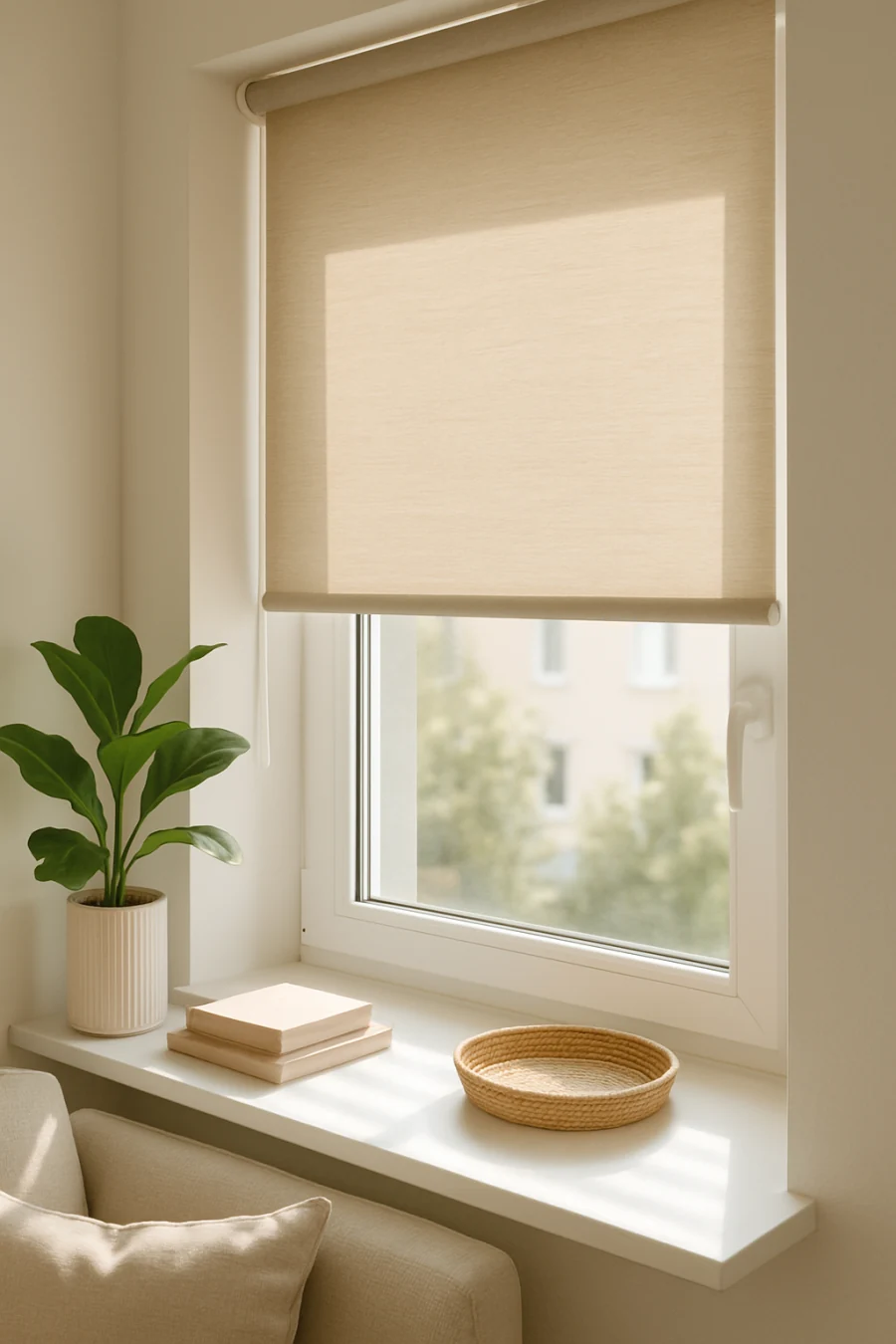


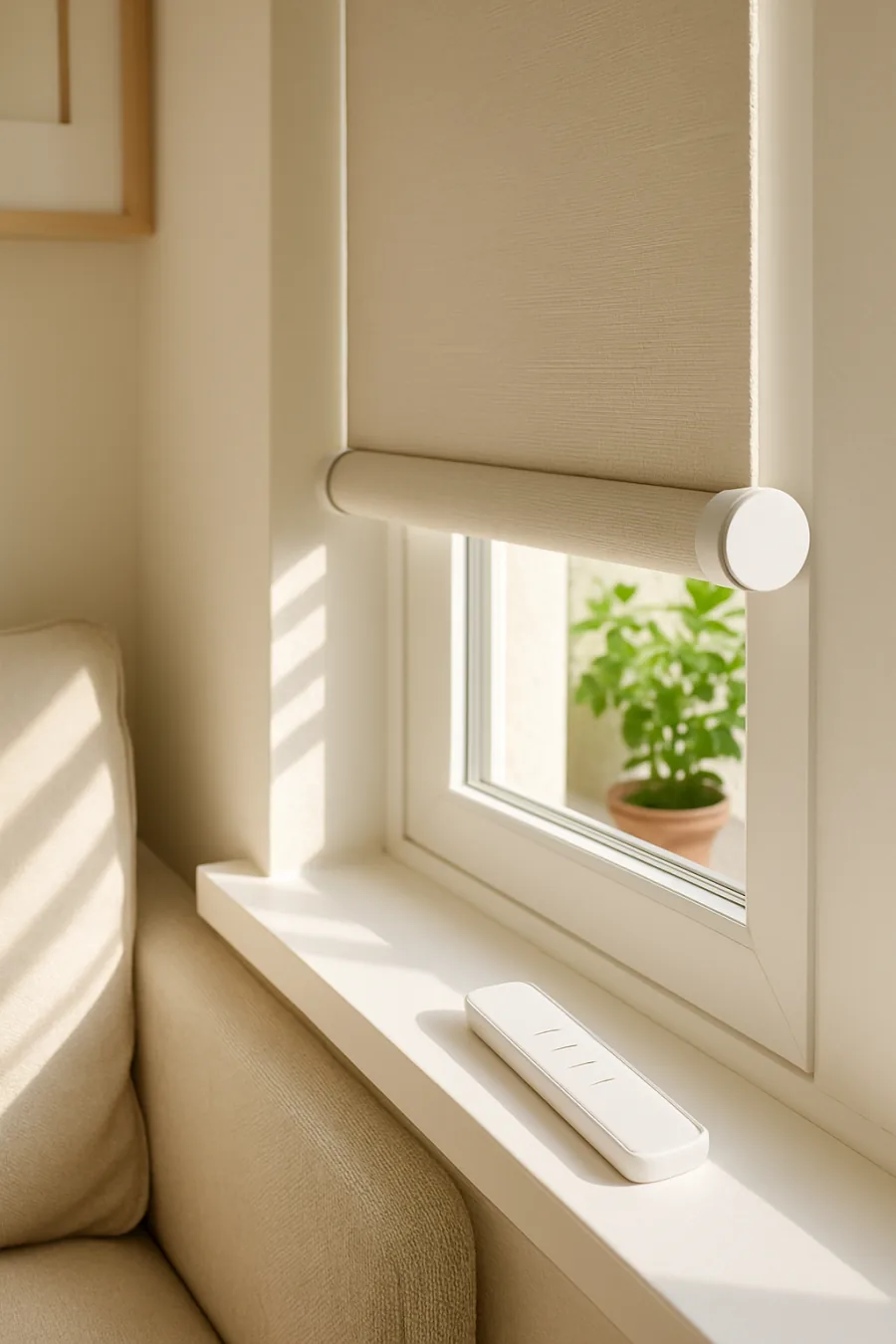
















Roller blinds without drilling in Almaty are installed in four ways: a hook on the sash, hook-and-loop tape, a clip in the glazing bead, and a suction cup. The frame and wall stay free of holes. We make our products to measure in our own workshop, and measurement is free: the measurer looks at the window profile and the side of the sun and selects the mounting for your sash.
How a roller blind stays on a window without a single hole
Roller blinds without drilling in Almaty are attached to the window in four ways: a hook over the sash, hook-and-loop tape, a clip in the glazing bead, and a suction cup. None of them requires holes in the PVC profile. The tube with the fabric is held by the profile itself, by the groove between the glass and the glazing bead, or by the smooth surface of the glass — depending on what your window allows.
Why has this become a topic of its own? Because standard mounting on the frame or wall leaves four to six holes, and in a rented flat the tenant is responsible for them. Jalusso makes its products to measure in its own workshop: the measurer arrives with samples, looks at the profile, the side of the sun, how the sash moves, and tells you on the spot which mounting will fit this window. Measurement and consultation are free.
How this differs from mounting on the frame or wall
No holes are left either in the profile or in the wall. With standard mounting, screws go into the PVC or the window reveal, and the blind can no longer be removed without a trace. Drilling-free mounting keeps the frame and wall intact: when you move, the product is taken down, and the window looks the same as before installation. For rented housing and new windows, this is the main difference.
Three different things that are often confused
Mounting is the hook, tape, clip or suction cup. Operation is the spring or chain. Fabric fixing is the magnet or side guide rails. These are three separate choices, and they are made independently: you can take a clip in the glazing bead with a chain and magnet, or a hook with a spring. At the measurement we go through each point separately so you understand what you’re paying for.
Installation is work covered by the warranty: three years on the mechanism and one year on installation from the date the acceptance report is signed. In a warranty case, we come free of charge within five working days.
Drilling-free mounting keeps the frame and wall free of holes, while the product itself is made to measure for a specific window.
Four mounting methods: hook, hook-and-loop tape, clip in the glazing bead, suction cup
On a plastic window, roller blinds without drilling are held in place in four ways. A hook fits over the top edge of the opening sash, a hook-and-loop tape is stuck to the frame, a clip is inserted into the groove between the glass and the glazing bead, and a suction cup holds on smooth glass. We don't touch the frame or the wall in any of these options.
- Hook (over-the-top bracket) — onto the sash, no glue or holes.
- Double-sided tape (mounting tape) — onto a degreased, even frame.
- Clip into the glazing bead — into the groove, no glue or screws.
- Suction cup — onto smooth glass, removed without tools.
Hook onto the sash
The hook fits over the top edge of the opening sash — this is the most mechanical of the four options. The frame isn't touched at all. The fabric on the tube hangs on the sash and rises with it when you open the window. It suits rented housing and windows where drilling isn't allowed. Checking the gap is simple: look at the top edge of the sash. If it's free and not taken up by the seal, the hook will fit.
Hook-and-loop tape
Double-sided tape is applied directly to the PVC frame. Before installation, the frame is degreased, and the adhesive layer is pressed down as instructed — how long it holds depends on this. It's an option for smooth profiles and for those who don't want to touch the window with tools. There's one downside: over time the tape may weaken, and then it's replaced with a new one.
Clip into the glazing bead
The clip is inserted into the groove between the glass and the glazing bead — no glue or screws. It holds firmly and suits tilt-and-turn sashes. The frame stays intact, and the blind can be removed and moved to another window. From experience, this is the best choice for long and heavy fabric, where glue risks not holding.
Suction cup
The suction cup holds on smooth glass and is removed without tools. It installs quickly and leaves almost no marks. It suits lightweight fabrics and cases where the blind needs to be taken down from time to time.
What's better — a hook or tape? It depends on the sash. On an opening window, a hook is more reliable because it doesn't depend on glue. On a fixed window, tape is simpler. And one more thing: whether it's roller blinds without drilling, roller shutters without drilling, or any blinds without drilling, we still make them to measure — the measurer looks at the profile and says which method will fit your particular window.
What's better for your window: a hook or tape
There's no universal answer: on an opening sash we more often install a hook or a clip into the glazing bead, while on a fixed window the adhesive option is simpler. Blinds for windows without drilling are chosen by sash type and profile, not by habit.
Below is a comparison by three criteria that determine the choice.
| Feature | Hook onto the sash | Hook-and-loop tape |
|---|---|---|
| Window type | Tilt-and-turn sash | Fixed window, even PVC profile |
| What happens when opening | The blind rises together with the sash | The blind stays on the frame |
| Surface preparation | Not needed | Degreasing the frame |
| Heat source nearby | Acceptable | Not recommended |
A tilt-and-turn sash requires checking that the mount doesn't interfere with the sash handle and doesn't catch the glazing bead. Jalusso checks this during the measurement, not after installation: moving the bracket is not the same as removing the blind without leaving marks.
On a fixed window there's more choice — there the glue doesn't interfere with the sash moving. True, you can't remove the blind from such a window for ventilation: there's nothing to open.
How to check the gap for the hook yourself
Look at the top edge of the sash. If it's free, not taken up by the seal, and you can slip the bracket over it — the hook will fit. If the edge is taken up or the gap is too small, the hook-and-loop tape or the clip into the glazing bead remains. In my view, this inspection saves more time than any calculations: you can see right away what the bracket will catch on.
Will it let in drafts
It won't, if the mount doesn't prevent the sash from pressing against the frame when closing. A tight window close is a must, and the measurer checks it separately. The bracket and mount are positioned so that the seal works along the entire perimeter. The measurement determines the right mount for the window profile — including exactly how the sash will sit against the rebate.
As for winter: a mount without drilling doesn't by itself create drafts. The problem appears if the bracket is sized incorrectly and prevents the sash from reaching the frame. That's why we install blinds on plastic windows without drilling after inspecting the profile, not from a photo of the window.
Summer on the sunny side and winter: how the mount behaves in Almaty
Double-sided tape on the sunny side weakens faster than in the shade, and this is the main risk for adhesive mounting in Almaty. In summer, south and west windows get more direct sun, the profile and glass heat up, and the adhesive layer softens. That's why roller blinds without drilling on the sunny side we more often install not with mounting tape, but with mechanical mounts — a hook onto the sash or a clip into the glazing bead. What suits your particular window, the measurer decides after inspection.
South and west
Here the window heats up the most, and this affects the choice of mount. The over-the-top hook holds onto the top edge of the sash without glue, and the clip sits in the groove between the glass and the glazing bead. Both options don't depend on how many hours the window is in the sun. Tape also works, but it requires an even, smooth profile and a degreased surface — on rough PVC the layer holds worse.
A window above a radiator and a kitchen by the stove
Heat sources — a radiator below and a stove nearby — are a reason not to glue, but to use a hook or a clip. Heat from below heats the frame constantly, not just in hot weather, and the adhesive layer loses its grip. In the kitchen, steam and grease are added. If the window is right above the stove, mechanical mounting is our usual advice. We don't recommend gluing there.
Here is how we usually sort out the situations:
- window facing south or west, sash opens — hook on the sash;
- window above a radiator — glazing bead clamp or hook;
- kitchen by the stove — mechanical fixing, we don't use glue;
- fixed window in the shade — hook-and-loop tape is acceptable;
- floor-to-ceiling window on the sunny side — glazing bead clamp or cassette system.
Frost and frame contraction
Winter contraction of the profile affects how the fixing behaves in frost. PVC shrinks in the cold, and the gap between the frame and the sash changes. The adhesive layer becomes stiffer, while the glazing bead clamp and the hook hardly depend on temperature — they hold onto geometry, not adhesion. This is another reason why, in a cold climate, no-drill roller blinds for plastic windows are more often mounted with mechanical fixings.
On the sunny side of Almaty the glue weakens from the heat, near a radiator and a stove from warmth, and in winter from the contraction of the profile — that is why near heat sources we always recommend mechanical fixing instead of glue.
Sash opens, tilts, balcony door
Yes, on an opening and tilting sash a no-drill blind is mounted right on the sash, and it moves together with it. The fixing sits on the top edge of the sash or in the groove of the glazing bead, and the profile stays intact. The same rule works on a balcony door: the fabric goes up and down regardless of whether the door is open or closed.
The blind should not flap in a draught, but that is not a property of the fixing — it is a matter of securing the fabric. A magnetic holder keeps the bottom bar against the frame — the fabric does not pull away from the glass and does not hit the windowsill. Side guide rails press the fabric against the frame along the whole height, so there are no gaps at the edges and the fabric does not bow into the room. The measurer will tell you what matters more in your case: on a draughty side we more often fit a magnet, and on a wide fabric — guide rails.
A no-drill blind gets along with a mosquito net if the fixing does not land on its frame. The net usually takes its own groove, and the glazing bead clamp must be placed so that they do not get in each other's way. The second point is the sash handle: the mounting plate must not overlap it, otherwise the sash will not close tightly.
We check this before the order, not after:
- Whether the top edge of the tilt-and-turn sash is free and whether there is enough room for the hook.
- Whether the fixing overlaps the handle and whether it touches the glazing bead.
- Whether the plate conflicts with the mosquito net frame and with the guides of the tilt mechanism.
- How the sash itself moves — whether it touches the fabric when opening.
A magnetic holder keeps the bottom bar against the frame, and side guide rails press the fabric along the whole height — with the sash open the blind does not dangle or flap.
What to check before ordering
The top edge of the sash must be free: a seal or an overlay eats up space, and the hook simply will not sit. We check the handle and the mosquito net on site — during the measurement it is clear where the fixing will sit without conflict. If the window opens outwards and the net frame is on the outside, there are usually no issues.
Marks on the frame, moving out of a rented place and the warranty
No holes are left on the frame. This is the main thing to know about no-drill blinds for plastic windows: the PVC profile and the wall stay intact, and after removing the hook-and-loop tape only a glue mark is possible — it is removed without acetone. That is exactly why this kind of fixing is often chosen for rented housing.
How to remove a glue mark on PVC
Acetone and aggressive solvents are not suitable for plastic — they strip the gloss and leave a matte spot that can no longer be fixed. We remove a glue mark gently: first we take off the bulk of the tape with a finger or a plastic scraper, then we go over the spot with alcohol or a special PVC cleaner. Suction cups leave almost no marks, and after a glazing bead clamp and a hook on the sash there is nothing to clean at all — there was no glue there.
How noticeable the mark will be depends on the profile and on how long the blind stood there. On a white smooth frame, hook-and-loop tape leaves a thin strip that is visible only up close. On a rough or dark profile the glue gets into the micro-relief more, and it is harder to wipe off. We say this honestly during the measurement: if the frame is expensive or new, we will suggest a glazing bead clamp instead of tape.
Moving it to a new window
You can move a blind to a new window when you move home — the product is taken off the old place and mounted on the new one. But there is a nuance worth knowing in advance: a blind you reinstall yourself is no longer covered by the installation warranty. The product itself and the mechanism stay under warranty, but we cannot guarantee the installer's work after you reinstall it yourself — all fixings are designed for the specific dimensions of the opening.
And here is what is worth replacing when moving it: the adhesive layer on the plate, sometimes the plate itself — it may not fit the new profile in shape. A suction cup just needs to be washed and pressed on again.
We do the move ourselves — it is more reliable that way. We take it down, bring it over, mount it, and check that the blind moves evenly. For rented housing this is the most convenient option: after you leave, the landlord gets a window without a single hole.
For a rented office and a café the logic is the same. The owner of the premises does not always allow drilling into frames or walls, and no-drill fixing removes that question: the tenant fits out the space and takes the products along when moving out. In a meeting room with two windows where the lease does not allow drilling, we covered the whole area with hooks and clamps — the order was ready in four days, and the frames stayed untouched.
What to keep in mind if you are planning a move or moving out:
- Tell the measurer about the move in advance — they will pick a fixing that is easy to remove without marks.
- A hook and a glazing bead clamp come off without tools and without marks, while hook-and-loop tape may leave a glue mark.
- Alcohol and a PVC cleaner are always better to have on hand than acetone.
- Order the move from us — the installation warranty stays valid.
No-drill fixing leaves no holes, but hook-and-loop tape may leave a glue mark that is removed without acetone; you can move the blind yourself, but installation after a self-reinstall is not covered by our warranty.
Heavy fabric: blackout, a wide window, a floor-to-ceiling window
Blackout can be mounted without drilling, but not on every fixing. The heavier the fabric and the wider the opening, the more the support area matters: thin mounting tape holds moderate weight, but it will no longer hold dense fabric on a wide window. Here the glazing bead clamp wins: it is inserted into the groove between the glass and the glazing bead and rests on the frame itself, not on the adhesive layer. On a long fabric that hangs almost to the floor, this margin of strength is decisive.
About the cassette system I will say it straight: it is not a no-drill fixing, but a different type of product. The fabric and the tube are covered by a housing box, side guide rails press the fabric at the edges, and the whole structure is held on the frame or on the wall. We recommend a cassette when the window is floor-to-ceiling, when the opening is wide, when you need dimming without gaps at the sides. Its installation does involve drilling, but for heavy blackout and a wide fabric the system provides that very support area that hook-and-loop tape lacks.
The price of a roller blind without drilling depends on four things: the size of the opening, the type of fabric, the control method and the installation method. Blackout costs more than light polyester, a wide blind uses more metres, and a chain and an electric motor each add their own factor. We calculate by area in square metres: the bigger the window, the higher the total. Drilling-free mounting adds a factor of 1.1 to a standard wall installation in the calculation, and this is a surcharge for the method itself, not for the fabric.
When drilling-free is not suitable
Honestly: drilling-free is not the best choice for a very wide opening, for heavy blackout over the full height, or for a window where the fabric must sit with no gap at all along the edges. In such cases we suggest a cassette system or mounting on the frame. You can't avoid holes then, but the blind stays straight and does not sag.
If you are not prepared to drill the frame under any circumstances, tell the measurer before the quote. He will look at the width of the opening and the weight of the fabric, check the glazing bead clamp and suggest a solution that your window can handle. Roller blinds without drilling on dense fabric are realistic to install, but the mounting has to be chosen on site, not from a general recommendation off the internet.
The heavier the fabric and the wider the opening, the more important the support area: for blackout and wide windows we more often suggest a cassette system or mounting on the frame.
Fixed window, aluminium, wood, insect screen, electric motor
A fixed (non-opening) window is the simplest case. The sash does not move, the handle is not in the way, nothing catches when opening, so the mounting point can be chosen almost anywhere on the frame or glass. And this is the case where roller blinds on plastic windows without drilling are installed fastest: the measurer only needs to check that the profile is level and which way the window faces.
Drilling into an aluminium frame is not forbidden — owners simply don't want to. Aluminium has a thin profile wall, and nobody needs an extra hole in it, so we use a glazing bead clamp or an adhesive option, and the frame stays intact. Wood behaves differently: the surface must be level and free of loose areas, otherwise neither the tape nor the clamp will sit tight. Our lead measurer Kirill is the one who handles non-standard windows and at the measurement he says right away what will work and what won't.
Windows under the developer's warranty are the customer's reason, not a prohibition. A person does not want to drill the frame while the building is under warranty, and that is understandable. We select drilling-free mounting, and the issue is resolved.
An insect screen and a drilling-free blind can coexist if the mounting does not cover the screen's seat. At the measurement we check this point separately.
An electric motor can be installed without drilling. The motor sits inside the tube, and the tube hangs on the same bracket as a regular blind, so the mounting method does not change. In the calculation, an electric motor comes with a factor of 1.85, and with a remote control — 2.1.
Spring or chain
A spring mechanism is a control method, not a mounting method. The blind lifts with a light movement of the hand: the spring inside the tube rolls the fabric up by itself, there is no cord or chain — nothing for a child to pull.
A control chain is also a way of controlling the blind, and it is chosen separately from the mounting. A chain gives familiar control and a choice of side, left or right. And these two solutions can be combined with any of the four mounting types.
Care after installation
Fabric care is simple: dry-clean it with a soft brush or a vacuum cleaner with an attachment, and wet-clean it without harsh products. The mechanism should be tightened once a year, and Jalusso does this even after the warranty: it comes, adjusts, replaces the cord or chain.
On a fixed window, mounting is easiest to choose; on an aluminium frame and on a window under the developer's warranty, people don't want to drill for their own reasons, not because it is forbidden; control can be spring or chain, and that is a choice separate from the mounting.
How much it costs and how the order works
No-drill roller blinds in Almaty cost from 5,400 ₸/m², manufacturing takes 4–6 days, and installation is paid separately — 4,500 ₸ per unit. With an order from 150,000 ₸ we install free of charge. No-drill mounting adds a coefficient of 1.1 to wall installation in the estimate. If you are planning to buy no-drill roller blinds, these three lines are the basis of the quote.
How the price is calculated
The total is made up of four things: the size of the opening, the fabric, the control method and the installation method. Control has its own multiplier — manual is one, chain 1.06, electric motor 1.85, electric with remote control 2.1. Installation has its own scale of factors.
| What we calculate | Wall-mounted | Frame-mounted | No drilling | Cassette system |
|---|---|---|---|---|
| Installation factor | 1 | 1.05 | 1.1 | 1.28 |
| Installation service | 4,500 ₸ per item, free from 150,000 ₸ | 4,500 ₸ per item, free from 150,000 ₸ | 4,500 ₸ per item, free from 150,000 ₸ | 4,500 ₸ per item, free from 150,000 ₸ |
| Manufacturing time | 4–6 days | 4–6 days | 4–6 days | 4–6 days |
The installation factor and the installation service are different lines, and they should not be mixed up. The factor 1.1 is a multiplier in the calculation of the installation method, while 4,500 ₸ per item is a separate installation service. For orders from 150,000 ₸ the service itself is waived, but the factor for the installation method stays in the calculation of the item.
A simple example. A window in the kitchen of a rented flat, a blind of about two square metres, chain control, drilling-free mounting. We calculate the item by area, multiply by the control factor, add installation with its factor. The measurer gives the exact amount on site — based on your dimensions and the fabric you choose.
How ordering works
The request comes in via WhatsApp. Then the measurer arrives with samples, looks at the profile, the sash and which way the window faces, selects the mounting and calculates the cost on site. The consultation and measurement are free, and delivery within the city also costs nothing.
Then the item is made in our workshop to your dimensions — there is nothing ready-made in stock. After that a team arrives and installs the blind. Installation carries a warranty of 1 year from the date the acceptance report is signed. For rented housing and leased offices this is convenient: no holes are left in the frame, and when you move you can take the blind down and take it with you.
Kaskelen, Talgar, Issyk, Kapshagay and other suburbs are also within our service area: we quote the travel cost in advance, and it is calculated by distance.
Drilling-free mounting keeps the frame and the wall free of holes, and its price is a factor of 1.1 to a wall installation plus a separate installation service of 4,500 ₸ per item.
FAQ
Does a suction cup hold in the cold? On smooth glass a suction cup works in winter too, but the colder the frame, the more carefully it is pressed on during installation. We take winter profile contraction into account at the measurement: the adhesive layer behaves differently in frost than in summer, so for windows on the cold side we more often suggest a glazing bead clamp or a hook.
Can I remove the blind and the adhesive residue myself? Yes. The blind comes off without tools, and the residue from the mounting tape is removed with a mild PVC cleaner. Acetone and aggressive solvents damage plastic, so we don't use them.
What about the warranty if I reposition the blind myself? Drilling-free mounting keeps the frame and the wall free of holes, but repositioning it yourself voids the installation warranty: we do not consider installation warranty claims after that. You can order repositioning from us — then the work stays under warranty.
Will a glazing bead clamp work if the window is fixed? Yes: the groove between the glass and the glazing bead is there on a non-opening sash too. The measurer looks at how the glazing bead sits and checks that the mounting does not interfere with the seal.
Can it be installed on a wooden frame
Yes, if the surface is level and allows the chosen method. On wood we more often use a hook on the sash or a glazing bead clamp — they don't touch the frame surface. The adhesive option on wood requires a level surface with no peeling, otherwise the mounting tape won't hold.
What if the owner is against any mounting on the window
Then we discuss the options and find a solution that fits the conditions. Sometimes it is enough to move the mounting onto the glazing bead or use a suction cup on the glass — the frame stays untouched. There are also cases where it cannot be done without drilling, and we say so honestly.
No-drill roller blinds in Almaty are always a compromise between the type of sash, the weight of the fabric and the conditions of the window, not a universal part.
Conclusion
Without drilling, the frame and the wall stay intact — that is the main point of this kind of installation. We install no-drill roller blinds in Almaty on a hook-over bracket, adhesive tape, a clip in the glazing bead or a suction cup, and no holes are left either in the profile or in the wall.
The mounting method is chosen to suit the sash and the side of the building, not out of habit. The hook needs a free top edge of the sash. The clip holds in the groove between the glass and the glazing bead. The adhesive tape goes on a degreased, even surface. The suction cup works on smooth glass. On the sunny side the adhesive layer weakens faster — there it is not the best choice.
Near heat sources — radiators and stoves — adhesive gives way to mechanical mounting. The hook and the clip in the glazing bead do not depend on heat, and near a stove we recommend exactly those. This also shows in how the profile behaves in winter: the frame takes frost differently, while mechanical fastenings are indifferent to temperature changes.
A blind that you move yourself is no longer covered by the installation warranty. You can move the product to a new window yourself, but if after that we need to come and adjust it, that is a paid visit. It is easier to order the move from us.
The price is made up of the area of the opening, the fabric, the control and the mounting method. Roller blinds start from 5,400 ₸/m², manufacturing takes 4–6 days, installation costs 4,500 ₸ per product, and from 150,000 ₸ we do it free of charge. No-drill mounting adds a coefficient of 1.1 in the mounting method line — it is part of the calculation, not the price of a service.
Before ordering, invite our measurer: they will look at the profile, the side of the building and how the sash moves, and will pick the mounting for your window. Measurement and consultation are free, and the measurer comes with samples.

