
Living room with a grey sofa
They come off and can be washed under the tap
Time: 4 days Aluminium1092 projects in Almaty and the region: apartments, houses, offices, shops and industrial premises. Each one shows what we installed and how long the work took — from measurement to handover.
They come off and can be washed under the tap
Time: 4 days Aluminium
Narrow slat for a small window
Time: 3 days Aluminium
Reflect heat back behind the glass
Time: 6 days Aluminium
Wet cleaning every day
Time: 9 days Aluminium
Light-coloured profile: on the sunny side it doesn't build up heat or give it off into the room
Time: 4 days Aluminium
Each sash has its own blind, the bottom rail is fixed to keep out draughts
Time: 5 days Aluminium
We set the tilt for video calls: no glare on the screen, and the room isn't dark
Time: 5 days Aluminium
Narrow sashes — the mini system doesn't cover the handle or run into the window reveal
Time: 3 days Aluminium
A chain instead of a wand: you can't turn slats at this height with a wand
Time: 4 days Aluminium
The fabric sits flush against the glazing bead: the gap along the edge is minimal, so less morning light comes in at the sides
Time: 4 days Aluminium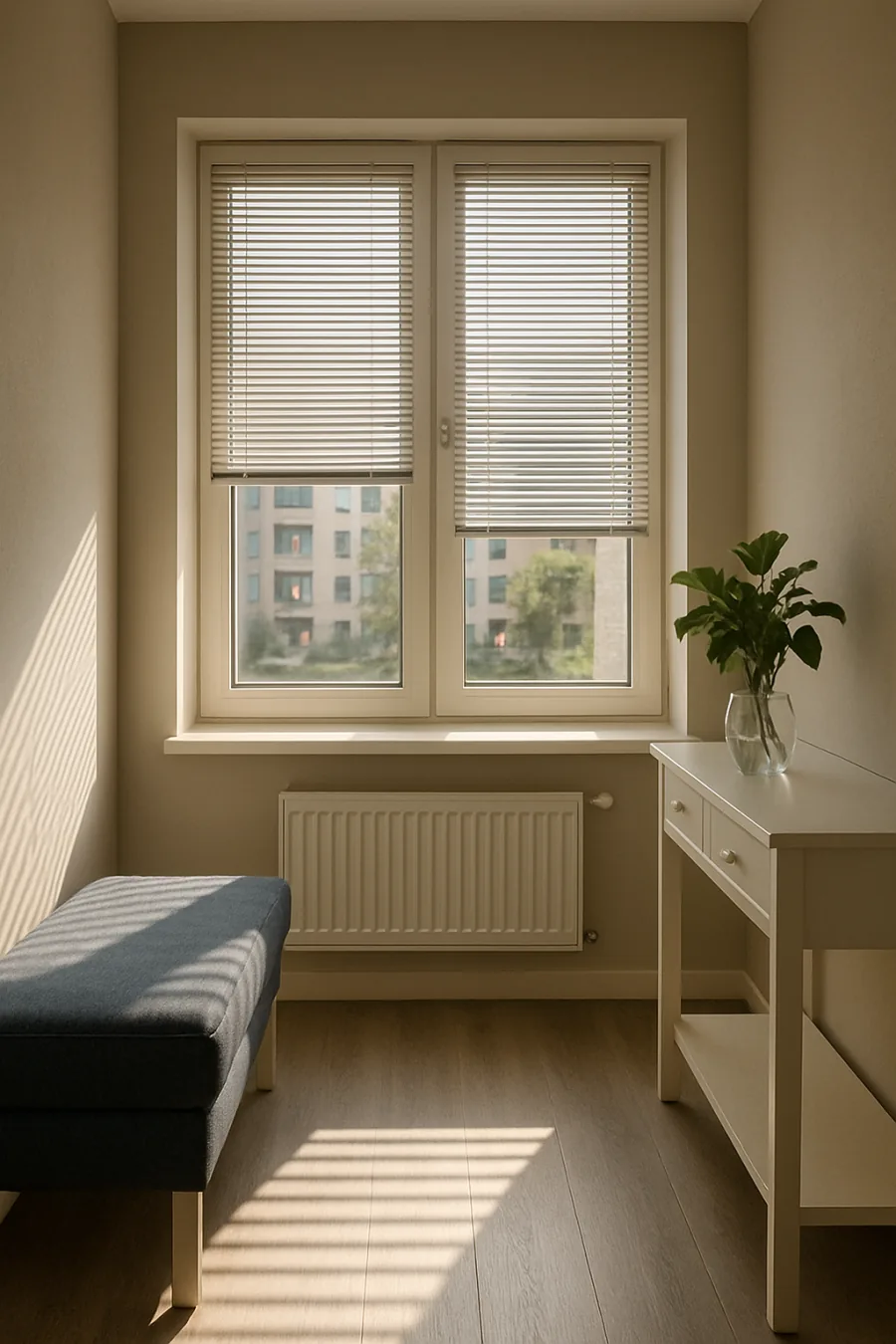
The fabric was split into sections so it doesn’t sag in the middle
Time: 6 days Aluminium
Dark slats on a white frame: the blind looks graphic, and the sun falls in even stripes
Time: 7 days Aluminium
Took its place alongside rattan and linen
Time: 10 days Bamboo
Soft shade, the view of the garden stayed
Time: 10 days Bamboo
Light falls in patches, not in stripes
Time: 9 days Bamboo
A calm texture in the frame
Time: 8 days Bamboo
Medium-density weave: the light is diffused, it’s not dark to work at the desk
Time: 8 days Bamboo
A dry room with no steam — the straw holds its shape and doesn’t warp
Time: 7 days Bamboo
The fabric backing covers the gaps in the weave: in the evening the room is almost invisible from the street
Time: 9 days Bamboo
A warm texture instead of a solid curtain: the goods stay visible, the sun is softened
Time: 10 days Bamboo
One batch of straw for the whole house, so the shade doesn’t differ anywhere
Time: 10 days Bamboo
We fitted a tensioner — there’s no dangling chain in the room
Time: 7 days Bamboo
Fabric over the full height: the studio reads as one whole, without being split up by windows
Time: 9 days Bamboo
Installed away from the hob: grease doesn’t soak into the fibre
Time: 8 days Bamboo
The developer asked us not to touch the profile — not a single hole in the frames
Time: 5 days No drilling
The owner asked us not to drill — we didn’t drill
Time: 4 days No drilling
The profile is thin, drilling it wasn’t an option
Time: 9 days No drilling
No approval from the building owner needed
Time: 7 days No drilling
The landlord forbade drilling — we mounted on brackets into the glazing bead
Time: 5 days No drilling
New windows under warranty: we didn’t touch the frame with a single hole
Time: 7 days No drilling
Spring clip: comes off in a minute when the fabric goes in the wash
Time: 4 days No drilling
The blind is mounted on the sash, and the sash opens together with it
Time: 5 days No drilling
The tape didn't hold up because of steam from the stove — we fitted a bracket into the glazing bead
Time: 4 days No drilling
We checked the weight of the fabric during the measurement: the bracket in the glazing bead holds it with room to spare
Time: 5 days No drilling
Rented flat: everything comes off when you move out, with no marks left behind
Time: 5 days No drilling
Roller blind on brackets in the glazing bead: not a single hole in the profile
Time: 6 days No drilling
Covered the windows during the finishing work
Time: 2 days Paper
They stayed up while the wooden ones were being made
Time: 2 days Paper
Quick and inexpensive before the tenants move in
Time: 2 days Paper
A solution for exactly one season
Time: 3 days Paper
Covered the windows during the renovation, while they decide on a permanent solution
Time: 2 days Paper
A temporary option: steam and grease will eat through the paper, and we warned about that right away
Time: 2 days Paper
Sticks on with tape right onto the sash, no tools needed
Time: 2 days Paper
The owner wouldn't let us touch the frame — it holds on tape and comes off without a trace
Time: 3 days Paper
Cheap sun protection for the season, until the balcony is finished
Time: 2 days Paper
The office is rented for six months, so they didn't want to invest in permanent blinds
Time: 3 days Paper
A north-facing window: little sun, so paper lasts longest here
Time: 2 days Paper
Folds up like an accordion at any height — they only covered the bottom third
Time: 2 days Paper
Bright during the day, yet neighbours in the building opposite can’t see into the room
Time: 6 days Day-night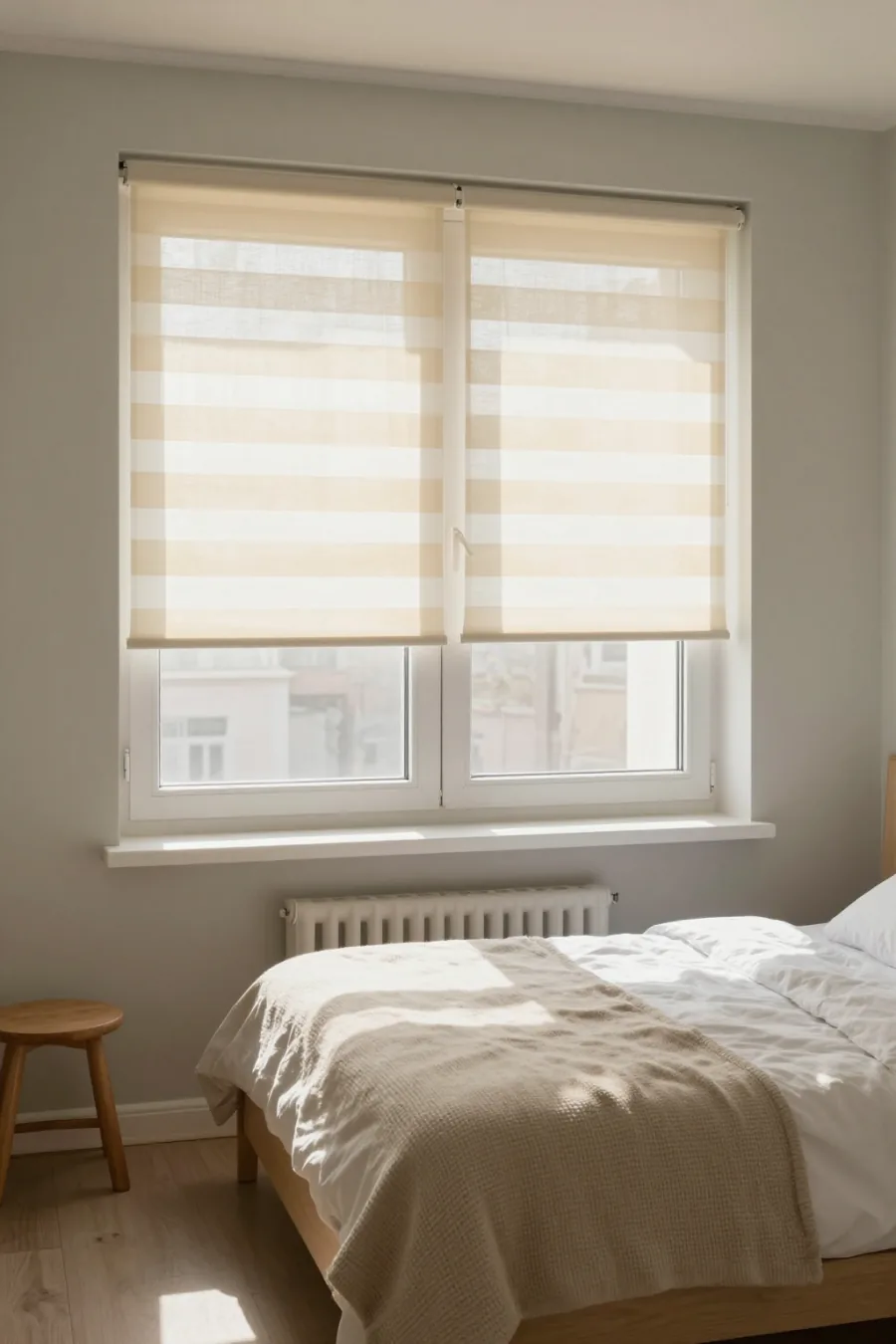
Got rid of the glare on the monitor without darkening the room
Time: 4 days Day-night
Each sash with its own blind, so you can open them one at a time
Time: 7 days Day-night
Guests can see the street, but the sun doesn’t glare for those sitting by the window
Time: 7 days Day-night
In the morning the strips are shifted — it's bright, but no one can look in from the street
Time: 5 days Day-night
Operated with a side handle: no dangling chain in the room
Time: 4 days Day-night
The blind moves with the sash — you can air the room without raising it
Time: 5 days Day-night
Guide rails on the sides: in a draught the fabric doesn’t bang against the frame
Time: 6 days Day-night
By day you can see the street, but clients in the chair can’t be seen from the street
Time: 7 days Day-night
The light is diffused, and what happens in the office can’t be made out from outside
Time: 6 days Day-night
The top was left transparent, the bottom closed — there’s light and privacy too
Time: 6 days Day-night
The glare on the monitors is gone, and the room wasn’t darkened
Time: 7 days Day-night
The slat tone was matched to the colour of the floor
Time: 12 days Wooden
Tinting to match the furniture fronts
Time: 10 days Wooden
A narrow slat for small windows
Time: 9 days Wooden
Slats to match the wooden frame and the herringbone parquet
Time: 12 days Wooden
A dry room with a steady temperature — wood here lasts for years
Time: 9 days Wooden
The balcony is heated: without heating the wood would have warped in the first winter
Time: 10 days Wooden
A matte finish: no glare in the sun and no fighting with the projector
Time: 11 days Wooden
The slat turns precisely — light falls on the desk, not in your eyes
Time: 8 days Wooden
Reinforced brackets: a wooden blind at this height is noticeably heavier than an aluminium one
Time: 10 days Wooden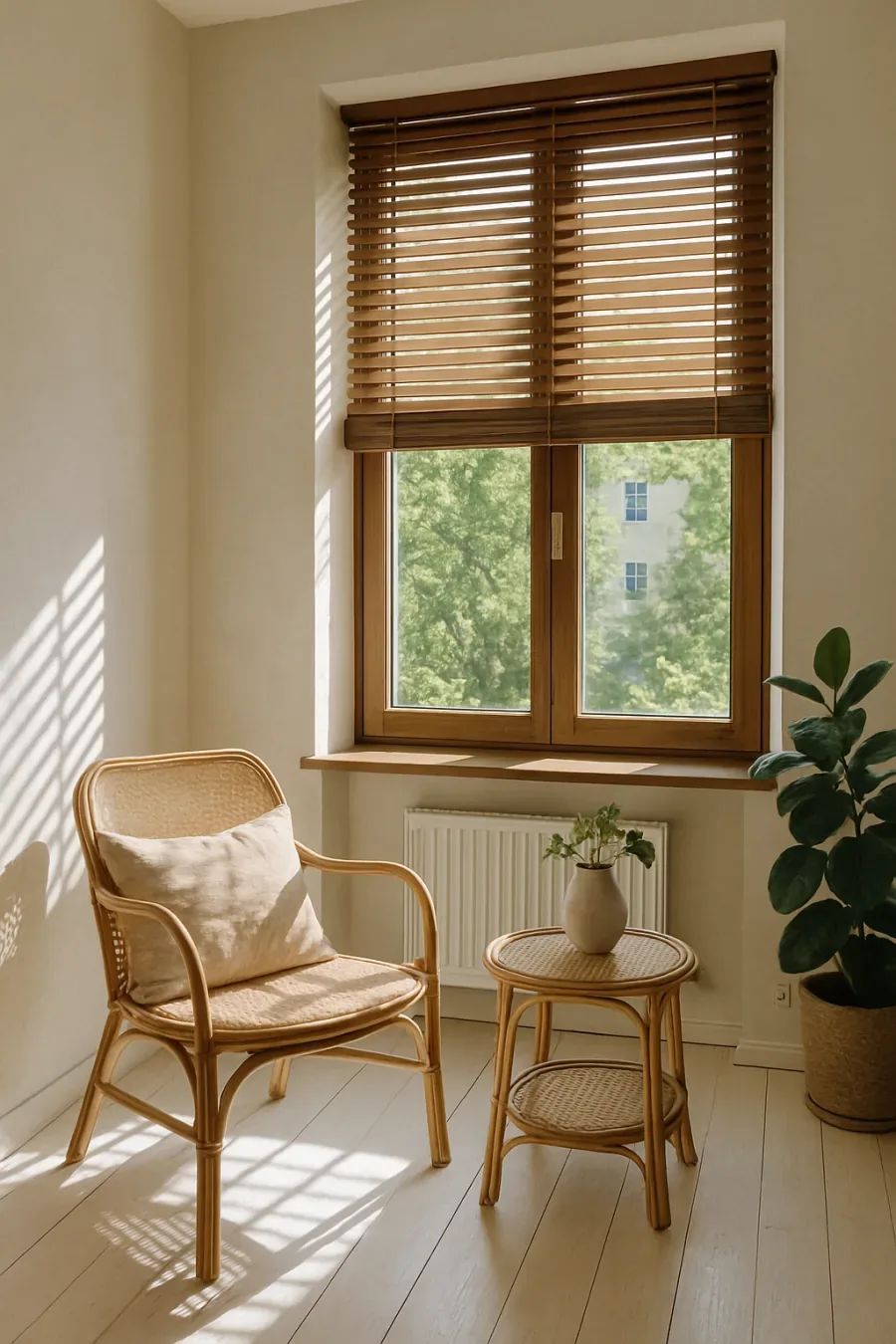
A warm shade to match the floor and furniture, matched on site against a sample
Time: 9 days Wooden
Split into three sections: a single blind of that width sags
Time: 12 days Wooden
The whole house from one batch of wood, so the shade matches in every room
Time: 12 days Wooden
One button closes the whole glazed wall
Time: 10 days Motorised blinds
They close automatically before a presentation starts
Time: 10 days Motorised blinds
Controlled from your phone, no more stepladder
Time: 10 days Motorised blinds
They open on a schedule at 7:30, and no socket had to be run
Time: 10 days Motorised blinds
The power supply was planned during the renovation, no wires visible in the wall
Time: 9 days Motorised blinds
The window is out of reach — controls moved to a wall switch
Time: 10 days Motorised blinds
Schedule: in the morning the blind goes up on its own, no need to get up and go to the window
Time: 9 days Motorised blinds
One button for all the blinds: opening each one by hand every morning takes too long
Time: 10 days Motorised blinds
Eight windows on electric motors, all controlled from a single remote
Time: 10 days Motorised blinds
No chain, no cord: we don’t leave hanging parts in a child’s room
Time: 8 days Motorised blinds
South-facing windows — the panel charges itself, no socket needed
Time: 10 days Motorised blinds
Button by the entrance: hands are covered in dough, no need to reach for the window
Time: 9 days Motorised blinds
Light fabric to match the walls: lowered halfway, the view of the mountains stays
Time: 7 days Cassette
Daytime sleep in the dark, with no light leaking at the edges
Time: 7 days Cassette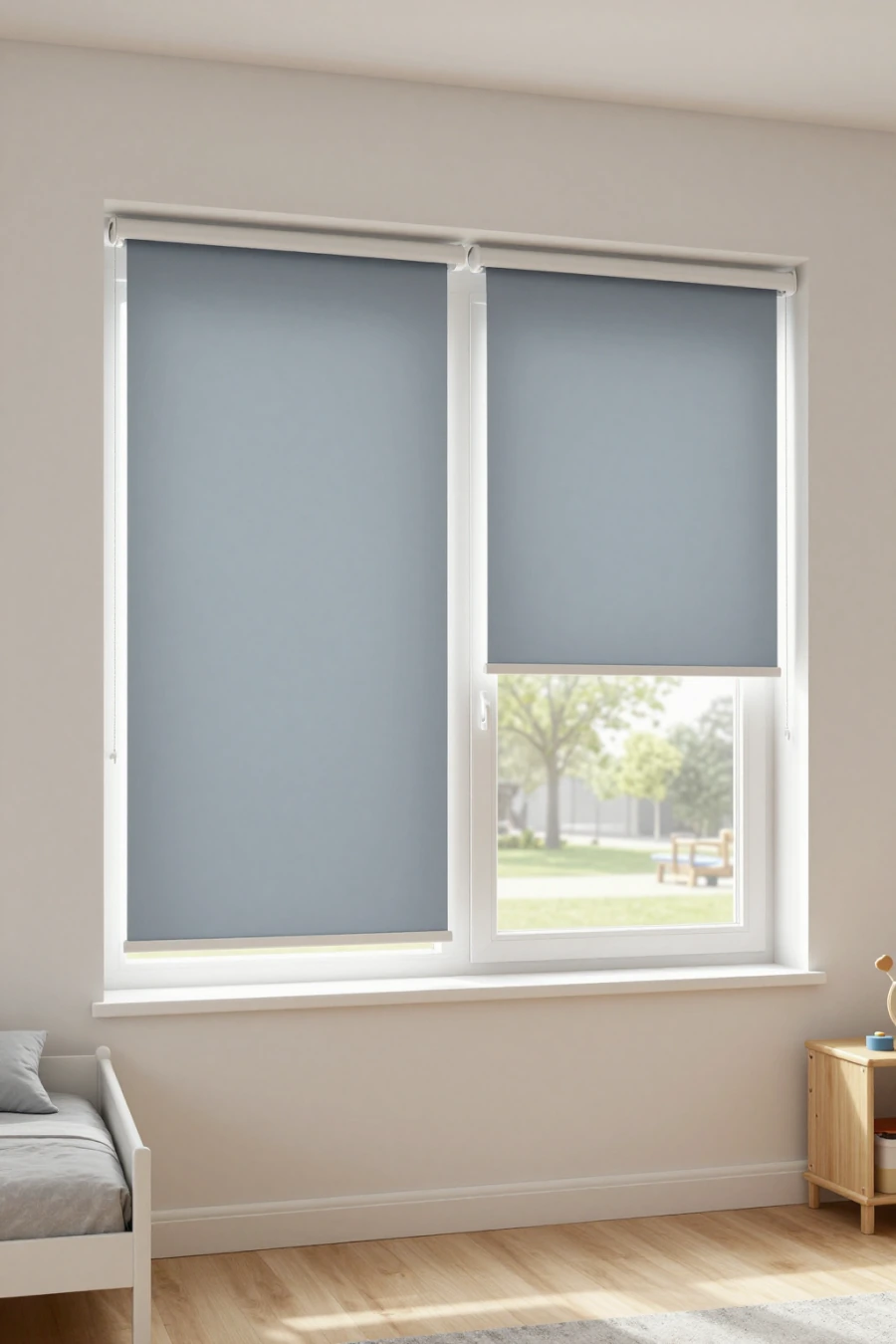
The contrast on the screen holds up during the day too
Time: 9 days Cassette
The blind doesn’t flap when you air the room
Time: 6 days Cassette
The cassette hides the roller tube: on a shop window you see only the fabric, not the mechanism
Time: 8 days Cassette
The guide rails hold the blind in a draught — the windows stay open all day
Time: 9 days Cassette
Grey fabric above the desk: the sun doesn’t glare on the notebooks, and the view of the courtyard stays
Time: 7 days Cassette
The compact cassette above the tall window is barely noticeable
Time: 7 days Cassette
The closed cassette keeps grease and dust off the roller
Time: 7 days Cassette
The blind sits in the grooves and doesn’t flap when the terrace door is opened
Time: 8 days Cassette
The fabric runs evenly in the guide rails and doesn’t skew when raised
Time: 8 days Cassette
Onto the sash, together with the guide rails — nothing dangles when you air the room
Time: 9 days Cassette
The blind gets hit by trolleys — aluminium would have been dented
Timeframe: 5–7 days Metal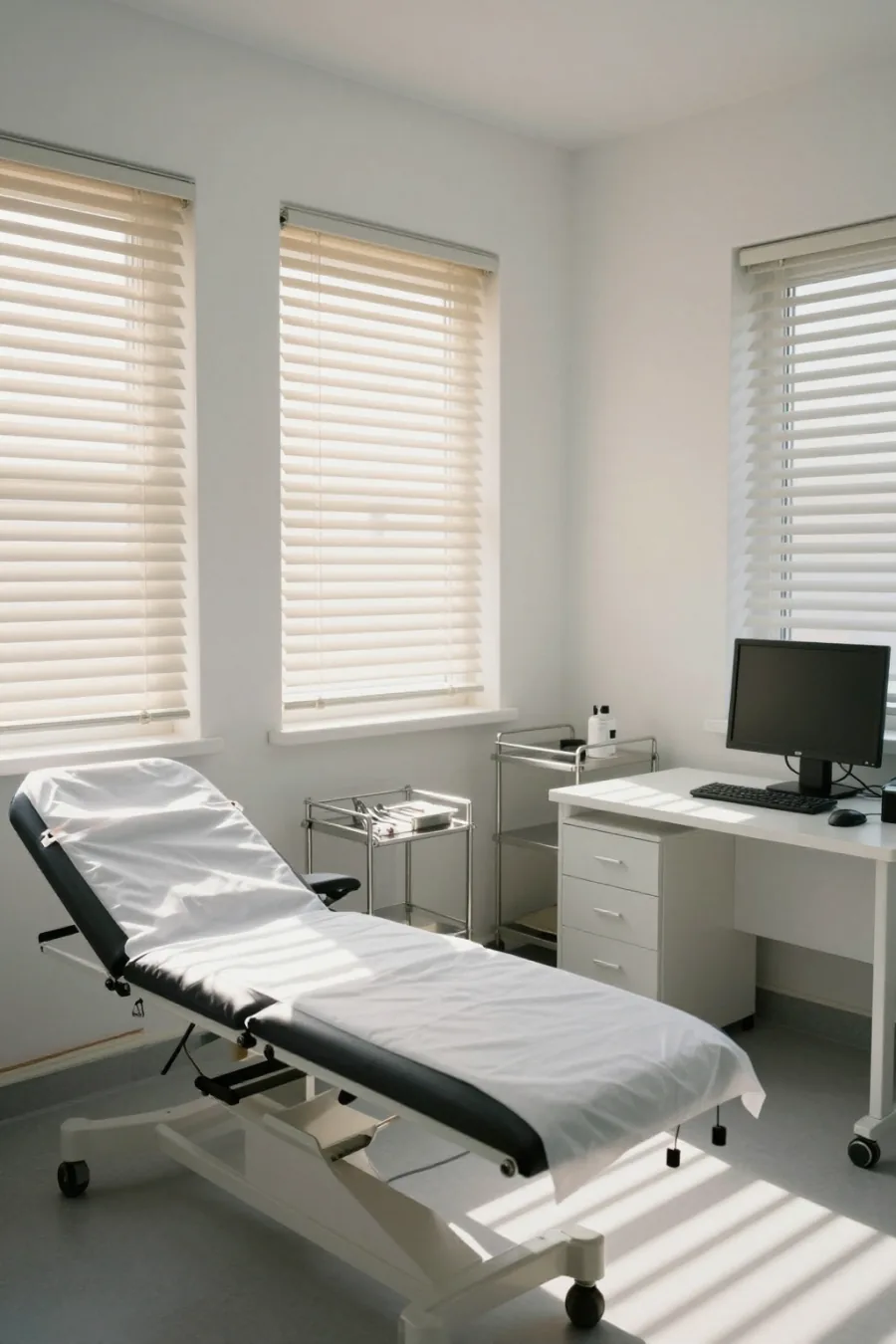
The span was covered without dividing it into sections
Timeframe: 5–7 days Metal
High traffic, the blind is touched every day
Timeframe: 5–7 days Metal
Washed with detergent together with the walls
Timeframe: 5–7 days Metal
Chosen for rigidity: a wide opening, and the slat hasn’t warped after a year
Timeframe: 5–7 days Metal
They’re washed with detergent and don’t absorb odours — a sanitation requirement
Timeframe: 5–7 days Metal
They take an accidental hit from a trolley, and there’s no one here to bend a slat
Timeframe: 5–7 days Metal
They wanted a “metal look”, but in a living room we went with aluminium: it’s quieter
Timeframe: 3–5 days Metal
The polymer coating protects the steel from the damp of the technical floor
Timeframe: 5–7 days Metal
The perforation lets light through when the blind is closed, so the room doesn’t feel sealed off
Timeframe: 7–10 days Metal
Ground floor: the blind can’t be pushed in from outside, unlike aluminium
Timeframe: 5–7 days Metal
Fixed into the wall, not the frame: a blind this tall would overload the frame
Timeframe: 5–7 days Metal
Not a single hole in the frame; when you move, the fabric comes off in minutes
Timeframe: 4–6 days Tape-mounted, self-adhesive
Put up for the duration of the renovation, then moved elsewhere
Timeframe: 4–6 days Tape-mounted, self-adhesive
The sash is often opened for ventilation, and the fabric moves with it
Timeframe: 4–6 days Tape-mounted, self-adhesive
No approval from the landlord was needed
Timeframe: 4–6 days Tape-mounted, self-adhesive
Smooth white PVC, degreased with alcohol — it’s held from day one
Timeframe: 4–6 days Tape-mounted, self-adhesive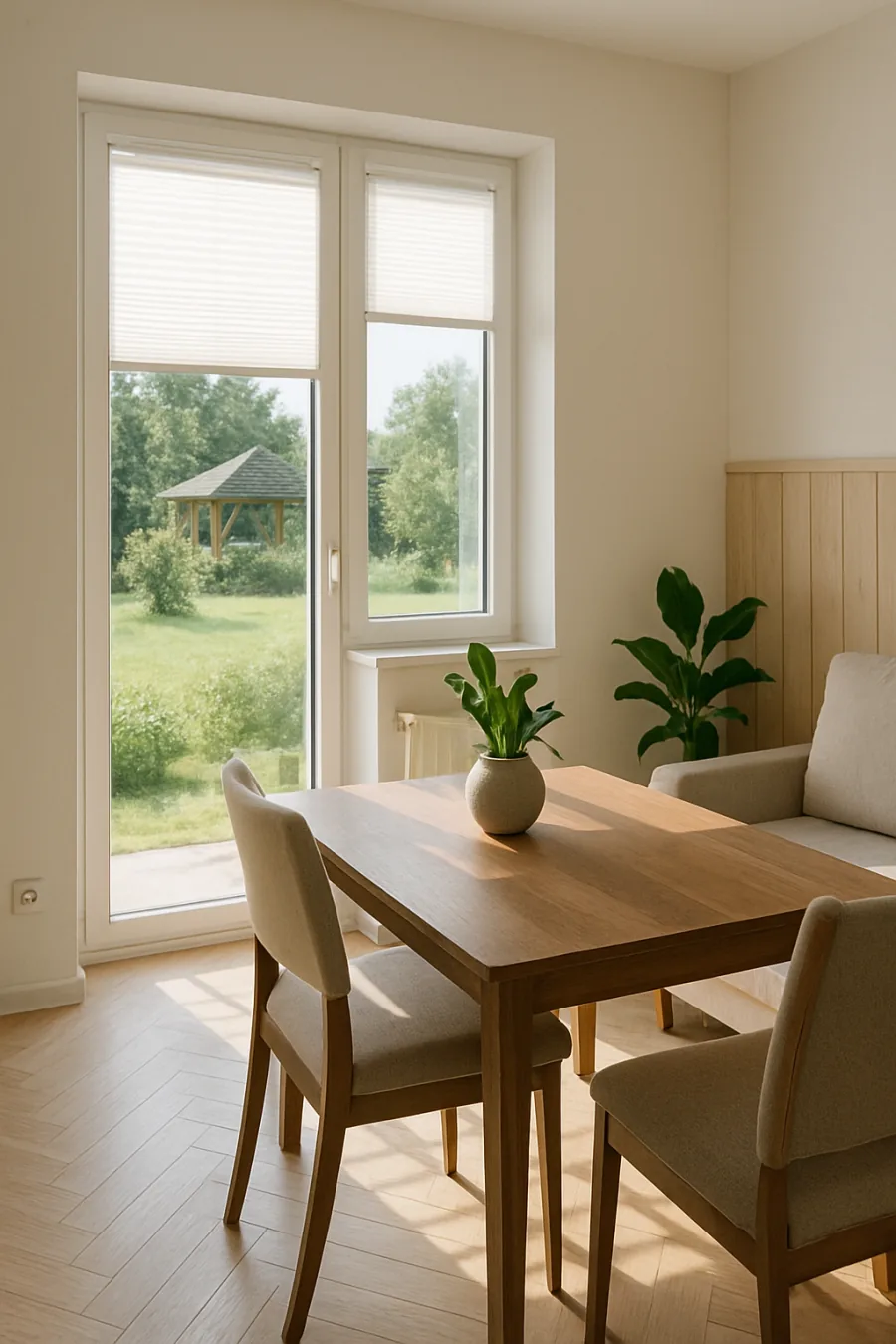
The fabric was taped to the door sash: it opens together with it
Timeframe: 4–6 days Tape-mounted, self-adhesive
The flat is rented, so no drilling: when moving out, they took it down and washed off the adhesive residue with warm soapy water
Timeframe: 4–6 days Tape-mounted, self-adhesive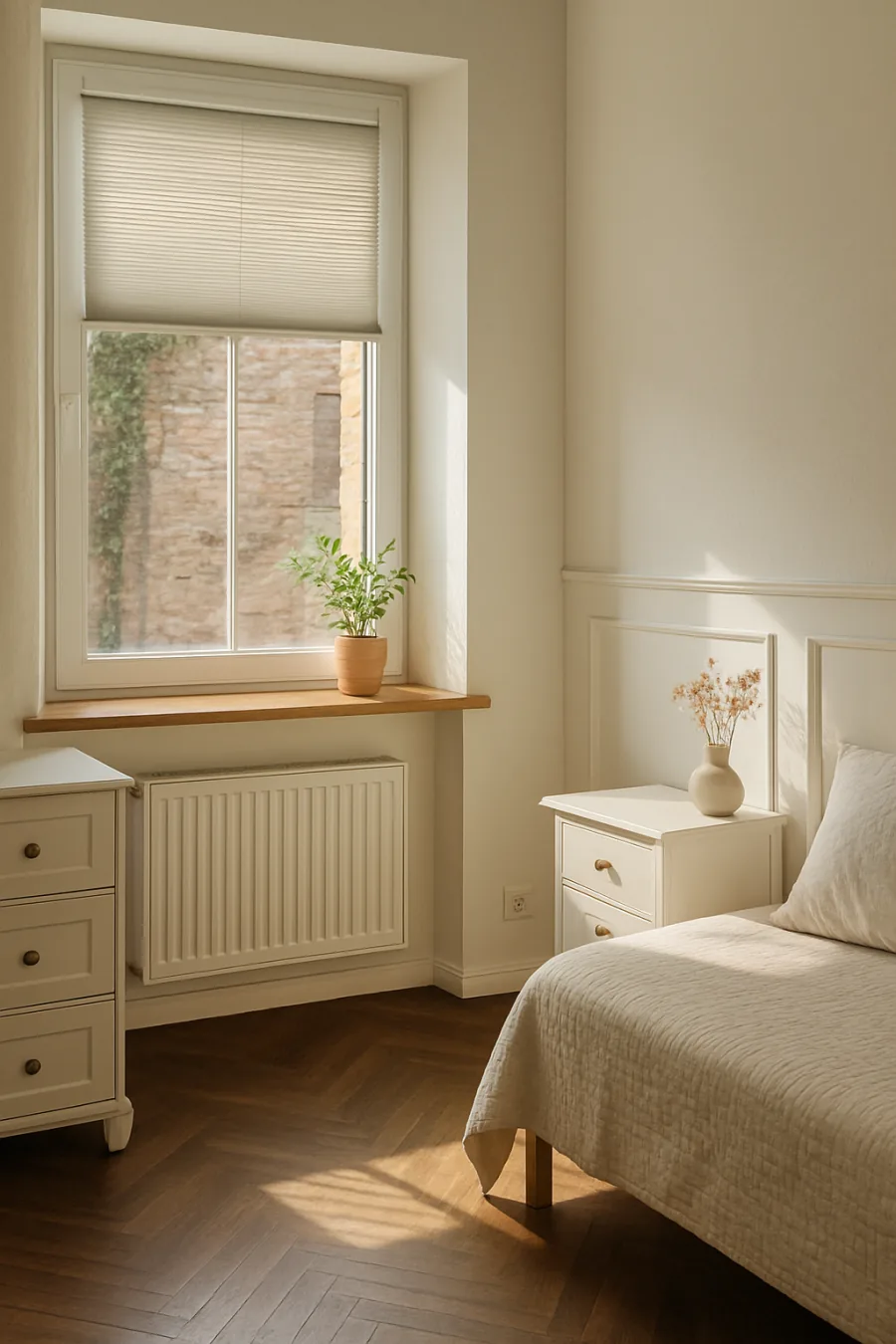
The window is in the shade of the neighbouring wall: the plastic doesn’t heat up, and the adhesive holds well
Timeframe: 4–6 days Tape-mounted, self-adhesive
Taped along the edge of the sash, under the glazing bead — the strip of tape isn’t visible from the street
Timeframe: 4–6 days Tape-mounted, self-adhesive
The wood-effect film doesn’t peel, so it was taped straight onto it after degreasing
Timeframe: 4–6 days Tape-mounted, self-adhesive
The fabric is lowered halfway: shade at the top, trees visible below
Timeframe: 4–6 days Tape-mounted, self-adhesive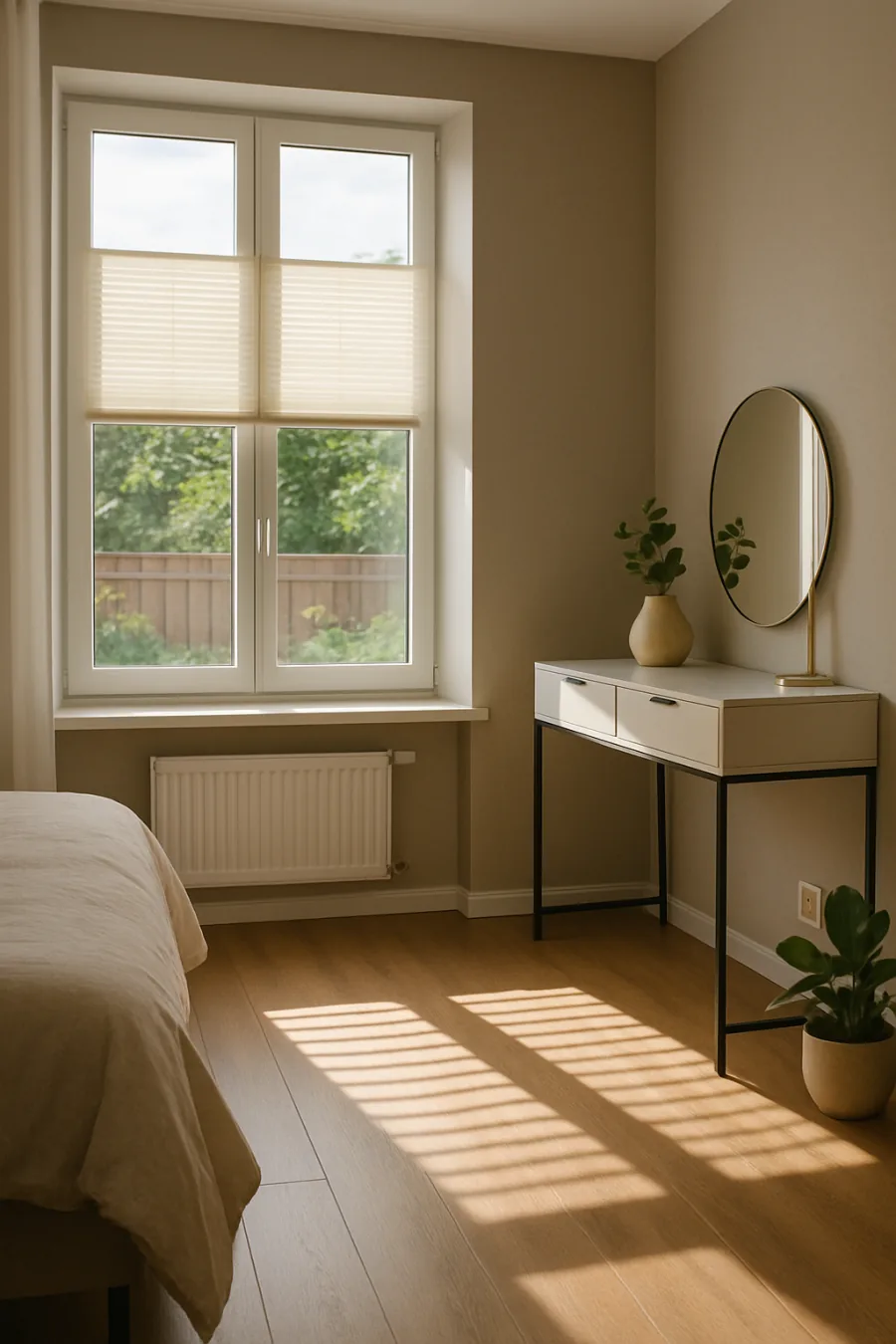
Country-house season: put up for the summer, taken down and stored in autumn
Timeframe: 4–6 days Tape-mounted, self-adhesive
The slat doesn’t swell from damp, and the fabric is washed together with the tiles
Timeframe: 3–5 days Plastic
Wood texture where wood would never survive
Timeframe: 5–7 days Plastic
The slat flexes and doesn't crease when you touch it
Timeframe: 3–5 days Plastic
The budget decided it at this volume
Timeframe: 3–5 days Plastic
A north-facing window: little direct sun, so the white slat yellows more slowly
Timeframe: 3–5 days Plastic
Light shade: fading shows on it much later than on a coloured one
Timeframe: 3–5 days Plastic
Installed in a child's bedroom: the slat doesn't rattle or clang like metal
Timeframe: 3–5 days Plastic
They wipe clean with a damp cloth on the window, no need to take the blind down
Timeframe: 3–5 days Plastic
Budget for the whole house: across six windows, plastic is noticeably cheaper than aluminium
Timeframe: 3–5 days Plastic
The slat bends and springs back: a stray ball doesn't break it
Timeframe: 3–5 days Plastic
Narrow sashes: the mini system takes up 4 cm when open
Timeframe: 3–5 days Plastic
They wanted wood, but chose plastic by the sink: damp by the sink doesn’t harm the slats
Timeframe: 5–7 days Plastic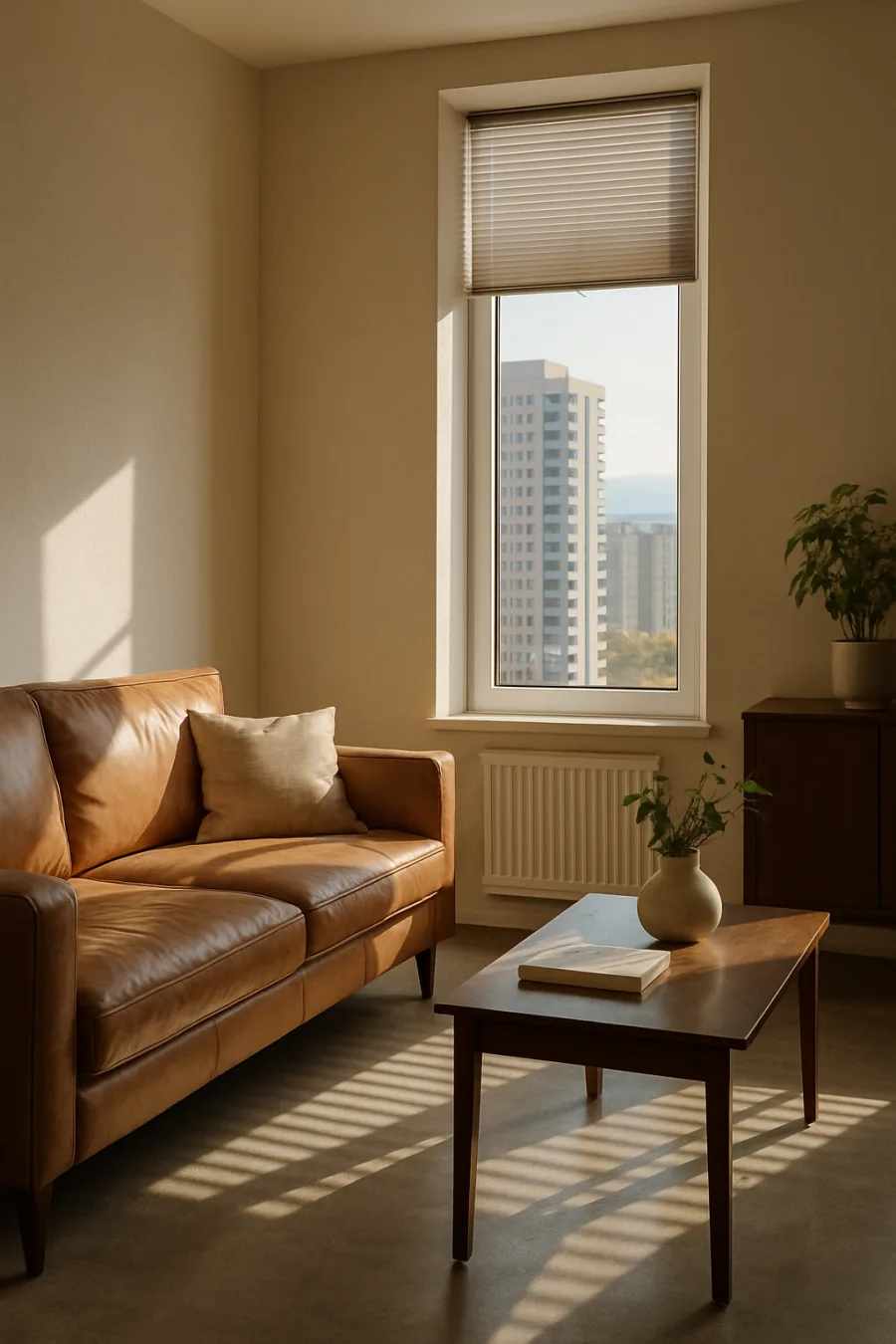
The fabric is raised to the top of the sash and is barely visible, with the city view open
Timeframe: 7–10 days Pleated blinds
Mounted on the sash: the window opens for ventilation together with the fabric
Timeframe: 7–10 days Pleated blinds
Above the sink the fabric is lowered halfway: the glare on the worktop is gone, the top vent is open
Timeframe: 7–10 days Pleated blinds
The mounting for the wooden frame was chosen during the measurement, each sash with its own fabric
Timeframe: 7–10 days Pleated blinds
The fabric is lowered from the top: the sky stays visible in the window, and the lower part is covered from the neighbouring buildings
Timeframe: 7–10 days Pleated blinds
The fabric sits on the fixed top vent and doesn’t get in the way of opening the balcony door
Timeframe: 7–10 days Pleated blinds
No cords: the fabric is moved by the handle on the bar, so there’s nothing for a child to pull
Timeframe: 7–10 days Pleated blinds
Open at the top by day, at the bottom in the evening — two scenarios on one window
Timeframe: 7–10 days Pleated blinds
Treated fabric: the pleats wipe clean with a damp sponge
Timeframe: 7–10 days Pleated blinds
Its own fabric on each sash: one is opened for ventilation, the other stays closed
Timeframe: 7–10 days Pleated blinds
The fabric is lowered from the top: soft shade on the seat, with the courtyard still visible
Timeframe: 7–10 days Pleated blinds
One fabric for the whole window: the fold is even across the full width, and the light is soft and warm
Timeframe: 7–10 days Pleated blinds
The folds fall evenly — frame rods every 25 cm
Time: 8 days Roman blinds
The blind is raised above the wide windowsill, where they sit with a book
Time: 7 days Roman blinds
A linen blend softens the brick and metal
Time: 8 days Roman blinds
Soft folds instead of blinds — the study feels like home
Time: 9 days Roman blinds
Chain with a hold-down: the children don’t yank the blind
Time: 10 days Roman blinds
The folds are raised above the sash: the sash tilts open, and soft light falls on the shelves
Time: 8 days Roman blinds
The blinds on both sides of the corner rise to the same number of folds
Time: 9 days Roman blinds
The fabric is held on the rail’s hook-and-loop tape — you take it down and send it for professional dry cleaning
Time: 8 days Roman blinds
The motor is quiet: the blind rises without distracting you from reading
Timeframe: 7–10 days
In the morning the blinds rise on schedule
Timeframe: 7–10 days
Wall panel: one button for all three blinds
Timeframe: 7–10 days
The cable to the rail was hidden in a cable duct along the window reveal
Timeframe: 7–10 days
After closing time the blinds come down on a timer
Timeframe: 7–10 days
Before a class the instructor darkens the studio with the remote control
Timeframe: 7–10 days
The motor drives both lift cords at once, so the folds fall evenly on a tall window
Timeframe: 7–10 days
No cords at all — controlled only with the remote
Timeframe: 7–10 days
Bamboo with jute to match the eco-style room numbers
Time: 10 days
The bamboo gathers in a cascade of folds, and the light through the weave is warm
Time: 10 days
A fabric trim along the edge — the weave doesn’t come apart
Time: 9 days
Bamboo replaced heavy drapes, and the room became brighter
Time: 9 days
The dense weave softens the early sun, and the light in the bedroom is gentle
Time: 9 days
The tall blinds gather into five folds and don’t block the view
Time: 8 days
Natural weave to match the rattan furniture
Time: 10 days
Blinds raised above the table where the family has breakfast by the window
Time: 10 days
Home cinema in the study: the screen is visible even in the daytime
Time: 9 days
The blackout lining is sewn to the linen, so the face fabric doesn’t let light through
Time: 8 days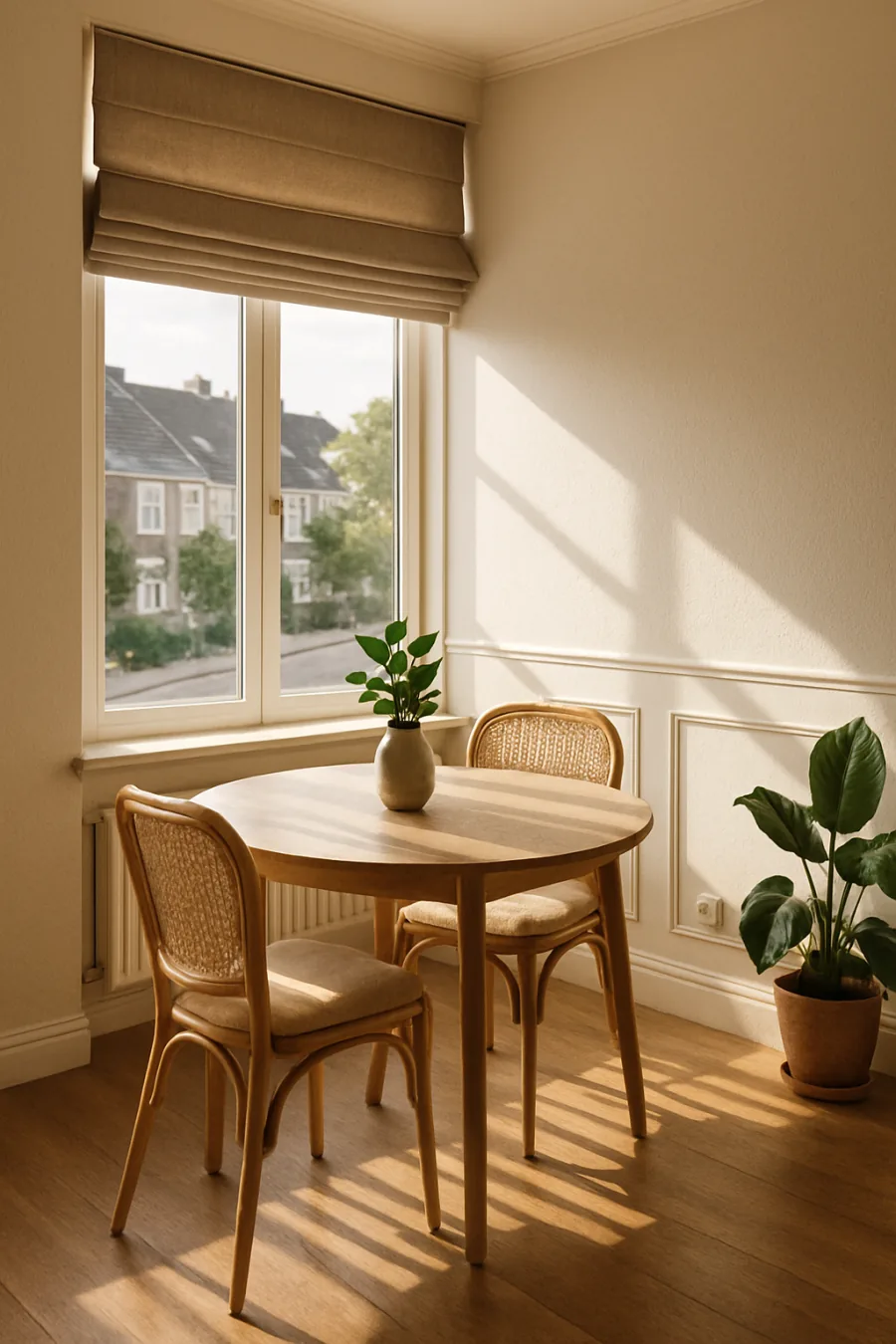
The evening sun no longer shines in your eyes at dinner
Time: 9 days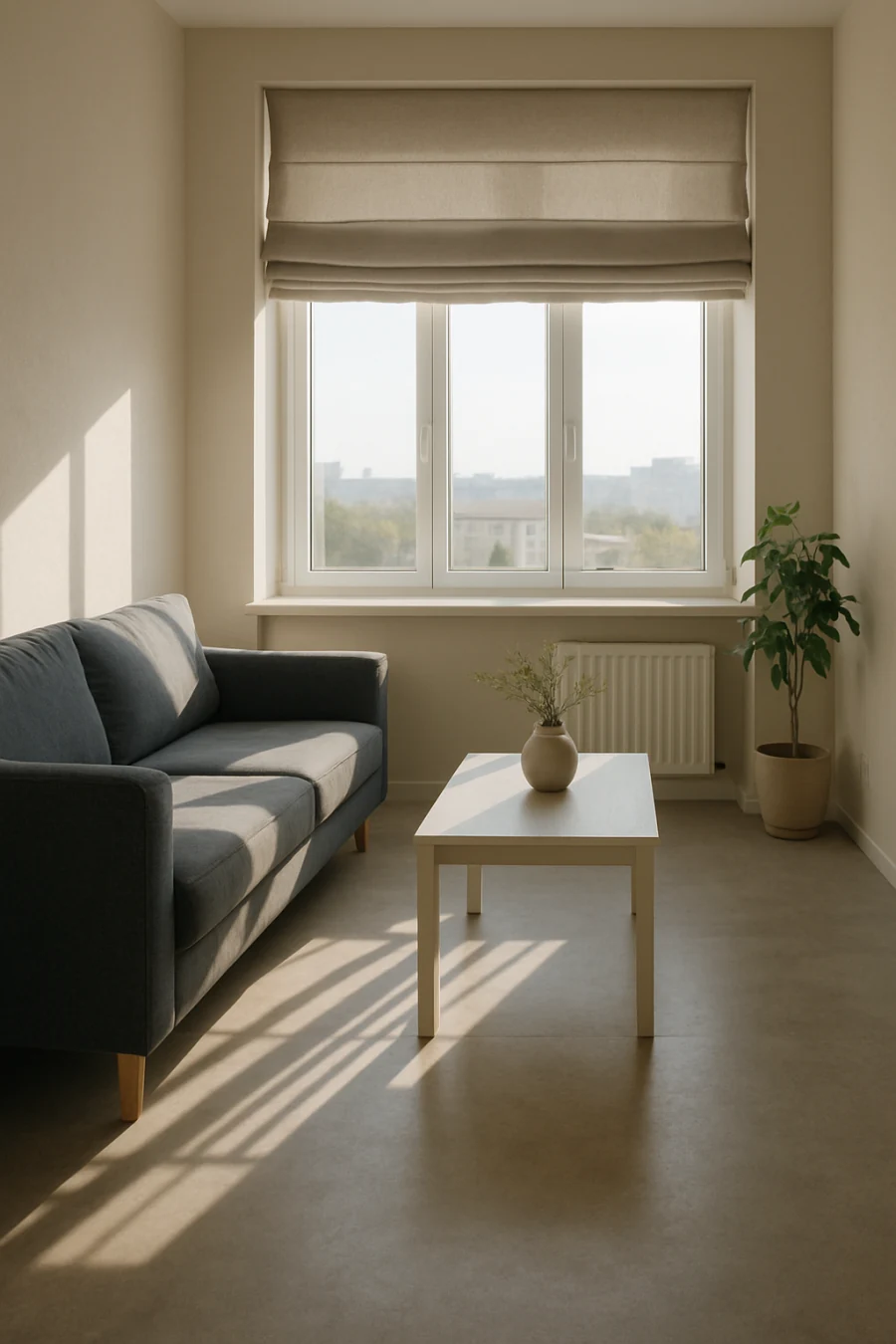
The blinds sit in the window reveals with almost no gap, so no light comes in at the sides
Time: 10 days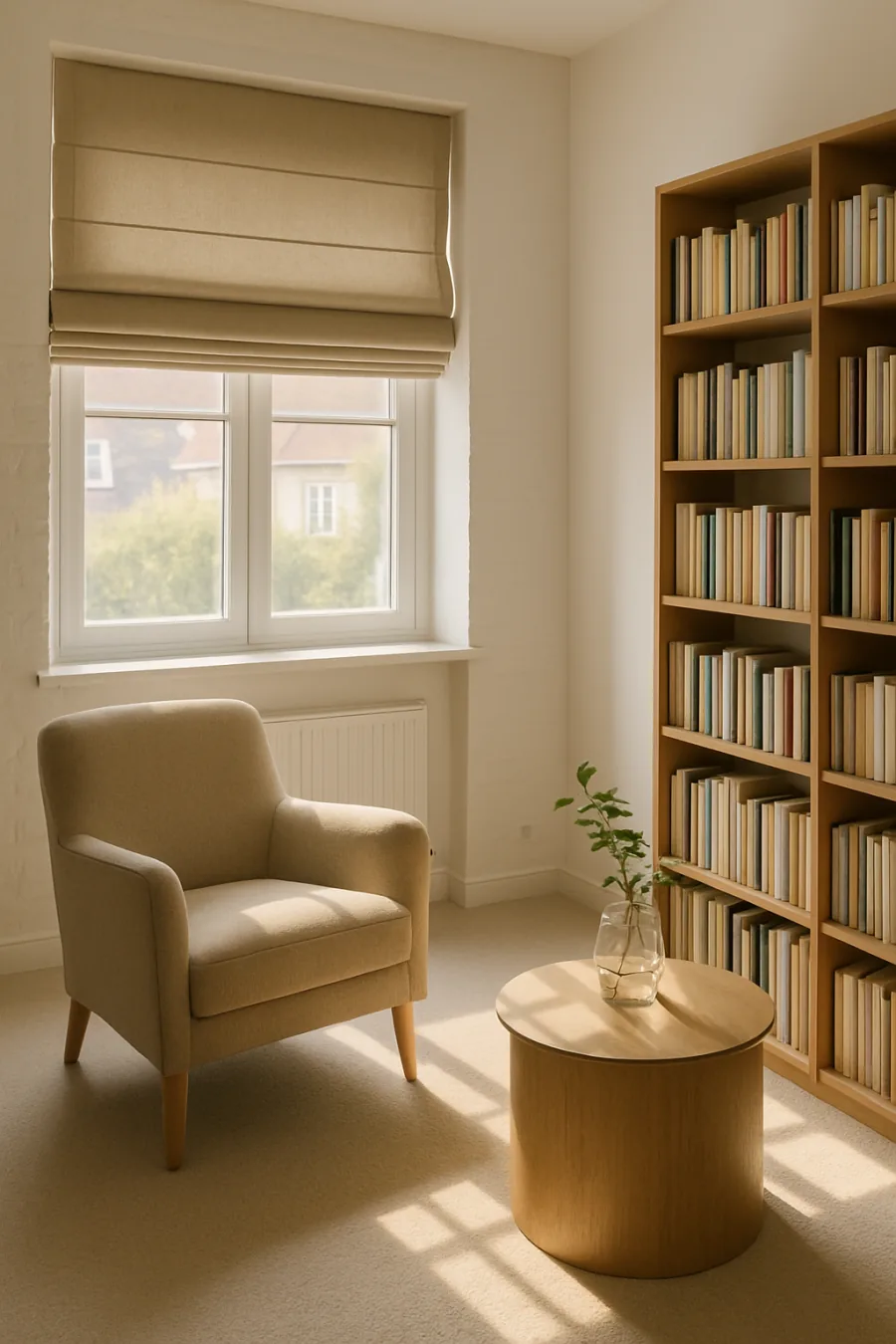
During the day the blind is lowered, so the shelves by the window aren’t in direct sun
Time: 9 days
No need for outside shutters — the blind itself makes the room dark
Time: 8 days
During the day the folds are raised; at night the lowered blind covers the whole window
Time: 8 days
Sleep in until noon on the weekend: the window stays dark even at midday
Time: 9 days
During the day the sheer is lowered; for presentations the opaque fabric is added
Time: 10 days
Double rail on a single strip, each fabric has its own chain
Time: 10 days
The sheer diffuses the light above the table, the opaque fabric is for the evening
Time: 10 days
In the evening the sheer is raised and the opaque fabric lowered — the windows opposite are out of sight
Time: 10 days
Double rails on both sides of the corner, all four chains brought out to one side
Time: 10 days
The sheer is washed separately from the opaque fabric
Time: 9 days
The opaque fabric is lowered only during treatments, the sheer stays down all the time
Time: 10 days
For a daytime nap the opaque layer is enough, the sheer stays for playtime
Time: 9 days
Strap control from inside: no need to go outside to close them
Time: 12 days Roller shutters
Foam filling: in summer the glass heats up less, in winter the window loses less heat
Time: 12 days Roller shutters
Closed at night: the terrace door is no longer a weak spot
Time: 13 days Roller shutters
Ground floor with no security — we chose a profile that can’t be prised open with a crowbar
Time: 15 days Roller shutters
Against dust and poplar fluff: a closed balcony is cleaned half as often
Time: 12 days Roller shutters
Installed for quiet and privacy, not just for protection
Time: 14 days Roller shutters
Motor with an emergency handle: if the power goes out, the blind can be raised
Time: 16 days Roller shutters
Guide rails fixed into the load-bearing wall through the insulation, not into the insulation
Time: 15 days Roller shutters
Closed from inside in the evening: no prying eyes get into the room, and you don’t have to go outside.
Timeframe: 10–14 days
The closed curtain blocks street noise — the room on the noisy side has become quieter.
Timeframe: 10–14 days
Foam filling: the glass heats up less in summer and the window loses less heat in winter.
Timeframe: 10–14 days
During the day the curtain takes the heat off the glass; in the evening the opening is clear and the curtain goes into the housing box.
Timeframe: 10–14 days
Closed at night; during the day the curtain goes into the housing box — the shopfront works for passers-by again.
Timeframe: 12–16 days
They close the windows from the sun and prying eyes; during the day the curtain is raised into the housing box — the façade stays clean.
Timeframe: 12–16 days
The closed curtain can’t be forced open or quietly broken into, and no alarm was installed.
Timeframe: 12–16 days
While the owners are away, the openings are shut: no one can look into the house from the street, and the windows are watched over.
Timeframe: 10–14 days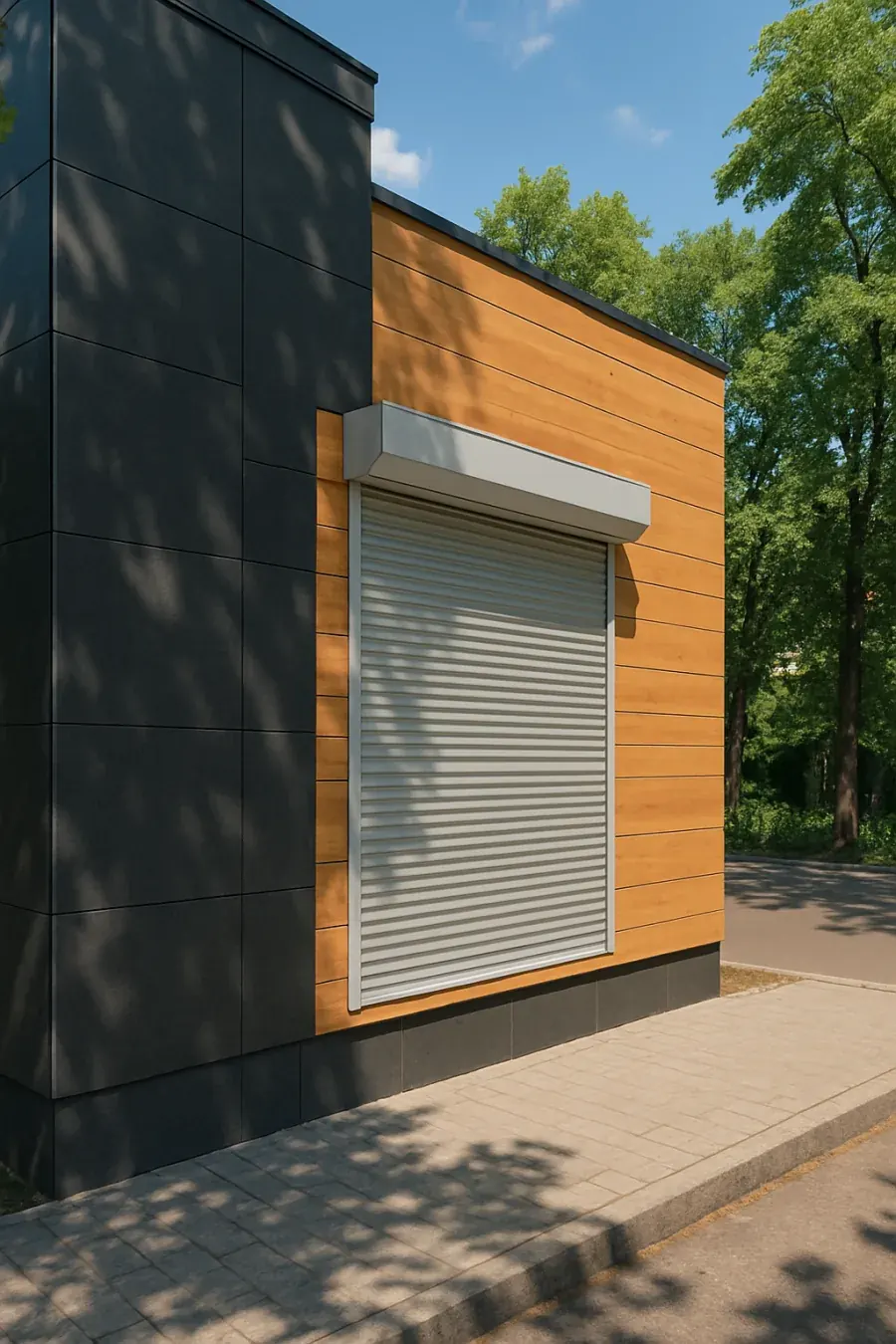
They close at night, and during the day the opening is free — the shopfront works for passers-by again.
Timeframe: 12–16 days
An unguarded property: the closed curtain can’t be forced open or quietly broken into.
Timeframe: 12–16 days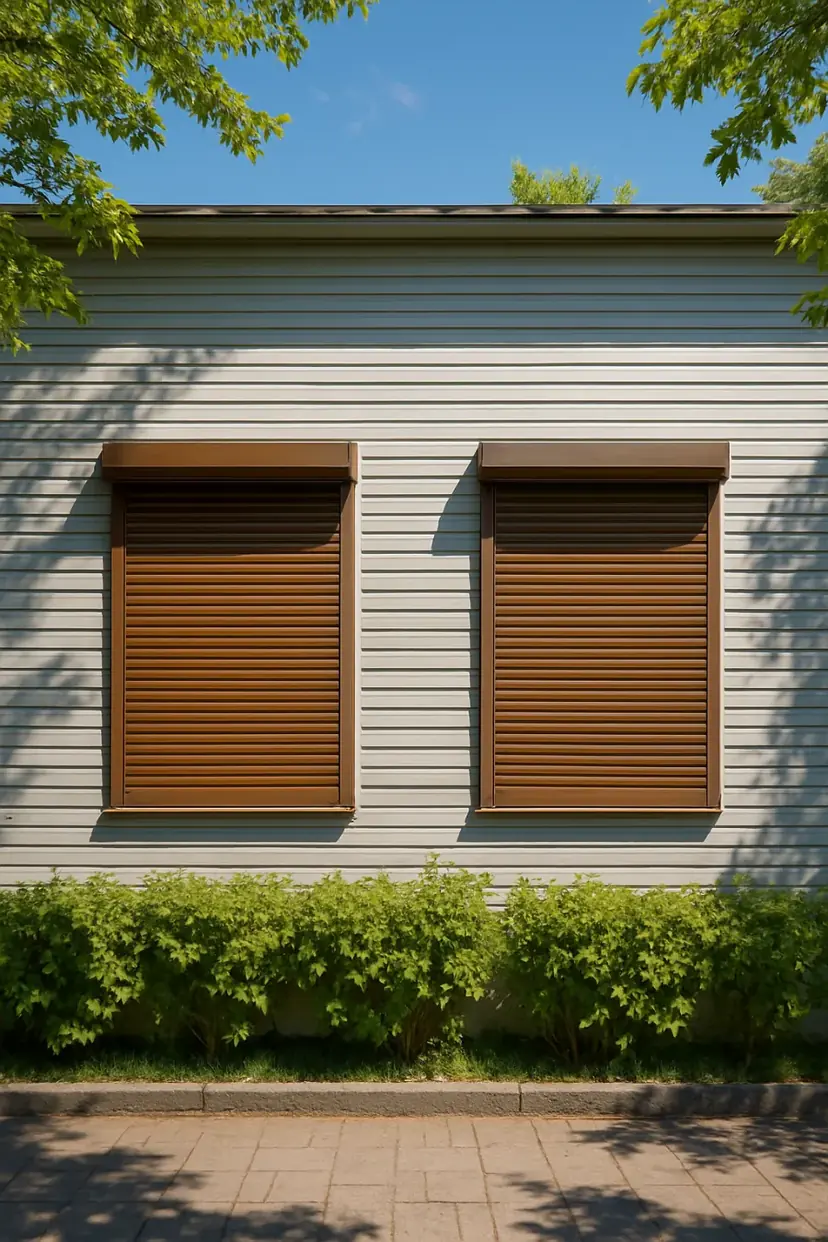
No outside looks get into the room, and the facade stays clean during the day.
Timeframe: 12–16 days
They close the windows against the sun and prying eyes, and during the day the curtain is raised into the housing box.
Timeframe: 12–16 days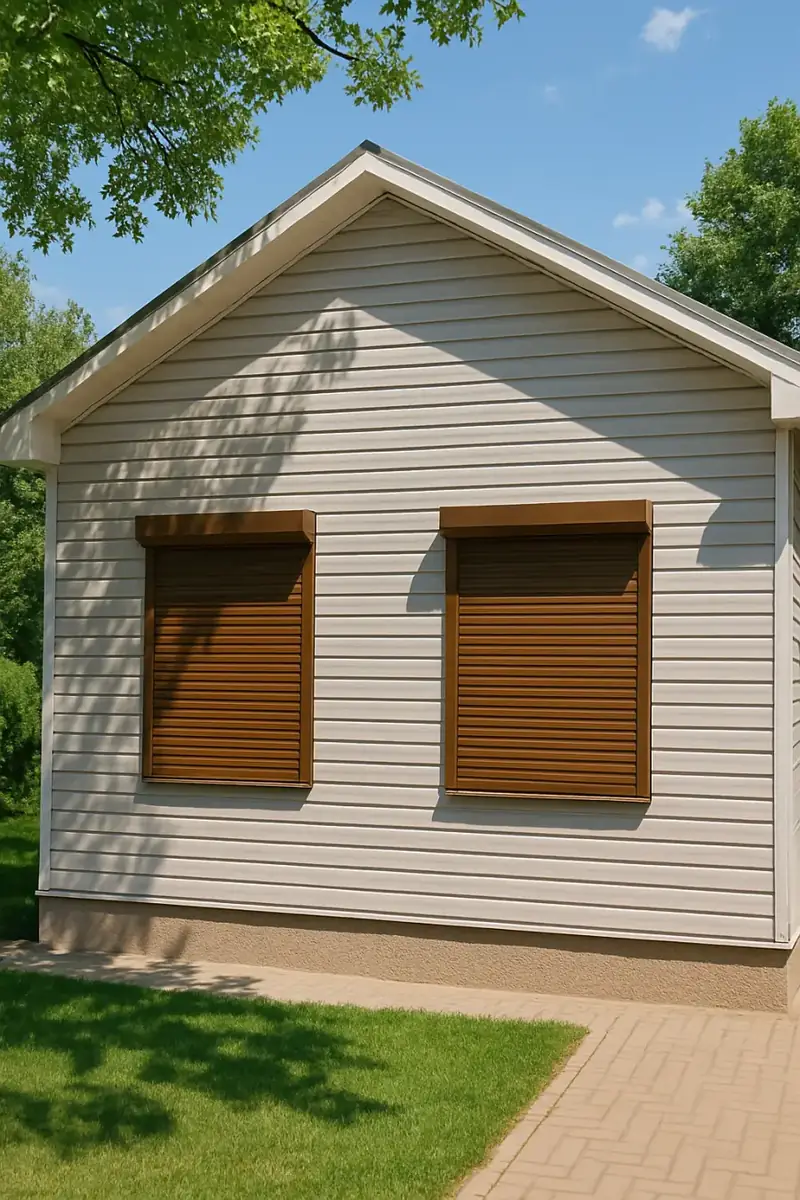
We used a profile that can’t be forced with a crowbar — no alarm was installed.
Timeframe: 12–16 days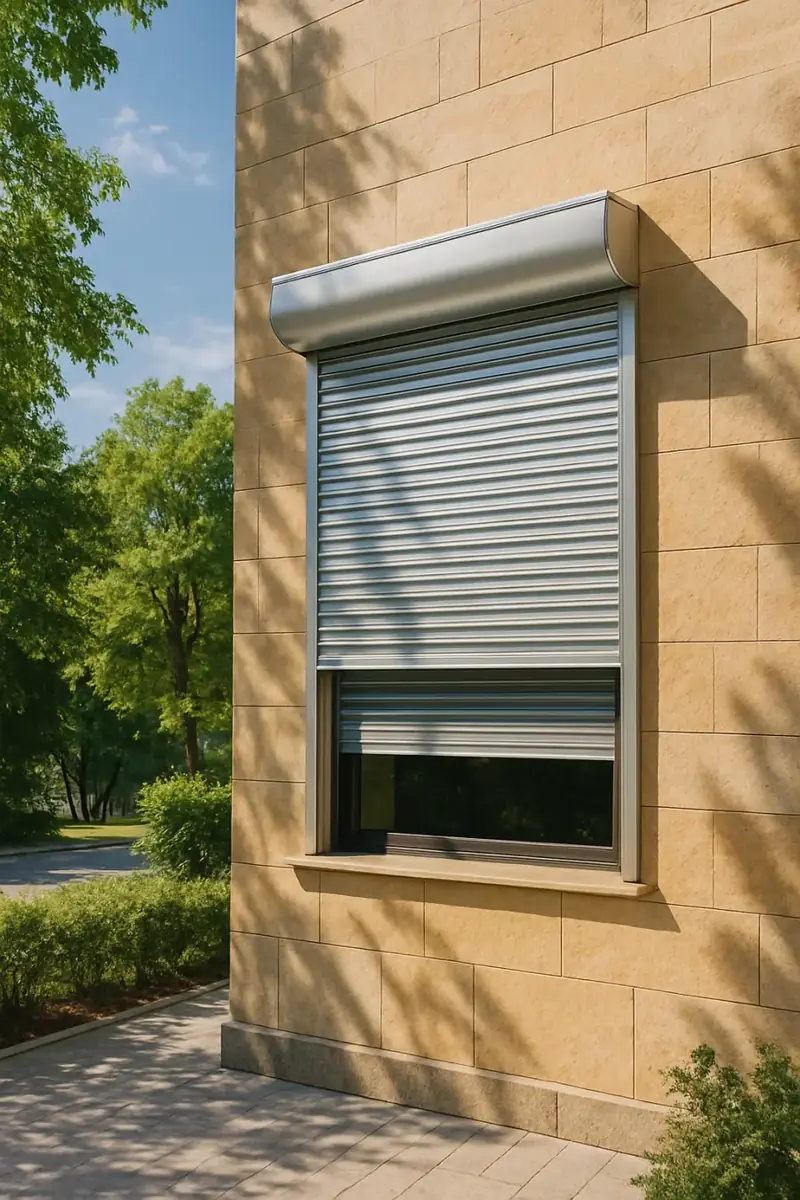
The housing box was mounted on the finished facade above the canopy, and the wall wasn’t opened up.
Timeframe: 12–16 days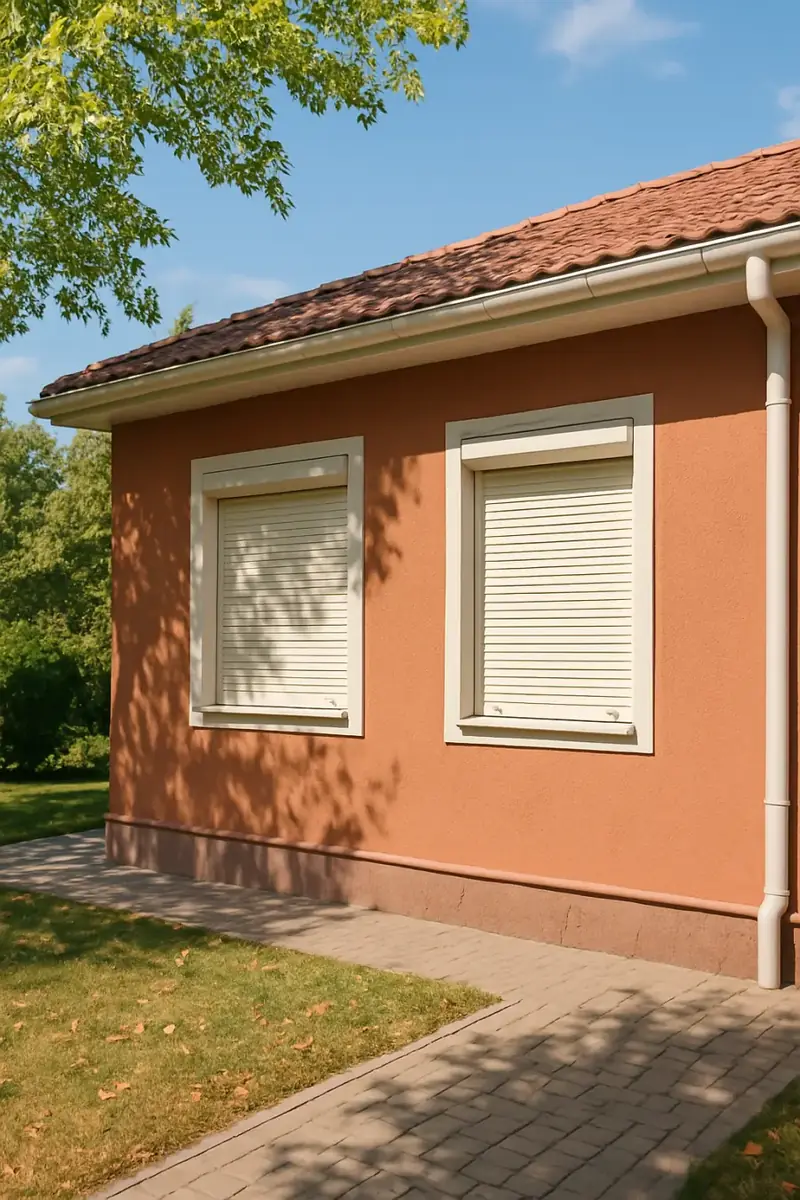
While the owners are away, the roller shutters keep the openings sealed tight — no outsider can look inside, and the windows stay protected.
Timeframe: 12–16 days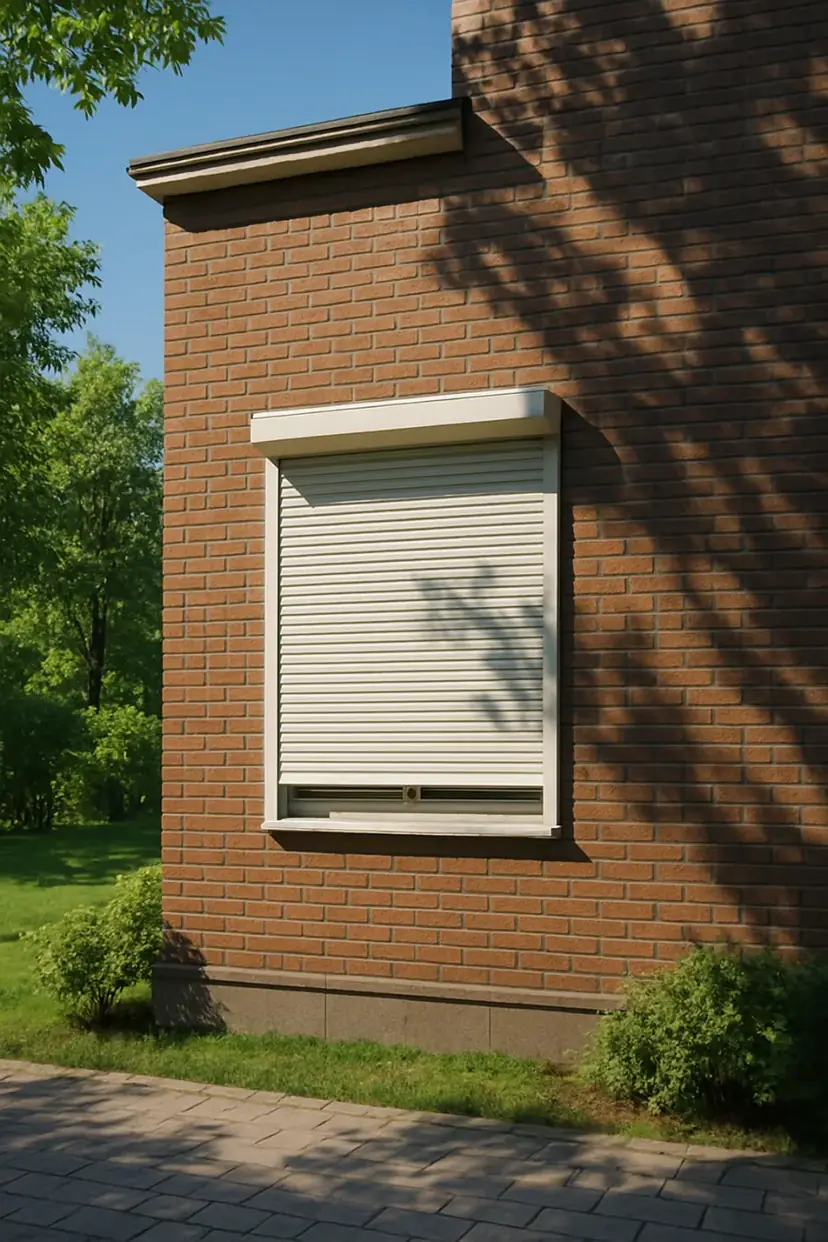
They close the windows from the outside, and in the evening the opening is shut — no outside looks get into the room.
Timeframe: 12–16 days
All the openings close from one remote control, and there’s no need to go up to each window
Timeframe: 14–18 days
The curtain is lowered and raised with a button, and there’s no need to reach for it by hand
Timeframe: 14–18 days
The sensor shades the shopfront by itself during the day: the goods fade less, and the view is kept
Timeframe: 14–18 days
In the evening the openings close on a schedule, and in the morning the curtain rises by itself
Timeframe: 14–18 days
The automation shades the room during the day: the glass heats up less, and the air conditioner doesn’t run at half power
Timeframe: 14–18 days
The opening closes from a remote control, and if the power goes out the curtain is raised with a crank handle
Timeframe: 14–18 days
It’s convenient to close at night from a remote control, and during the day the curtain goes into the housing box
Timeframe: 14–18 days
One control point for all the openings, and during the day the curtain is raised and the facade stays clean
Timeframe: 14–18 days
Closed with an armoured curtain, and no alarm was installed: the profile can’t be forced with a crowbar.
Timeframe: 12–16 days
At night the curtain is lowered, and during the day it goes into the housing box — and the shopfront is open to passers-by again.
Timeframe: 12–16 days
The opening is closed with a profile that can’t be forced with a crowbar. No alarm was installed.
Timeframe: 12–16 days
They close the door from the outside without putting in a second door — the space in the vestibule is kept.
Timeframe: 12–16 days
The windows close from inside, no outside eyes get into the room, and you don’t have to go outside.
Timeframe: 12–16 days
A closed curtain can’t be opened quietly — no night shift needed, the property is looked after.
Timeframe: 12–16 days
While the owners are away, the openings stay closed: no one from the street can look inside, and the windows are looked after.
Timeframe: 12–16 days
The housing box was mounted on the finished façade above the canopy, the wall was not opened up — the finish is intact.
Timeframe: 12–16 days
In the evening you just lower the curtain from inside — no outside eyes get into the room, and there’s no need to go outside.
Timeframe: 10–14 days
The wooden curtain takes the heat off the glass: in summer the room heats up less, in winter the window doesn’t get as cold.
Timeframe: 10–14 days
A closed wooden curtain blocks street noise — the room on the noisy side has become quieter.
Timeframe: 10–14 days
They close the window off from the sun and dust, the windowsill stays free, and access to the frame is not blocked.
Timeframe: 10–14 days
The curtain was tinted to match the window frame: when closed, it doesn’t clash with the façade, and in the evening the living room can’t be seen from the road.
Timeframe: 10–14 days
During the day the curtain is lowered to the middle of the window: the sun doesn’t hit the monitor, and you can see the yard from the desk.
Timeframe: 10–14 days
Strap control from inside the room: it’s easy to close at night without going out onto the balcony or opening the sash.
Timeframe: 10–14 days
The housing box was mounted on the finished façade above the canopy, the wall was not opened up — the wall and the finish stayed intact.
Timeframe: 10–14 days
In the evening the roller shutters are lowered, and in the morning the opening is open — and the shop window again attracts those walking past.
Timeframe: 12–16 days
They close the entrance door from outside without installing a second door — the space in the vestibule is saved.
Timeframe: 12–16 days
There is no security at the property — but a lowered curtain can’t be forced out or opened without noise.
Timeframe: 12–16 days
The perforated curtain takes the heat off the shop window, the goods fade less, and the view is preserved.
Timeframe: 12–16 days
The shop window was closed with a security profile, and the hall windows with a foam-filled one: the curtain blocks street noise, and it’s quieter inside.
Timeframe: 10–14 days
A surface-mounted housing box without opening up the wall, controlled by remote and schedule.
Timeframe: 14–18 days
A motor with emergency manual lift: when the power goes out, the curtain is raised by hand.
Timeframe: 14–18 days
No outside eyes get into the sales area, and the façade stays clean during the day.
Timeframe: 12–16 days
The curtain hides the contents and doesn’t take up the space of a sash — light and air come through the perforation.
Timeframe: 10–14 days
Instead of a second sash: the passage is clear, the hallway space is kept.
Timeframe: 10–14 days
Closes without a threshold and doesn’t block the passage; the curtain rolls up into the housing box.
Timeframe: 10–14 days
The opening is closed while cooking, smells don’t drift into the room, and during the day the curtain is raised.
Timeframe: 10–14 days
Closed during the day so noise from the living room doesn’t bother anyone, and in the evening the opening is left open.
Timeframe: 10–14 days
The perforated curtain lets light through but hides the contents from prying eyes.
Timeframe: 12–16 days
A moisture-resistant curtain instead of a hinged sash; the gaps are closed, and light still comes through.
Timeframe: 10–14 days
The opening is closed during a meeting, and during the day the curtain rolls up into the housing box.
Timeframe: 14–18 days
Security roller shutters close the entrance door from outside: no prying eyes get into the hallway.
Timeframe: 12–16 days
Closed at night over the entrance area without adding a second door — the space in the vestibule is kept.
Timeframe: 10–14 days
A roller shutter door into the room instead of a hinged one: it closes without a threshold and doesn’t block the passage.
Timeframe: 10–14 days
The curtain rolls up and needs no space for a hinged sash; it hides things from view, while the perforation lets air and light through.
Timeframe: 12–16 days
Closes the exit at night, and during the day the curtain rolls up into the housing box — the terrace door is no longer a weak point.
Timeframe: 10–14 days
Security roller shutters on a door with no guards or alarm system: the closed curtain can’t be pried open.
Timeframe: 12–16 days
Боковую дверь со стороны сада закрывают полотном на ночь и на время отъезда: замок больше не единственная защита.
Timeframe: 10–14 days
Roller shutters on a door with an electric motor and emergency lift: if the power goes out, the curtain is raised by hand.
Timeframe: 14–18 days
No prying eyes get into the room, and the windowsill stays free
Timeframe: 10–14 days
In summer the glass heats up less, in winter the window doesn’t get as cold
Timeframe: 10–14 days
The closed curtain absorbs street noise — the room is quieter
Timeframe: 10–14 days
The roller curtain hides the goods from the sun and prying eyes, and during the day the shop window works for passers-by
Timeframe: 10–14 days
Closed against the sun and prying eyes, and during the day the curtain is raised into the housing box
Timeframe: 10–14 days
The curtain can’t be pried open with a crowbar, and no alarm system was installed
Timeframe: 12–16 days
Closed at night, the curtain is raised during the day, the facade stays clean
Timeframe: 14–18 days
While away, the openings are closed: no one can look into the house from the street
Timeframe: 10–14 days
Closed from inside with a strap, without going outside: no prying eyes get into the room.
Timeframe: 10–14 days
The foam-filled curtain reduces glass overheating: the room heats up less in summer, and the window loses less heat in winter.
Timeframe: 10–14 days
Closed with a crank handle: the closed curtain cannot be forced open or quietly broken into.
Timeframe: 12–16 days
Closed manually at night, the opening is free during the day — the shop window works for passers-by again.
Timeframe: 12–16 days
The exit is closed at night with a chain from inside the room: the terrace door is no longer a weak spot.
Timeframe: 10–14 days
A curtain instead of hinged doors, operated by cord: the space in front of the wardrobe is free.
Timeframe: 10–14 days
The perforated curtain lets light through, closes with one hand, and the gaps are sealed.
Timeframe: 12–16 days
Windows are closed off from the sun and prying eyes by hand, without remotes: the curtain is raised during the day.
Timeframe: 10–14 days
In the evening the window is closed with a metal curtain: no one can look into the room from the sidewalk
Timeframe: 10–14 days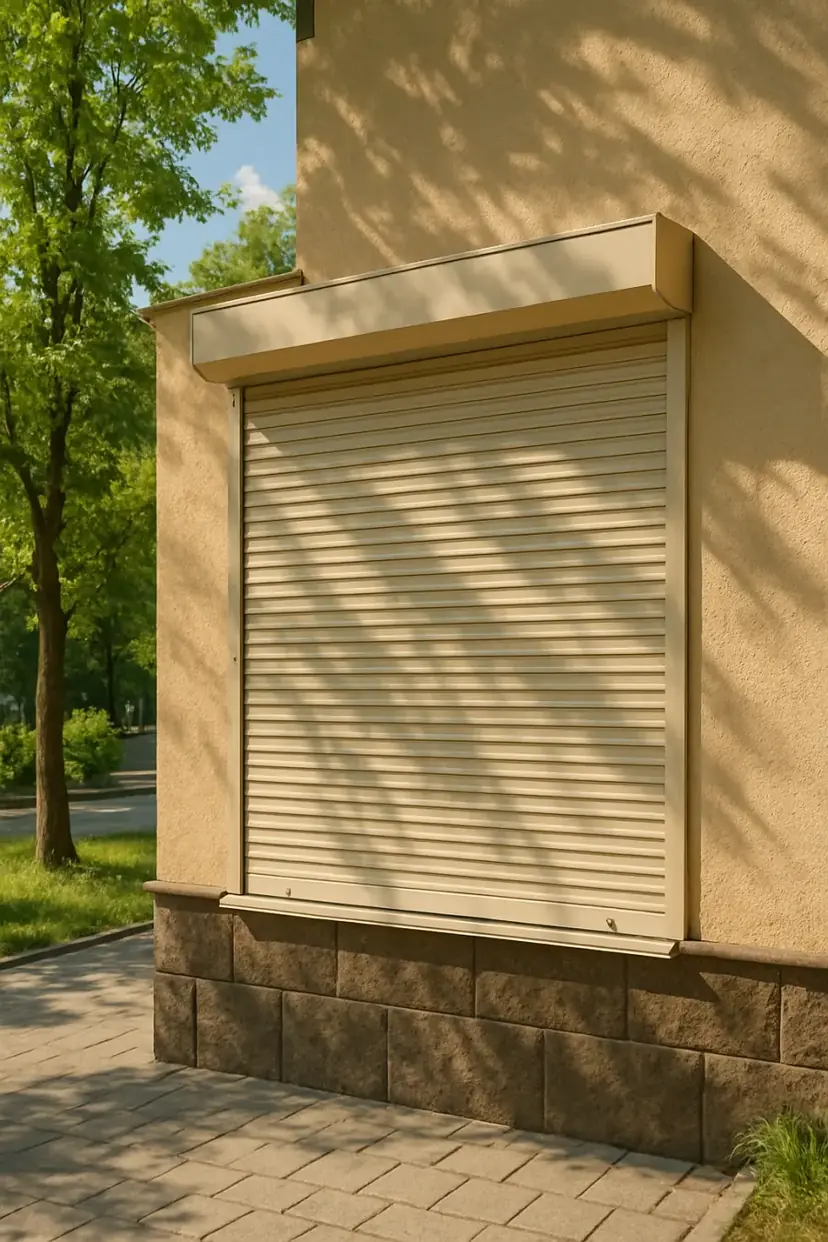
The extruded curtain is lowered after closing, and in the morning the display is open again
Timeframe: 12–16 days
The heavy curtain on the gate is raised with a crank handle, without a motor or a socket in the garage
Timeframe: 12–16 days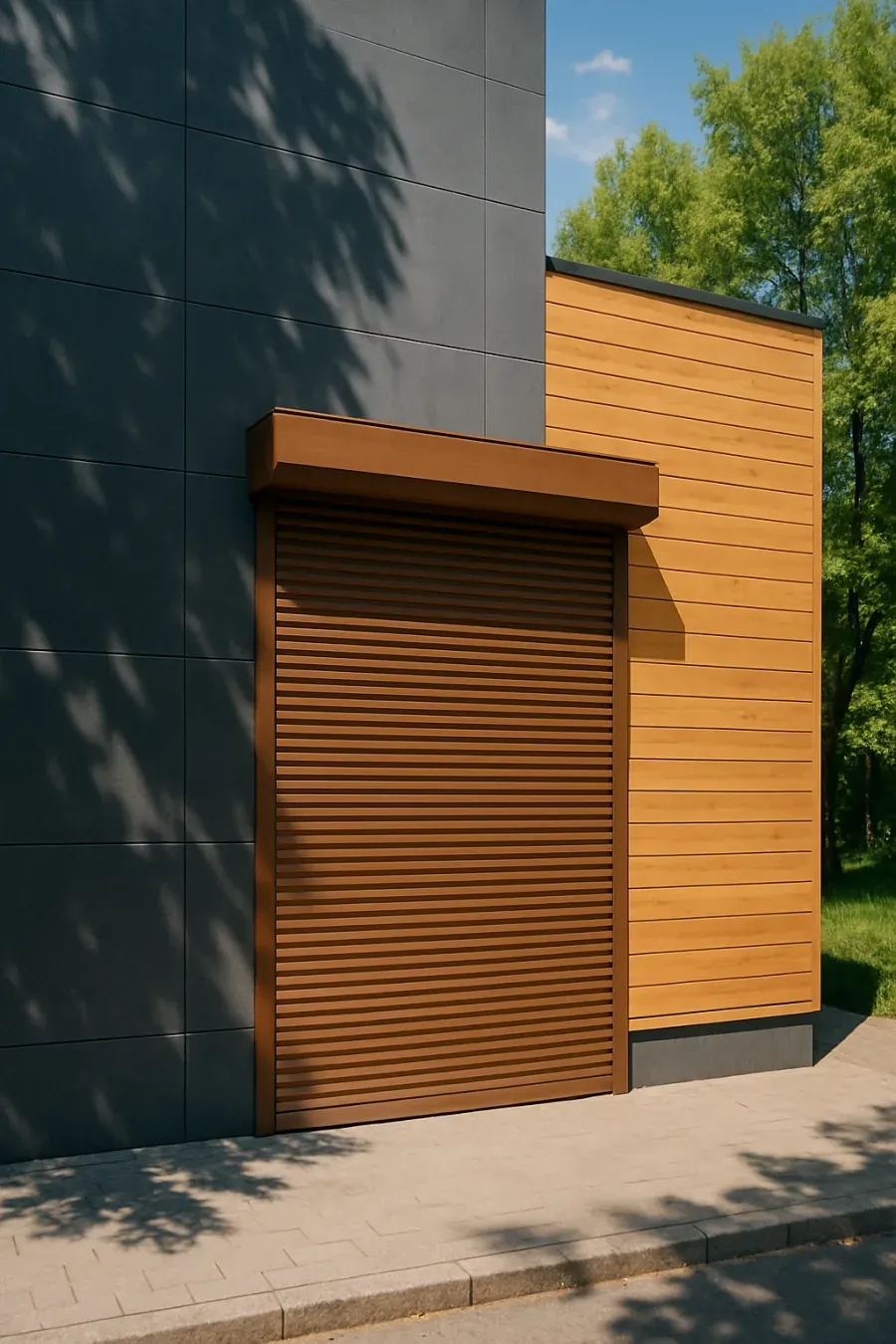
The roller shutter covers the entrance over the door: we didn't add a second door to the vestibule
Timeframe: 10–14 days
We chose an extruded profile with a deadbolt lock and didn't install an alarm
Timeframe: 12–16 days
The closed foam-filled curtain muffles street noise, making the room quieter
Timeframe: 10–14 days
Foam filling: the glass heats up less in hot weather, and the window loses less heat in the cold
Timeframe: 10–14 days
Leaving for the winter, they lower the curtains on the windows and door: the glass is protected from stones and prying eyes
Timeframe: 12–16 days
A roller shutter door instead of a hinged one: it closes without a threshold and doesn't block the passage.
Timeframe: 10–14 days
No space is needed for a swinging door, the contents are hidden, and light and air pass through the perforation.
Timeframe: 10–14 days
While cooking, the opening is closed and smells don't get into the room, and during the day the curtain is raised.
Timeframe: 10–14 days
During the day the curtain is lowered — so noise from the living room doesn't bother, and in the evening the opening stays open.
Timeframe: 10–14 days
The perforated fabric lets light through but keeps the room out of sight.
Timeframe: 10–14 days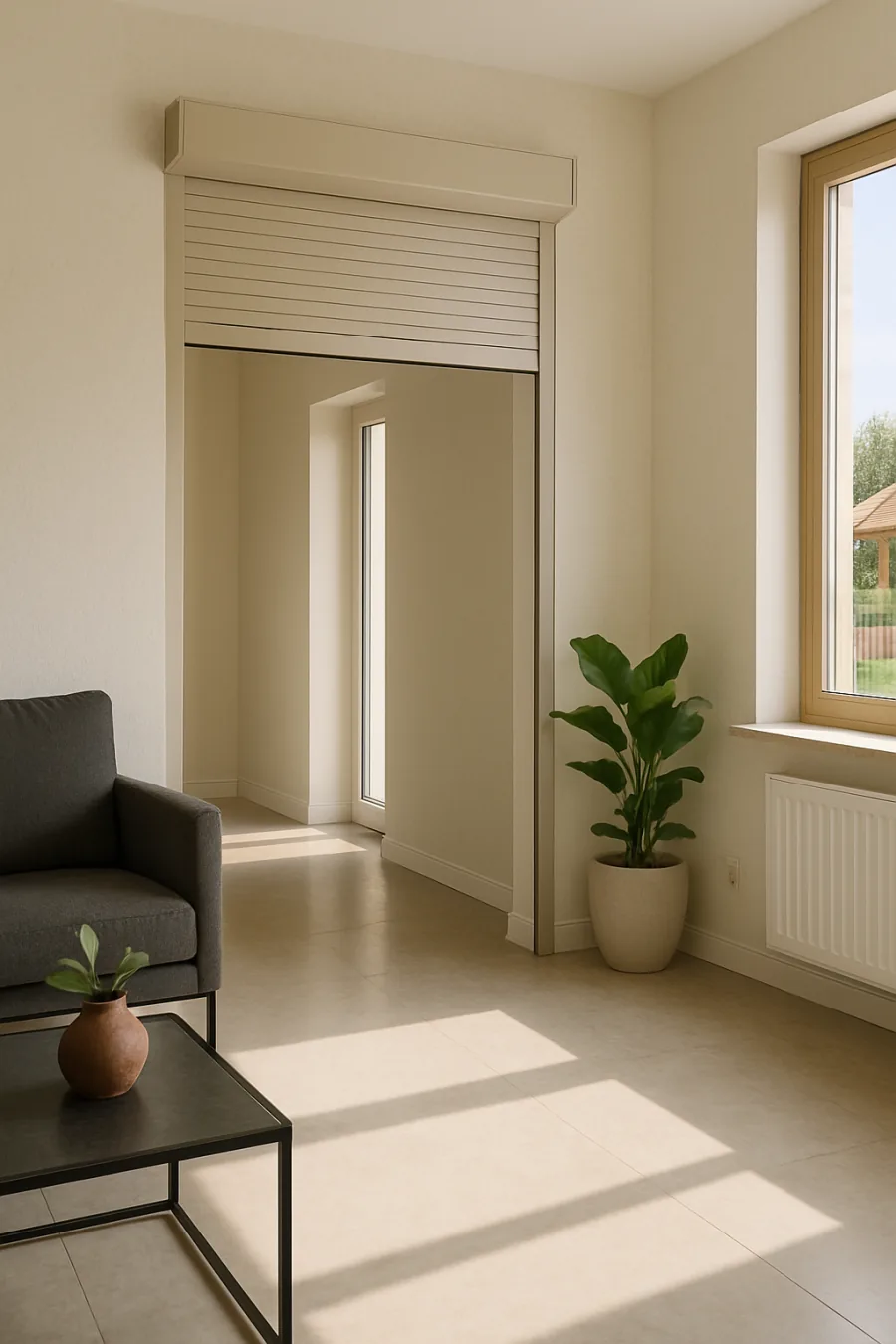
No second sash needed: you can walk through freely, and the hallway keeps more space.
Timeframe: 10–14 days
The hinged sash was replaced with a moisture-resistant fabric: the gaps are covered, and light still comes through.
Timeframe: 10–14 days
It is closed off during meetings, and in the daytime the fabric rolls up into the cassette.
Timeframe: 10–14 days
Closed at night: the terrace door is no longer a weak spot, and in the daytime the curtain is raised.
Timeframe: 10–14 days
During the hot hours a solid curtain is lowered: the sun does not beat on the glass, and the veranda heats up less.
Timeframe: 10–14 days
Strangers cannot see inside, and in the daytime the curtain goes up into the housing box.
Timeframe: 10–14 days
They close it off from the sun and dust, while the windowsill and the walkway stay clear.
Timeframe: 10–14 days
We used a profile that cannot be pried open with a crowbar, so no alarm was installed.
Timeframe: 12–16 days
The closed foam-filled curtain blocks street noise: the terrace has become quieter.
Timeframe: 10–14 days
The housing box was mounted on the finished facade without opening up the wall, and the windows close on a schedule.
Timeframe: 14–18 days
If the power goes out, the curtain on the terrace or veranda can be raised by hand — the motor has an emergency manual lift for this.
Timeframe: 14–18 days
We close the windows from the outside: strangers cannot see into the room, and in the evening the opening is shut.
Timeframe: 10–14 days
The external curtain takes the heat off the glass: the room heats up less in summer, and in winter the window does not get so cold.
Timeframe: 10–14 days
The closed curtain blocks street noise: the room on the noisy side has become quieter.
Timeframe: 10–14 days
We used an extruded profile with a deadbolt lock: the opening cannot be pried open with a crowbar.
Timeframe: 12–16 days
The external housing box was mounted on the finished facade above the canopy, without opening up the wall.
Timeframe: 10–14 days
While you are away from home, external roller shutters keep the openings sealed tight: no stranger can see in from the street, and the windows stay looked after.
Timeframe: 10–14 days
External roller shutters close the windows off from the sun and prying eyes, and in the daytime the curtain is raised.
Timeframe: 12–16 days
Surface-mounted housing box without opening up the wall, remote control: the windows close on a schedule.
Timeframe: 14–18 days
They close it at night, and in the daytime the opening is clear — the shop window works on passers-by again, and the goods fade less.
Timeframe: 12–16 days
Strangers cannot see into the room, while light and air pass through the perforation.
Timeframe: 12–16 days
In the daytime the fabric is tucked away in the cassette, and the rest of the time it protects the window from prying eyes and sunlight.
Timeframe: 12–16 days
Closed at night, open during the day, the shop window works on passers-by.
Timeframe: 14–18 days
The perforation provides ventilation, and the closed curtain cannot be pried open with a crowbar.
Timeframe: 12–16 days
Light passes through the curtain, the room does not get darker, the gaps are closed.
Timeframe: 12–16 days
They protect from the sun and dust, light and the view remain, the passage is clear.
Timeframe: 12–16 days
While away, the openings are closed: you cannot see inside from the street, but the room is ventilated.
Timeframe: 12–16 days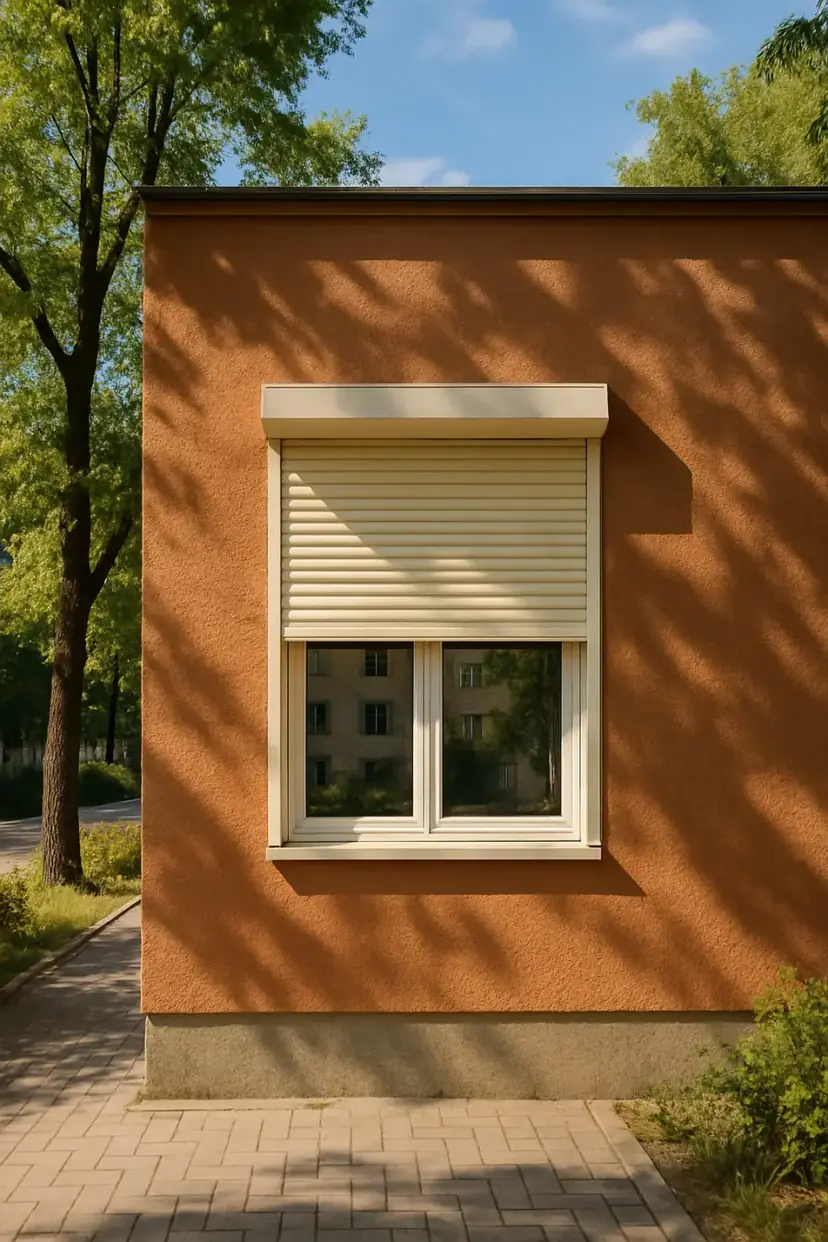
The strap is brought into the bedroom: the curtain is lowered before sleep without opening the window.
Timeframe: 10–14 days
The curtain reduces overheating of the glass: in summer the room heats up less, in winter the window does not get as cold.
Timeframe: 10–14 days
The closed foam-filled curtain muffles street noise — the room on the noisy side has become quieter.
Timeframe: 10–14 days
They protect the window from the sun and dust, the windowsill stays free — access to the frame is not blocked.
Timeframe: 10–14 days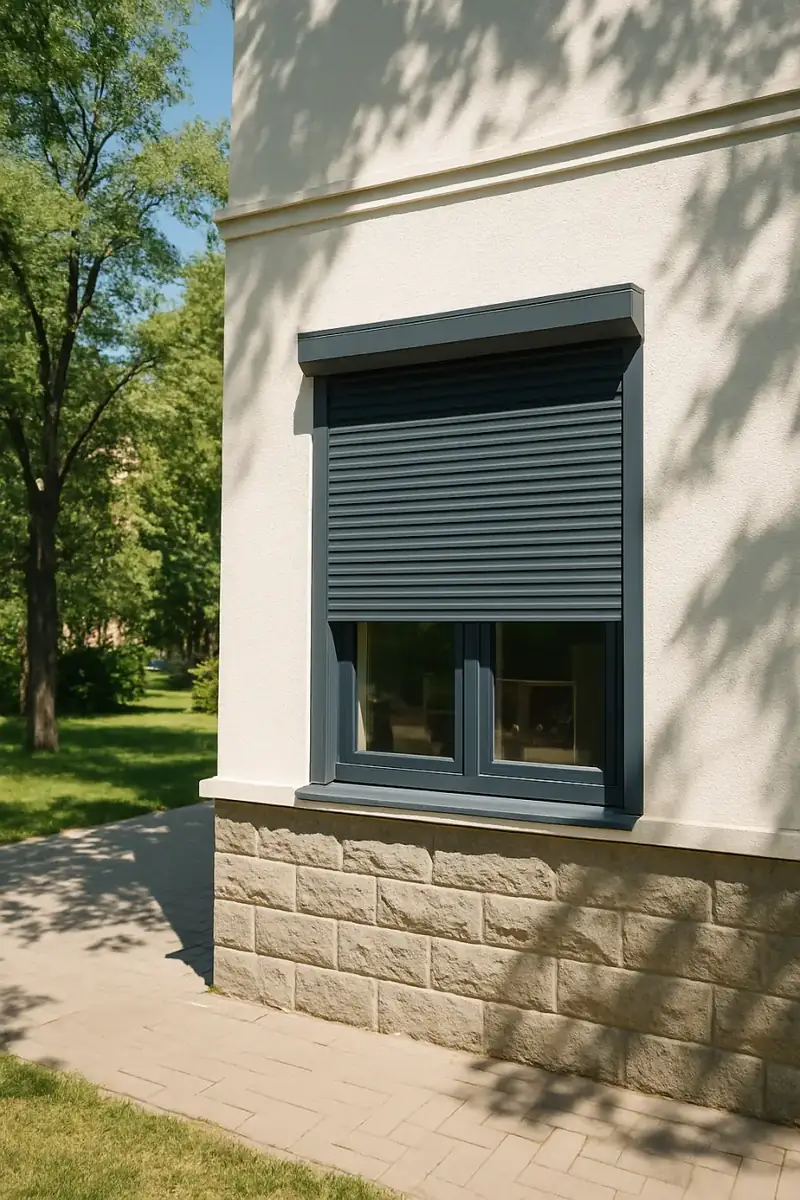
Closed during the day against the sun, in the evening the opening is clear, the curtain goes up into the cassette above the window.
Timeframe: 10–14 days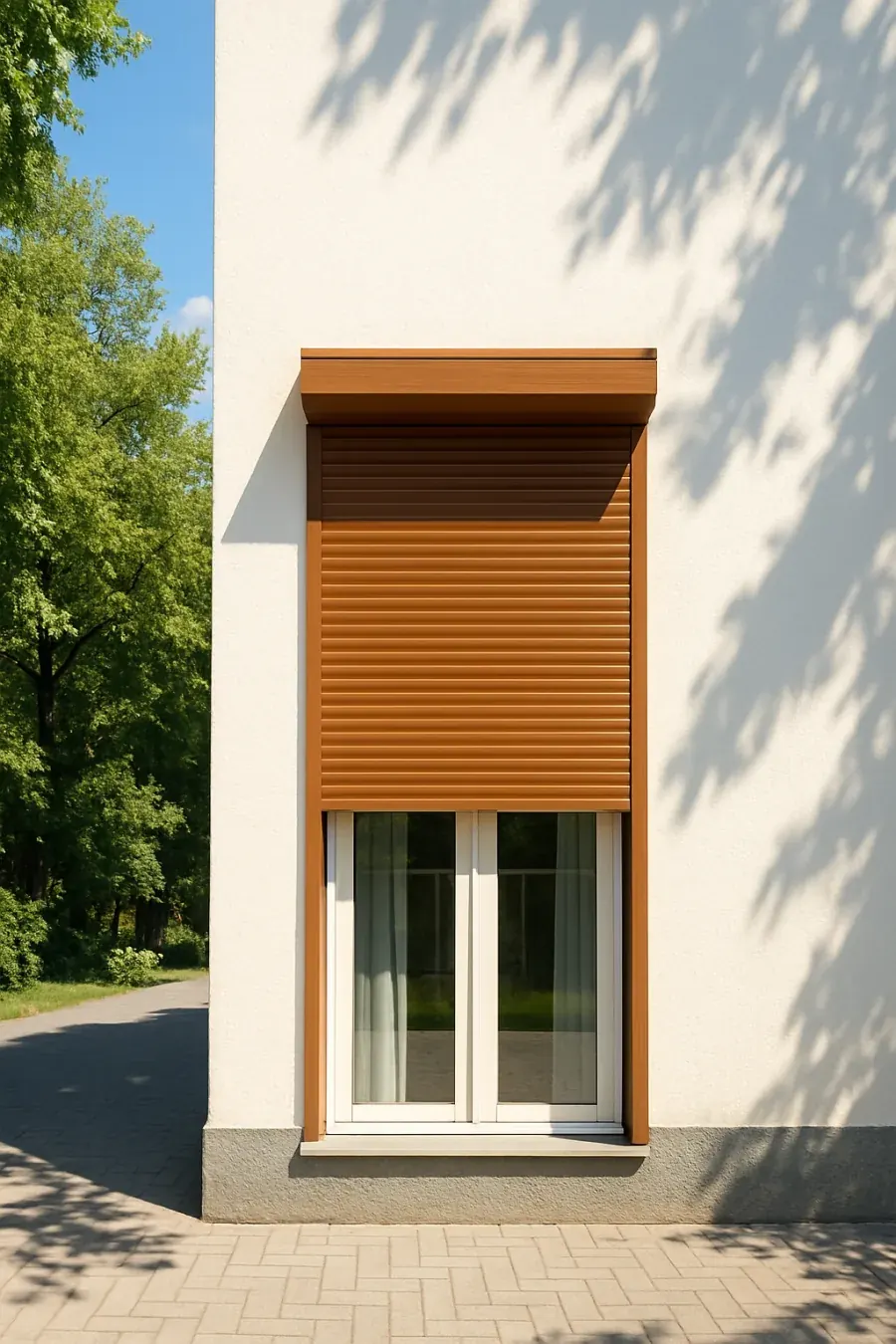
Strap control from inside the room: easy to close without going out onto the balcony or opening the sash.
Timeframe: 10–14 days
During the day the curtain goes up into the housing box and the facade looks clean again, while before that the roller shutters protect the windows from prying eyes and sunlight.
Timeframe: 10–14 days
Light curtains on all the windows of the house are lowered before leaving in a couple of minutes, without keys or locks.
Timeframe: 10–14 days
Closed at night, during the day the curtain is raised: by morning there is no dust or leaves on the table, and light is kept inside.
Timeframe: 14–18 days
The transparent curtain reduces overheating: in summer it heats up less inside, light and the view remain.
Timeframe: 14–18 days
They protect from the sun and dust, the windowsill and the passage stay free, the curtain goes up into the cassette.
Timeframe: 14–18 days
They close the exit at night, during the day the curtain goes up into the housing box: the wind does not blow dust and poplar fluff onto the terrace.
Timeframe: 14–18 days
The external curtain reduces overheating of the glazing: in summer the veranda heats up less, light passes through.
Timeframe: 14–18 days
Housing box on the finished facade without opening up the wall, in the evening the openings close on schedule.
Timeframe: 14–18 days
Grey tint: during the day you can see the courtyard from the window, while from the street the room is harder to see into than through clear glass.
Timeframe: 14–18 days
While away, the openings are closed: rain and wind do not bring debris inside, light and the view are preserved.
Timeframe: 14–18 days
The housing box is hidden in the opening, the façade has no surface-mounted elements, and the window is closed off from prying eyes.
Timeframe: 10–14 days
The concealed installation was planned together with the windows: outside the wall is clean, and the curtain goes into the wall.
Timeframe: 10–14 days
Concealed roller shutters close the windows from the sun and prying eyes; during the day the curtain is raised and out of sight.
Timeframe: 10–14 days
The curtain hides in the opening: during the day the window is open, in the evening it is closed with no external elements.
Timeframe: 10–14 days
We used an extruded profile in a concealed housing box — no alarm was installed.
Timeframe: 12–16 days
They close the window from the inside against the sun and dust, the windowsill stays free, and the housing box is hidden in the window reveal.
Timeframe: 10–14 days
The closed foam-filled curtain blocks street noise, and the housing box is not visible from the room.
Timeframe: 10–14 days
Controlled from inside the room: easy to close without stepping onto the balcony, and the façade is untouched.
Timeframe: 10–14 days
The closed foam-filled curtain blocks street noise — the room on the noisy side has become quieter.
Timeframe: 10–14 days
During the day the curtain reduces heat gain through the glass: in summer the room heats up less, and in winter the window loses less heat.
Timeframe: 10–14 days
With foam filling, the glass heats up less in hot weather, and in frost the window unit loses less heat.
Timeframe: 10–14 days
A warm curtain plus protection: the window is closed off from prying eyes, and no alarm was installed.
Timeframe: 10–14 days
The strap is brought into the room, so in the evening you just pull it — no need to step onto the balcony or open the sash.
Timeframe: 10–14 days
The housing box was mounted on the finished façade above the canopy without opening the wall — the finish stayed intact.
Timeframe: 10–14 days
While the owners are away, the openings stay closed — no one can look in from the street, and the windows are not left unattended.
Timeframe: 10–14 days
During the day the curtain goes into the housing box and the façade looks neat, while the window itself is protected from both sunlight and prying eyes.
Timeframe: 10–14 days
They close the openings at night, and during the day the curtain is raised: furniture and belongings inside are no longer left in view
Timeframe: 10–14 days
The transparent curtain keeps out wind and dust, while light and the view of the yard stay inside
Timeframe: 14–18 days
The closed foam-filled curtain blocks street noise: it has become quieter inside
Timeframe: 10–14 days
We used a profile that cannot be pried open with a crowbar — no alarm was installed
Timeframe: 12–16 days
The housing box was mounted on the finished posts without opening the cladding, and the openings are closed on a schedule
Timeframe: 14–18 days
Motor with emergency manual raise: if the power goes out, the curtain is raised by hand
Timeframe: 14–18 days
While the owners are away, the openings are closed: no one can see in from the street, and the gazebo is looked after
Timeframe: 10–14 days
They keep out wind and dust, it stays light inside, and the windowsill and walkway stay clear
Timeframe: 14–18 days
A white curtain on a white facade is barely noticeable, and the toilet window at eye level no longer shows anything.
Timeframe: 10–14 days
The brown slats continue the brown frames, and from the street the bathroom is closed off when the lights are on in the house.
Timeframe: 10–14 days
The bathroom window looks out into the garden behind the bushes: the curtain is raised with a switch by the door, so there is no need to reach across the bath to the window.
Timeframe: 14–18 days
When the owners leave, the small bathroom window is shut tight along with the rest of the house’s windows.
Timeframe: 10–14 days
The curtain is lowered to the middle of the window: light comes in from below, while the glass above is closed off from view.
Timeframe: 10–14 days
In the evening the roller shutter is lowered to the windowsill, and with the lights on you cannot make anything out in the window from the yard.
Timeframe: 10–14 days
In the heat the slats are lowered two-thirds of the way, and the small bathroom does not heat up by midday.
Timeframe: 10–14 days
The bathroom window faces straight onto the path: thick slats in deep guide rails close it off from passers-by and from break-ins.
Timeframe: 12–16 days
Closed at night, during the day the curtain goes up into the cassette and the windowsill stays clear
Timeframe: 10–14 days
Closed with a vertical curtain at night, during the day the opening is clear — the shop window works on passers-by
Timeframe: 12–16 days
They keep out sun and prying eyes, while light and the view stay
Timeframe: 12–16 days
They close off a tall door without a second sash, and the space in the vestibule is kept
Timeframe: 10–14 days
Lowered in the evening, raised in the morning — the facade stays clear throughout the day
Timeframe: 12–16 days
The window is closed from the inside without going outside, and prying eyes do not get into the room
Timeframe: 10–14 days
They block out the sun and dust, while the windowsill and the walkway stay clear
Timeframe: 12–16 days
Closed with a vertical curtain that can’t be pried open or quietly broken into
Timeframe: 12–16 days
Close the window from inside in the evening without going outside: no prying eyes get into the room.
Timeframe: 10–14 days
The closed, foam-filled curtain takes on the street noise — the room on the noisy side has become quieter.
Timeframe: 10–14 days
During daylight hours the curtain absorbs the excess heat from the glass: in summer the room is not as hot, and in winter the window gives off less heat to the outside.
Timeframe: 10–14 days
They close the window from inside against the sun and dust, and the windowsill stays clear — access to the frame is not blocked.
Timeframe: 10–14 days
Ground floor with no security: we went with an extruded profile that can’t be pried open with a crowbar — no alarm system was installed.
Timeframe: 12–16 days
The perforated curtain lets light through but hides the room from prying eyes from the street.
Timeframe: 12–16 days
Controlled from inside the room: convenient to close at night without going out onto the balcony or opening the sash.
Timeframe: 10–14 days
The housing box was installed from inside on the existing opening, the facade was not opened up — the wall and the finish stayed intact.
Timeframe: 10–14 days
The solid curtain is lowered after the checkout closes, and the shop window glass can’t be seen from the street at night.
Timeframe: 12–16 days
The curtain on the gate is lowered with a crank handle from inside; outside there is neither a handle nor a keyhole.
Timeframe: 12–16 days
Nothing can be seen from the street into the room, and during the day no structures spoil the facade.
Timeframe: 12–16 days
After the workday the offices are closed with the curtain, and the equipment on the desks can’t be seen from the street.
Timeframe: 12–16 days
We settled on a profile that can’t be pried open with a crowbar — and did without an alarm system.
Timeframe: 12–16 days
The canopy gave convenient access to the second-floor window — now the opening is covered with extrusion.
Timeframe: 12–16 days
In winter the house stands empty: the windows have an extruded profile with deadbolt locks.
Timeframe: 12–16 days
The curtain is on the outside: in the evening the opening is closed, and no one can peek into the room from the street.
Timeframe: 12–16 days
A mini system on each sash: the office is aired between patients without raising the blind
Time: 4 days Roller blinds
The tall window was covered with a single curtain, and the chain was shortened to countertop level
Time: 5 days Roller blinds
Fabric to the floor on wall brackets, the 32 mm roller tube does not sag
Time: 6 days Roller blinds
The sashes tilt open with the blind down — the system sits right on the frame
Time: 5 days Roller blinds
Two blinds meet flush in the corner, with no gap between the fabrics
Time: 5 days Roller blinds
Three fabrics from a single roll of cloth — the shade is identical on all sashes
Time: 4 days Roller blinds
Grey polyester against concrete and brick, the fixings hidden behind the window reveal
Time: 5 days Roller blinds
The blind is on the sash, the windowsill stays free for flowers
Time: 4 days Roller blinds
The blinds come down on a timer while the owners are at work
Timeframe: 7–10 days
Not a single chain in the room — the parents keep the remote control
Timeframe: 7–10 days
The barista lowers the blind with a button behind the counter, without walking through the room
Timeframe: 7–10 days
Battery-powered motor: no chasing the wall for wiring
Timeframe: 7–10 days
The top of the tall window is out of reach — the blind is raised with the remote control
Timeframe: 7–10 days
Two blinds on one remote control channel, moving in sync
Timeframe: 7–10 days
A sun sensor lowers the blind when light falls on the desk
Timeframe: 7–10 days
A button by the door closes both sides of the corner before a slide show
Timeframe: 7–10 days
The roll is held on cotton cords: the height is set by hand, there is no mechanism
Timeframe: 7–10 days
The natural weave softened the austere room with white walls
Timeframe: 7–10 days
The long fabrics roll up evenly, without skewing at the edges
Timeframe: 7–10 days
Straw against the brick wall: a warm texture instead of dark fabric
Timeframe: 7–10 days
Bamboo on both sides of the corner in the same shade, the joint is invisible
Timeframe: 7–10 days
A wide bottom bar: when there is a draught from the veranda, the fabric does not bang against the frame
Timeframe: 7–10 days
Light comes through the weave diffused, and the master sees the dye shade correctly
Timeframe: 7–10 days
The blind by the desk is wiped with a slightly damp cloth, without soaking
Timeframe: 7–10 days
White dim-out: the light is even, faces on video calls are not in shadow
Time: 5 days
White fabric on a white frame is almost invisible
Time: 4 days
Milky fabric softens the light, the room feels taller
Time: 5 days
White fabric with a herringbone weave — you can see the texture up close
Time: 6 days
In the morning the fabric glows, it’s easier to wake up
Time: 4 days
In a small room white fabric doesn’t eat the light, the walls seem farther away
Time: 5 days
White light with no tint — the master sees the paint colour accurately
Time: 5 days
White fabric softens the midday sun over the dining table
Time: 5 days
Rented office: drilling the windows isn’t allowed under the lease
Time: 4 days
It’s warm by the stove, so no adhesive was used — the fabric is held by clips in the glazing bead
Time: 4 days
Hook brackets on the sash come off without tools
Time: 5 days
A long fabric is heavy — clips in the glazing bead instead of adhesive tape
Time: 5 days
The developer hadn’t accepted the windows yet, so we fixed everything into the glazing bead only
Time: 5 days
Rented space: when you move out, the blind comes down in a minute
Time: 4 days
Blinds on hooks, the sashes open together with them
Time: 5 days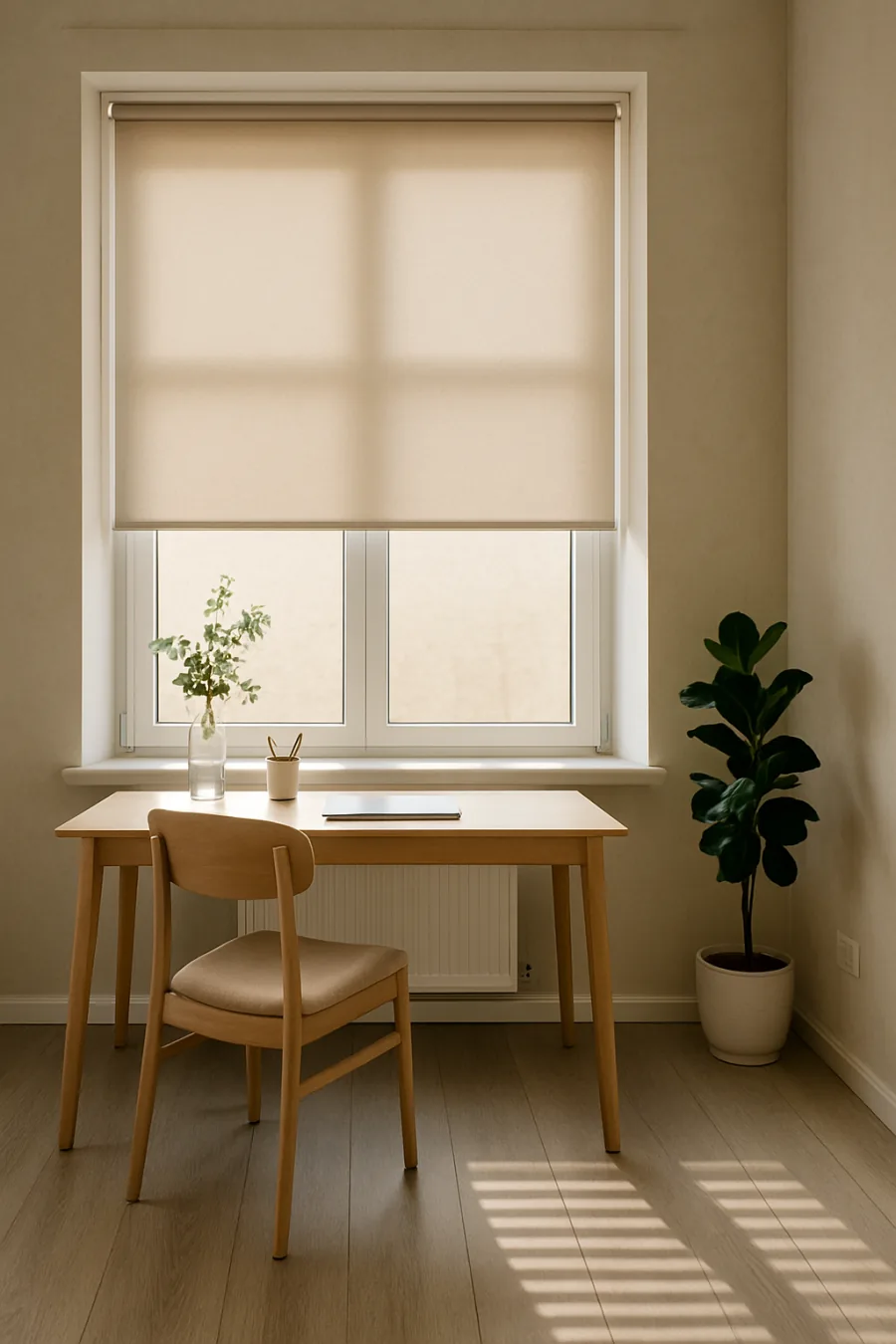
The owners didn’t want to drill the aluminium frames — we fitted clips into the glazing bead
Time: 6 days
Book spines don’t fade: the southern sun doesn’t reach the shelves
Time: 6 days
The owner works night shifts: during the day the room is as dark as in the evening
Time: 5 days
The sleeping area is darkened separately, the kitchen by the second window stays bright
Time: 6 days
Guide rails along the edges removed the strip of light along the frame
Time: 6 days
A projector instead of a TV: the picture isn’t washed out during the day
Time: 5 days
West-facing window: by evening the room no longer heats up
Time: 5 days
The yard light shone straight into the window — now you can’t see it
Time: 5 days
Three-layer fabric: in winter noticeably less cold comes off the glass
Time: 6 days
Black screen fabric: the street is clearer from inside than through a light-coloured one
Time: 6 days
Black linen-look fabric against dark shelving
Time: 5 days
Black blackout in a bright room: the kids’ room stays dim during the day, so the child gets enough sleep
Time: 5 days
A graphic accent on the white wall, matching the picture frames
Time: 5 days
Dark frames and black fabric read as one whole
Time: 5 days
Black blackout: no light passes through the fabric itself
Time: 4 days
The black colour echoes the chairs and the light fixture
Time: 5 days
Guests catch up on sleep during the day after a flight — blackout shuts out the daylight
Time: 6 days
During the day the stripes are aligned — the light is even, with no sun patches on the desk
Time: 6 days
Ground floor: the stripes are shifted, so no one can look in from the street
Time: 5 days
A narrow strip: no glare on the monitor, and the room stays bright
Time: 5 days
Clients in the chair can’t be seen from the sidewalk, and the stylist still has enough light
Time: 6 days
Cassette with guide rails: the stripes don’t separate on a long fabric
Timeframe: 4–6 days
The fabric was split into two per window, each one controlled separately
Timeframe: 4–6 days
A blind on the sash — you don’t have to raise it to air the room
Time: 5 days
The blinds on the two sides of the corner are set so the stripes run in one line
Time: 6 days
Soft lavender against light shelving and a green armchair
Time: 5 days
Dense aubergine for daytime naps, with the walls kept light
Time: 6 days
Dusty lilac — a compromise between pink and grey
Time: 5 days
Plum to match the leather armchair, with no gloss
Time: 6 days
Purple is the colour of the sign, and the windows carry it inside
Time: 6 days
A muted shade: colourful, but it doesn’t distract the children
Time: 5 days
A dark wine shade to match the bedspread
Time: 5 days
The pale lilac tone is soft, with no harsh contrast against the white walls
Time: 5 days
Guide rails run the full height, the fabric stays tight to the glass
Time: 6 days
The roller tube is hidden inside the cassette, so grease doesn’t settle on the roller tube
Time: 6 days
The sash tilts open, and the fabric stays in the guide rails without flapping
Time: 5 days
No strips of light at the edges, so the screen isn’t washed out from the side
Time: 6 days
U-shaped guide rails for a deep glazing bead
Time: 6 days
The white cassette blends with the frame, so the fitting is invisible
Time: 5 days
Blackout with no gaps before a slide show
Time: 6 days
Children can’t reach the roller, it’s hidden in the cassette
Time: 6 days
Each sash has its own blind, so you can read in the armchair in the shade
Time: 5 days
UV-resistant fabric: on a south-facing window it fades more slowly than ordinary fabric
Time: 4 days
Things in the wardrobe no longer heat up in the sun
Time: 4 days
The blind is lowered at midday, so the seedlings don’t burn
Time: 5 days
Sliding sashes: the blinds were hung above the frame, the sashes move freely and the fabric doesn’t catch on them
Time: 6 days
The laptop on the windowsill doesn’t overheat by midday
Time: 5 days
Two blinds meet in the corner, and the drying rack under them doesn’t get in the way of lowering the fabric
Time: 5 days
High floor, sun all day — we installed dim-out
Time: 6 days
Two blinds of different lengths, both with their bottom edge on the same line
Time: 6 days
The cord holds the fabric on the door: a child can open it and the blind doesn’t catch
Time: 6 days
The blind on the sash doesn’t get in the way of carrying furniture out onto the loggia
Time: 5 days
Brown brackets to match the laminated frame
Time: 6 days
We left a gap for the handle at the measurement — the handle turns freely
Time: 5 days
Three fabrics — door, fixed glass and window, all in the same fabric
Timeframe: 4–6 days
The door is tilted for ventilation, the blind is held against the glass
Time: 5 days
The blind is inside, the screen outside — they don’t get in each other’s way
Time: 6 days
The blind on the moving sash travels with it
Time: 5 days
The glass door to the treatment room is closed with a blind during the session
Time: 4 days
Magnetic bottom holder: the blind doesn’t bang when the door slams
Time: 5 days
In the morning the terrace door is closed off from the sun, but opens freely
Time: 5 days
We didn’t touch the frameless glass: the blind was hung on the wall above the door
Time: 6 days
A narrow cassette exactly the width of the insert, so light from the hallway doesn’t wake you
Time: 4 days
The blind is on the wall above the opening: it’s lowered at night and raised to open the sashes
Time: 5 days
Mounted on the door leaf, the frame wasn’t touched
Time: 5 days
The bottom of the blind is above the tap, so splashes don’t reach the fabric
Time: 5 days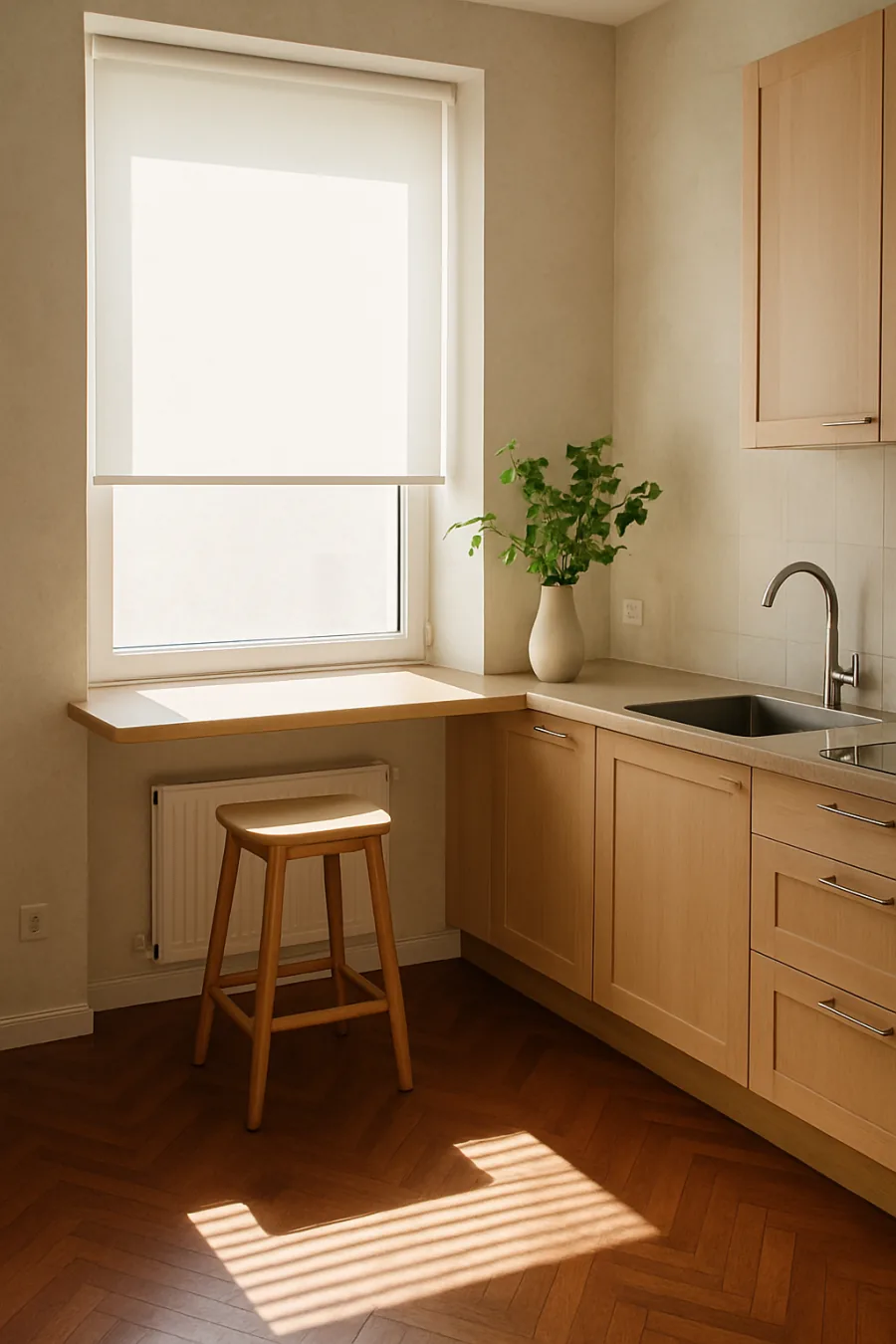
The blind stops above the counter so it doesn’t get in the way at breakfast
Time: 6 days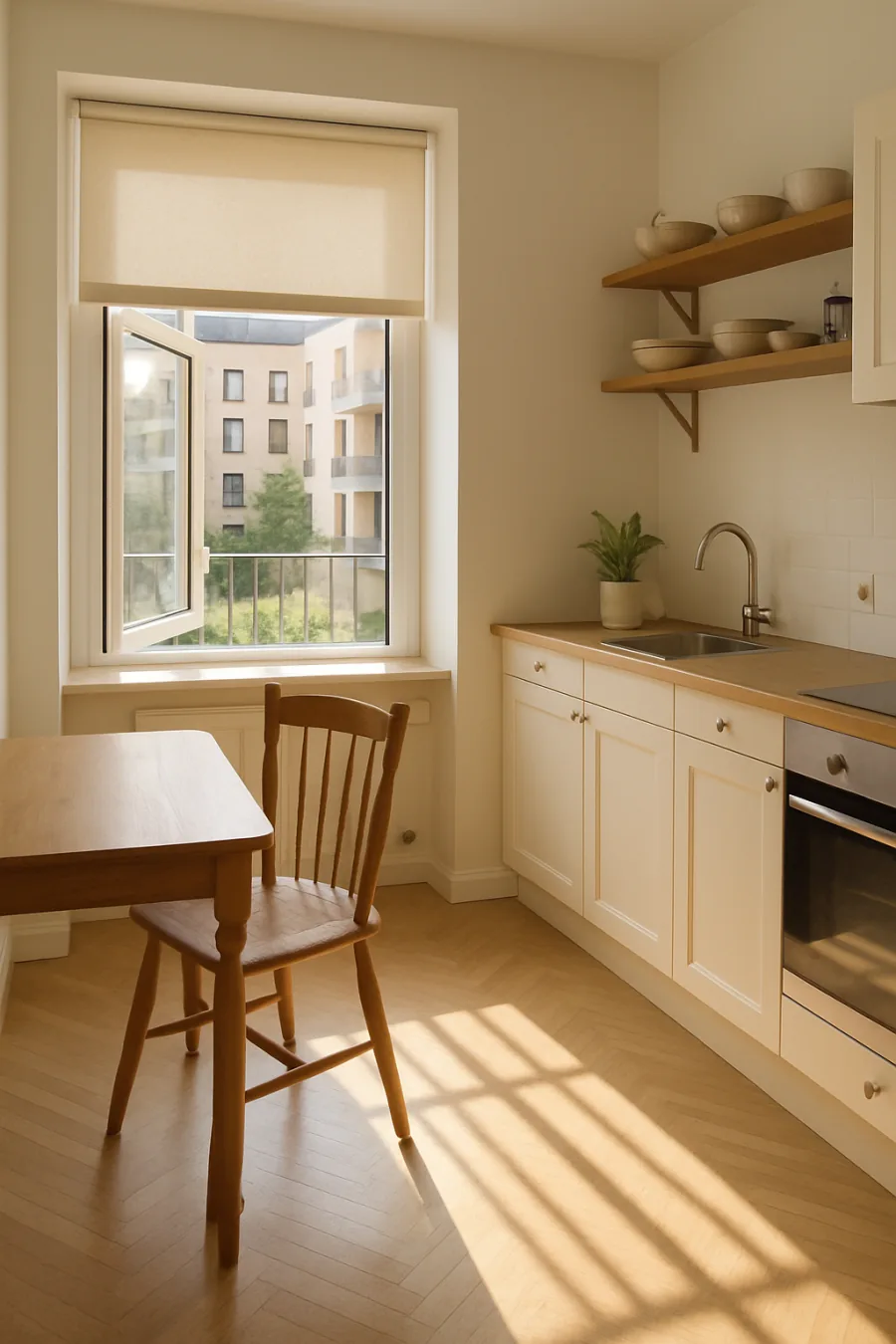
Wipeable PVC fabric: after frying, you just wipe it down
Time: 4 days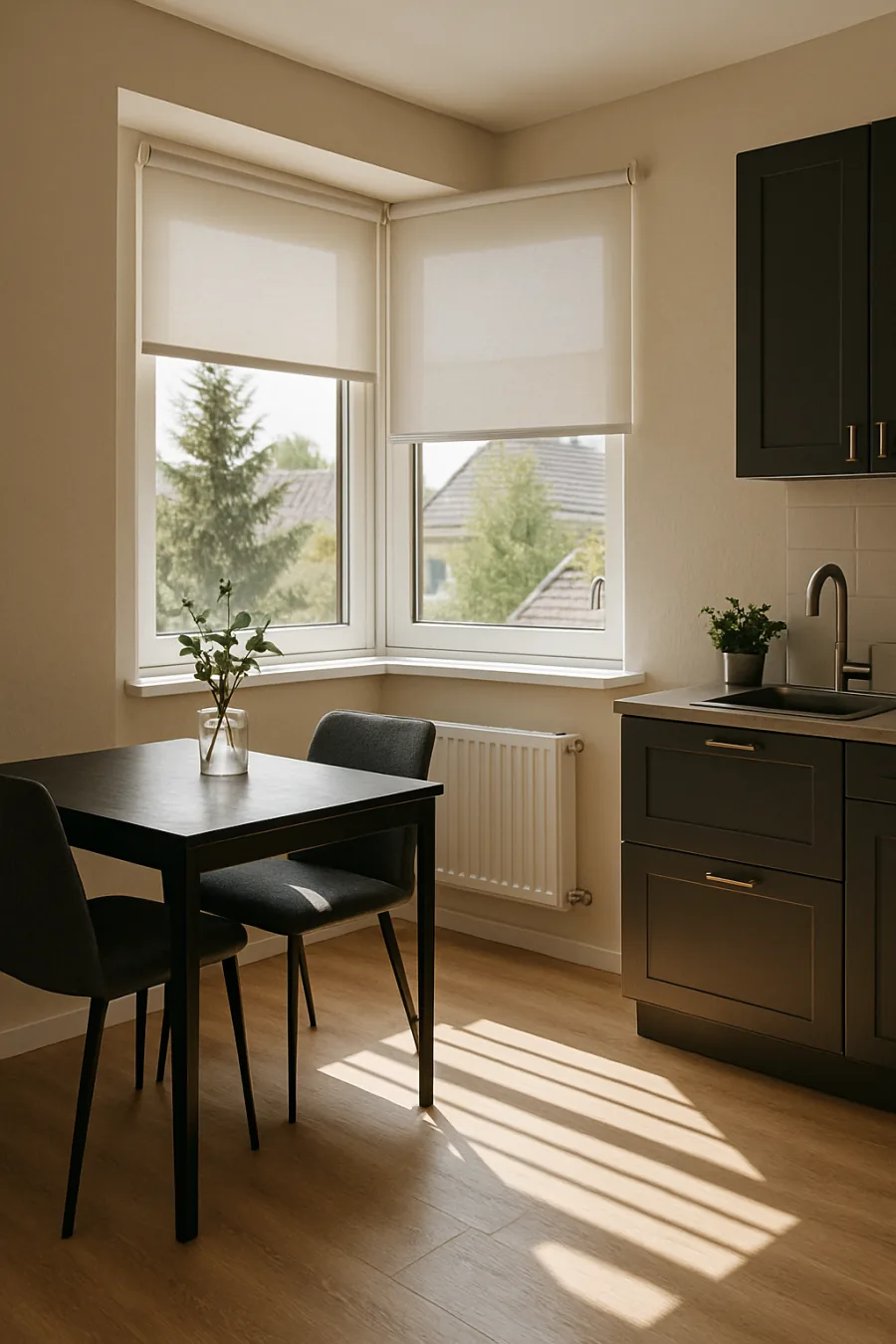
Light fabric balances out the dark cabinets
Time: 5 days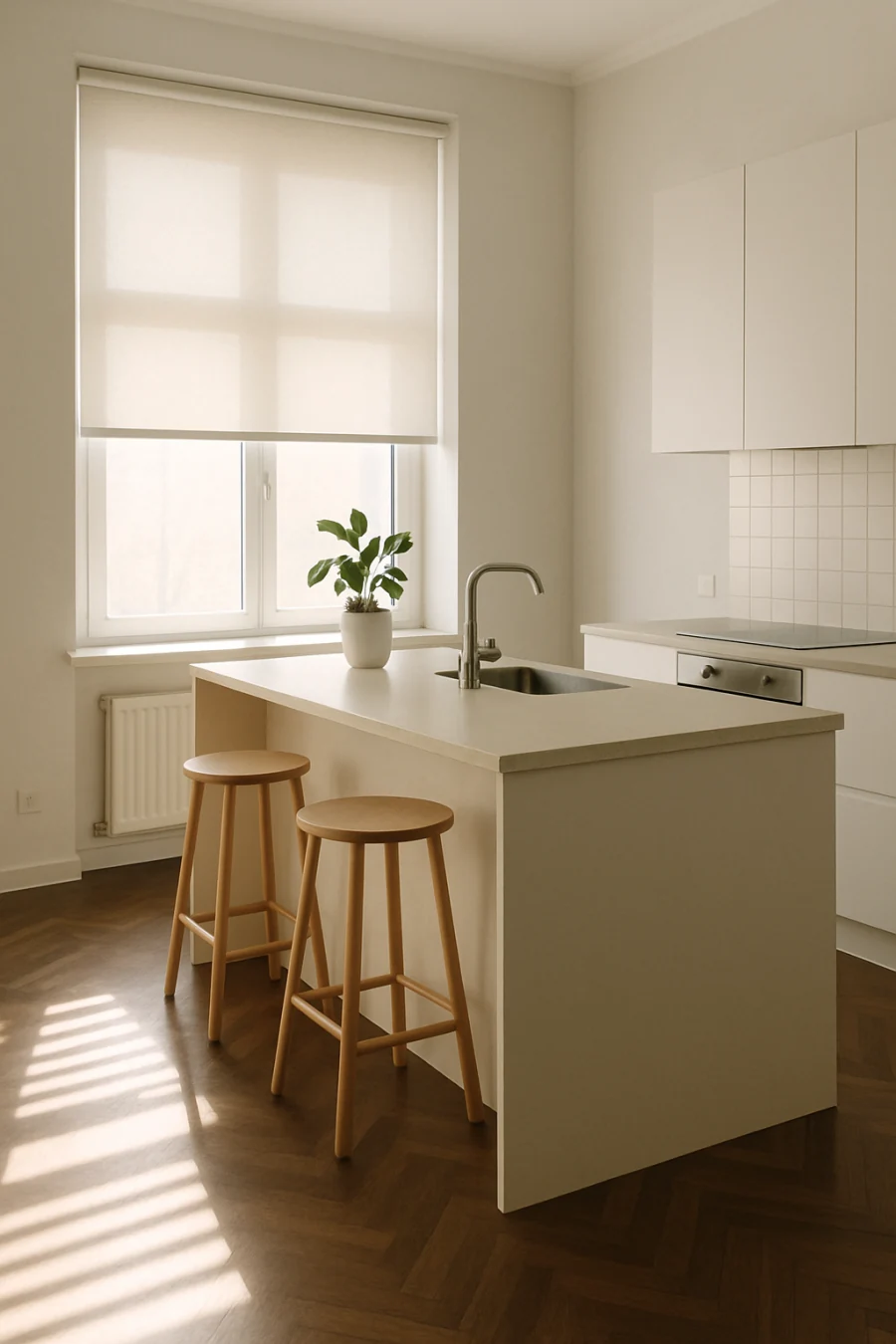
Dirt-repellent finish, stains don’t soak in
Time: 5 days
The mini system on the sash takes up not a single centimetre of wall
Time: 4 days
The blind reaches the windowsill, where the herb pots stand
Time: 4 days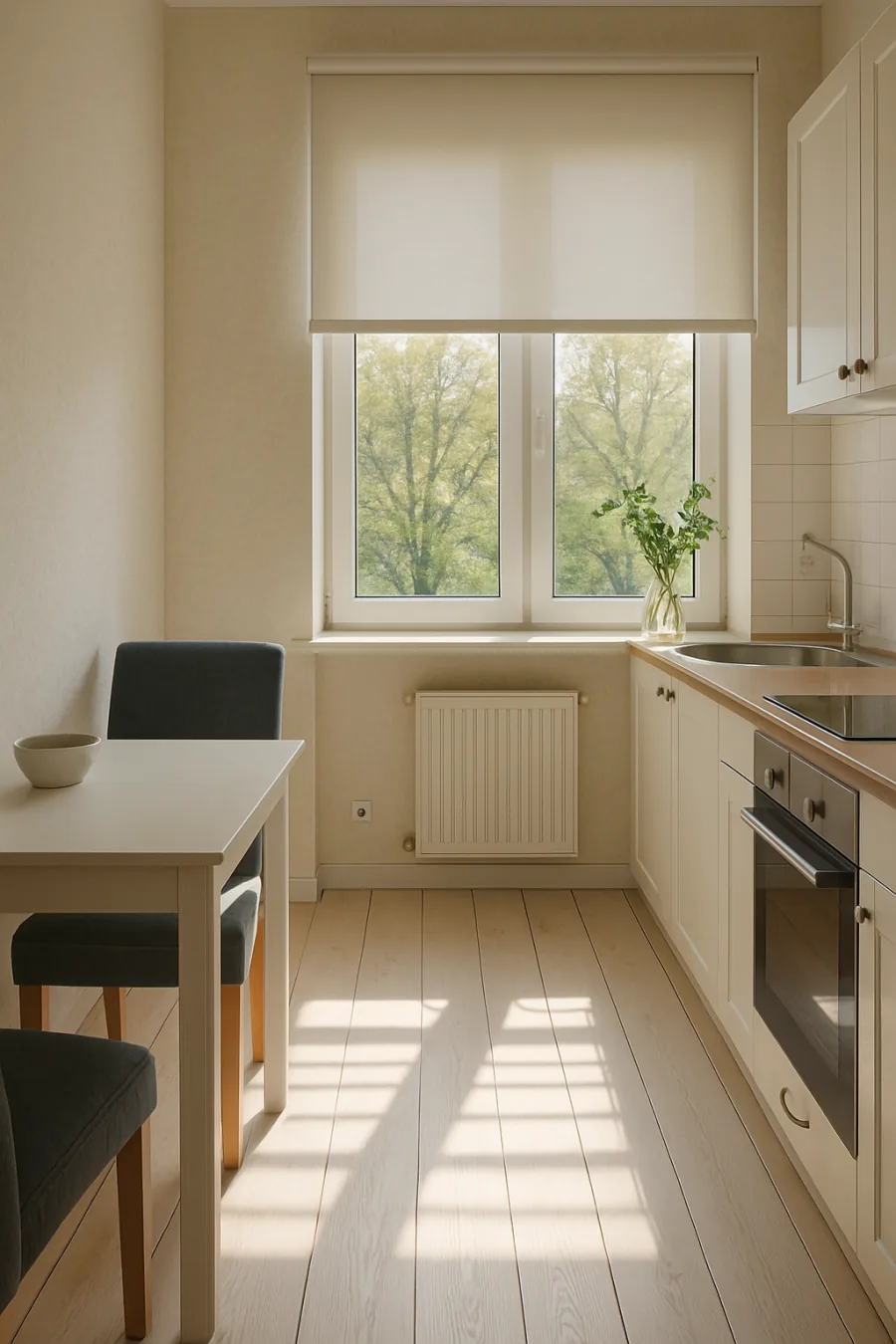
The gas stove is right there, so the blind was hung on the far sash, away from the flame
Time: 5 days
Rented flat: the fabric comes off together with the tape, the frame stays clean
Time: 4 days
The fabric is taken down and washed, the tape stays on the frame
Time: 4 days
Ties hold the roll at the height you need
Time: 4 days
Temporary, until the renovation: the frame wasn’t drilled, and the tape will come off after the finishing work
Time: 4 days
A strip with hook-and-loop tape on the window reveal, the sash opens freely
Time: 4 days
Linen fabric tied back with ribbons to match the tablecloth
Time: 4 days
In summer the fabric hangs at the country house, and for the winter it’s taken down and taken away
Time: 4 days
Light linen on tape: soft diffused light in the room in the morning
Time: 5 days
The blind is moved to whichever sash the sun is on
Time: 4 days
Three suction cups hold the fabric on smooth glass
Time: 5 days
The blind is lowered halfway: shade at the table, but the view of the street below stays open
Time: 4 days
The spring mini roller blind rolls up by itself, no chain
Time: 4 days
They didn’t drill the new frames: before installation the glass was wiped with alcohol, and the suction cups hold tight
Time: 4 days
Three light blinds on the glass, frames without a single hole
Time: 4 days
Guests come in summer, so the blinds are brought out of the wardrobe for the season
Time: 4 days
The bottom suction cup holds the fabric, so it doesn’t flap in a draught
Time: 4 days
No chain, no cord: you pull the blind by the handle on the bottom bar
Time: 5 days
The blinds stop at any height without a lock
Time: 6 days
Wooden handle on the bottom bar, matched to the colour of the shelves
Time: 5 days
No side cords — the desk was pushed right up to the window
Time: 5 days
The tall window was checked at the measurement: we chose a light fabric that the spring can hold
Time: 6 days
The floor-to-ceiling windows were decided at the measurement: light fabric, a spring matched to its weight, and the blind doesn’t creep up
Timeframe: 4–6 days
Nothing hangs by the window — that was exactly the look the owner wanted
Time: 5 days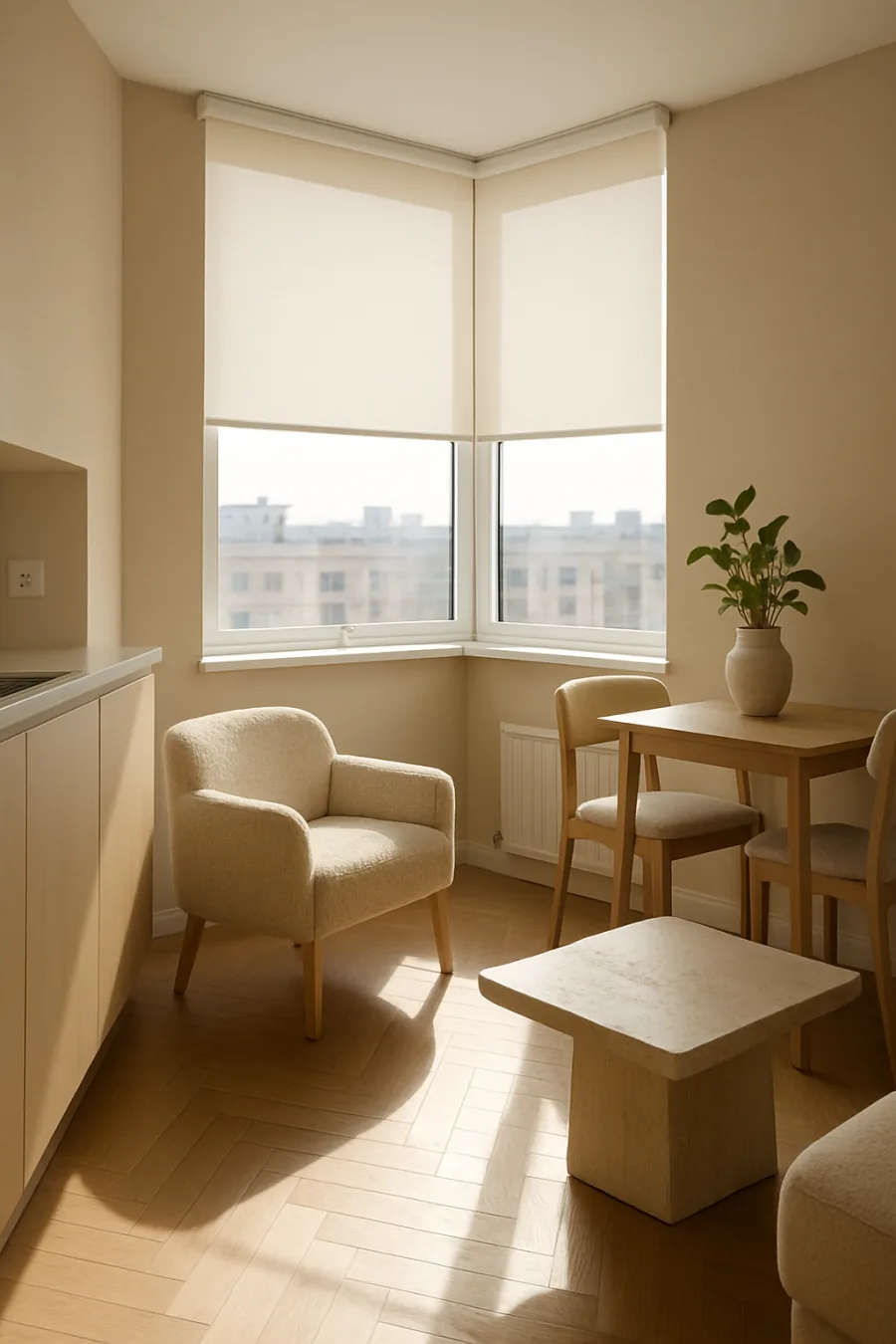
With no chains by the stove, there’s nothing for a frying pan handle to catch on
Time: 5 days
The acrylic fabric handles the swing from daytime heat to night-time cold
Timeframe: 10–14 days
Cables instead of guide rails: the housing box wouldn’t sit straight on the uneven brick pillars
Timeframe: 10–14 days
Under the pitched roof the sun hits from the side — the blinds are lowered down to the table
Timeframe: 10–14 days
Motors on both blinds, one button at the entrance
Timeframe: 10–14 days
The fabrics were kept a safe distance from the fireplace
Timeframe: 10–14 days
Blinds between the black columns shield the terrace from the low evening sun
Timeframe: 10–14 days
The sofa is shaded from the evening sun, while the garden view to the side stays open
Timeframe: 10–14 days
The sand-coloured acrylic dries within a couple of hours after rain
Timeframe: 10–14 days
Grey screen fabric: no glare on the monitors, and the window isn’t blocked out
Time: 6 days
One wide fabric over both sashes, operated by a single chain
Time: 6 days
Dense flame-retardant fabric in the client waiting area
Time: 5 days
The same height on every window, so the façade looks neat
Time: 6 days
The long chain is brought down to hand level, so no stepladder is needed
Time: 6 days
Installation was scheduled around the office hours, work never stopped
Time: 6 days
5% screen: the drafting table in even light, no harsh shadows
Time: 5 days
No glare on the wall screen: before a call the blind is lowered, and the room stays bright
Time: 6 days
The afternoon sun is diffused, spreadsheets on the monitor are easy to read
Time: 5 days
A dense graphite screen: patients in the chair no longer squint in the sun
Time: 6 days
Three sashes under one fabric, the desk by the window is glare-free
Time: 6 days
The open weave keeps the view of the mountains
Time: 5 days
During classes the sash is tilted open, the screen stays down
Time: 5 days
Fibreglass screen by the stove: grease is wiped off with a damp cloth, no washing needed
Time: 6 days
The screen by the whiteboard is readable in daytime, the classroom lights stay on
Time: 6 days
The panorama is still there, direct sun no longer blinds
Time: 6 days
Sheer instead of a curtain: the hall is bright, and no one in the neighbouring house can see the people working out
Time: 4 days
No glare on the whiteboard, and the classroom light is not dimmed
Time: 5 days
The garden is visible through the fabric, direct sun does not fall on the pages
Time: 4 days
A sheer curtain cannot hang by the stove — we fitted a short fabric on the sash
Time: 4 days
Replaced the old sheer: the curtain rail was removed, the wall looks cleaner
Time: 5 days
The hall is visible from the street, but guests by the window are not blinded
Time: 6 days
A transparent fabric for daytime, with a blackout layer behind it for night
Time: 6 days
The mesh fabric hardly picks up odours or dust
Time: 4 days
Misty mountains over the full window height: the construction site outside is no longer visible
Timeframe: 4–6 days
A birch grove on two fabrics, the pattern lines up into a single picture
Timeframe: 4–6 days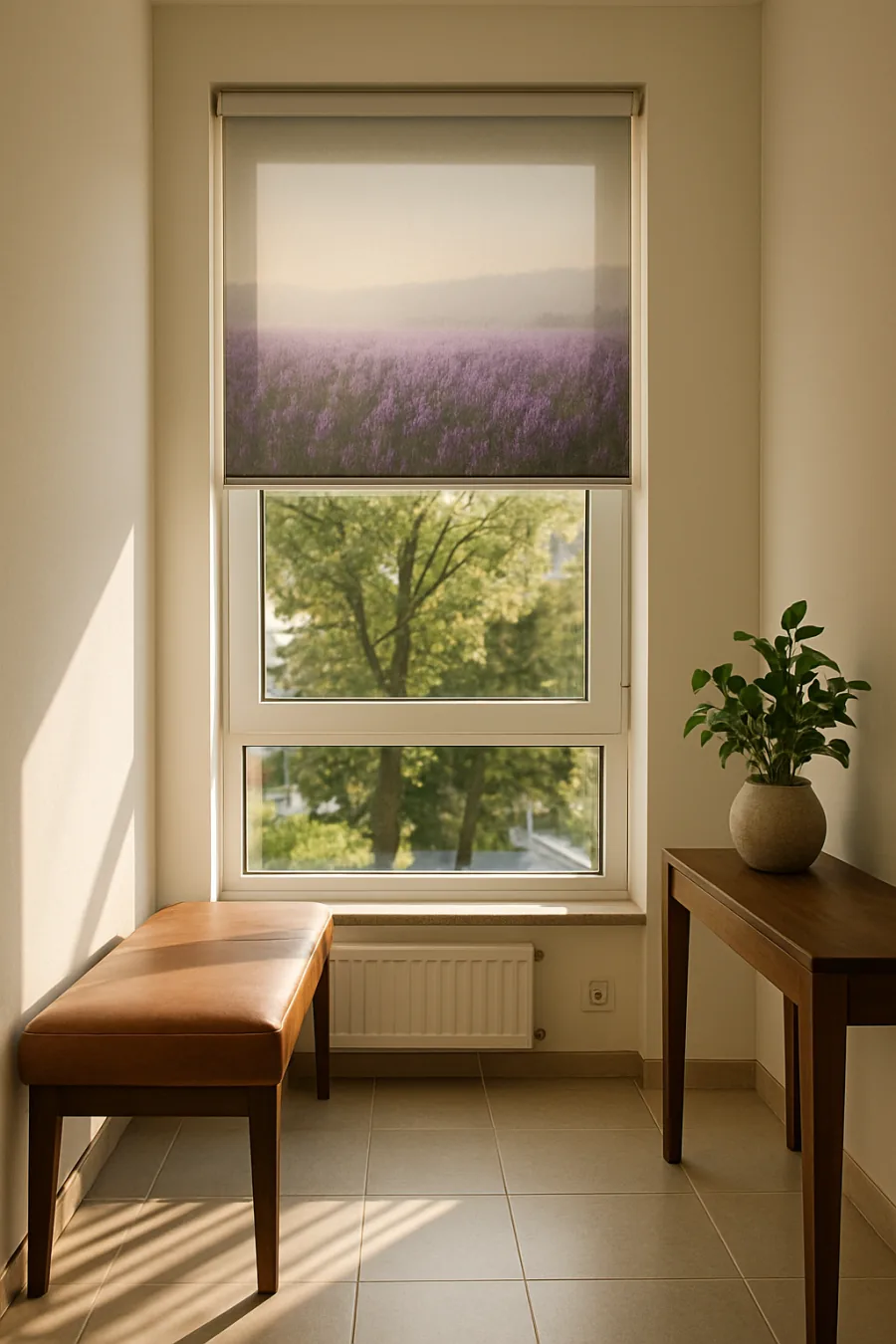
The window looks onto the wall of the neighbouring building — now it shows a lavender field instead
Timeframe: 4–6 days
A sea horizon across two sides of the corner, the sea line matched in height
Timeframe: 4–6 days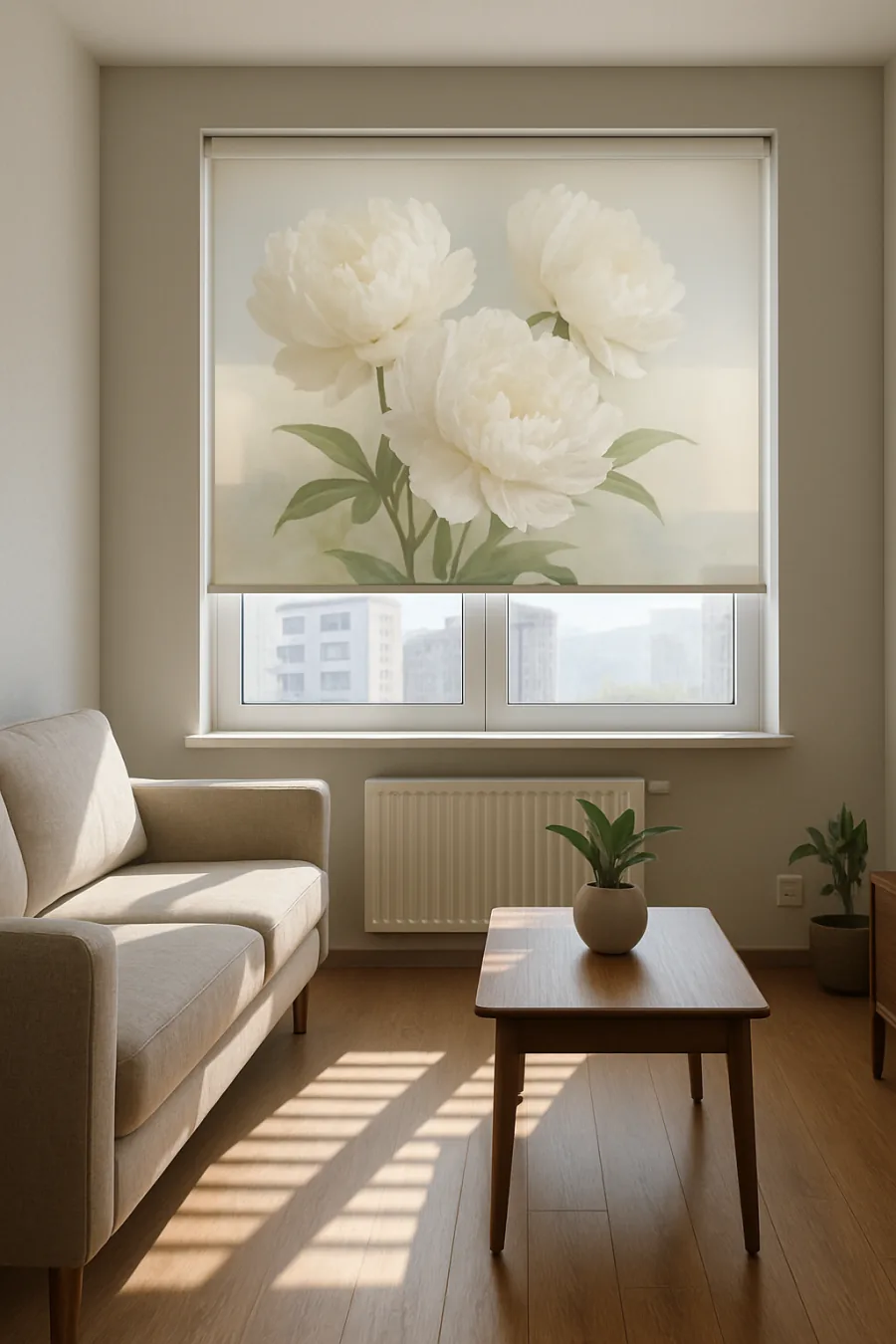
Close-up peonies split across three sashes, the joins falling on the mullions
Timeframe: 4–6 days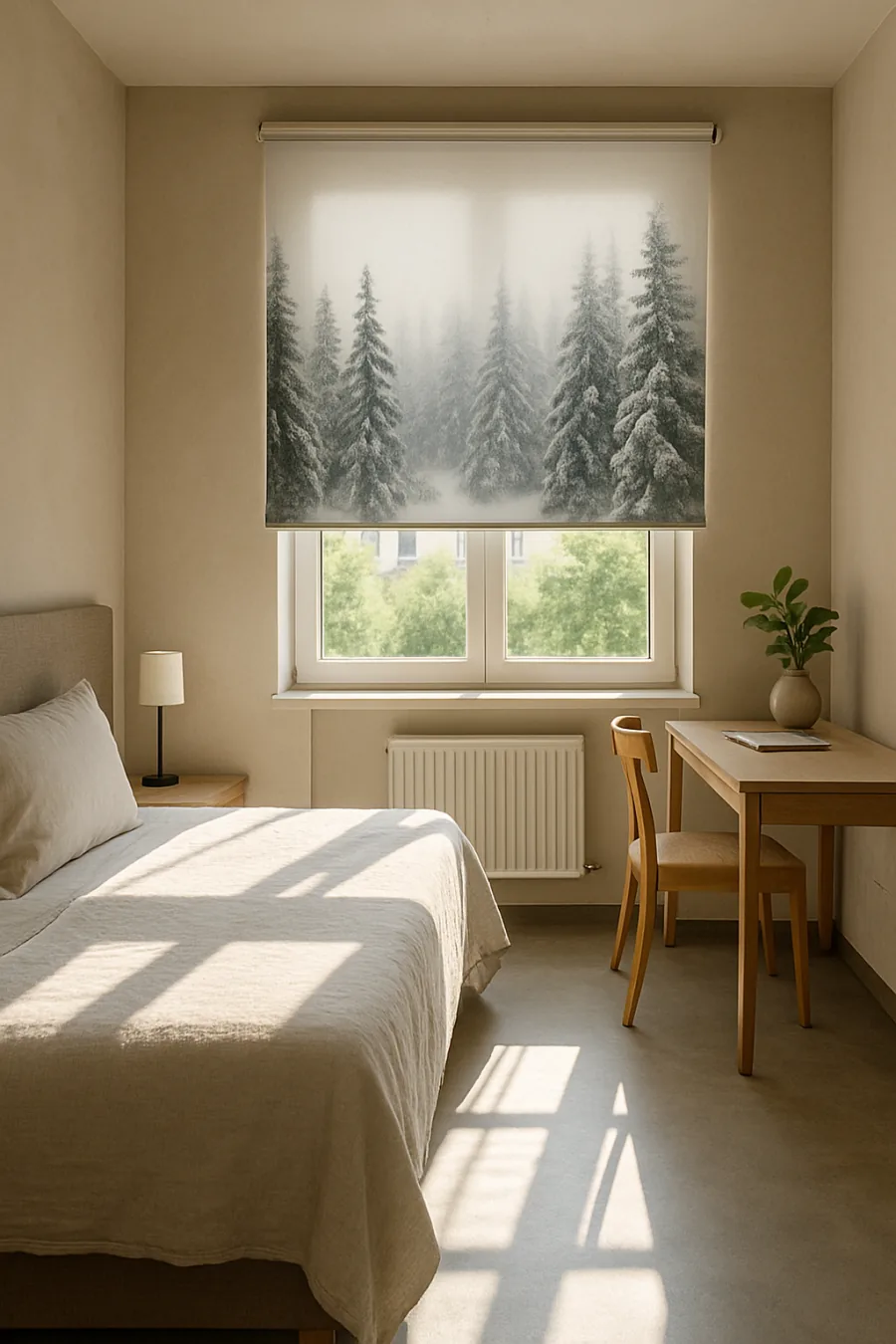
A snowy forest on dense fabric: a picture and darkness for sleep at once
Timeframe: 4–6 days
Sunflowers on light fabric, in the morning the sun lights up the pattern
Timeframe: 4–6 days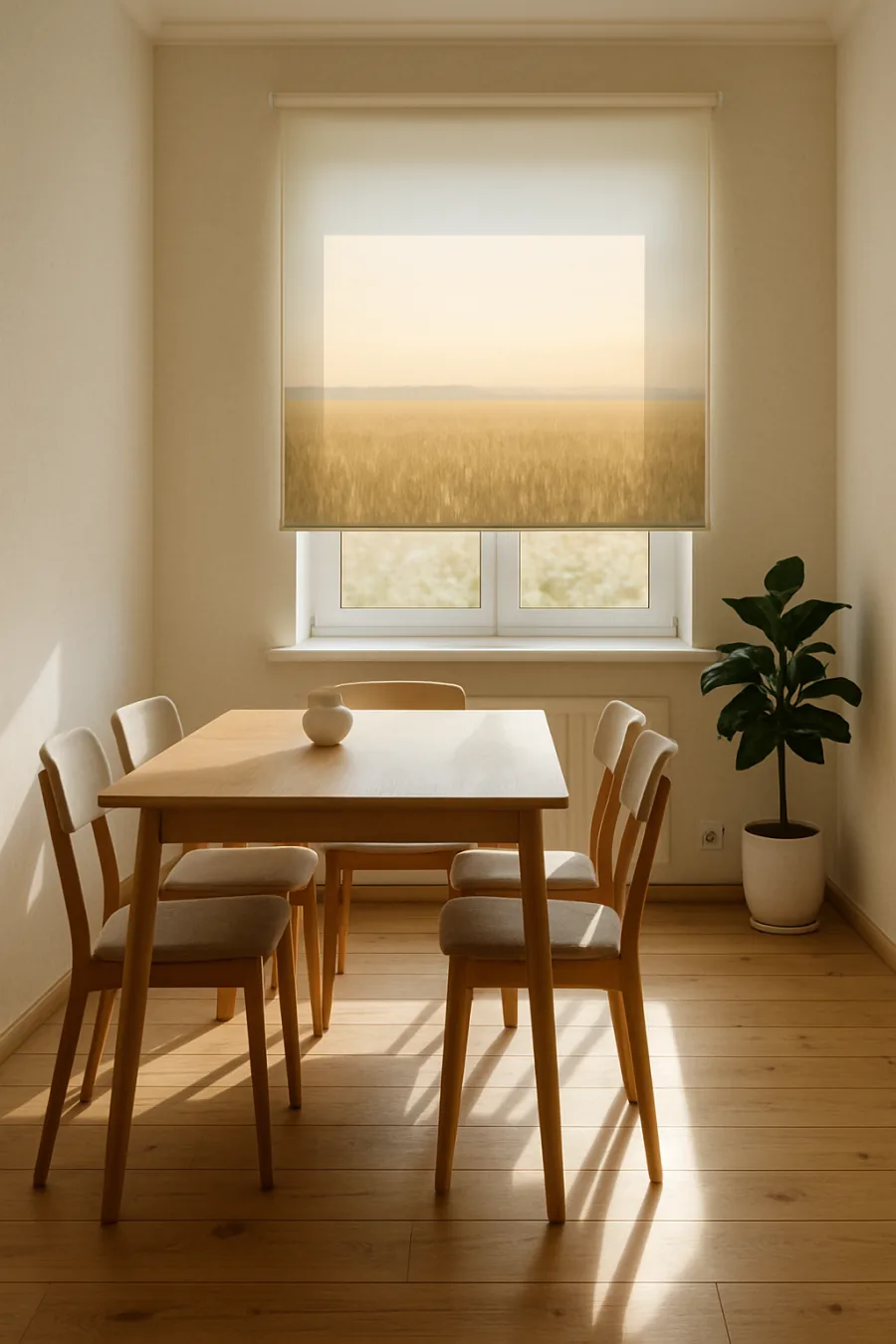
A wheat field with no logos: the customer asked for a calm picture
Timeframe: 4–6 days
A fine geometric grid: the pattern won’t look childish once the child grows up
Time: 5 days
Small leaves instead of plain white fabric — the office looks softer
Time: 6 days
Scandinavian polka dots: the meeting room stopped looking institutional
Time: 5 days
The blue wave was matched to the bedspread and the rug
Time: 6 days
A Moroccan ornament — the only pattern in the light hallway
Time: 6 days
A fine diagonal is calmer than a wide stripe, it doesn’t shimmer in the bedroom
Time: 5 days
Small stars on white: the pattern shows up close but doesn’t distract from a school desk
Time: 6 days
Grey-beige damask on cream across three sashes, the repeat matched at the joins
Time: 6 days
Dark blue fabric to match the headboard, the room feels deeper
Time: 5 days
Bright cobalt — the only splash of colour in the light studio
Time: 5 days
Indigo with texture takes away the sterility of the white office
Time: 6 days
The shade was chosen from samples, the closest to the company’s brand blue
Time: 5 days
A muted blue against grey concrete
Time: 5 days
Deep blue against the honey wood of the bed and the chest of drawers
Time: 6 days
Rich blue against the dark wood of the shelves
Timeframe: 4–6 days
For evening practice the hall is darkened almost completely
Time: 5 days
Rooms on the south side: the blind is lowered during the midday sun
Time: 6 days
The pearlescent layer faces the glass, so the light in the room is diffused
Time: 5 days
The parquet by the window no longer fades in a stripe
Time: 6 days
Dim-out: it keeps the heat out, but the room isn’t dark in the morning
Time: 6 days
Top floor, windows facing west — after lunch the fabric keeps the heat outside
Time: 5 days
The sun sets on two sides, so both sides of the corner were shaded
Time: 6 days
Light sand colour: from the street the facade isn’t dotted with dark windows
Time: 5 days
Desk by the window: the laptop screen is readable even at noon
Time: 5 days
The melange hides dust better than a smooth fabric
Time: 6 days
Cotton blend in dusty pink to match the armchairs
Time: 5 days
Linen-look fabric — the room feels homely, not hotel-like
Time: 5 days
The dense texture blocked the view of the neighbouring balcony
Time: 4 days
Grey melange by the sink: splashes are almost invisible on the uneven colour
Time: 5 days
Linen texture to match the wooden walls, no gloss
Time: 4 days
Warm grey that doesn’t show marks, by the front door
Time: 4 days
The coarse weave complements the brick and metal
Time: 6 days
Zip guide rails: the mountain wind doesn’t tear the fabric out
Timeframe: 10–14 days
Height and strong wind — the housings were fixed to the brick with anchors
Timeframe: 10–14 days
During the hot hours the fabrics are lowered, and the tables on the sunny side end up in the shade
Timeframe: 10–14 days
Fabrics of 4 m with no sagging, a motor on each
Timeframe: 10–14 days
The long side was divided into three fabrics
Timeframe: 10–14 days
The screen keeps the sun out, and the pool is still visible from the sun loungers
Timeframe: 10–14 days
The neighbours’ windows are opposite — the fabric screens the patio from prying eyes
Timeframe: 10–14 days
The screen lets air through: the smoke from the grill drifts away, and there’s shade on the desk
Timeframe: 10–14 days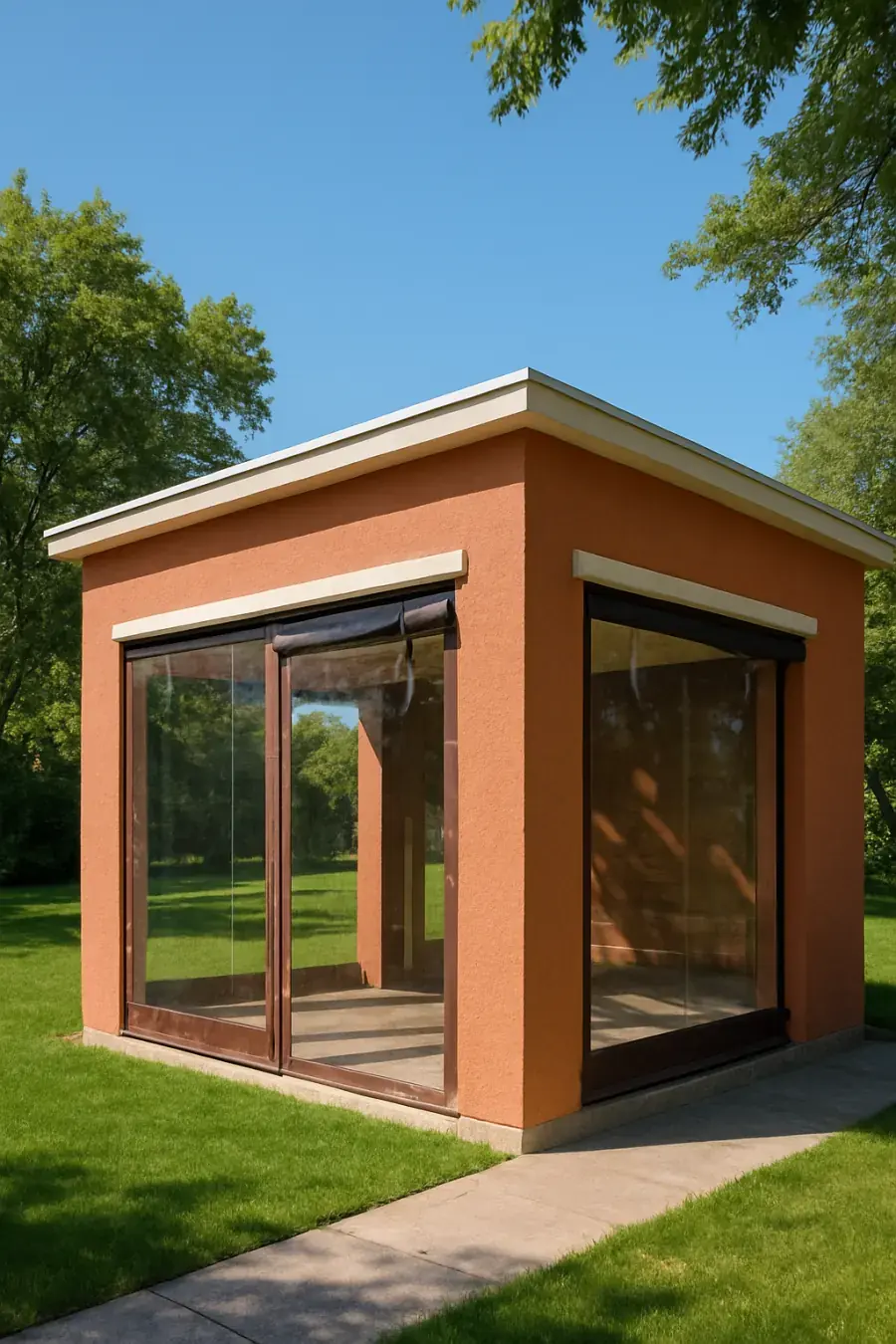
Clear PVC film: you still see the lawn, but the wind stays out
Timeframe: 10–14 days
Each side has its own curtain, opened from the sheltered side
Timeframe: 10–14 days
The grill stayed outside the clear wall — smoke no longer drifts into the gazebo
Timeframe: 10–14 days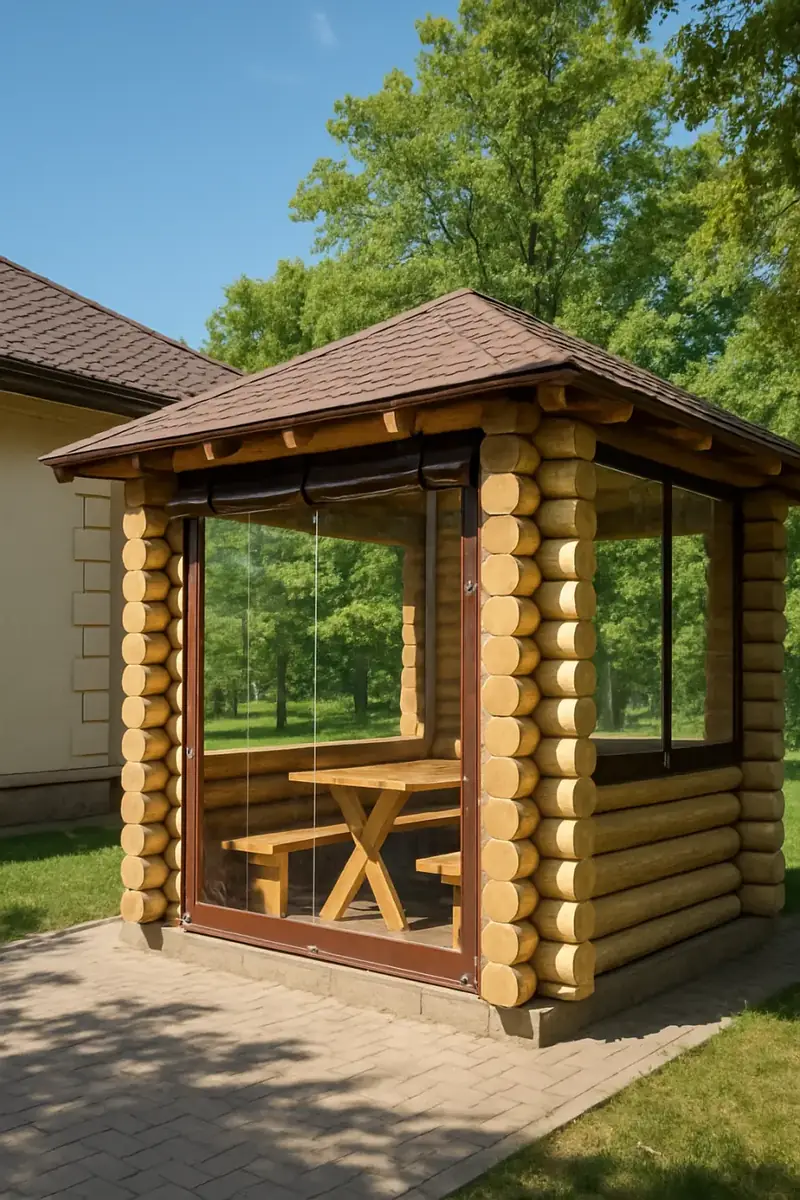
Straps with buckles: the roller blind is tied up at any height
Timeframe: 10–14 days
In the evening cold comes down from the mountains — all sides are lowered
Timeframe: 10–14 days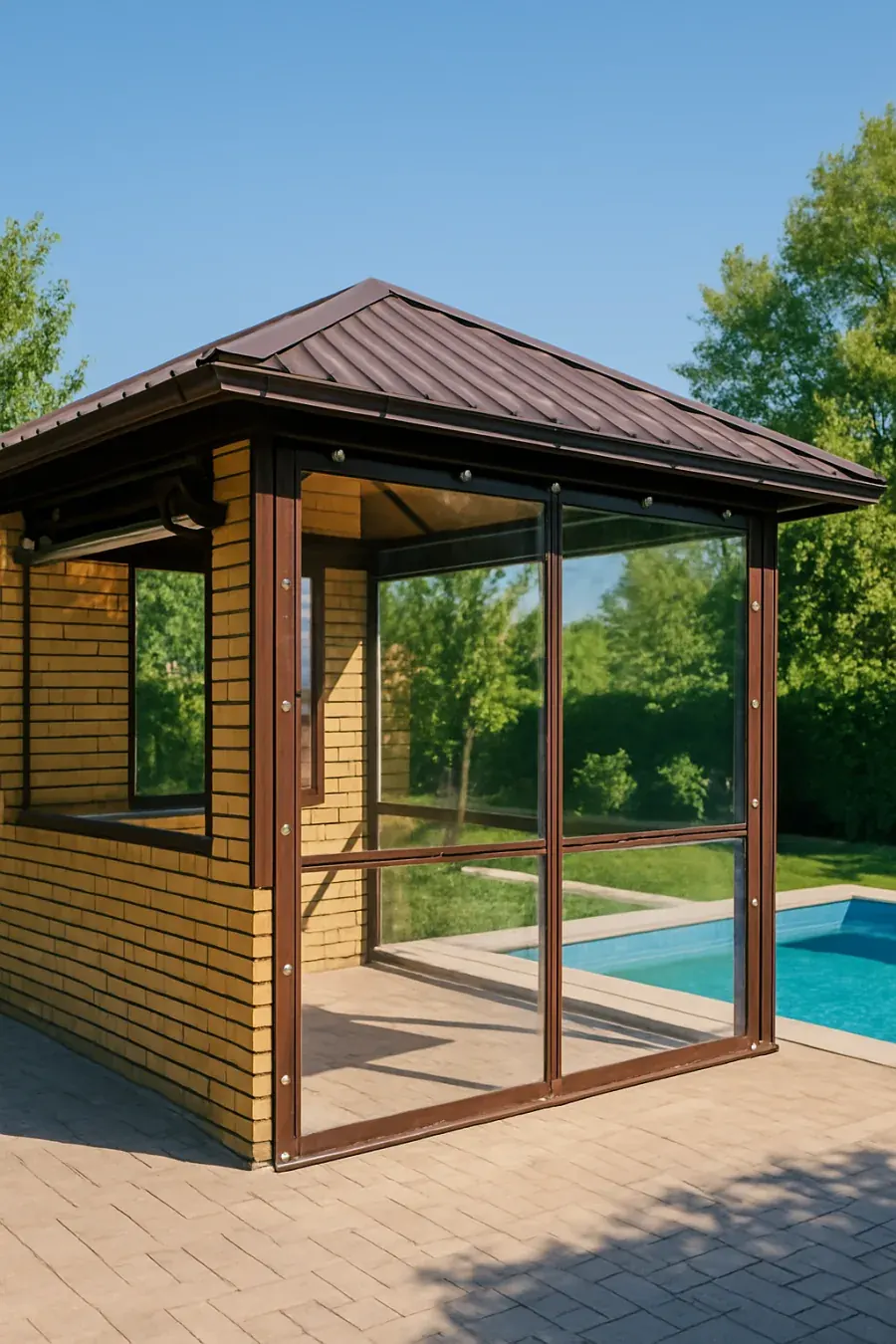
Splashes from the pool no longer reach the table
Timeframe: 10–14 days
By the water it gets cool in the evening — the sides are lowered, and you can still see the river
Timeframe: 10–14 days
In autumn the curtains are lowered, and people sit in the gazebo until October
Timeframe: 10–14 days
The chain is tensioned and fixed to the frame, so there is no loop
Time: 5 days
A cream fabric to match the bedspread, the desk by the window in even, soft light
Time: 6 days
The desk is right against the window: the blind is lowered a third of the way, the notebook is in the shade, and the room stays bright
Time: 5 days
Blackout for daytime naps, the blind on the sash
Time: 5 days
Each bed has its own blind and its own wake-up time
Time: 6 days
The little one sleeps in the dark during the day, light comes in only along the edge
Time: 6 days
Mini systems take up no wall space above the bed with storage
Time: 5 days
There is a wall bars next to it — the roller blind sits in a cassette, so a ball can’t knock it off
Time: 5 days
The PVC fabric is not afraid of steam, and the sash tilts open with the blind still on it
Time: 5 days
Two blinds on an anodised profile — there is nowhere for rust to start
Time: 6 days
Fibreglass does not stretch from steam, the fabric keeps its shape
Time: 6 days
During the day the white fabric lets light through and blocks the view in
Time: 5 days
The blind was hung away from the dryer, so steam does not reach the fabric
Time: 5 days
Ground floor: the window is closed while the light is on in the bathroom
Time: 5 days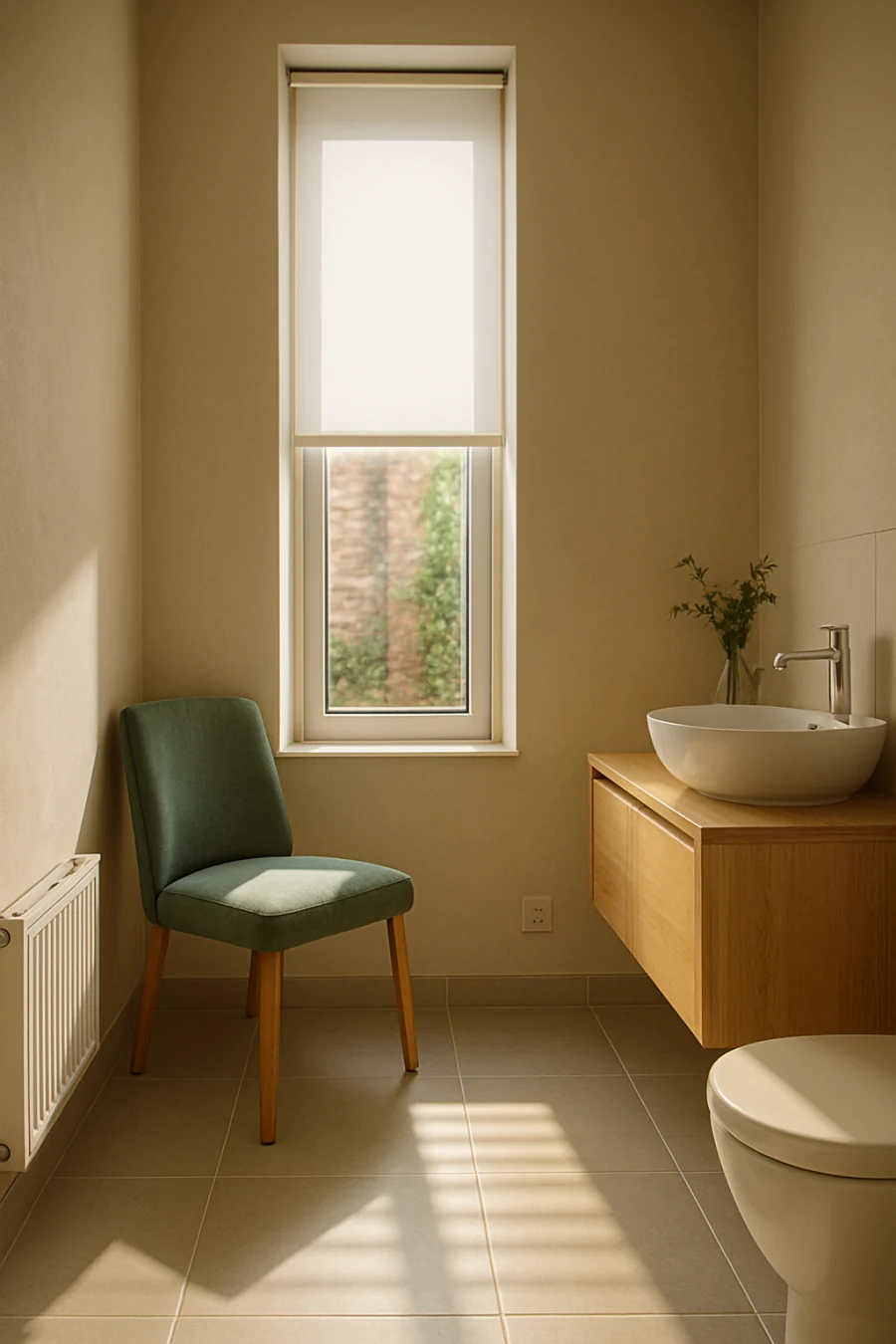
The narrow window was covered with a single blind 45 cm wide
Time: 4 days
Floor-to-ceiling windows in a bathroom — the fabric runs the full height with no seams
Time: 6 days
The fabric is taken down and washed once a season
Timeframe: 4–6 days Removable
Fabric with no treatment, handles washing easily
Timeframe: 4–6 days Removable
Taken down and washed off construction dust
Timeframe: 4–6 days Removable
For the winter the fabric is taken indoors
Timeframe: 4–6 days Removable
Clips on the rail: the fabric comes off completely, without tools
Timeframe: 4–6 days Removable
Washed once a season — the fabric has no treatment and handles washing easily
Timeframe: 4–6 days Removable
Kids and a dog: the fabric is taken down and washed, not scrubbed on the window
Timeframe: 4–6 days Removable
The rail stays on the wall, only the fabric is changed — for the season
Timeframe: 4–6 days Removable
For the winter the fabric is taken indoors, the mechanism doesn’t stay out in the cold
Timeframe: 4–6 days Removable
Dry cleaning once a year as required by the landlord, they take them down themselves
Timeframe: 4–6 days Removable
Spring clip: take down and put back in a minute, windows can be washed without help
Timeframe: 4–6 days Removable
Tall window: the blind comes off from below, no stepladder needed
Timeframe: 4–6 days Removable
The fabric was matched to the wall colour
Timeframe: 3–5 days Fabric
Installation at the weekend so the departments could keep working
Timeframe: 3–5 days Fabric
The density was chosen for daytime naps
Timeframe: 5–7 days Fabric
The light transmission was chosen for video calls
Timeframe: 3–5 days Fabric
The fabric was matched to the wall colour, we looked at the samples in our own lighting
Timeframe: 3–5 days Fabric
The blind slides to the side: the balcony door opens freely
Timeframe: 3–5 days Fabric
Wide slat: from three metres across there are fewer joints and it looks calmer
Timeframe: 3–5 days Fabric
Turning the slat removes the glare from the monitor without darkening the room
Timeframe: 3–5 days Fabric
Weights along the bottom: at height the slats do not fly apart in a draught
Timeframe: 3–5 days Fabric
The density was chosen for daytime naps, with an overlap at the edges
Timeframe: 5–7 days Fabric
Wide slats on a large shop window: the blind is pulled to the side, and the goods are visible from the street
Timeframe: 3–5 days Fabric
Antistatic treatment: by the road dust does not stick to the slat
Timeframe: 3–5 days Fabric
Separated the sleeping area without a door
Timeframe: 5–7 days Rope
The passage stayed completely clear
Timeframe: 5–7 days Rope
String curtains for looks, roller blind for light
Timeframe: 5–7 days Rope
Zoning workstations without walls
Timeframe: 5–7 days Rope
Light comes through, while direct rays on the table are softened
Timeframe: 5–7 days Rope
Not on a window but on the opening: zoned the hallway and living room
Timeframe: 5–7 days Rope
Two layers of threads: light is dimmed more than with a single string curtain
Timeframe: 5–7 days Rope
Shine in the light — the shop window is visible from the street even in the evening
Timeframe: 5–7 days Rope
Air passes freely: on a veranda that matters more than shading
Timeframe: 5–7 days Rope
The threads don’t tangle: we fitted a weight at the bottom
Timeframe: 5–7 days Rope
Instead of drapes: doesn’t eat up the space of a small studio
Timeframe: 5–7 days Rope
Fitted away from the stove, washed once a season in a bag
Timeframe: 5–7 days Rope
Shaded the shop window from the sun, the goods on the shelves stopped fading
Time: 5 days Blinds
The whole house in one visit, the shade matched in every room
Time: 8 days Blinds
No dangling cord — the parents’ requirement
Time: 3 days Blinds
Two floor-to-ceiling windows covered the same way, the studio reads as one whole
Time: 4 days Blinds
Wiped with a damp cloth right on the window, no need to take them down
Time: 4 days Blinds
Tilting the slat changes the light at the desk from morning to evening
Time: 5 days Blinds
Light profile to match the walls, mounted on the sash without drilling
Time: 5 days Blinds
Each sash gets its own blind, the windows open together with it
Time: 5 days Blinds
White slats match the plastic frames: the closed window blends into the light wall, and the living room stays bright during the day.
Timeframe: 3–5 days
White slats by the stove: splashes show up on them right away, and they are wiped off with a sponge on the window before they dry.
Timeframe: 3–5 days
White day-night blinds on an east-facing window: the morning sun passes through the light stripes as diffused light, with no harsh spots on the wall.
Timeframe: 5–7 days
White PVC in a child’s room: the slat springs back if a toy hits it, and it is wiped with a cloth right on the window.
Timeframe: 3–5 days
The white slats are mounted on the door sash and move with it, so the way out to the balcony is not blocked at all.
Timeframe: 3–5 days
White to match the landlord’s white frames: mounted into the glazing bead, so after moving out the window looks just as it did at check-in.
Timeframe: 3–5 days
White vertical blinds across the whole glazed wall: even with the slats closed, the office does not feel dark.
Timeframe: 3–5 days
White PVC on a bathroom window: nothing can be seen from the street, and the light in the small room is not reduced.
Timeframe: 3–5 days
A warm beige matches the tone of the living room walls; the slats are mounted on the sash and open together with the window
Timeframe: 3–5 days
The beige slat by the stove is wiped with a sponge and a mild cleaner, without taking it off the window
Timeframe: 3–5 days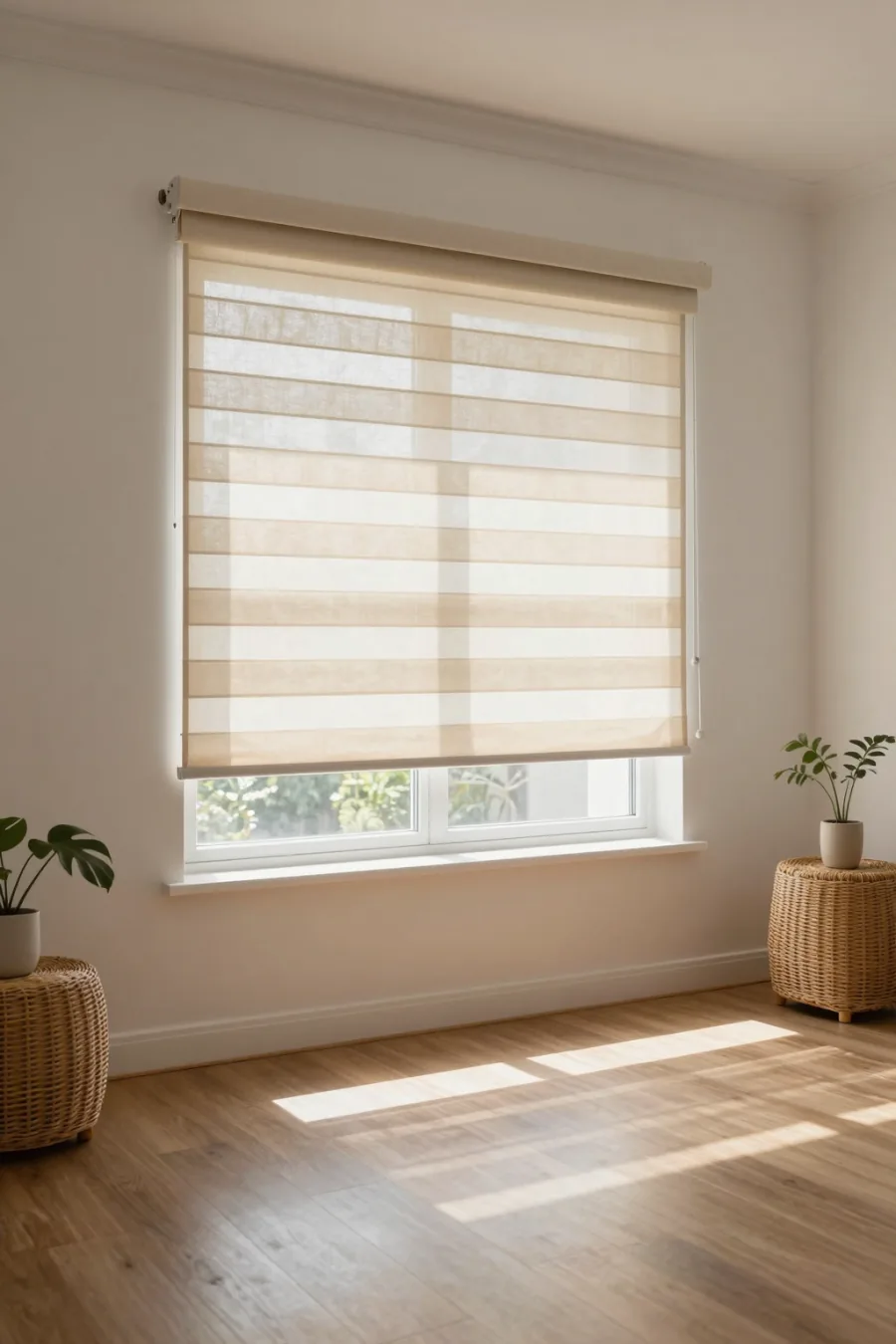
Beige day-night blinds on the sash: in the morning the stripes are closed, and the light in the bedroom becomes soft and warm in tone
Timeframe: 5–7 days
The beige slats serve as a calm backdrop for bright toys and are wiped with a cloth right on the window
Timeframe: 3–5 days
The slats are mounted on the door sash and open together with it; the transom above the door is covered by a separate blind
Timeframe: 3–5 days
The beige blinds are held on brackets in the glazing bead — after moving out, no holes will be left in the frame
Timeframe: 3–5 days
Beige fabric slats across all the glazing: offices get soft diffused light and fewer reflections on monitors
Timeframe: 3–5 days
Beige aluminium on a small bathroom window handles steam and is washed right in place
Timeframe: 3–5 days
The fabric sits right against the glazing bead: in the morning the bedroom is in twilight, and the window is closed off from the neighbouring building
Timeframe: 4–6 days
Reflections on the screen are gone, and the contrast holds even during the day — the window is fully covered
Timeframe: 4–6 days
Sun-protection blinds on the balcony reflect the heat back behind the glass: cooler in summer
Timeframe: 3–5 days
The child’s room was darkened for a daytime nap; only a narrow strip of light remains at the edges of the window
Timeframe: 4–6 days
The window is fully covered, and the studio reads as a single line, with no division into zones
Timeframe: 3–5 days
An even dark background behind you, no glare on the screen, and the room still isn’t sealed off
Timeframe: 4–6 days
During the day visitors look out at the street through the open slats; at closing time the row is closed up
Timeframe: 3–5 days
Bracket mounting into the glazing bead: the frame was left untouched, and it comes off without a trace if you move
Timeframe: 4–6 days
Black day-night blinds soften the morning sun and screen the bedroom from the windows of the house next door
Timeframe: 5–7 days
Closed black slats take direct glare off the screen during the day, though they don’t make the room fully dark
Timeframe: 3–5 days
A black background behind you instead of a busy wall reads cleanly on video calls
Timeframe: 3–5 days
Black vertical slats read as part of the brand and close off the hall in the evening
Timeframe: 3–5 days
Black day-night blinds soften the window during a shoot, and between takes the strips are opened and work goes on in daylight
Timeframe: 5–7 days
Black slats in the same tone as the frames and the metal elements of the interior
Timeframe: 3–5 days
Black blinds keep the salon’s dark palette and close off the shop window after the shift
Timeframe: 3–5 days
The black fabric above the window echoes the dark dining table and pulls the studio into one graphic line
Timeframe: 5–7 days
The office is hidden from view while the slats are closed; open them and daylight is back on the desk
Timeframe: 3–5 days
The sun no longer falls on the screen: the slats are set at an angle, and the meeting room is still bright
Timeframe: 3–5 days
The strips on each window are moved separately: at the monitors the sun is blocked without darkening the whole hall
Timeframe: 5–7 days
The brackets sit in the glazing bead, the frame was not drilled; the mounting method was agreed with the property owner in advance
Timeframe: 3–5 days
Slats 89 mm cover a wide opening with a single blind; turned edge-on, they diffuse the light evenly
Timeframe: 3–5 days
During the hours of direct sun the slats are angled to cover, and no hot spots are left on the desks
Timeframe: 3–5 days
During the day the street is visible through the sheer strips; in the evening the dense ones are closed, and the reception is barely visible from the pavement
Timeframe: 5–7 days
The developer’s frame was left untouched: the blinds are held on brackets in the glazing bead
Timeframe: 3–5 days
Each sash has its own blind, opens together with it, and the second sash stays closed.
Timeframe: 4–6 days
Blocked the sun without losing the view: during the day you can see who has arrived, and the glare on the reception desk is gone.
Timeframe: 3–5 days
The fabric can be wiped with a damp cloth right on the door, no need to take it down.
Timeframe: 3–5 days
A chain instead of a wand: the top of the opening is out of reach, so the control was brought down to a convenient height.
Timeframe: 3–5 days
White slats cover the door glass down to table level, and tilting them softens the sun over dinner.
Timeframe: 3–5 days
Mounted on brackets into the glazing bead: the frame was left untouched, and they come off without a trace when you move.
Timeframe: 3–5 days
Vertical slats on the shop window next to the glass door: during the day they are turned towards the light, in the evening they screen the room from passers-by.
Timeframe: 3–5 days
The fabric does not flap in a draught, and the way out to the terrace stays clear.
Timeframe: 3–5 days
Purple PVC to match the walls of a child’s room: the slat springs back from an accidental touch and can be wiped with a cloth right on the window.
Timeframe: 3–5 days
Purple aluminium can be wiped right on the window, grease does not soak into the slat — no need to take the blind down.
Timeframe: 3–5 days
Purple fabric slats to match the living room textiles gather to one side and open the window completely.
Timeframe: 3–5 days
The slats take the glare off the monitor without darkening the room — you can work without a lamp during the day.
Timeframe: 3–5 days
Purple in the brand palette: bright during the day, screened from passers-by in the evening.
Timeframe: 3–5 days
Purple day-night on the sash: in the morning the stripes are closed, and the sun in the bedroom becomes soft and lilac.
Timeframe: 5–7 days
Installed without drilling the frame, they come off without a trace when you move.
Timeframe: 3–5 days
Purple vertical blinds hold their shape on wide openings, and the light stays even all working day.
Timeframe: 3–5 days
Blue slats 25 mm to match the walls of a child’s room, wiped with a cloth right on the window
Timeframe: 3–5 days
Blue slats on the kitchen window freshen up a warm kitchen, and cooking marks are wiped off with a damp sponge right on the window
Timeframe: 3–5 days
Blue PVC to match the living room textiles, the slats sit on brackets without drilling the frame
Timeframe: 3–5 days
Blue slats at an angle take the glare off the monitor, while daylight stays in the study
Timeframe: 3–5 days
Blue slats on the shop window: bright during the day, and after closing they are turned so the room is barely visible from the street
Timeframe: 3–5 days
Blue day-night on a bedroom window: in the morning the stripes are closed, and the light becomes soft and cool in tone
Timeframe: 5–7 days
Blue blinds on brackets without drilling the frame: when moving out, residents can take them down without a trace
Timeframe: 3–5 days
Blue slats 89 mm were turned at an angle to the sun — the glare on the monitors is gone, while the office still has daylight
Timeframe: 3–5 days
The slats are tilted by a motor, the morning sun is softened, and the window stays covered by the fabric
Timeframe: 7–10 days
Slat tilt from the remote control, no hanging cords or chains in the room
Timeframe: 7–10 days
The slats by the stove are wiped on the window; the motor and rail are left in place and not removed
Timeframe: 7–10 days
The slats are tilted at an angle, the glare on the screen is gone, and the light in the room stays daylight
Timeframe: 7–10 days
The motor and power supply were matched to the moving sash, and the wiring was checked at the measurement
Timeframe: 7–10 days
The depth of the glazing bead and the space for the rail were checked at the measurement before ordering the motor
Timeframe: 7–10 days
Each sash has its own blind and its own motor, with one button for all
Timeframe: 7–10 days
The frame was not drilled under warranty — mounted into the glazing bead, slats adjusted
Timeframe: 7–10 days
Each sash has its own blind: slats in different windows are tilted differently depending on where the sun is coming from.
Timeframe: 3–5 days
The aluminium slats by the stove are wiped after tilting them: the grease stays on the surface and comes off with a cloth.
Timeframe: 3–5 days
A separate blind on each sash and on the transom: the slats are partly closed, the direct rays are blocked, and the bedroom gets soft diffused light.
Timeframe: 3–5 days
White slats against pine furniture: the kids’ room is bright during the day, and direct sun falls on the floor in soft stripes.
Timeframe: 3–5 days
The blind on the door rises to the top of the sash and opens with it, while the transom is covered by a separate blind.
Timeframe: 3–5 days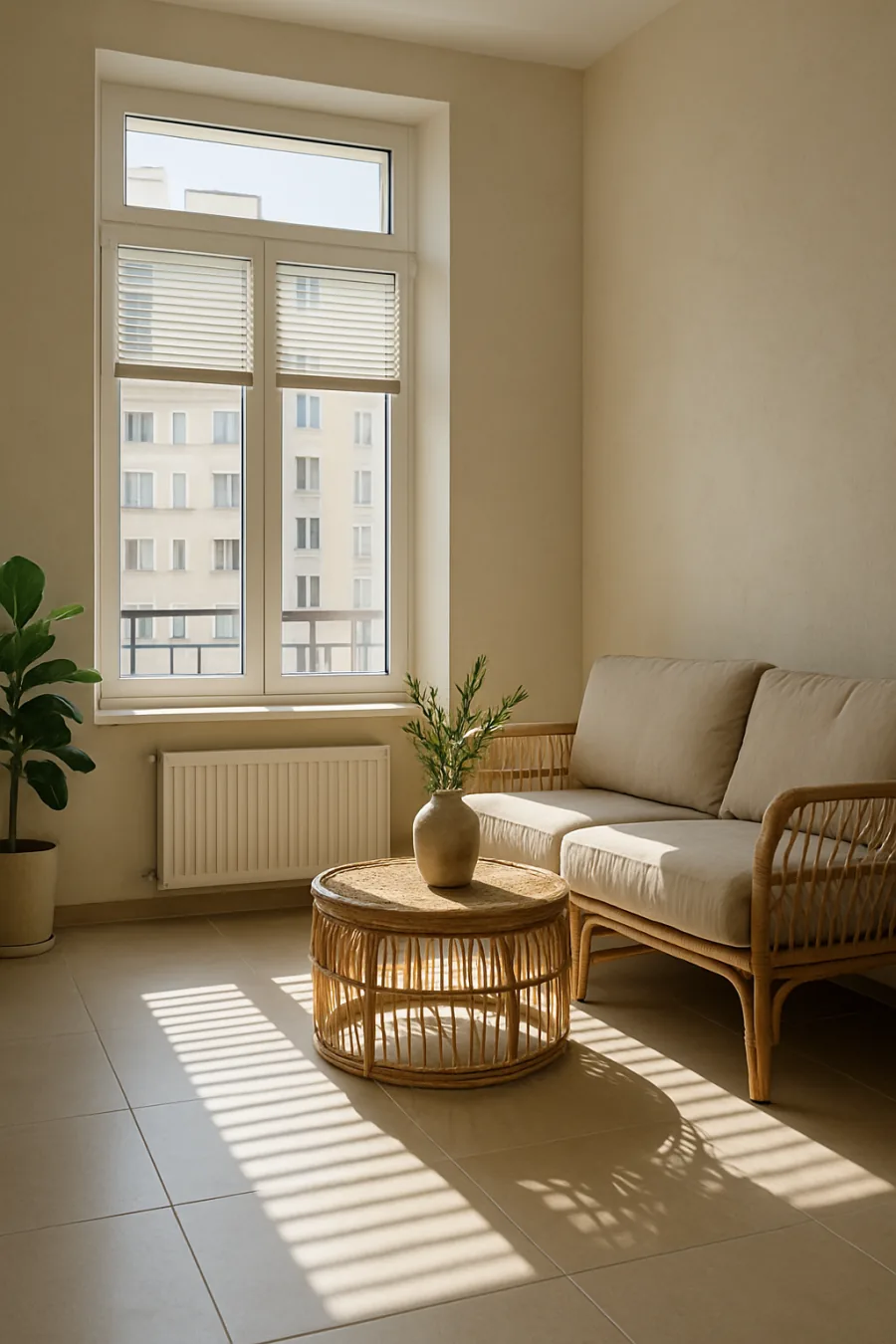
Rails on brackets in the glazing bead: not a single hole in the frame, and the blinds can be removed without a trace when you move out.
Timeframe: 3–5 days
The white blind is lowered to the lower sashes: diffused light over the desk, while the view of the garden below stays open.
Timeframe: 3–5 days
Narrow window above the tiles: the blind is raised a third of the way, and the slats are wiped with a damp cloth right in place.
Timeframe: 3–5 days
Clouds and hot-air balloons on the slats, opened in strips during the day
Timeframe: 7–12 days
A calm motif matching the backsplash; splashes are wiped off with a cloth right on the window
Timeframe: 7–12 days
The scene forms a picture when the slats are closed; during the day they are tilted and you look out into the yard
Timeframe: 7–12 days
The mug logo comes together on the lowered slats, and there is no glare at the table
Timeframe: 7–12 days
The mountains on the two windows meet at the corner, and in the morning the light comes through the slats in stripes
Timeframe: 7–12 days
The scene in the salon’s colour palette; in the evening the hall is closed off from the street
Timeframe: 7–12 days
A neutral geometric print, the glare on the screen is gone
Timeframe: 7–12 days
Patterned blinds across the whole shop window, so direct sun never hits the goods
Timeframe: 7–12 days
Each sash has its own narrow blind right at the glass, and the windowsill stays free
Timeframe: 3–5 days
The blind on the door sash lifts and moves with the door, and the window is covered by its own blind
Timeframe: 3–5 days
The slats shade the room from the morning sun: soft light in the bedroom, and the windows of the house next door no longer look straight into the room
Timeframe: 3–5 days
The slats sit between the panes of the wooden frame, so a child can’t reach them or bend them
Timeframe: 3–5 days
Blinds on glazing-bead brackets: when tenants move out, the window goes back with not a single hole in the profile
Timeframe: 3–5 days
The wide window was split into two blinds, each lowered to its own height
Timeframe: 3–5 days
Glazing-bead brackets, so the landlord’s frame was not drilled and there was no need to clear the installation with the owner
Timeframe: 3–5 days
The slats were turned so the sun doesn’t hit the screen, while the desk by the window stays bright
Timeframe: 3–5 days
Each window has its own section, so no sun spots are left on the monitors along the glass.
Timeframe: 3–5 days
The slats shade at an angle to the screen: the projector image reads clearly, and it stays bright at the desk.
Timeframe: 3–5 days
Closed slats on both sashes screen the manager’s desk from the windows opposite.
Timeframe: 3–5 days
Glazing-bead brackets, so the landlord’s frame was not drilled — the fixing was shown to him before installation.
Timeframe: 3–5 days
The tall sashes are covered by separate blinds, and each opens together with its own blinds.
Timeframe: 3–5 days
By midday the slats are turned away from the sun, and the desk by the window doesn’t heat up.
Timeframe: 3–5 days
During the day the street is visible, and in the evening, with the lights on, the slats are closed — otherwise the hall can be seen from the street.
Timeframe: 3–5 days
The blinds were installed before the departments moved in, one floor per visit, and by the move every window was already covered.
Timeframe: 3–5 days
The slat tone was matched to the floor colour, so the window reads as a single line, without clutter
Timeframe: 3–5 days
A brown slat on the narrow sash by the stove: splashes and grease wipe off with a sponge, without taking the blinds down
Timeframe: 3–5 days
The closed stripes of the brown day-night blind soften the morning sun into a warm half-shade
Timeframe: 5–7 days
Brown slats hide marks from children’s hands and wipe clean with a damp cloth right on the window
Timeframe: 3–5 days
The day-night blind is fixed to the balcony door sash and lifts without getting in the way of going out
Timeframe: 5–7 days
At an angle, the brown slats kill the glare on the monitor, while the light in the office stays warm and natural
Timeframe: 3–5 days
Brown fabric slats in a coffee palette: the hall is bright during the day, and the slats are closed after hours
Timeframe: 3–5 days
Brackets in the glazing bead hold the brown slats without a single hole in the frame — when you move, they simply come off
Timeframe: 3–5 days
A row of opaque and sheer slats on floor-to-ceiling windows: the living room is bright by day, and in the evening the slats close
Timeframe: 7–10 days
The opaque slats were turned towards the sun — the glare left the monitor, while the sheer ones kept the desk bright
Timeframe: 7–10 days
Each bay window sash has its own short rail, and the slats are moved one at a time
Timeframe: 7–10 days
By day the slats are turned edge-on to the shop window, and by evening the opaque ones close the sales floor off from the pavement
Timeframe: 7–10 days
In the morning the slats are turned — the bedroom brightens, while the opaque strips screen the bed from the windows opposite
Timeframe: 7–10 days
In the north-facing kids’ room there are more sheer slats: there is little light, and the row does not take it away
Timeframe: 7–10 days
The slats are moved to the wall, and the sash opens for ventilation without removing anything
Timeframe: 7–10 days
The row slides apart to both sides, and the balcony door opens without obstruction
Timeframe: 7–10 days
Cut to the radius: the fabric follows the shape of the opening, and the corners are not left exposed
Timeframe: 3–5 days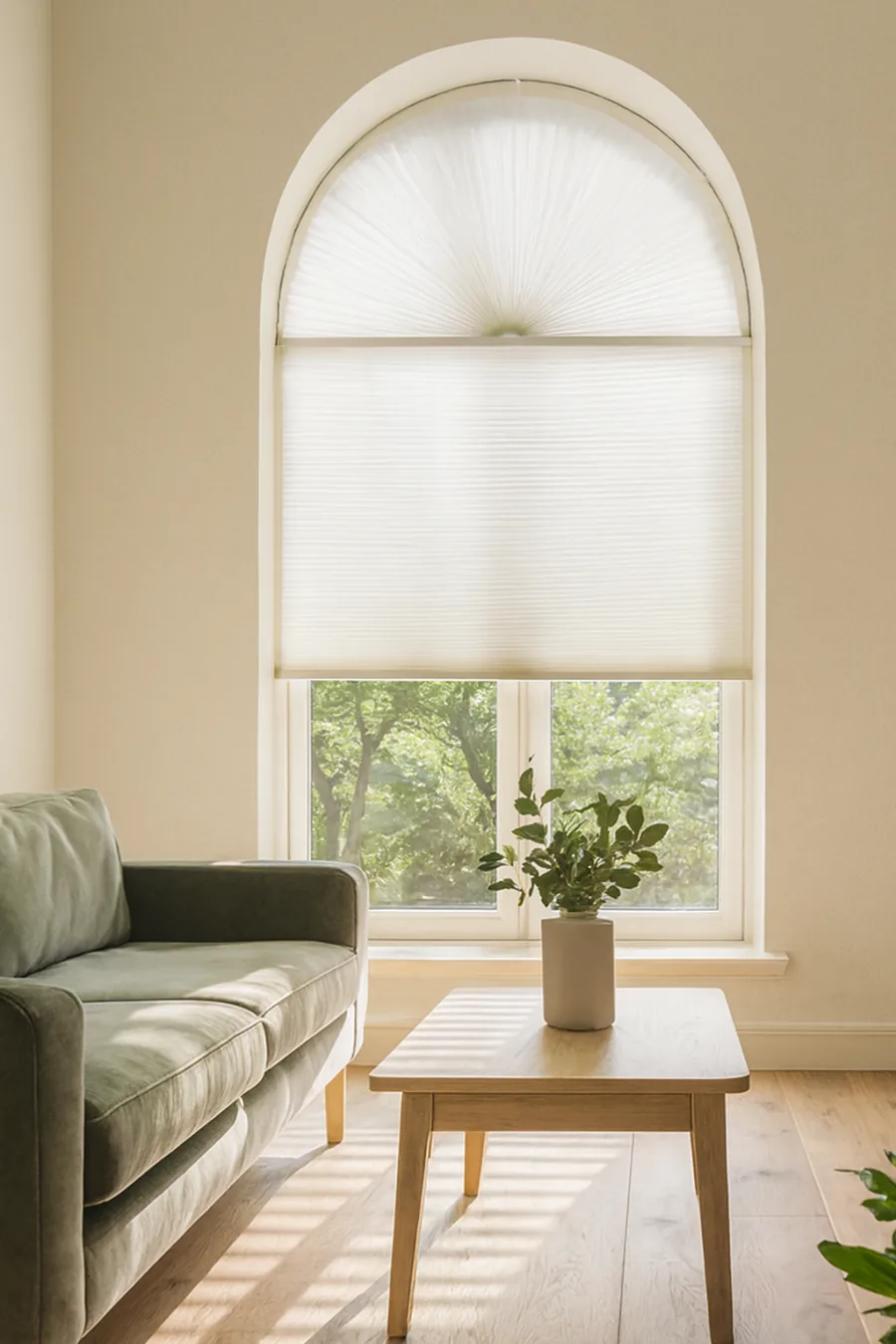
The straight part is movable, the arch is fixed to a template — otherwise the curve cannot be covered
Timeframe: 5–7 days
The fabric does not stop the door from opening and covers the opening completely
Timeframe: 3–5 days
The semicircular frame was not drilled: the brackets went into the glazing bead, so the profile in the new build has not a single hole
Timeframe: 3–5 days
The fabric is on the sash: the door opens together with it, and the window closes separately
Timeframe: 5–7 days
The slats follow the curve of the window: by day they are turned, so the sun does not hit the desk and the facade opposite stays visible
Timeframe: 3–5 days
The wooden slats follow the curve, and the straight part is raised above the windowsill — even stripes of light on the floor
Timeframe: 7–12 days
The top is out of reach — the control was brought down to a convenient height
Timeframe: 5–7 days
Each sash has its own fabric, the windows open together with the blinds, and you can ventilate without raising them
Timeframe: 3–5 days
The guide rails on the sides hold the fabric, so in a draught it does not bang against the frame when the sash is open
Timeframe: 3–5 days
A separate blind on each sash on both sides of the corner: the sun is blocked from two sides, and the sashes open together with the blinds
Timeframe: 3–5 days
By day the slats are tilted at an angle to the southern sun, so the room is bright but without glaring rays
Timeframe: 3–5 days
Dark slats remove glare from the laptop screen, while the desk along the windowsill stays in even light
Timeframe: 3–5 days
One fabric for both sashes of a floor-to-ceiling window; the slats cut the light without blocking the view of the courtyard
Timeframe: 3–5 days
The profile was not drilled; each sash is covered by its own fabric with its own control
Timeframe: 3–5 days
The fabric does not get in the way of hanging laundry and shields the balcony from the sun and prying eyes during the day
Timeframe: 3–5 days
The fabric runs the full height, so the window reads as a single line, with no division into sections
Timeframe: 3–5 days
A separate fabric on each sash; in the morning the bedroom gets soft, diffused light
Timeframe: 4–6 days
Closed with a single fabric, so the studio reads as one whole, without being broken up by windows
Timeframe: 4–6 days
The soft fabric gathers in folds above the door, leaving the way to the balcony clear
Timeframe: 7–10 days
Aluminium slats on brackets fitted into the glazing bead: not a single hole was left in the profile of the rented flat
Timeframe: 3–5 days
The slats remove glare from the monitor without darkening the room
Timeframe: 3–5 days
One light-coloured fabric for both sashes softens the sun above the desk
Timeframe: 4–6 days
Vertical slats on a floor-to-ceiling window: by day the hall is bright, in the evening they are turned to screen the tables from passers-by
Timeframe: 3–5 days
The fabric locks at any point and does not slide down the slope, even when the window is open.
Timeframe: 7–10 days
Cut to the shape of the opening: the corners along the slope are not left exposed.
Timeframe: 7–10 days
Soft shade, the view of the garden stays clear, and the plants do not stretch towards the glass.
Timeframe: 7–10 days
Each sash has its own fabric in side guide rails, covering the wide slope completely.
Timeframe: 7–10 days
The fabric in guide rails with cords holds in any position and does not sag.
Timeframe: 7–10 days
A daytime nap in the shade: dense fabric and no dangling cords in the room.
Timeframe: 7–10 days
Open at the top by day, closed at the bottom in the evening — two lighting scenarios on one window.
Timeframe: 7–10 days
The pleated blind is mounted on the door itself and opens with it; the bottom of the fabric does not catch on the threshold.
Timeframe: 7–10 days
The fabric was cut to a circular template: only a technical gap was left along the edge.
Timeframe: 3–5 days
The top is out of reach, so the control was brought down to a convenient height, with the chain running along the window reveal.
Timeframe: 3–5 days
The dark fabric is lowered over two thirds of the circle: the sun does not beat into the room, while the lower segment keeps the view of the city.
Timeframe: 7–10 days
The pleated blind holds the fabric along the arc of the circle: the plants get diffused light instead of direct midday sun.
Timeframe: 7–10 days
The semicircular window above the sashes is covered with a fan-shaped pleated blind, so the light above the bed is diffused.
Timeframe: 7–10 days
The wide slats were lowered to the lower segment of the circle: light falls in stripes on the sofa, while the view of the city below stays open.
Timeframe: 3–5 days
The brackets were fitted into the glazing bead, so the round frame of the new building was not drilled, and the slats were cut along the circle.
Timeframe: 3–5 days
The wooden slats follow the circle: open them slightly and warm diffused light falls on the table.
Timeframe: 7–12 days
We installed a mini system: the handle and the window reveal stay free, the fabric moves with the sash, and you can ventilate without raising it
Timeframe: 3–5 days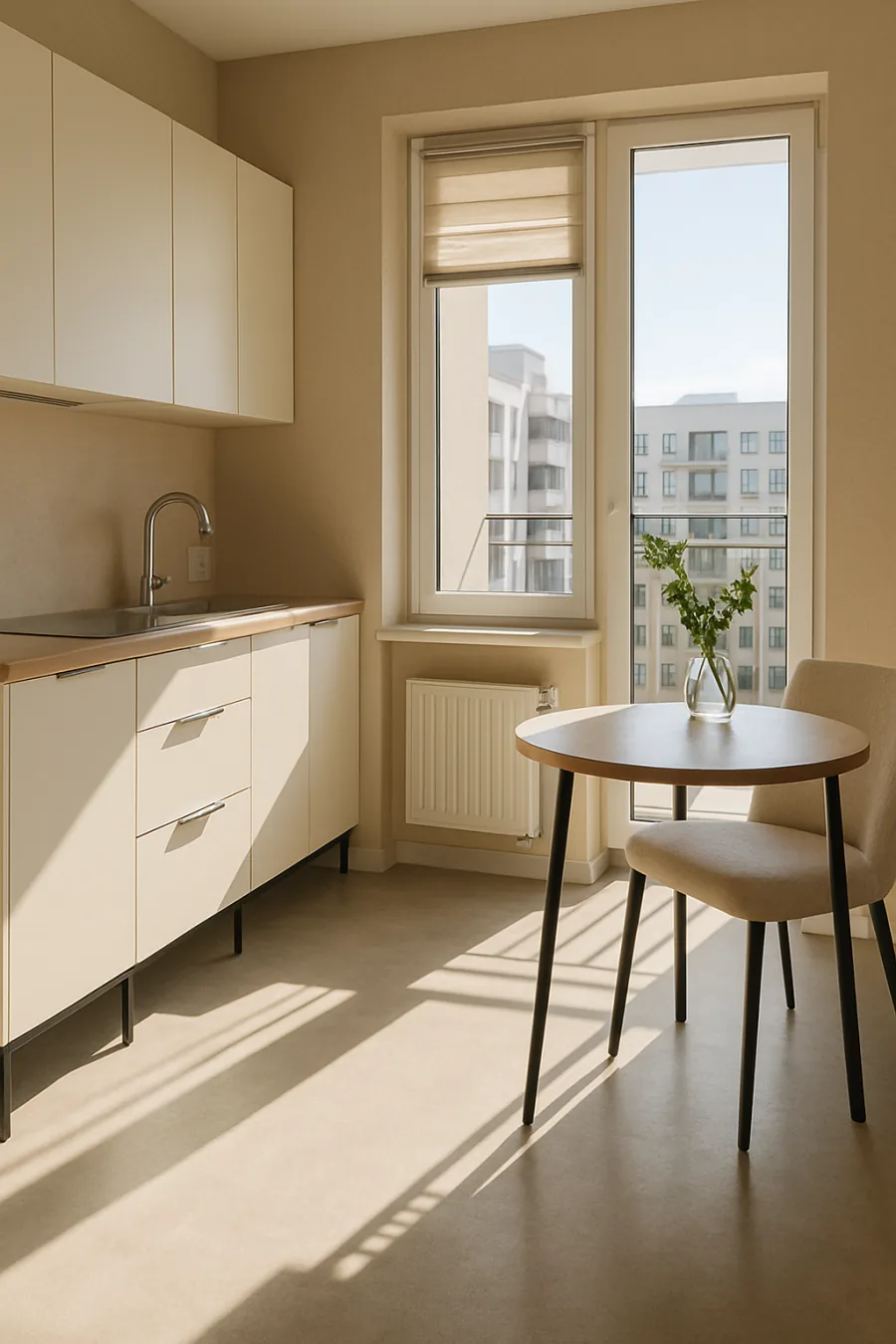
The horizontal slats on the door move with the sash, while the window is covered by a separate fabric
Timeframe: 3–5 days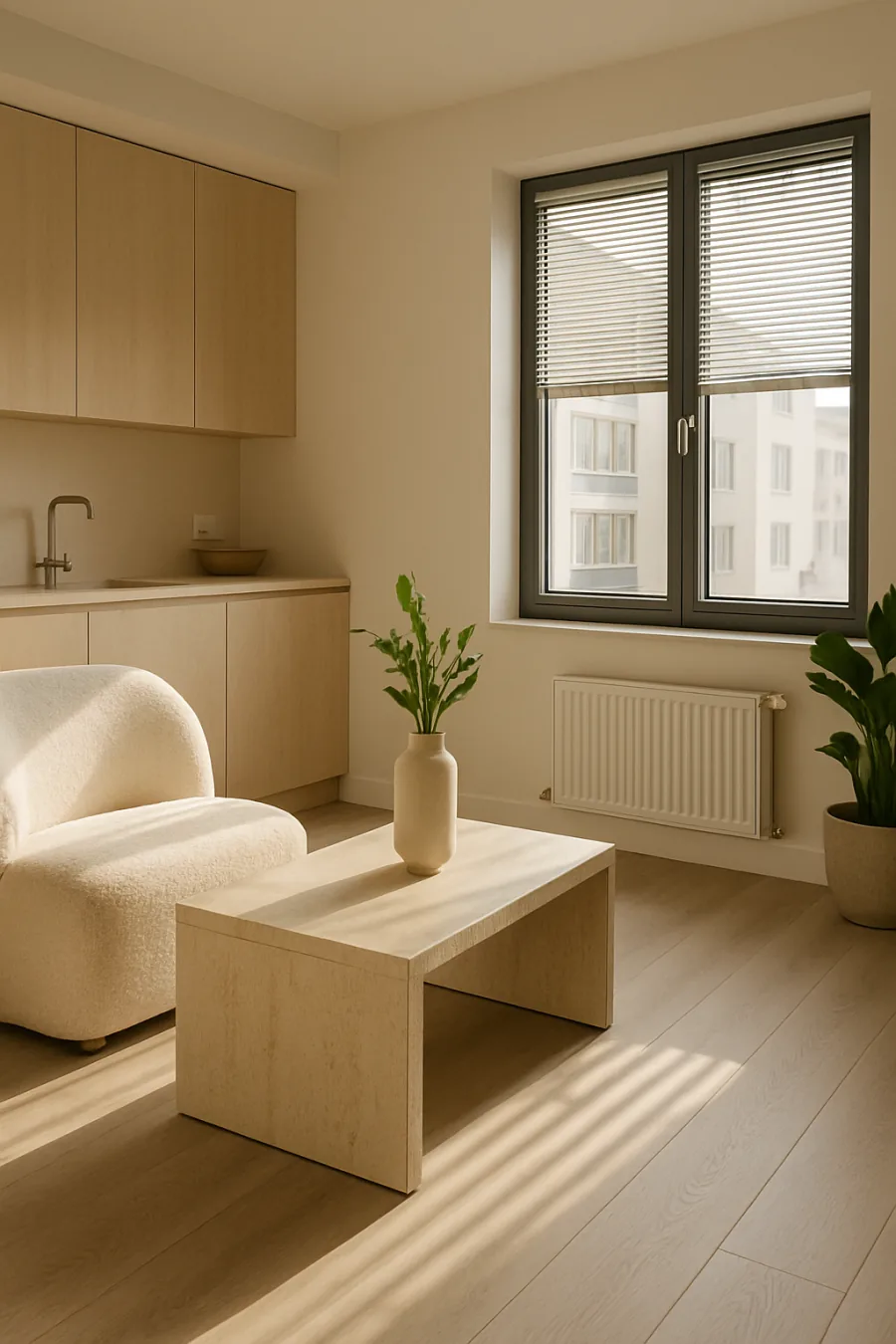
The slats on each sash are fixed into the glazing bead, with not a single hole in the frame of the new building
Timeframe: 3–5 days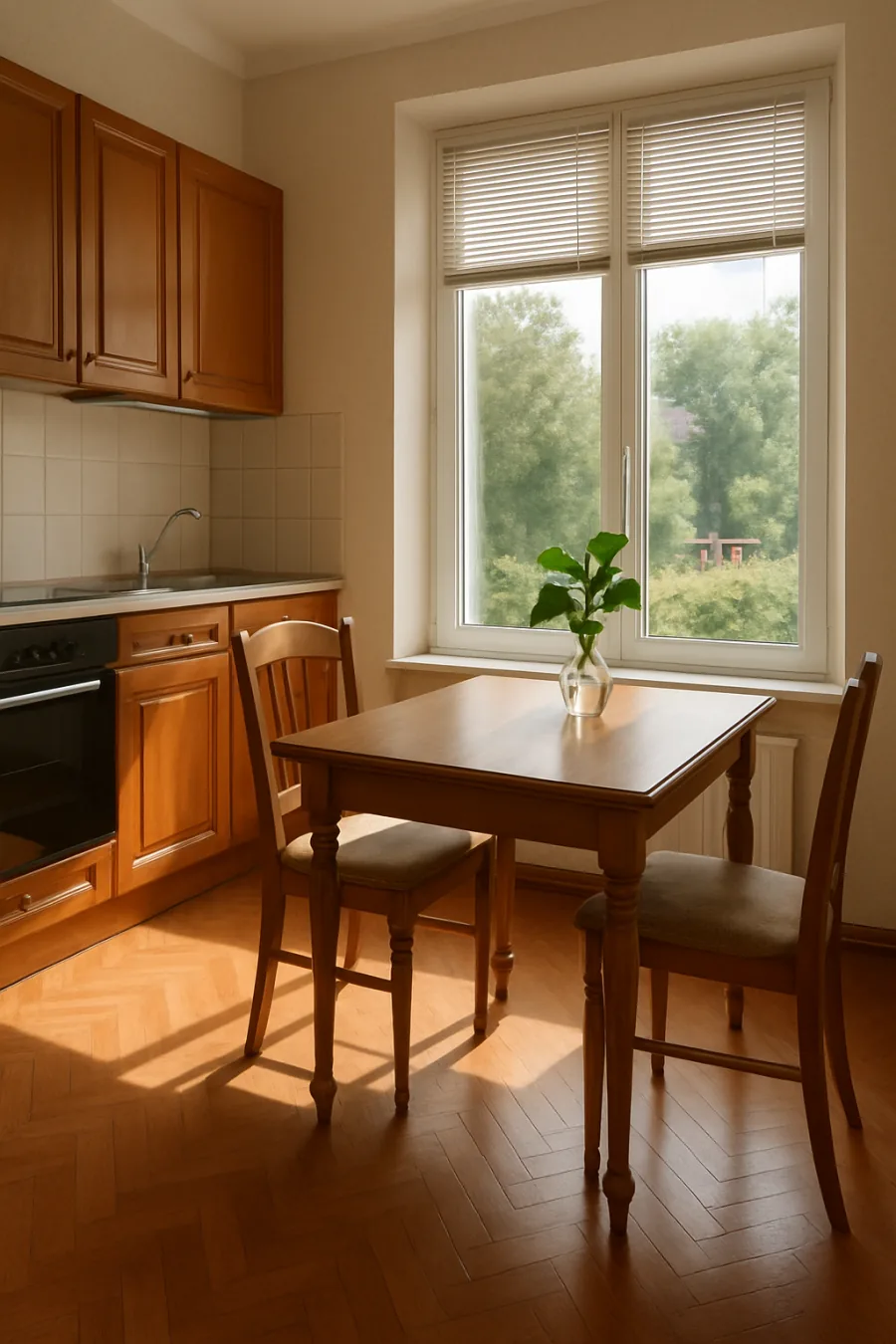
Aluminium was chosen; they wipe it with a damp cloth right on the window, with no need to take the fabric down
Timeframe: 3–5 days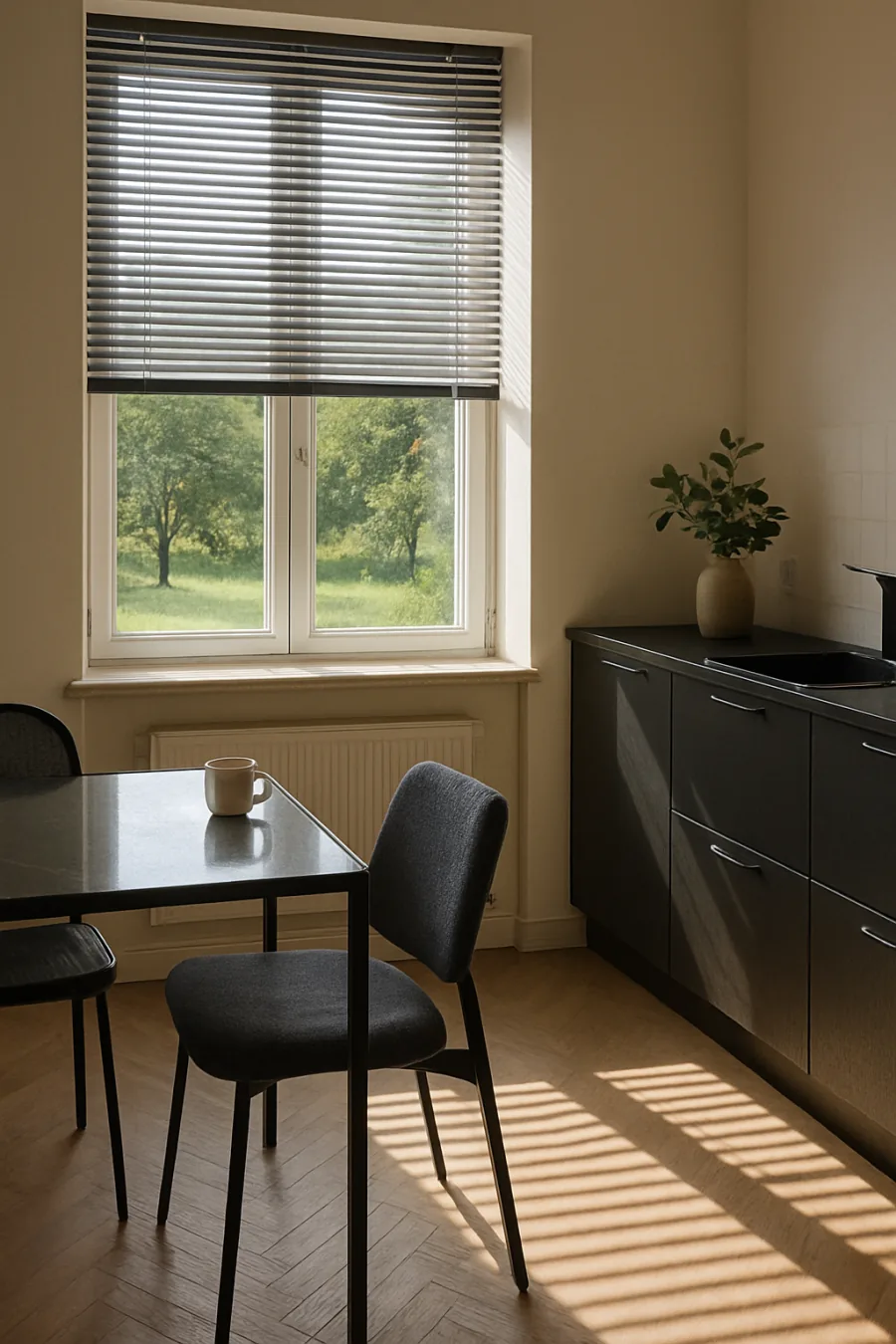
The horizontal slats are turned away from direct sun, so the work area is bright without glare
Timeframe: 3–5 days
One fabric for both sashes, dark slats to match the kitchen fronts
Timeframe: 3–5 days
The owner would not allow drilling: we fitted them on brackets into the glazing bead, and on moving out they were removed without a trace
Timeframe: 3–5 days
Light fabric gathers in folds above the window by the dining table, away from the stove
Timeframe: 7–10 days
The pleated blind was stopped halfway down the roof window: shade over the bed, and the sky still visible at the top.
Timeframe: 7–10 days
The gable window under the ridge was covered with a pleated blind cut to the roof angle: the double-height space no longer glares in the evenings.
Timeframe: 7–10 days
The pleated blind is pulled up to the top edge: soft light falls on the table, and the trees outside are visible.
Timeframe: 7–10 days
A row of windows in the roof slope, each with its own pleated blind, so in the morning only the ones facing the sun are closed.
Timeframe: 7–10 days
Roof windows above the staircase: the pleated blinds with cables stay in place even when the sash is tilted open for ventilation.
Timeframe: 7–10 days
An afternoon nap: thick fabric and no hanging cords.
Timeframe: 7–10 days
A studio under the roof: pleated blinds on the roof-slope windows shade the work corner from the midday sun, while the kitchen stays bright.
Timeframe: 7–10 days
The fabric on the roof-slope window runs in side guide rails, and the balcony door next to it was left without blinds.
Timeframe: 7–10 days
The arch was covered with slats cut to a template: in the curve they only rotate, while the rectangular part below lifts
Timeframe: 3–5 days
The pleated blind on the roof-slope window is lowered halfway: the attic stays bright, but direct sun doesn’t hit your eyes
Timeframe: 7–10 days
The shape was built to follow the roof slope, with the joints tucked into the corners
Timeframe: 3–5 days
The pleated blind covered the slanted upper panes of the bay window, while the lower sashes are open to the courtyard
Timeframe: 7–10 days
The fabric was cut to a circular template, with a gap along the edge only for the mechanism
Timeframe: 3–5 days
Horizontal slats on the upper pane of the narrow window only; the lower one, down to the floor, was left clear for the view of the garden
Timeframe: 3–5 days
Each sash is covered by its own fabric, so the window is fully covered
Timeframe: 3–5 days
The pleated blind moves both ways along the slanted sash: you can cover just the lower part of the glass or just the upper part
Timeframe: 7–10 days
Each sash has its own aluminium blind; they can be raised to different heights — one side in shade, the other in light.
Timeframe: 3–5 days
The slats hang on a rail above the opening: they slide to the side, and the sash opens without obstruction.
Timeframe: 3–5 days
The door and the window each have their own fabric, gathered in folds above the glass, so the way out to the balcony is clear.
Timeframe: 7–10 days
Aluminium slats diffuse the southern sun when rotated, so direct rays don’t fall on the sofa.
Timeframe: 3–5 days
Soft fabric gathers in folds above the window and, when raised, doesn’t block the garden.
Timeframe: 7–10 days
Slats across the full width of the opening; raised, they clear the way to the balcony, and when rotated they don’t catch on the reveal.
Timeframe: 3–5 days
A pleated blind on each of the four sashes; they’re lowered only where the sun is at that moment.
Timeframe: 7–10 days
When laundry is hung out, the fabric is raised; the rest of the time it keeps the loggia in shade.
Timeframe: 3–5 days
The pleated blind on the sloped sash is pulled up to the narrow top edge — the lower part of the glass is open to the trees
Timeframe: 7–10 days
The shape is built to the slope, the fabric reads as a single plane, the seams are tucked into the corners
Timeframe: 3–5 days
The sloped top of the glazing is covered by a fabric cut to a template, and at midday the plants stand in diffused shade
Timeframe: 7–10 days
By day the top is open, in the evening the bottom — two lighting scenarios on one window
Timeframe: 7–10 days
For a daytime nap the pleated blind is lowered to the windowsill, the cords do not hang down
Timeframe: 7–10 days
The pleated blind covers the sloped transom and the left sash, the right half of the window by the desk is open
Timeframe: 7–10 days
Each window has its own fabric cut to a template, the sloped edge is held by a profile
Timeframe: 7–10 days
Fitted into the glazing bead without drilling, the frame stayed intact
Timeframe: 3–5 days
The shape is built to the roof slope, the fabric reads as a single plane, the seams are tucked into the corners
Timeframe: 7–10 days
The pleated blind on each of the two windows follows the sloped top, two identical fabrics hang between the beams
Timeframe: 7–10 days
The pleated blind sits on two straight sashes and opens together with them, the pointed top was left without a fabric
Timeframe: 7–10 days
The view of the garden stays clear, the plants do not reach towards the glass
Timeframe: 7–10 days
The seams are tucked into the corners, each facet is covered by its own fabric
Timeframe: 7–10 days
The triangular top is covered by a pleated blind cut to a template, the straight sashes below it were left open to the garden
Timeframe: 7–10 days
The pleated blind on the straight sash is lowered to the windowsill, the triangular peak above it was left light
Timeframe: 7–10 days
Pleated blinds on the two lower sashes, the triangular top made of two panes was left without a fabric
Timeframe: 7–10 days
Wooden slats shade the entrance to the pavilion, the garden path is visible through the gaps
Timeframe: 7–12 days
The slats are mounted on the side wall, away from the fire, and the smoke escapes through the open facade
Timeframe: 7–12 days
Grey aluminium slats shade the terrace window from the midday sun, splashes are wiped off them with a cloth
Timeframe: 3–5 days
Honey-toned slats soften the sun, even stripes of light fall across the wall and the armchair
Timeframe: 7–12 days
The upper part of the wall was covered with slats to match the timber, the lower part was left solid
Timeframe: 7–12 days
The bamboo fabric is lowered to the middle of the opening, and a fine checkered shadow falls on the stone floor
Timeframe: 7–10 days
Blinds hang on each leaf and don’t get in the way when you step out to the table on the terrace
Timeframe: 7–12 days
Both openings were covered with dark slats to match the brick, and cool shade stays inside
Timeframe: 3–5 days
One fabric across the floor-to-ceiling glazing — and the studio reads as a single space rather than a set of separate windows
Timeframe: 3–5 days
Each sash has its own fabric, and the windows open together with the blinds
Timeframe: 5–7 days
Glare is gone from the screen, and the room isn’t dark
Timeframe: 3–5 days
Slats along the whole glazed wall, and no sun spots on the monitors
Timeframe: 3–5 days
Bright during the day, closed off from the street in the evening, and the sash opens freely
Timeframe: 5–7 days
In the morning the strips are shifted: it’s bright, but no one can look in from the street
Timeframe: 5–7 days
The shop window was covered from direct sun, and during the day the street is visible from the shelves
Timeframe: 3–5 days
Mounting without drilling the frame, the profile stayed intact
Timeframe: 3–5 days
An orange accent to match the walls of the kids’ room; the slats are wiped with a damp cloth right on the window
Timeframe: 3–5 days
The orange aluminium slat by the stove is washed from grease with a sponge right on the window
Timeframe: 3–5 days
Orange slats to match the living room textiles are held on brackets in the glazing bead, and the frame wasn’t drilled
Timeframe: 3–5 days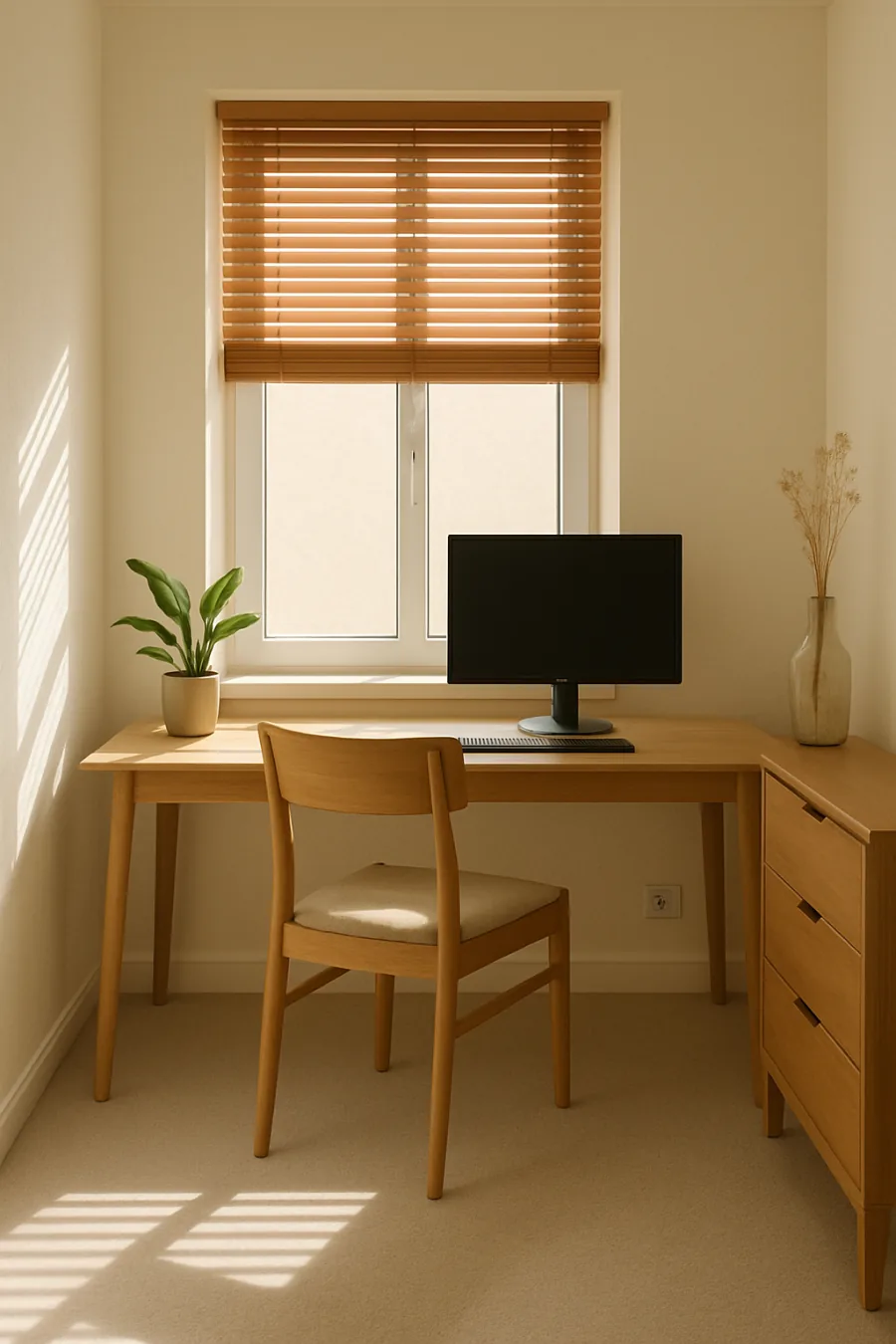
The slat is turned so the sun goes up to the ceiling instead of the screen, and warm orange light stays in the study
Timeframe: 3–5 days
Orange slats echo the coffee shop’s brand colour and diffuse the daytime sun over the tables
Timeframe: 3–5 days
Orange day-night blinds right up against the glazing bead: in the morning the closed strips turn the sun into warm, muted light
Timeframe: 5–7 days
The apartment owner’s frame wasn’t touched: mounting without drilling, and the blinds are simply taken down before moving out
Timeframe: 3–5 days
On the panoramic glazing the slats are turned to follow the sun: open in the morning, closed once the sun reaches the tables
Timeframe: 3–5 days
The fabric gets caught by carts, so steel was installed: an aluminium slat in a passage like this quickly loses its shape.
Timeframe: 5–7 days
The wide wall was split into sections and joined in one plane — no height differences.
Timeframe: 5–7 days
People walk past the windows all day and brush the slats with their shoulders. Steel holds up, and the bottom weight keeps the fabric from flapping.
Timeframe: 5–7 days
Oil and soot are washed off the powder coating with a mild product during the general cleaning of the service bay.
Timeframe: 5–7 days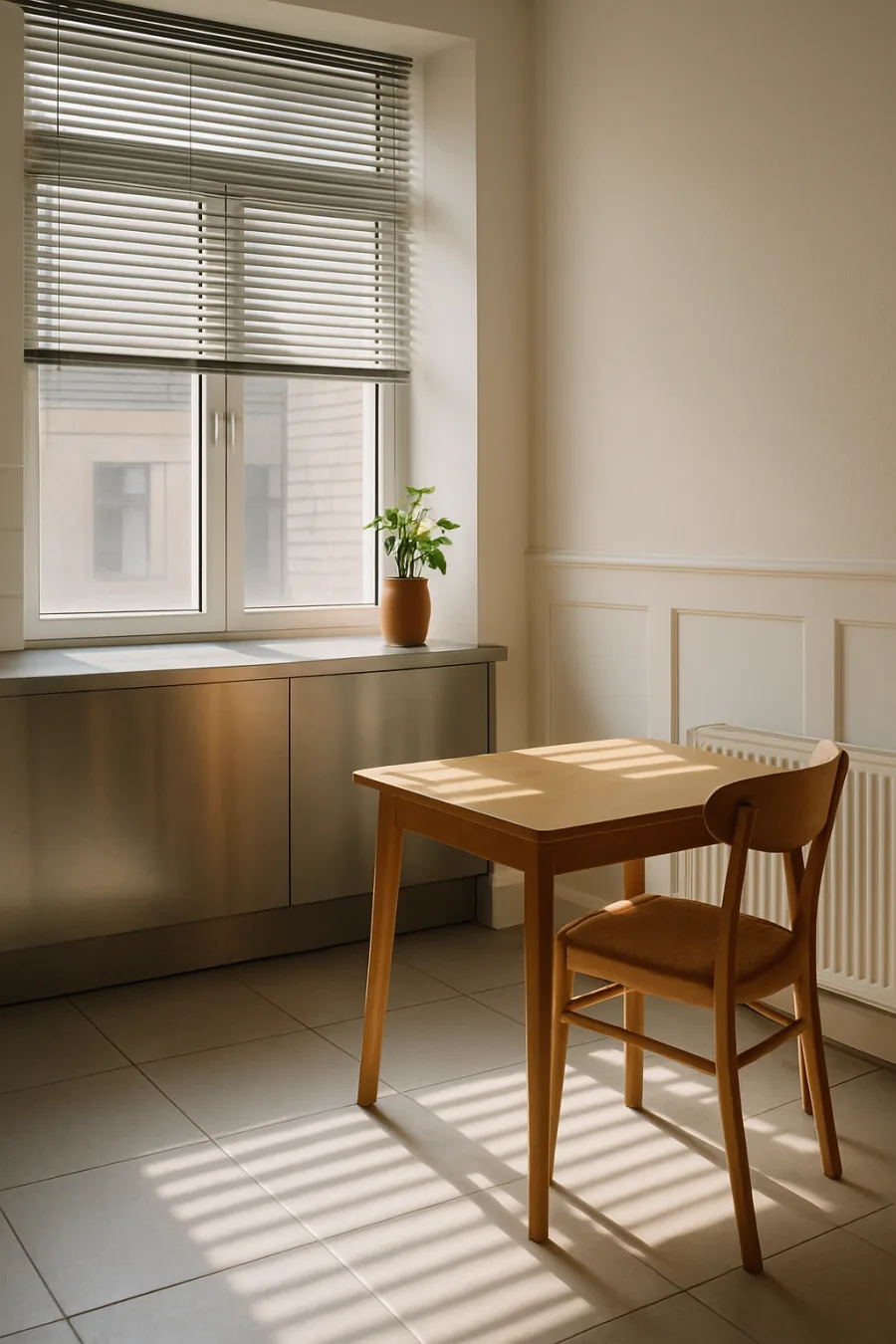
The slats are washed with the same mild product as the steel cabinets under the window. The blind is wiped right on the window, without taking it down.
Timeframe: 5–7 days
The blind takes an accidental hit from a trolley: the slat flexes and springs back, and there is no one in the walkway to bend it.
Timeframe: 5–7 days
The perforation lets light through with the blind closed — the room is not sealed off, glare on the screen is gone, and the slat tilt is precise.
Timeframe: 5–7 days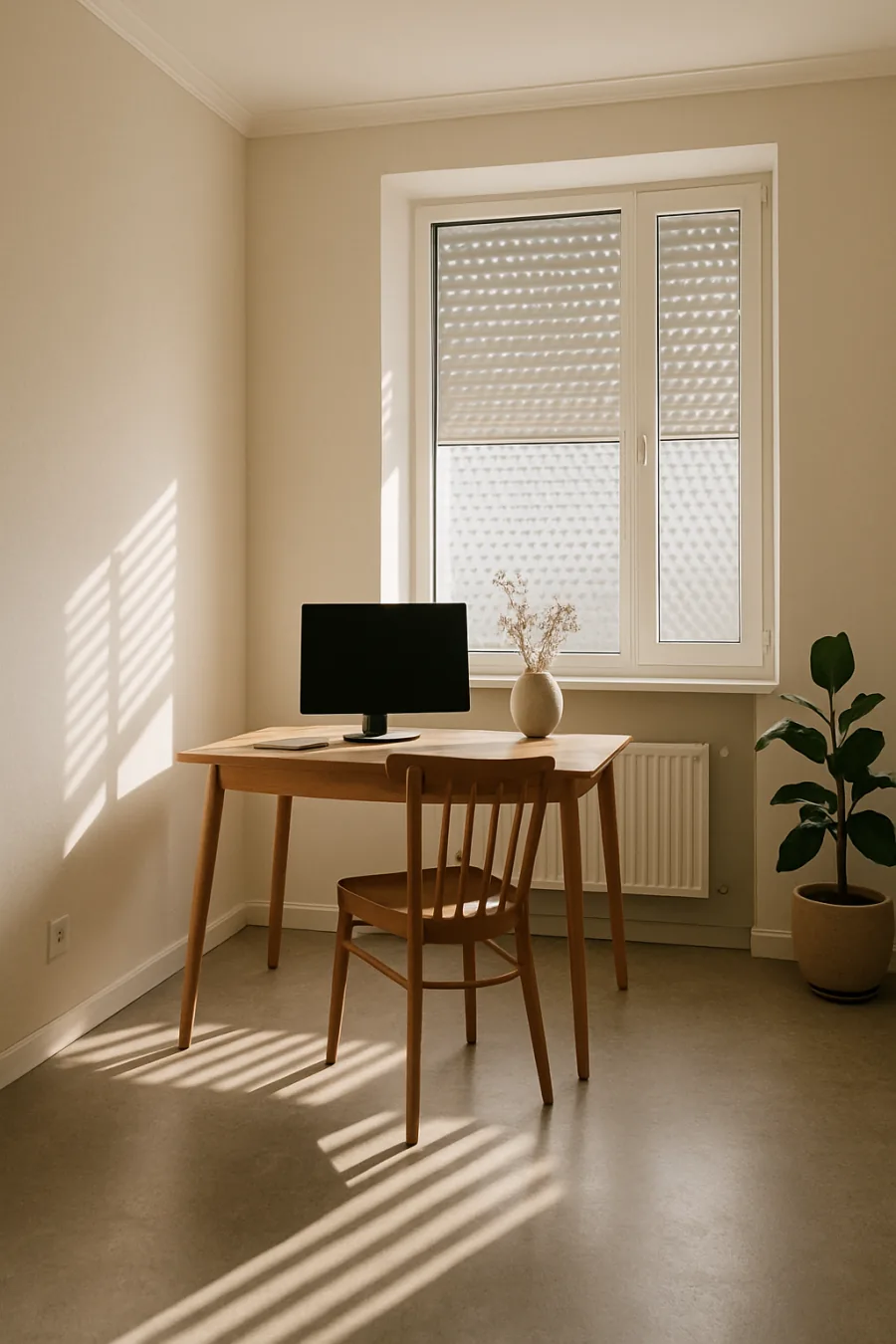
Through the perforation you can see the courtyard during the day, and there is no sun glare on the monitor at the post.
Timeframe: 5–7 days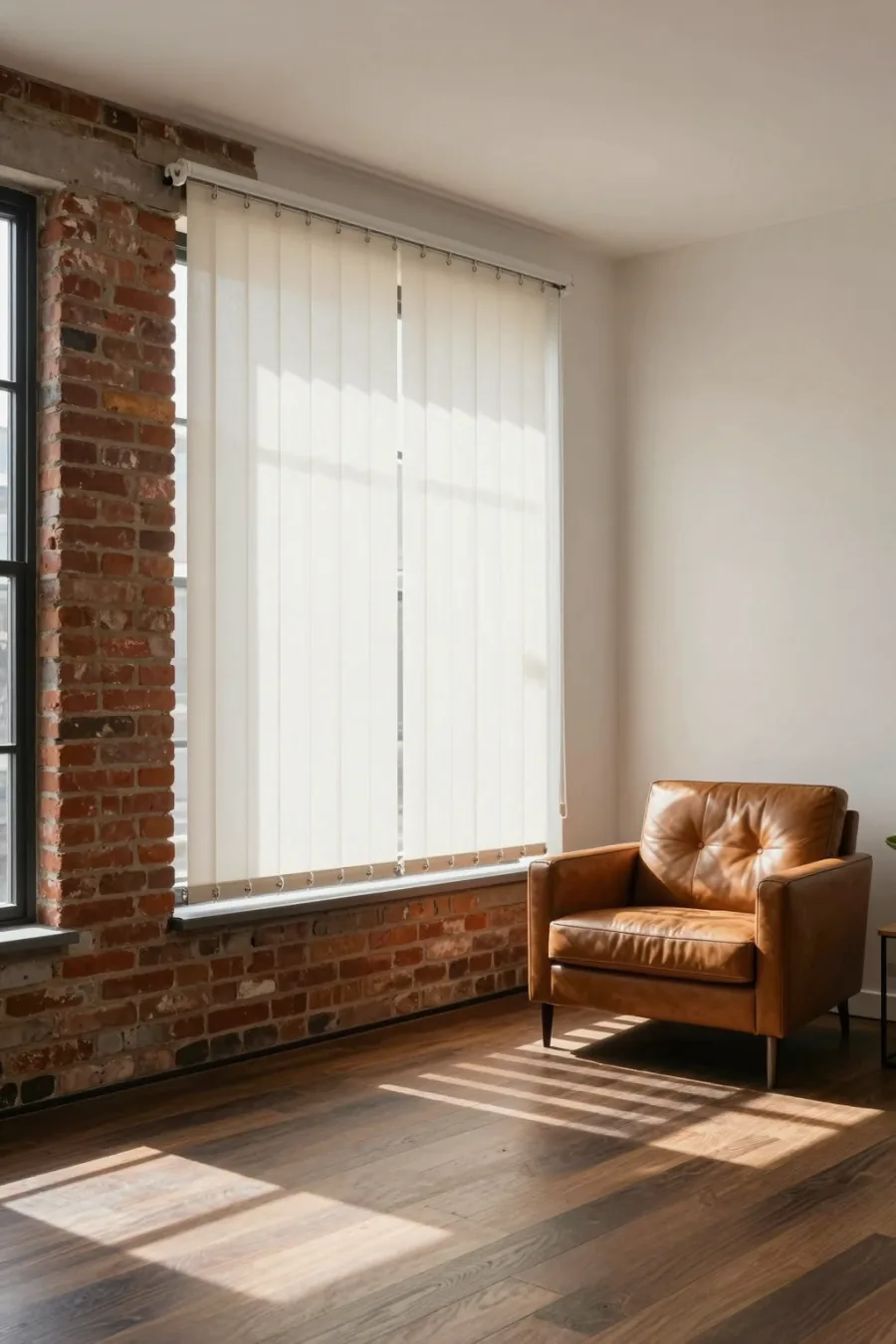
One sheer blind for the whole window — the studio is not divided into zones by curtains
Timeframe: 3–5 days
The fabric was matched to the colour of the walls, and the samples were viewed under their own lighting
Timeframe: 3–5 days
In the morning the opaque stripes are aligned — the sun is softened and the windows of the neighbouring building are not looking in
Timeframe: 5–7 days
The screen fabric is wiped with a sponge right on the window, and the desk by the window sits in soft shade
Timeframe: 4–6 days
The sheer slats gather to the edge of the window — the door to the loggia opens without obstruction
Timeframe: 3–5 days
A sheer blind on the glazing bead: the owner’s frame stays intact, and when they move out it can be taken down in a single visit
Timeframe: 3–5 days
During the day the day-night blind is kept open, and for quiet time the opaque stripes are aligned
Timeframe: 5–7 days
The screen fabric is lowered to the middle of the window — the glare on the monitor is gone and the office stays bright
Timeframe: 4–6 days
The shade was chosen from samples together with the child, and sticky marks are wiped off the aluminium with a cloth
Timeframe: 3–5 days
By the stove they chose aluminium rather than fabric: grease splashes wipe off the slat in a minute
Timeframe: 3–5 days
The muted pink does not clash with the furniture: the rest of the interior was kept neutral
Timeframe: 3–5 days
During the day the slats are turned edge-on to the sun: there is no glare on the monitor and the lamp is not switched on
Timeframe: 3–5 days
A pink tone from the brand palette: the hall is bright by day and closed off from passers-by in the evening
Timeframe: 3–5 days
The aligned stripes soften a bright morning into a gentle pinkish light, but do not make the room dark
Timeframe: 5–7 days
The owner of the flat would not allow drilling — the brackets went into the glazing bead
Timeframe: 3–5 days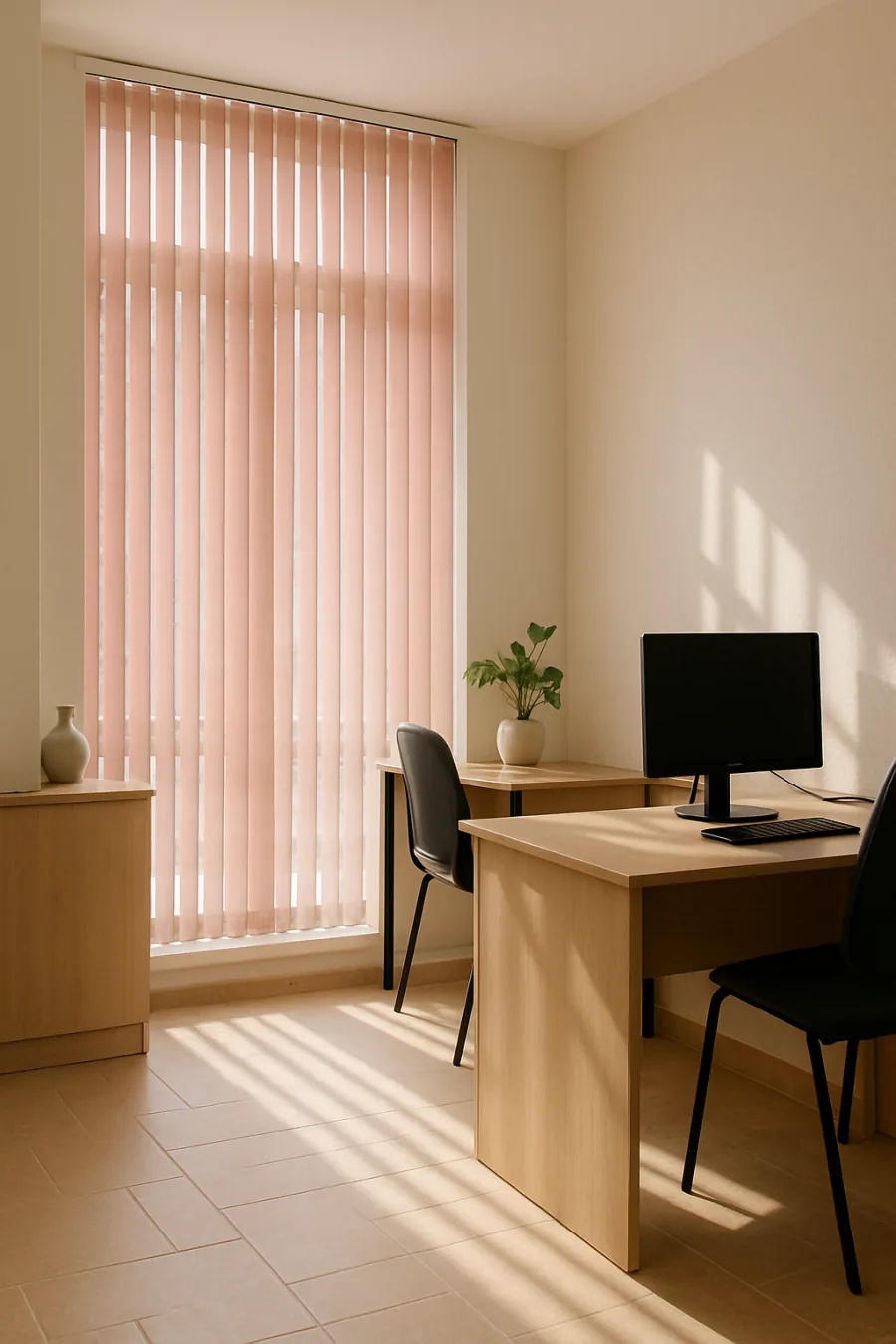
The 89 mm slats are moved to the edge when the view is wanted, and turned towards the sun after lunch
Timeframe: 3–5 days
The patterned wall continued onto the fabric — the window became part of the room
Timeframe: 7–12 days
The motif was matched to the colour of the backsplash, and the fabric can be wiped with a damp sponge
Timeframe: 7–12 days
The cityscape on the fabric continues the view from the window, the lower part of the glass is left open
Timeframe: 7–12 days
The cup logo on the fabric faces the hall, the sun on the tables is softened
Timeframe: 7–12 days
A print with a soft gradient: in the morning the light comes through the fabric in patches
Timeframe: 7–12 days
A subtle beige motif to match the salon walls, the sun does not glare in the stylists’ chairs
Timeframe: 7–12 days
A calm textured print with no pattern: the TV on the wall does not reflect, the table sits in even light
Timeframe: 7–12 days
Full-length silhouettes on the vertical slats, direct sun does not fall on the clothing racks
Timeframe: 7–12 days
A warm light grey to match the oak floor and linen sofa: the window receded into the background, the focus stayed on the furniture
Timeframe: 3–5 days
A cool grey to match the stainless steel appliances and countertop, the matte finish does not glare above the work area
Timeframe: 3–5 days
A grey day-night fabric fitted right up to the glazing bead: in the morning the light is softened in stripes, and the room keeps a calm tone
Timeframe: 5–7 days
Light grey slats next to bright furniture: the window does not compete with the toys, and the room stays bright during the day
Timeframe: 3–5 days
The grey slats remove glare from the monitor without darkening the room — you can work without a lamp during the day
Timeframe: 3–5 days
A grey tone from the brand palette: the hall is bright by day and closed off from passers-by in the evening
Timeframe: 3–5 days
Neutral grey was chosen so as not to guess the taste of the next tenants; the brackets go into the glazing bead, so the frame was not drilled
Timeframe: 3–5 days
Grey vertical blinds to match the concrete columns: the monitors by the windows do not glare, and the facade reads as a single band from outside
Timeframe: 3–5 days
A blue accent to match the walls: the slats are closed for an afternoon nap, and the kids’ room becomes dim
Timeframe: 3–5 days
The slats are angled towards the screen: the glare on the monitor disappears, while the blue stays a calm backdrop behind the desk
Timeframe: 3–5 days
The blue was matched to the backsplash: the window continues the kitchen’s finish, and the slats by the sink can be wiped with a sponge without taking them down
Timeframe: 3–5 days
A blue day-night fabric fitted right up to the glazing bead: in the morning the light is softened, and the layers are shifted when the room needs daylight
Timeframe: 5–7 days
A full-height blue fabric pulls the studio into one line, without the windows dividing it into zones
Timeframe: 5–7 days
Blue fabric slats across the whole glass wall: they are turned before a meeting, and the hall has no glaring stripes
Timeframe: 3–5 days
The brackets go into the glazing bead: when you move, the blinds can be taken down and brought along, and the profile stays intact
Timeframe: 3–5 days
Slats in the brand blue: in the morning they are gathered to the wall so the shop window is visible from the street, and closed by evening
Timeframe: 3–5 days
During the day the room does not heat up — the sun is reflected back outside the glass, and the air conditioner is switched on later.
Timeframe: 3–5 days
The glare on the monitor was removed by angling the slats, without darkening the room.
Timeframe: 3–5 days
A heavy fabric fitted right up to the glazing bead softens the morning sun, leaving a thin strip of light at the edges.
Timeframe: 5–7 days
Each section is covered by its own blind and opens together with it; a narrow gap remains at the edges.
Timeframe: 5–7 days
The heat from the window doesn't reach the work area, and the fabric can be wiped with a damp cloth right on the window.
Timeframe: 3–5 days
During the day the slats are partly open and the hall is bright; in the evening they are closed — no one can look in from the pavement.
Timeframe: 3–5 days
A daytime nap in soft shade: the dense fabric softens the sun but doesn't make the room fully dark.
Timeframe: 3–5 days
No glare on the screen, no one sits in the dark; the light stays even all day.
Timeframe: 3–5 days
Light slats across the full height of the window: the studio is bright during the day, and the window looks as if it has a sheer curtain
Timeframe: 3–5 days
The fabric was chosen a shade lighter than the walls so the window doesn't stand out as a patch
Timeframe: 3–5 days
For the bedroom we used a dense jacquard: the morning sun is diffused and doesn't hit you in the face
Timeframe: 3–5 days
The treated fabric at the kitchen window is wiped with a damp sponge right on the rail
Timeframe: 3–5 days
The row of slats is moved to the wall, and the way out to the balcony is clear
Timeframe: 3–5 days
The rail is held on brackets in the glazing bead: the owner's frame was left without holes
Timeframe: 3–5 days
Untreated fabric: a soiled slat is taken down and washed separately
Timeframe: 3–5 days
The sun no longer falls on the screen, and the study is bright — the slats were simply turned at an angle
Timeframe: 3–5 days
The sun is reflected before it reaches the glass, the room is cooler in summer, and the air conditioner is switched on later
Timeframe: 5–7 days
Goods by the glass fade less, the street is visible during the day, and in the evening the hall is closed off from passers-by
Timeframe: 5–7 days
One system covers the wall from the outside and takes up no space inside
Timeframe: 7–10 days
The morning sun no longer hits the monitor, and the glare on the screen is gone
Timeframe: 5–7 days
The slats are turned away from the morning sun: the tables by the shopfront are in shade, and guests don't squint
Timeframe: 5–7 days
The heat from the window doesn't reach the room, and the air conditioner is switched on later
Timeframe: 5–7 days
In the morning the slats are closed: direct sun doesn't hit the bed, and the room is in soft half-light
Timeframe: 5–7 days
Glare on the monitors is gone, and the staff aren't sitting in the dark
Timeframe: 7–10 days
Wooden slats shade the gazebo from the sun and wind, and the garden is visible between the slats
Timeframe: 7–12 days
The blind was hung on the opening further away from the grill: we don’t put slats next to an open fire, and the smoke drifts out through the open side
Timeframe: 3–5 days
Pool splashes are wiped off the slats with a damp cloth, and aluminium doesn’t mind that kind of cleaning
Timeframe: 3–5 days
The side guide rails hold the edge of the blind against the post, so a gust of wind doesn’t swing it about
Timeframe: 3–5 days
The hook-and-loop tape was tinted to match the posts, so the blind doesn’t stand out on the frame
Timeframe: 7–12 days
Under the canopy the bamboo is sheltered from the rain, while soft diffused light comes through the weave into the gazebo
Timeframe: 7–10 days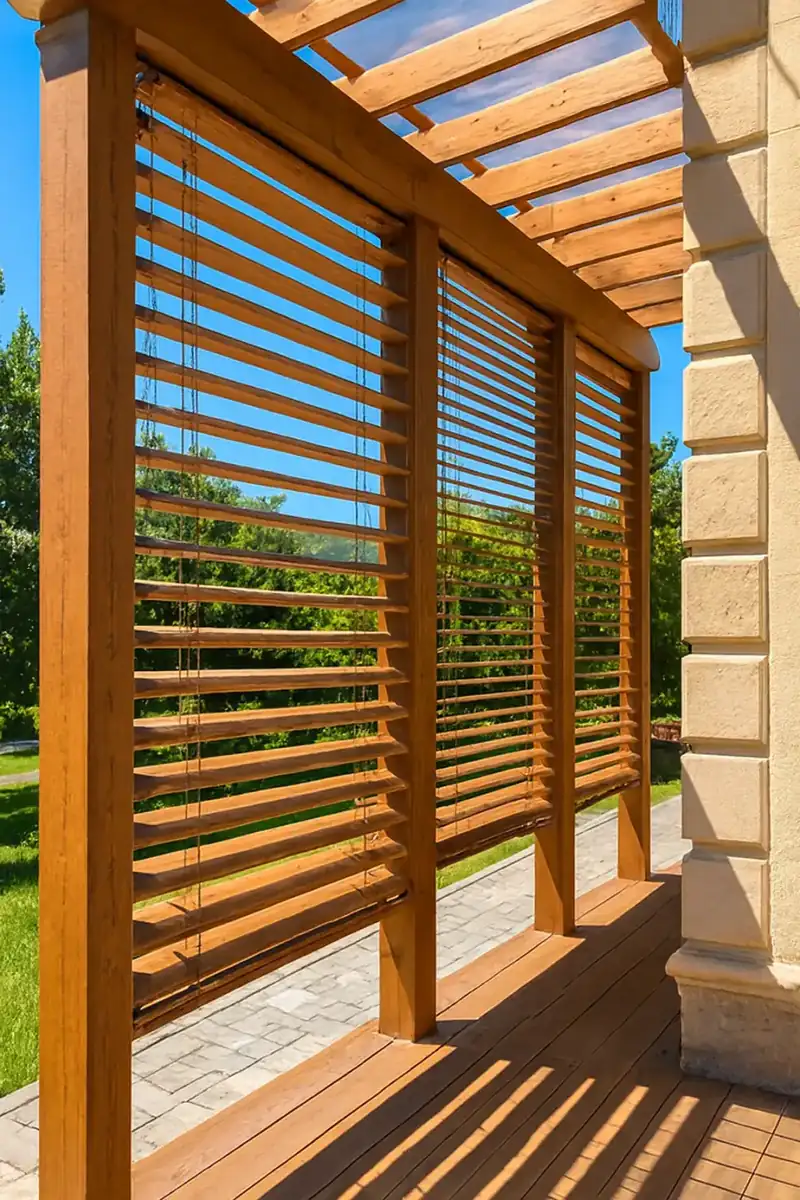
During the day guests have plenty of light; towards evening the slats are closed, and the tables are almost invisible from the pavement
Timeframe: 3–5 days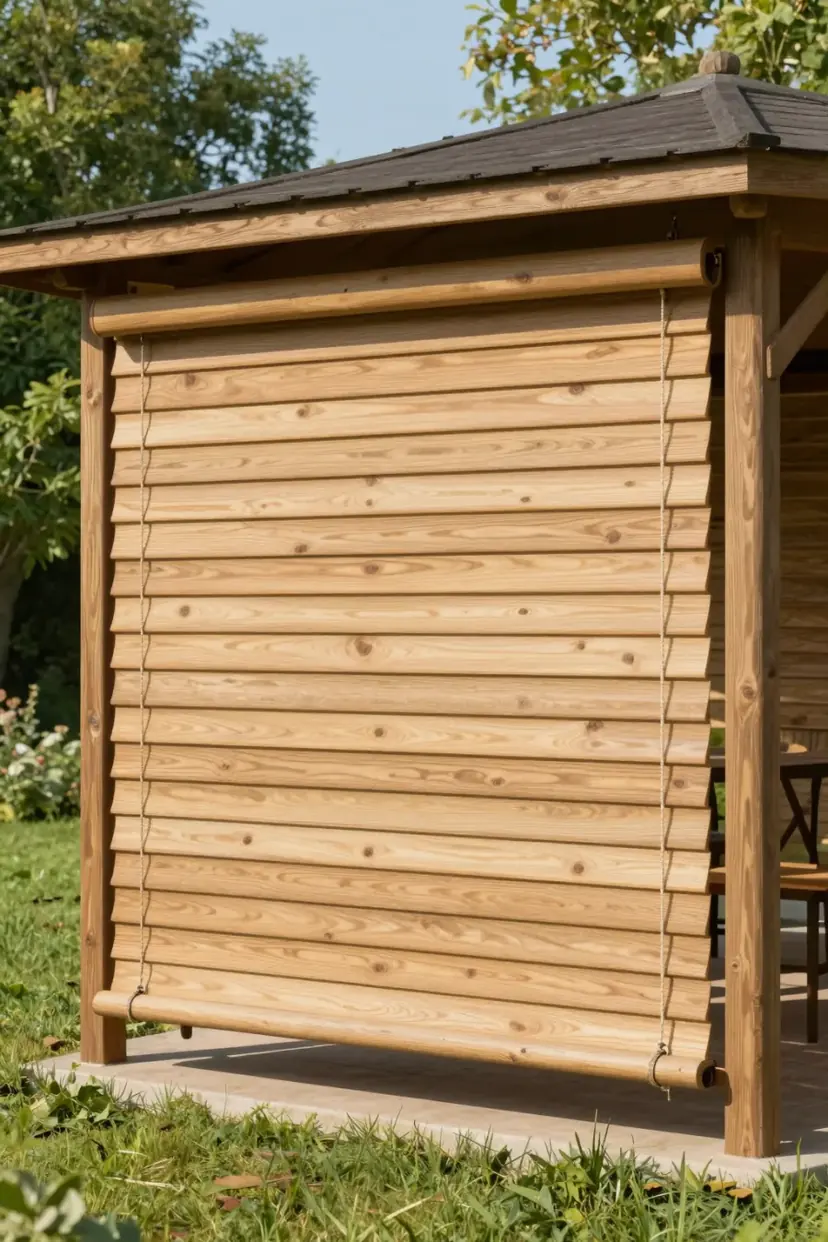
Each opening is covered by its own blind
Timeframe: 3–5 days
The blinds are turned with a side handle, so nothing hangs by the child’s bed — no chain, no cord.
Timeframe: 3–5 days
For daytime naps the dense slats are closed: the room is in half-light, with a thin strip of light left at the edge of the sash.
Timeframe: 5–7 days
The light is diffused and it isn’t dark at the desk — you can work during the day without a desk lamp.
Timeframe: 3–5 days
In the morning the dense slats block the direct sun above the bed, leaving soft half-light in the room.
Timeframe: 5–7 days
The brackets sit in the glazing bead, with not a single hole in the frame — when the family moves, the blinds move with them.
Timeframe: 3–5 days
The window is covered completely, each sash with its own blind and its own control.
Timeframe: 5–7 days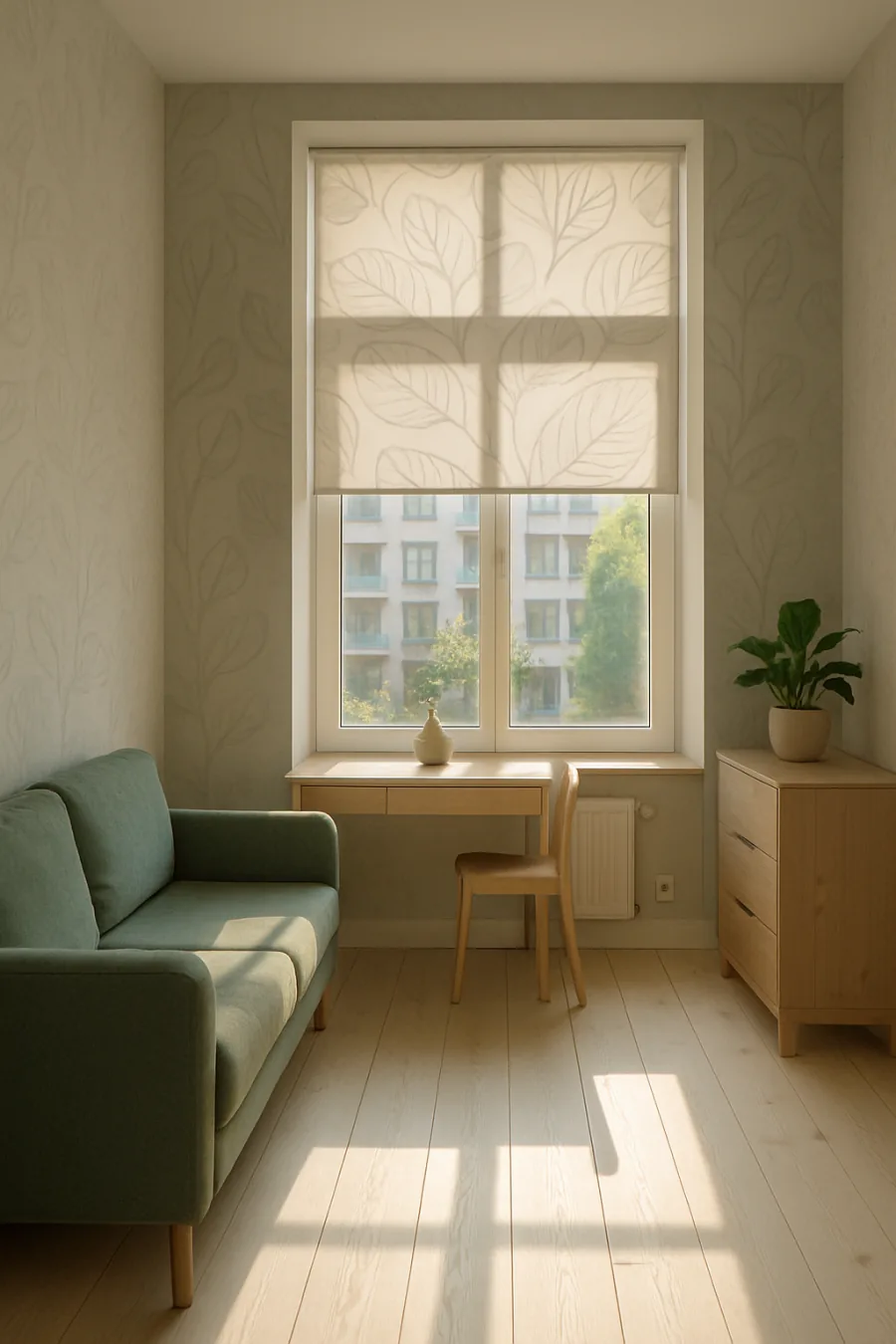
The pattern on the wall carried over onto the blind — the window became part of the room, without being overloaded.
Timeframe: 7–12 days
The windows had just been installed: the frame wasn’t touched with a single hole, everything is held in the glazing bead.
Timeframe: 3–5 days
The small window was covered with narrow slats; the blind doesn’t get in the way of opening the sash and doesn’t press against the window reveal.
Timeframe: 3–5 days
They didn’t drill into the new window: the blinds went onto brackets in the glazing bead.
Timeframe: 3–5 days
The narrow opening was covered with a mini system; the handle and the window reveal are clear, and the sash opens together with the blind.
Timeframe: 3–5 days
Wet cleaning every day: the aluminium slats are wiped right on the window, with no need to take the blind down.
Timeframe: 3–5 days
The owner wouldn’t allow drilling — the spring-clip mounting comes off without a trace when you move out.
Timeframe: 3–5 days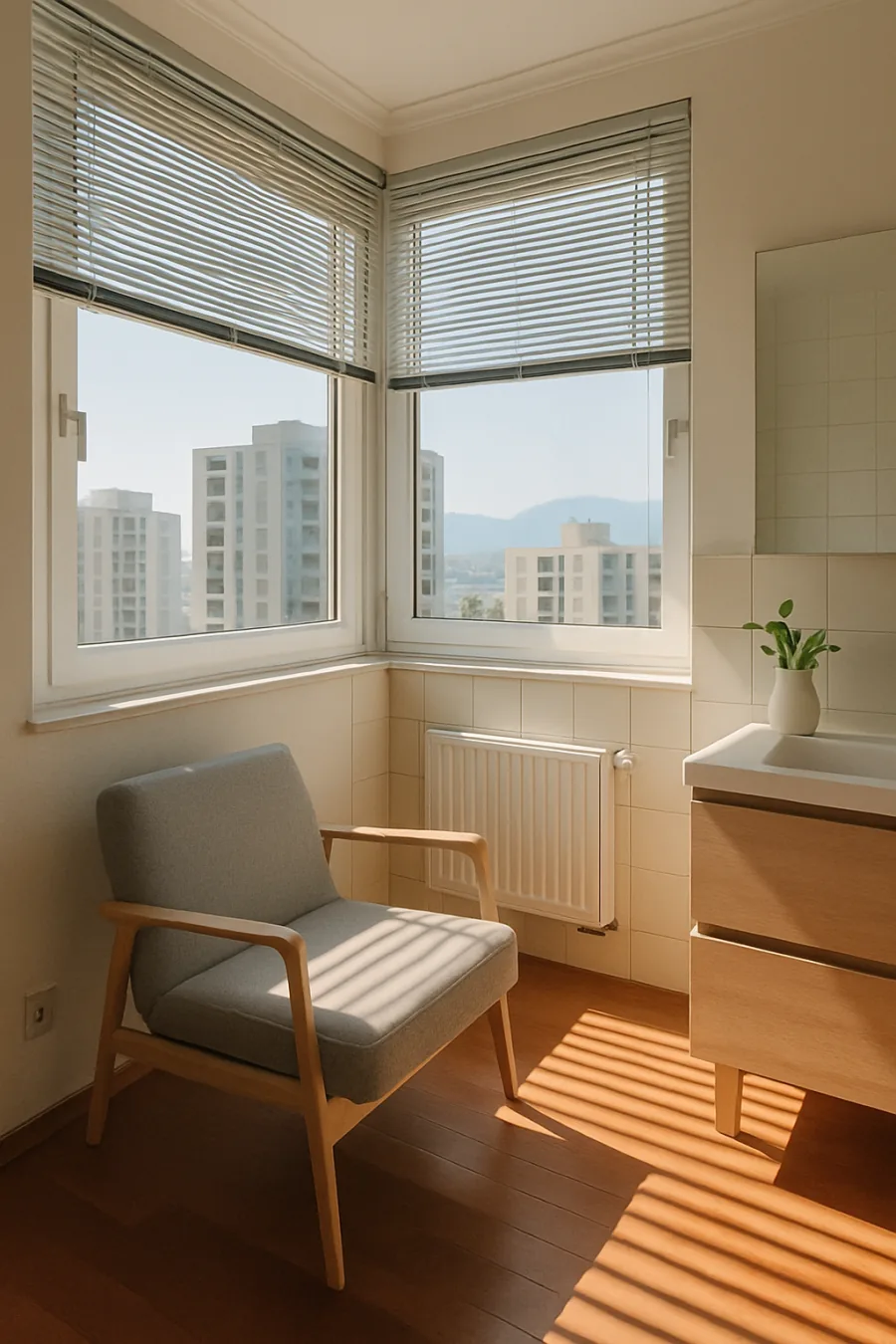
On the corner window there are two blinds; the slats of each are turned to follow its own sun — one in the morning, the other during the day.
Timeframe: 3–5 days
The window faces the courtyard: the slats are turned edge-up, so you can’t see in from the courtyard, while daylight passes between them.
Timeframe: 3–5 days
PVC doesn’t swell from the damp air of the laundry room; the blind is wiped down together with the tiles, without taking it off.
Timeframe: 3–5 days
Tilting the slats removed the glare from the whiteboard screen, while the classroom didn’t become dark
Timeframe: 3–5 days
The slats are turned with a wand, and the lift cord is tied up at the frame — nothing dangles over the desks
Timeframe: 3–5 days
The blind is touched every day, and the slats take the handling without creasing
Timeframe: 3–5 days
The floor-to-ceiling windows were covered with vertical blinds, and the light stays even all day
Timeframe: 3–5 days
During direct sun hours the slats are closed, and there are no glaring spots on the lab tables
Timeframe: 3–5 days
During the day the strips are spread apart for reading, by evening the dense ones are drawn together — the reading hall is almost invisible from the street
Timeframe: 5–7 days
The chain was lowered to the teacher's hand, no more going for a stepladder to the tall windows
Timeframe: 3–5 days
The fabric is wiped with a damp cloth right on the window, no need to take it down
Timeframe: 3–5 days
In the morning the strips are moved apart: it's light, but no one can look into the room from the street.
Timeframe: 5–7 days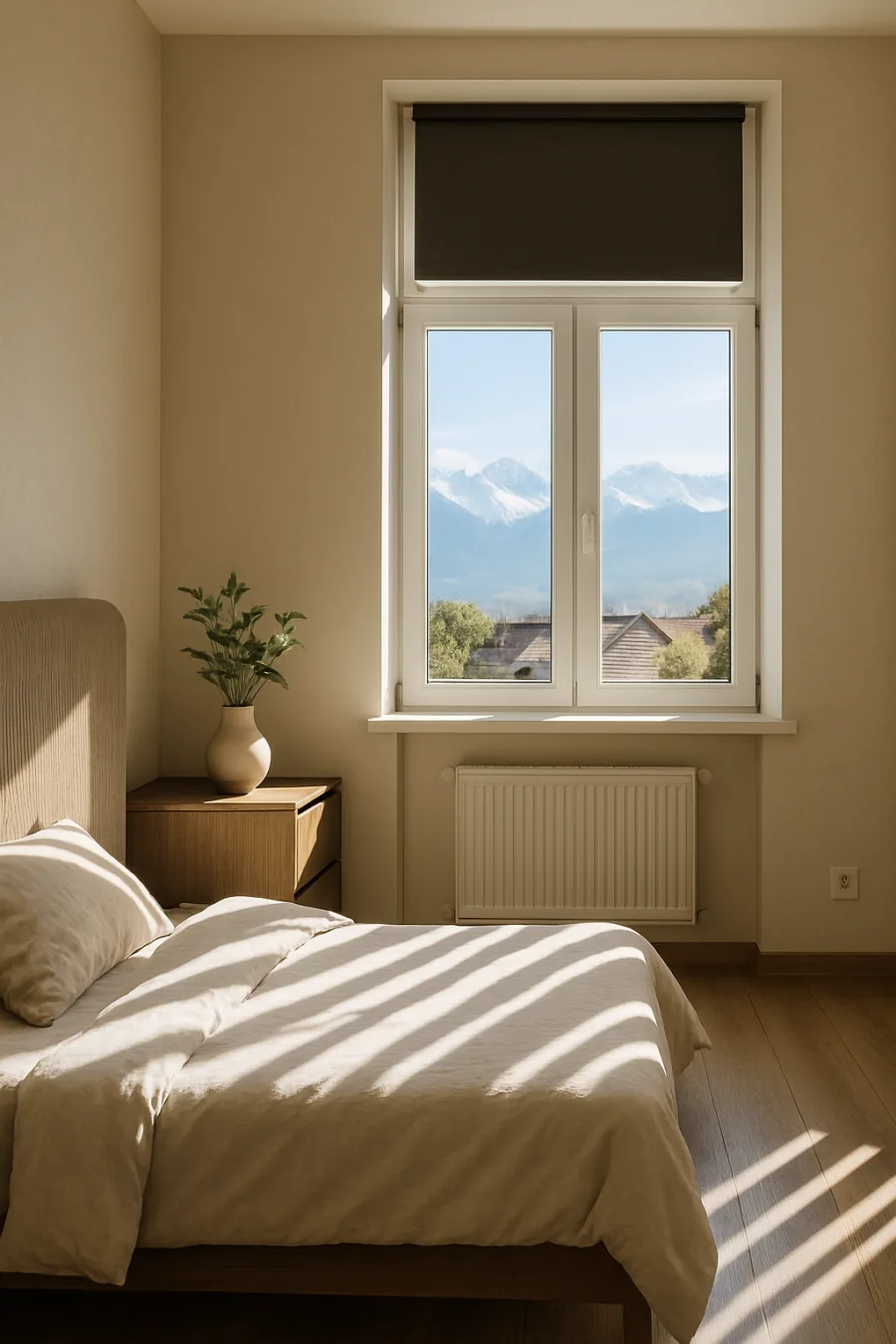
The dark fabric is lowered for the night: the morning sun is muted, only a thin strip remains along the edge.
Timeframe: 4–6 days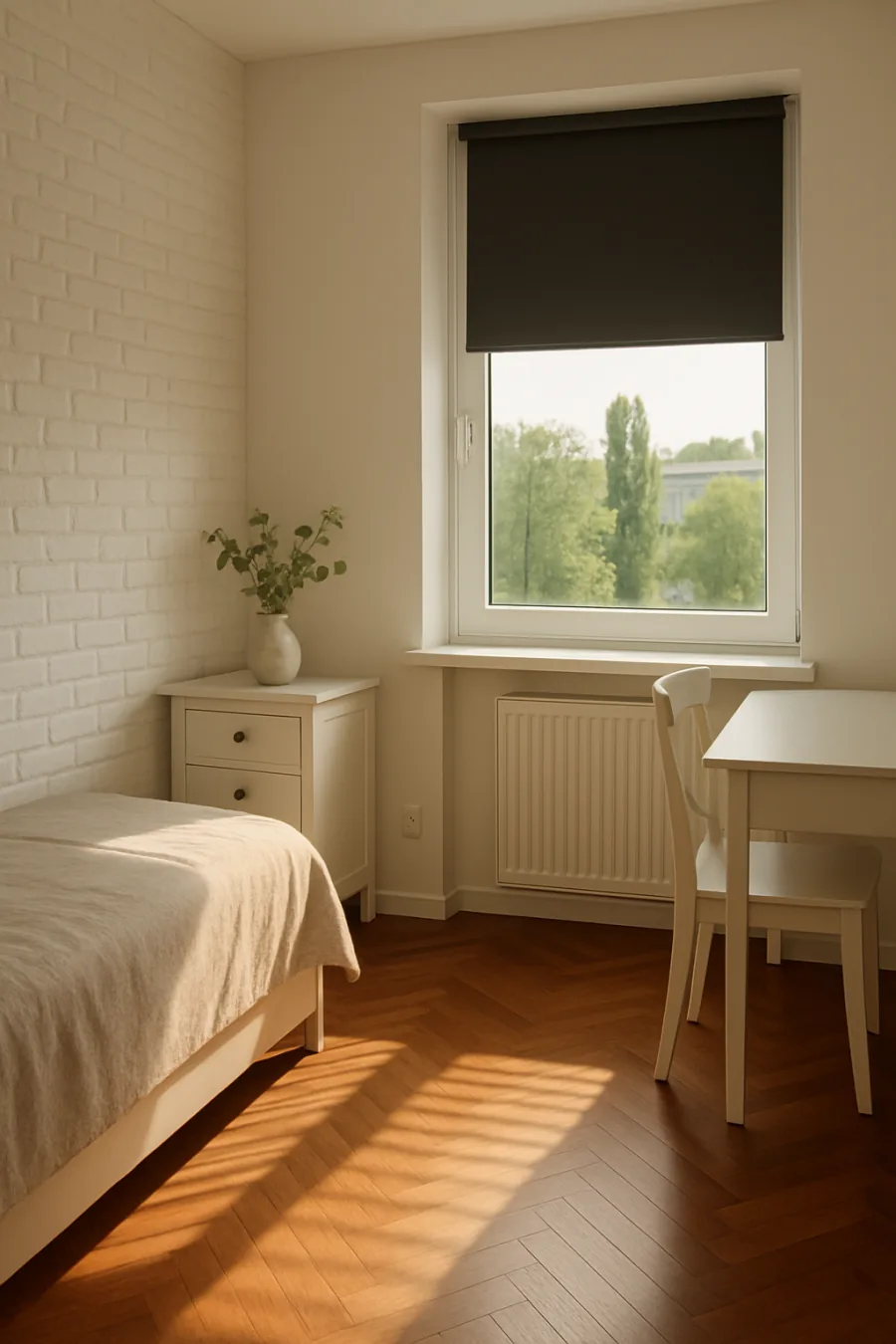
For a daytime nap the dense fabric is lowered, the room is in semi-darkness, with a narrow strip of light along the edge.
Timeframe: 4–6 days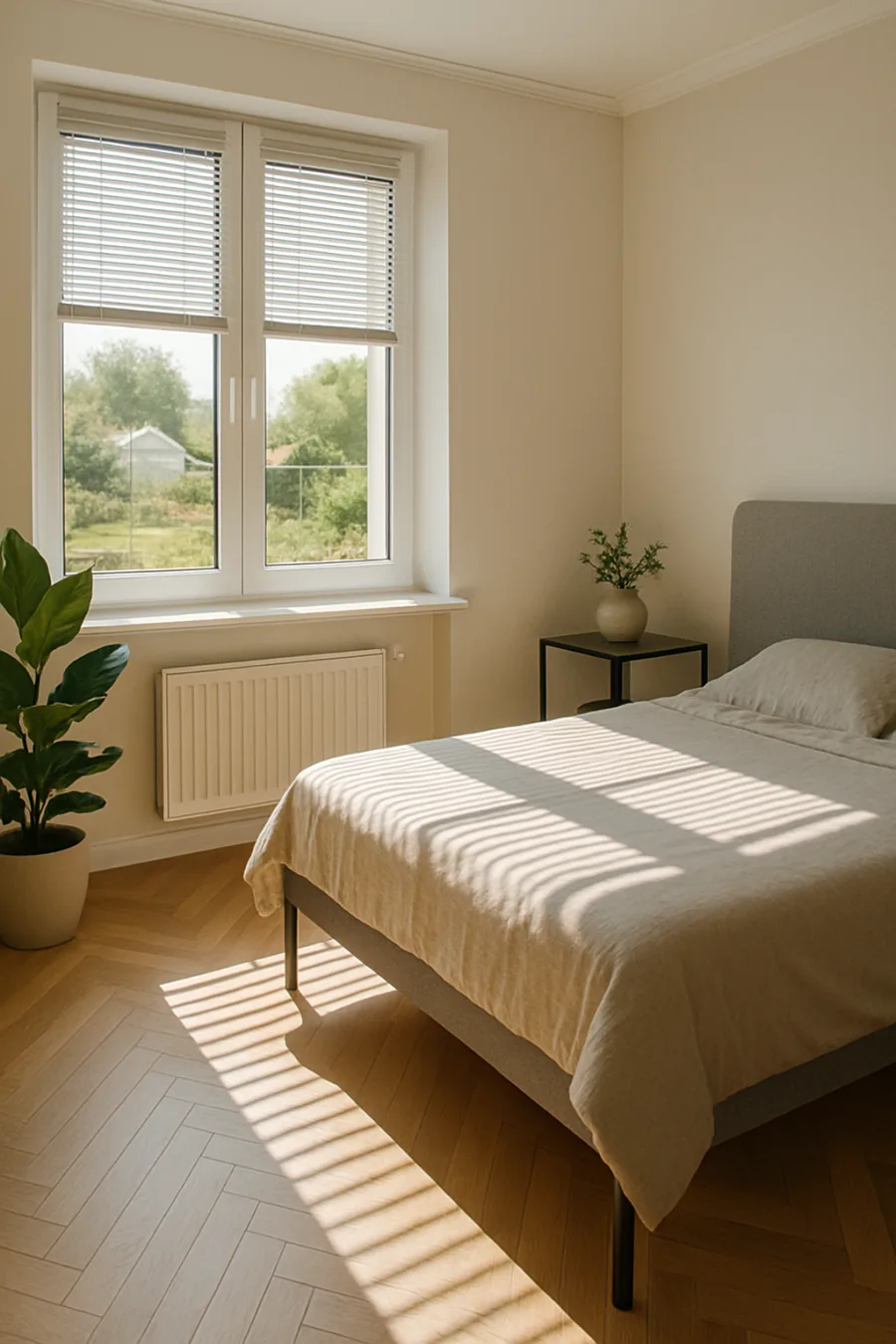
The brackets went into the glazing bead, and no permission from the owner to drill the frame was needed.
Timeframe: 3–5 days
The strips are moved halfway: the flowers on the windowsill get enough light, the bed stays in the shade.
Timeframe: 5–7 days
The slat tone was matched to the floor colour, the texture is natural, not plastic imitation wood.
Timeframe: 7–12 days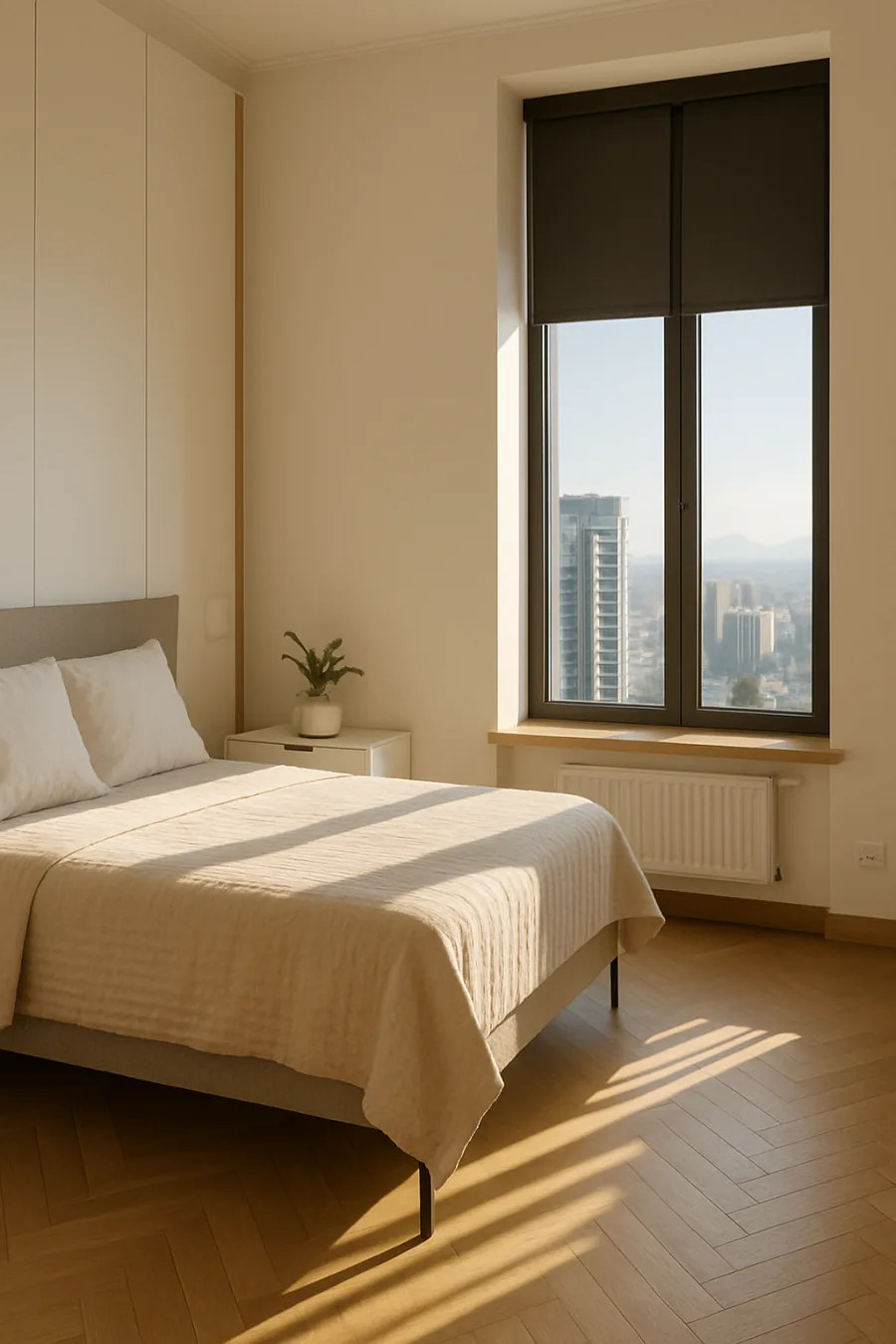
Two dark fabrics are lowered with a remote control, each over its own sash.
Timeframe: 7–10 days
The lowered fabric removes glare from the screen, during the day the room is in semi-darkness, not darkness.
Timeframe: 4–6 days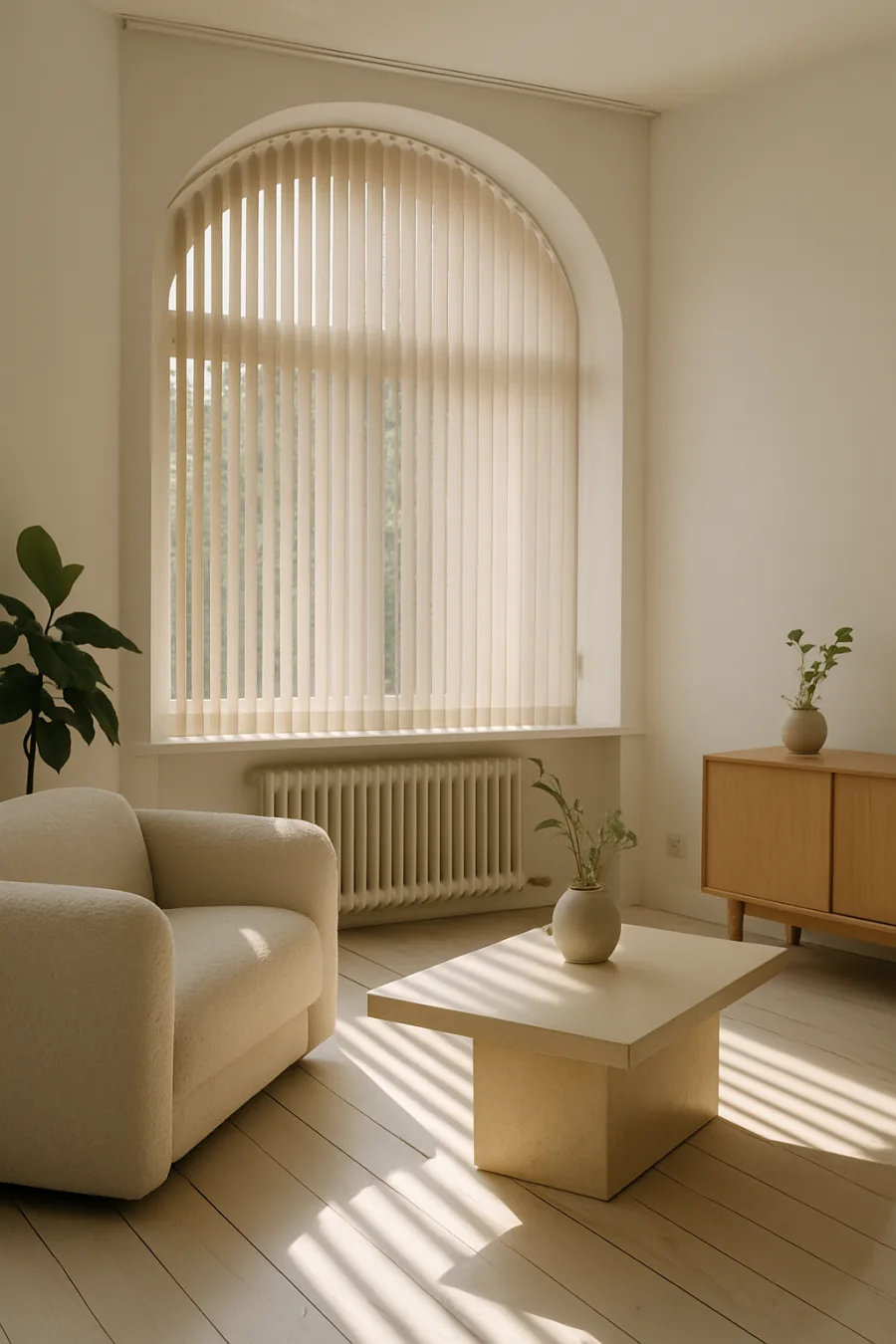
Slats of different lengths filled both the arch and the straight part — no open corners were left under the arch
Timeframe: 3–5 days
The straight part is movable, the arch is fixed to a template — only the lower part can be opened
Timeframe: 3–5 days
The slats are gathered to one edge of the arch, the passage to the entrance door is clear
Timeframe: 3–5 days
The rail was mounted on brackets in the glazing bead: the tall arched frame was not drilled, the slats run from the arch to the windowsill
Timeframe: 3–5 days
The balcony door with the arch was covered with slats separately, the straight window next to it was left without a blind
Timeframe: 3–5 days
The slats were turned edge-on to the window — diffused light falls on the desk, not direct sun
Timeframe: 3–5 days
The slats were moved to one sash: soft light by the bed, the other half of the window is opened for ventilation
Timeframe: 3–5 days
Tall arch above the staircase: the chain was brought out to hand level from the landing, the slats are turned without climbing up
Timeframe: 3–5 days
The slats are closed along the glazing bead: by morning the bedroom is in semi-darkness, and the windows of the house opposite don't look inside
Timeframe: 3–5 days
Glare on the screen is gone, contrast holds even during the day, the window is fully covered
Timeframe: 3–5 days
An even dark background for video calls, the screen doesn't glare, the room isn't dead silent
Timeframe: 3–5 days
The slats are closed during nap time — the kids’ room is in semi-darkness, though a thin line of light comes through the edges
Timeframe: 3–5 days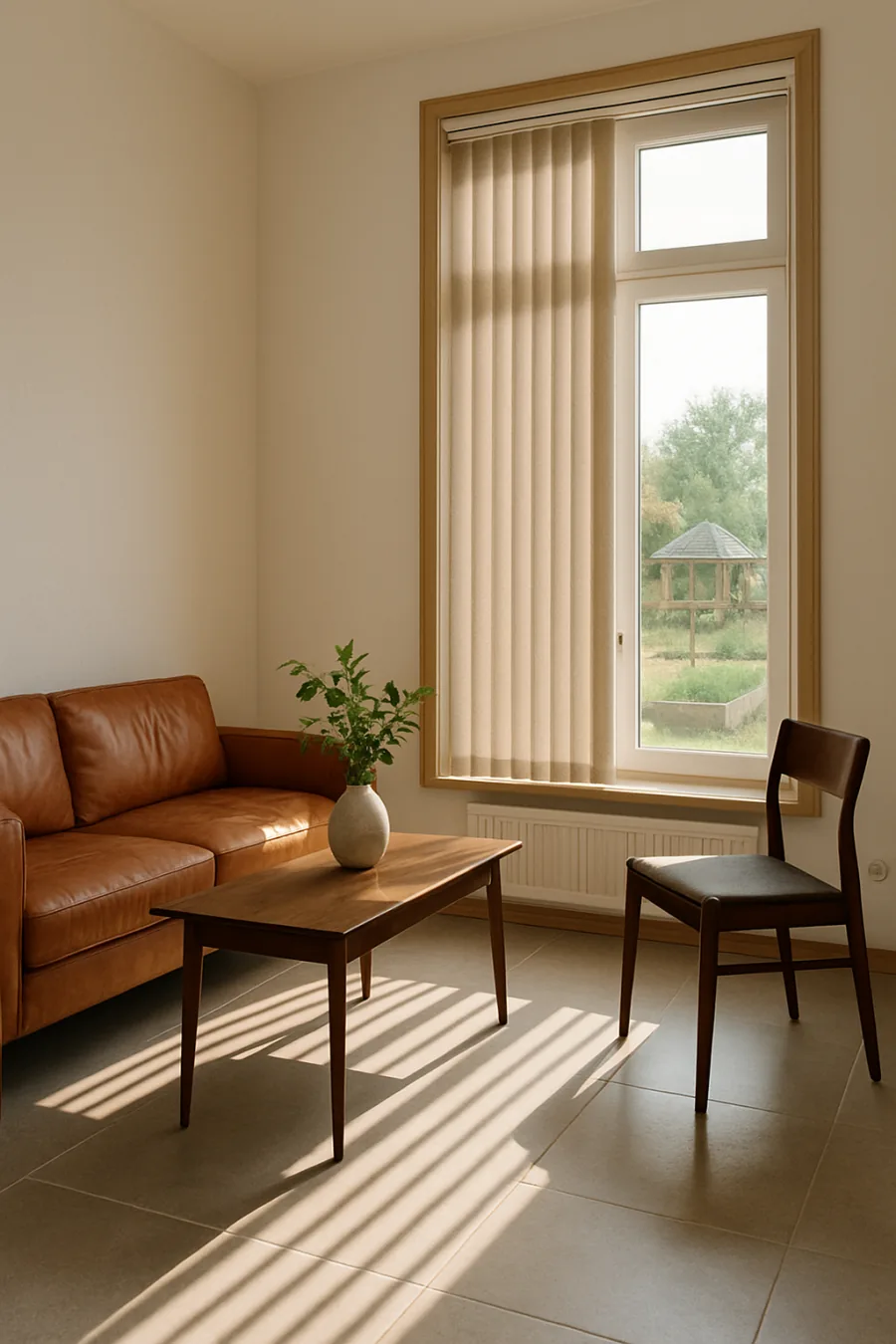
One fabric panel across the full height, so the studio reads as a single space, not divided by windows
Timeframe: 3–5 days
During the day the slats are turned edge-on and you can see the street; in the evening they are closed — the hall cannot be seen from outside
Timeframe: 3–5 days
A dark backdrop behind the back instead of a busy wall, while the light on the desk stays
Timeframe: 3–5 days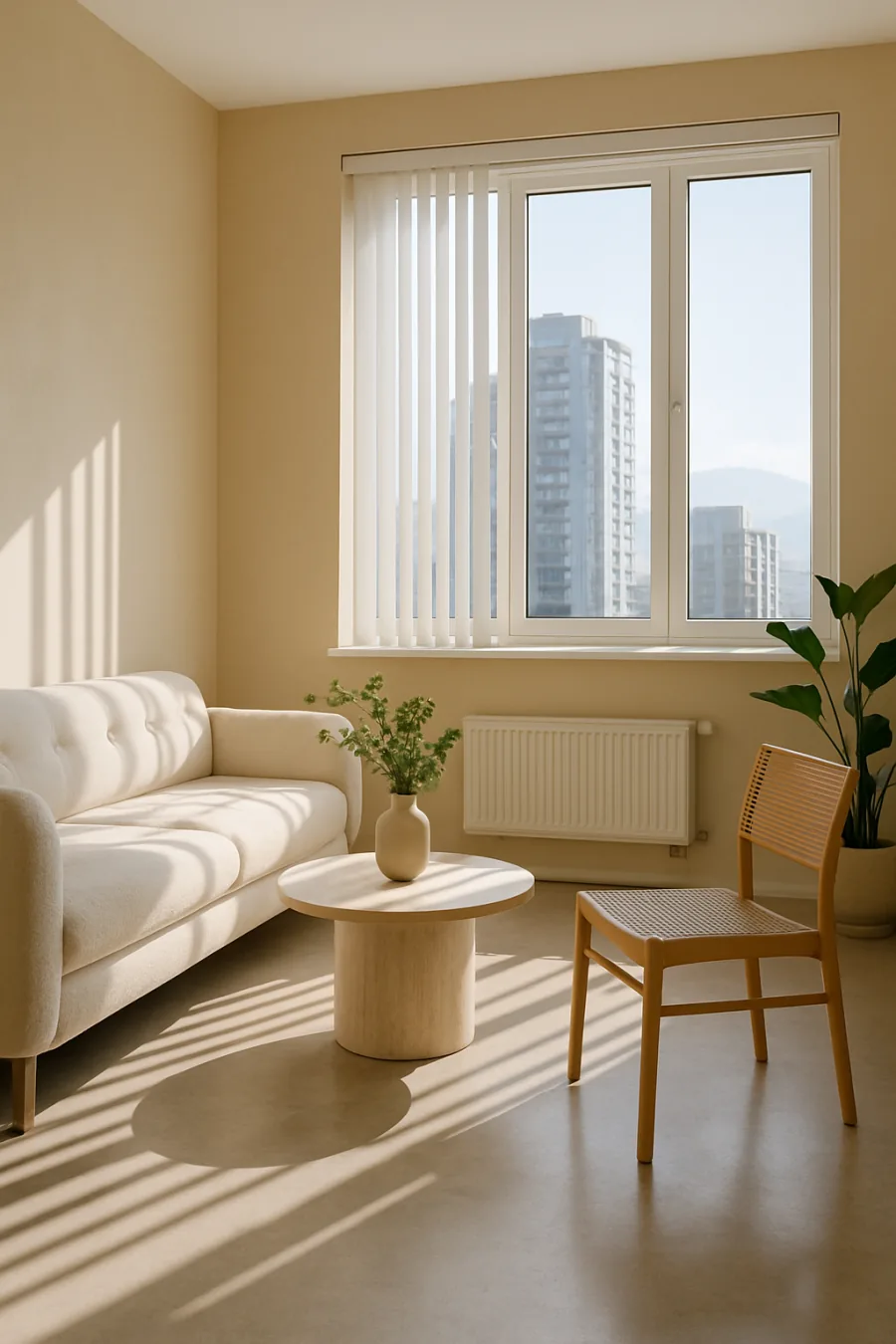
The brackets fit into the glazing bead of the balcony door and window unit: the frame has no holes, and the rail can be taken down and moved when you move out
Timeframe: 3–5 days
A forest with a deer on vertical slats in a tone to match the wooden furniture; soft light comes through the fabric into the kids’ room
Timeframe: 7–12 days
A plant pattern on the slats gathered at the edge of the window: during the day the view of the trees is open, in the evening the print is slid over the glass
Timeframe: 7–12 days
A seascape by the bed: when the slats are turned, the picture breaks into stripes, and bands of sunlight fall on the floor
Timeframe: 7–12 days
Watercolour leaves in a tone to match the green upholstery; dust is removed from the slats with a vacuum cleaner, without wetting the fabric
Timeframe: 7–12 days
A misty coniferous forest across the full height of the window; the light top of the print lets in more daylight
Timeframe: 7–12 days
Bright citrus fruit on the slats by the master’s chair; the sun is diffused and falls on the floor in stripes
Timeframe: 7–12 days
Skyscrapers on the slats by a white brick wall; the print softens the evening sun
Timeframe: 7–12 days
Mountains under the night sky on dark slats: the room is darkened, with narrow strips of light passing between the slats
Timeframe: 7–12 days
A single fabric panel covers the floor-to-ceiling window: it is bright during the day, while the room can only be seen from the street as a blur
Timeframe: 7–10 days
The transitions between dense and sheer fabric read as texture across the whole wall, not as a flat single colour
Timeframe: 7–10 days
The wide dense sections shield the bed from the eastern sun, while a thin line of light remains along the edges
Timeframe: 7–10 days
One fabric panel instead of a sheer and a heavy curtain; the window is not split into two layers, and the door opens freely
Timeframe: 7–10 days
The sheer sections let light onto the desk, the dense ones remove the glare from the monitor
Timeframe: 7–10 days
The brackets are held in the glazing bead, the frame has no holes — the rail moves with the owners when they move out
Timeframe: 7–10 days
The slats are turned with the dense fabric towards the sun: there is no glare on the monitors, while daylight comes into the open-plan office through the sheer sections
Timeframe: 7–10 days
During the day the hall is bright and the street is visible; in the evening the slats with the wide dense section hide the hall from passers-by
Timeframe: 7–10 days
Vertical panels run along the whole wall of the open-plan office, so there are no sun patches on the monitors by the windows
Timeframe: 3–5 days
The fabric slats were turned edge-on to the window — slides on the screen are easy to read, and the lights stay off during the day
Timeframe: 3–5 days
The thick fabric shields the office from prying eyes, while daylight still comes through the gaps between the slats
Timeframe: 3–5 days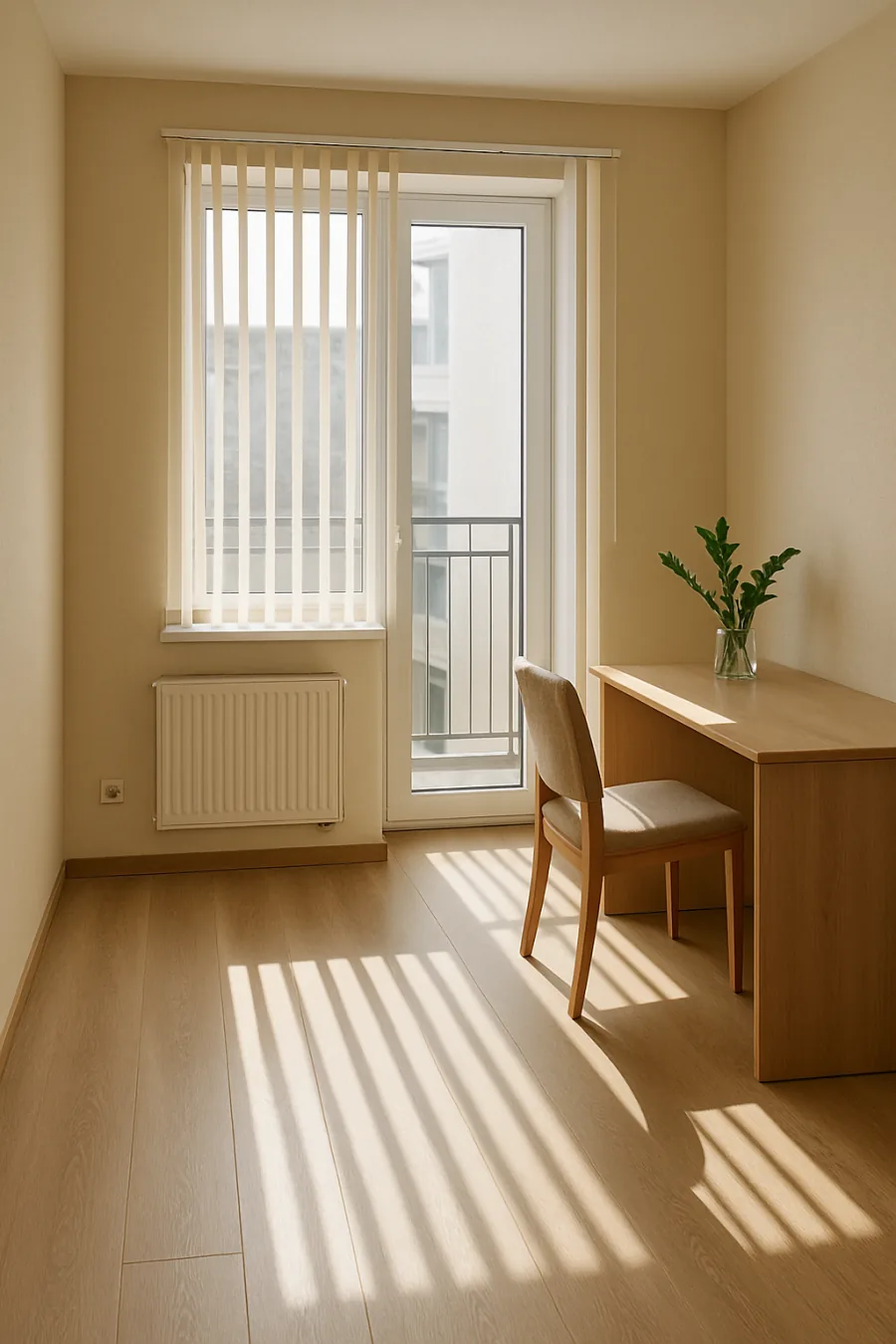
The rail is held by brackets in the glazing bead: the owner gets the frame back with no fixing marks
Timeframe: 3–5 days
A single blind across the whole width of the wall, with no joints — the turned slats let in an even, diffused light
Timeframe: 3–5 days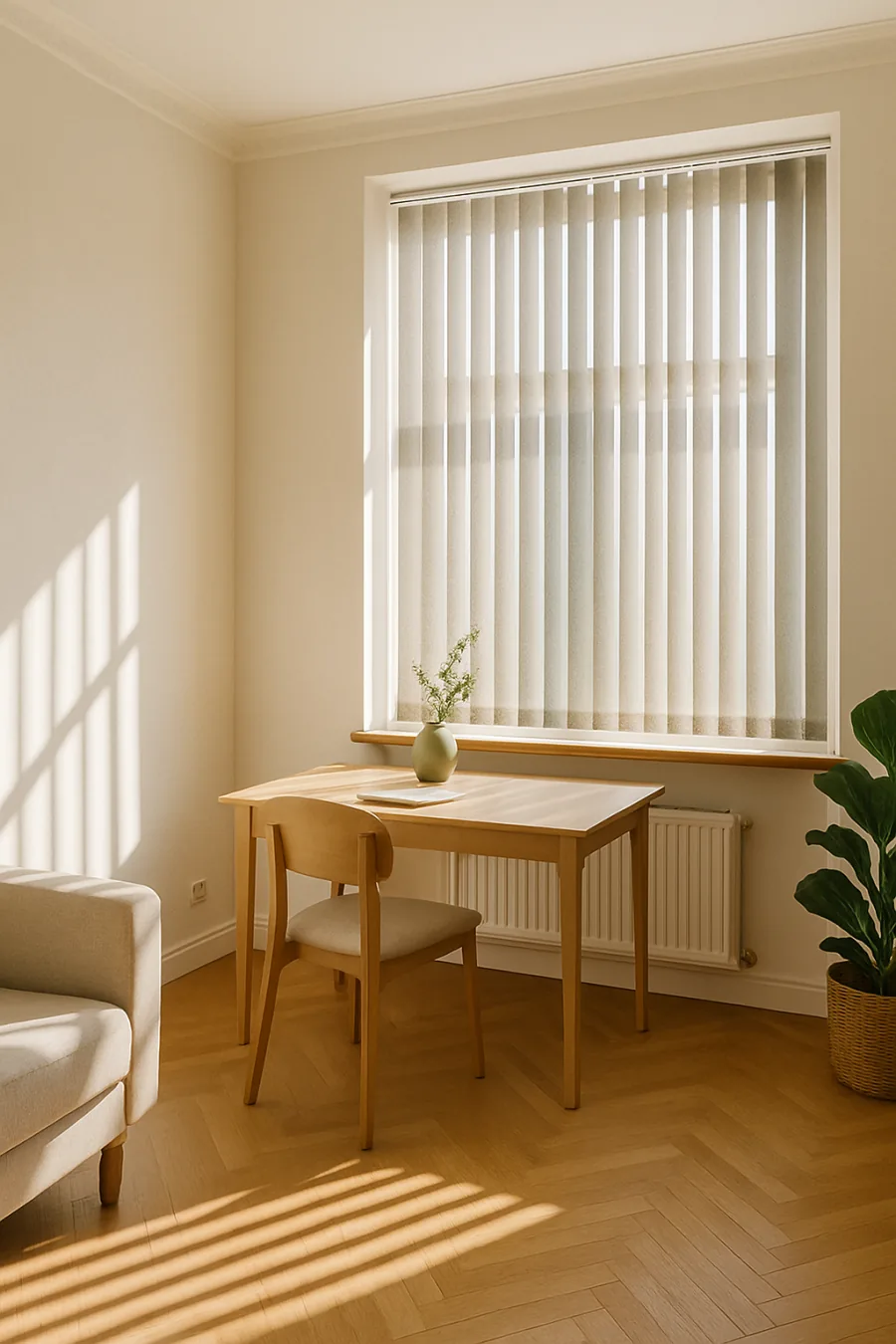
The coating reflects some of the sun’s heat back outside the glass, so by midday the office heats up less
Timeframe: 3–5 days
In the evening, with the lights on in the reception area, silhouettes show through ordinary fabric, so for the shopfront we chose a denser blind
Timeframe: 3–5 days
The rail with the slats was hung on the glazing bead — nothing had to be drilled into the new glass unit
Timeframe: 3–5 days
The sections run along the whole wall, each blind moves to its own edge, and the glass can be cleaned without taking the slats down.
Timeframe: 7–10 days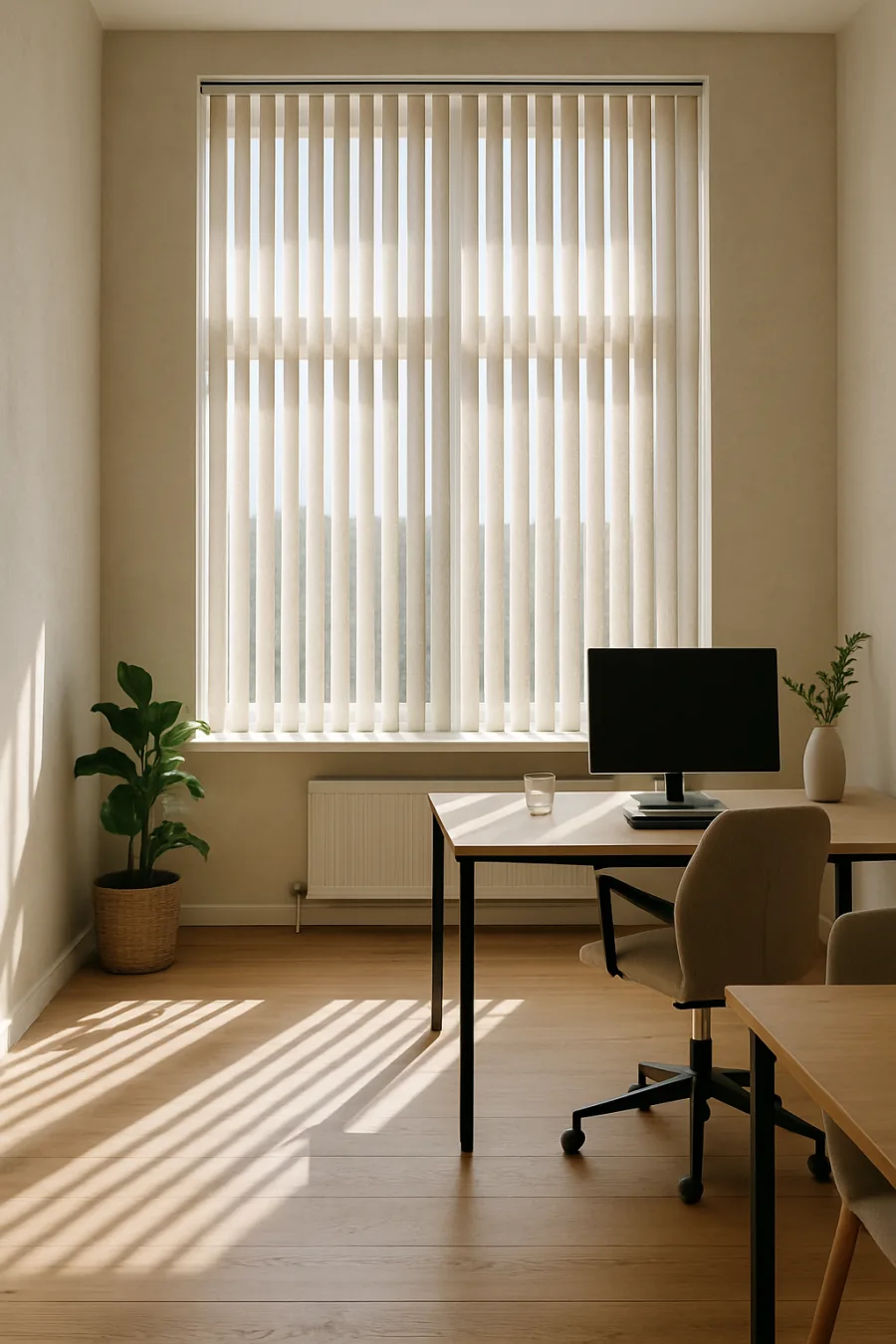
The slats are turned edge-on to the sun: no glare on the monitors by the windows, and the room still gets daylight.
Timeframe: 7–10 days
The slats are angled towards the projector: the picture is easy to see, the desk area is bright, and the lights stay off during the day.
Timeframe: 7–10 days
The blind moves to the wall, the way out to the balcony stays clear, and the glass in the door is covered by a separate blind.
Timeframe: 7–10 days
By morning the slats are closed edge-on: the room is in half-light, and the windows opposite can’t see in.
Timeframe: 7–10 days
The top is out of reach, so the controls were brought down to hand level; the slats can be turned and moved without getting up.
Timeframe: 7–10 days
During the day the slats are turned edge-on and the street is visible; by evening the blind is moved to the edge and the room is closed off.
Timeframe: 7–10 days
The slats are angled towards the monitor: the glare is gone, and the desk stays in daylight without a lamp.
Timeframe: 7–10 days
Sheer slats from rail to floor replaced ordinary sheer curtains — the studio reads as one whole space, with no division by windows
Timeframe: 3–5 days
The shade of the slats was chosen against the light at your own window — the row doesn’t clash with the interior
Timeframe: 3–5 days
The closed slats diffuse the morning sun, and the windows opposite see only a light silhouette
Timeframe: 3–5 days
The row was hung further away from the stove, and a soiled slat can be cleaned separately without taking the rail down
Timeframe: 3–5 days
The row of sheer slats is drawn to the wall with a cord, and the balcony door opens and closes without catching the fabric
Timeframe: 3–5 days
Brackets in the glazing bead, not a single hole in the frame; if you move out, the row comes down without a trace
Timeframe: 3–5 days
The light slats keep daylight in the kids’ room, and at quiet time they are closed
Timeframe: 3–5 days
The sheer slats were turned edge-on to the sun: no glare on the monitor, and the desk stays in daylight
Timeframe: 3–5 days
The olive slats picked up the green of the flower on the windowsill and the tone of the pine chest of drawers — the window became part of the room.
Timeframe: 3–5 days
Above the sink there are splashes and steam every day: the green slats are wiped with the same sponge as the kitchen splashback.
Timeframe: 3–5 days
The eastern sun woke us before the alarm: in the mornings the day-night stripes are kept closed, the light is dimmed, though it is not completely dark.
Timeframe: 5–7 days
A soft sage tone against white furniture: the slats are turned so that during the day the children’s room is bright but not glaring.
Timeframe: 3–5 days
The slats are tilted against the sun: there is no glare on the monitor, and there is enough light on the desk for papers.
Timeframe: 3–5 days
Green slats to match the wooden rack and the plants in the hall; after closing they are turned, and the shop window can no longer be seen into.
Timeframe: 3–5 days
The brackets are clipped onto the sash, the frame was not drilled — the flat’s owner will get the window back without a single hole.
Timeframe: 3–5 days
The green vertical blinds run along the entire glazed wall, the slats are turned with the chain to follow the sun.
Timeframe: 3–5 days
Yellow slats to match the wall by the cot: during the day there is soft light in the children’s room, direct rays do not fall into the cot.
Timeframe: 3–5 days
Sunny yellow aluminium by the stove: the film is wiped off with a damp cloth without taking the blind off the window.
Timeframe: 3–5 days
Yellow slats on each sash to match the mustard cushions, the frame stayed intact — not a single hole.
Timeframe: 3–5 days
Pale yellow slats on the dark frame cut the sun on the screen, while warm daylight remains in the study.
Timeframe: 3–5 days
Yellow vertical slats pick up the warm tones of the hall; by evening they are closed, and the hall cannot be seen from the pavement.
Timeframe: 3–5 days
Yellow day-night fabric right up to the glazing bead: the morning sun is dimmed, by midday the stripes are aligned and let the light in.
Timeframe: 5–7 days
Yellow fabric on each sash, brackets without drilling the frame — the boxes are not unpacked yet, but the windows are already covered.
Timeframe: 3–5 days
Yellow fabric slats 89 mm along the entire glazing: during sunny hours they are turned edge-on, and the light falls evenly across the desks.
Timeframe: 3–5 days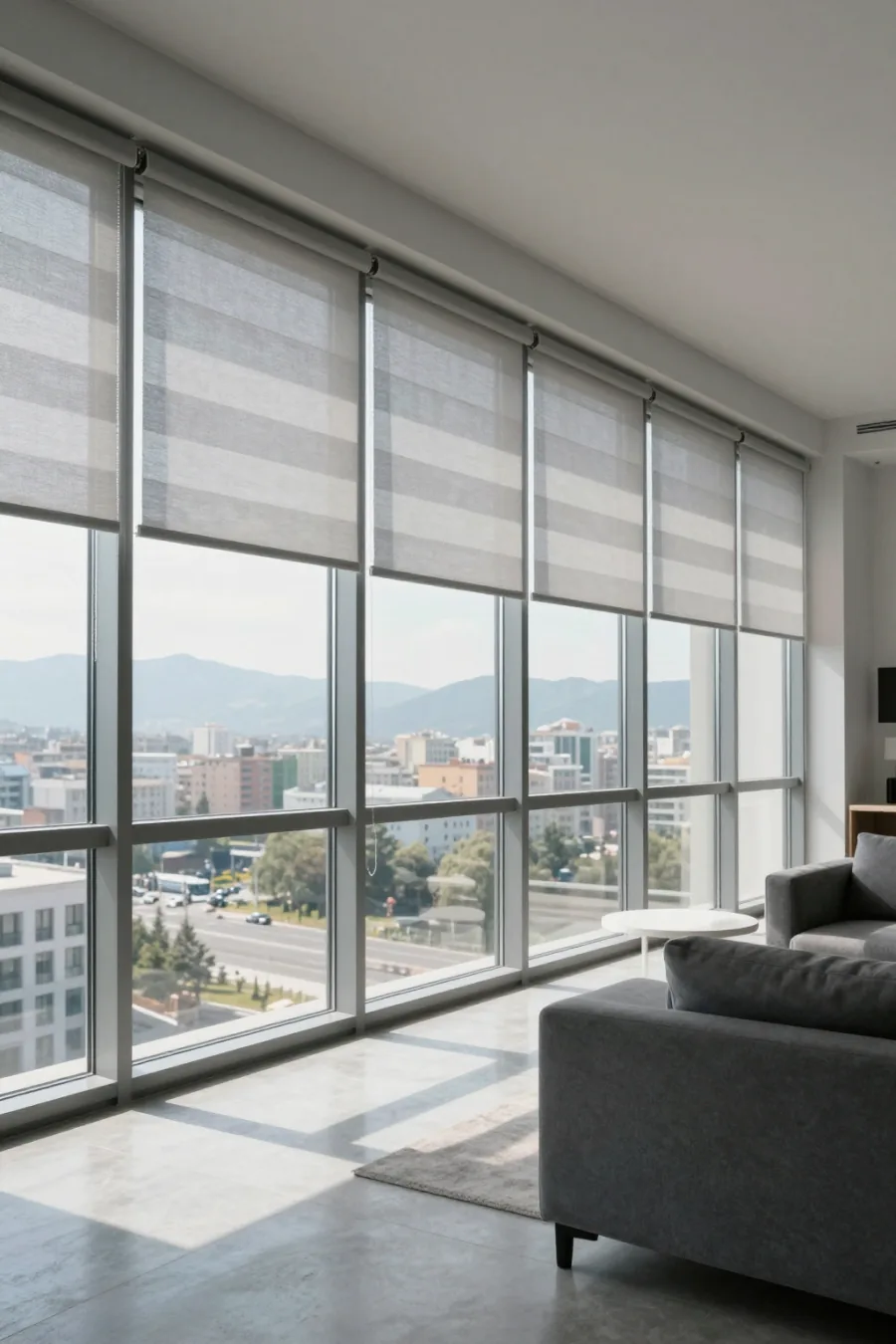
Floor-to-ceiling panoramic glazing, the fabric matched to the wall colour
Time: 6 days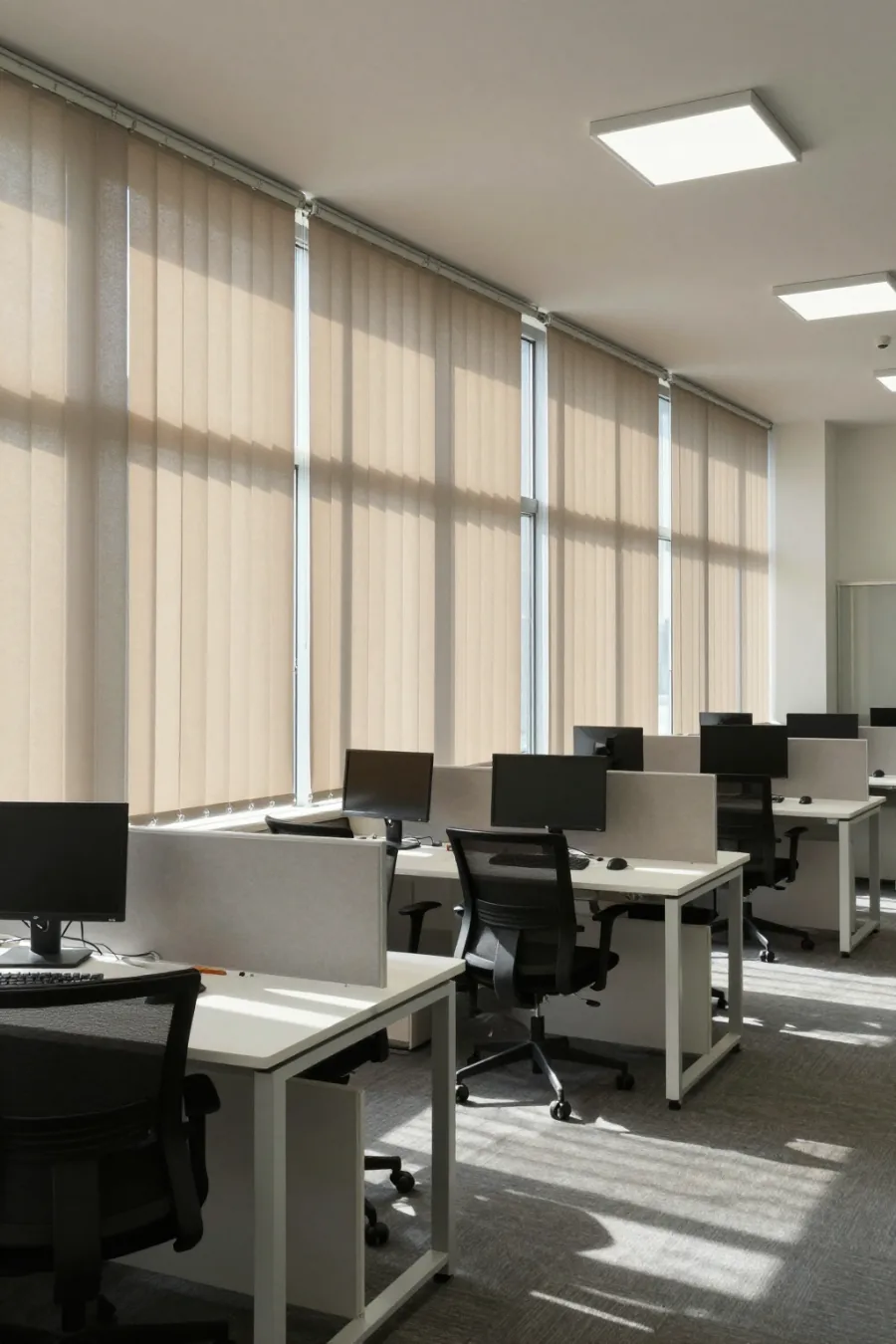
Installation at the weekend so the departments wouldn’t stop working
Time: 12 days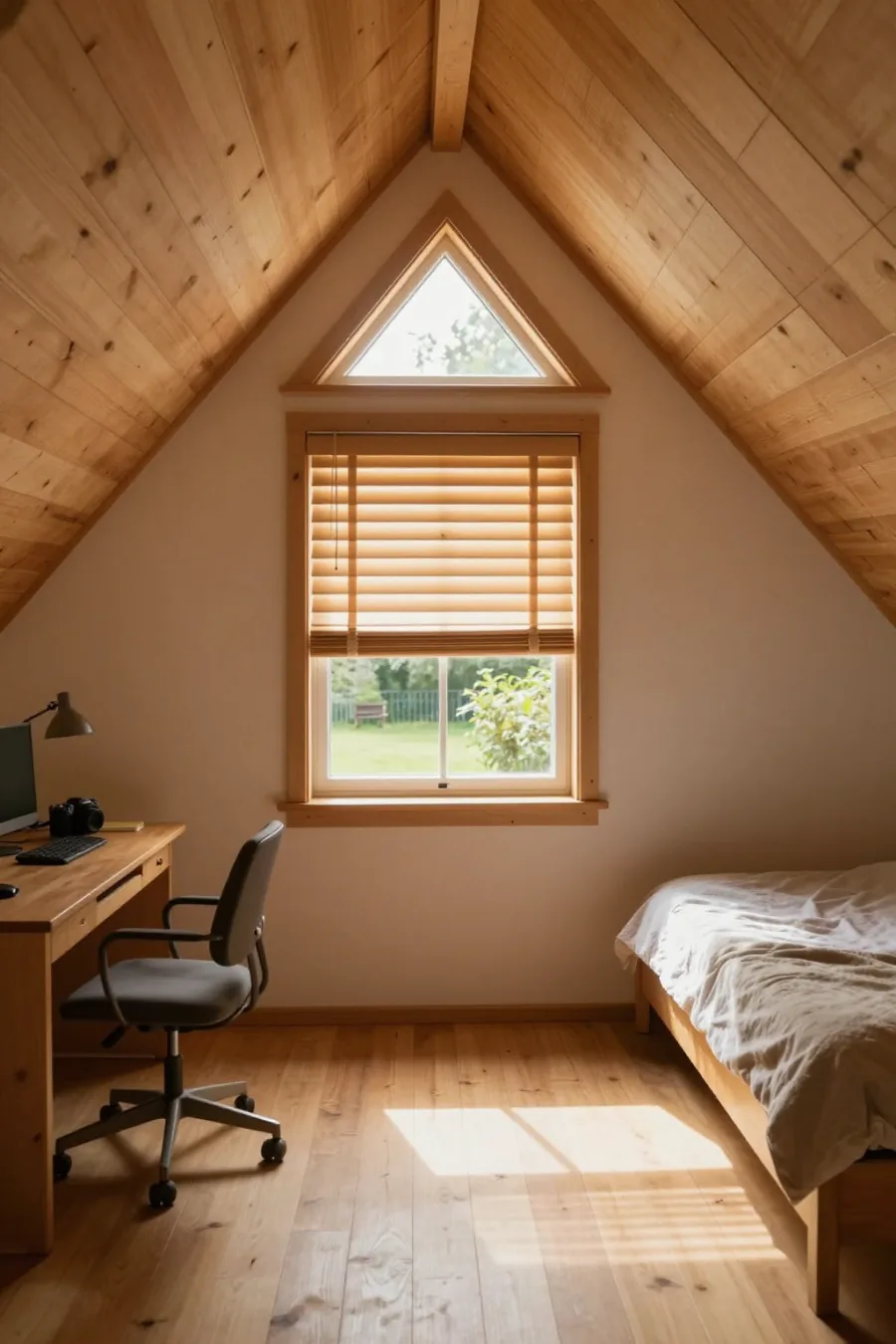
Two triangular windows in the attic — the mechanism on the slope
Timeframe: 3 weeks
Sun protection by day, closed roller shutters at night
Time: 14 days
Extruded profile, manual lift included
Time: 16 days Roller shutters
The shop window stays visible at night, goods behind the perforation
Time: 15 days Roller shutters
Closes completely for the winter, branches don’t break the glass
Time: 12 days Roller shutters
Remote control, emergency lift on each one
Time: 18 days Roller shutters