




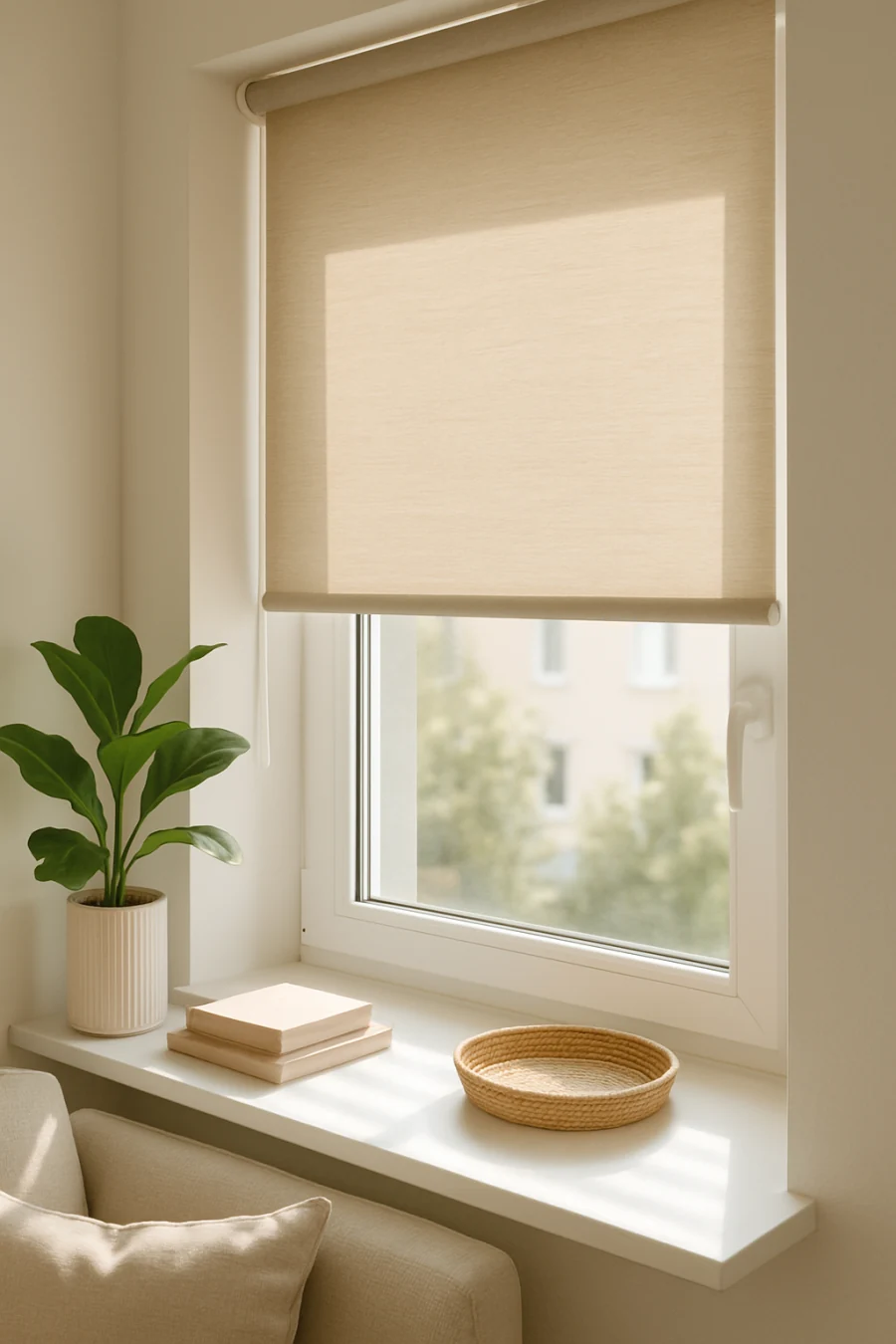


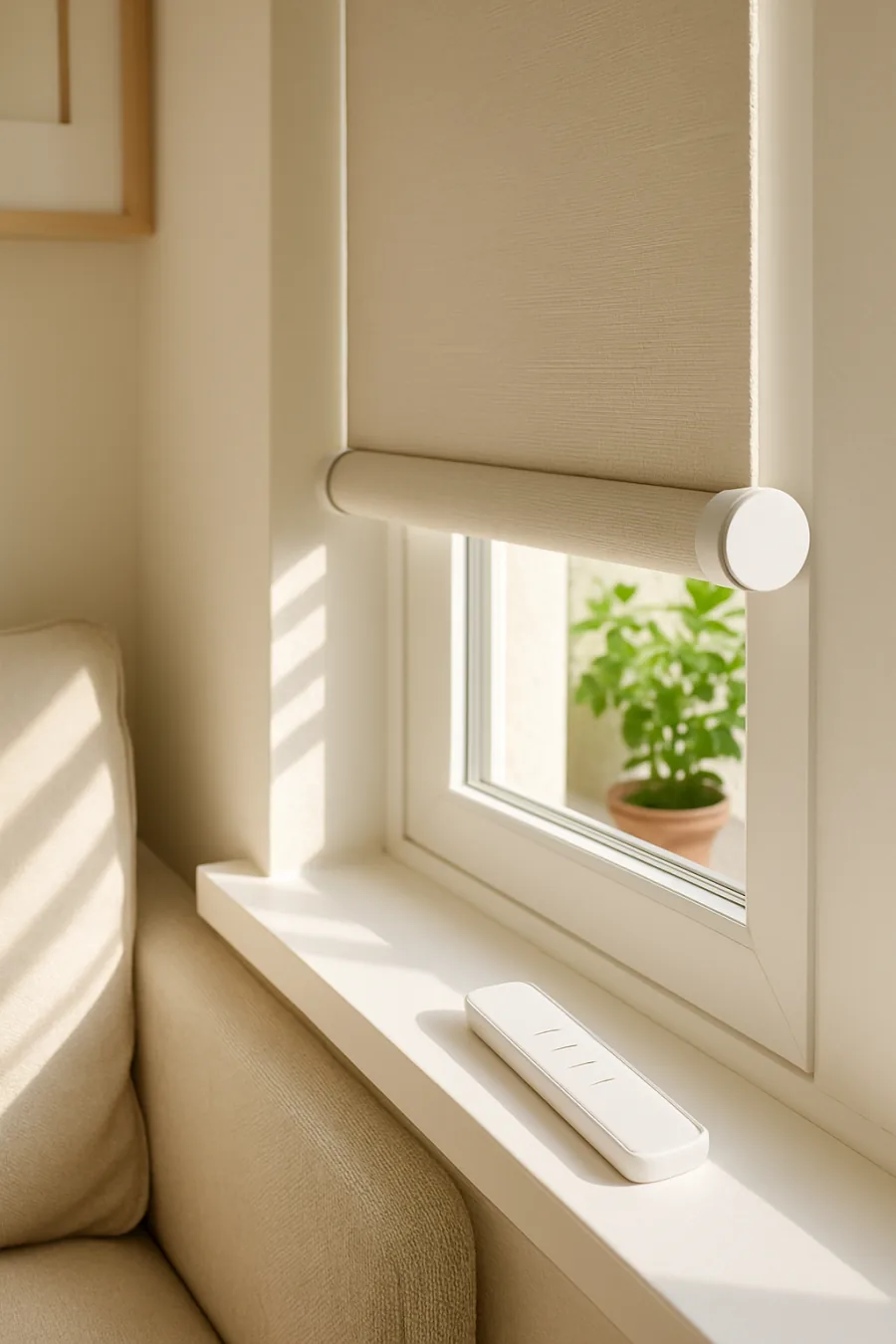


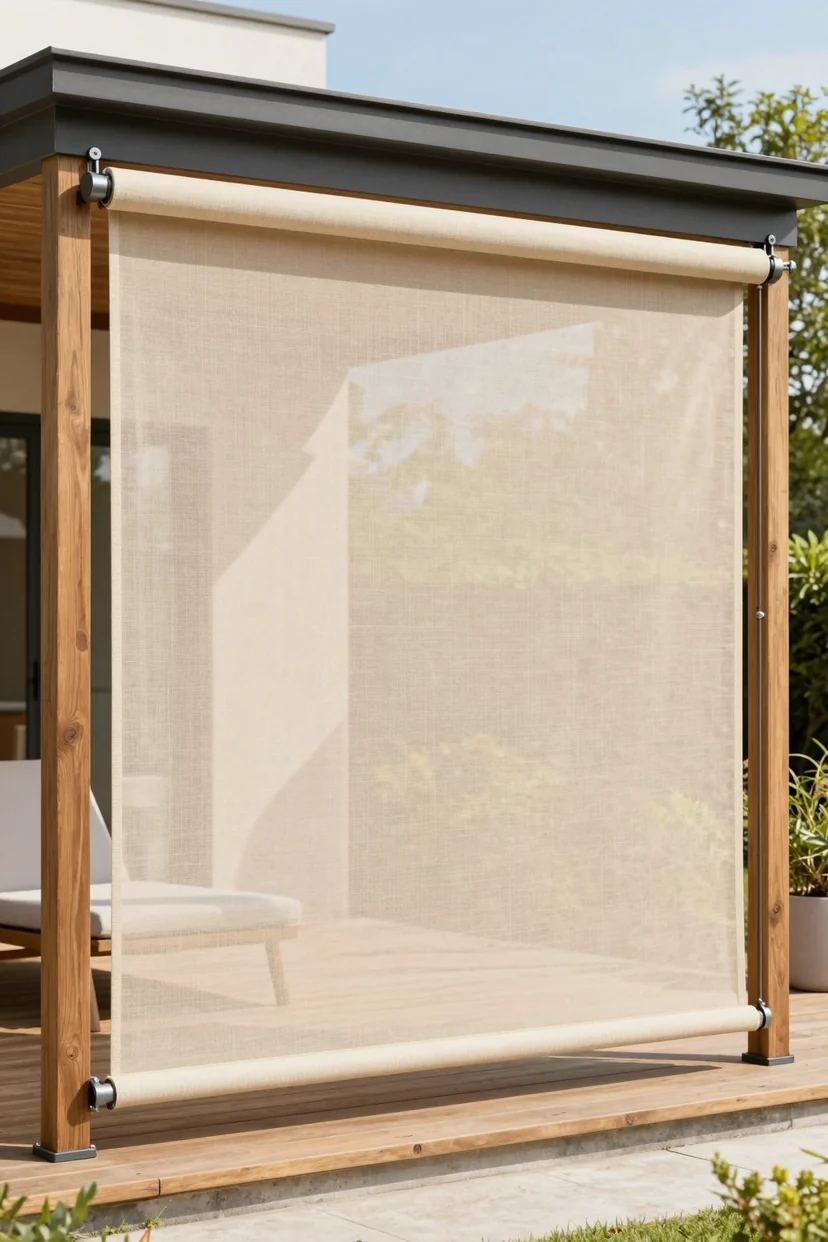











We make black roller blinds in Almaty to measure: the fabric rolls onto a tube at the glass instead of a curtain and rail. It's not the colour that darkens the room but the density of the fabric: blackout gives near-evening darkness, while screen and dim-out let light through. A free-hanging roll leaves light along the edge; a cassette with guide rails removes it.
Why black doesn't mean darkness
Black roller blinds in Almaty don't darken a room just by their colour. Darkness is determined by the density of the fabric, not the shade of the blind. Black screen and black dim-out let light through, and only blackout doesn't let it pass.
Let's take it step by step. Fabric density is how much light passes through the weave of the fibres. Blackout has three layers: two outer ones and a darkening layer inside. Screen is woven as a mesh, and light passes through it freely. Dim-out sits between them — it dims but doesn't block.
Black here works on the look of the window. It pulls the interior into a single outline and gives a graphic line instead of a sheer curtain. That's where the confusion comes from: a person chooses black fabric, expects darkness, and gets a fabric that holds back the sun but keeps the room light.
Three densities in one colour
Let's take the same black and see what it does to a window.
- Blackout. A three-layer matte fabric; during the day in a bedroom you get near-evening darkness.
- Screen. A black mesh holds back the sun and glare but keeps the view from the window.
- Dim-out. A semi-transparent black fabric dims the light; during the day you can make out silhouettes outside the window.
Each of the three fabrics rolls onto a tube at the glass. A roll at the glass takes up less space than a rail with a curtain, and that's the only thing all three options do the same way.
Why black screen beats light screen for the view
A paradox at first glance. Black fabric scatters less light from inside: it absorbs some of the glare from the room, so the street through a black screen is clearer than through a light one. It's easy to check — the measurer brings samples and holds them up to your window.
With blackout the view is fully closed off, and that's its purpose, not a drawback. For a living room and an office it's more important to keep the view of the street, so screen is chosen more often there; for a bedroom — blackout.
It's the structure of the fabric that darkens the room, not the colour of the blind: black screen and black dim-out let light through, and only blackout doesn't.
Where light strips come from and how to remove them
A strip of light appears not because of the fabric but because of the gap between the blind and the window reveal. A free-hanging roll is fixed on brackets, and a gap a few millimetres wide remains on the sides — that's enough for a light line to run down the wall in the morning. A cassette system with guide rails removes it: the fabric slides inside the side profiles, and no gap remains along the edge.
You can also order black roller blinds in the open version — then you should prepare for even darkness differently. We talked about fabrics that let light through the blind itself in the first section; here we're only talking about what leaks past the fabric.
Where exactly the light comes through
Two places give a noticeable strip. The first is the edge along the sides of the blind: the wider the opening, the longer this line. The second is the gap at the bottom bar, between the weight and the windowsill. Through it, light falls as a patch on the countertop or the floor.
There's also a third, less obvious one: the gap between the tube and the top of the window reveal. On a free-hanging roll the fabric winds onto an open roller tube, and a strip remains above it up to the very top of the window. This upper light is barely visible during the day, but in the evening, when the room is dark, it shows clearly.
What a cassette and guide rails give you
A cassette system with guide rails closes all three places at once. The fabric runs inside the side profiles, with a bar at the bottom and a housing box at the top that hides the tube. The light along the edge disappears because the blind simply has nowhere to separate from the profile.
We pay for this with two things: price and appearance. The cassette counts as a factor in the calculator, and the housing box itself is noticeable on the frame — not everyone likes it. If you want even darkening without guide rails, there's an option with mounting flush against the window reveal and the fabric inside the opening, but it can't fully remove the edge. We have a separate page with more on cassette systems.
Jalusso usually advises this: for a bedroom and a child's room — a cassette; for a living room a free-hanging roll is fine if the light along the edge doesn't bother you. The measurer comes with samples and shows both options on your window, so the decision isn't just words.
A free-hanging blind always leaves light along the edge, because there's a gap between the fabric and the window reveal; a cassette system with guide rails removes it.
Heat on the sunny side: what to do with black fabric
On a south or west window, black fabric heats up more than light fabric. Black pigment absorbs more rays, the fabric releases heat into the room, and it gets stuffy by the glass. This is no reason to give up the colour — it is a reason to choose a different fabric or a different roller design.
Why this matters especially in Almaty
Almaty has a sharply continental climate: hot, sunny summers with dust, cold winters with frost and a big temperature swing between day and night. The sunny side of a home carries a heavy heat load, and not only in July.
What does this mean for a blind? Fabric on a south window takes in rays all day, and the temperature by the window depends on how the fabric handles them. Screen handles this differently from blackout: it keeps the sun and glare outside without turning the room dark. Fabric with a reflective layer sends some of the rays back outside before they pass through the glass.
The back side and the position of the fabric
A reflective layer works on heat, not on darkening. These two tasks are easy to confuse: dense fabric without a reflective layer gives darkness but will not save you from heat, while a screen with a reflective layer cuts some of the heat before the glass and keeps the view. Buyers often expect both from one fabric — that is not how it works.
Techniques we recommend on the sunny side:
- Screen instead of blackout — the fabric holds back rays and glare, and the room does not turn dark.
- Fabric with a reflective layer — some of the heat is cut off before the rays pass through the glass.
- Fabric lowered in the heat and raised in the evening — during the day the fabric works as a barrier, at night it does not get in the way.
- Roller at the glass, not on the reveal — the fabric sits closer to the source of heat, so it catches the rays earlier.
People ask about the back side separately. The colour of the back side does not determine how much heat gets into the room: what matters is the structure of the fabric and whether it has a reflective layer. And one more thing: black roller blinds should not be chosen by shade alone — two fabrics of the same colour can have a different heat load.
Black pigment heats up more noticeably in the sun than light pigment, so on a south or west window choose fabric with a reflective layer or a screen that keeps the rays outside. At the same time, darkening and protection from heat are different tasks, and it is better to solve them with different fabrics.
Screen or blackout: what to choose for the living room
For the living room we install a black screen. It holds back the sun and glare but keeps the view from the window: you can see the street from inside, while the room cannot be seen from outside. Blackout is a different task. It gives darkness close to evening, and it is chosen for the living room only if you watch movies or work with a projector there. The choice here is not about colour but about what you want from the window during the day.
Screen and blackout differ in the structure of the fabric, not in shade. A screen has a fine mesh fabric: it reflects some light and lets some through, so during the day you see the yard, trees, cars. Blackout has three layers, and light does not pass through it at all. Black roller blinds in Almaty in a living room almost always mean screen — dense fabric in a room for socialising would turn it into a cinema.
Table: room, task, fabric, design
| Room | What you need from the window | Fabric | Cassette with guide rails |
|---|---|---|---|
| Living room | Hold back the sun, keep the view | Screen | Optional |
| Bedroom | Darkness close to evening | Blackout | Yes, if light comes in along the edge |
| Kids' room | Complete darkness for daytime sleep | Blackout | Yes |
| Study | Remove glare from the monitor | Screen | Optional |
| Home cinema | Full blackout | Blackout | Yes |
| Hotel room | Catch up on sleep during the day after a flight | Blackout | Yes |
In hotels and apartments the logic is different from a home. A guest closes the window during the day and expects darkness, not a view of the city, so here they choose blackout, and almost always a cassette system with guide rails. A free-hanging fabric would leave light along the edge, and a guest sees such a strip as a flaw. A cassette system with guide rails removes light along the edge completely: the fabric runs in grooves, with no gap at the sides.
Glare on the monitor and TV
Matte black fabric gives no glare — neither on a laptop screen nor on a TV. There is no gloss among our fabrics. That is why in a study a screen solves two tasks at once: it cuts the sun and removes the glare on the monitor, while the view from the window stays. A nice side effect that people rarely ask about in advance.
For the living room choose a screen, and install blackout where you need darkness close to evening.
Six black designs and how they differ
The density of the fabric is visible already on the samples: the measurer brings them along, and the client holds the fabric against their own glass. We have six black designs, and they differ not in shade but in how much light they let through.
- Black blackout. A three-layer matte fabric that does not let light through. During the day the room is in twilight close to evening. The fabric has no sheen, and in side light you can see the weave.
- Black screen. Through the fabric the street is visible during the day, while the room cannot be seen from outside. It holds back the sun and glare without darkening the room completely.
- Black dim-out. A semi-transparent fabric softens the light but does not plunge the room into complete darkness. During the day silhouettes outside the window can be made out, while the room cannot be seen from outside.
- Black linen. A dense fabric with the texture of linen and a melange irregularity. No gloss, and in side light a fine structure is visible.
- Black polyester. A smooth matte surface without texture. The fabric does not stretch and holds the shape of the roller — for openings that need a calm dark background.
- Black with an open roller tube. The fabric winds onto a visible tube without a housing box, and the mechanism is fixed to the frame or wall.
Here is how this looks by situation.
| Room | What you need from the window | Version | Manufacturing time |
|---|---|---|---|
| Bedroom | Darkness close to evening | Black blackout | 4–6 days |
| Living room | Keep out the sun and glare while keeping the view | Black screen | 4–6 days |
| Kitchen, dining room | Soft light without full darkness | Black dim-out or black linen | 4–6 days |
| Home office by the window | Matte background, glare doesn't get in the way of work | Black polyester | 4–6 days |
Dim-out diffuses light without plunging the room into full darkness, and that's what sets it apart from blackout. Bedroom and home cinema — blackout, living room and home office — screen, kitchen and dining room — dim-out or linen.
How an open roller tube differs from a cassette
An open roller tube leaves the blind visible by the glass: the fabric runs flush with the window reveal, there's no housing box. A cassette covers the mechanism with a strip, and it deserves its own page — that's also where you'll read about the guide rails that remove light along the edge.
Roller blind and sheer curtain
A roller blind by the glass takes up less space than a rail with a sheer curtain. You can keep the sheer: black roller blinds are mounted in the opening, and they don't get in the way of the curtain if it's on a separate rail. But more often the sheer is removed — a self-sufficient fabric replaces it.
All six versions are made to measure: our workshop cuts the fabric for a specific opening, there are no ready-made products in stock.
Black fabric in a small room and in a child's room
Black fabric on its own doesn't shrink a room. A small room needs light walls and the blind raised during the day — then the dark fabric works as an accent on the window, not as a wall looming overhead. What makes a room gloomy isn't the colour of the blind, but the amount of light that gets into it and how dark the surfaces around it are.
We've installed black roller blinds in small bedrooms of panel buildings, where the window faces the street and there's enough light during the day. The fabric stays on the roller tube by the glass, doesn't take up the windowsill, and the room doesn't lose a single centimetre of usable space — unlike a rail with a sheer curtain, which eats into part of the opening and visually cuts the wall. This is exactly what minimalism and loft love about roller systems: one graphic line instead of three layers of fabric.
Conditions under which a dark roller blind in a small room reads calmly:
- Walls and ceiling are light, furniture doesn't take away the last of the light.
- During the day the blind is raised — the window is open, the room doesn't look closed off.
- The fabric is chosen for the task: dim-out dims the light without plunging the room into darkness, blackout is kept for the bedroom.
- Fabric the same width as the opening, with no extra margin on the sides.
When black fabric in a small room isn't worth hanging
Another combination: a low ceiling, dark walls, dark furniture and a window facing a courtyard where the sun almost never reaches. In that setup the room reads as dark, and the blind adds its share. In this case we suggest a graphite shade or a light fabric with black hardware — the colour stays in the interior, but the window doesn't turn into a black rectangle. Honestly: there's no universal rule here, it all comes down to the light in a specific room, and it's obvious right away at the measurement.
A child's room for daytime naps
In a child's room, black fabric is chosen for one task — daytime naps. Blackout gives darkness close to evening: the three-layer fabric doesn't let light through the blind, and the child falls asleep in the dark during the day. But a free-hanging roller blind leaves light along the edge — a strip between the fabric and the window reveal, and in a light room it's visible. If you need complete darkness, add a cassette system with guide rails: the fabric runs in the grooves, with no gap on the sides.
What to replace a black blind with in a child's room if it seems too dark? Dim-out — it dims the light and keeps the room readable, but doesn't plunge it into full darkness during the day. So the choice here is simple: sleep in the dark — blackout with a cassette, soft light — dim-out.
Darkness in a child's room is determined by the density of the fabric and the mounting method, not the colour of the blind.
A black blind on a white window and next to dark laminate
On a white plastic window, black fabric gives the sharpest contrast of all possible combinations. The dark fabric reads as a graphic line over the light frame, and there's no need to repaint the window — everything is held by the hardware. In interiors with white walls, such a window becomes the accent: the eye goes to it first. This is the case where minimalism and loft do without decor — the frame and the fabric already give the right pattern.
Sometimes the contrast seems too harsh. Then we suggest a graphite shade — it reads as black, but softer, and the transition from frame to fabric looks calmer. In my opinion, graphite on a white window wins over pure black where there's a lot of light in the room and few dark details: the eye doesn't stumble over the boundary. The difference between the two shades is only visible on samples side by side — it doesn't come across in photos.
Dark laminate and dark furniture
For a window with dark laminate, the fabric is matched to the frame or a shade lighter. Then the window doesn't argue with the interior but continues it: black on graphite looks like part of the joinery. If you take fabric noticeably darker than the frame, the window will start to sink into the wall as a black spot.
Dark fabric next to dark furniture works when there's a light surface between them — a wall, floor, countertop. Without that pause the room loses depth, and that's when black really starts to press.
Rented housing
Drill-free mounting leaves no holes in the frame: the system is held by hook-and-loop fasteners, suction cups or clips on the glazing bead. For a rented apartment this is often the only option — no reworking the frame, and when you move you take the blind down and take it with you. For a permanent window Jalusso more often recommends mounting on the frame or on the wall: the fabric doesn't get in the way of the sash, the mechanism sits more rigidly and lasts longer.
Dark fabric on a white frame gives sharp contrast and works as a graphic line; if the contrast seems harsh, a graphite shade is chosen, which reads as black but softer.
Visibility from the street, screen glare and fabric care
During the day, the room can't be seen through black fabric from the street. In the evening the picture changes: with the lights on, silhouettes are visible through screen and dim-out, while blackout doesn't show through even in the dark. The reverse side of our fabrics is the same colour as the front — we don't use a light backing. If evening privacy matters to you, tell the measurer in advance: we'll match the density to your scenario, not to generic advice from the internet.
What the street sees during the day and in the evening
The day works for you: from outside the window looks like a dark rectangle, and the interior details behind it can't be made out. Black screen and black dim-out also don't show the room during the day — from outside the eye sees tinted glass. In the evening the rule is the opposite: black blinds keep the view only as long as there's less light inside than outside. Turn on the chandelier — and silhouettes can already be made out through the screen. This is an optical pattern, not a defect of the fabric.
Caring for black fabric and what will happen to it in the sun
Dust on black fabric is more noticeable than on light fabric. We say this straight: black doesn't make the fabric dirt-resistant.
- Dust is removed with a vacuum cleaner with a soft brush — once every few weeks, without taking the blind off the roller tube.
- Fabric with a PVC coating is wiped with a damp cloth right on the roller tube, without removing the roller tube.
- A removable fabric is sent for cleaning. Washing it whole is not a good idea — washing damages the coating.
Fading is the second issue. A black fabric on the sunny side may turn grey over time, and that is a natural process: the 3-year warranty on the mechanism and 1-year warranty on installation do not cover it. We stand behind the mechanism and installation, but not the colour. That is more honest than promising that black will stay black for years.
Glare on the screen and fabric care are linked through texture: a matte black fabric does not produce glare, and there is no glossy fabric among ours. The approach is the same as with wallpaper — we sit down to watch a movie and turn off the lights.
During the day the street sees a dark rectangle, in the evening — silhouettes through screen and dim-out, and only blackout does not let light through; fading of the black fabric is not covered by the warranty.
How much a black roller blind costs and what the configuration changes
The basic calculation starts from the price per square metre: roller blinds — from 5,400 ₸/m². This amount already includes the fabric, roller tube, mechanism and fasteners. The price per metre is only a starting point, not the final order total.
The total is made up of three things: the area of the opening, the fabric group and the control type. Control is applied as a calculator coefficient. Manual control is the starting point, that is ×1. Chain — ×1.06. Electric motor — ×1.85, and electric with a remote — ×2.1. The difference between the simplest chain and a remote is noticeable, and you see it right away as soon as the measurer puts your dimensions into the calculation.
| Position | Coefficient | What changes |
|---|---|---|
| Manual control | ×1 | Basic configuration, no surcharge |
| Chain | ×1.06 | Chain control of the fabric |
| Electric motor | ×1.85 | Motor included in the price |
| Electric with remote control | ×2.1 | Motor plus remote control |
| Cassette system | ×1.28 | Housing box and guide rails included |
Installation is calculated as a separate coefficient: on the wall — ×1, on the frame — ×1.05, without drilling — ×1.1. No-drill mounting is most often chosen for rented housing — no holes are left in the frame. A cassette system raises the cost through a calculator coefficient, but it eliminates light along the edge.
How we calculate, with an example
Measurement at the window determines the area of the opening, the fabric group and the control type. Let us take the standard logic: a window in the bedroom, fabric from the basic group, manual control. The cost of the opening is multiplied by the control coefficient. If we use a chain instead of manual — ×1.06 is added to the result. If we use electric with a remote — already ×2.1, because the motor itself is included in the price.
What we do not do is list a separate price for blackout or screen: the price list has a base item, and the measurer selects the fabric group on site. The figure from 5,400 ₸/m² is the price you will see in the calculation for your window.
Timelines and installation
Manufacturing takes 4–6 days: during this time the workshop cuts the fabric to your dimensions and assembles the mechanism. It is realistic to be ready by move-in if the measurement was done in advance. We charge 4,500 ₸ for installation of each item, but if the order total reaches 150,000 ₸, we install it free of charge. Measurement and delivery within the city are free. To the suburbs — Kaskelen, Talgar, Issyk, Kapshagay — we do travel, and the cost of the visit depends on the distance and is quoted before the visit, so there are no surprises.
Black roller blinds are calculated by one scheme: area, fabric, control and mounting. The final total is made up of these four components.
How we make and install them: from measurement to installation
We make black roller blinds in Almaty at our own production facility: measurement at the window, fabric cutting in the workshop, installation on site. We do not have ready-made items in stock — each blind is assembled for a specific opening, so the measurer takes the dimensions, not the client.
No-drill mounting on the frame exists. These are clips on the glazing bead, hook-and-loop fasteners and suction cups; they leave no holes in the plastic, and this option is often chosen for rented housing. But a mechanism on clips holds the fabric a little further from the glass than mounting on the frame or on the wall.
Steps from first contact to a finished window
- You message us on WhatsApp and describe your windows.
- The measurer arrives with fabric samples and takes dimensions for each opening.
- He calculates the cost on site — by area, fabric group and control type, taking the fasteners into account.
- The workshop cuts the black fabric and assembles the mechanism: manufacturing takes 4–6 days.
- The team installs the blinds on the windows: installation costs 4,500 ₸ per item, and for orders from 150,000 ₸ we do it free of charge.
Measurement and delivery within the city are always free. To the suburbs of Almaty — Kaskelen, Talgar, Issyk, Kapshagay — we do travel, but the cost of the visit depends on the distance, and it is quoted before the visit, not after the fact.
A roller by the glass versus a rail with a sheer: the fabric is wound onto a roller tube that sits right against the frame, so the windowsill stays free. A rail with a sheer takes up more space both in depth and across the width of the opening.
A practical case
Panoramic glazing in an office: several sashes in one row, a black screen holds back the sun and glare, and the view from the window is preserved — employees do not have to stand up to look outside. We select the mounting and fabric group according to the opening: in some places it is the frame, in others the wall.
The second case is a corner window in a child’s room for daytime naps. Blackout covers the opening, but a freely hanging fabric leaves a strip along the edge, so here we install a cassette system with guide rails.
Jalusso measurer Kirill takes on non-standard windows — arched, triangular, mansard — so black roller blinds in Almaty can be ordered for such a window too.
FAQ
How does a black screen differ from a black blackout in terms of view and darkening? A screen holds back the sun and glare but preserves the view from the window — you can see the street. Blackout does not let light through the fabric, and during the day the room gets a darkening close to evening. For the living room and study we more often install a screen, for the bedroom — blackout.
What to do if you want black but the frame is white and the contrast seems too sharp? Choose a graphite shade: it reads as black but is softer. On a white plastic window a dark fabric gives the clearest graphic line, and the frame does not need to be repainted for it. Graphite softens the junction with the frame and furniture if sharp contrast is not to your taste.
Can a black roller blind be installed without drilling the frame? Yes, no-drill mounting leaves no holes. It uses hook-and-loop fasteners, suction cups or clips on the glazing bead and is suitable for rented housing. For a permanent window we more often use mounting on the frame or on the wall — that way the fabric does not interfere with the sash.
What is covered by the warranty and what is not? The warranty covers the mechanism — 3 years, and installation — 1 year from the date the acceptance report is signed. Fixing a warranty issue will take the technician 5 working days, and you will not have to pay for it. But natural fading of the fabric is not covered by the warranty, nor are mechanical damage, water or re-installation on your own.
Do you travel outside the city and how is the call-out charged? Measurement and delivery within the city are free. To the suburbs — Kaskelen, Talgar, Issyk, Kapshagay — we do travel; the cost depends on the distance and is quoted before the visit.
Can I order a black blind for a non-standard window? Yes. Everything is made to measure; we don't keep ready-made items in stock. Our lead measurer Kirill handles arched, triangular and attic openings. Manufacturing takes 4–6 days, installation is 4,500 ₸ per item, and free for orders from 150,000 ₸.
Every answer is based on the company's facts: warranty on the mechanism, free measurement within the city, installation and a manufacturing time of 4–6 days.
What to remember
It's not the colour that darkens the room, but the density of the fabric. Black blackout doesn't let light through the fabric and gives a dimming close to evening, while black screen and black dim-out let light through — they hold back the sun and glare, but don't plunge the room into darkness. If someone promises you “total blackout” just because the fabric is black, that's not about density.
A free-hanging fabric lets light through along the edge. The gap between the fabric and the window reveal doesn't go anywhere, and the strip is visible on the sides and at the bottom bar. A cassette system with guide rails removes it: the fabric runs in the guide rails, so there's no gap on the sides.
On the sunny side, black pigment heats up more noticeably than a light one. For a south- and west-facing window in Almaty we use fabric with a reflective layer or screen — it keeps the rays outside, before they reach the glass. The reflective layer works on heat, not on dimming, and these two tasks shouldn't be confused.
A black screen beats a light one for the view from the window. Dark fabric scatters less light from inside, so the street reads more clearly, and for a living room or study we most often install a screen.
Before ordering, invite a measurer with samples. Hold the fabric against your glass, see how it behaves in your light, and get the cost calculated by opening — measurement and consultation are free, and the measurer calculates on site.

