















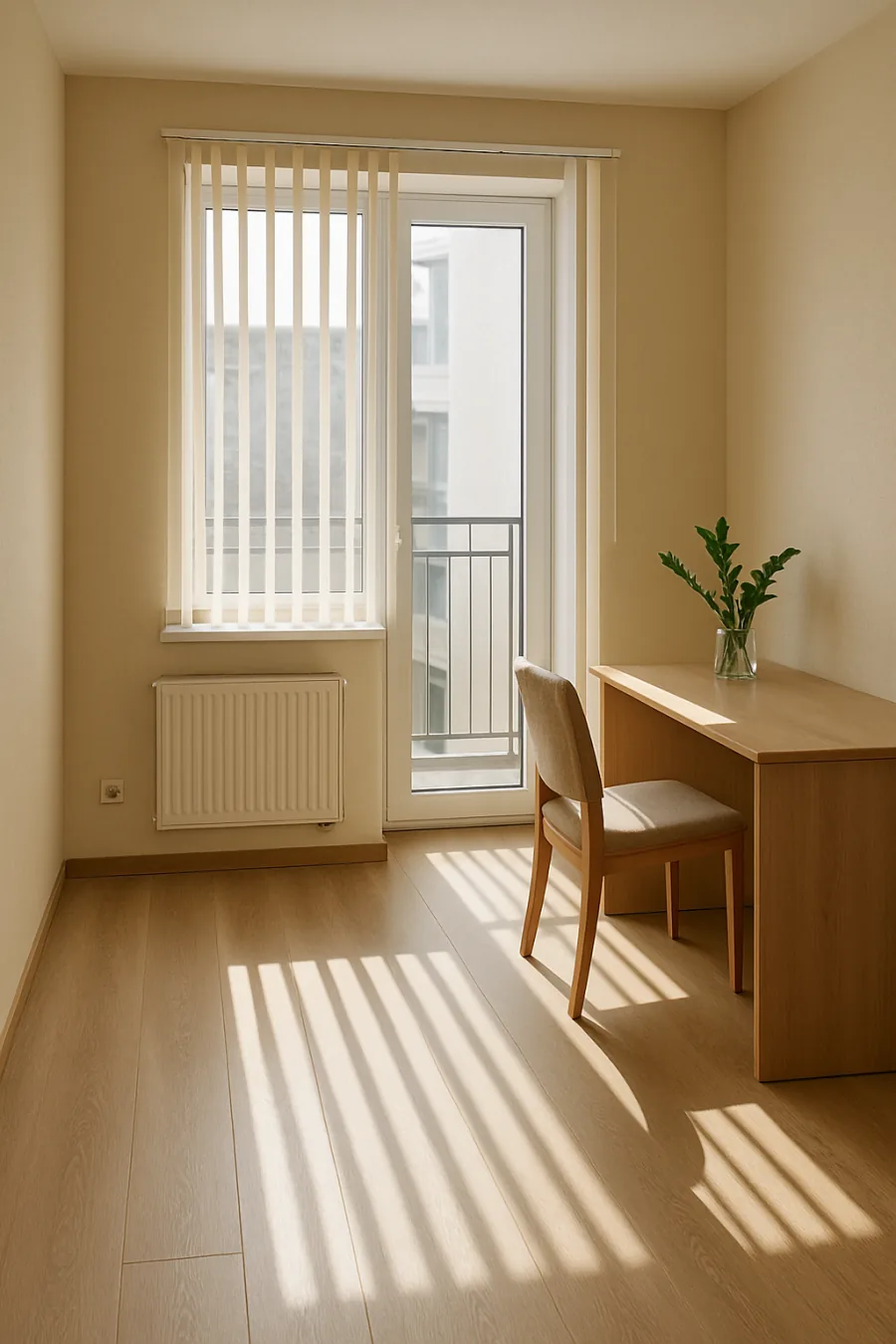

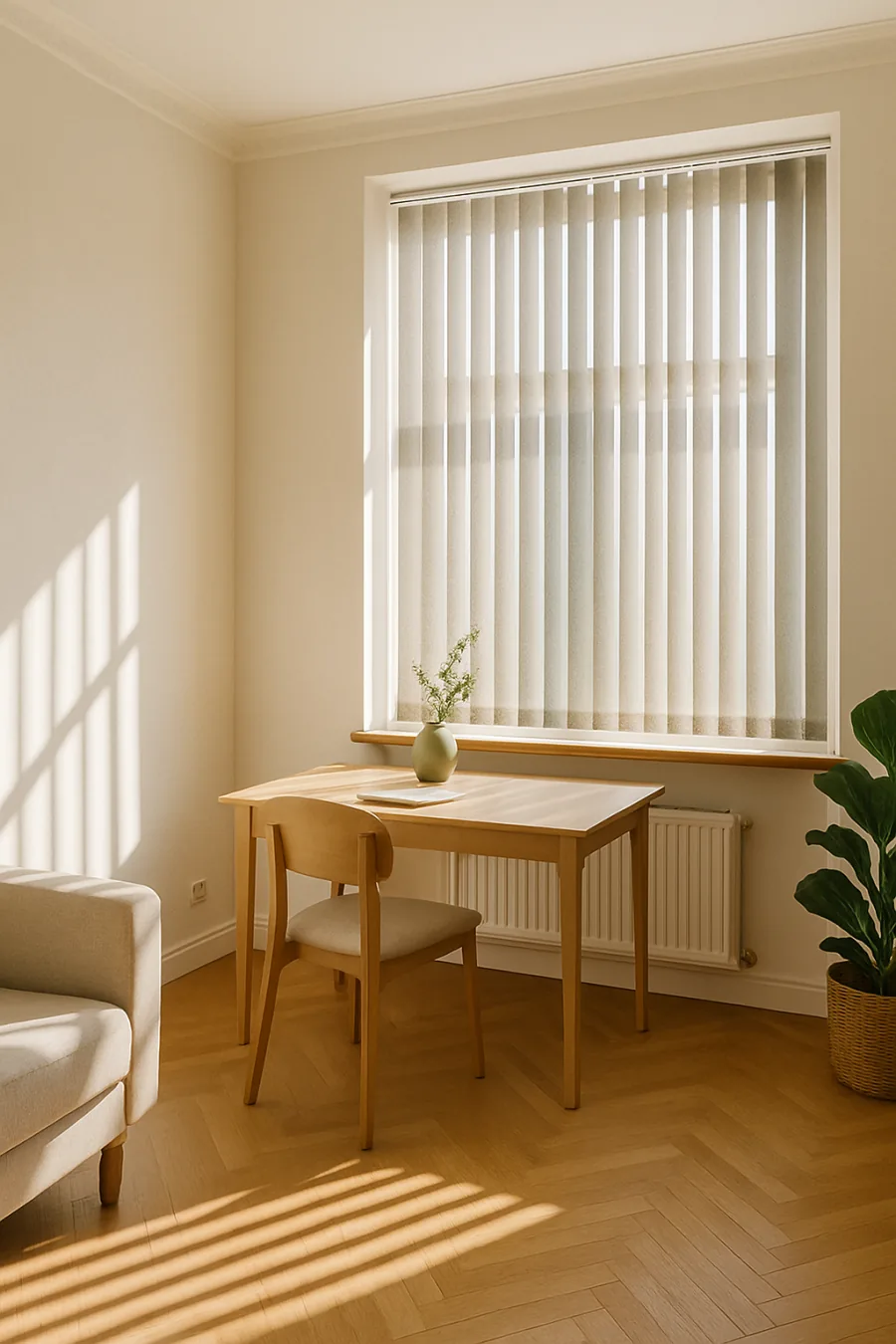


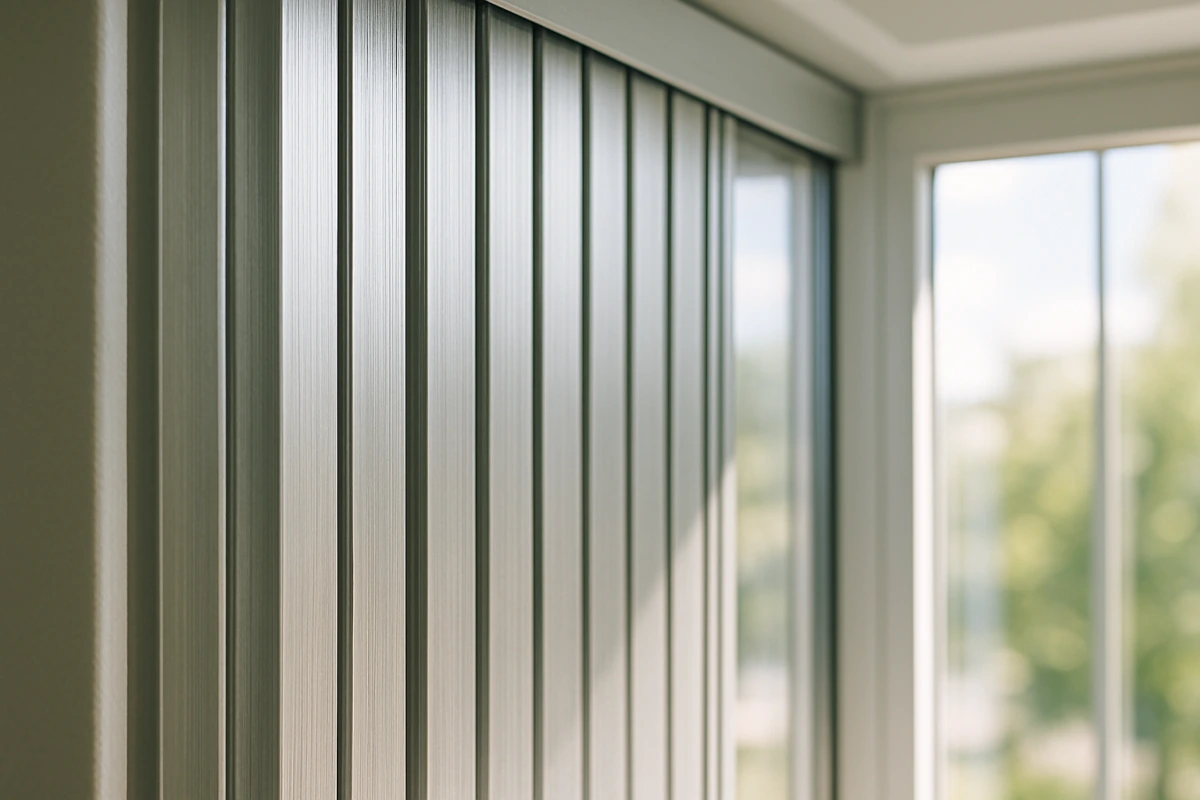

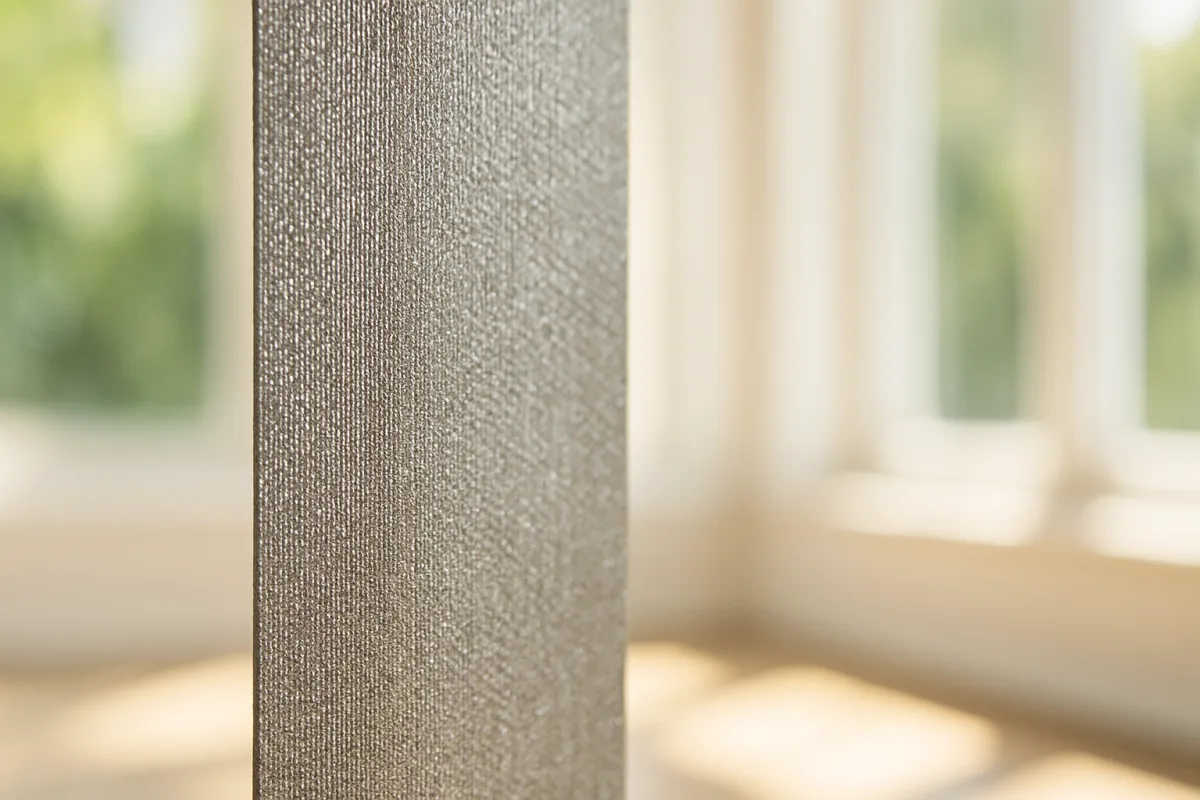










We manufacture office vertical blinds in Almaty to measure: fabric slats 89 mm from 4,600 ₸/m², lead time 3–5 days. Our measurer comes with samples, quotes all the offices at once, and no-drill mounting preserves the frame and the warranty on the windows. Installation is 4,500 ₸ per unit, free from 150,000 ₸.
Why offices more often choose vertical blinds rather than horizontal
Vertical blinds are installed on wide office windows and panoramic glazing because the slat runs from top to bottom and holds its geometry over the full height of the opening. We make office vertical blinds in Almaty to measure, and on such windows they cover the opening with a single blind. Horizontal ones sag in the middle at this width, gaps appear between the slats, and the window no longer closes completely.
Then there's glare on monitors. Vertical blinds for an office are chosen so that an employee can tilt the slats to the angle of the sun rather than shutting the window completely. Fabric slats 89 mm diffuse the light: a direct beam doesn't hit the screen, but the working light in the room remains. And the aspect makes a big difference. On the south side the blind is turned more tightly and the angle is changed more often during the day; on the north side it stays in one position for long periods.
Vertical blinds cost more than horizontal ones, and we say so plainly. But horizontal ones have their own price on a panorama: a short slat doesn't cover a tall opening with a single blind, so several sections are needed, and light leaks build up at the joins.
What a vertical design gives an office:
- A single blind covers the window from windowsill to ceiling, with no joins
- The slats draw to the side, opening up access to the window
- A wide span holds without intermediate supports
- The tilt angle is adjustable at any point
Panoramic glazing calls for vertical slats, not horizontal ones: only then does the blind keep a straight line across a wide opening. This is the main argument in favour of vertical blinds for an office with large windows.
How vertical blinds differ from horizontal ones in design
With vertical blinds, the slat hangs from the rail and moves along it, and a tilt mechanism runs inside the slat. The blind draws to the side and turns around its axis — hence the single-chain control. With horizontal blinds, the slat lies across the window and lifts up on a cord. The difference is in the geometry: a vertical slat works on height, a horizontal one on width. For a long window in a meeting room or on a panorama, that's what decides the choice.
An office is not just one window: open space, meeting room, private office, reception
We select office vertical blinds in Almaty not by window size, but by the task of the room, and the main parameter here is fabric density. There is no universal fabric for every office: in some places it is more important to remove glare from screens, in others to hide the room from prying eyes. Fabric density also determines how much the blind darkens the room and what is visible from the street in the evening when the lights are on inside.
Fabric slats 89 mm diffuse light rather than cut it, so working light in the room remains. A loose fabric gives a soft shade during the day, but does not turn the office into a dark room. In the evening the picture changes: with the lights on, silhouettes are visible from the street, not details. For a meeting room and an executive office this is not enough — there we select a denser fabric.
Open space
A long row of windows in an open space means sun that comes from one side all day and hits the monitors. The slats are turned at an angle to the sun: glare on monitors disappears, diffused light remains, and the lights can stay off during the day. Employees sit in even lighting all day, not in alternating glare and shadow. Each window is covered by its own blind with its own control — you can adjust one spot without touching the rest.
Meeting room
In a meeting room with a projector, vertical blinds need to be dense. It is not only about the screen: with a loose fabric the projector image is paler, and participants sit in half-shade. A dense fabric removes glare from the table and keeps the picture contrasty. In the evening it also hides the room from prying eyes — a loose fabric with the lights on inside shows silhouettes, and the meeting becomes visible from the street.
Executive office and reception
In an executive office, a dense fabric solves privacy: during the day the room is bright, but from the corridor and the street you cannot see who is sitting there or what is on the desk. A reception with a shop window works differently. During the day the street is visible from the window, and that works for the office, not against it. In the evening the shop window becomes a problem: an ordinary fabric blind starts to show through when the lights are on inside. If visitors are expected in the reception in the evening, we also use a dense fabric there.
For example, in an office with south-facing windows we installed a light fabric in the open space to keep the working light, and a dense fabric for the projector in the meeting room next door. Fabric density, the side the light comes from and the purpose of the room affect darkening more than the colour of the slat.
Fabric, plastic or aluminium slats: what goes where
The slat material is chosen by room, side of light and how many hands touch the blind every day. For an office we usually name three options: fabric slats 89 mm, PVC plastic slats and aluminium slats. The fourth is fabric with a coating, a separate story for south-facing windows.
| Material | Where we install | Why |
|---|---|---|
| Fabric slats 89 mm | Open space, meeting room, private office, reception | Fabric diffuses light and does not turn the room dark |
| Plastic slats (PVC) | Corridors, reception, high-traffic areas | Wiped with a cloth, do not crease when touched, not afraid of moisture |
| Aluminium slats | Long spans, stairwells | Rigidity along the full length, slats are replaced one by one |
| Coated slats | South-facing offices and open spaces, windows on the bright side | The metallised layer reflects part of the heat back outside the glass |
Fabric slats 89 mm are the most common choice for office windows. Fabric diffuses light rather than cutting it: workstations stay lit, and glare on monitors disappears. We cut the slats to the height of the window, so a wide opening is covered by a single blind without joints. They suit both panoramic glazing and a standard sash.
PVC plastic slats are suitable for high-traffic areas. A corridor, a reception with a shop window, an area by the kitchen: the blind is not afraid of moisture, is wiped with a cloth and springs back if it is touched. Another reason to choose plastic is a dusty street outside the window: the slat can be wiped right in place, without taking it down.
Aluminium slats are installed on long spans and stairwells. Aluminium reflects heat back outside the glass, does not accumulate it in the room and is not afraid of moisture. Rigidity along the full length is what fabric lacks on a long span. If damaged, one slat is replaced, not the whole blind.
Coated slats are fabric with a metallised layer. This material reflects part of the heat back outside the glass, so the room heats up less from the sun. The light stays soft, without harsh flashes on monitors. We use it on windows on the bright side — where ordinary fabric simply cannot cope with the heat.
What to choose if you are unsure? At the measurement we bring samples and lay them out on the windowsill — you can see how each texture behaves in your light. We also calculate what a particular material will cost for the area of all offices. In my opinion, it is not worth saving on material for the sake of a difference in price per square metre: the blind hangs in full view of employees and guests every working day. We make office vertical blinds to measure, cutting the slats to the specific height of the window.
Fabric diffuses light, plastic is washable and handles traffic, aluminium gives rigidity on long spans, and the coating reflects part of the heat back outside the glass.
Price of office vertical blinds: what the total is made up of
Fabric vertical slats 89 mm cost from 4,600 ₸ per m². This is the base price item from which any office window is calculated. The total is made up of three things: fabric density, the area of the opening and the type of control. The denser the fabric, the wider the window and the more complex the mechanism, the higher the total — and vice versa, a narrow sash in a utility room will cost noticeably less than a panorama in a meeting room.
We calculate per product, not per square metre in isolation. We multiply the area of the opening by the price per m² and by the coefficients. Why? A metre of fabric without a rail, slats and mechanism is not yet blinds. A product is a finished blind for a specific window, with a rail, slats and control, and it is measured on site.
How the price per product is calculated
Control and installation are applied as coefficients to the base price. Mechanical control — ×1, chain — ×1.06, electric motor — ×1.85, electric with remote control — ×2.1. Wall installation is taken with a coefficient of ×1, on the frame — ×1.05, without drilling — ×1.1, cassette option — ×1.28.
Let us look at an example. Panoramic glazing in a meeting room, vertical fabric slats 89 mm, chain mechanism, mounting in the opening without drilling. We take the area of the opening, multiply by 4,600 ₸, then by the control coefficient 1.06 and by the installation coefficient 1.1. We get the cost of one product. A projector hangs nearby, and the customer separately asks for a dense fabric — this is a different item by density, and it will raise the price. Two windows that look identical can differ in price because of the fabric, and that is normal.
Installation and terms for organisations
Installation costs 4,500 ₸ per product. For orders from 150,000 ₸ we install free of charge — an office with several rooms quickly reaches this amount, and installation across the whole floor comes at no extra cost. The exact amount is quoted by the measurer on site: they walk through the rooms, see each window and calculate based on the actual situation. We do not have a separate price list for legal entities — the price is the same for a company and for a private customer. Private offices, the reception and the open space go into one calculation, and measuring several rooms in one visit saves the office manager time.
The price of vertical fabric slats 89 mm is from 4,600 ₸/m², and the total depends on fabric density, opening area and the control type.
How to order blinds for a whole floor: one measurement for all offices
A whole floor is ordered with one measurement, not office by office. The measurer comes once, goes through all the rooms in a row and measures every window on site — so you get one total and one deadline for the whole job, not five different quotes from five visits. There is no need to come to the same floor a second time: the rails, the slat type and the mounting are clear after the first walk-through.
The process is as follows:
- Message us on WhatsApp with roughly how many windows and which rooms need to be covered.
- We agree on a day and time when someone with access to the offices is on site.
- The measurer walks through the office, takes the opening dimensions and checks where the frame is rented and cannot be drilled.
- On site, they calculate the cost for each window and the total.
- You approve the fabric and the control type; we give the deadline for the whole floor after the walk-through.
- The workshop makes the slats to the height of each window, then installation follows.
How the measurement works
Measuring several offices takes more time than one window, and it is worth being ready for that. The measurer comes with fabric samples: density and shade are easier to choose at your own window than from a picture on a screen. Measurement and consultation are always free with us, and the visit within the city costs nothing either.
An important detail: we are a manufacturer with a workshop in Almaty. There are no ready-made products in stock; every slat is cut to the specific height of the opening. That is why we take the dimensions accurately and only once.
When the deadline is fixed
Fabric vertical slats 89 mm at a price from 4,600 ₸ per m² are made in 3–5 days. If an electric motor is added to the project, the deadline grows to 7–10 days — this is a price list item, not our extra caution.
We give the deadline for the whole floor at the measurement, after we have seen the scope. Promising 3–5 days for an entire office is wrong: a large order takes more time than one window, and we say so right away. Installation can be scheduled for the weekend or the evening.
At the measurement you get both the total and the date — for the whole office at once, in one quote.
Installation without drilling: rented space, business centre, window warranty
In a rented office, vertical blinds can be installed without drilling the frame — we mount them on brackets into the glazing bead or on spring clamps. The frame stays intact, the window manufacturer's warranty is not lost, and the structure can be removed without traces. For a business centre this matters: the property owner and the management company look at the condition of the windows, not at our mounts.
We do installation without drilling at a coefficient of ×1.1 to the base installation price. A little more expensive than regular wall mounting, but the window stays under warranty. This is the case where paying a few percent more removes the whole topic of conversation with the management company — you simply show an intact frame.
Mounting in the opening or on the frame
A rented office requires mounting into the glazing bead or on clamps, but the choice between the opening and the frame depends on the window itself.
With deep reveals, the rail is placed inside the opening on the wall — then the slats sit flush and the windowsill is free for documents and equipment. If the reveal is shallow or the sash is standard, mounting on the frame is more convenient: the rail is closer to the glass, and the blind does not catch the windowsill when sliding. Mounting on the frame comes at a coefficient of ×1.05, the cassette system — ×1.28.
At the measurement we look at both options and say which is cheaper for the specific window. There is no point guessing from a photo: a spring clamp does not hold equally well on every frame.
Moving office
When moving, the blind is taken off the rail, the rail is detached from the glazing bead or clamps, and everything moves to the new place.
The slats are transported folded, so the fabric does not crease from contact. On the new window the rail is mounted the same way — without drilling, if the frame allows it. When an office moves, we relocate the whole structure: only the mounting changes, the blind itself stays functional. If the opening at the new place is wider or narrower, we take some of the slats back to the workshop and re-cut them to the new height.
Mounting into the glazing bead or on clamps leaves the frame intact, so the window manufacturer's warranty is not lost, and when moving, the structure can be removed without traces.
One shade for the whole facade: how to choose fabric and colour
All windows of one facade should use one fabric and one shade. Otherwise the difference between batches is visible from the street, when the slats face outward, and inside — when light from the window passes through fabric of different density and neighbouring offices look different. We cut the fabric from one roll for the whole order, so the shade matches across all offices.
A single shade of slats creates a uniform look for the business centre facade: from the street the office reads as one solution, not as a set of mismatched windows. This is especially noticeable on panoramic glazing, where neighbouring blinds stand in the same plane and a difference in shade is the first thing to catch the eye.
With corporate identity there is a simple rule: the slat colour is either neutral or repeats the corporate shade, but does not clash with it. Practice shows that saturated warm tones on windows facing south tint the light in the room red — furniture and screens take on a warm hue, and this gets in the way of working with documents and colour on a monitor.
What to consider when choosing fabric and colour:
- one fabric and one batch for all windows of the facade;
- fabric density — according to the room's purpose, and the shade — shared;
- window orientation: on the south and west, warm shades visually increase the heat;
- we hold the sample against the glass in your own light, rather than choosing from a catalogue in the workshop.
Fabric density can differ on different windows, but the shade cannot. All windows of one facade should use one fabric and one shade.
Checklist before ordering
We look at the window at the hour when the sun hits it, hold the samples against the glass, check the shade against the company's corporate identity and fix one fabric option for the whole order. The measurer brings the samples along, so the decision is made on site, at the specific window.
Chain or electric motor: control for tall and panoramic windows
The chain mechanism controls the rotation of the slats and the sliding of the blind, and the chain runs along the full height of the window. That is why on tall windows that you cannot reach by hand, the chain is the usual choice: it comes down to shoulder level, and an employee can easily turn the slats from open to closed. No stepladder, no stopping work.
An electric motor is needed where the height or area of the opening makes manual control inconvenient: panoramic glazing, windows right up to the ceiling, long rows of slats across a whole wall. The motor runs on 220 V mains or a battery, and with a remote control it is operated from the workplace. According to the price list, the item “Blinds with electric motor” starts from 7,800 ₸/m², manufacturing time — 7–10 days, whereas vertical blinds with a mechanical control we make in 3–5 days.
| What we compare | Chain mechanism | Electric motor |
|---|---|---|
| For which window | A tall window within arm's reach | Panoramic glazing, floor-to-ceiling windows |
| Control | Chain along the full height | Button, with a remote control — from your desk |
| Power | Not required | 220 V or battery |
| Price per m² | from 4,600 ₸ | from 7,800 ₸ |
| Lead time | 3–5 days | 7–10 days |
A separate question is how vertical blinds for an office get along with an air conditioner and a radiator under the window. The slats run inside the opening, and the rail is mounted to the ceiling or into the window reveal, so the windowsill and the equipment under it stay free. The blind does not cover the radiator or trap heat in front of the air conditioner — the air moves as usual.
At one site with panoramic glazing, we installed a chain on the windows up to chest level and a motor on the top row of slats; employees use the chain, and the top opens with the remote control. The chain mechanism is chosen for offices more often because it is cheaper and needs no power supply.
Installation outside working hours and working with a legal entity
We do installation outside working hours as standard — in the evening after the office closes, at weekends or at night. The office does not stop for a single day. This is the first thing an office manager asks about when the windows face the sunny side and employees sit all day with the blinds closed.
It is not one installer with a bag of tools who arrives, but a crew. We finish one floor in a single visit, offices one after another, and in the morning the finished products are already in place. And there is no need to move furniture or equipment — we work at the window without touching the desks.
What about the paperwork? We are a manufacturer, so we work with organisations too. We discuss the document forms and payment procedure at the measurement with the customer’s accounting department — that is a question for the company itself, not for the blind design. The measurer calculates the exact amount for each window on site.
Within Almaty, measurement and delivery are free, and this applies to an office in any district of the city. To the suburbs — Kaskelen, Talgar, Issyk, Kapshagay — we travel as well. The cost of the visit depends on the distance, and we quote it before the visit, not after we arrive. We measure several offices in the suburbs in the same way as in the city: one visit, a walk through the rooms, samples with us.
For example, an office in a business centre with a shop window on the ground floor is convenient to close on a Saturday: no employees, no visitors, and the crew goes through all the rooms one after another. By Monday, all that is left is to sign the acceptance report.
Installation outside working hours lets you hand over the office without downtime and without rearranging workstations.
Care, slat replacement and warranty
Caring for the slats depends on the material. Fabric slats 89 mm are cleaned with a vacuum cleaner on low power or with a soft sponge — without soaking. The fabric must not be washed in a machine: it loses its treatment and shape, and after washing the slat no longer hangs straight.
Plastic and aluminium slats are wiped with a damp cloth and a mild product right on the window, without taking them down. If the windows face a dusty street, fabric blinds are vacuumed more often — once a month instead of once a season — while plastic and aluminium are simply wiped. Once a year, the mechanism should be cleaned of dust: jamming most often starts with dust inside the rail, not with a breakdown.
Replacing a single slat
A single damaged or soiled slat is replaced on its own. There is no need to take down and re-sew the whole blind — this is one of the main advantages of the vertical design. And we replace it even after the warranty has expired: we come, tighten, adjust and fit a new slat.
What we cover under warranty
For office vertical blinds, the mechanism stays under warranty for 3 years, and the installation work for 1 year, and we count both periods from the signing of the acceptance report. If the mechanism jams in the office, we fix the warranty case free of charge within 5 working days. The warranty does not cover fabric fading, mechanical damage, re-installation on your own or exposure to water.
How long vertical blinds last
We do not quote a service life in years — it depends on the premises and on how the blinds are handled. One thing I can say: after the warranty we still come — to tighten, adjust, replace the cord or chain. In practice, vertical blinds in an office last longer than a design that is constantly pulled by the slats by hand. </br>
FAQ
There are always more questions about office orders than about a single window. We have collected the ones asked at measurements and in messages.
How is the price calculated for several offices?
By the area of each opening separately, not as a single sum for the office. The measurer walks through the offices, calculates vertical fabric slats 89 mm at 4,600 ₸ per m², adds a coefficient for the control and mounting — a chain gives ×1.06, installation without drilling ×1.1 — and quotes the cost for each window. This way you can see which room pushes the budget up and where you can save by choosing a less dense fabric. The measurer arrives on site with samples and calculates everything in front of you.
How long does an order for a whole floor take?
According to the price list, vertical blinds take 3–5 days, and with an electric motor 7–10 days. For a whole office, the timeframe is quoted at the measurement rather than taken directly from these figures. The reason is simple: the workshop makes products in batches, and twenty windows follow a different schedule than one. Measuring several offices is what gives an exact timeframe for the whole volume.
What about the warranty on installation?
The warranty on installation is 1 year from the date of signing the acceptance report. The mechanism is covered by a 3-year warranty. If the control jams in the office or a mounting comes loose, we fix the warranty case free of charge within 5 working days. The warranty does not cover mechanical damage, re-installation on your own, exposure to water or natural fading of the fabric.
Can I order one more window later?
Yes. A single damaged slat is replaced on its own, without changing the whole blind. A new window is trickier: a batch of fabric from a different production run may differ in shade. That is why for a facade, one fabric and one shade are chosen from the start.
What to do with the mechanism after the warranty?
Once the warranty period is over, we still come — to tighten the mountings, adjust the movement, replace the cord or chain. Jamming is usually fixed by cleaning the mechanism — dust inside it is the most common cause.
The 3-year warranty covers the mechanism but not fabric fading, so windows on the sunny side are covered with a coated fabric.
The bottom line
We make office vertical blinds in Almaty to measure, rather than assembling them from ready-made parts. Hence the main point: the amount and the timeframe are calculated for your windows, not taken at random from the price list.
Fabric slats 89 mm start from 4,600 ₸ per m². The final price is affected by the fabric density, the area of the opening and the control — a chain or an electric motor. The timeframe for vertical blinds without a motor is 3–5 days, with a motor 7–10 days. Installation of one product costs 4,500 ₸, but if the order total reaches 150,000 ₸, we install it free of charge.
Mounting into the glazing bead or with clamps leaves the frame intact. This matters in a rented office and in a business centre where the window is under warranty: when you move, the design is taken down without a trace and moved to a new place.
We give a 3-year warranty on the mechanism and 1 year on installation; the count starts from the day the acceptance report is signed. We fix a warranty case within 5 working days. Replacing one slat does not require changing the whole blind.
What I advise as a first step: call a measurer for the whole office at once. They will walk through the offices, bring fabric samples and calculate the cost for each window on site. Measurement and consultation are free, and in the end you get an exact amount and timeframe for the whole volume, not a range for one window.
One measurement for all the offices saves both the office’s time and money on installation: a large order is installed free of charge.

