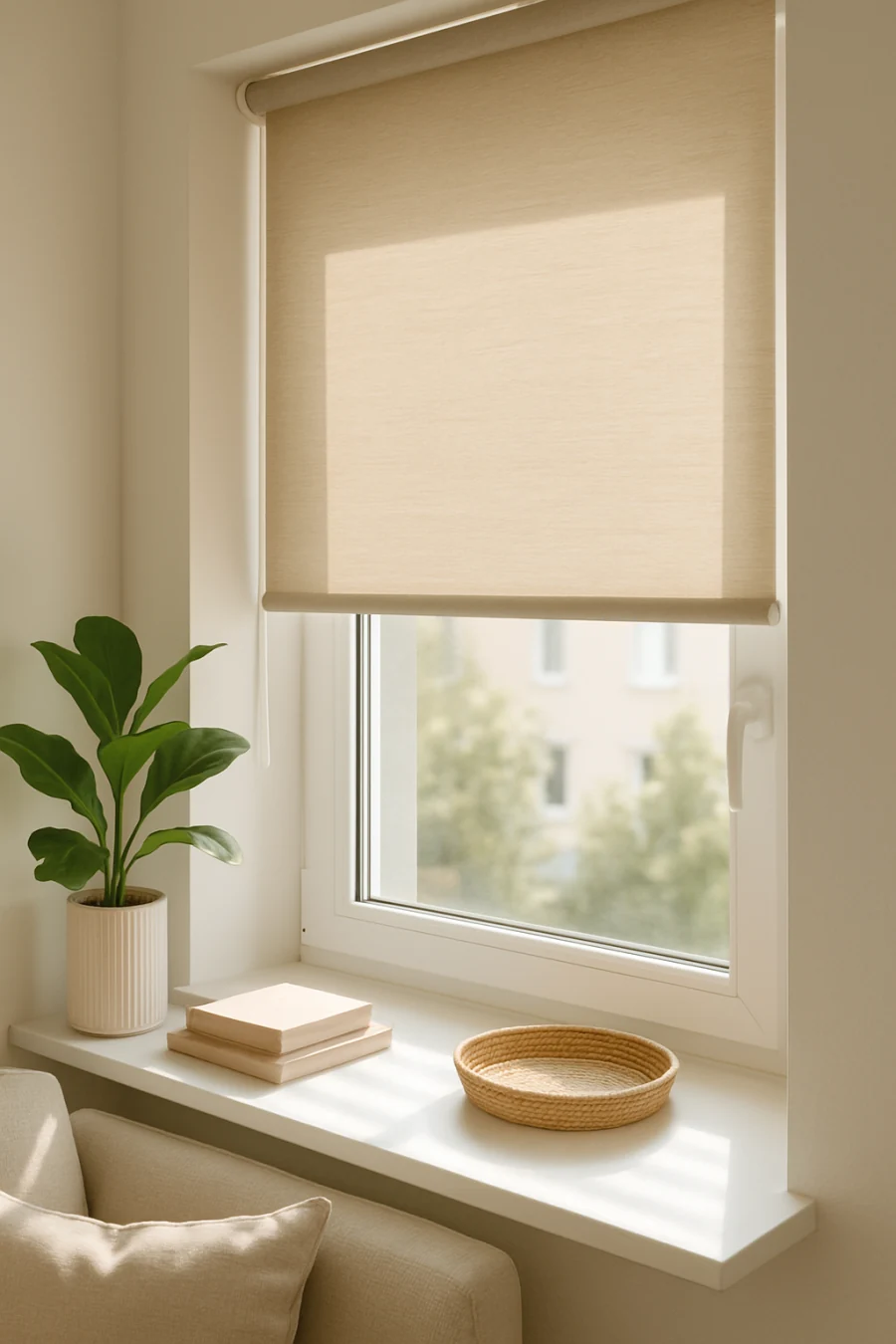


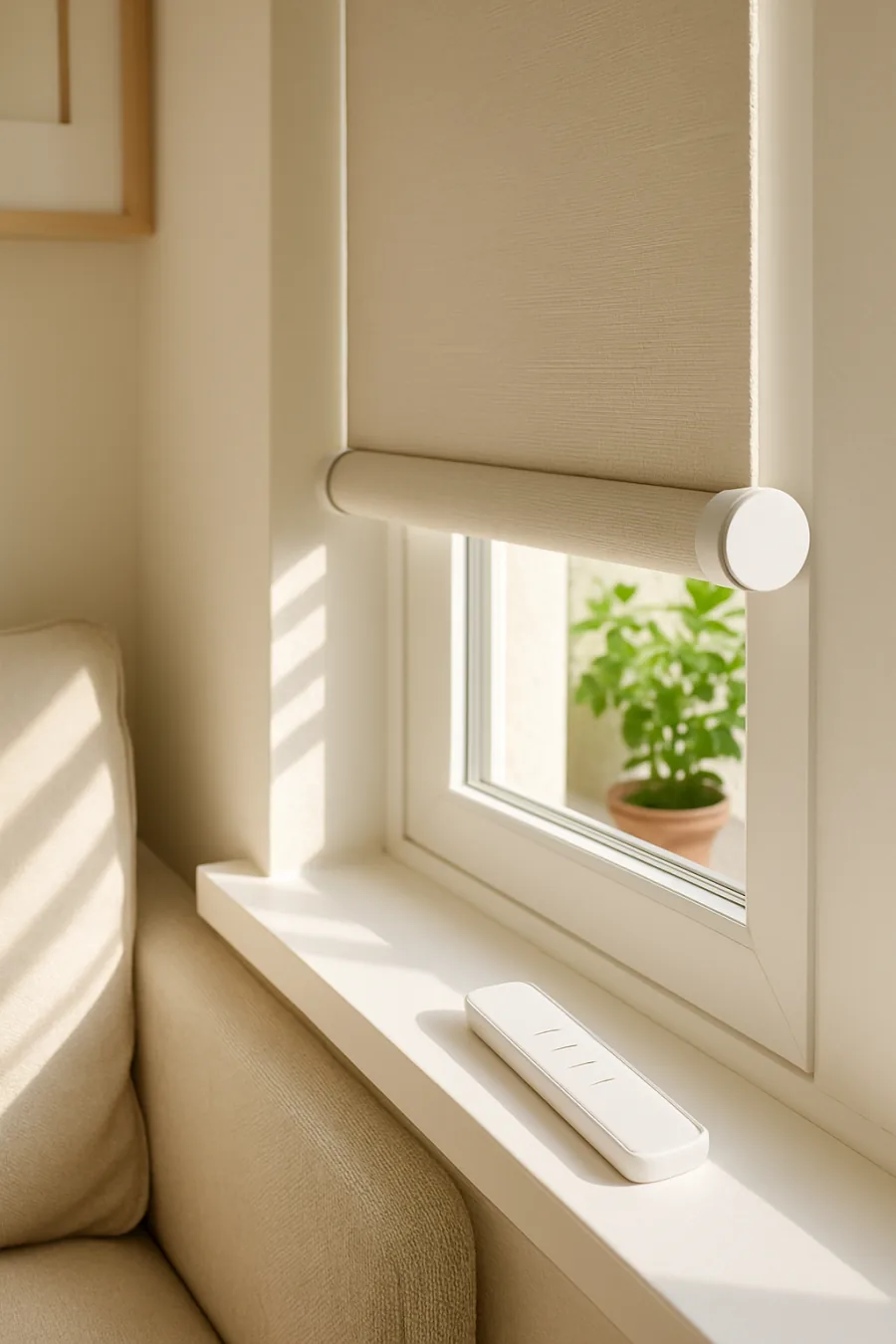


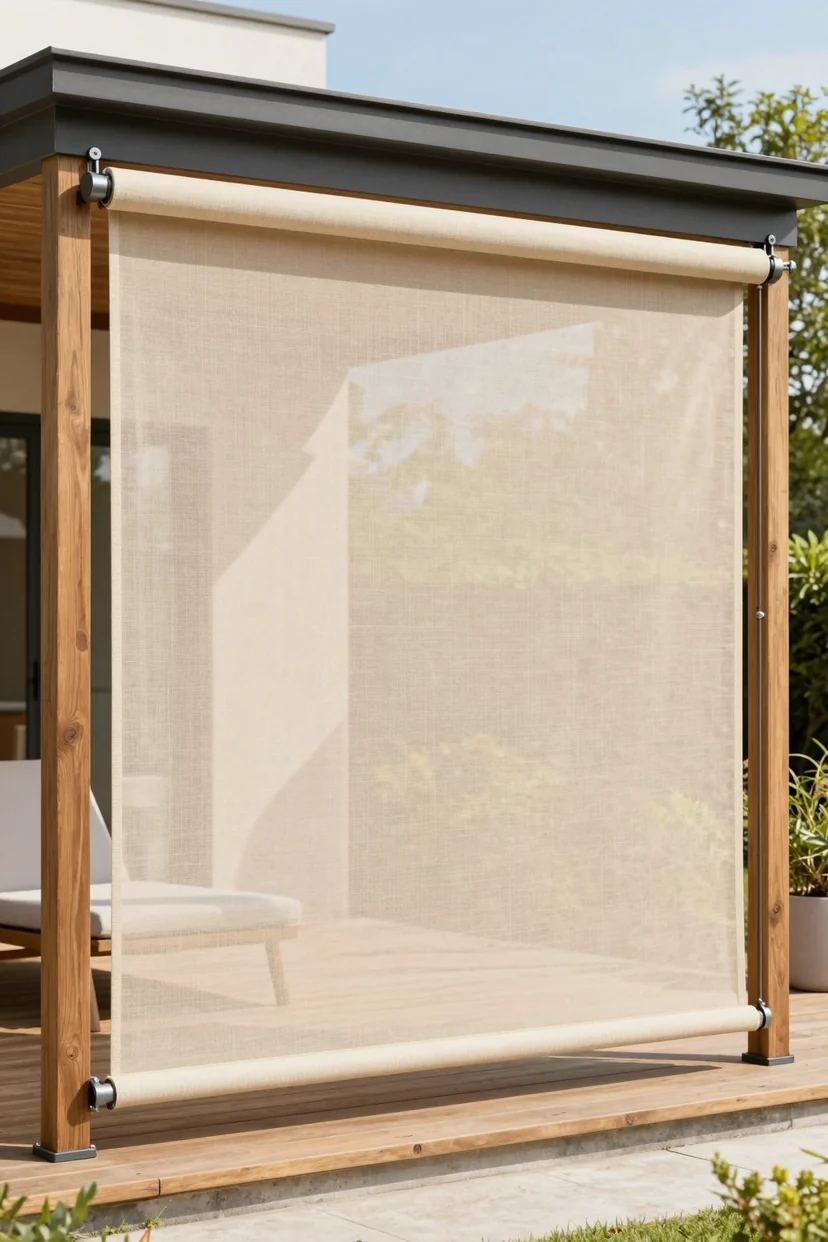











We make roller blinds in Almaty to measure: a single fabric on a tube rolls up compactly at the window and needs no rail. Price — from 5,400 ₸/m², manufacturing 4–6 days, measurement and delivery within the city are free. No ready-made items from stock.
Roller blinds, blinds and Roman blinds: what to choose for the task
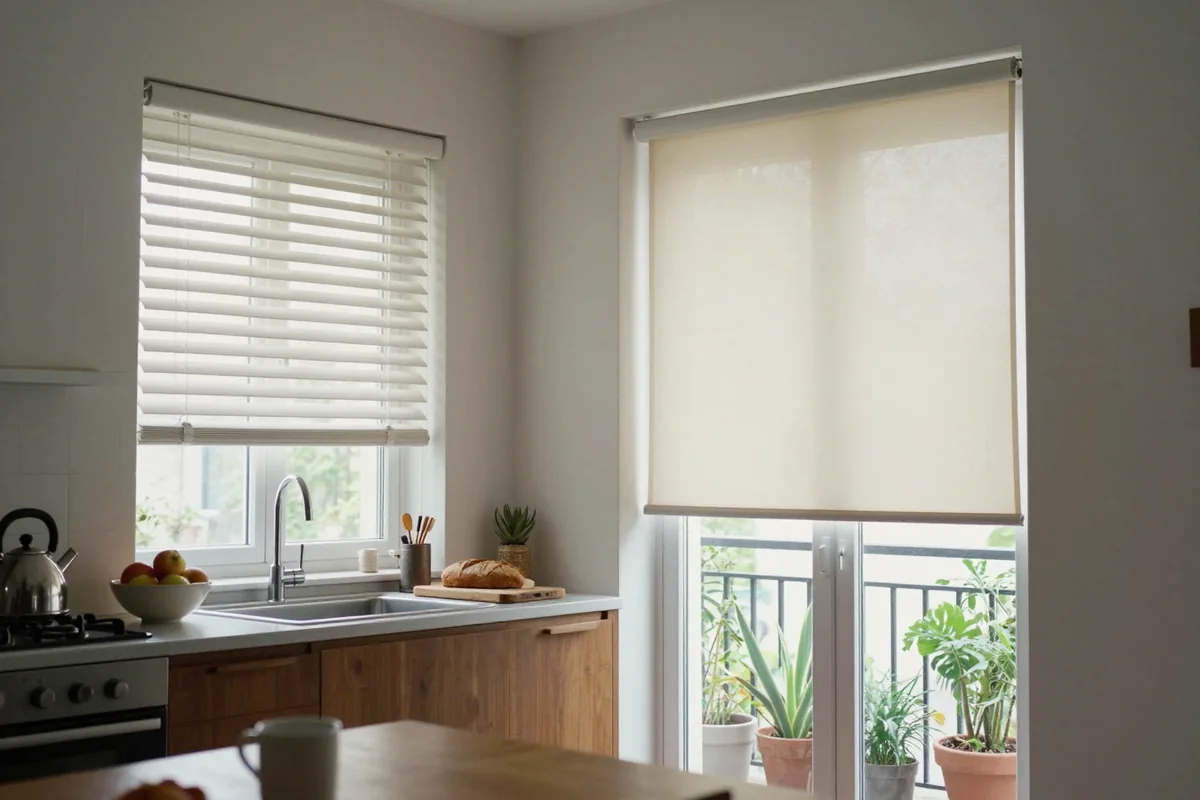
Roller blinds in Almaty are a single fabric on a tube that rolls up compactly at the window. Horizontal blinds gather light from narrow slats, while Roman blinds fall in soft folds. The difference is clear already at measurement: a roller blind doesn't compete with the windowsill and needs no rail, whereas textile curtains simply can't be hung without a rail.
People spell these blinds all sorts of ways in search: “roll blinds”, “roll-up blinds”, “roller shades”, “rollo blinds”, “rollets”, “rolletes”, “roller curtains”, “roller blinds” and “roller shutters” — you even see “role blinds”, and in conversation they are often just called “rolls”. They all mean one product: a fabric on a roller tube that covers the window.
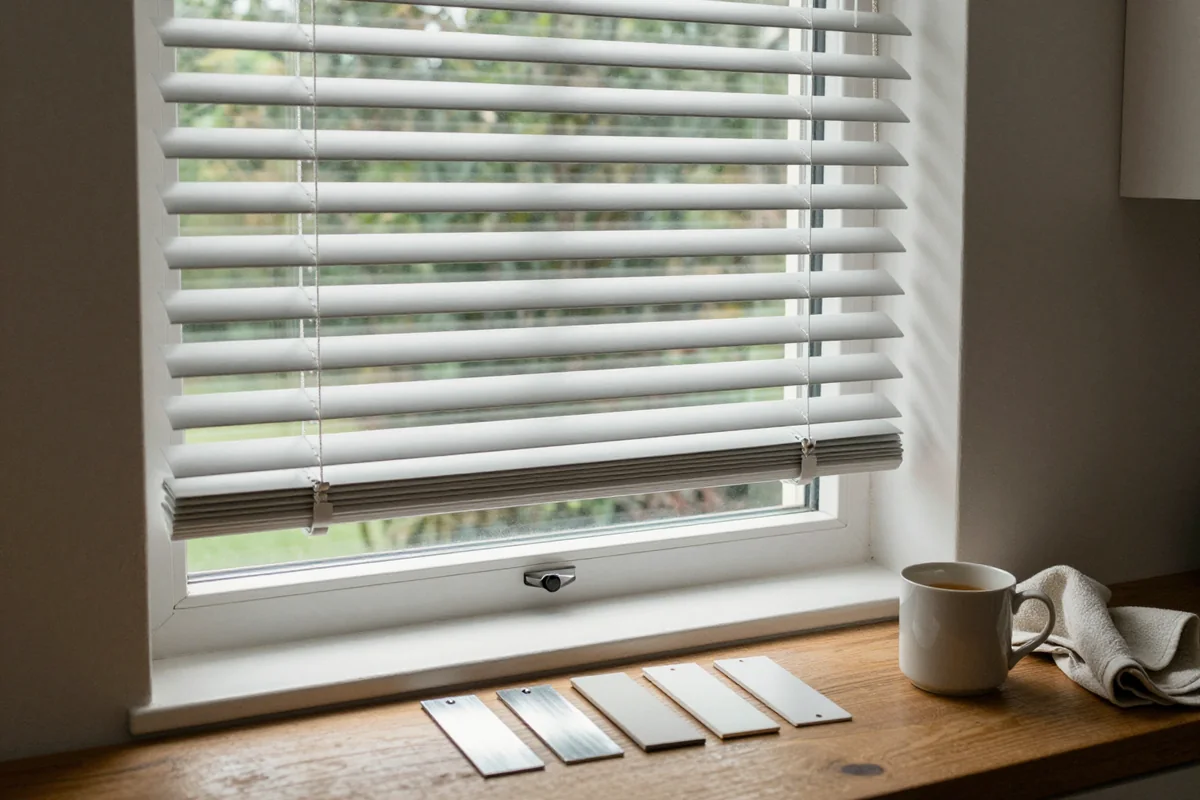
We make roller blinds to measure for a specific window — the fabric is cut to your opening, so no light gaps remain at the edges. Horizontal blinds are assembled from slats and adjust light at an angle: turn the slat — and the room is in half-shade, not darkness. Roman blinds gather into folds when raised, and that takes up space at the window. Care is different too: the fabric of a roller blind is removed and cleaned as a whole, while slats are wiped one by one.
Comparison by task
Roller blinds and curtains coexist peacefully: the fabric goes in the opening, the curtains — on the sides on a rail, and they don't get in each other's way. If there's no rail and you don't want to drill the walls, the roller blind covers the window on its own.
What is cheaper in the end? The result depends on the window area, the fabric and the type of control — our measurer works it out on site. By the price list, horizontal blinds are cheaper per square metre than roller blinds. But that difference is not always the deciding factor: if you are used to adjusting the light at an angle, slats are more convenient.
Roller blinds do away with a rail and curtains entirely, so in a small room they also save space.
When a roller blind loses
A narrow sash and a habit of catching light at an angle are two cases where slats or folds are more convenient. On such a sash we honestly recommend horizontal blinds: the roller fabric would come out disproportionately narrow.
How measurement works: opening, glass or sash
The measurement determines one of three bases: the window reveal, the glass or the sash. The difference is fundamental, because it decides what exactly the blind will cover and whether the windowsill stays free.
The measurer first looks at how the sash opens. This is the first thing they do at the window — and not out of politeness to the owner. If the blind drops into the opening path or catches on the handle, the window will no longer ventilate properly, and the blind will snag on the hardware with every movement.
A mistake in the measurement leads to light gaps along the edges. A blind cut a centimetre smaller than needed leaves a strip of light at the reveal or the glazing bead, and it cannot be removed afterwards — the product is already made to measure. That is why the measurer takes the base measurement at several points: reveals are rarely even, and a skew of a couple of millimetres on a wide window is immediately noticeable.
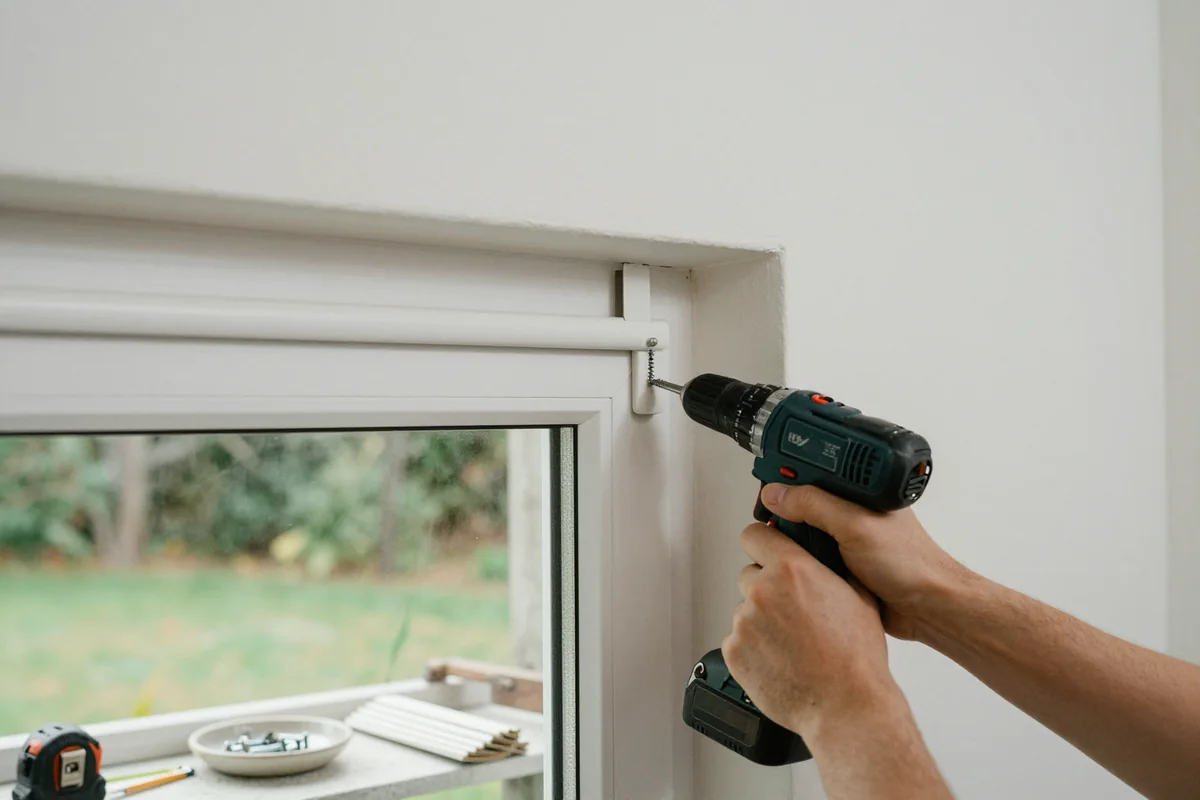
Ask about drill-free mounting separately during the measurement. It is a mounting option, not a property of the base position: the frame can be left undrilled, but then the bracket holds differently, and this option does not suit every profile. For rented housing it is often the only way.
Three measurement bases
Reveal — the blind covers the whole window together with the reveals, leaving almost no light gaps, but the windowsill ends up under the fabric. Glass — the blind covers only the glass unit, the windowsill stays usable, but a strip of light is possible along the edges. Sash — the blind is mounted on the moving part of the window, the fabric rises together with it and does not interfere with ventilation.
Measuring it yourself
Before the measurer arrives, prepare the main things: show how the sash opens — with a handle or a tilt mechanism, whether there is an insect screen, where the handle sits. These three details determine the choice of bracket. You don't need to measure anything with a tape: measurement is free within the city, and the measurer quotes the suburban visit fee before coming, so the exact figures are taken on site anyway.
Mini system, wall-mounted and cassette: which to choose for your window
The choice of system is determined by the window, not the other way round. The mini system mounts directly on the sash of a PVC window: a small cassette with a 19 mm roller tube and narrow brackets that does not stop the sash from opening. The wall-mounted system uses an aluminium roller tube of 32 mm and brackets on the wall above the window — it holds a long blind without sagging. The cassette system includes guide rails on the sides and a closed cassette on top: the fabric runs inside the grooves, and light does not leak through the edges. Here the roller tube is hidden in the housing box, not exposed as in the first two.
System comparison table
| System | Roller tube | Mounting | What it covers | Where it fits | Ventilation |
|---|---|---|---|---|---|
| Mini system for a sash | 19 mm | directly on the sash | sash glass | PVC windows with tilt mode | does not interfere |
| Wall-mounted | 32 mm | to the wall above the window | the whole reveal | wide windows, floor-to-ceiling windows | the blind drops in front of the sash |
| Cassette | hidden in the housing box | on the frame or in the reveal | reveal plus guide rails | windows where light-tightness at the edges matters | does not interfere |
A roller blind on the window sash does not interfere with ventilation: the mini system sits on the sash and tilts together with it. The wall-mounted one covers the reveal in front of the sash, so you will still have to raise it before opening — this is the main practical difference between frame mounting and wall mounting. The cassette system behaves like the mini system if it is mounted on the frame.
The sash tilts with the blind down
This works under two conditions. The mini system brackets are mounted to the side of the sash, not in the handle area, so the handle stays accessible. And the blind is shorter in height than the sash — it covers the glass without reaching the tilt mechanism.
At a dental clinic we installed a mini system on each sash of a two-sash window: the room is ventilated between patients without raising the blind. The product was made in 4 days. A similar task comes up in a country house — there the sashes tilt with the blind down, because the system sits directly on the frame.
The mini system on the sash suits tilt mode, the wall-mounted one is for a long blind, and the cassette one adds guide rails and a closed cassette where there should be no light gaps along the edges.
What the price is made up of and what is included
Roller blinds in Almaty cost from 5,400 ₸/m² for the base price position. The price is made up of four components: the area of the fabric, the fabric group, the type of control and installation. Polyester is the base of the fabric, and its density determines light transmission: light passes through thin fabrics, while dense ones darken the room.
The area is calculated from the measurement — by the width and height of the opening, the glass or the sash. The fabric is chosen from samples that the measurer brings along. The control type affects the mechanism in the roller tube: manual, chain, electric motor or electric with a remote control. Installation is paid separately — 4,500 ₸ per unit, and free on orders from 150,000 ₸. Prices for roller blinds are listed per square metre in the price list, and the measurer gives the final amount on site, after measuring the window. Roller blinds are inexpensive at the base price list position with simple controls.
What is already in the price and what is separate
The price list position already includes the fabric, roller tube, control mechanism and brackets. Installation is charged on top — 4,500 ₸ per unit. No-drill mounting and the cassette system are calculated as a coefficient to the base price, so the total changes. The warranty — 3 years on the mechanism and 1 year on installation — is included in the price, with no extra charge. We sell roller blinds by measurement only: there are no ready-made items in stock, and every blind is made for a specific window.
How an example is calculated
The calculation is based on the price list and the calculator coefficients. We take the window area and multiply it by the base price from 5,400 ₸/m². Then the control coefficient: manual ×1, chain ×1.06, electric motor ×1.85, electric with remote ×2.1. Then the installation coefficient: wall-mounted ×1, no-drill ×1.1, cassette system ×1.28. The electric motor is not more expensive in itself — its coefficient covers both the mechanism and the power supply. You cannot buy roller blinds in our online shop: orders go through a measurement, not a shopping cart, because the size of the blind is determined on site. But roller blinds in Almaty at low prices are exactly what the base price list position is about, not a random discount. The measurer calculates the exact cost on site, based on your windows. In my view, an electric motor is only justified where it is hard to reach — on a high or floor-to-ceiling window.
Installation is charged per product, and from an order total of 150,000 ₸ it becomes free.
How to order roller blinds in Almaty with measurement
You can order from home: you message us on WhatsApp, and then the measurement takes over. A measurer comes with fabric samples and calculates the cost on the spot — within the city, both measurement and delivery are free. That way we remove the main risk: the blinds are made for your windows, not picked to fit a size.
- A WhatsApp message — you describe your windows and what you need: kitchen, bedroom, rented apartment, panoramic glazing.
- The measurer with samples — looks at the profile, sashes and handle, and determines what the blind covers: the opening, the glass or the sash.
- On-the-spot calculation — you see what the total is made up of, and choose the fabric and the control type.
- Workshop — roller blinds are made to measure for a specific window; according to the price list, the lead time is 4–6 days.
- Installation — the technician installs the product and shows you how to open the sash and care for the fabric.
This is the order everything follows: measurement → calculation → workshop → installation. Nothing is done “by eye” or taken from stock. The warranty covers the mechanism and the installation: 3 years on the mechanism, 1 year on the installation from the date the acceptance report is signed; we fix warranty cases free of charge within 5 working days.
We are often asked about instalments. We do not offer instalments — that is not something we promise on this page, and we will not. What we do give without any conditions is free measurement and delivery within the city.
Trips to the suburbs
We travel to the suburbs — Kaskelen, Talgar, Issyk, Kapshagay. We calculate the call-out cost and tell you before we come, so there are no surprises in the invoice. Installation costs 4,500 ₸ per product, and for orders from 150,000 ₸ we do it free of charge.
We manufacture roller blinds in Almaty to measure; the lead time according to the price list is 4–6 days, measurement and delivery within the city are free, and the warranty covers the mechanism and the installation.
Fabrics: light transmission, day-night, blackout, screen
Light transmission depends on the density of the fabric: light passes through thin fabrics, while dense ones darken the room. The base of the fabric is polyester, so it does not stretch from moisture and does not shrink after cleaning. In the catalogue we divide fabrics into four groups: transparent, light filtering, day-night and blackout. Plus screen separately — more on that below.
The difference between day-night and blackout is simple. Day-night fabric regulates light with alternating stripes: the blind shifts, the stripes align or separate, and the room brightens or darkens. Blackout darkens the bedroom for sleep — a solid, dense fabric that does not let light through. Choose by what you need: day-night where you want light during the day, blackout where you want to sleep in the morning.
How day-night works
Day-night fabric consists of alternating transparent and dense stripes. You control it with the chain — the stripes shift relative to each other. When they align, light passes through the transparent sections. When they separate, the dense ones overlap and the room darkens. Smoothly, without steps.
Screen and fading
Screen is a mesh fabric through which you can see the street, but from outside the room cannot be seen. We do not install it on the outside: the purpose of screen fabric is to block the sun on windows and protect furniture and floors from fading. On the south side, fabric fades faster, especially saturated shades. This is a natural process, and the warranty does not cover fading. If you want to keep the colour longer, choose light tones — they fade less noticeably.
The measurer brings samples in a fan: white, beige, grey through to graphite. Hold them against your window in your own light — fabric looks different in a photo. That way you will see how the blind will behave in your space.
If you need custom blackout roller blinds, tell the measurer — he will select a dense fabric and a system to match. Light transmission is the main criterion when choosing fabric, not colour: first decide how much light to keep in the room, then choose the shade.
Control: chain, spring, electric motor with remote
The lifting mechanism is what determines how you will use the blind every day. A control chain raises the blind by hand, a spring mechanism works without hanging parts, and an electric motor drives the roller tube from the mains and requires a socket by the window. The price difference between these options is noticeable: in the calculator, control is calculated as a coefficient to the base price — manual ×1, chain ×1.06, electric motor ×1.85, electric with remote ×2.1.
| Control | How it works | Socket by the window | Who it suits |
|---|---|---|---|
| Mechanical | the blind is raised by hand by the edge | no | small windows, occasional use |
| Chain | raising the blind with a chain and weight | no | standard windows, bedroom, kitchen |
| Spring mechanism | the roller tube raises the blind by itself | no | a sash where no hanging parts are wanted |
| Electric motor | motor in the roller tube, button or remote | yes | tall and panoramic openings |
| Electric with remote control | motor plus remote control | yes | several blinds in one room |
What to choose by window height
The height of the opening determines whether you can reach the blind by hand. On a standard window, a control chain is enough: it is simple, repairable and needs no electrics. An electric motor is chosen where the blind is hard to reach — on tall windows and panoramic glazing — and a remote is convenient when there are several blinds hanging at different ends of the room. In our experience: on a kitchen window 2.2 m high, we kept the chain but shortened it to worktop level so it is easy to grab.
Safety in a child’s room
For a child’s room, use a mount without hanging cords and a short chain fixed to the wall. This is not about convenience, but about making sure a child cannot reach a freely hanging loop. A spring mechanism is also suitable here: the blind rises without a chain or cord. Tell the measurer that the room is a child’s room — he will suggest a mount and chain length to suit it.
The service life of the mechanism is covered by our warranty: 3 years on the mechanism and 1 year on the installation.
Mounting: on the frame, on the wall, without drilling
Roller blinds for plastic windows, with or without guide rails, are mounted in three ways: on the sash, on the wall above the window, and without any drilling at all. The option determines whether the frame stays intact, whether the windowsill is freed up, and how you will open the window to air the room.
What we offer:
- On the sash. The brackets sit on the sash, leaving no marks on the wall. The windowsill stays clear, and the blind covers the glass.
- On the wall. The fixings go above the opening. Suitable for a wide window and for a floor-length blind.
- No drilling. Held by hook-and-loop tape, suction cups or a spring. No drilling at all.
And here’s what matters. No-drill mounting suits rented housing. The owner won’t see holes in the frame, and you won’t lose part of your deposit over a couple of screws. Those who rent a flat usually choose this option — and don’t regret it.
And if you’re moving? The blind is taken off the window and rehung on another one, if the sizes match. The mechanism isn’t taken apart. We do this: carefully remove it, fit it on the new window, adjust the tension.
What we look at on the profile
The measurer doesn’t feel the frame for show. The width of the frame decides whether the bracket will fit. The glazing bead tells us what the fixing will catch on. The insect screen and the handle dictate where to shift the blind so it doesn’t rub against the hardware and doesn’t stop the sash from opening.
Ventilation depends on this directly. With sash mounting, the blind lowers together with the sash, and the window opens as usual. We charge installation as a separate line: 4,500 ₸ per item, and free for orders from 150,000 ₸.
Mounting and cost
No-drill mounting and the cassette system are charged as a coefficient to the base price: ×1.1 and ×1.28 respectively. That is, no-drill is a mounting option, not a property of the base price item.
With any of the three options, the windowsill stays clear — the tube and the blind run along the window, not above it.
Choosing by room: kitchen, bedroom, kids’ room, bathroom
The room sets three things: how much light you need to let in, how often the blind will be touched by hand, and whether there’s moisture in the room. For the bedroom, people choose a dense sun-blocking fabric or blackout; for the kitchen, a practical fabric that can be removed and cleaned; for the kids’ room, a mounting without hanging cords. The bathroom is a separate matter, and we’ll cover it below.
Kitchen
Roller blinds for the kitchen are chosen by one criterion: the fabric must be easy to take down and clean, because it hangs over the work area. We cover a tall window with a single blind and shorten the chain to worktop level — reaching up over the sink is awkward. The windowsill stays free: a mini system on the sash does not take it up, so space for jars and spices is kept.
Brown fabrics in the kitchen are more practical than light ones: splashes and grease marks show less on a dark surface, so you have to wipe it less often. Polyester is more convenient here than heavy textile — it does not absorb kitchen vapours the way fabric curtains do, and wiping is enough. The kitchen needs airing more often than any other room, so it is especially important here that the system does not get in the way of tilting the sash.
Bedroom
The bedroom is about sleep, and here it’s not the pattern that decides but the density. Blackout darkens the bedroom for sleep: in summer the sun rises early in Almaty, and a thin blind is no help here. If you don’t need complete darkness, choose a dense sun-blocking fabric — it dims the light but keeps the room liveable. The measurer brings samples fanned out and shows the difference against the light, not from a catalogue.
There’s a nuance people remember only after installation: sash mounting covers the glass but leaves the frame, so the sash can be tilted with the blind down. The habit of airing the room before bed doesn’t suffer.
Kids' room
For the kids’ room Jalusso fits a mounting without hanging cords — that’s the main criterion, not the colour. A short chain or a spring mechanism removes anything a child could pull on. The light is adjusted with the chain, and an older child does it themselves.
Just tell the measurer that the room is a kids’ room — they’ll suggest a system and a fabric group for that scenario.
Bathroom and damp rooms
In the bathroom, polyester fabric handles moisture calmly: the material doesn’t absorb water the way natural textile does and doesn’t swell. There’ll be no sagging from steam if the room has working ventilation — it, not the fabric, determines how long the blind stays flat.
The warranty doesn’t cover water or natural fading of the fabric, so in the bathroom we advise against placing the blind right next to the shower area.
Care for the fabric is the same everywhere and includes removing and cleaning — that’s the main fact worth remembering: the room is chosen not by the fabric but by how you use the window.
Non-standard windows: arched, sloped, roof, panoramic
A non-standard window is not an obstacle for a roller blind but a reason to make it to measure. The fabric is cut to the shape of the opening, so an arched, sloped or triangular window is covered just like an ordinary rectangular one. The only difference is the geometry of the cut and the mounting.
A roof window requires a system with guide rails: the blind runs along a sloped plane, and without side guide rails it would drift sideways. Lead measurer Kirill is the one who handles such windows — arched, triangular, roof — and here the most important thing is to take the shape of the opening, not its width and height. We split panoramic glazing into several blinds butted together: one long blind across the whole wall sags under its own weight and gets in the way of stepping out onto the balcony. Several blinds join without a light gap between them and rise independently of each other. On roof windows we fit a system with guide rails — the same solution for a slope, only assembled to the angle of your roof.
Roller blinds for floor-to-ceiling windows are a separate story: there are many sections and thin mullions, so we divide the glazing into several blinds along the profile lines rather than stretching one across the whole wall. For roller blinds on wooden windows with a vent, we make sure the vent sash opens independently: the blind sits on the upper part of the frame, and the lower tilt element stays free.
Arched, sloped, triangular
The blind follows the shape of the opening. On an arched window, the top of the blind runs along an arc; on a sloped one, along a slanted line; on a triangular one, along two converging sides. Such an item can’t be calculated by overall dimensions, so measurement is especially important here: the measurer takes the contour of the opening and transfers it into the calculation. A real detail: on sloped blinds, the tube is often placed horizontally at the bottom edge, and the blind rises from bottom to top — otherwise the slanted edge hits the window reveal as it rises.
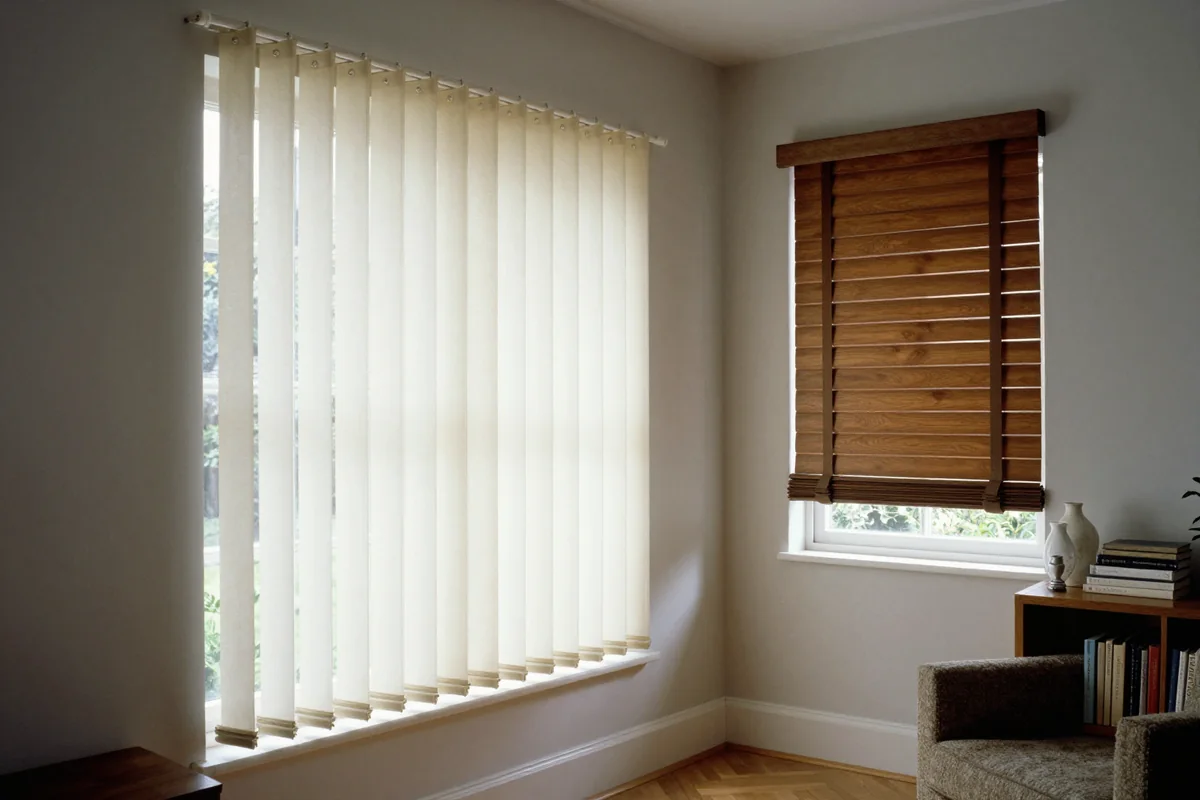
Roller blinds for a small window are, on the contrary, the simplest geometry: a narrow roller tube and a short chain so the fabric does not get tangled under your hand. And do not confuse them with vertical roller blinds: a roller blind already moves vertically, up and down. If you need slats that slide sideways, those are vertical blinds, a different type of product, and we make those too.
Balcony door and window unit and corner window
One wide blind on a balcony block or two — it depends on the sashes. If the balcony door opens separately from the window, two blinds make more sense: the door one rises, the window one stays closed. On a corner window, two blinds meet at the corner butted together — during measurement we check that no gap is left between the blinds right at the corner, as that’s where light most often comes through. And the blind can also be removed and rehung on another window if you move within the flat and stay on the same system.
A panoramic window is split into several blinds butted together, and a roof window requires a system with guide rails.
Maximum sizes and windows wider than the blind
We cover a wide opening not with one large blind but with two or three. The maximum size of the blind is set by the tube: the wider the blind, the greater the load on the tube it’s wound onto. The mini system on the sash with a 19 mm tube is designed for a narrow sash of a plastic window; the wall system with a 32 mm aluminium tube carries a long blind without sagging. So the wider the window, the more important what the fabric hangs on.
Splitting a window into parts is not a compromise. On a panoramic window, several blinds are fitted butted together, and there’s no gap between them. A balcony block is also more often covered with two blinds: one on the fixed part, the second on the sash that opens.
- Balcony door and window unit: two blinds — on the sash and on the fixed part.
- Panoramic window: several blinds butted together across the full width.
- Tall window: one blind, chain shortened to level.
- Window wider than the opening: we choose the system by measurement, not by the width of a ready-made roll.
Why a wide blind sags
The fabric hangs on the tube and pulls it down. The wider the fabric and the longer the drop, the more the tube bends — and the more noticeable the skew along the bottom edge. A wall-mounted system with an aluminium tube of 32 mm holds a long blind precisely thanks to the rigidity of the tube, so on a wide window it is preferable to a mini system, where the tube is thin.
The question “one wide blind or two” is decided at the measurement, not in advance: the measurer looks at the width of the opening, the weight of the fabric and how the sashes open. A wall-mounted system with an aluminium tube of 32 mm holds a long blind without sagging, and a wide opening is divided into several blinds.
Care, ventilation and what to do after the warranty
Caring for a roller blind is simple: the fabric is taken off the brackets and cleaned with a soft brush or a damp cloth without detergents. It cannot be washed in a machine — the tube and the mechanism are not dismountable, and polyester fabric shrinks and goes wavy after spinning. Dust is removed while the blind is hanging, without lowering it to the windowsill.
The fabric collects dust noticeably: in our city the summer is dry and dusty, and on the south side a thin fabric darkens at the edges over a season. It is easier to wipe it with the blind taken down rather than in place. What distinguishes white and beige fabric from graphite is exactly how visible settled dust is on it.
If the chain breaks or pops out of the mechanism, you should not replace it yourself. We come, fit a new cord and adjust the tension. The warranty covers the mechanism for 3 years and the installation for 1 year from the date the acceptance report is signed; we fix a warranty case free of charge within 5 working days. After the warranty, servicing continues too: tightening, adjustment, replacement of the cord or chain — we charge separately for this, but we do not refuse.
Does the fabric fade on the south side? Over time — yes, in direct sun the colour loses its saturation. This is a natural process, and it is not covered by the warranty, just like mechanical damage, water and re-installation on your own. To find out how much replacing the fabric or a unit on your window will cost, you can calculate the price of roller blinds with us — the measurer will come with samples and give you the figure on the spot.
What the warranty covers and what it does not
The warranty covers the mechanism and the installation: if the blind stops rising evenly, the chain does not hold, the bracket has come loose — we will come and fix it. Mechanical damage, re-installation on your own, water ingress and natural fading of the fabric are not covered. The distinction is simple: what broke in normal use is our case, what happened from an impact, a move or the sun is not.
Ventilation with the blind lowered
A sash with a standard push handle opens with the blind lowered without any problem — the blind hangs on the frame and does not interfere with the tilt mode. Only the window handle gets in the way: if it presses against the bracket, the measurer turns the mount or shifts the system. For tilt-and-turn sashes this is checked before manufacturing, at the measurement — it cannot be redone afterwards.
The warranty is 3 years on the mechanism and 1 year on the installation; after the warranty we come to tighten, adjust and replace the cord or chain.
Case studies
The measurement decides where the blind goes: on the sash or on the wall above the window. A mini system is mounted directly on the sash of a plastic window, a wall-mounted system uses an aluminium tube of 32 mm and brackets above the opening. Hence the difference in whether the blind interferes with ventilation.
At the dental clinic we started with the question of how the surgery is ventilated. A mini system on each sash made it possible to open the window between patients without raising the blind. We did not have to drill the frame, and the installation took little time. And this is a case where the solution is dictated not by the interior but by how people use the window.
A window with three sashes
In a bedroom in a new building there was a window with three sashes. We cut three blinds from a single roll of fabric, so the shade is the same on all sashes. The room can be ventilated with the blind lowered: the fabric on the sash does not stop it from tilting.
A tall window and floor-to-ceiling windows
In the kitchen the window rose two metres twenty centimetres. It was covered with a single blind, and the chain was shortened to the level of the worktop. A wall-mounted system with a tube of 32 mm holds a long blind without sagging. In the hallway, two floor-to-ceiling windows got a floor-length blind on the same wall-mounted brackets.
We fit a mini system on each sash where the window is opened often, and wall-mounted brackets where a long blind is needed.
FAQ
Here are brief answers to what people most often ask before the measurement. Below are seven questions asked in almost every order.
How long does the mechanism last? We give a warranty of 3 years on the mechanism and 1 year on the installation from the date the acceptance report is signed. The chain and the tube last for years, but if something goes wrong, we will come and fix it. Fabric wear and re-installation on your own are not covered by the warranty.
Can the fabric be washed? We advise against washing polyester fabric in a machine; clean it with a soft brush or a damp cloth. It comes off the brackets without tools. The fabric does not like plenty of water.
Is a socket needed for an electric motor? Yes, an electric motor requires a socket by the window. If there is none and you do not want to run one, a chain or a spring mechanism is left. The coefficient for electric with a remote control is noticeably higher than for a chain — the socket is not the only thing to consider.
Does the fabric fade on the south side? Natural fading is not covered by the warranty — it is a normal reaction of fabric to the sun. On south-facing windows a dense fabric lasts longer. One measurer once said: nobody puts thin white polyester on the south side and then acts surprised.
Can the blind be re-hung when moving? Yes, the product is taken off the brackets and re-hung on another window if it fits the size. Drill-free mounting is especially convenient here — it leaves no marks on the frame of a rented flat.
What to do if the chain breaks? After the warranty we come too: to tighten the fabric, adjust the mechanism, replace the cord or chain. This is servicing, not a reason to replace the whole blind.
Are there ready-made products in stock? No. We are a manufacturer and make everything to measure, so you cannot buy ready-made roller blinds from us. The measurer brings the fabric catalogue with him. The price is from 5,400 ₸/m², manufacturing takes 4–6 days, installation is 4,500 ₸ per product and free for orders from 150,000 ₸.
Measurement and delivery within the city are free, and the measurement determines the base — the opening, the glass or the sash; the warranty covers the mechanism and the installation, and everything made to measure is manufactured in 4–6 days.
Conclusion
Let us briefly sum up what matters before ordering. We make roller blinds in Almaty to measure, and we have no ready-made products in stock: every blind is cut for a specific window in our workshop. The price of the basic option is from 5,400 ₸/m², manufacturing takes 4–6 days, installation costs 4,500 ₸ per product and becomes free for orders from 150,000 ₸.
Second. The system is chosen for the window, not the other way round. A mini system mounts directly on the sash, a wall-mounted one holds a long blind on an aluminium tube of 32 mm, a cassette one adds guide rails and a closed cassette. Until the measurer has seen how the sash opens and where the handle is, it is too early to argue about the system.
Third. Drill-free is a mounting option, not a property of the basic option. In the price list this is a separate line, with a coefficient, because drill-free mounting is a different kit. For rented housing it is a way out; for a permanent window people more often choose mounting on the frame or on the wall.
Fourth. We give 3 years on the roller blind mechanism and 1 year on installation; the count starts from the day the acceptance certificate is signed. Mechanical damage, re-installation on your own, water and natural fading of the fabric are not covered.
There is one practical recommendation. Before you call, decide what the fabric should cover — the opening, the glass or the sash. With that answer, invite the measurer: he will come with fabric samples, look at the profile, the window reveal and the handle, and calculate the cost on the spot. Measurement and delivery within the city are free; to the suburbs — Kaskelen, Talgar, Issyk, Kapshagay — we do travel, and we tell you the call-out cost before the visit.
After that, the fabric and the controls decide, not the other way around.