
















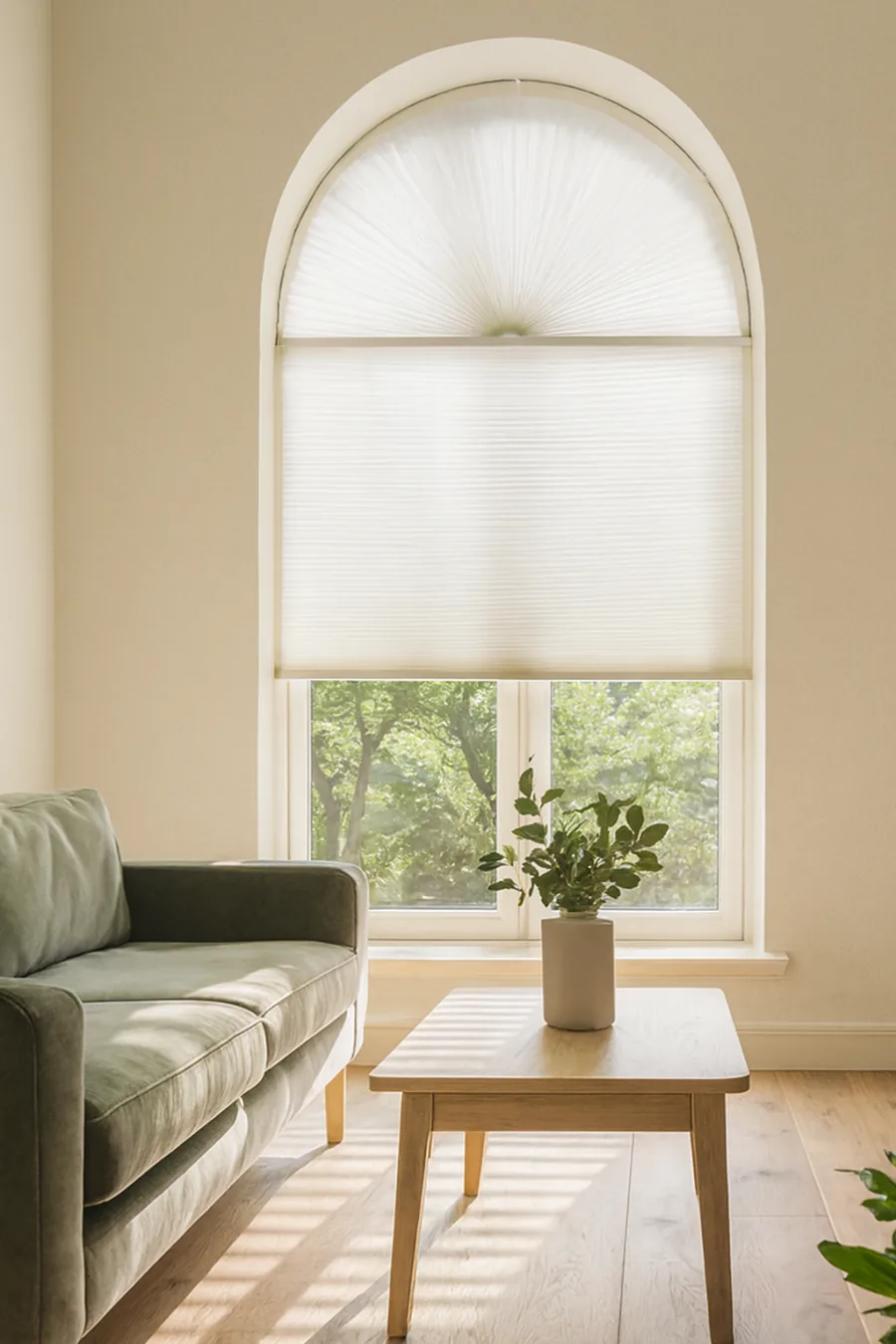











An arched window consists of a curve and a straight part, and they're covered differently: the curve almost always stays fixed — the blind is cut to a template of the opening, and only the lower part moves. We manufacture such blinds in Almaty to measurement: the measurer comes with samples, takes the contour of the curve, then the workshop and installation follow.
What an arched window is and why standard blinds don't fit it
An arched window consists of a curve at the top and a straight part at the bottom, and a ready-made rectangular product doesn't suit such an opening: the upper contour is curved, and open areas would remain in the corners. We make blinds for arched windows in Almaty only to measurement, because the cutting follows the contour of the specific opening, not a catalogue size. For this geometry, horizontal aluminium slats, pleated blinds, vertical and wooden slats are suitable — each product works with the curve and the straight part in its own way.
The curve and the straight part are two different sections of the opening
The upper part of the opening follows a radius, the lower stays straight. So we divide the window into two sections and cover them with different blinds: the curve with a fixed one, cut to the contour, and the lower part with a movable one, like on a standard window. One product can't cover both sections: the lifting mechanism is designed for a straight tube, not a curve. And at the measurement this is the first thing we explain to the client — otherwise expectations diverge from what's actually possible.
How arch shapes differ for cutting
A semicircular, segmental and flat arch each give a different contour, and for us that's different template geometry, not a different type of blind. With a semicircular arch the curve runs as a full half-circle, with a segmental one it's raised, with straight sections on the sides, and with a flat one it transitions into a straight line with rounded corners. A semicircular transom above a sash is a common case in Almaty apartments. Here it's important to take the contour of your specific opening, not to pick a product from a photo of a similar window.
Cutting to the radius follows the contour of the specific opening: the template is taken on site, and the blind is made to it in the workshop. Without a template the curve can't be covered — a gap will remain either at the edges or along the top of the arch.
What moves on an arched window and what doesn't
The curve of the opening is covered with a fixed blind. The straight part of the window works like standard blinds — opened and closed by chain, cord or motor. That's why Jalusso always calculates blinds for arched windows in Almaty as two blinds: an operable one at the bottom and a fixed one at the top. The lower part moves, the upper section stays in place.
Why is that? The curve is a curved section, and the blind doesn't run on a tube there. It's cut to a template of the opening and mounted statically. Light in the fixed arched section is adjusted not by raising the blind but by choosing fabric by light transmission: a dense fabric darkens the curve more, a sheer one lets in more light. In my view, this is the most underrated part of the choice — people argue longer about the slats, while it's actually the fabric on the curve that decides.
Why the arch can't be raised
The catch is in the geometry, not the mechanics. A fabric cut to a radius doesn't wind onto the roller tube evenly: the edge follows a curve, and when raised it catches the frame or sags in a wave. So the scheme is this: the arch of the opening stays fixed, and the movable straight part is below, down to the windowsill. You can install one system across the whole window if you make the top fixed and the bottom operable. There's no other arrangement for an arched window.
Replacing only the straight part
And that's convenient for the future. The straight part of the window can be replaced separately — re-cover the fabric, swap the slats, fit a motor instead of a chain — without touching the arched blind. The upper section doesn't need to be removed; we've already taken the arch template and keep it on file. So repairing the lower part doesn't turn into redoing the whole window.
The bottom line is simple: the arch is covered by a fixed blind, and the straight part works like ordinary blinds.
What each type of blind does with the arch
The arch is followed by a fabric cut to its contour, while roller systems on a straight roller are installed only on the rectangular part of the window. That's exactly why blinds for arched windows in Almaty are chosen not by the name of the type, but by which section of the opening needs to be covered and left movable.
Pleated blinds
Pleated blinds are the only type that covers both the arch and the slope of the opening on an arch. The pleated fabric is cut to the radius rather than straightened into a rectangle: the blind locks at any point of travel, so it holds on the curved section and doesn't sag under its own weight. It follows the contour of the arch through the cut, not by bending the roller tube. We install pleated blinds on the sash, most often on arched windows in living rooms.
Horizontal aluminium blinds
Horizontal aluminium blinds come with a 25 mm slat and are cut to the radius of the arch: the blind follows the curve instead of cutting the opening into a rectangle. The moisture resistance of the slat is what matters here — aluminium doesn't mind moisture and can be washed right on the window. That's why these blinds are chosen for kitchens, bathrooms and offices with arched glazing. Operation is mechanical or by chain, and the lead time according to the price list is 3–5 days. In my view, for an arch this is the most practical combination of price and upkeep of everything we have.
Day-night and cassette
Day-night blinds are cut to the rectangular part of an arched window, not to the arch. The two-layer fabric with alternating opaque and sheer stripes gives smooth light control, but it's a roller blind and runs on a straight roller — it doesn't follow the arch when raised. The cassette system hides the roller tube in a housing box, with guide rails at the edges, and the blind doesn't pull away from the glass when the sash is opened. Base options — day-night from 7,300 ₸/m², 5–7 days. A good option for arches in the living room and bedroom: the arch is covered by a fixed blind, and the straight section with such a cassette is what moves.
Vertical slats, wood and motors
Vertical slats 89 mm wide are cut to different lengths to follow the contour of the opening: on tall arches the bottom of the slat stays level, while the top is fitted to the arch. Turning them by chain changes the light without raising the blind. Wooden slats 50 mm made of linden with custom tinting give a warm texture for living rooms — on an arch the blind is also cut to the arch template. We install an electric motor when the top is out of reach: a 220 V motor or a battery moves the straight part of the blind by remote control, smartphone or schedule, but it doesn't raise the arch itself. Motor price — from 7,800 ₸/m², 7–10 days.
What's best for an arch depends on which part of the window needs to move: if you need a movable arch and non-standard geometry — pleated blinds; if moisture resistance and easy upkeep matter more — horizontal aluminium; for smooth light control in a living room — day-night on the straight part.
Comparison of types: what covers the arch, what covers the straight part, how it's operated
The choice comes not from the type of blind, but from which part of the arched window needs to move. The arch is followed by a fabric cut to its contour, and it can't move along a radius — so for the arch you choose what's cut to a template, and the movable blind goes on the straight part. That's where the difference between types comes from: some cover only the bottom, others only the curved section, and still others work on both.
| Type | What it covers on the arch | What it covers on the straight part | What it's controlled by |
|---|---|---|---|
| Pleated blinds | Cut to the radius and slope of the opening, holds at any point | Can cover both parts with a single blind | By cord or handle, the blind locks at height |
| Horizontal aluminium, slat 25 mm | Not cut to shape, doesn't cover the arch | The whole straight part | Mechanical or chain operation |
| Vertical slats 89 mm | Slats of different lengths to follow the contour of the opening | The straight part with the same slats | By chain, turning the slats without raising them |
| Day-night and cassette | Doesn't work: the blind is on a straight roller | The rectangular part of the window | By chain; the cassette system hides the roller tube in a housing box |
| Wooden slats 50 mm | Cut to a template for a living room | The straight part | Chain control |
| Electric motor | Doesn't move the arch | The straight part, if the top is out of reach | Remote control, smartphone or schedule |
Horizontal aluminium blinds are installed on the straight part and in rooms where the slat can be washed on the window — a kitchen, a bathroom, an office with arched glazing. The cassette system hides the roller tube in a housing box and runs along the edges with guide rails, so the blind doesn't pull away from the glass when the sash is opened; it's chosen for living rooms.
If you need to darken a bedroom, pleated blinds are cut to the radius and give a dense fabric on both parts of the window, while day-night on an arched window works only on the straight part, and the arch stays covered by a separate blind. In price, pleated blinds are more expensive: from 9,800 ₸ per m² versus from 4,200 ₸ per m² for horizontal aluminium. With an equal opening the difference is noticeable, and it's worth paying where the arch really needs to be covered with dense fabric. We had an order where horizontal blinds were installed only on the bottom, and the top was covered with pleated blinds in a matching tone: in my view, for a kitchen that's more sensible than stretching one expensive blind over the full height — the bottom works every day anyway, while the arch stays fixed.
Different types work differently with the arch and the straight part, so the choice comes from which part of the window needs to move.
How our measurer takes the arch template and what to prepare before the visit
The arch template is taken by our measurer on site, and without this step blinds for an arched window can't go into production. Measurement is always free with us, the measurer arrives with samples and calculates the cost right at the window. Measurement comes before the cost estimate: first the contour, then the figure.
Here’s how it looks, step by step.
- The measurer inspects the opening: where the arch begins, where the straight section ends, how the sash opens.
- They trace the arch of the opening on site — taking a template of the arch along the actual contour, not a standard radius.
- They show fabric and slat samples so you can choose the blind in the light and by touch.
- They calculate the price from the price list, taking into account the control type and installation method.
Cutting along the radius happens at the workshop: following the traced contour, the blind takes the shape of your arch. How precisely will it fit? Exactly to the template — that’s why we don’t take the radius “by eye” and don’t adjust the product to a catalogue.
If there are several arches and they have different radii, the measurer traces each one separately: an arch that looks identical on another window can give a different contour. Cutting along the radius is then done to each template, and preparation takes longer than for a single arch. We give the final timeline after the measurement and fix it.
What to prepare before the measurer arrives
Clear access to the window: remove flowers, curtains and anything else that stops you getting right up to the frame from the windowsill. The measurer needs to see the whole arch, not part of it behind a pot. If there are several arched windows in the flat, show them all in one visit — that way the arch template is taken for each one at once, and no second visit is needed. We travel to the suburbs — Kaskelen, Talgar, Issyk, Kapshagay — and we tell you the call-out cost before we come; it depends on the distance.
The measurer arrives with samples, traces the contour and calculates the price on site — the workshop cuts to this contour, so the blind follows the radius of your specific opening.
How to mount blinds on an arched window without drilling the frame
Drill-free mounting preserves the window warranty. The brackets slide into the glazing bead or are fixed with spring clamps, and the profile stays intact. The frame gets not a single hole — when the window is replaced or you move, the blinds come off, and the glass unit stays factory-made.
The glazing bead takes the bracket without modification if the profile is standard and the bead sits tight. On a thin profile the clamp may not give the needed rigidity, and then we suggest mounting to the wall or to the frame. By the way, the load on an arch is higher than on the straight section: a blind cut along the radius is heavier than a straight one, so we select the fasteners separately for the arch and separately for the bottom.
Options by window, briefly:
- New plastic window — glazing bead or spring clamp, no drilling
- Wooden frame — bracket into the glazing bead or surface mounting on the wall
- Thin profile on a high arch — wall mounting so the blind doesn’t hang on the clamp
A wooden frame in an old building usually gives a flat surface for surface mounting. But the geometry of an old frame can be uneven, and the measurer checks this on site: it determines whether the bracket will fit into the glazing bead or will have to be moved out to the wall.
We match the profile colour to the frame or to the blind. When the housing along the arch and the housing on the straight section are the same colour, the seam between the arch and the bottom is almost invisible, and on a white profile the joint is more noticeable than on a dark one. In my view, on an arched window what matters more than the colour itself is that both housings are from the same series.
If the arched part is above a door, the fasteners are calculated taking into account the travel of the sash. More on that in the next section about blinds for a door arch.
The bracket slides into the glazing bead or is fixed with spring clamps, so the frame stays intact and the window warranty is not lost.
The arch above the door and the sash under the arch
On the arch above a door, the blind is mounted taking into account the travel of the sash, so the door opens freely without catching the slat or the bottom rail. An arch above a door requires accounting for the sash travel twice: when the door is swung open and when it is tilted for ventilation. The first thing the installer does is look at where the blind goes when the door opens, and only then marks the brackets.
A sash that tilts for ventilation
If there is a sash under the arch, the blind on it moves together with the sash, while the window below it is covered separately. The straight part of the window is covered by a moving blind, and this is the main thing that sets work on a door unit apart from an ordinary arch: you have to watch not only the arch but also the hinges. And drill-free mounting is especially handy here — the bracket goes into the glazing bead and doesn’t stop the sash moving. The risk is clear: if the blind is placed too close to the hinges, it catches the frame every time it opens. Such a mistake isn’t visible at the measurement; it shows up during installation.
On the glass part of the door we often install a separate blind. It covers the glass, while the top of the arch stays on its own template. A real detail: customers ask for one system for the whole unit, but then the arch would have to move together with the door — and by its cut it is fixed.
An interior arch with no glass
On an interior arch with no glass, blinds make sense in only one case — when the opening needs to be partitioned off, not protected from the sun. Light isn’t held back here, dust travels from room to room, so the logic is different. The blind is cut to the contour of the opening, but we tell the customer straight: you get a division of space, not shading. There are flats where such openings are closed to separate the kitchen area from the hallway. And sometimes the opening leads to a bedroom where quiet is needed — then blinds won’t help, and we advise looking elsewhere.
The blind on the arch above a door is cut to the template and mounted so the door opens freely without catching the slat or the bottom rail.
What makes up the price of blinds for an arched window
Blinds for an arched window are calculated by the area of the blind, not by the type of window. The base is the price per square metre from the price list, and coefficients for the control type and installation method are added to it. Cutting along the radius is part of the workshop’s work; Jalusso doesn’t quote a separate surcharge for it. If you want to estimate buying arched blinds in advance, before the measurement you’ll only get a range — the exact sum is calculated by the measurer on site.
Base from the price list
The price per m² serves as the base for calculating the cost of the product, and it differs by type. Horizontal aluminium — from 4,200 ₸/m² for a 25 mm slat. Vertical fabric with a 89 mm slat — from 4,600 ₸/m², day-night on two-layer fabric — from 7,300 ₸/m². Pleated blinds, which we most often use to cover the arch, — from 9,800 ₸/m², wooden linden slats 50 mm — from 12,400 ₸/m². The larger the area of the opening, the more noticeable the difference between types: on a small transom it’s almost invisible, on a tall arch in a living room it’s quite clear.
Control and installation coefficients
Chain control makes the product more expensive by 6 % — a coefficient of ×1.06 to the base. Electric motor — ×1.85, electric with remote control — ×2.1, and that makes sense: the mechanism is more complex, and on a tall arch it removes the need to reach up. Installation affects the price separately. Frame mounting — ×1.05, drill-free — ×1.1, cassette system — ×1.28.
The installation method affects the cost no less than the fabric. For orders from 150,000 ₸ we install free of charge, otherwise it’s 4,500 ₸ per product — this line isn’t in the coefficients, it’s calculated separately.
What to choose for your opening
Which option to take for an arch depends on the room and on whether you need a motor for the straight section.
| Type | Price per m² | Lead time | When people choose it |
|---|---|---|---|
| Horizontal aluminium | from 4,200 ₸/m² | 3–5 days | Kitchen, bathroom, office — moisture and a sink at the window |
| Day-night | from 7,300 ₸/m² | 5–7 days | Living room and bedroom, smooth light control |
| Pleated blinds | from 9,800 ₸/m² | 7–10 days | Arch and slope, non-standard geometry of the opening |
| With electric motor | from 7,800 ₸/m² | 7–10 days | Tall arch, can’t reach the top |
What the measurer determines
Measurement comes before the cost estimate, and without it the figures remain a rough guide. The measurer arrives with samples, measures the arch and the straight section, checks which control is convenient, and calculates the amount for your opening. If there are several arches of different radii, he goes around all of them — the areas add up, and the range becomes exact. Before measurement, any figure is just the price per square metre multiplied by an approximate area.
The price is made up of the fabric area at the price list, a coefficient for the control type and the installation method, while cutting to the radius is part of the workshop’s work with no separate surcharge.
Manufacturing times and warranty
The manufacturing time depends on the type of product in the price list, and the warranty is 3 years on the mechanism and 1 year on installation from the date the acceptance form is signed. Cutting to a template does not in itself make the time longer — what makes it longer is how many fabrics have to be cut and what mechanism they use.
When there are several arches and their radii differ, the measurer takes a separate template for each one. In the workshop such fabrics are cut one after another, and it is not one product that goes into work but several. The overall time stretches out because of this, but we give the exact date after measurement and fix it — before measurement, any range stays a range.
Times by type
- Horizontal and vertical — 3–5 days
- Day-night blinds — 5–7 days
- Pleated blinds — 7–10 days
- Wooden — 7–12 days
For blinds on semicircular windows, pleated and horizontal blinds are mostly chosen, and their times differ by almost half: some arrive for installation in the first week, others closer to the end of the second.
Warranty and care
The warranty covers the mechanism and installation. If a case is recognised as a warranty case, we carry out the visit and repair free of charge — this takes no more than 5 working days. When the warranty period has already ended, we will still come: tighten the mounting, adjust the movement, fit a new cord or chain. Mechanical damage, reinstallation on your own, water and natural fading of the fabric are not covered by the warranty — on a south-facing arch the fabric lightens over time, and this is a normal process, not a defect. If the south side is critical for you, raise this question at the measurement: the fabric’s light transmission and weave density are selected so that the fabric keeps its colour longer.
Almaty dust and heat get at the fabric from both sides. Aluminium and PVC slats are wiped with a damp cloth and a mild product right on the window — the slats’ moisture resistance helps here. Fabric is cleaned with a vacuum cleaner on low power or a sponge without soaking. And yes, taking a non-standard-shaped fabric down entirely is inconvenient — it is easier not to let it get heavily soiled.
The manufacturing time depends on the type of product in the price list, and the warranty is 3 years on the mechanism and 1 year on installation from the date the acceptance form is signed.
How to order and what happens next
We do the cutting to the arch template in Almaty ourselves — the company has its own workshop, and non-standard geometry is handled by our lead measurer Kirill, who has 9 years on arched, triangular and mansard windows. The procedure is as follows.
- You write to us on WhatsApp and describe the opening: one arch or several, whether there is a sash under it, what currently covers the window.
- The measurer arrives with samples of fabrics and slats, traces the arch on site and calculates the cost right there, on site.
- The workshop cuts the fabric to the template taken, and the slats or fabric are cut to the contour of the specific opening.
- We bring the finished product and install it: 4,500 ₸ per product, and for orders from 150,000 ₸ installation is free.
- You accept the work and sign the acceptance form — the warranty runs from this date.
Measurement and consultation are always free, and delivery is free within the city. We travel to the suburbs: Kaskelen, Talgar, Issyk, Kapshagay. The cost of the visit depends on the distance, and we give it before the car sets off. What’s more, the measurer comes with samples, not just a tape measure: the material and control are chosen on site, based on how the light falls on your arch.
We handle arched shop windows in offices separately. Panoramic glazing and winter gardens are handled by our sun-protection engineer Yerlan — 7 years on commercial properties and glazing, from calculation to handover. Here the count is in metres and in the number of sashes, not in one window, and measurement for such glazing is agreed with the office’s working schedule.
Measurement comes before the cost estimate — without the contour of the arch we do not give a figure. And the warranty covers the mechanism and installation: 3 years on the mechanism, 1 year on installation.
FAQ
A motor or a chain, if you can’t reach the top? On a tall arch the control is brought down to a convenient height, and if it is still inconvenient to reach, an electric motor is fitted — it moves the straight part of the fabric by remote control, smartphone or on a schedule. The motor does not raise the arch itself: the fixed arched section stays in place. Customers with winter gardens and offices with glass to the ceiling choose exactly this option. An electric motor starts from 7,800 ₸/m², the time is 7–10 days. Simple chain control costs less, but then you reach up to the top with your hands.
Will a gap be visible between the arch and the straight section? We make the junction of the two fabrics along a single line taken from the opening, so the gap stays minimal. Such a joint exists on any arched window where the bottom moves and the top is fixed — otherwise the moving part simply would not run. The question is rather how noticeable the joint is in the light. Metal and wooden slats, and vertical blind slats, are fitted along the contour so that the junction line does not catch the eye.
Does fabric fade on a south-facing arch? Almaty summers are hot and sunny, and fabric on the south side fades faster. The fabric’s light transmission determines how much light passes through the arch and how quickly the fabric loses its look: denser fabrics have more margin. We honestly warn you about this at the measurement — the warranty does not cover natural fading of fabric.
Are blinds for oval windows different from arched ones? We do not make a separate version for a round or oval window: cutting follows the template of the specific opening, and here the geometry is simply more complex. If you have an oval window, show it to the measurer — he will tell you what can realistically be covered.
The arch almost always stays fixed, and the control is fitted only on the straight section — with a chain or a motor.
The bottom line
An arched window consists of two sections, and they are covered differently: the arch of the opening stays fixed, while the straight section works like ordinary blinds. That is where the whole choice comes from — not from colour and not from material, but from what you want to move.
The arch is followed by a fabric cut to a template. The measurer traces the contour on site, and in the workshop the cutting to the radius follows this contour — otherwise there would be open areas at the edges. Such a system can be mounted without drilling the frame: the bracket fits into the glazing bead, and the window warranty stays intact. For tall arches we bring the control down to a convenient height or fit a motor that moves the straight section.
The price is calculated from the cost per square metre in the price list, and the control and installation method add a coefficient. For example, horizontal aluminium — from 4,200 ₸/m², a chain gives ×1.06, installation without drilling — ×1.1. The exact amount is given by the measurer: before measurement it is a range, not an invoice.
What to do next? Call a measurer with samples. Measurement and consultation are always free with us, as are the visit and delivery within the city, and we travel to Kaskelen, Talgar, Issyk and Kapshagay, giving the cost of the visit before we set off. For your opening, a specialist will calculate the type of product, the mounting and the time according to the price list. We manufacture blinds for arched windows in Almaty in our own workshop and handle the order from the first visit to installation.

