



















We make roller blinds for kids' rooms in Almaty to measurement in our own workshop: the fabric rolls onto the tube and takes the place of a rail with curtains. We pick the control to suit the age — a tensioned chain, a spring or an electric motor. Base price from 5,400 ₸/m², manufacturing 4–6 days, measurement free.
Why a roller blind is more convenient in a child's room than curtains and a rail
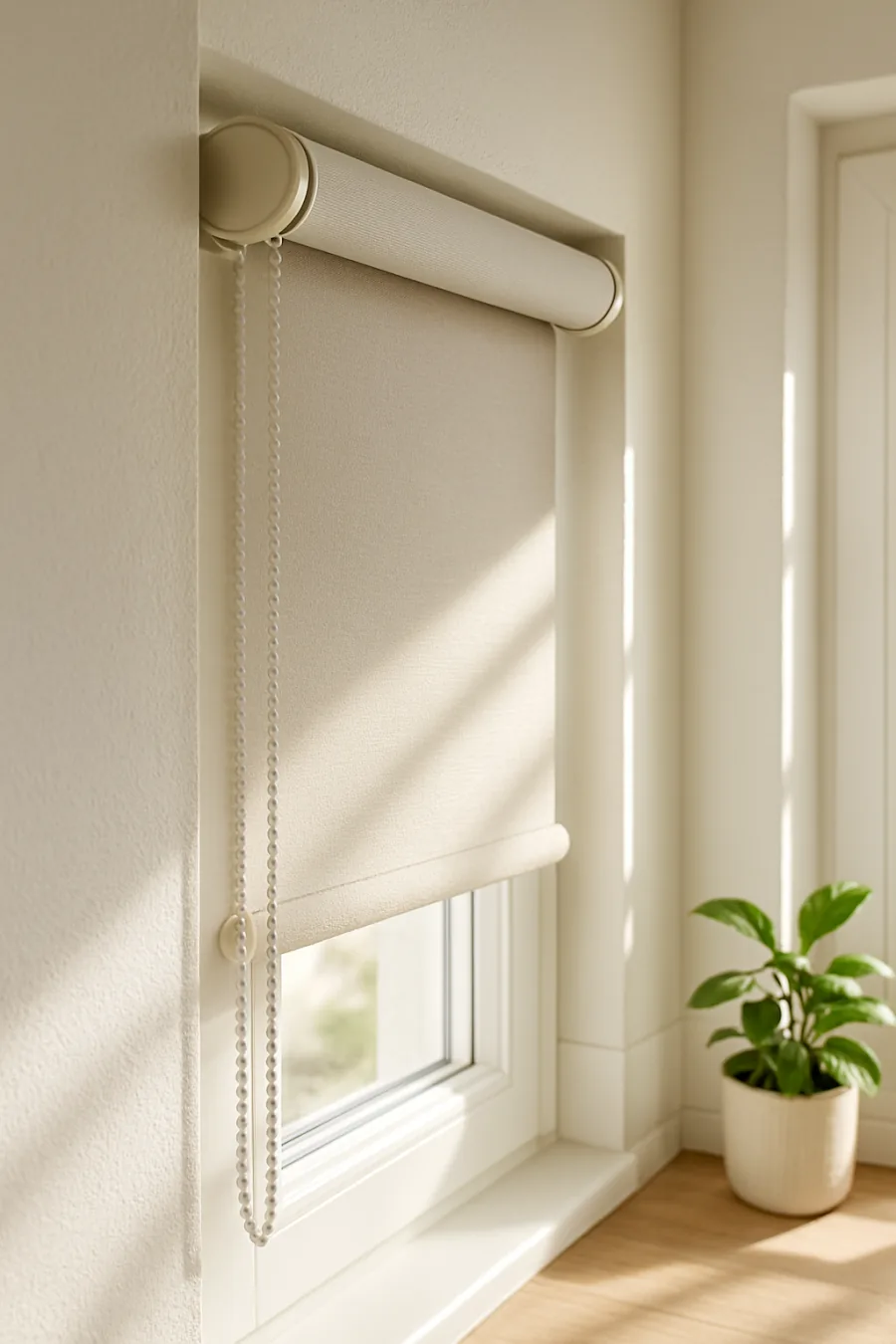
Children's roller blinds cover the window with a compact roll instead of a rail and curtains, so no hanging elements are left above the windowsill. The fabric rolls onto an open roller tube — no rail or heavy curtains needed. Installation takes less time: the mount is fixed to the sash or to the wall.
What takes the place of curtains
The fabric gathers into a roll on the roller tube. The roller tube is fixed to the sash of a plastic window or to the wall above the opening, and everything that used to hang along the window now takes up a strip at the top. You choose the pattern and colour of the fabric — from calm light shades to dense dark ones, and it is this fabric that sets the look of the room, not heavy textiles on a rail.
What this gives in a child's room
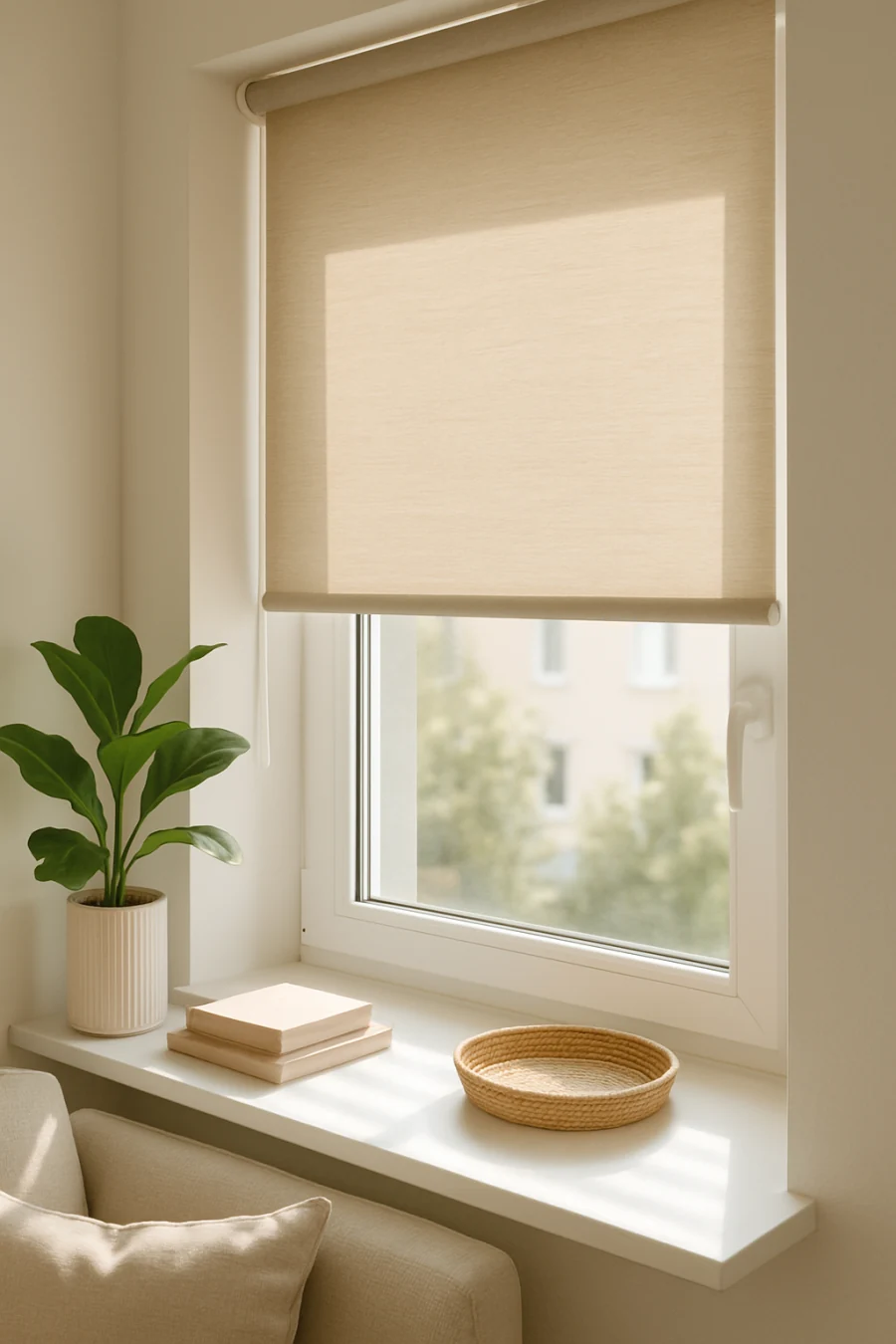
There are fewer parts above the windowsill that a child can pull on. The window stays a working area: the windowsill is free for books, building blocks and toys, and the blind does not catch the items standing on it when lowered.
A roller blind in a child's room replaces a rail with curtains with one compact structure on a roller tube — and that is the main difference from the usual textiles.
Safety: what is dangerous about a chain and how it is dealt with
Safety in a child's room rests on three points: the control, the length of hanging parts and the mounting. It is not the control chain as such that is dangerous, but the free loop that hangs down to the floor. A child reaches for everything that hangs — and pulls on exactly that. A chain tensioner removes the loop: the chain is tensioned and fixed to the wall.
Where exactly the risk is
The free loop of the chain hangs along the wall at a level the child can reach from the cot or from the floor. That is the only truly dangerous place in a roller blind.
We fit the tensioner during installation. It is easy to check — run your hand along the wall: if the chain does not come away from the wall anywhere and does not sag, there is nothing to pull. For roller blinds in a child's room we do this by default.
Options without a chain
A spring mechanism raises the fabric with a hand movement on the bottom bar, the spring is hidden in the roller tube. There is no chain or cord on the outside.
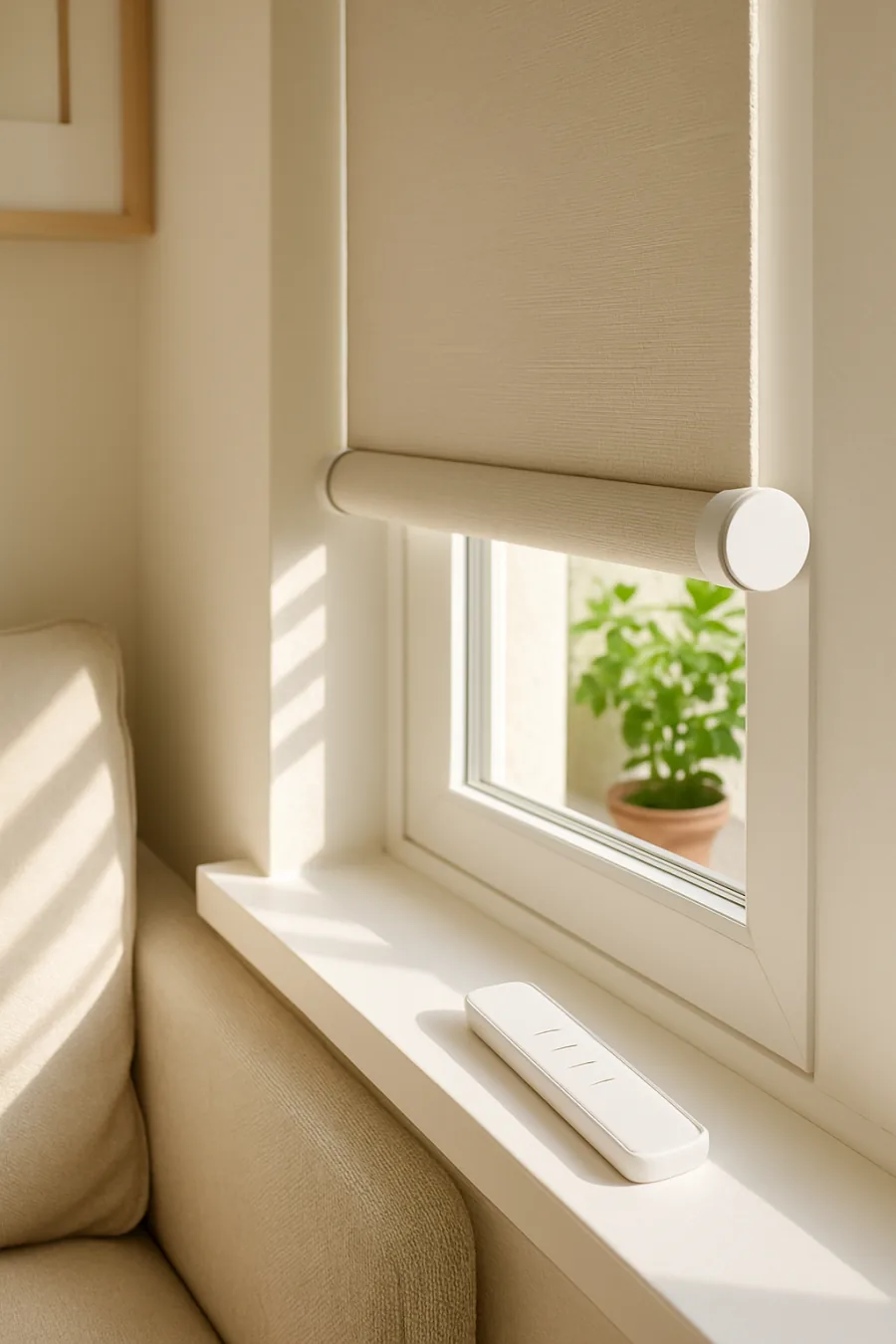
An electric motor eliminates hanging control parts altogether: the blind is operated with a button or a remote control. Electric with a remote control is the same thing, only the remote lies separately, at hand. What to choose by age? For a toddler — a spring or an electric motor: they will not pull on what is not there. For a preschooler and a younger schoolchild, a chain with a tensioner will do. For a teenager, an electric motor or electric with a remote control is more convenient — operating the blind without getting up from the desk.
Cot by the window
The Jalusso measurer looks at where the cot stands and from which side the child reaches for the window, and suggests a control to suit that habit. If the cot is right next to the window, an option without a chain is more sensible.
And the bottom of the fabric: on a roller blind the bottom bar is at windowsill level or higher. There is no freely hanging edge to pull on. But if the child reaches the bar and swings the fabric, the measurer positions the brackets so that there is no room for movement.
No-drill mounting and a child's room
No-drill mounting keeps the frame and the wall intact — an option for a rented flat or a new building where the windows cannot be drilled yet. In a child's room there is one requirement for such a mount: the child must not pull the fabric off together with the mount. The pulling force of a two-year-old and a seven-year-old is different, so the measurer looks at the profile and the sash and says which mount holds reliably in this particular place. If any doubt remains — they choose mounting on the sash or on the frame.
It is not the chain itself that is dangerous, but the free loop that hangs down to the floor; the tensioner fixes the chain to the wall, and no loop is left.
Which fabric to choose: blackout, dim-out or semi-transparent
The fabric is chosen for the task of the room, not for the name that sounds louder. Children's roller blinds with blackout fabric darken the room for a daytime nap: the dense fabric does not let light through, and the child falls asleep in familiar darkness. Semi-transparent fabric leaves soft light and a view outside — this option is taken when the yard needs watching. Dim-out fabric sits in the middle: less light than through a semi-transparent one, but the room does not turn dark.
Day-night and blackout solve different tasks. The first option is two fabrics in one system, and it is about flexibility during the day. The second is about dense darkening. For a child's room, blackout or a dense fabric without full darkening is chosen more often, and the day-night system takes second place: in a child's room a predictable result matters more than switching modes.
Table by task
| Task of the room | Fabric group | What you get in the room |
|---|---|---|
| Daytime nap of a toddler | Blackout fabric | The room is darkened, the child falls asleep during the day |
| The child is afraid of the dark | Dense fabric without full blackout | Direct rays don't hit the eyes, light stays |
| Teenager's room, keeping an eye on the window | Semi-transparent fabric, dim-out | Soft light and a view of the window |
| Desk by the window | Semi-transparent fabric, the blind is lowered by a third | The notebook is in the shade, the room is bright |
Dense fabric without full blackout suits a child who is afraid of the dark: the blind blocks direct rays, but the room doesn't become completely sealed off. This is a compromise that we discuss separately during the measurement.
Smell of new fabric
Blackout fabric doesn't smell once the blind has aired out. Dense fabrics with treatment may give off a manufacturing smell in the first hours — it goes away after airing. Blackout fabric isn't considered harmful, but it's better to check this before ordering: the measurer brings samples, and you look at and smell them yourself, not based on a description on the website.
Pattern and colour
A calm pattern doesn't clash with the wallpaper and doesn't distract: a white background with small clouds in pale blue suits both a toddler and a schoolchild. A bright pattern is a matter of taste — in a couple of years the child may want a different room, and then you change the blind, not the mounting. For the same reason, we don't recommend taking children's prints for the whole wall: replacing the blind is cheaper than redoing the window.
The fabric is chosen for the room's purpose: blackout — for daytime sleep, semi-transparent — when you need to keep an eye on the window, dense without full darkening — if the child is afraid of the dark.
How much darkness blackout gives: open roller tube vs cassette
You won't get full darkness at the base price. On an open roller tube, blackout fabric, even lowered to the windowsill, leaves faint strips of light along the edges of the blind. An open roller tube is a design where the roll with the wound fabric stays outside and isn't covered by anything: there's a gap at the top and sides between the fabric and the frame, through which light leaks in. A cassette system covers the roll with a housing box and guides the fabric along guide rails, so it fits tightly on all sides. The difference between these two options isn't in the fabric, but in how neatly the blind meets the frame.
What you see in the room
With a dense blind lowered on an open roller tube, the room settles into semi-darkness: light comes in narrow strips along the edge. For daytime sleep this is usually enough — the child falls asleep in familiar half-light. But if your little one wakes up from the first strip of light on the wall, those strips become a problem. Then you choose a cassette with guide rails: the blind moves inside the side rails, presses against the windowsill or the frame at the bottom, and no light leaks through at all. The guide rails are mounted on the sash or on the frame — the installation still stays neat.
What to choose
For a toddler who sleeps during the day, a cassette with guide rails solves the darkening issue completely. For a teenager's room, an open roller tube is enough: soft light and a view out of the window matter more there than absolute darkness. Moreover, a cassette system increases the product's cost by a coefficient — you pay more for the tight fit and the housing box than for an open roller tube. During the measurement we look at the window, the crib, and how light enters the room at different times of day, and based on that we decide whether a cassette is needed or the base design will do.
Only a cassette system with guide rails gives full darkness in a child's room, not the blackout fabric itself.
Controls by age: chain, spring, electric motor, remote control
Controls are chosen by age: for a toddler — no chain, for a schoolchild — a chain with a tensioner or a spring mechanism, for a teenager — an electric motor or remote control. The difference isn't in price, but in whether the child can reach the hanging loop.
Toddler
A spring mechanism raises the blind by hand using the bottom bar. The spring is hidden in the roller tube, and there's no chain or cord at all. An electric motor eliminates hanging control parts — only the blind remains on the window. Which to choose? For a toddler who pulls on everything within reach, both options solve the problem equally well, and the difference is in budget and parents' habits: a motor is more convenient for a tall window.
Preschooler and younger schoolchild
Chain with a tensioner: the chain is tensioned and fixed to the wall, so no free loop remains. The child lowers and raises the blind themselves — at this age, independence is a joy. A spring also works if you don't want any chain in the room. Chain control increases the cost by a coefficient from the price list — that's the only way it differs in money from mechanical.
Teenager
Roller blinds for a teenager's room are more often chosen with an electric motor or an electric one with a remote control: the blind is operated without getting up from the desk. One wide blind covers both sashes at once, and the bottom of the blind doesn't get in the way of placing a monitor or lamp on the windowsill. And this is the case where we advise not to cut corners: pulling the chain over the desk every time gets old fast.
Blind on the sash and ventilation
When mounted on the sash, the blind hangs together with the window and opens with it. During the measurement we look at the profile and the sash: the mounting must not interfere with opening for ventilation. For example, in a boy's room with a two-sash window, we brought the chain out to a convenient level and placed the tensioner so it wouldn't interfere with the sash opening. In a girl's room with a 2.3 m window, an electric motor solved the issue: the blind covers both sashes, and ventilation isn't pinched by anything.
The measurer looks during the measurement at where the crib is and how the child reaches for the window, and based on that habit suggests the controls. It's not the chain that's dangerous, but the free loop that hangs down to the floor.
Mounting: on the sash, on the frame, without drilling
Roller blinds for a child's room in Almaty can be installed without drilling into the frame — this isn't a compromise, but a standard working option. The brackets are placed directly on the window sash, the blind hangs together with the window and doesn't interfere with opening. The frame and wall stay intact with this type of installation. There are other mounting methods too — the choice depends on the window profile and on how the child behaves at the windowsill.
- Mounting on the sash: brackets are attached to the sash, and the blind raises and lowers together with it. Suitable for plastic windows in a child's room because it doesn't touch the frame or the window reveals.
- Mounting on the frame: screws are driven into the frame. A reliable option, but the holes stay forever — a downside for a rented apartment.
- Mounting without drilling: keeps the frame and wall intact. This type of installation is chosen for a rented apartment or when the developer hasn't yet accepted the windows in a new building.
For the sash
Brackets are placed directly on the sash — the blind hangs together with the window. Suitable for plastic windows in a child's room.
No drilling
Drill-free mountings keep the frame and wall intact: an option for a rented apartment or when the developer hasn't yet accepted the windows.
What to look at in a child's room
If the child pulls on the blind, the mounting must hold securely — otherwise the blind will come off with them. A child can pull a soft blind down, and a suction-cup or Velcro mounting holds weaker than a bracket. The measurer looks at the window profile and the sash and tells you which option will work here.
Ventilation is a separate point. If the fabric hangs on the sash, it moves with it when you open the window, but the chain or the bottom bar must not catch on the window reveal. This is immediately visible during the measurement. In practice, we advise against saving on the mounting hardware just to be able to take the blind down without a trace: in a child's room, it matters more that the blind holds up when it is touched.
The brackets are mounted directly on the window sash without drilling the frame; the blind hangs together with the window and does not interfere with opening.
A desk by the window and a teenager's room: light, glare, monitor
Roller blinds for a teenager's room are chosen not for darkness, but for controlling the light at the workspace. The task is different from a small child's room: here you don't need to darken the whole room, you need to remove the direct beam from the desk and the glare from the screen.
If the desk is right up against the window, the fabric is lowered by a third. A blind lowered by a third removes the glare on the monitor at the teenager's desk and at the same time does not turn the room into a dark cave — the notebook falls into soft shadow, while the space around stays bright.
Semi-transparent fabric lets through soft light and keeps the view outside: the teenager can see what is happening in the yard and is not sitting in a sealed box. Dim-out works in a similar way — it diffuses light rather than cutting it off completely. In my opinion, for a teenager's room this matters more than density.
Light on the notebook and on the screen
A monitor and a notebook need different light. Bright sun on the screen glass creates glare, which makes the teenager hunch to find an angle without reflection. Semi-transparent fabric removes that beam without losing overall brightness.
Raising and lowering by a third is more convenient with a remote control if the window is high and behind the desk. There is no need to reach across the whole desk to the chain — the teenager controls the blind without getting up.
How this looks in practice
A schoolchild's room, a window by the desk. We install semi-transparent fabric; during the day it is lowered by a third: the notebook is in shadow, the room stays bright, the screen is free of glare. This is a typical scenario, and the measurer selects the fabric and the control right at the window.
The fabric for a desk by the window is chosen during the measurement: what matters is how much light should remain in the room and from which side the beam falls.
Almaty sun: south side, heat at the glass, fading
The south side in summer is not “just brighter” — it is a different mode of using the blind. The Almaty sun heats the area near the glass, and the question is not whether the room is hot, but what to do with that heat before it spreads through the apartment. Dense fabric lowered at noon holds back the light and part of the heat at the window — before the glass, not after. Semi-transparent fabric does not work that way: it diffuses light but does not stop the room from heating up. For a small child's bedroom on the south side, the logic is simple — the blind is down during the day, up in the evening.
Summer in Almaty
Summer in Almaty is hot and sunny, with dust, and on the south side the area near the glass heats up more than the rest of the room. Blackout fabric here serves two purposes: it darkens the room for daytime sleep and keeps the heat at the window. For a teenager's room, where the desk is by the glass, this is not enough — you also need controllability. A remote control or an electric motor lets you lower the fabric during the hottest hour without getting up from the desk. On the west side, however, the peak comes in the evening, when the room is already cooling down — there, semi-transparent fabric is enough.
Fading
The warranty does not cover natural fading of the fabric. This is not fine print but a working condition: the Almaty sun strips colour from any fabric within a few seasons, and the only question is which one fades faster. Fabrics with UV protection hold their colour longer — when ordering, tell the measurer that the window faces south or west, and he will select the fabric for that side. In a child's room this matters more than in a living room: the pattern on the fabric is chosen to match the wallpaper and furniture, and when it fades, the room looks alien. What's more, replacing the fabric solves the issue — the mounting stays on the window, only the fabric is changed. But it is cheaper to take UV-protected fabric right away than to redo it a couple of years later.
Children's roller blinds on a sunny side are worth choosing together with the measurer: he sees the window's orientation and selects the fabric for it, not from a catalogue.
Fabric care: wiping, vacuuming, stains
Fabric care depends on the type of fabric, and this is clarified by the measurer when ordering, not by a universal instruction from the internet. Children's roller blinds in this sense behave like any roller system: the fabric hangs on the tube, it is not taken off with a click and not thrown into the washing machine. You cannot wash a roller blind from a child's room — the tube and the mechanism will be ruined by water. Wiping, vacuuming and removing fresh stains are fine, and most of the time that is enough.
Let's go through in order what you can actually do with the fabric on the window.
- Wiping. The fabric is wiped with a damp sponge without detergent — first over the whole surface, then along the edges where dust settles. Blackout fabric is dense and not afraid of light moisture, but you should not rub it in one spot: it leaves a mark.
- Vacuuming. A soft brush attachment at low speed removes dust from the fabric while it hangs on the tube. It is more convenient to vacuum from top to bottom, without touching the bottom bar.
- A stain from a felt-tip pen or modelling clay. The stain is removed immediately while it is fresh — on washable fabric this is easier and visibly cleaner. Dried modelling clay is first carefully removed with a blunt edge, not rubbed into the fabric.
Some fabrics can be taken off the tube entirely without touching the mounting on the sash or the frame; others stay on the tube for their whole service life. This is a property of the specific fabric, so the question of a removable fabric is settled during the measurement, not by a general memo. And if the fabric does become unusable — from a stain that did not wash out, or from time — the mounting stays on the window, and the fabric is replaced.
The care method depends on the type of fabric, and the measurer tells you during ordering — this is the point where it is decided how you will maintain the blind going forward.
Replacing the fabric when the child grows up
The mounting stays on the window, only the fabric is changed — this is how the blind moves from a small child to a teenager without redoing the window. We replace the fabric by measurement: we take off the old roller, put a new one on the same tube and the same mounting.
The pattern on the fabric is a question not of taste for one season, but of a reserve for years. A white background and small clouds in pale blue do not clash with the wallpaper and do not distract, so such a blind lives comfortably both in a small child's room and later in a teenager's room. Replacing the fabric lets you refresh the blind when the child grows up or when the interior changes: it is noticeably faster and simpler than installing a new system with new installation.
When the fabric is replaced
Three reasons: the child has grown up and the room is being rearranged, the interior has changed, the pattern is tired. In all cases the mounting and the tube stay in place. We come for a measurement, take the dimensions of the same opening and make a new fabric for the brackets already in place.
Two beds by one window
If two beds stand by one window, we divide the window into two blinds: each has its own time to be raised. This is how it is done in a shared children's room — each bed has its own blind. The child who gets up earlier raises his fabric and does not wake the other.
In a teenager's room the same solution works differently: one wide fabric covers both sashes, and the control is brought out to a convenient level. Which is better in your case — dividing the window or installing one fabric — the measurer looks at on site.
The brackets stay on the window, only the fabric is replaced — so the blind moves from a toddler to a teenager without any rework on the window.
How much it costs and how we calculate from the measurement
Roller blinds for a kids’ room in Almaty start from 5,400 ₸/m² for polyester on an open roller tube. This base includes the fabric, the roller tube, the mechanism and the brackets — the whole product, with no separate charge for fittings. From there the total is built from three things: the area of the opening, the fabric group and the control type. The wider the window and the denser the fabric, the higher the final figure.
What's included in the price per m²
The price per m² is not just the fabric. The fabric is wound onto the roller tube, the roller tube carries the mechanism, the mechanism connects to the brackets, and all of it works as one system. That is why the area of the opening is multiplied by the base rate, and then coefficients for control and installation type are applied to the result. During the measurement the measurer measures the opening, shows fabric samples and gives the price on the spot — it does not change after the order is signed, unless the window dimensions are revised.
Coefficients
Control and mounting are listed as separate coefficients to the base.
| Parameter | Option | Coefficient |
|---|---|---|
| Control | Mechanical | ×1 |
| Control | Chain | ×1.06 |
| Control | Electric motor | ×1.85 |
| Control | Electric + remote control | ×2.1 |
| Installation | Wall-mounted | ×1 |
| Installation | Frame-mounted | ×1.05 |
| Installation | No drilling | ×1.1 |
| Installation | Cassette system | ×1.28 |
Coefficients are multiplied, not added. A cassette system with an electric motor in one blind is the most expensive combination on the list: full darkness and control without a chain are paid for separately. An electric motor on its own more than doubles the price of the product, and that is a fair price: the motor, power supply and remote control are all in the drive. For a toddler’s room, a spring or a chain with a tensioner is more common; for a teenager’s room with a tall window, electric with a remote control.
Installation and lead times
Installation is 4,500 ₸ per product. For orders from 150,000 ₸ installation is free: for a kids’ room with two or three windows this amount adds up, and the installers’ work is already included in the order. Manufacturing time for roller blinds is 4–6 days. We are a manufacturer with our own workshop, there are no ready-made products in stock, every fabric is cut to the size of a specific window.
The final cost of a kids’ room blind is made up of the area of the opening, the fabric group and the control type, and the base price position is from 5,400 ₸/m² for polyester on an open roller tube with a manufacturing time of 4–6 days.
How to order: measurement, workshop, installation, warranty
Yes, we make roller blinds for kids’ rooms in Almaty by measurement, not by a standard size. Every product is calculated for a specific window, so an order starts with a measurer’s visit, not with choosing a ready-made fabric.
Step by step
The process is as follows:
- You write on WhatsApp and describe the window and what the room needs.
- The measurer comes with fabric and bracket samples and calculates the price on the spot.
- The workshop makes the product to the size of your window — 4–6 days.
- Jalusso delivers and installs the blind on a plastic window.
- A warranty applies after installation.
Measurement and consultation are always free. Within the city, measurement and delivery are also free. We travel to Almaty’s suburbs — Kaskelen, Talgar, Issyk, Kapshagay — the cost of the visit depends on the distance and is quoted before the visit, not after the fact.
We charge 4,500 ₸ for installing one product, and if the order total reaches 150,000 ₸ or more, installation is included at no extra charge. A nice detail: we have no ready-made products in stock — everything is made in our own workshop, so the size and pattern of the fabric are not tied to what is already on display.
Warranty
3 years on the mechanism and 1 year on installation from the date the acceptance report is signed. If a case is recognised as a warranty case, we will do the work free of charge — it will take no more than 5 working days. Once the warranty period has ended, you can still call us — we will tighten the brackets, adjust the movement, replace the cord or chain.
The warranty does not cover cases where the mechanism is mechanically damaged, the product was re-installed by the customer, or the fabric was exposed to water or has faded over time.
Measurement and delivery within the city are free for the customer in Almaty — that is where it is worth starting, because the final price depends on the window, not on a general price list.
FAQ
We have collected what parents ask most often during measurement. The answers are short and to the point — no promises beyond the price list and warranty.
Which fabric should I choose for a kids’ room?
Blackout fabric is chosen for daytime naps — it darkens the room. Semi-transparent fabric lets in soft light and keeps a view outside, and in a teenager’s room that is more convenient when you need to keep an eye on things outside. If a child is afraid of the dark, a dense fabric without full blackout is chosen: light remains, but direct rays do not hit the eyes. During the measurement Aida shows samples, and you choose by looking at the fabric, not at a picture on your phone.
Will it be completely dark with blackout?
Full darkness is only provided by a cassette system with guide rails: the fabric runs in the side grooves, and light does not pass along the edge. On an open roller tube with a dense fabric lowered, faint strips of light remain at the edges — for daytime naps this is usually enough, and the room is in semi-darkness. If you need true darkness, choose a cassette, but remember: it comes with a coefficient and costs more.
Can the blind be installed without drilling into the frame?
Yes. Drilling-free mounting keeps the frame and wall intact — this is an option for a rented apartment or a new building where the windows cannot be drilled yet. In a kids’ room, something else matters: if a child pulls on the fabric, the brackets must hold securely. The measurer looks at the window profile and the sash and says which option will work here.
Will the fabric fade on a sunny side?
Fabrics with UV protection hold their colour longer. Tell the measurer that the window faces south or west — they will select a fabric for that side. And an important point about the warranty: natural fading of the fabric is not covered, so the decision is made during the measurement, while the fabric is still intact.
How do you care for the blind?
Fabric care depends on the type of fabric, and the measurer clarifies this when you order, rather than giving a universal instruction. In general, the fabric is wiped with a damp sponge or vacuumed with a soft attachment, and a fresh marker stain is removed immediately before it soaks in. Not every fabric can be removed from the roller tube for washing — check with your specific fabric.
What should I do if a teenager has a tall window?
For a tall window by a teenager’s desk, we install an electric motor or electric with a remote control: the blind is operated without getting up from the desk. One wide fabric covers both sashes at once.
How much does it cost and how long is the wait?
The price per m² for roller blinds is from 5,400 ₸/m² for polyester on an open roller tube: the price includes the fabric, roller, mechanism and brackets. From there the total depends on the area of the opening, the fabric group and the control type — a chain, an electric motor and a cassette add a coefficient. Installation is 4,500 ₸ per product, free for orders from 150,000 ₸. Manufacturing time for roller blinds is 4–6 days: we are a manufacturer with our own workshop, there are no ready-made products in stock, and we make each one to the size of your window.
Conclusion
If you boil it down to four points, a kids’ room roller blind rests on the control type, the fabric, the blackout system and the calculation from the measurement. Let’s go through them in order.
Safety in a kids’ room is decided not by the blind itself, but by the control: a chain with a tensioner, a spring mechanism or an electric motor. A spring and a motor remove hanging parts altogether, and with a chain, the tensioner fixes it to the wall — no loose loop remains. For toddlers, an option without a chain is usually chosen, and this is not an over-precaution — it is calmer for both you and the measurer.
The fabric is selected for what the room needs: daytime naps, fear of the dark, a desk by the window. Blackout darkens the room for sleep, semi-transparent fabric lets in soft light and keeps a view, and a dense fabric without full blackout suits a child who is afraid of the dark. There is no universal fabric for every case.
Total darkness means a cassette system with guide rails. On an open roller tube, light comes through as faint strips along the edges of the fabric, and for daytime sleep that is usually enough. The base price does not promise total darkness — for that you need a cassette.
The price depends on the size of the opening, the fabric group and the control type. The base is from 5,400 ₸/m² for polyester on an open roller tube, installation is 4,500 ₸ per item, and from 150,000 ₸ it is free. Manufacturing takes 4–6 days.
There is only one piece of practical advice — order a measurement first, it costs nothing. The measurer will bring samples, look at the window and the cot, tell you which mounting holds securely, and work out the cost on the spot — with no obligation on your side.

