













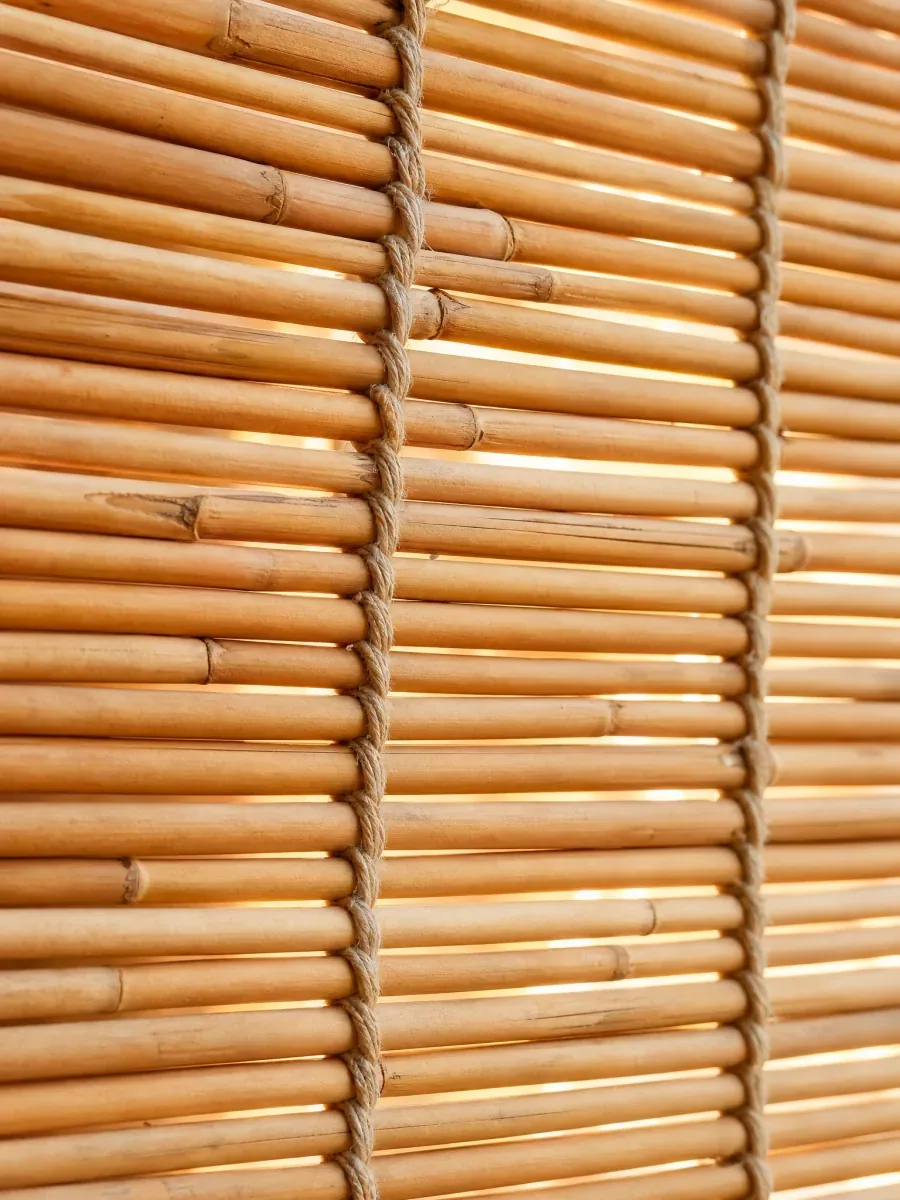
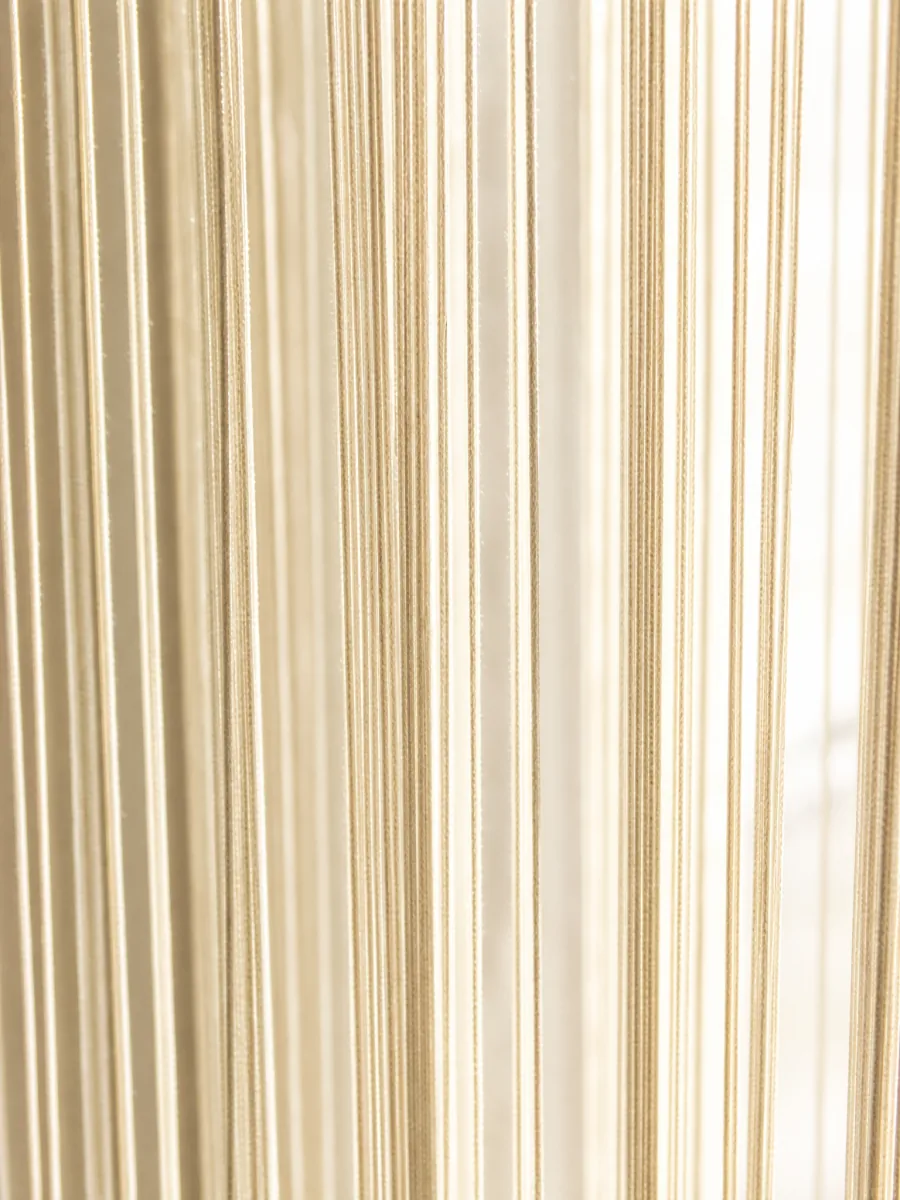











Blinds for a veranda or terrace in Almaty are a hanging structure of rotating slats that mounts to posts or a wall, not to a window frame. The slats control light and screen the opening from prying eyes, but they do not replace a soft PVC window and do not protect against rain. We make them to measure in Almaty.
What veranda blinds are and what they are not
Veranda blinds are a hanging structure of rotating slats that mounts to the frame posts or the wall, not to a window frame. Slat blinds for an open veranda or terrace control light and views. They do not close the opening against rain and cold. These are different jobs, and they should not be confused.
What exactly the slats do
A slat is a narrow strip of wood, bamboo straw, anodised aluminium or fabric. Each slat rotates around its own axis. The fabric does not rise.
Hence the main property. Light on the terrace is adjusted smoothly — from a narrow gap to a fully closed opening. The garden stays visible: you look through the gaps between the slats, not at a solid wall.
The turning mechanism is operated by a chain or a cardan wand. The angle is changed by hand, without electricity. For an opening on an open veranda this is convenient: the blinds hang all season, and you only change the tilt angle of the slats.
And here is what matters in practice. From the street side during the day the blind reads as a dense curtain, while from inside the veranda stays bright.
What slat blinds do not do
Soft PVC windows close the opening against rain and cold — blinds cannot do that. Transparent film holds heat and keeps water out. A slat lets water through between the plates.
An awning extends above the opening and does not close it at the sides. It gives shade from above, but side wind and slanting rain pass freely. Blinds close the opening over its whole area — from post to post.
A list of what a slat structure is not:
- a soft PVC window — we do not make or install film;
- an awning — it mounts above the opening, not in the opening;
- protection from rain and cold — a slat does not hold water or frost;
- veranda insulation — blinds do not change the air temperature.
Slat blinds control light and views, but they do not close the opening against rain and cold the way a soft PVC window does.
How slat blinds differ from soft windows and awnings
Slat blinds for an open veranda control light and views over the whole area of the opening, while soft PVC windows and awnings solve other jobs. Soft PVC windows close the opening against rain and cold — these are film covers, they hold heat. An awning extends above the opening and covers only the top: at the sides and below the opening stays open. Slat blinds sit in the opening as a whole, from post to post, and by turning the slat you change how much light comes inside.
For a homeowner these are three different purchases, and they should not be confused. If you need a dry veranda on a cold evening — that is not our story: we make blinds, and we do not produce soft PVC windows. If you need shade above the dining area during the day — an awning will do, but it will not screen you from neighbours’ eyes in the evening. Slat blinds are chosen precisely to keep light and privacy in one pair of hands: the garden is visible, and the sun is softened.
Comparison table
| Product | What it covers | Light control | Side protection | Mounting |
|---|---|---|---|---|
| Slat blinds | Opening over its whole area | Slat rotation, smooth | Guide rails or cable | To the frame posts or the wall |
| Soft PVC windows | From rain and cold | No, only lifting the panel | Around the perimeter of the opening | To the frame or the wall |
| Awning | Top of the opening | Projection and tilt | No | To the wall or frame |
| ZIP system | The whole opening, tightly | Lifting the blind | Guide rails in the grooves | To the posts and the opening |
| Polycarbonate roller shutters | The opening solid, opaque | Only raising and lowering | Side guide rails | To the frame posts |
| Outdoor roller blinds | Light and partly the view | Lifting the blind, less often tilting the slats | Weak, depends on the weight of the blind | To the wall or frame |
A ZIP system is a tight fabric with side guide rails that closes the opening more tightly than slatted blinds. Polycarbonate roller shutters are installed where a solid, opaque barrier is needed: they let no light through. Outdoor roller blinds are raised and lowered as a single fabric and offer almost no soft angle adjustment. For a terrace at home Jalusso usually recommends slatted blinds — they are cheaper to make and let you play with the light all day.
Why these products get confused
The same task — sheltering a veranda from the sun — is solved by different structures, and they are sold under similar names. Soft PVC windows are called “transparent blinds”, an awning is called a “terrace canopy”, roller blinds are called “outdoor blinds”. The name is similar, but the product is different.
The practical takeaway is simple: first decide what you actually need — warmth and protection from rain, or soft light and privacy. The first is solved by soft PVC windows, the second by slatted blinds.
Soft PVC windows hold in heat and protect from rain, an awning covers only the top of the opening, and slatted blinds adjust light and the view across the whole area.
How to mount blinds on a terrace when there is no window frame
Mounting to the frame posts replaces the window frame on a terrace. We hang terrace blinds on wooden or metal posts — every veranda, canopy or gazebo has them. No frame is needed. The measurer looks at what to mount to and calculates the cost on site.
After that, side fixing decides everything. Guide cables hold the blind along the edges of the opening: the slats run inside the grooves or along a tensioned line and do not move aside. A loose blind flaps in a draught and wind — this is the main reason a cheap installation on a single top rail does not work. On the sides we install either guide rails or a cable to the frame posts. And on the open side you cannot do without it.
Checklist for mounting without a frame
- Inspection of the posts and frame material.
- Choice of fixing: to wood, to metal, to the wall.
- Installation of guide rails or cable along the edges of the opening.
- Hanging the blind.
- Checking the movement of the slats and the tilt angle.
Inspecting the posts comes first. The frame posts must be straight and rigid: if a post wobbles under your hand, it is reinforced first, otherwise any fixing will work loose over time. The choice of fixing depends on the material — we use different elements for wood and metal. Installation of the guide rails or cable comes before the blind, not after: first the edges of the opening, then the structure itself.
Evening wind from the mountains
In Almaty, the evening wind from the mountains is a common thing. It comes on suddenly, along with the temperature difference between day and night. That is why on an open terrace we always close the edges of the opening: if the blind hung calmly in the morning, by evening it will be pulled. Guide rails and cable remove the very possibility of swinging. The slats do not knock against the posts at night, and the neighbours below sleep peacefully too.
Fixing to the frame posts with guide rails is the basic assembly for a terrace without a frame; without side fixing, the blind flaps in the wind, and no lock on top will fix that.
Which material to choose: open veranda, canopy, glazed opening
The material is chosen by the type of opening, not by colour or a picture from a catalogue. An open veranda requires a material resistant to wind and dust, a veranda under a canopy allows wood and bamboo, and a glazed veranda removes the outdoor question altogether. We assemble outdoor blinds for terraces from four materials, and each is good for its own opening.
An open veranda is an opening without overhead protection: rain reaches the fabric, wind blows along the slats, dust settles in a layer. Here an aluminium slat 25 mm with a polymer coating is used. The aluminium slat is wiped with a damp cloth right in place, and dust is brushed off it in a minute. Fabric slats with impregnation also hold up in an open opening: water rolls off, the fabric does not swell from damp. True, in my opinion, fabric on a windy side lives more restlessly — it sails until you stretch it properly.
A veranda under a canopy is a different story. The roof removes rain and part of the wind, and wooden slats and bamboo straw go here without a problem. We make wooden blinds for terraces from linden, slat 50 mm, tinted to match the frame. Bamboo straw gives soft dappled shade rather than stripes, and the veranda reads as an extension of the garden. Wood outdoors behaves predictably if there is a canopy or side walls above it: without them, linden will absorb moisture and warp.
A glazed veranda is almost a room. Glass cuts off wind and rain, there is less dust, fewer temperature swings. Any material from our list can be used here — wood, bamboo, and aluminium. The only thing that changes is the fixing: on a glazed opening we more often work on the frame or on the frame posts.
A separate question is the windy side. Aluminium or wood? If the opening is exposed to wind from the mountains, use aluminium with guide rails on the sides. Wood holds up on such a side, but requires a canopy and rigid fixing. Wind presses on the area of the blind, and the lighter the slat, the less load on the posts.
Table “veranda type — material”
| Opening type | What fits | What not to install |
|---|---|---|
| Open veranda | Aluminium slat 25 mm, fabric slats with impregnation | Wood and bamboo without a canopy |
| Veranda under a canopy | Wooden linden slats, bamboo straw, aluminium | Dense fabric near the mangal |
| Glazed veranda | Any material: wood, bamboo, aluminium, fabric | Heavy outdoor structures with cables |
| Windy side | Aluminium with guide rails | Loose fabric, thin fabric |
South side and fading
The south side speeds up fading of fabric and wood tinting. The sun in Almaty is hot and high, so fabric slats with impregnation on the south are taken denser and darker — light fabric loses colour first. Linden tinting on a south opening is renewed when it fades. This is not a defect of the material, but normal work under the sun. Wood and bamboo are appropriate under a canopy and on a dry terrace, while aluminium and fabric with impregnation handle an open opening better.
Wood or bamboo for an outdoor terrace
We make wooden blinds for terraces from linden with a slat of 50 mm, and bamboo ones from bamboo straw. Both materials are alive, both work outdoors, but they behave differently. Wood is stricter in geometry, bamboo is warmer in appearance.
Wooden slats are tinted to match the frame of a gazebo or house — the customer sends a photo of the posts, and the workshop selects the tone. A veranda under a canopy is a native scenario for wood: there is no direct rain, the slat does not absorb moisture and keeps a straight line. Tinting is not just decoration. It closes the pores, and dust with poplar fluff is brushed off such a slat with a brush in a couple of minutes.
Bamboo straw gives soft dappled shade rather than stripes. Light passes through the weave diffusely, and the veranda reads as an extension of the garden, not as a room with a dense curtain. The weave is lighter than wood. I prefer this option for the south side: solid shade there quickly becomes tiresome, while dappled shade stays comfortable all day.
Can wooden blinds be hung outdoors? Yes, if the opening has a canopy or side walls that keep direct water off. On a fully open terrace, wood does worse — the warranty does not cover water damage, and Jalusso says this before the measurement, not after.
Bamboo is a little calmer about moisture, but we also do not recommend wetting the weave: wipe with a slightly damp cloth, do not spray with a hose. Both materials need to be taken down for the winter. Wood and bamboo age beautifully if you look after them by these simple rules.
What to do with blinds in winter and the off-season
Blinds for a terrace in Almaty live in a seasonal mode: in winter the blind is taken down and stored indoors, in spring it is returned to its place. This is not year-round outdoor use, and we say this directly at the measurement, not after the first winter.
Why this is so is clear from the climate. Almaty winters bring frosts and sharp temperature swings between day and night. The slat-turning mechanism is designed for hand operation, not for icing: if the blind stays on the posts, moisture and frost settle on the cables, guide rails and the turning unit itself. Plus the wind from the mountains — it pulls the blind even in summer, and in winter it carries snow grains across the opening. Taking it down is easier than later dealing with a jammed mechanism.
What we do by season:
- At the end of the season, we take the blind off the posts and carry it indoors — to a dry room without temperature swings.
- Before storing, wipe wood and bamboo with a dry or slightly damp cloth: brush dust and poplar fluff off the slats with a soft brush, and do not wet the weave.
- We leave the cables and guide rails on the frame — in spring the blind goes back onto them.
- In spring we check the movement of the slats and tighten the fixing if necessary.
Dust and poplar fluff are a separate story of the Almaty summer. After a dust storm, the blind is not washed under a stream, but brushed: this way dust does not get into the weave and the joints of the slats. We wipe the aluminium slat with a damp cloth right in place, and wood and bamboo — only with an almost dry one.
Our lead measurer Kirill usually offers two fixing options at once: stationary, if you are ready to take the blind down yourself, and quick-release, so that putting it away for the winter takes minutes, not an evening.
Why the Almaty winter does not forgive mistakes
The climate here is sharply continental: frosty nights give way to daytime thaws, and such a difference between day and night repeats in waves. Metal and wood react to this differently, so the fixing and material are chosen with a margin for the temperature swing. Leaving the blind to winter on an open veranda means giving it to the wind from the mountains, ice on the cables and grains that will clog the grooves of the guide rails.
In winter the blind is taken down and stored indoors, in spring it is returned to its place — this is a seasonal mode, not year-round outdoor use.
Transparent blinds for a veranda: what they are and whether you can see in at night
Transparent blinds for a veranda are a fabric made of light-coloured material with a treatment that lets diffused light through during the day. It is bright inside, but no one can look in from the street. Treated fabric slats diffuse the light and keep the space private during the day — and this is not a film, but actual slats on a turning mechanism.
How does this work in practice? During the day the street is brighter than the veranda, so a look from outside meets the glowing fabric. In the evening the picture flips: the lights go on inside, and silhouettes can be made out if the fabric is not dense. This is not a defect but the physics of any light-coloured fabric — we always mention it at the measurement so the owner has no surprises on the first evening.
Soft PVC windows are a different product
Soft PVC windows are a transparent film in a frame that holds in heat and keeps out rain. Transparent blinds for a terrace do not solve that task: they regulate light and the view, not temperature and humidity. We do not make film — we make slat systems, and we will not pass one off as the other.
Adjustment is done with a turning mechanism: the slats change angle without raising the blind. Smoothly, from a narrow gap to full coverage — handy when the blinds hang all season and you only need to adjust the light to the time of day.
On the south side, light-coloured fabric loses its colour faster. For evening privacy, choose a denser fabric or close the opening with a slat.
Transparent blinds keep the space private during the day, but in the evening with the lights on inside, silhouettes can be made out — the density of the fabric is the main choice.
How much blinds for a veranda and terrace cost
The price of blinds for a veranda and terrace in Almaty is calculated by the area of the opening and the slat material. Wooden linden blinds with a slat of 50 mm — from 12,400 ₸/m², bamboo — from 9,400 ₸/m², horizontal aluminium with a slat of 25 mm — from 4,200 ₸/m². Then controls and mounting are added to the base price. The exact amount is given by the measurer on site, because the area and number of fabrics can only be seen at the property.
Price table according to the price list
| Product | Price from | Lead time |
|---|---|---|
| Horizontal blinds, aluminium, 25 mm slat | 4,200 ₸/m² | 3–5 days |
| Bamboo blinds | 9,400 ₸/m² | 7–10 days |
| Wooden blinds, linden, slat 50 mm | 12,400 ₸/m² | 7–12 days |
| Motorised blinds | 7,800 ₸/m² | 7–10 days |
An electric motor makes the product more expensive than a mechanical one: in the calculator this is a coefficient of 1.85, and electric with a remote control — 2.1. Mechanical control has a coefficient of 1, a chain — 1.06. Soft blinds for a terrace made of treated fabric slats are priced separately — from 4,600 ₸/m² with a slat of 89 mm, lead time 3–5 days.
Calculator coefficients
Mounting also changes the total. On a wall — coefficient 1, on a frame — 1.05, without drilling — 1.1, cassette system — 1.28. To hang blinds on a veranda or terrace, you pay 4,500 ₸ per product — except when the order total reaches 150,000 ₸: then installation is included at no extra charge.
A wide opening is divided into several blinds. That way the blind does not sag in the centre and passes through the guide rails more easily; on a panoramic veranda this is standard practice. Each blind is calculated separately and mounted separately, so the price for several openings is the sum for each one.
An example from a quote: horizontal aluminium blinds for an opening of 6 m² with mechanical control and wall mounting — 6 × 4,200 = 25,200 ₸ plus installation 4,500 ₸. The order does not reach the free installation threshold, but several openings together do cross it. The larger the area, the more noticeable the difference between aluminium, bamboo and wood.
Measurement and consultation are always free. Within the city, measurement and delivery are free, and we also travel to the suburbs — Talgar, Kaskelen, Issyk, Kapshagay — and we tell you the cost of the visit before we come, not after. The measurer arrives with samples, looks at the opening and the posts, and calculates the cost right on site.
The price of blinds for a veranda and terrace is made up of four values: the slat material, the area of the openings, the controls and the mounting.
Care: dust, poplar fluff, fading
Caring for outdoor blinds depends on the slat material, not on which side the blind hangs. A dust storm in Almaty leaves a thick layer on the slats, and poplar fluff gets stuck in the weave and in the grooves of the guide rails. Both should be brushed off with a soft brush — dry, without water, before the dirt is rubbed into the surface.
Aluminium slats are easier to care for than the rest. They are washed with a damp cloth and a mild product, right in place, without taking the blind off the posts. The polymer coating takes this kind of cleaning well; abrasives and the rough side of a sponge scratch it.
Wood and bamboo need a dry approach. Wooden linden slats and bamboo straw weave are wiped with a dry or slightly damp cloth — they should not be soaked, because water makes wood and weave swell and lose their shape. Snow is brushed off the blind with a soft brush, not knocked or chipped off.
Soft blinds for a terrace — that is, treated fabric slats — are cleaned with a brush, dry. Water washes out the treatment, and the fabric absorbs moisture from the air faster. If a stain does not come out with dry dusting, it is better to show it to us than to scrub harder.
Fading happens on the south side, and it is a normal process, not a defect. Fabric and wood tint lose their richness under direct sun faster than in the shade under a canopy. For a south-facing opening we recommend choosing a denser fabric or a light tint right away: it fades less noticeably because it is not dark to begin with. The warranty does not cover natural fading of fabric.
Aluminium is washed with a damp cloth and a mild product, wood and bamboo are wiped with a dry or slightly damp cloth, and snow is brushed off with a soft brush.
Measurement, installation and work in the suburbs
Consultation and a measurer’s visit cost nothing and do not depend on an order: he brings samples and calculates the price right at your place. Within the city, measurement and delivery are also free. Outside the city — to Kaskelen, Talgar, Issyk, Kapshagay — we also come; the cost of the visit depends on the distance and is quoted in advance, before you make a decision.
The process is this: you message us on WhatsApp, we agree on a time, the measurer arrives, then the workshop and installation. No ready-made products from a warehouse — we make veranda blinds to your dimensions.
What the measurer looks at on site
The type of opening. An open veranda, a veranda under a canopy or a glazed opening — the material and mounting depend on this.
The material of the frame posts. Wood, metal, brick — the measurer looks at what to attach the structure to without a window frame.
Width and height. A wide opening is divided into several fabrics: one large one catches the wind more than two smaller ones.
The side of the light. The south side fades faster, and the measurer takes this into account when choosing the material.
The number of fabrics and guide rails. How many openings, where to put the cable or guide rails.
Jalusso always brings samples — wood, bamboo, aluminium, treated fabric. Touching them with your hands is more honest than choosing from a photo.
A café terrace in Almaty
For a café terrace everything is calculated the same way, but the scale is different. We close a panoramic opening onto the street with several blinds: during the day the hall is bright, in the evening the hall is closed off from the street. Installation on the frame posts, guide rails along the edges.
Questions and answers
Short answers to what people most often ask about blinds for an open veranda before the measurer’s visit.
Can blinds be placed next to a mangal?
A mangal next to the fabric rules out mounting right against the fire. Wood and bamboo dry out and warp from the heat, and we do not put treated fabric where sparks fly. If the mangal stands on the veranda permanently, the fabric is moved to the neighbouring opening, further from the firebox.
What happens to the blind by the pool?
On a terrace by the pool, the blind lives next to splashes and steam. This doesn't damage an aluminium slat — it's wiped with a damp cloth along with the furniture. Note that the warranty doesn't cover water: if the blind gets wet, that's not a warranty case.
What does the warranty cover?
We give 3 years on the mechanism and 1 year on the installation work; both periods start from the day the acceptance report is signed. It doesn't cover mechanical damage, re-installation on your own, water or natural fading of the fabric. We fix warranty cases free of charge within 5 working days, and after the warranty we still come out — to tighten, adjust, replace a cord or chain.
Can blinds be installed on several openings at once?
Yes, we cover each opening with a separate blind. A wide opening is divided into several blinds so the slat doesn't sag and the movement stays even.
What is a ZIP system and polycarbonate roller shutters?
A ZIP system and polycarbonate roller shutters are different products — Jalusso doesn't make them. The blind turns on its slats and is held on cables, rather than rolling up into a housing box like roller shutters.
Conclusion
Blinds for a veranda or terrace in Almaty solve two tasks — they regulate light and screen the opening from prying eyes. Slatted blinds don't protect against rain and cold, and you shouldn't expect them to: for warmth and dryness you need a soft PVC window, and we don't make those.
Fixing to the frame posts replaces a window frame. Along the edges of the opening we install guide rails or tension a cable — then the blind doesn't flap in the wind from the mountains and doesn't pull away from the post. Without this, a free-hanging blind on an open terrace behaves badly.
The material is chosen by the type of opening. Wooden blinds and bamboo straw suit a covered area and a dry terrace, while aluminium slats and coated fabric slats cope better with an open opening exposed to wind and dust.
In winter, veranda blinds live on a seasonal schedule: the blind is taken down and stored indoors, then put back in spring. The Almaty winter with frosts and day-to-night temperature swings isn't kind to a structure out in the open, and we say so honestly before the order, not after.
The price depends on the material and slat size, the area of the openings, the controls and the mounting. An electric motor costs more than a manual one, a cassette system costs more than wall mounting, and we do the installation free of charge on orders from 150,000 ₸.
The practical advice is simple: first determine the type of opening and the window’s orientation, then call the measurer with samples. He'll look at the posts, calculate the cost on site, and you'll see the material in your hands, not in a picture. And it costs nothing — measurement and consultation are always free.

