


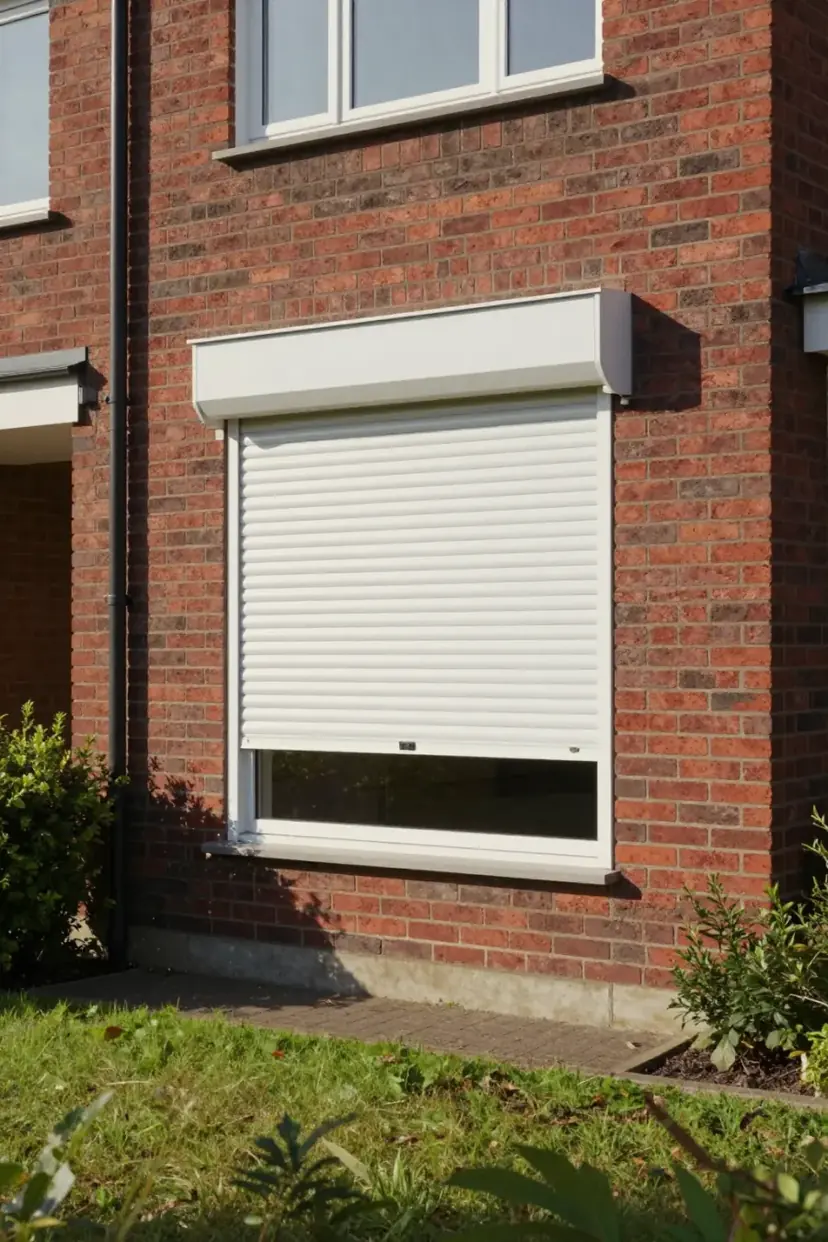


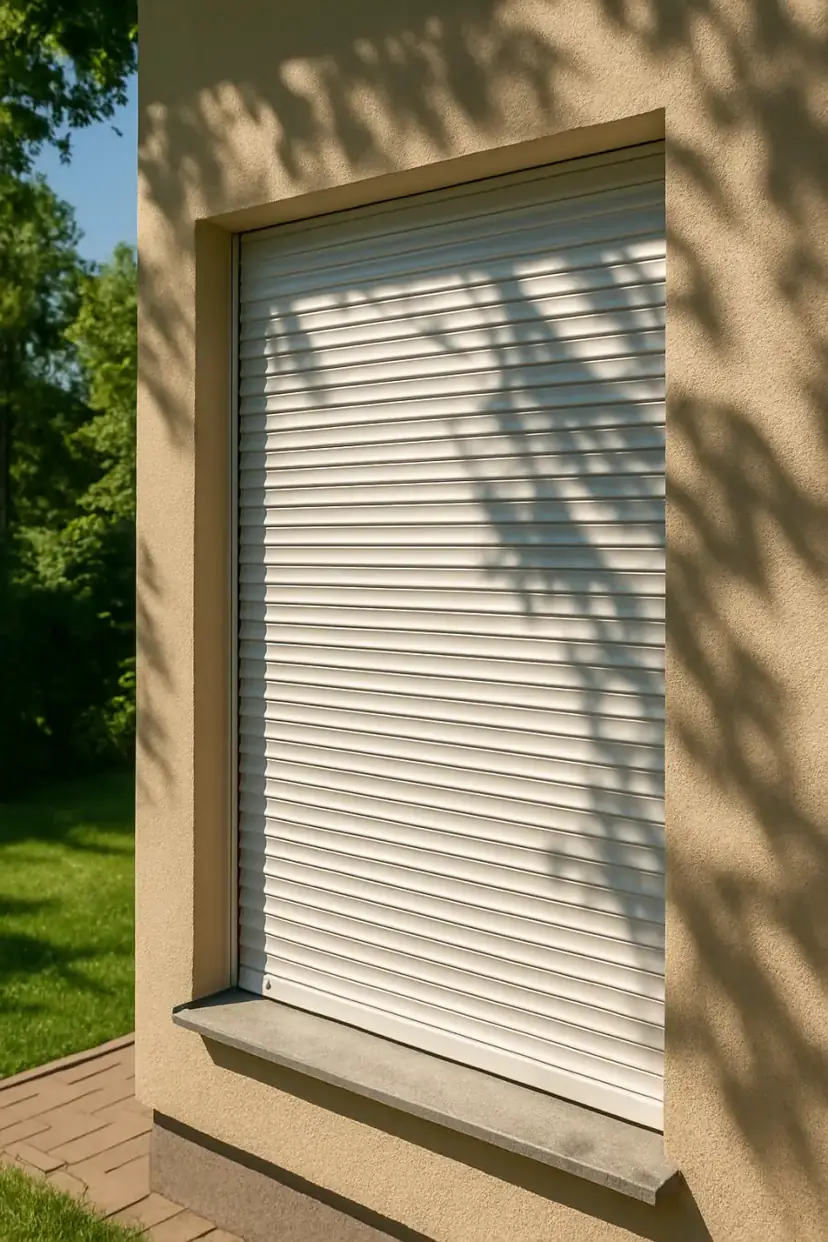
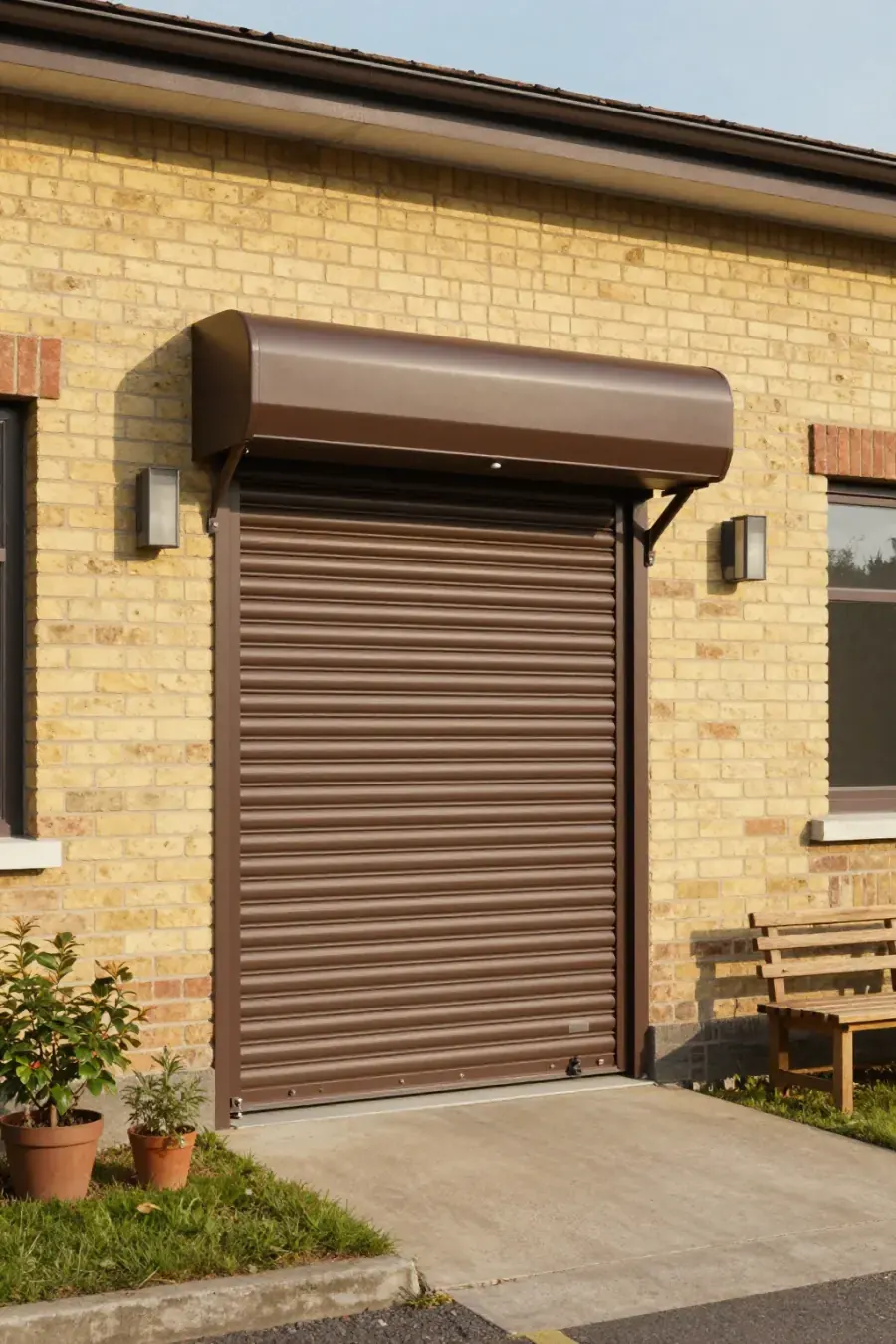

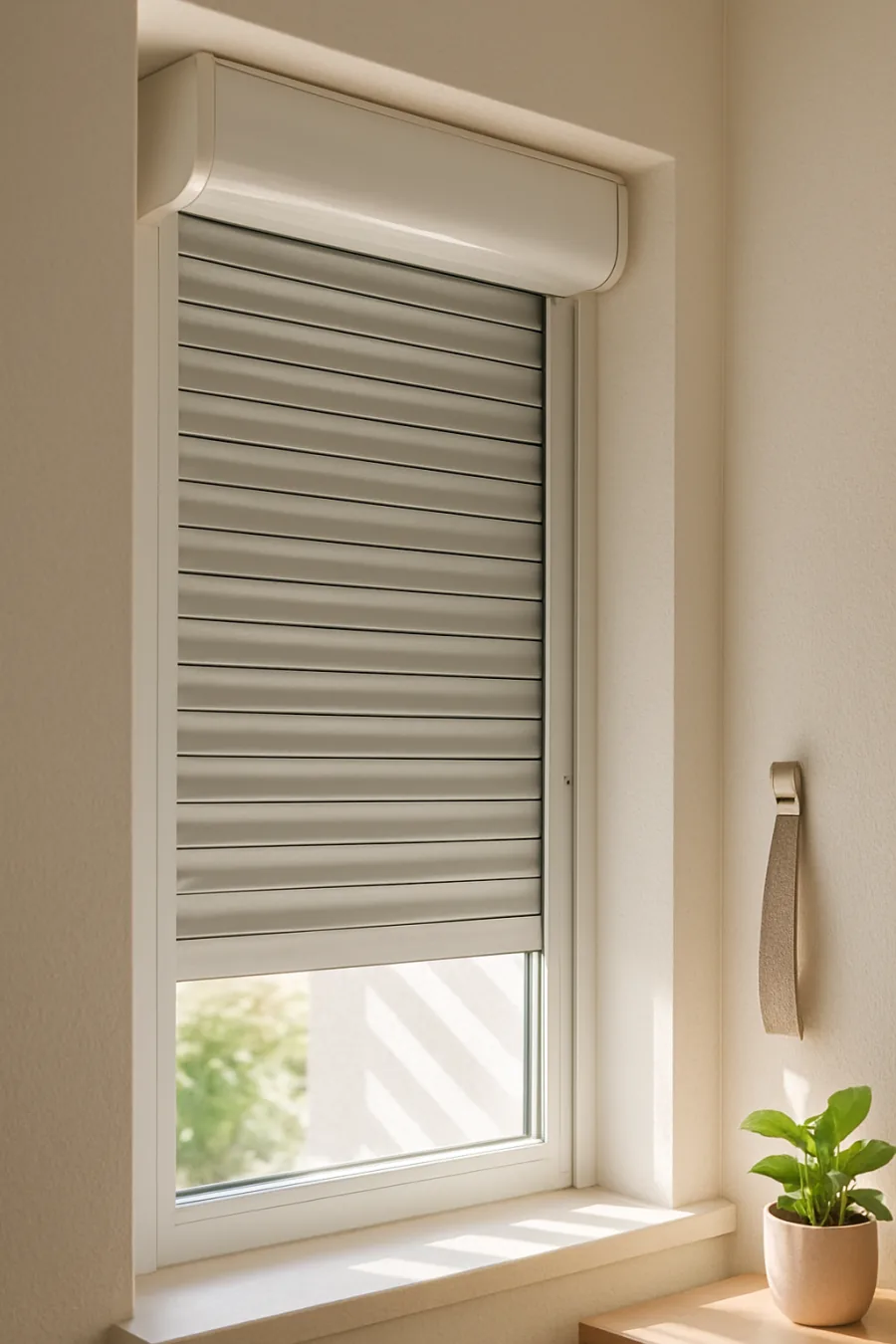











Armoured roller shutters in Almaty are a curtain made of extruded aluminium profile with a deadbolt lock and slat latches, mounted with guide rails into the load-bearing wall so that it cannot be pried off with a crowbar. We manufacture to measurement: from 24,900 ₸/m² for a protective set, from 17,500 ₸/m² for basic roller shutters for windows.
What armoured roller shutters are and how they differ from protective and anti-vandal ones
Armoured roller shutters are a curtain made of extruded aluminium profile with a deadbolt lock and slat retainers, mounted with guide rails into a load-bearing wall so that it cannot be pried open with a crowbar. The word “armoured” in the name refers to the construction of the curtain, not to the price and not to the thickness of the paint.
Extruded aluminium profile differs from foam-filled roll-formed profile in how it behaves under load. In extruded profile the slat is solid, the wall is thicker and there are stiffening ribs — a tool hits metal and finds no point where the curtain gives way. A foam-filled roll-formed profile is filled with foam inside, and its job is to close the opening from the sun, dust and prying eyes, not to take a hit.
Jalusso manufactures such roller shutters to measurement in its own workshop in Almaty — it does not keep ready-made products in stock.
Where the line runs between “protective” and “armoured”
The difference is not in the name on the display, but in how much time and noise a burglar needs. A roll-formed profile is pried open quickly and almost silently: wedge in a crowbar, pry up a slat, climb through. Extruded profile does not pry open like that — it is loud and slow for someone standing under the window. The opening time is what you are actually buying. Burglary resistance is not made up of one profile alone: a deadbolt lock and guide rails anchored into a load-bearing wall are added to it.
In practice customers confuse three words — “protective”, “anti-vandal” and “armoured”. In our workshop we keep one rule: we call only extruded profile in a full assembly armoured, not a curtain with reinforced paint.
Full protection or reduced risk
There is no absolute protection, and it is more honest to say this right away. Armoured roller shutters do not guarantee “they will never break in” — they increase the time and noise a burglar needs, and thereby shift his choice towards an easier target. For a shop window without security and for a ground-floor window this is usually enough: a noisy and long break-in in full view of the street is a bad scenario for someone who came with a crowbar.
Only a curtain made of extruded aluminium profile is considered armoured, while a roll-formed foam-filled profile does not take such a load.
What makes up burglary protection: profile, lock, mounting
Burglary protection is made up of three equally important parts: extruded aluminium profile, a deadbolt lock and guide rails anchored into a load-bearing wall. Not one of them, even the most expensive one. If you expect the profile alone to decide everything, the money will go into the curtain and the weak spot will remain right next to it.
Let us go through all three in order.
- Extruded aluminium profile. Its slat is solid, the wall is thicker, with stiffening ribs inside. That is exactly why the curtain does not pry open with a crowbar the way a foam-filled roll-formed profile does, which bends under a lever. Extruded profile takes the load and does not give way on the first lift. For ground-floor windows and shop windows Jalusso installs only this kind of profile — with roll-formed profile, protection turns into a closed sash, nothing more.
- Deadbolt lock and automatic slat retainers. The deadbolt lock secures the curtain in the guide rails: the bolts go into the side rails and pull the slats together. Automatic slat retainers hold the curtain along its entire height, not only at the lock. Moreover, for large openings we install two locks — one in the centre will not hold the curtain if someone tries to pry it up from the edge.
- Mounting of the guide rails into a load-bearing wall. The guide rails are anchored into the load-bearing wall through the insulation and cladding — not into the insulation and not into the finish. Mounting into insulation comes out together with the anchor: a burglar pries up the guide rail and it comes out of the wall as a whole piece. The profile may be strong, the lock expensive, but if the assembly is held in the cladding, the whole structure comes apart in a matter of minutes.
And here is what is important to understand. A strong profile does not save a weak mounting, and an expensive lock does not save a bad profile. All three parts work only together: the curtain cannot be pried open while the lock holds the slats and while the guide rails sit in the load-bearing wall. That is why at the free measurement we look not only at the size of the opening, but also at what the wall underneath it is made of.
Why mounting matters more than it seems
A weak assembly devalues a strong curtain. If the guide rails are held in insulation or in the cladding, armoured roller shutters on windows come out together with the anchor — and neither a solid slat, nor stiffening ribs, nor a deadbolt lock helps. We see this at measurements: the opening is ready for the fasteners, but the wall under the finish turns out to be loose, and then the configuration has to be recalculated. It is better to find this out before the order than after installation.
Burglary protection is made up of three equally important parts — profile, lock and mounting of the guide rails into the load-bearing wall through the insulation, not into the insulation.
Which profile counts as armoured and which simply closes the window
Only a curtain made of extruded aluminium profile is considered armoured. A foam-filled roll-formed profile does not take such a load: it closes the window from prying eyes, but not from a crowbar. The difference shows in three signs — how the slat is built, what it is filled with and what happens to the curtain when a tool is wedged under it.
Comparison of the two profiles
| Feature | Extruded aluminium profile | Foam-filled roll-formed profile |
|---|---|---|
| Slat type | solid, with stiffening ribs | thin-walled, bent |
| Filling | voids inside the profile and ribs | foamed material |
| Behaviour under a pry bar | holds the load, it can't be pried open | bends and springs back |
| Which property it suits | shopfronts, garages, ground floors, anything without security | windows of flats and houses where protection is not the main task |
What “one-piece slat” means
Extruded aluminium profile is pressed out as a single piece. The slat comes out one-piece, its wall is thicker, and inside there are stiffening ribs — they act as a frame and spread the force across the full height of the blind. When a pry bar is forced under the slat, the load goes into the ribs, not into a thin wall. With a foam-filled roll-formed profile, the slat is bent and thin, and only the foam filling provides rigidity. The filling holds its shape well, but not its resistance to prying: the blind gives way and springs back.
In my view, the confusion comes from the word “aluminium”: it appears both in the description of the roll-formed profile and in the description of the extruded one, while the difference in price and protection between them is several times over.
What this means on site
For a shopfront, a garage or a ground-floor window that is left without security, we only quote extruded aluminium profile. For a window on an upper floor or for a country house, where the task is to close the opening off from strangers, a foam-filled roll-formed profile is enough, and there is no point paying for the armoured option there.
With an extruded profile the slat is one-piece, the wall is thicker and there are stiffening ribs, so it holds the load from a pry bar, while a foam-filled roll-formed one does not.
Burglary resistance class: what it means in practice and what we can confirm
A burglary resistance class describes not the material itself, but the time and noise a burglar needs to open the blind. The P1–P5 scale runs from minimum to maximum resistance: the higher the class, the longer and louder it takes to work on the structure. GOST R 52502 is built around exactly this logic — the tester presses, cuts and pries the blind, and the result is measured in minutes and in the nature of the noise.
What does this mean for a shopfront or a ground-floor window? A simple fact: a burglar counts not the metal, but his own minutes. He leaves quickly and quietly when he sees noisy fiddling with a solid blind. Slowly and loudly — when he has nothing to pry the slat with.
This is where the confusion most often comes from when people come to us: the buyer is sure that the burglary resistance class is the thickness of the profile wall in millimetres. Not only. Burglary resistance is determined by the time and noise a burglar needs — and it is achieved by three components at once: extruded aluminium profile, a deadbolt lock and guide rails fixed into the load-bearing wall. A weak component brings down the whole class, even if the others are made strong.
What we can confirm and what we cannot
We do not have a certified burglary resistance class. We do not invent one and do not write “P4” or “P5” on a shopfront for the sake of a nice number. We also do not have figures for break-in time in minutes — unlike some competitors who print such figures.
And what do we have? A construction you can check with your own hands at the measurement: a one-piece slat made of extruded aluminium profile, stiffening ribs, a deadbolt lock, slat retainers, fixing into the load-bearing wall through the insulation. We assemble armoured roller shutters for windows from these elements and explain to the customer how each of them works. If there is a lot of unsecured property, it is more honest to show the component than to draw a class.
Locks and retainers: how a deadbolt lock differs from an ordinary one
On armoured shutters for windows we fit a deadbolt lock. It fixes the curtain directly in the guide rails: the bolts come out of the slat sideways and go into the groove of the guide rail on both sides. An ordinary lock on roller shutters works differently — it locks only the slat itself in the centre, while the curtain stays free at the edges. It is easier to pry the edge of such a curtain, and it is at the edges that a burglar looks for a weak spot.
A deadbolt lock holds the blind not with one point, but with two. Automatic slat retainers add retention along the full height: when closing, each retainer clicks into the guide rail and prevents a single slat from being pulled outwards or shifted sideways. In the construction of extruded aluminium profile, the retainers work together with the stiffening ribs — the profile resists bending, and the retainers prevent it from being pulled out piece by piece.
A short list of what a lock with retainers provides:
- A deadbolt lock fixes the blind in the guide rails on both sides, not in the centre.
- Automatic slat retainers hold the slats along the full height of the blind.
- For large openings and panoramic glazing we fit two locks — one on each edge, plus retainers along the full height.
Which lock is fitted on armoured roller shutters? A deadbolt. Not because it is more expensive or more complex, but because it is the only one that locks the curtain behind the guide rails, not behind the central slat. The price difference between a deadbolt and an ordinary lock is not shown as a separate line in our price list — it is already included in the price of the set.
One note from practice: customers often choose a lock by the number of keys and the look of the cylinder, while what actually holds the blind against a break-in is something else entirely. At the measurement we show both options in cross-section — the difference is visible at once, without explanations.
When one lock is not enough
For large openings and panoramic glazing we fit two locks and slat retainers along the full height. Panoramic glazing in an office or on a shopfront is a wide blind, and one lock in the centre leaves both edges free. Two locks close both edges, and the retainers work between them: the blind has to be pried at several points at once, and that is a different load and a different noise.
The wider the opening, the more important this component. A narrow kitchen window with a vent holds with one deadbolt lock, but a shopfront does not.
A deadbolt lock fixes the blind in the guide rails, and automatic retainers hold the slats along the full height — on wide openings they are fitted as a pair of locks.
Roller shutters or metal grilles: which is better against break-ins
Metal grilles are pried with a jack or cut with bolt cutters at a single point, while armoured roller shutters for windows hold a pry bar with the whole curtain at once. On top of that, grilles obstruct fire evacuation. These are two different approaches to one task, and the difference is visible not in the price, but in how the construction behaves under load and in everyday use.
Let us compare by four features that usually decide the choice.
| Feature | Metal grilles | Armoured roller shutters |
|---|---|---|
| Appearance during the day | Permanently on the facade | The blind goes into the housing box, the facade stays clean |
| Fire evacuation | They get in the way if there is no opening sash | They open from the inside as standard |
| The point where a burglar applies force | A single bar that bends or cuts | The whole blind sits in the guide rails, there is nothing to pry |
| Installation option | Welding or anchors into the opening | A surface-mounted housing box on a finished facade, or a built-in one at the finishing stage |
Let’s take it step by step. Grilles are fixed into the opening and work as separate bars: a burglar only has to find a weak bar and work on it. Burglar resistance here depends on the thickness of the bar and the quality of the welding, not on the whole structure.
Armoured roller shutters are built differently. The curtain made of extruded profile sits in the guide rails, the lock secures the slats, and the force is spread along the whole height of the window. You cannot pry the curtain open the way you can a grille.
Evacuation is the second point, the one people remember later. Grilles on a ground-floor window or on a shopfront turn the premises into a trap if there is no separate opening sash. With roller shutters the curtain is raised from the inside, and that is a standard mode, not a modification.
The third point is the facade. Grilles are always visible: day and night. The roller shutter curtain goes up into the housing box during the day. For a shopfront this often matters more than it seems: a grille on a shopfront tells the customer “they are afraid here”, while a clean facade does not.
Installation is different too. Grilles are welded or screwed into the opening, and on a finished facade this shows. The surface-mounted housing box of armoured roller shutters is fitted onto a finished facade without opening up the wall — that is how we did it on a window above a canopy, where the finishing was already done.
Metal grilles hinder fire evacuation and are always visible on the facade, while the roller shutter curtain goes up into the housing box during the day.
Armoured roller shutters or an alarm system: what to choose for a premises with no security
One does not cancel out the other. An alarm system complements armoured roller shutters but does not replace the fixing: the sensor reports an attempt, while the curtain buys time until a response team or the owner arrives. Choosing between them means choosing between notification and delay, and a premises with no security needs both.
What does an alarm system actually do? It triggers on broken glass, on movement inside, on an open door — and sends a signal. Fast, useful, but it does not physically hold anything back. While the signal travels, while someone makes a decision, while the car is on its way — the window is already open. Burglar resistance in this scheme is zero: the sensor records the fact, it does not prevent it.
The structure works the other way round. The extruded aluminium profile, the deadbolt lock and the guide rails fixed into the load-bearing wall through the insulation do not let the blind be pried open with a crowbar — a burglar needs time and noise, and that is exactly what he is not prepared to spend on a premises with no security. In this combination the alarm system becomes the second line: the blind holds, the sensor notifies.
On property insurance. Insurance companies may take the installation of protective systems into account when calculating the terms of the contract — this point is worth checking with your insurer, because requirements differ from company to company. And here is what matters: an insurer is usually interested in documented proof of protection. If there is no system and the window has been broken into, the conversation with the insurer goes quite differently than when a shopfront has a system certified with the paperwork.
Our practical view: an alarm system without a structure is a camera that films the goods being carried out. We have seen that. A structure without an alarm system is time that a burglar wastes and then leaves. You should install the structure, and add sensors on top if the budget allows.
What to do if there is no alarm system
For a shopfront with no security, protection is built on the structure, not on sensors — there is simply no other option. Three things decide the outcome: a solid extruded profile, a deadbolt lock with slat retainers, and guide rails fixed into the load-bearing wall itself, not into the cladding or insulation. A weak point devalues the rest: the blind comes out together with the anchor.
And honestly, without promises: there is no such thing as absolute protection. We are talking about the time and noise a burglar needs, not a guarantee that “it will never be broken into”. An alarm system complements armoured roller shutters but does not replace the fixing: it reports an attempt, while the curtain buys time until help arrives.
Housing boxes: surface-mounted, built-in, concealed and the cassette system
The housing box determines how the blind sits on the facade and how much space it takes up at the top of the opening. There are surface-mounted, built-in, concealed housing boxes and the cassette system. Only a surface-mounted box can be fitted onto a finished facade without opening up the wall — the other options require the opening to be exposed.
A surface-mounted housing box is fixed on top of the wall or frame — a visible strip remains above the opening. There is no need to open up the wall, and the finishing is not damaged. That is why a surface-mounted box is the usual choice for a finished facade: the shopfront is already clad, the window is installed, the canopies and reveals are in place. This is exactly how armoured roller shutters are fitted to windows when the renovation was finished long ago.
A built-in housing box is hidden in the wall: a niche is left for it in the masonry or frame. A concealed box goes further — it is masked behind the reveal or the trim, and only the blind is visible from outside. Both options are installed at the stage of the windows or the finishing. Later the niche can no longer be cut out without consequences for the facade.
The cassette system is a separate structure: an aluminium cassette housing box, armoured inserts in the guide rails and fixing into the load-bearing wall. The inserts prevent the guide rail from being pried or levered from outside. The cassette system can also be surface-mounted, which is why it is chosen where the wall is already finished but there is not enough protection.
What does the type of housing box change in practice? Not just the appearance. The concealed and built-in options leave fewer points for leverage — a burglar has nothing to hook the blind onto at the top. A surface-mounted box leaves these points open, and that is exactly why for shopfronts with no security we more often recommend the cassette system rather than a simple surface-mounted one.
Roller shutter installation starts with a measurement: the measurer checks whether there is space above the opening for the housing box, where the guide rails will go and how the fixing into the load-bearing wall will run. This determines which of the four schemes is even possible on a particular window.
What to choose for a finished facade
If the wall is finished and the window is in place, the choice narrows down to two options: a surface-mounted housing box or the cassette system. The first is simpler and cheaper, the second takes the load better. We work out the difference during the measurement — based on the opening, the wall and what is behind the window.
A surface-mounted housing box is fitted onto a finished facade without opening up the wall, while built-in and concealed ones are only possible at the stage of the windows or the finishing.
How an order works: measurement, workshop, installation
An order for armoured shutters for windows goes in four steps: measurement, calculation on site, manufacturing in the workshop and installation. Measurement and consultation are always free, and the measurer arrives with samples of profiles, locks and guide rails and calculates the cost right at your place. The measurement determines the configuration of the housing box, locks and fixing — a mistake at this stage costs more than redoing the curtain.
- You message us on WhatsApp and briefly describe the opening and what needs to be covered.
- We agree on a time. Within the city, measurement and delivery are free. We also travel outside the city — to Kaskelen, Talgar, Issyk, Kapshagay; the price of the visit depends on the distance and is quoted in advance, before the trip.
- The measurer arrives with samples. He looks at the opening, the wall, where the guide rails will go and where the housing box will be.
- The workshop manufactures the blind, the housing box and the guide rails to your dimensions. We do not keep ready-made products in stock.
- Installation of roller shutters. It costs 4,500 ₸ per unit and is free for orders from 150,000 ₸.
We give 3 years of warranty on the mechanism and 1 year on installation; the count starts from the day the acceptance certificate is signed. If the case is recognised as a warranty case, the work is done free of charge — within 5 working days maximum. When the warranty period has already expired, we still come out — to tighten the mechanism, adjust the travel, fit a new cord or chain.
A practical example: a window above a canopy
A typical situation: the window is already installed, the finishing is done, the canopy hangs over the opening, and no one is going to open up the wall for a built-in housing box. We fit a surface-mounted housing box onto the finished facade — the blind lies on top, the wall stays intact. The measurer checks on site what the guide rails can be anchored into through the insulation, and calculates the configuration. In most such orders the structure is assembled using the surface-mounted method — this is a workable option for a finished facade, not a compromise.
Motor, remote control and emergency manual lift
An electric motor requires an emergency manual lift: without it, when the power goes out, a garage or the only entrance will be locked with no way in. The emergency lift is done with a crank handle — you raise the blind manually from inside.
The connection is simple. The motor is mounted in the housing box, a remote control runs from it, and the sun sensor is placed outside — it closes the blind by itself when the sun goes down. At the same time, all of this works only by mechanics. For a garage and the only entrance we fit a manual lift in any case, even if the customer takes a motor with a remote control.
Measurement and consultation are always free, the measurer arrives with samples and calculates the cost on site, and installation costs 4,500 ₸ per unit and is free for orders from 150,000 ₸.
How much armoured roller shutters cost in Almaty
The price of armoured roller shutters in Almaty is calculated per square metre of the curtain and starts from 24,900 ₸/m² for a protective set made of extruded aluminium profile. Basic roller shutters for windows — from 17,500 ₸/m², perforated — from 27,800 ₸/m², with an electric motor — from 35,000 ₸/m².
| Version | Price from, ₸/m² | Manufacturing time |
|---|---|---|
| Basic roller shutters for windows, roll-formed foam-filled profile, mechanics included | 17,500 | 10–14 days |
| Protective, extruded aluminium — shop windows, garages, ground floors | 24,900 | 12–16 days |
| Perforated, perforated profile — the shop window stays visible, air passes through | 27,800 | 12–16 days |
| With electric motor — motor, remote control, emergency lift, schedule and sun sensor | 35,000 | 14–18 days |
The gap between the first and second line is exactly the transition from “closing a window” to “resisting a break-in”. The extruded aluminium profile is more expensive than the roll-formed foam-filled one not because of the brand, but because of the one-piece slat, the thicker wall and the stiffening ribs. The price also includes a deadbolt lock, slat retainers and reinforced guide rails — in the basic version these are either absent or weaker.
The lead times in the table are manufacturing times. From measurement to the finished product takes a little longer, because installation of the roller shutters comes into the chain, and it is scheduled separately.
What changes the price within one version
Within one line, two levers move the price: the control type and the installation method. We take mechanical control as the base, a chain adds a little to the price, an electric motor — significantly, a motor with a remote control — even more. The difference between a motor and a motor with a remote control is that the remote removes the need to reach for a switch, and on a shop window that is noticeable.
We also calculate mounting as a coefficient. Wall mounting is the basic option. On the frame it is more expensive, without drilling even more, the cassette system is the most expensive of the four, because it includes a cassette housing box and armoured inserts in the guide rails. The measurement determines the configuration of the housing box, locks and mounting, so the final figure appears only after the site visit, not over the phone.
A separate line is installation: 4,500 ₸ per unit, free for orders from 150,000 ₸. This does not affect the warranty on the mechanism: 3 years apply regardless of whether you paid for the installation or not.
In practice, the spread within one version can be more noticeable than the difference between neighbouring lines of the table. A panoramic shop window with two locks and retainers along the full height will cost more than a small window in the same extruded profile — even though a metre of the blind costs the same.
The price of armoured roller shutters in Almaty is determined by the profile version, the control type and the mounting method, not by the window area by itself.
Care and operation in the climate of Almaty
Armoured roller shutters for windows in Almaty work in a sharply continental climate: in winter, frosts and a temperature difference between day and night, in summer, heat, sun and dust. The structure withstands this, but not on its own — care for roller shutters comes down to four regular actions, and they are cheaper than any replacement of the mechanism.
The guide rails are the first thing to look at. In winter, snow and ice build up in them, in summer, dust, and the blind starts to move stiffly. We clean with a brush or a stiff cloth along the full height, then apply a thin layer of lubricant to the guide rails. Lubrication once a season removes almost all the calls that we later deal with as “it jammed and won’t go up”.
Wash the blind with water and a mild agent, without abrasives and without solvents — they strip the coating off the slat. On an extruded aluminium profile this is especially noticeable: the one-piece slat with stiffening ribs holds its geometry, but the top layer goes cloudy from chemicals.
In winter, the blind that is looked after does not freeze stuck. Ice forms in the guide rails and on the bottom bar when moisture gets inside and freezes; before frosts it is useful to go over them with lubricant, and after snowfall do not leave snow in the grooves. There is no need to remove ice with a crowbar or hot water — that bends the guide rails, and that is no longer a warranty case.
In summer the main job is dust. Almaty dust is fine, it clogs the grooves and settles on the mechanism; blowing out and wiping the guide rails is enough for the chain or electric motor to run smoothly.
The wind region is taken into account at the measurement. A blind made of extruded profile is heavy, and on high floors and open facades we select the mounting and the thickness of the blind for the wind load, not just for the size of the opening. This is one of the reasons why we always do the measurement on site: wind load cannot be assessed from a photo.
What is covered by the warranty and what is not
We give 3 years of warranty on the mechanism of armoured roller shutters and 1 year on installation work, counted from the date the acceptance certificate is signed. If the case is recognised as a warranty case, we carry out the repair free of charge — it takes up to 5 working days. Mechanical damage, reinstallation on your own, water and natural fading of the fabric are not covered by the warranty — that is exactly why we ask you not to pry off ice and not to pour boiling water on the guide rails.
After the warranty we also come out: to tighten the fasteners, adjust the travel of the blind, replace the cord or chain. So winter operation requires only cleaning and lubricating the guide rails — everything else stays with us.
Where armoured roller shutters are justified and where they are wasted money
Armoured roller shutters in Almaty are ordered from the manufacturer where the property is left unguarded. A shop window, ground-floor windows, a garage in a private house, a retail pavilion, a country house for the winter, an office entrance group — that is the typical list. The common feature is one: at night there is no one nearby, and the alarm is either not installed or will report an attempt when the curtain is already being pried open. Next to this list there is also the other side. If the window faces a courtyard where people live, and the opening itself is on the second floor or higher, the extra money for extrusion gives nothing but a denser curtain.
And where exactly should you order? From the manufacturer, not from a reseller. We make roller shutters in our own workshop in Almaty, everything is made to measure — there are no ready-made products in stock, because a made-to-measure opening and an opening from a catalogue almost never match.
What a burglar's tool does to the blind
A crowbar is the main argument against roller shutters. An extruded aluminium profile with a solid slat, stiffening ribs and a thick wall cannot be pried away from the guide rails: the force is spread across the whole curtain, not one point. A sledgehammer is used less often — it's noisy, and the impact on the curtain is distributed across the slats. A cable tied to a car is a scenario from crime reports, not from practice: to tear out the curtain, you first have to tear out the guide rail mounts, and we fix them into the load-bearing wall through the insulation, not into the insulation or the cladding.
A drill and an angle grinder are a different story. Metal can be cut through with tools, and we don't hide it: there is no such thing as absolute protection. But cutting takes time and makes noise, and that's exactly what you pay for. Metal grilles in this sense hold a point, while armoured roller shutters hold the whole opening; besides, grilles block fire evacuation and spoil the facade during the day, whereas the curtain rolls up into a surface-mounted housing box and the facade stays clean.
Insurance companies in Kazakhstan don't always give a discount for installing security systems — it depends on the contract, and we won't promise it on behalf of an insurer. As for repairs after an attempted break-in, they are calculated on the facts: replacing slats, a lock or tightening the guide rails is assessed after inspection, there is no fixed figure here.
The armoured option is justified where the property is left unguarded — a shop window, a ground floor, a garage, a retail pavilion, a country house for the winter and an office entrance, and nowhere else does the extra cost pay off.
FAQ
Bulletproof and armoured are not the same thing. Armoured roller shutters do not stop a bullet by definition: their job is to prevent the curtain from being pried open with a crowbar and to buy time until help arrives. Bulletproofing is a different class of construction and a different material thickness, and we don't promise it.
An angle grinder can cut through a lot, and it's more honest to say it straight: there is no such thing as absolute protection. An extruded aluminium profile with stiffening ribs resists prying, but it isn't designed to withstand being cut with tools. What really works is time and noise: while the burglar struggles with the blind, the property has a chance of being noticed.
Getting out in a fire is realistic if the installation is done sensibly. The mechanism opens from the inside, and on the only entrance and in the garage we always leave an emergency lift. An electric motor in this sense requires a manual backup: a crank handle lifts the blind even during a power cut. And on shop windows and panoramic glazing this is decided at the measurement stage, not after installation.
It makes sense even if your neighbours have an alarm. Sensors report an attempt, but they don't prevent it; fixing the guide rails into the load-bearing wall through the insulation and a deadbolt lock work until the response team arrives. An alarm complements the construction, it doesn't replace it.
We install them on shop windows, on ground-floor residential windows and on office entrances. You can install them on a single window. The price still has to be calculated per opening: the measurer takes the dimensions, looks at the wall and the material, and only then names the configuration of the housing box, locks and mounting.
Conclusion
Armoured roller shutters in Almaty are a construction, not a name in a price list. Four points worth remembering before you order.
Only a blind made of extruded aluminium profile is considered armoured. A solid slat, a thick wall, stiffening ribs — all of this withstands the force of a crowbar. A foam-filled roll-formed profile does not withstand such force, whatever you call it. If you are offered an “armoured” set with a foam-filled roll-formed profile inside, you are paying for the word.
Protection consists of three equally important parts: the profile, the deadbolt lock and fixing the guide rails into the load-bearing wall through the insulation, not into the insulation. A weak point devalues a strong profile. Guide rails set into the cladding come out together with the anchor — and the whole blind goes with them, no matter how strong it is.
We don't have a certified burglary resistance class, and we don't invent one. The burglary resistance class in a data sheet describes the time and noise a burglar needs to open the blind — but we cannot confirm this class and we don't write it in the documents. We talk about what can be checked by hand: the profile, the lock and the mounting.
The armoured option is justified where the property is left unguarded: a shop window, a ground floor, a garage, a retail pavilion, a country house for the winter, an office entrance. For an apartment on an upper floor with a guarded courtyard it's usually money wasted — it's more honest to say this before the measurement than after installation.
There's only one piece of practical advice: call a measurer first — it's free. The measurer arrives with samples, calculates the cost on site and determines the configuration of the housing box, locks and mounting for the specific opening — based on the actual wall, not a photo.

