















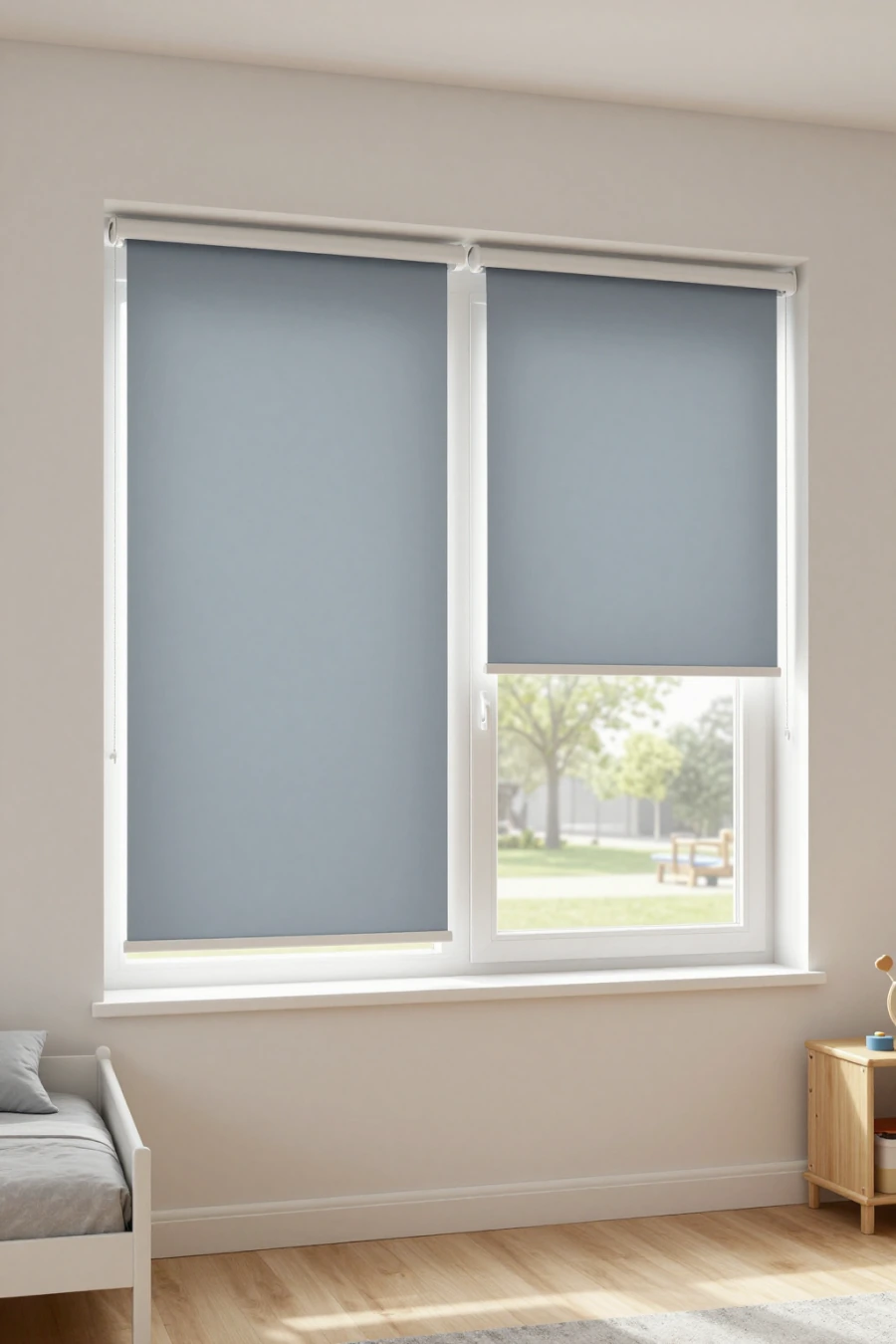











Cassette blinds in Almaty are a roller system in which the fabric tube is enclosed in a housing box and the blind moves along guide rails on the sash. The box hides the mechanism and does not darken the window: only the guide-rail profile blocks side light. Price — from 5,400 ₸ per m², measurement and consultation are free.
Cassette blinds and cassette horizontal blinds are different products
Under the name “cassette blinds” in Almaty, two different products are sold: a fabric roller system in a housing box and aluminium slats in a housing box. We manufacture the first; the second is not made at our workshop. Let us sort out what stands behind each name.
A cassette roller system is a fabric blind wound onto a tube. The tube is enclosed in a housing box, and guide rails run along the edges of the sash. This product is called both cassette blinds and cassette window blinds — the name has stuck to the roller tube design, although it has nothing to do with slats. A cassette roller system differs from an open roller system primarily by the housing box: in an open system the tube with the wound fabric stays visible, the blind hangs freely, and a strip of light passes along the sides between the fabric and the frame. In a cassette system the box hides the tube completely, and the guide rails press the blind against the glass along the edges of the sash.
Cassette horizontal blinds are a different product. Here it is not fabric on a tube that is hidden in the box, but aluminium slats: narrow metal strips that rotate around their axis and regulate the light. Many people know such systems under the name “Isotra”. Jalusso does not manufacture such cassette horizontal blinds. If you need a slat design specifically, look for it on the horizontal blinds page — it is described there separately.
By appearance, the two systems differ at once. On a cassette roller system you see a narrow box above the window, from which a single continuous blind goes down. An open roller system has no box at all — the tube with the roll of fabric is exposed, and it is visible from any point in the room. On cassette horizontal blinds, separate slats with gaps between them hang from the box.
The key difference is simple: a cassette roller system is fabric plus a housing box plus guide rails, while cassette horizontal blinds are aluminium slats plus a housing box. The difference is also visible in the darkening: a single continuous blind in guide rails covers the window differently from rotating slats.
A separate note about “iron blinds”. This is what metal slat systems are usually called — the same horizontal product, just named by material. This name does not apply to our cassette product.
Fabric in the housing box
Our system looks like this: the tube with the blind is hidden in a housing box along the top edge of the sash, and guide rails run along the side edges. The blind moves inside them and does not move away from the glass when the sash is opened or tilted.
Slats in the housing box
In a slat system the housing box does the same job — it hides the turning and lifting mechanism, only instead of a tube with fabric there are aluminium slats inside. We do not quote the price of such a cassette horizontal option here: it is not our product, and comparing it with our roller cassette by cost would be incorrect.
Under the single name “cassette blinds” in Almaty, two different products are sold — a fabric roller system in a housing box and aluminium “Isotra” slats in a housing box; we manufacture the first, the second is not made at our workshop.
What actually gives the darkening: the housing box, guide rails and cord
A cassette by itself does not darken a window. The housing box covers the tube with the wound blind — the mechanism is not visible and less dust settles on the fabric, but along the edges of the sash between the blind and the frame there is still a strip of light about a finger wide. And this is the main confusion: people order a cassette for darkness but get a neat appearance. Darkness comes from another element.
Side light gaps are removed by guide rails. This is a profile that runs along the edges of the sash and presses the fabric to the glass over the full height of the window. If the system has a guide-rail profile, the fabric moves inside the groove, there is practically no gap at the sides, and that’s when cassette blackout blinds with dense fabric really do plunge the room into darkness. Cassette day-night blinds work differently: the two-layer fabric controls how much light passes through the fabric itself, but it doesn’t remove the strip at the side — only a guide rail does that.
And now about the cord, because this is where mistakes happen most often. In compact systems the blind is guided not by a profile but by a cord — a thin thread stretched along the glass. The cord keeps the fabric straight and stops it from swinging when the sash is opened. But it does not create pressure against the frame: a gap remains between the blind and the glazing bead, and the strip of light along the edge of the window does not go anywhere. No matter how much you pay extra for dense fabric, the cord will not remove side light.
| System element | What it does | Affects darkening |
|---|---|---|
| Housing box | Covers the roller tube with the wound fabric | No: the tube is hidden, but light still comes in at the edges |
| Cord | Guides the fabric along the glass and holds it when the sash is opened | No: a gap remains along the edge |
| Guide rail profile | Presses the fabric against the glass along the full height of the sash | Yes: it eliminates side light bleed |
| Fabric (textile) | Determines how much light passes through the fabric itself | Partially: without a guide rail, the edges still let light through |
Another point I see at measurements all the time: the housing box and the guide rails serve different purposes, and they shouldn’t be confused. The housing box is about appearance and protecting the fabric. The guide rail is about light. So the question “will your cassette give complete darkness” is better phrased as: “will the system have a guide rail profile or just a cord”. The answer to that determines the result.
The housing box covers the roller tube but doesn’t darken the window; side light bleed at the edges is eliminated only by the guide rail profile, while the cord merely holds the fabric along the glass and leaves a gap at the edge.
UNI 1, UNI 2 and mini cassette: which system to choose
We make cassette roller blinds in three versions: UNI 1, UNI 2 and mini cassette. The difference between them is not in the fabric, but in how the fabric is held against the glass and which housing box will fit your sash.
UNI 1 is a compact cassette that mounts on the glazing bead, and the fabric runs along a cord against the glass. This system is the thinnest of the three, and that’s its main advantage on narrow windows: the sash opens and tilts together with the housing box, and the fabric moves with it. But UNI 1 has its own feature that few mention at the measurement: cassette blinds for plastic windows with this cassette work neatly and predictably, but you shouldn’t expect complete darkness from them — the cord holds the fabric against the glass, but a gap remains along the edge.
UNI 2 holds heavy fabric with a guide rail profile. The cassette is wider, the guides are not a cord but a rigid profile, and only with it does blackout truly darken the room: the profile presses the fabric against the glass along the entire edge. If your goal is to block morning light in the bedroom or make it dark in the kids’ room during the day, the choice ends with UNI 2.
The mini cassette is a reduced housing box for narrow sashes and windows with a small glazing bead. It’s installed where a standard cassette hits the window handle or doesn’t fit in the depth of the rebate. In my opinion, this is the most underrated option: customers usually don’t know about it and are surprised at the measurement that a window that “clearly isn’t for a cassette” can still be covered.
| System | What guides the fabric | Darkening | When we choose it |
|---|---|---|---|
| UNI 1 | Cord along the glass | Partial | Narrow windows where a thin housing box matters |
| UNI 2 | Guide rail profile | Complete with blackout | Bedroom, kids’ room, the task of darkening |
| Mini cassette | Reduced housing box on the glazing bead | Depends on the guide rail | The handle hits it or there’s not enough rebate depth |
Does the housing box interfere with opening and tilting the sash? The cassette system mounts on a tilt-and-turn sash, the housing box and guide rails move with it, so the window opens and tilts as usual, and the fabric stays in place. That’s why we don’t recommend installing a cassette over a sash with a screen without checking the rebate.
So it comes down to this: UNI 1 mounts on the glazing bead and guides the fabric along a cord, UNI 2 holds heavy fabric with a guide rail profile and only with it does blackout truly darken, and the mini cassette is chosen when the standard one hits the handle or doesn’t fit in depth.
We check your window before the measurement: glazing bead, handle, sash, screen
Cassette blinds for plastic windows don’t fit every sash the same way, and this is visible before the technician arrives. Look at your window yourself — four signs will tell you whether there’s enough room for the housing box, whether it will hit the handle, and whether the mosquito screen will interfere. The measurer arrives with samples and calculates the cost on site, but a home check saves time: sometimes a person waits for the measurement, and the system simply doesn’t suit their window due to the rebate depth.
- Glazing bead. The glazing bead is a narrow strip that presses the glass unit against the frame from the inside. The cassette mounts on brackets into it, so what matters is not the width of the strip but how much it protrudes and whether there’s a free groove behind it. If the glazing bead is narrow or flush with the frame, there’s nothing to attach the housing box to, and a mini cassette with a reduced housing box is needed. Visually it’s like this: if a fingernail goes under the edge of the strip, there’s room; if it doesn’t go under anywhere, we’ll show you the options at the measurement.
- Window handle. The protrusion of the handle limits cassette installation: the housing box runs along the top of the sash, and if the handle sits high and close to the rebate, it will cover it. Check how many centimeters remain from the handle to the top edge of the sash — that’s enough for a preliminary conclusion. When there’s little room, we shift the housing box down or choose a system with a lower profile height.
- Sash type. A tilt-and-turn sash is the main scenario for a cassette system: the housing box and guide rails mount directly on it, the window opens and tilts together with the system, and the fabric stays in place. A fixed sash also works, but there the cassette mounts on the frame, not the sash, and it doesn’t need to be opened. A cassette also fits a balcony door — by the same logic as on a sash.
- Mosquito screen. The screen affects compatibility with a cassette system: if it’s on the sash on the inside, the guide rails may hit its frame. At the measurement we check whether the screen can be removed for the summer or can stay in place. More often the issue is solved by the installation order, less often by moving the guide rail.
The measurer checks the rest on site: rebate depth, frame evenness, gaps. In my opinion, it’s more honest to show a person the housing box on their window and immediately say whether the system will fit or another option is needed, than to sell over the phone and sort it out during installation. That’s how we work with any window — from a kitchen sash to a balcony unit.
Drilling, adhesive installation and a south-facing window
Cassette blinds for windows are usually installed without drilling into the frame. The housing box sits on brackets in the glazing bead, and the guide rails are attached with mounting tape along the edges of the sash. The frame stays intact, and the system is held by the same window elements as the glass unit. That is exactly why a cassette can be installed in a rented apartment without worrying about what the owner will say.
But adhesive installation is not universal. Guide rails on tape work as long as the surface underneath is even and the load is moderate. If the blind is heavy — a large blackout, dense day-night fabric on a wide sash — the tape holds worse, and then we switch to mechanical fastening. We do the same when the window is a non-standard width: there simply isn’t enough contact area for adhesive fastening.
When mechanical fastening is needed:
- the system is heavy: blackout or dense fabric on a wide sash;
- the window is a non-standard width, and the guide rail doesn’t have enough support area;
- the glazing bead is thin or the surface under the tape is uneven;
- the window faces south and is in direct sunlight.
A south-facing window in Almaty is a separate conversation. Summers here are hot and sunny, the frame heats up, and the adhesive layer on a warmed surface behaves differently than on a shaded sash. After a couple of summer seasons the tape can shift, the guide rail starts to come away — and the blind stops pressing against the glass exactly where it’s needed most. On the south side we check the fastening separately and, without hesitation, suggest drilling if we see a risk. This doesn’t weaken the frame: the holes go into the glazing bead or the profile along the edges of the sash, not into the glass unit.
In a project with south-facing panoramic glazing, we planned for mechanical fastening from the start: the blind area is large, the frame heats up noticeably in summer, and a taped system would have had to be rehung after the very first season. Mounting to the frame is more reliable and calmer in such cases — both for us and for the client.
Mounting tape is suitable for light blinds on sashes of moderate width; a heavy system, a non-standard width and a south-facing window in Almaty require mechanical fastening, and our measurer determines this on site.
Fabrics: blackout, day-night and what to choose for a child’s room
Yes, cassette blackout blinds exist — a blind made of dense, light-blocking fabric is fitted into the same cassette as a regular one. But dense fabric alone doesn’t darken a room. Blackout in a cassette only darkens together with a guide rail profile: without it, light strips remain along the edges of the window, and you won’t feel any difference from an ordinary curtain. This is the main thing to understand before choosing a fabric. Guide rails remove side light along the edges of the window, and only on top of that does the density of the blind do its work.
Cassette day-night blinds are built differently: the fabric is two-layered, made of alternating opaque and sheer stripes. By shifting the layers you control how much light passes through — from diffused in the daytime to almost fully blocked. This fabric is good where you need controlled light rather than darkness: living room, study, kitchen. For a bedroom with morning sun, a two-layer fabric is usually weaker than blackout.
Now about the child’s room. The choice here is not between fabrics but between systems — with or without a profile. Take the same dense darkening fabric in an open roller system: the blind hangs freely, a strip of light a finger wide passes between it and the frame, and during the day the child will wake up from that strip. In a cassette with a guide rail profile, the same material holds the edge of the blind in the groove, and daytime naps happen in darkness.
An example from practice: a client came to us with the task of darkening a child’s room where a dense roller blind with an open roller tube was already hanging — replacing the fabric with a denser one turned out to be pointless, because the side light wasn’t coming through the blind but along its edge. A cassette system with a guide rail profile solved the problem.
The price of cassette blinds is from 5,400 ₸ per m², and measurement and consultation are free.
The guide rail profile is the only element of the system that turns blackout fabric into a truly darkening one: the material itself sets the density of the blind, but only the profile blocks light along the edges of the window.
How much cassette blinds cost and what’s included in the price
Cassette blinds in Almaty start from 5,400 ₸ per m². This is the price for the assembled product, not for the fabric alone: it already includes the housing box, guide rails, roller tube, blind and brackets. The exact amount is calculated by the measurer on site, because it depends on the area of the sash and the chosen system.
A cassette is about a quarter more expensive than an open roller blind. In the calculator, the cassette system is applied as a coefficient of 1.28 to the base price — this is not our markup but a difference in construction.
What’s included in the price:
- the housing box, which covers the roller tube with the wound blind;
- guide rails along the edges of the sash;
- brackets for mounting the housing box;
- fitting the blind to the specific sash;
- measurement and consultation are free — the measurer comes with samples and calculates the cost on site.
An open system is cheaper precisely because half of this list isn’t in it. No housing box. No guide rails. The measurer doesn’t need to measure the sash to the nearest millimetre so the blind doesn’t catch on the guide rail. That’s what you pay for.
Installation costs 4,500 ₸ per product. For orders from 150,000 ₸ we install for free. If you have two sashes in the kitchen and one in the bedroom, the order easily crosses that threshold, and installation effectively costs nothing. It’s better to calculate this at the measurement stage, not after signing — that way you see the final amount in advance instead of adding it up from parts.
With an electric motor, control is handled by a 220 V motor or a battery: you can raise the blind with a remote control without going up to the window. Such a system costs more than a mechanical one, and the extra cost here is for the mechanism, not the fabric — the blind remains the same as in the manual version. For tall windows and shopfronts, this is often the only way to operate a cassette without a stepladder.
You can only buy cassette blinds from us after a measurement: we don’t keep ready-made units in stock, and the price is calculated from the price list once the measurer has seen your sash and gives you the final amount. The bottom line: 5,400 ₸ per m² is the price of the cassette itself, the coefficient 1.28 shows how it differs from an open system, installation adds 4,500 ₸ per unit and drops to zero from 150,000 ₸, and the electric motor is a separate line in the price list that raises the cost of the system.
How we work: measurement, workshop, installation, warranty
You can order cassette blinds in Almaty from us only by measurement — there are no ready-made products in stock, and every system is made for a specific sash. We are a manufacturer with our own workshop, so the window goes from calculation to installation within one company, without intermediaries.
Here’s how it works.
- You write to us on WhatsApp, describe the window and send a photo. That’s enough to understand in advance which system will suit.
- The measurer comes with samples of fabrics and systems, checks the glazing bead, the handle projection, the type of sash and the mosquito net. Measurement and consultation are always free.
- We calculate the cost on site, according to the price list and coefficients. Within the city, measurement and delivery are free.
- The workshop manufactures the system to your dimensions, after which the team installs it on the sash.
The suburbs are a separate story. We travel to Kaskelen, Talgar, Issyk and Kapshagay, but the cost of the visit depends on the distance and is quoted before the visit, not after. No surprises in the bill.
An already-hanging open roller blind cannot be converted into a cassette one. These are different constructions: a cassette has a different roller tube, different brackets and guide rails. The blind from an open system can sometimes be reused if the dimensions match, but more often it’s easier to order a complete cassette — otherwise the savings are questionable.
From the moment the acceptance report is signed, the warranty is 1 year on installation and 3 years on the mechanism. If a case is recognised as a warranty case, we do the work free of charge — within 5 working days at most. When the warranty on cassette blinds has already expired, we still come: we tighten the mechanism, adjust the travel, replace the chain or cord. The warranty does not cover damage from impact, re-hanging by yourself, water damage or fabric fading in the sun.
A real-world example
A kitchen window with a tilt sash is the most common situation our customers come to us with. In an open system the fabric hangs loose and flaps against the frame when you air the room. In a cassette system the housing box and guide rails are mounted directly on the sash, so the window opens and tilts together with the system, and the fabric stays in place. This is checked during the measurement: the measurer looks at how far the handle sticks out and the depth of the rebate, and tells you whether the cassette will fit without any modifications.
We make cassette blinds in Almaty to measure in our own workshop, and the warranty covers the mechanism for 3 years.
Care, the kitchen, and when a cassette isn’t needed
The housing box comes off the brackets without any tools. That’s the first thing to know about care: fabric in a closed cassette is no harder to look after than in an open system. You take the box off by hand, unroll the fabric all the way and go over it with a dry brush or a vacuum cleaner on the lowest power. Dust hardly gets inside the box — that’s its advantage over an open roller tube, where the fabric hangs in plain sight and collects everything that flies in from the street.
In the kitchen, a closed cassette stays noticeably tidier than an open roller system. Steam and grease settle on the housing, not on the roll itself: the roller tube is hidden, and the fabric doesn’t soak up kitchen grime. The housing just needs a wipe with a damp cloth. But there’s a catch: if the kitchen is small and the window is right next to the stove, grease will still find its way to the guide rails along the edges of the sash — you’ll have to wipe them more often than the box. From experience, the guide rails in a kitchen are the dirtiest part of the system.
And when isn’t a cassette needed? That happens too.
- A fixed window with no opening sash. The guide rails hold the fabric in place when the sash opens — if the sash doesn’t move, that function simply doesn’t work, and paying extra for a cassette doesn’t pay off. An open roller system is enough.
- A window that’s almost always closed, with no ventilation. In a cassette, the fabric is pressed against the glass by the guide rails. If you don’t need to tilt the sash, a design with guide rails gives you less than it costs.
- Windows where the look of the roll from outside matters more than light gaps. To be honest here: some people simply prefer the look of an open roller system, and there’s no point arguing with that.
Cassette roller blinds in the kitchen and in rooms with opening sashes perform exactly where they’re meant to. The main fact about care: the housing box hides the fabric roller, so the fabric inside barely gathers dust and doesn’t build up grease in the kitchen, and all the cleaning comes down to taking off the box and wiping the fabric dry.
FAQ
Which housing box colour should you choose for a white, laminated or dark window profile?
We match the housing box to the window profile, not to the room’s interior. A white profile gets a white box, a wood-effect laminate gets one that matches in tone, a dark profile gets a dark one. Cassette blinds in a closed housing box are almost invisible on the window, and matching them to the profile makes them even less noticeable. If the profile is a non-standard shade, the measurer brings samples along and the decision is made on the spot. I’ll say more: the colour of the housing box is the last thing to worry about when ordering. The design matters more.
Can an existing roller blind be converted into a cassette one?
No, and it’s not a question of wanting to. A cassette roller system differs from an open roller system in its roller tube, its brackets and its guide rails, which an open blind doesn’t have at all. The fabric can sometimes be reused if the dimensions match the new cassette, but in most cases it’s easier to order the whole system. The old mountings on the frame are removed in the process.
Can a cassette be fitted to a fixed window and to a balcony door?
Yes, it can be fitted to both. On a fixed window a cassette is even easier to fit: the sash doesn’t open, so nothing gets in the way of the box and guide rails. On a balcony door the system is mounted the same way, and the fabric doesn’t catch on the threshold as it moves. The only thing the measurer checks on site is where to bring the control out.
And if the window is tall? An electric motor controls the cassette system from a remote, and you don’t have to reach for the chain.
You should only buy cassette blinds after a measurement: the sash, the glazing bead and how far the handle sticks out determine which system will fit your window.
Conclusion
Cassette blinds in Almaty are a roller system in which the fabric roller is covered by a housing box and the fabric runs along guide rails on the sash. The box hides the mechanism but doesn’t darken the window: the side light gaps at the edges are removed only by the guide rail profile, not by the box itself. That’s the main thing to take away from this article.
Next are four points that decide the choice.
First. Under the name “cassette blinds” two different products are sold: a fabric roller system in a housing box and aluminium “Izotra” slats in a box. We don’t make cassette horizontal blinds on slats; cassette roller blinds we manufacture in our own workshop.
Second. How much it darkens depends on the type of guide rail. The cord in UNI 1 holds the fabric along the glass but still leaves a gap at the edge. The profile guide rail in UNI 2 removes the side light gap, and only with it does blackout fabric give you real darkness. Buying dense fabric for a system without a profile is money down the drain, in my view.
Third. A cassette system is mounted on a tilt-and-turn sash: the box and guide rails go directly on the sash, the window opens and tilts together with them, the fabric stays in place and doesn’t flap when you air the room. For a kitchen with a tilt sash or a balcony that’s opened all day, this is the main reason to go for a cassette.
Fourth. Before the measurement you can check the window yourself: look at the glazing bead, how far the handle sticks out, the type of sash and the mosquito net. If the glazing bead is narrow or the handle presses against the box, a mini cassette with a smaller box is selected.
The practical recommendation is simple. Tell us the width and height of the sash and the type of opening, and show us a photo of the window — the measurer will come with samples of UNI 1, UNI 2 and the mini cassette, hold them against your glazing bead and work out the price on the spot.
Cassette blinds in Almaty cost from 5,400 ₸ per m², and the cassette system carries a coefficient of 1.28 to the base price. Measurement and consultation are free.

