


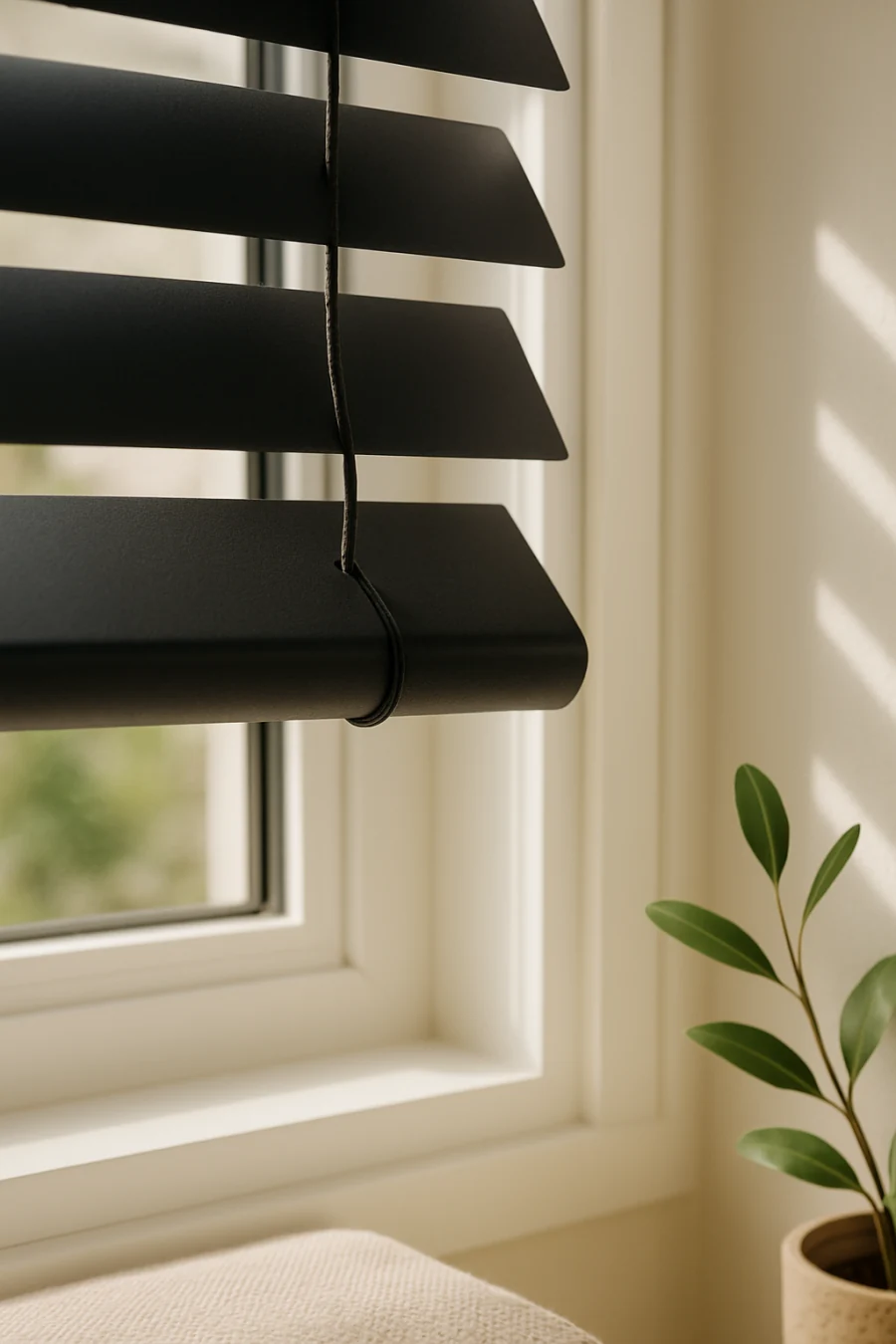






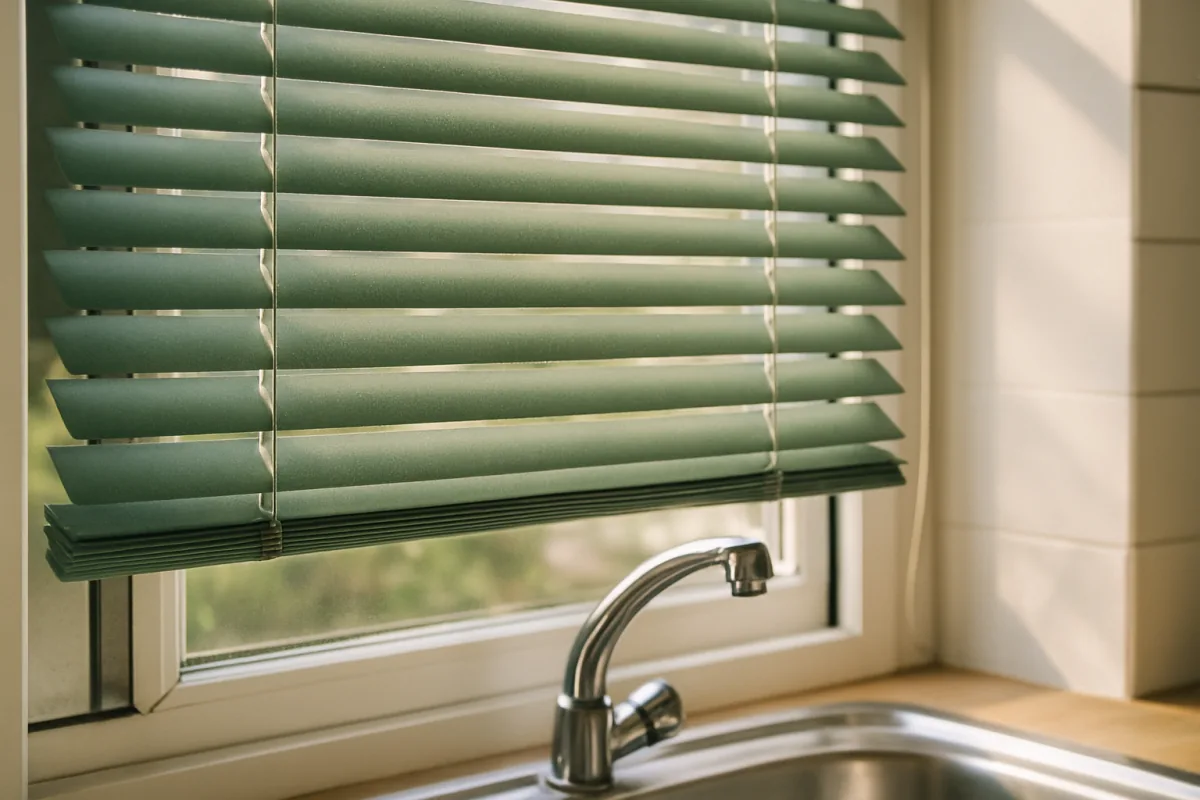











We make green blinds to measure in Almaty: aluminium, PVC and fabric — from muted sage to rich emerald. The same shade reads differently on metal and on fabric, and on the south side a saturated fabric lightens over time. Our measurer comes with samples free of charge.
Which shade of green to choose and what it depends on
Choosing the shade of green blinds depends on three things: which way the window faces, the slat material and whether you want the window to be a background or an accent. You can’t choose a shade from a phone screen. The same sage tone looks light and warm on a sunny window, while in a room on the north side it turns grey. That’s why our measurer comes with fabric and slat samples, and the colour is viewed in the light of your particular window, not in a showroom. Measurement and consultation are free.
Which way the window faces really does determine which shade and which material will suit. On the south and west, a saturated tone on fabric lightens over time — we’ll say so honestly in the section about the sun. In the soft light of the north and east, green reads evenly and calmly.
The slat material changes everything. Powder coating on aluminium gives a sheen, and the colour on metal seems brighter than on fabric. PVC is matte and softer in tone. Fabric lightens when backlit and tints the passing light green — this is noticeable on white walls. That’s why green blinds are ordered by sample: there’s almost always a difference between the screen and the window.
Why is green chosen most often? It gives the room calm and doesn’t clash with wood and plants. It’s not so much “the effect of colour on the psyche” as simple interior logic: a muted shade doesn’t clash with wallpaper, furniture and plants, while a saturated one becomes a focal point the eye is drawn to.
- Sage — the most neutral, almost grey-green. Good on small windows and in bright rooms.
- Olive — warmer, with a yellow undertone. Holds its own next to wood and warm textiles.
- Grey-green — restrained, appropriate for an office and a kitchen.
- Emerald — rich, cool. For an accent.
- Dark green — deep. Gives dense shade on the window.
The exact price range is given by the measurer on site, because the shade and material are calculated together with the window size. The main thing is not to choose a tone from a picture: look at a sample in your own room.
Muted shades
Sage, olive and grey-green are chosen when the window should remain a background. They don’t clash with wallpaper, furniture and plants and work calmly in a small room. A muted tone forgives a mistake in the wallpaper shade — a saturated one doesn’t.
Saturated shades
Emerald and dark green — when the window becomes an accent. On a wide opening such a tone anchors the room, on a narrow sash it can overpower. Choose a saturated one if the walls and furniture are neutral.
How the shade reads in different rooms
For a bedroom, green blinds in Almaty are chosen in muted tones: a calm shade doesn’t interfere with rest. For a kitchen, a slat is more practical than fabric, and the tone is matched to the cabinet front. For a kids’ room — something in between: not dark and not acid-bright. What’s appropriate in each room is decided using samples in the light of the window.
How green aluminium differs from green fabric
The same green shade looks different on aluminium, PVC and fabric. An aluminium slat 25 mm goes through powder coating: the surface gets a slight sheen and holds the tone evenly, without iridescence, in any light. A PVC slat 25 mm is matte and a little softer in colour, because plastic doesn’t reflect light the way metal does. Fabric behaves differently: it lets light through and lightens when backlit, and the light passing through the green weave tints the room greenish. In a kitchen this is immediately noticeable — a white worktop and hands look greener in such light than with the blinds down.
Green fabric blinds in Almaty give soft diffused lighting that a slat can’t provide. Hence the difference in tasks: where an even tone and rigid geometry are needed, aluminium or PVC is chosen; where smooth light adjustment is needed, fabric.
Table: one tone in three materials
| Material | How the surface looks | What happens to the light | Where it works well |
|---|---|---|---|
| Aluminium slat 25 mm | Slight sheen, even tone | Reflects light, lets it through at the edges | Kitchen, balcony, living rooms |
| PVC slat 25 mm | Matte, slightly softer in colour | Reflects light, diffuses it slightly | Bathroom, kitchen, kids’ rooms |
| Fabric | Matte, with a weave | Lets light through, lightens when backlit, tints the light | Bedroom, living room, office |
When a neutral base is better
If you’re unsure about the shade, it’s wiser to go with a calm tone and add green through textiles — curtains, cushions, plants. In my view, that’s the safest route for a room where the colour of the window may get tiresome faster than the furniture. Green blinds are a decision for years, while changing a sofa cover is easier than reordering a fabric. And one more thing: a shade only shows its true colour in your own light, so we look at samples on site — our measurer arrives with slats and fabric, and the shade is compared with the wallpaper and furniture right in the room.
Powder coating on aluminium gives a sheen and holds its tone evenly, while fabric lightens when backlit and tints the light passing through it with a greenish hue.
The Almaty sun: how the side of the building changes your choice
The side of the building determines how long green keeps its tone. Summer in Almaty is hot and sunny, winter is cold with frosts and a big temperature swing between day and night, and there’s plenty of dust on windows all year round. The window endures all of this: the slat and the fabric sit under ultraviolet light all day long, and on the south side the load is at its maximum. The difference between south- and north-facing windows shows not in the shade itself, but in how soon it starts to shift.
South and west
Saturated fabric on the south and west sides lightens over time. This isn’t a defect: the pigment reacts to ultraviolet light, and the warranty doesn’t cover natural fading of fabric — it covers the mechanism and installation, not the colour. We give a three-year warranty on the mechanism and one year on installation from the date the acceptance report is signed, and faded fabric isn’t on that list — we say this honestly before the measurement, not after.
What to do about a south-facing window? A sun-protective treatment on the fabric slows fading, but doesn’t stop it. A slat is more reliable: aluminium and PVC don’t fade to white the way fabric does, though on a bright side any colour lightens over time. That’s exactly why the slat material for a south-facing window is chosen on this basis.
North and east
On the north side, green won’t make a room cold and dark. Soft light without direct heat reads muted shades — sage, olive, grey-green — evenly and calmly, and rich emerald looks deeper in that light than it does in the sun. The rule is simple: the less direct heat, the more freely you can go with a saturated tone, and the lower the risk that it will shift within a year.
East sits in the middle: the morning sun hits the window, but only briefly, and fabric on the east side holds up noticeably longer than on the south. For an east-facing bedroom window, people often choose day-night blinds — the light is adjusted smoothly, they don’t give full darkness, and the fabric is more often out of the direct stream.
My advice from experience: if the window faces south or west, don’t commit to a saturated fabric tone. Go with a slat or add green through textiles, and put a muted option on the window.
Bold or calm: a green window next to furniture and wallpaper
It’s contrast, not colour, that makes a window look bold. Muted green — sage, olive, grey-green — sits calmly against neutral walls and wood. But bright emerald next to patterned wallpaper or colourful furniture starts to clash with them. And note: dust shows more on a dark green slat than on a light one. That’s not a downside of the colour, but a feature of the surface.
Before you take samples, look at the room as a whole. How many active spots are there — a pattern on the walls, colourful textiles, bright furniture? If there are at least two, it’s better to choose a green window in a muted tone, or leave green to the textiles and plants and pick neutral blinds.
Green and wood
Warm wood furniture and parquet almost always go with green. The reason is simple: in nature, leaves and trunks stand side by side, and the eye is used to that pairing. Olive and sage against oak or walnut read as a continuation of the interior rather than as a separate bright object. Rich emerald on warm wood looks more contrasting — that’s already an accent, and it’s worth checking on a sample in your own lighting.
Green and a white plastic window
A white frame and windowsill create a cool contrast, and green against them can look sharper than it does on the wall. There are two ways to neutralise this. First — go with a muted grey-green, which is closer to white in calmness. Second — add another green element to the room: textiles, ceramics, a plant. Then the window stops being the only spot of colour.
Green and plants on the windowsill
Live leaves on the windowsill set the tone, and it’s convenient to start from there. A simple rule applies: choose blinds a shade darker or lighter than the foliage, but not the exact same shade. A direct match looks flat — the leaves and the slat blend together, and the green stops reading. If the plants on the windowsill are large and dark, it’s better to keep the window lighter; if the foliage is small and light, a dark green slat will give the depth you need.
Dark green can go in a small room, but with a caveat: it works as an accent, not as a background. On a small window, a saturated tone takes up a lot of visual space and makes the room feel tighter; a muted one in the same dimensions doesn’t. In a small room, green wins when there are few other strong spots around.
The takeaway is simple: muted green sits calmly against neutral walls and wood, and a dark green slat shows dust more than a light one.
What blinds come in green: materials and designs
In green, we make horizontal aluminium and PVC blinds, vertical fabric slats 89 mm, day-night blinds and horizontal blinds with an electric motor. Everything is made to measure — there are no ready-made items in stock.
The list of designs isn’t random: the choice starts with the question “what kind of window is it”, not “what shade”. A kitchen window above the sink and a panoramic opening in an office require different materials, and green doesn’t change that — only the tone does.
Horizontal aluminium and PVC
We make horizontal blinds in green from aluminium slats 25 mm and PVC slats 25 mm. Aluminium doesn’t mind moisture and steam, can be washed right on the window, and the green tone holds for years. PVC is cheaper, the slat springs back and doesn’t crease when touched, and it handles water just as calmly. Both options are installed in kitchens, on balconies, in bathrooms and kids’ rooms.
What’s better for a kitchen — green aluminium, PVC or treated fabric? If the window is next to the stove or sink, a slat is more reliable: grease doesn’t cling to it, and you don’t need to take the fabric down to wash it. Green aluminium will last longer, green PVC will cost less — according to the price list, plastic from 3,600 ₸/m², aluminium from 4,200 ₸/m². Treated fabric in a kitchen is also possible, but only if the window isn’t right next to the hob: you’ll have to clean it with a sponge without soaking.
Vertical fabric slats 89 mm
Vertical blinds in green are fabric slats 89 mm wide. The fabric covers a panoramic window or a partition from edge to edge without breaking up the room with frequent seams. A soft green tone gives even, diffused light, which is why vertical blinds are more often chosen for balconies with wide glazing and for offices.
Window width matters more than colour here. On a one-metre opening, a 89 mm slat reads as an almost solid fabric, while on a three-metre one it already reads as verticals with air between them. And the same green will look different on each window: denser and darker on a narrow one, lighter on a wide one. This is one of the reasons the shade is checked on a sample at your own window, not from a photo.
Day-night and electric motor
Jalusso makes day-night blinds from a two-layer fabric: alternating opaque and sheer stripes are shifted with a chain, and the light changes smoothly, without complete darkness. The green shade stays even across the full width — the stripes don't break it into different tones. This design is chosen for bedrooms and living rooms.
The electric motor runs on a 220 V mains supply or a battery and is controlled by remote, smartphone and schedule. The slats tilt and rise hands-free — handy on a high window, a stairwell opening or a shop window. Manufacturing time with a motor is 7–10 days versus 3–5 for regular horizontal blinds.
Can green blinds be made with a leaf pattern? Yes, we do photo printing on the fabric. But with green shades I'd advise against rushing: a leaf pattern over green is already a double motif, and next to live plants on the windowsill it starts competing with them. A solid fabric in the right tone reads more calmly.
In green we make horizontal aluminium and PVC blinds, vertical fabric slats 89 mm, day-night and horizontal with an electric motor — the design is determined by the window, not by the colour.
How much do green blinds cost and are they more expensive than white ones
Green blinds in Almaty cost the same as blinds of any other colour in the same design. Colour is not a surcharge, but a finish option for the same slat or fabric. Horizontal aluminium — from 4,200 ₸/m², vertical fabric slats — from 4,600 ₸/m², day-night — from 7,300 ₸/m².
More often the question isn't about the shade, but that a person compares green fabric with white aluminium and is surprised by the difference. But you need to compare the same designs: day-night fabric and an aluminium slat are different products, and their prices differ by definition.
Price table by design
| Design | Material | Price | Lead time |
|---|---|---|---|
| Horizontal blinds | Aluminium, slat 25 mm | from 4,200 ₸/m² | 3–5 days |
| Horizontal blinds | PVC, slat 25 mm | from 3,600 ₸/m² | 3–5 days |
| Vertical blinds | Fabric, slat 89 mm | from 4,600 ₸/m² | 3–5 days |
| Day-night blinds | Two-layer fabric | from 7,300 ₸/m² | 5–7 days |
| Motorised blinds | 220 V motor or battery | from 7,800 ₸/m² | 7–10 days |
The cheapest option in green is PVC: a plastic slat is not afraid of water, wipes clean with a cloth and costs less than aluminium. Aluminium is more expensive than PVC, but holds the slat's shape better. Fabric in a day-night design costs more than slats, but regulates light smoothly.
What affects the price
Controls and mounting change the total by coefficients, not by colour. A control chain raises the price by a factor of ×1.06. An electric motor raises the price by a factor of ×1.85, and electric with a remote — ×2.1.
The same logic applies to mounting: wall mounting is ×1, frame mounting — ×1.05, no drilling — ×1.1, cassette system — ×1.28. Installation itself is calculated separately: 4,500 ₸ per item, and for orders from 150,000 ₸ it's free.
The window size affects the area, and the area affects the final amount. For example: a standard window with an aluminium slat at the base price is one amount, the same window with a chain is six percent more by coefficient, and with an electric motor — almost double.
The measurer comes with samples and calculates the cost on site, before you order. Colour doesn't affect the price — green blinds cost the same as blinds of other colours in the same design.
How to match green to wallpaper, a facade and plants
The tone is matched against samples under the customer's lighting: the measurer comes with slats and fabric, and the shade is compared with the wallpaper, kitchen facade and textiles right on site. A phone screen won't do for this — on it both sage and olive look equally even.
Let's go through step by step how it works during our measurement.
Selection checklist
- Work out which way your window faces. South and west set one set of rules, north and east another; this determines which saturation is even worth looking at.
- Take samples. The measurer comes with slats and fabric and calculates the cost on site, so you get samples and a quote in one visit.
- Compare under your own lighting. Hold the slat against the wallpaper, kitchen facade, furniture wood and textiles. A muted shade doesn't compete with wallpaper, furniture and plants, while a saturated one pulls attention to the window.
- Check against the light. Fabric held against the light brightens and tints the passing light greenish — this is noticeable in the kitchen and in a room where people eat: greenish light falls on skin and food.
- Order all windows at once. Fabric batches differ in tone, and a set assembled window by window risks differing in shade.
The same principle works with a white plastic frame and windowsill: white is a neutral background, it doesn't compete with any green. It's trickier with plants on the windowsill. A live leaf is always a little more yellow or grey than a slat, so an exact match isn't needed here — it's enough that the green of the blinds and the leaves are at the same saturation. And yes, with the fabric closed in the evening, silhouettes are visible from the street, not the shade, so a residential complex facade won't look busy because of a green window.
The main rule of selection: the tone is chosen not from a picture, but from a sample under the light of a specific window, and one batch is taken for all windows.
Caring for green blinds
Care depends on the fabric material, not the colour: green blinds are washed and cleaned with the same products as blinds of any other shade. With proper cleaning the colour doesn't suffer — it suffers from aggressive chemicals, machine washing and abrasives. An aluminium slat 25 mm and a PVC slat 25 mm hold their tone for years, while fabric requires care.
Aluminium and PVC
Aluminium and PVC slats are wiped in place — with a damp cloth and a mild product. The fabric doesn't need to be removed — the slats are tilted, wiped between, and left to dry. Grease in the kitchen comes off with ordinary dish soap. A plastic slat flexes and doesn't crease when touched, while aluminium is not afraid of moisture or steam. The only thing these materials don't like is abrasive powders: they leave matte scuffs on the painted surface that are especially visible on coloured metal. For a bathroom and a kitchen above the sink, this is the most trouble-free option.
Fabric
Fabric is cleaned with a vacuum on low power with a soft brush, or with a sponge without soaking. A stain is removed spot by spot, with a slightly damp sponge, and dried immediately — if you wet the whole fabric, it shrinks and ripples. Machine washing is not allowed: it washes out the treatment, and without the treatment the fabric both fades faster and collects dust. And yes, colour behaves differently here than on metal. On the south side fabric lightens over time, and this natural fading is not a warranty case. Jalusso warns about this before ordering and uses fabric with a sun-protective treatment on sunny windows.
Green blinds don't require special colour-specific products: aluminium and PVC are wiped with a damp cloth and a mild product right on the window, while fabric is cleaned with a vacuum on low power or a sponge without soaking, because machine washing washes out the treatment.
Green in a commercial space
A commercial space demands one thing of green: it must be in the brand's palette, not live apart from it. In a coffee shop, salon or office, green blinds work as part of the brand colour — the sign, menu, walls and window read as one line rather than competing with each other. The facade won't look busy: the fabric is visible from the street, and if it matches the sign, the shop window looks put together.
Most often we install vertical blinds in such spaces. Vertical slats 89 mm cover a panoramic window from edge to edge — on a wide opening a horizontal slat would break the glass into stripes, while vertical holds the geometry as a whole. Green on verticals gives an even, soft light: during the day the room stays bright, in the evening it's closed off from passers-by.
Coffee shop and salon
In a coffee shop, the storefront window is a working surface: it has to let light through and keep the room away from prying eyes.
Here green is chosen muted — sage or olive, it doesn't pull attention away from the counter and the customers. Bright emerald on a storefront looks like advertising, and that's not always what you need. Manufacturing time for vertical blinds is 3–5 days — the coffee shop opens on the day it planned.
Office with glazing
We cover an office with glazing using vertical slats or horizontal motorised ones — the choice depends on the window height.
The electric motor is controlled by remote, from a smartphone and on a schedule: on a tall window the slats turn and rise without hands, and in the morning they open on their own by the start of the working day. Manufacturing time for a motorised option is 7–10 days. Mounting is on the wall or in a cassette system, so the blind doesn't get in the way.
In a coffee shop, salon or office, green is chosen to match the brand palette: vertical slats 89 mm hold their geometry on wide openings, and the electric motor controls tall windows without hands.
Repeat order: why a shade is ordered in one batch
We don't promise an exact shade match on a repeat order a year later — and that's more honest than promising and not delivering. Fabric batches differ in tone from order to order: the manufacturer dyes the fabric in batches, and the next batch comes with a different number and a slightly different shade. The difference can be small — on one window you won't see it, but next to last year's fabric the eye catches it at once.
That's why green for the whole home is ordered in one batch. If you're planning to cover several windows with blinds — don't stretch it over months, even when the rooms are being renovated one after another. Let the first batch include all the windows: both those ready for installation and those where the old frames are still in place.
With aluminium and PVC it's simpler: the slat is painted to a catalogue, and a repeat order of the same colour matches more precisely. But even here Jalusso advises against splitting the order — slight variations are possible between batches.
What does the measurer do to avoid this? He comes with fabric and slat samples, and goes around all the windows at once — both those you're replacing now and those you're planning. The shade is chosen once and recorded: the workshop makes the whole batch to it.
A repeat order for one more window requires ordering the whole batch at once, otherwise that window will live with its own shade.
FAQ
How a green window looks from the street — won't the building's facade look motley?
From the street you see the closed blind, not the interior, so the facade reads calmer than it seems from inside. Rich emerald on panoramic glazing really is noticeable to the neighbours, and that's worth keeping in mind if the building faces the street. Muted sage or olive almost blends with the facade. We always suggest holding a sample against the glass from outside and looking at it from the street — that way the decision is made without surprises.
How to mount green blinds on a PVC window without drilling the frame
Yes. The brackets slide into the glazing bead or clip onto the sash, and the frame stays intact. Drilling-free mounting preserves the warranty on the PVC window — an important point for rented housing and new windows under warranty. Mounting on the frame is charged at a coefficient of ×1.05, the drilling-free option — ×1.1.
Which green blinds we make with an electric motor
Yes, we motorise horizontal aluminium, vertical fabric and day-night blinds. Control can be by remote, from a smartphone and on a schedule, and we select the motor for the weight and width of the blind. The electric motor raises the price by a coefficient from 1.85, manufacturing time — 7–10 days. In a living room with a tall window, a remote instead of a cord is noticeably more convenient, and clients appreciate it quickly.
Do green blinds darken the room much during the day?
Aluminium and PVC slats close the room tightly when turned, but don't give full darkness during the day — light comes through at the edges. Day-night fabric adjusts the light smoothly, without full darkness, and blackout covers the window completely. For a bedroom, day-night is usually chosen; for an office, a slat — it removes glare from the monitor but keeps the room bright.
What about the warranty if the fabric has faded?
We give 1 year on installation work and 3 years on the mechanism; the count starts from the day the acceptance certificate is signed. The warranty doesn't cover natural fading of the fabric: on the south and west side any colour lightens over time. If a case is recognised as a warranty case, we'll repair it free of charge — that takes up to 5 working days. For sunny windows we install fabric with a sun-protective treatment from the start or suggest a slat — that way the colour lasts longer.
How much does measurement cost and how does an order start?
Consultation and measurement cost nothing — as does the visit with delivery within Almaty. The measurer comes with samples of green fabric and slats and calculates the cost on the spot: horizontal aluminium — from 4,200 ₸/m², vertical fabric — from 4,600 ₸/m², day-night — from 7,300 ₸/m². Installation — 4,500 ₸ per item, free for orders from 150,000 ₸. Colour doesn't affect the price.
Conclusion
Green blinds in Almaty cost the same as blinds of any other colour in the same design. Colour doesn't affect the price. Horizontal aluminium — from 4,200 ₸/m², vertical fabric slats — from 4,600 ₸/m², day-night — from 7,300 ₸/m². So the decision should be based on light and interior, not budget.
The same green shade looks different in aluminium, PVC and fabric. Fabric lightens when backlit and tints the passing light green, while powder-coated aluminium holds the colour densely and evenly. And on the south or west side, rich fabric lightens over time — the warranty doesn't cover natural fading of the fabric. For such windows we install fabric with a sun-protective treatment or a slat.
It's not the colour that looks motley, it's the contrast. Muted sage or olive sits calmly against neutral walls and wood, while bright emerald next to patterned wallpaper starts to clash. The shade for all windows is ordered in one batch: fabric batches differ in shade from order to order, and we don't promise an exact match on a repeat order a year later.
There's one practical recommendation. Message us on WhatsApp, call a measurer with samples and look at the shade in your own window's light. Neither the consultation nor the measurement is charged, and the visit and delivery within Almaty are free too. The measurer calculates the cost on the spot; before the measurement it's always a range — you find out the exact sum standing at your window with a slat in your hands.

