




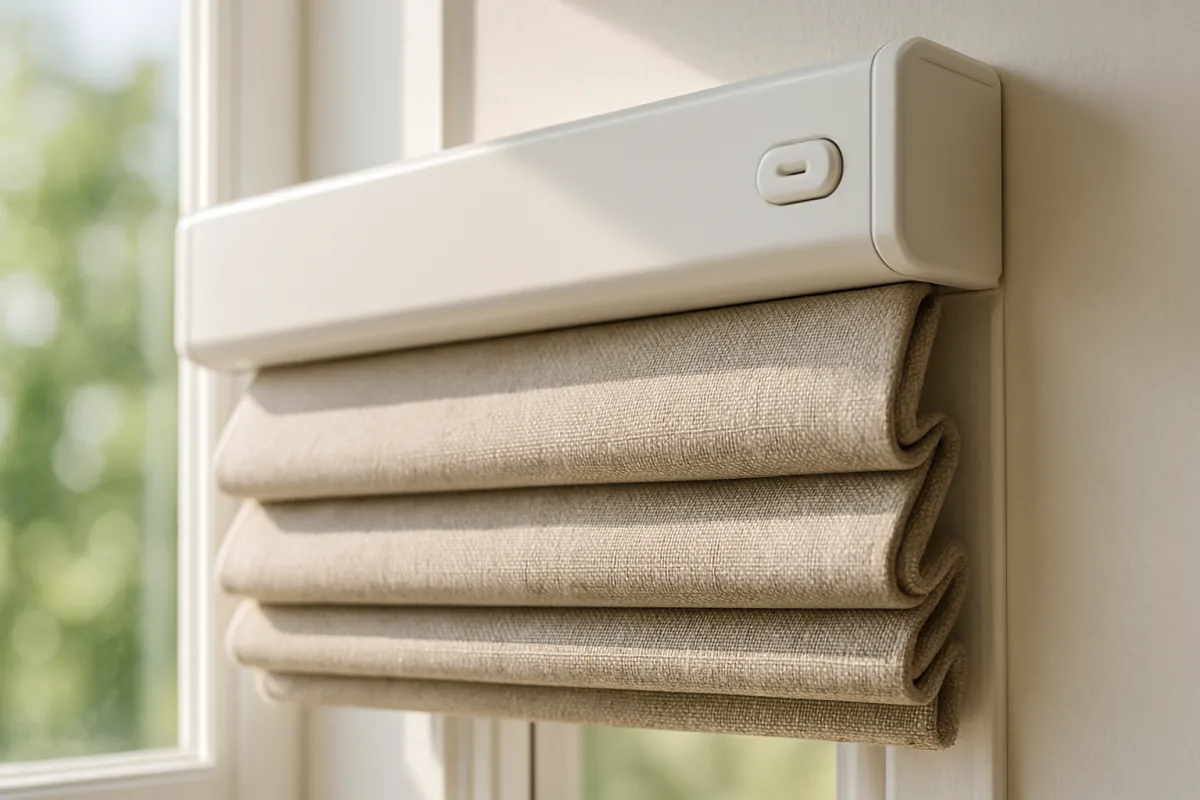
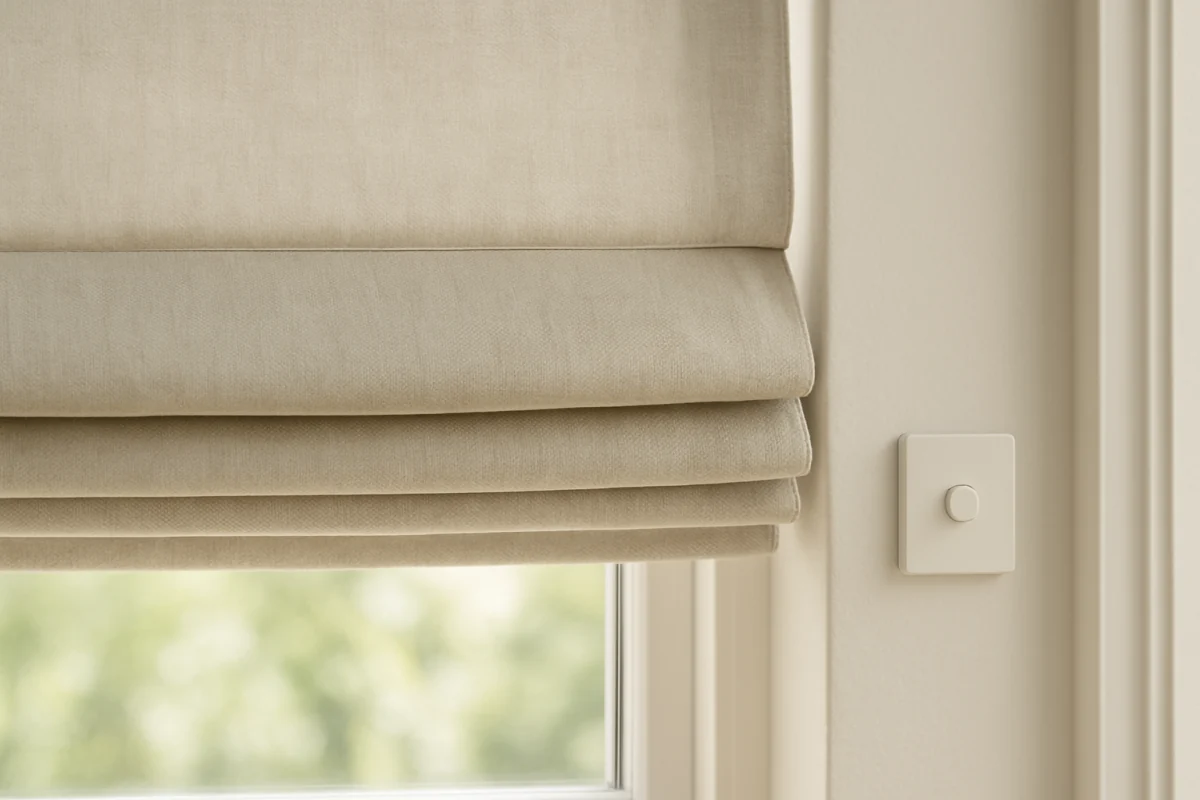
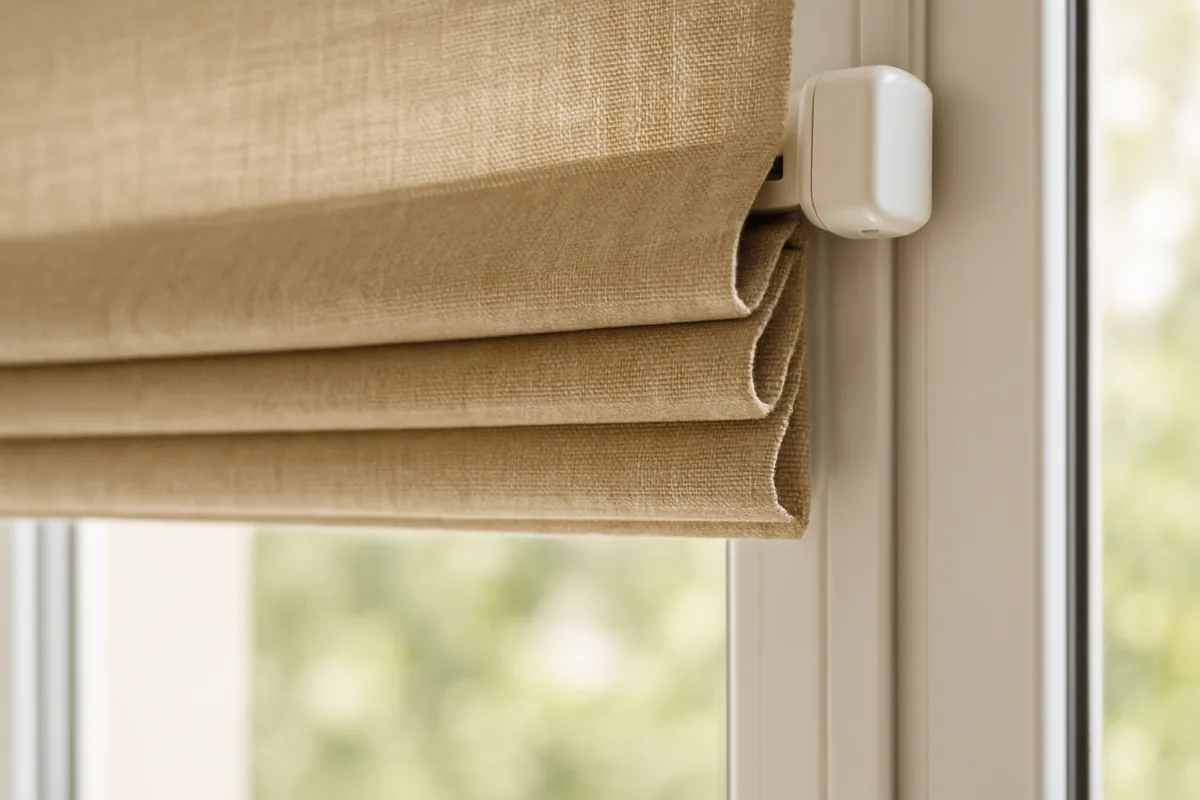
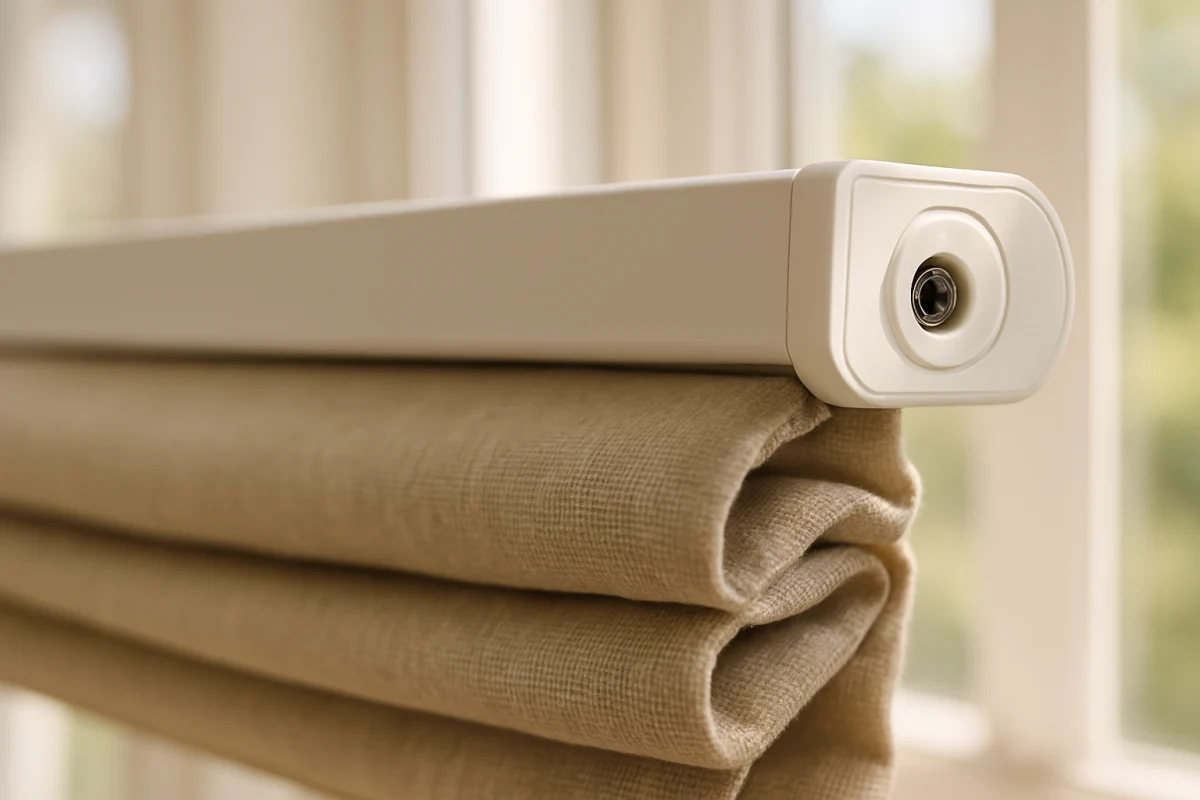









Automated Roman blinds raise the fabric folds with an electric motor in the rail — from a remote control, a button or a wall panel, without a cord or chain. We make them in Almaty to measure: the sewing base is from 8,100 ₸/m², to which a control coefficient is applied — 1.85 for the electric motor and 2.1 for electric with a remote control.
How an automated Roman blind differs from a regular one with a chain
Automated Roman blinds in Almaty differ from a regular blind in one detail — the raising is done by a motor, not by pulling a chain. The fabric is raised by an electric motor hidden in the rail: it pulls the lift tapes, and the blind folds into even pleats on command from a remote control, a button on the housing or a wall panel. The fabric for a Roman blind stays the same as for a manual model — it is the mechanism that changes, not the material.
Automated Roman blinds do not change the familiar look of a window. The fabric hangs from the rail just as on a blind with a chain, the wall or frame mounting is the same, and the pleat spacing is set to your dimensions. With a manual model you pull the chain, while with an automated one the same movement is performed by the electric motor.
What stays the same
The fabric. The pleat spacing. The frame. The mounting. Everything as on a blind with a chain. The fabric is attached to the frame with the same lift tapes, and from the outside, when the blind is lowered, you see an ordinary Roman pleat — neither the motor nor the spools show from behind the fabric.
When a chain is enough
Automation is not essential where the chain is easy to reach by hand. A low window, a window with no furniture in front of it, a windowsill at waist height — on such a window you lower and raise the blind in a couple of seconds, and a motor will not make it any easier. But if the cord hangs over a bed, over a countertop or goes up to the ceiling of a double-height space, you have to reach for it every time — then people look at an electric motor or a chain extension. In my view, an extension is a stopgap: the cord still dangles across half the room, while automation removes that hassle altogether.
| Situation at the window | What we install | Price from, ₸/m² | Lead time per price list |
|---|---|---|---|
| Low window, you can reach the chain by hand | Manual control | from 8,100 | 7–10 days |
| The same opening, but you want smooth movement | Chain | from 8,600 | 7–10 days |
| Cord over a bed or countertop | Electric motor | from 15,000 | 10–14 days |
| Double-height space, the fabric is out of reach | Electric with remote control | from 15,000 | 10–14 days |
In the lines with an electric motor, the motor is already included in the price. Mounting is calculated as a separate coefficient on the base price: on the frame ×1.05, no drilling ×1.1, cassette system ×1.28, on the wall — ×1, so the same blind in different openings will cost differently. The remote control, button or wall panel is chosen at the measurement — we don’t quote a separate price for the remote itself.
The fabric folds and the frame of a motorised Roman blind are the same as on a regular one — only the way it's operated changes.
How a motor raises a Roman blind if it doesn't roll onto a tube
A Roman blind is raised by tapes, not by winding the fabric onto a tube. The lift tapes are sewn along the back at equal distances from each other, pass through rings and go inside the electric rail for Roman blinds. There they wind onto spools — one for each tape. The motor turns the spools in sync, the tapes shorten, and the fabric gathers into folds. The fabric stays hanging on the rail and doesn't wind anywhere. That's exactly why motorised Roman blinds in Almaty look the same when raised as manual ones — the same even bands of fabric.
The mechanism doesn't have many parts, but each one affects how it runs:
- Lift cords — they carry the weight of the fabric and determine how evenly the folds lie. Their number depends on the width of the blind.
- Spools inside the rail — the tape winds onto them when raised. They're driven by a single motor.
- Fold spacing — the distance between the rings. It determines how many folds gather when the blind is raised.
- Fabric weight — the load on the motor. The heavier the fabric, the higher the demands on the drive.
Why a Roman blind needs its own drive
A roller blind motor turns the tube that the fabric itself winds onto. A Roman blind doesn't use a tube for the fabric at all — there's nothing to turn. Here the motor drives the spools with the tapes, and whether the folds lie evenly or skew depends on how well their rotation is coordinated. A roller system drive doesn't fit a Roman blind by design, so the electric rail for Roman blinds is selected separately — taking into account the width and weight of the fabric.
What happens if the fabric goes unevenly
An edge caught in a fold stops the movement: its tape tightens more than the others, and the fabric skews. It's exactly the same situation with fabric that's too heavy for a weak motor — the folds lie skewed instead of in an even accordion. On site, the measurer checks the weight of the fabric, the width and height of the window so the mechanism can handle the load. By the way, if you change your mind about the motor, a regular blind with a chain works on the same tape system — the only difference is that the tapes are pulled by hand.
A Roman blind is raised by tapes that wind onto spools inside the rail, not by winding the fabric onto a tube as with a roller blind.
Motor power: do you need a socket by the window and what to do if the renovation is already finished
The motor needs power — from the mains or from a battery — and that determines whether the wall has to be touched. A socket right by the window isn't essential. The measurer chooses the option on site: they look at what stage the finishing is at, where the line runs, and only then name the configuration. We make motorised Roman blinds by measurement precisely because power isn't a standard solution but part of the design of a specific window.
The choice is simple. If the renovation is still ahead, it makes sense to run the cable to the rail in advance — it's cheaper and neater than going back to a finished wall. If the renovation is finished and you can't chase the wall, the rail is supplied with a removable battery: it attaches to the rail, and no cable is run to the window at all. Both options work; it's only a question of how convenient they are to maintain.
Renovation ahead: where to run the cable
The cable to the rail is run before the finishing stage — then it's hidden behind the fabric or laid in a cable channel, and nothing extra is left on the wall. Mains power at 220 V connects here without any caveats.
The measurer looks at the connection point together with the window dimensions. It's one visit: they take the measurements, check where the line comes out, and calculate the cost on site. If the finishing is already underway, we can usually agree on the cable outlet before the wall is closed up.
Renovation finished: battery
The removable battery attaches to the rail, and no cable is run to the window — the wall doesn't need to be opened up. There's no need to chase a finished renovation.
How often it needs charging depends on the motor model: one version holds its charge longer, another less. The measurer gives the specifics on site and shows how the battery is removed. In homes where the power goes out often, this is also worth discussing before ordering — the drive does have a manual mode, but the procedure differs from motor to motor.
The measurer chooses the power option on site — mains cable if the finishing is still ahead, or a battery if a finished wall can't be chased.
What happens during a power cut: manual mode and emergency lift
Most electric drives for Roman blinds have a manual mode — the fabric can be raised or lowered without electricity. The exact procedure depends on the motor model, and the measurer demonstrates it on a sample. There's no single universal instruction here, and that's more honest than promising a rescue button on every blind.
Manual mode lets you raise the blind during a power cut, but it works differently: on some models you pull the lift tape, on others there's a lever on the housing, on others the fabric is moved by hand while holding the folds. Jalusso doesn't recommend pulling on the fabric itself: the lift tapes are a delicate mechanism, and a jerk can throw off the fold spacing. On a sample, the measurer shows exactly the procedure that suits your model.
A tall window calls for a motor or a chain extension — this is where manual mode helps most often. You can't reach the chain in a double-height room, while a motor raises the fabric at the push of a button; when the power is out, you can still reach the lever or the tape, because the rail stays within arm's reach. And in emergency mode the blind moves more slowly — that's normal for the mechanism.
A short checklist for manual mode:
- ask the measurer whether the specific motor model has a manual mode;
- show everyone who uses the blind where the lever or lift tape is;
- don't pull on the fabric — only on the tape or the lever;
- if the power goes out often in your home, discuss this before ordering.
If the power goes out often in your home
This is worth discussing before ordering: the measurer will show you on a sample how manual mode works on a specific motor. How evenly the lift tapes stay depends on how you raise the blind in the first months. On the sample you can see where to apply force and where you shouldn't.
How it works day to day
The blind rises in even folds, without jerking; the mechanism is built for constant use. The fabric folds at the same spacing as on a manual Roman blind — the motor doesn't change the pattern of the fabric. Quiet? Quiet enough that the blind rises without distracting you from what you're doing.
A motorised Roman blind stays a fabric blind in any mode — the only thing that changes is what you use to start the lift: mains power or your hand.
Control options: button, remote, wall panel, timer
You can control the blind in four ways: with a button on the housing, with a remote, with a wall panel by the window, or on a timer. No phone or apps are needed — all the electronics live in the rail. The choice depends on who will touch the blind and how often. Jalusso installs all four options and shows them on a sample during the measurement.
- Button on the housing. The simplest option. The button is on the rail itself and you press it by hand — you walk up to the window just like with a chain, only you don't have to reach up. Chosen by those who don't need a remote control.
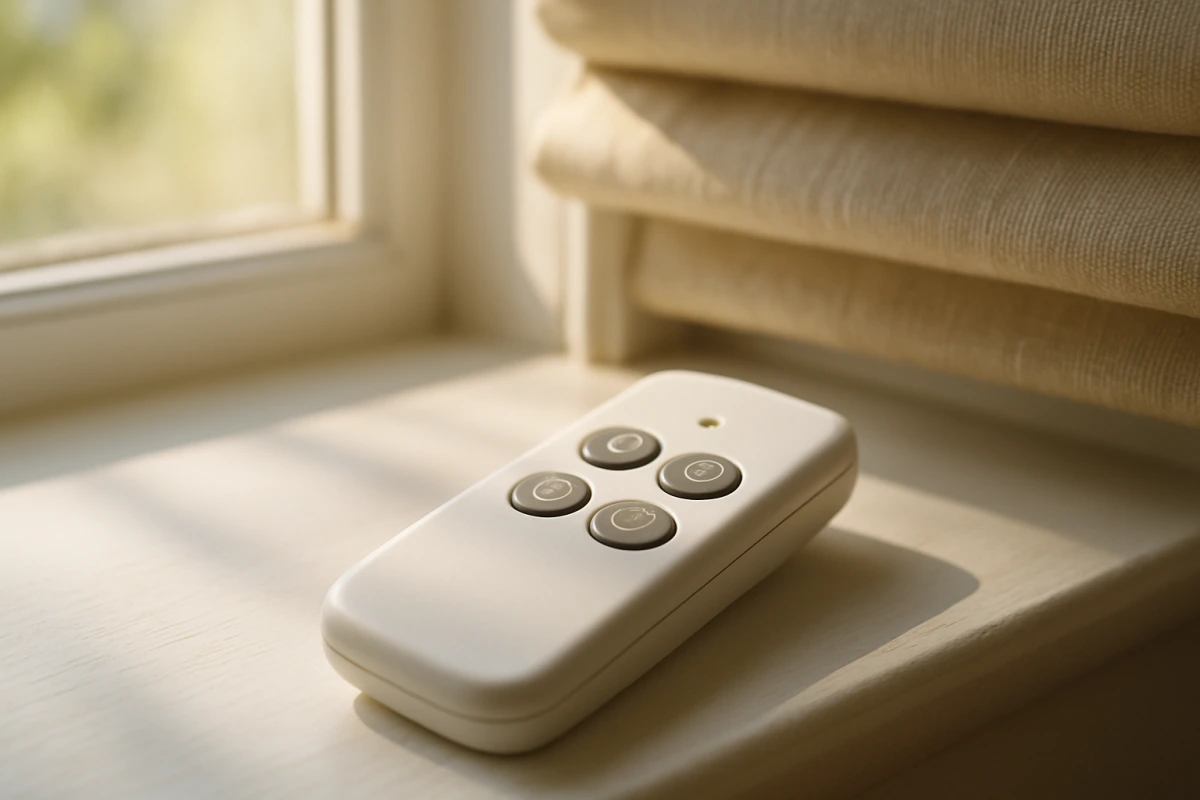
- Remote control. Raising and lowering is done with a button in your hand. The remote lies on a bedside table or a small table by the bed — you can lower and raise the blind without getting up. For a bedroom and a tall window, this is the main argument for automation.
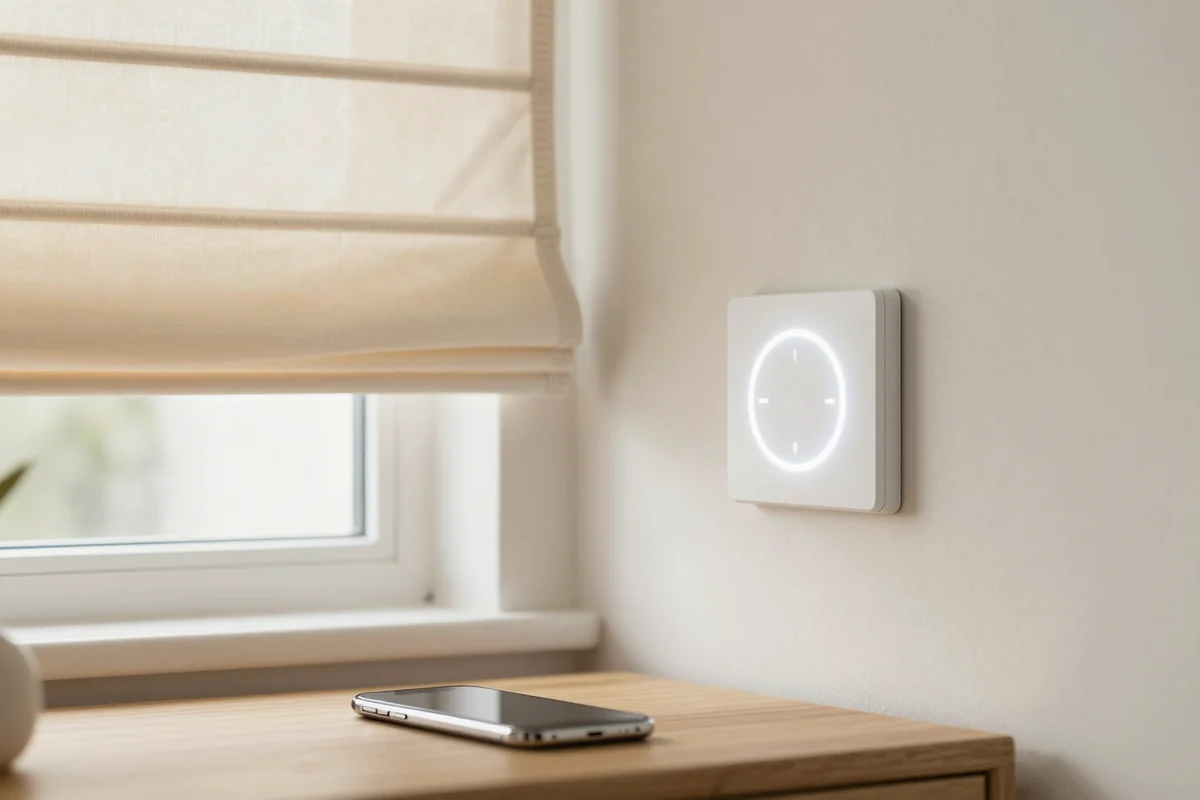
- Wall panel. A panel with three buttons is mounted on the wall by the window and controls several blinds with one button — for example, two windows in the living room at once. We don't run wires to the panel.
- Timer. The blind raises and lowers on a schedule without any human involvement. In the morning the fabric opens at a set time, in the evening it closes. This is set up on the motor itself or on the remote, not through a phone.
Remote and button
Motorised Roman blinds with a remote control are chosen when the window is far from the bed or high up. The remote is a separate little box that lies wherever is convenient. If you don't need a remote or tend to lose it around the house, choose an electric motor with a button on the housing: fewer functions, and no new habits either.
Wall panel and timer
A panel is convenient in a room with several blinds used by different people — in a meeting room, a salon, a large living room. A timer removes the chore altogether: the “morning”, “evening” and “leaving home” scenarios are set up once. Jalusso configures them so they don't interfere with each other.
If the remote is lost or its battery is dead
The procedure depends on the motor model — there's no universal advice here. During the measurement, our measurer shows what to do in your specific configuration and who to contact. This is worth discussing before ordering, not after.
Controlling a Roman blind isn't tied to a phone: the button, remote, wall panel and timer all work independently.
Comparison and calculation: manual blind, chain, electric motor, motor with remote
The price of an automatic Roman blind is made up of the price-list line per square metre and the mounting coefficient. Roman blinds with manual control — from 8,100 ₸/m², with chain control — from 8,600, with an electric motor — from 15,000 ₸/m², blackout with an electric motor — from 20,300, day-night with an electric motor — from 25,200 ₸/m². In the lines with an electric motor, the motor is already in the price; there’s no separate item for it. Lead times according to the price list: manual and chain — 7–10 days, with an electric motor — 10–14, day-night with an electric motor — 12–16 days.
The control coefficient applies to the base sewing price only for the manual options. Mechanical control comes with a multiplier of 1, chain control — 1.06. For the lines with an electric motor, control is already included in the price per square metre: the remote control, button or wall panel are chosen at the measurement, and we don’t quote a separate price for the remote.
The mounting coefficient applies to the base sewing price regardless of the control type. Wall mounting — multiplier 1, on the frame — 1.05, no drilling — 1.1, cassette system — 1.28.
Comparison table of control options
| Control | What it's controlled by | Where it's convenient | Price from per m² |
|---|---|---|---|
| Manual | By hand, no chain | Low window, rarely used | from 8,100 ₸ |
| Chain | Chain on the side | Low window, chain is easy to reach | from 8,600 ₸ |
| Electric motor | Button on the housing | Tall window, window behind furniture | from 15,000 ₸ |
| Electric with remote control | Remote and button | Bedroom, double-height ceiling, several windows | the same line with an electric motor, from 15,000 ₸ |
Mounting coefficients
| Mounting | Coefficient |
|---|---|
| Wall-mounted | ×1 |
| Frame-mounted | ×1.05 |
| No drilling | ×1.1 |
| Cassette system | ×1.28 |
Example calculation using the formula
Let’s take a conventional window with an area of 2 m² and a blind with an electric motor, wall mounting. The formula is: price-list line × area × mounting coefficient. We plug in: 2 × 15,000 = 30,000 ₸. The same window, but on the frame: 30,000 × 1.05 = 31,500 ₸. Installation — 4,500 ₸ per item, free for orders from 150,000 ₸.
This is the calculator’s arithmetic on a conventional area. The final figure for your window is given by the measurer — they see the width, height and weight of the fabric, and these determine which motor can handle it. They also look at where to bring the power supply, which sometimes changes the mounting option too.
What will be cheaper on a tall window
A chain is cheaper than a motor: from 8,600 ₸/m² versus from 15,000 ₸/m². But on a double-height window you still have to reach for the chain, and an extension adds a hanging cord. A motor removes the need to reach at all. In my view, saving on a chain for a tall window is an overrated approach: you pay less, but you deal with the inconvenience every day.
If you want to buy Roman blinds with an electric motor as an informed decision, compare the two price-list lines for your window: with chain control and with an electric motor. The price difference is immediately clear, and the decision is still made after the measurement.
Roman blinds with manual control — from 8,100 ₸/m², with an electric motor — from 15,000 ₸/m²; mounting is calculated as a coefficient.
Which fabric suits a motor: fabric weight and heavy materials
Motorised Roman blinds can be made with heavy blackout or with bamboo — what matters to the motor isn't the fabric itself but the weight of the fabric it pulls. Heavy fabric increases the weight and the load on the motor, because raising is done not by a roller but by tapes: the heavier the fabric, the more force on the spools. Fabric weight limits the choice of motor and the width of the blind — a wide window in heavy fabric requires a stronger mechanism than a narrow one in light sheer.
We choose the fabric for a Roman blind together with the motor, not separately. What this means in practice:
- Blackout and dimming fabrics — chosen for bedrooms and children's rooms where light needs to be blocked out; we do fit them with a motor, but the measurer checks the width and weight so the lifting tapes run evenly.
- Bamboo and heavy linen — look beautiful on a tall window, but weigh noticeably more than light fabric, so a power reserve for the motor matters more here.
- Light fabrics — for the living room and study, where diffusing the light is enough; the motor handles them most easily.
And it's not the name of the material that decides, but how the fabric behaves on the lifting tapes. A narrow blind in heavy fabric and a wide one in light fabric can produce the same load — the measurer calculates this.
How to remove the fabric for washing
The procedure for removing the fabric depends on the rail design, so we don't dictate it over the phone: the measurer shows the mounting on site and explains how to take the blind down and put it back. There's no need to rush here — a wrong move breaks the even spacing of the folds.
Heavy fabric increases the weight of the blind and the load on the motor, so the material is chosen together with the motor, not after.
High windows, double-height spaces, a window behind furniture, and a plastic window sash
For double-height spaces and tall openings, an electric motor is chosen because you can't reach the cord or chain there. A tall window requires either a motor or a chain extension, and these are two different scenarios in terms of convenience. The chain can be extended and lowered, but you'll still have to walk up to the window every time. A motor removes the need to reach at all. From experience I'll say this: in a double-height space, extending the chain is a compromise people come back to reluctantly.
We discuss automation options for an already-hung blind separately. If the rail and the blind allow it, the mechanism is replaced with an automatic one — sometimes it works with the same dimensions. But more often it's easier to install a new rail with a motor. The measurer looks on site at how the blind is mounted and how much it weighs, and after the inspection names the option.
- Tall window and double-height space: raise it with a remote or a button, no one can reach the chain.
- A window behind a bed, sofa or above a countertop: you can't reach it by hand, a motor solves the problem.
- Plastic window sash: a rail can't be installed in the opening, so the motor on the sash is mounted directly on it.
- An already-hung blind: replacing the mechanism or a new rail with the same dimensions, the decision is made after inspection.
A window behind a bed and above a countertop
You can't reach it by hand, and it's not about laziness. Reaching for a cord behind a headboard or above a kitchen worktop is inconvenient and simply unsafe — you can knock over dishes or a lamp. A motor solves this: raising is done with a remote or a button, you don't need to stand next to the window.
Plastic window sash
Mounting on the frame doesn't work here the way it does on a solid wall. A rail can't be installed in the opening, so the motor on the sash is mounted on the window sash itself together with the blind. When the window opens, the blind moves with it. Control is via remote. This is an option for plastic windows where a regular rail above the opening can't be placed.
Retrofitting an already-hung blind
Motorised Roman blinds can also be achieved by replacing the mechanism on an already-installed one. If the rail and the blind allow it, the mechanism is replaced with an automatic one, but more often it's easier to install a new rail with a motor with the same dimensions. The decision is made after inspection: the measurer looks at the design, the weight of the blind and where to run the power.
For double-height spaces and tall openings, an electric motor is chosen because you can't reach the cord or chain there — that's the main criterion for choosing.
Automation in an apartment and in a commercial space: scenarios and practice
A Roman blind motor runs quietly. The motor is hidden inside the rail, the blind folds evenly, and in the bedroom the blind goes up without waking anyone still asleep. In a home library or study this is especially valuable: the blind goes up without distracting from reading. The noise level depends on the motor model, and the measurer lets you listen to how it sounds on a sample.
Electric Roman blinds in a commercial space solve a different task — there it's important to control several windows at once. In a meeting room, a wall panel controls three blinds with one button, and no one has to walk around the room. In a coffee shop, one blind lowers on a timer after closing, and staff don't touch it every evening. In a beauty salon, a motor drove both lift tapes at once, and the folds on a tall window lay evenly. A commercial space gets one button for all windows — this saves staff time.
In a child's room, an automatic blind does without a cord or chain, and that's the main safety argument. Control is via remote only. For a child's room we installed motorised Roman blinds on two floor-to-ceiling windows. A child can't reach a hanging cord because there is no cord at all.
Bedroom and living room
A smart home scenario is set up for morning, evening and leaving home. In the morning the blind goes up on schedule, in the evening it closes. A remote with a timer raises and lowers the blind at a set time — convenient for those who leave early and want to come back to a darkened room.
Coffee shop, salon, meeting room
A wall panel with three buttons is mounted on the wall, no wires are run to it. One button closes all windows at once. The blind lowers on a timer after closing — staff don't touch each blind separately.
Kids' room
There are no cords at all — control is via remote only. This removes the risk that's usually the reason for avoiding chain-operated blinds in child's rooms.
Care, maintenance and warranty
From the date of signing the acceptance report, the warranty on installation is 1 year, and on the mechanism — 3 years. If the case is recognised as a warranty case, we do the work free of charge — within 5 working days. These are the general terms for motorised and manual Roman blinds — we don't declare a separate warranty on the motor and remote, the same one applies.
Measurement and consultation are always free. The measurer comes with fabric samples and calculates the cost on site, based on the window dimensions and the chosen control. For installing one item we charge 4,500 ₸; if the order total reaches 150,000 ₸, installation is free of charge. Installation includes mounting the rail, motor and blind — that is, the whole assembly on the window, not just hanging the fabric. By the way, it's during installation that small things like a skewed rail most often come to light, and they're easier to fix right away than six months later.
What the warranty doesn't cover
The warranty covers the mechanism and installation, but not everything. Mechanical damage, reinstallation on your own, water ingress and natural fading of the fabric are not warranty cases. Moreover, we don't consider fading a defect: fabric on the sunny side changes shade over time, and this is a property of the material, not a fault of the rail or motor.
After the warranty
Once the warranty has expired, a visit is still possible: we'll put the mechanism in order, replace the cord or chain. The work is paid, but the window isn't left unattended, and you don't need to go looking for a new blind.
Measurement, timelines and how we work in Almaty
We make automatic Roman blinds in Almaty to measure, rather than bringing ready-made ones: we have our own workshop, and every blind is sewn for a specific window. There are no ready-made items in stock — and this isn't a marketing ploy, it's how the work is set up. The motorised rail, the blind and the mounting are assembled into one set only after the measurer has seen the window.
You can get in touch via WhatsApp. After that you don't go anywhere: the Jalusso measurer comes to you with fabric samples and calculates the cost on site, based on your dimensions. This is convenient — no need to send photos, guess by millimetres and then be surprised that it turned out wrong.
How ordering works
- You message us on WhatsApp and describe the window.
- The measurer comes with fabric samples, takes measurements and looks at the power connection point.
- The workshop sews the blind to your dimensions and assembles the rail with the motor.
- Installation: we mount the rail, the motor and the blind.
Measurement and consultation are always free, and measurement and delivery within the city are free too. We charge 4,500 ₸ per unit for installing automatic Roman blinds, but if the order total reaches 150,000 ₸, we install them free of charge.
Timelines
According to the price list, we make Roman blinds in 7–10 days. The timeline for a motorised blind is confirmed separately by the measurer — it may affect the overall manufacturing time if a non-standard mounting is required.
Suburbs
We travel to Kaskelen, Talgar, Issyk and Kapshagay. The cost of the visit depends on the distance and is quoted before the visit, not after.
Almaty Climate
The climate here is sharply continental: cold winters with frosts and a noticeable temperature difference between day and night, and hot, dusty summers. We select the fabric for the motor with this in mind — in winter it is important that the fabric does not lose its shape from dry air, and in summer that it holds back dust and sun.
Basic sewing of Roman blinds — from 8,100 ₸/m²; a coefficient for the control type and a coefficient for the mounting are applied to this figure; the exact amount is quoted by the measurer on site.
Conclusion
Automatic Roman blinds in Almaty are the same fabric blind with lift tapes, where the folds move by a motor rather than by a chain. The appearance of the fabric does not change: the manufacturer sews the fabric to measure just as for a manual Roman blind. Automation does not take away the fabric look of a Roman blind — it only removes the manual lift.
The motor does not wind the fabric onto a roller. The lift tapes are wound onto spools inside the rail, which is why the mechanism of a Roman blind differs from a roller blind drive. Every day the blind rises in even folds, and if the power goes out, most electric motors keep a manual mode.
The power supply is decided not by aesthetics but by the timing of the renovation. While the finishing is still ahead, the measurer plans the wire to the rail. If the wall is already finished and cannot be chased, we discuss a battery. The power option is chosen on site together with the connection point — this question cannot be settled over the phone in advance.
The cost of automation is calculated from the basic sewing. The base for Roman blinds is from 8,100 ₸/m², and a coefficient for the control type is applied to it: electric motor 1.85, electric with remote control 2.1. The mounting adds its own coefficient. The final figure is quoted by the measurer based on the dimensions of the specific window.
What we advise before ordering: decide whether you need a remote control or whether a button on the housing is enough. A remote control and timer are chosen where the window is far from the bed or high up. The measurement determines both the window dimensions and the power connection point — it is the first step of the order.
Our measurement and consultation are free; the measurer arrives with fabric samples and calculates the cost on site. According to the price list, we make Roman blinds in 7–10 days; the timeline for a motorised fabric is confirmed after the inspection. We give 3 years on the mechanism and 1 year on the installation from the date of the act. Write to us on WhatsApp — we will arrange a visit.

