
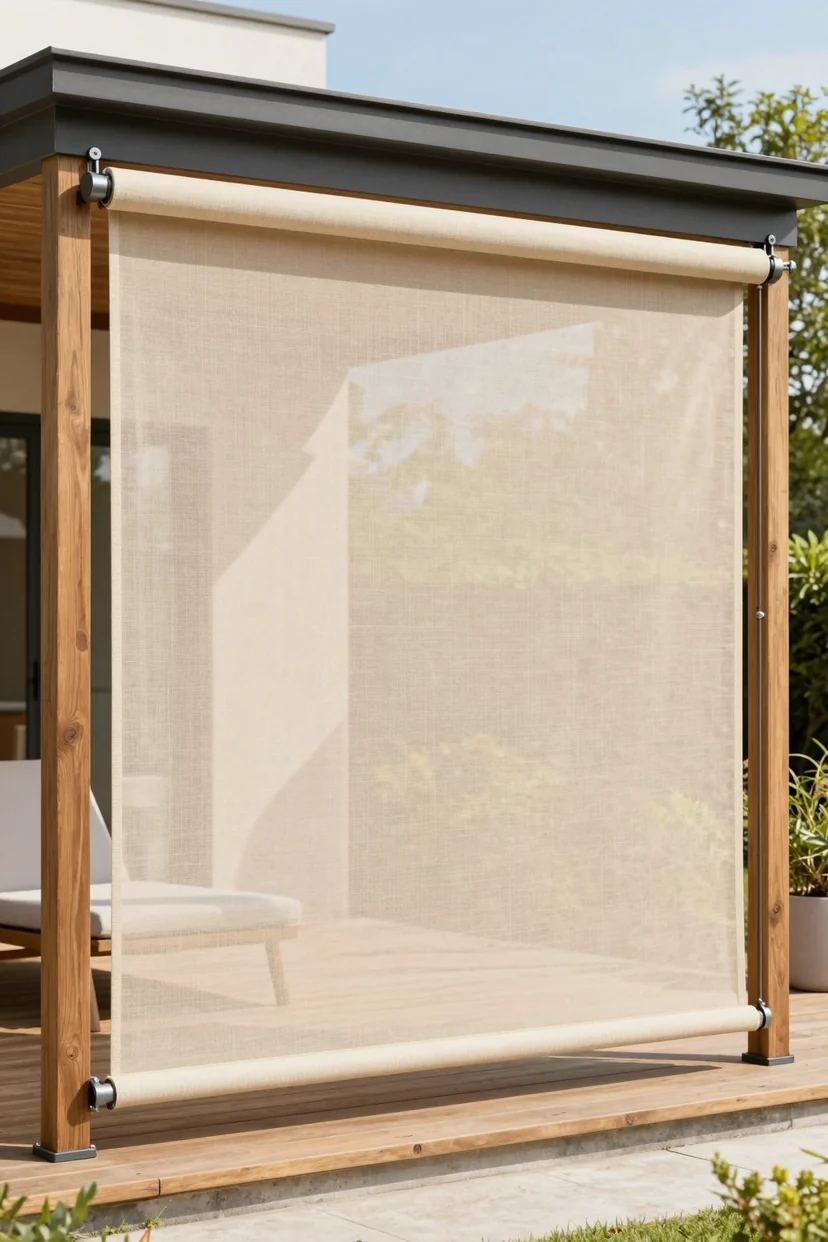



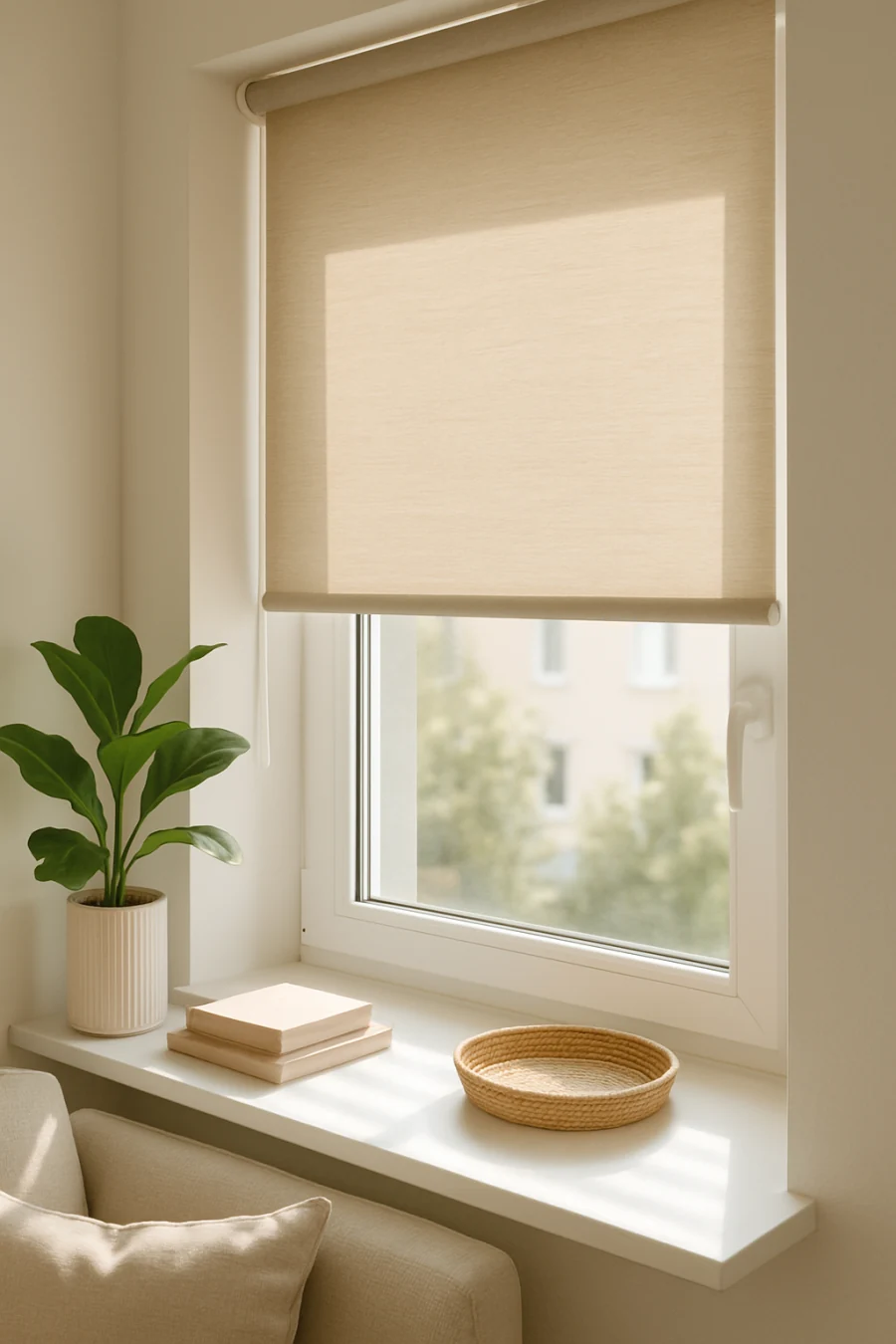


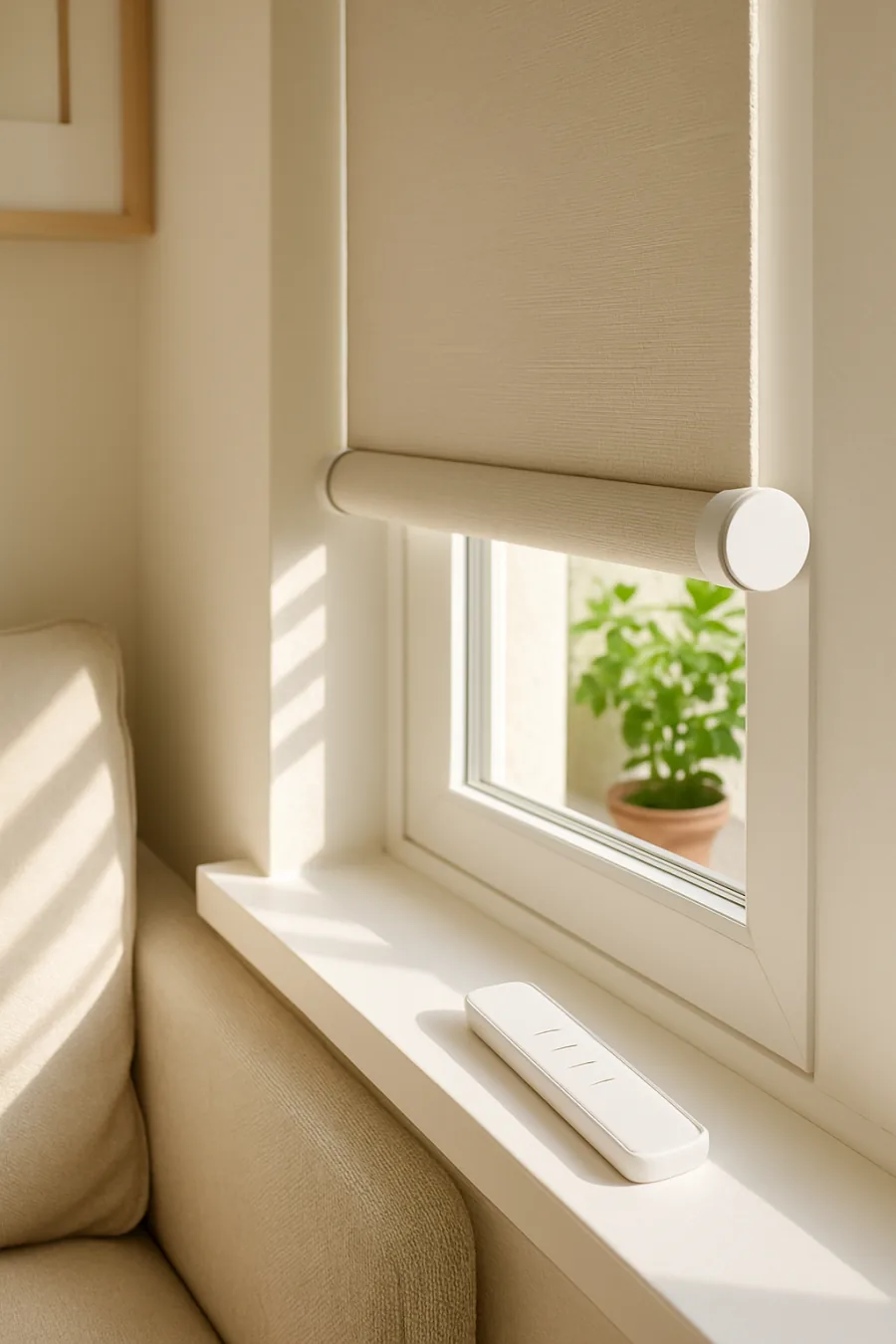











Outdoor roller blinds in Almaty are a fabric made of outdoor material on reinforced fasteners, with side guide rails or a bottom fastener. They protect a terrace, porch, patio and summer area from the sun, mountain wind and prying eyes. We make them to measure in our own workshop: the measurer comes with samples and calculates the price on site. Price — from 14,500 ₸/m².
How an outdoor roller blind differs from an indoor one, a ZIP system and an awning
Outdoor roller blinds are made for open air, so they differ from indoor ones not by the fabric first of all, but by the fasteners and guide rails. Outdoors, the fabric has to withstand wind load, and whether the blind works calmly or starts flapping depends on exactly how it is fixed along the edges. Let's look at how outdoor roller blinds differ from indoor ones, from a ZIP system and from an awning — and where each type is enough.
Outdoor and indoor blind — what's the difference
An indoor roller blind works behind glass: the window is closed, there's no airflow, the fabric hangs freely and nothing gets in its way. An outdoor blind stands on an opening that is open to wind, rain and dust, so it has a different job — not just to shade, but to hold its shape in gusts. The fabric here is denser and made for ultraviolet, the fasteners are reinforced for wind load, and guide rails run along the edges of the fabric. If you put an indoor blind on a terrace, the first strong wind will start turning it inside out and flapping it. We see this regularly when we come to measure after unsuccessful attempts to close a space with whatever was at hand.
Outdoor blind, ZIP system and awning
A ZIP system is one of the variants of an outdoor roller blind, not a separate class of products. Its fabric fits into side guide rails, there's a housing box on top, and the whole structure is made for constant use in the open air. The ZIP guide rail holds the fabric along its full height, so the wind doesn't turn it inside out.
An awning works differently: it's a retractable canopy that extends forward on brackets and shades the area from above. It doesn't close the opening vertically, and if strong wind picks up, the awning has to be retracted — its windage is high. An outdoor blind, on the contrary, comes down from top to bottom and covers the opening completely.
Where a simple design is enough, and where guide rails are essential
The design is chosen based on how exposed the area is to wind. On an enclosed terrace, where walls stand on three sides, an open roller tube with a bottom lock is enough: the fabric is held by the bottom bar, and that is sufficient. On an area where the wind blows in, side guide rails are needed — they hold the fabric along the edges. And on terraces and open areas that are blown through from all sides, ZIP guides are essential.
| Version | How it holds up against wind | Where to install |
|---|---|---|
| Open fabric with a bottom lock | Held by the bottom bar | Enclosed terrace, patio with three sides |
| Side guide rails | Fabric runs into guide rails along the edges | Terrace with partial wind protection |
| ZIP guide rail | Fabric is held along the entire height | Open areas, terraces, porch |
| Facade housing box | Fabric is protected, roller is housed in a cassette | Facades, entrance areas |
An outdoor blind differs from an indoor one not by its fabric, but by being designed for open air: reinforced fasteners for wind load and guide rails along the edges of the fabric.
How an outdoor blind behaves in mountain wind and what to do in strong wind
Outdoor roller blinds in Almaty are designed for wind load, but not for any wind: the fabric is held by guide rails along the edges and a bottom lock. These are what prevent flapping — the material runs into them rather than hanging freely. On an open area without these elements, the blind flaps at the first gust, and this is not a fabric defect but the wrong design choice.
Why wind gets special attention in the foothills of Almaty
Almaty has a sharply continental climate: cold winters with frosts and temperature swings between day and night, hot, sunny and dusty summers. During the day the terrace heats up, and by evening the wind from the mountains blows off everything that is not properly secured. Strong mountain wind is not an emergency but a routine operating condition. It determines the choice of design and fasteners: the same area is covered differently depending on how exposed it is to wind. Fastening to the base is chosen with the same consideration — guide rails are mounted so that wind cannot tear them out together with the fabric.
What to do if strong wind picks up
The steps are short, and it is best to keep them in mind in advance.
- Raise the fabric and leave the blind in the cassette.
- Do not keep it lowered to full height when gusts intensify.
- Do not pull on frozen or wet fabric — the mechanism does not like it.
- Check that the guide rails and bottom lock are in place and the fabric is threaded into them.
A raised blind in strong wind is normal, not a defect. That is how the system is designed: the fabric is retracted when the load exceeds the design limit. If the blind flaps when lowered in calm weather, it is a design issue, and it is corrected at the measurement stage: the fabric is divided into sections, and a bottom lock is added. Wind load tests not the fabric, but how correctly the guide rails, bottom lock and fastening method are chosen.
Winter, spring ice and rain: operating rules for an outdoor blind
The mechanism of an outdoor blind is designed for temperature swings, but the fabric itself is best raised and secured for the winter. Then the guide rails, the roller tube and the fabric all get through the cold without load.
Outdoor roller blinds in Almaty operate in a sharply continental climate. Winters here are cold, with frosts and temperature swings between day and night, so leaving the fabric lowered to full height until spring is not advisable.
What to do in winter
- Raise the fabric and secure it in the upper position. The fabric will stay dry and will not collect ice.
- Leave the mechanism in the roller tube as is — there is no need to disassemble and lubricate it before winter.
- If the fabric has been left hanging until the frosts, do not try to straighten it by force. In the cold the fabric loses its elasticity and creases easily.
Wintering the blind is not seasonal mothballing but unloading the fabric. A raised blind remains operational, and during a thaw it can be lowered.
Spring ice in the guide rails
After a thaw, ice may build up in the guide rails and on the bottom bar. Do not pull on frozen fabric: first let the ice melt on its own, then operate the mechanism. One yank on a frozen edge — and the guide rail warps, the fabric tears at the seam, and that is no longer covered by warranty.
Rain and water
Screen fabric lets water through in splashes during rain, so the fabric is either raised or left to dry in place. Wet fabric must not be rolled up for long — when rolled up, the fabric mildews and moisture gets into the roller tube. Water entering the mechanism is not a warranty case, so after a downpour it is best to unroll the blind and let it dry.
At the Jalusso workshop they take rain calmly: an outdoor system with a cassette is better protected than an open one, but it still needs to be dried. The mechanism of an outdoor blind is designed for temperature swings, but for the winter the fabric is best raised and secured, and frozen fabric must not be pulled.
How much an outdoor roller blind costs in Almaty and what the price consists of
The price of outdoor roller blinds starts from 14,500 ₸ per square metre. This amount already includes outdoor screen or PVC fabric, the cassette and ZIP guide rails. The final price depends on the size of the opening, the fabric group and the control type — chain, electric motor or electric with remote control.
What's included in the price per m²
The price per m² is made up of three parts: the fabric, the housing box and the guide rails. We use outdoor fabric, not indoor — screen or PVC. The housing box hides the roller tube and the fabric from rain and dust, while ZIP guide rails hold the fabric along its full height. On a low terrace you can do without the housing box, but then the open roller tube is visible from the street.
Control and installation coefficients
The control type and installation method are calculated as coefficients on the base price.
| Control | Coefficient |
|---|---|
| Mechanical | ×1 |
| Chain | ×1.06 |
| Electric motor | ×1.85 |
| Electric with remote control | ×2.1 |
| Installation | Coefficient |
|---|---|
| Wall-mounted | ×1 |
| Frame-mounted | ×1.05 |
| No drilling | ×1.1 |
| Cassette system | ×1.28 |
An electric motor is chosen for high terraces and large openings: where you can't reach the chain, we install a motor, and the remote control saves you unnecessary trips. Manufacturing time for an outdoor system is 10–14 days. We charge 4,500 ₸ to install one outdoor blind, but if the order total reaches 150,000 ₸, installation is free. However, for outdoor use we recommend installation with drilling rather than adhesive: under wind load, that kind of fixing doesn't hold.
What the final price depends on
Four things determine the final figure: the area of the opening, the fabric group, the control type and the installation method. A two-metre opening and a four-metre opening differ in area — and in both fabric and hardware. The measurer calculates the cost on site using samples: he checks the base, confirms the height and gives you the exact price before you order.
Outdoor roller blinds — from 14,500 ₸/m², this price includes outdoor screen or PVC, the housing box and ZIP guide rails.
Measurement, manufacturing and installation: how an order works in Almaty and the suburbs
You don't pay for the consultation or the measurer's visit: he brings samples with him and gives you the price right on site. After that the order goes to the workshop, and once it's made, the installation crew arrives. Everything is made to measure — we don't keep ready-made products in stock.
- You message us on WhatsApp and give the address.
- The measurer arrives with fabric and hardware samples.
- He checks the base, the height and the length of the opening.
- He calculates the cost on site, and you decide on the finish.
- The workshop makes the fabric and the mechanism.
- The installation crew mounts the system on the base.
How to book a measurement
Outdoor roller blinds start with a request on WhatsApp. Within the city, measurement and delivery are free. For the Almaty suburbs — Kaskelen, Talgar, Issyk, Kapshagay — we do travel out, and we tell you the travel cost before we come, so there are no surprises. The measurer brings samples: screen, PVC, dense fabric. The fabric is chosen on site, in daylight. Our sun-protection engineer Yerlan works out where the system will go — on a post, a beam or a glazing frame.
Manufacturing in the workshop and installation
Measurement comes before manufacturing in the workshop: the fabric is cut to the measured dimensions and the roller tube with the mechanism is assembled. The measurer tells you the manufacturing time for an outdoor system — it depends on the fabric, the control type and the workshop's workload. Installation is 4,500 ₸ per unit, free for orders from 150,000 ₸. We mount on a post, a beam or a frame, and we fix the guide rails so the wind can't tear them out along with the fabric.
Warranty and service after it
We give 3 years on the mechanism and 1 year on installation work, with both periods counted from the day the acceptance certificate is signed. If a breakdown is covered by the warranty, we'll fix it within 5 working days and won't charge you for it. And after the warranty ends, our crew will still come out to you: we'll tighten the fixings, adjust the mechanism, replace the cord or chain. And here's what matters: the warranty doesn't cover mechanical damage, re-installation done yourself, water, or natural fading of the fabric. For example, if you left the fabric down in winter and the wind bent a guide rail, that's no longer a warranty case but a repair for a separate fee.
Outdoor blind configurations: open roller tube, guide rails, ZIP, façade housing box
The choice of configuration determines how the system behaves under wind load. An open roller tube with a bottom lock holds the fabric only by the bottom bar, side guide rails add support at the edges, a ZIP guide rail runs the fabric along its full height, and a façade housing box tucks the roller tube and fabric under an aluminium bar. Here's each option in turn.
Open fabric with a bottom lock
An open roller tube without guide rails requires the bottom bar to be secured — otherwise the fabric flaps in the wind. This is the simplest configuration: the roller tube is fixed to the base, the fabric drops freely, and a lock holds the bottom. It suits areas sheltered from the wind by a wall, a neighbouring building or a tall fence.
Side guide rails and ZIP
Side guide rails hold the fabric at the edges and noticeably reduce wind catch. A ZIP guide rail runs along the full height, and the fabric's edge slots into it — it doesn't turn inside out or flap even in strong wind. We install ZIP on terraces and open areas where the mountain wind is a constant load, not a rare occurrence.
Facade housing box
The roller tube and fabric are tucked into a slim aluminium housing box under the terrace ceiling. From the street, all you see is a neat bar, and the fabric itself is protected from rain and dust. A façade housing box is chosen for façades and entrance areas where a tidy line matters, not a protruding roller tube.
You can't install a blind on a gazebo or pergola without a frame: fixing to a base requires something to fix to — a post, a beam or a glazing frame. The measurer checks whether there's a suitable support and selects the configuration based on it.
Comparison of configurations
| Version | How it holds up against wind | Where to install |
|---|---|---|
| Open fabric with a bottom lock | Held only by the bottom bar | Areas sheltered from the wind |
| Side guide rails | Fabric guided at the edges | Moderately open terraces |
| ZIP guide rail | Fabric slots into the guide rail along the full height | Open areas and terraces |
| Facade housing box | Guide rails plus protection for the roller tube and fabric | Façades and entrance areas |
For outdoor roller blinds in an opening with a strong draught, we recommend installing them with guide rails — an open roller tube doesn't justify itself there. The fabric slots into the side guide rail and is held along its full height, so it doesn't turn inside out or flap even in strong wind.
Outdoor fabrics: screen, PVC and dense fabric
Three fabric groups suit outdoor use: outdoor screen, PVC fabric and dense fabric. Screen cuts glare and wind while keeping the view; PVC comes from tent products; dense fabric gives deep shade and hides the area from prying eyes. The difference between them is how the fabric behaves with light, air and other people's gazes.
Outdoor screen
Outdoor screen lets air through and keeps the view: through the fine mesh you can see the garden, but outsiders can't make out what's happening inside. It's not stuffy under it at midday, so screen is chosen for verandas and terraces with a view. In the evening, when the lights are on in the area, screen is more see-through from the street — if privacy matters more than the view, the measurer will suggest another fabric group.
But a screen does not protect against mosquitoes and fine dust: it lets air through along with them, and insects need a separate mesh. In the summer kitchen project, we separated these two tasks — screens on the openings for sun, mosquito mesh on the work area.
PVC fabric
PVC fabric is a group of outdoor fabric that came from tent products. It is used where density and moisture resistance are needed, not transparency. Our measurer brings PVC samples along with screen samples, and the fabric is chosen on site: in photos the difference between the groups is almost invisible, but in your hand and in the light it is obvious right away.
Dense fabric
Dense fabric does not let light through and protects from prying eyes, gives deep shade and blocks the wind. It is chosen for patios and terraces that are overlooked from the street or from the windows of neighbouring houses. But dense fabric has a downside: a terrace closed on all sides risks overheating at midday, because the air under the fabric does not move. In direct sun the fabric lightens over time — natural fading is not covered by warranty.
Comparison by task
| Fabric | View | Light | Air | Privacy |
|---|---|---|---|---|
| Outdoor screen | preserved | blocks glare | lets through | medium |
| PVC fabric | limited | dense | limited | high |
| Dense fabric | no | deep shade | doesn’t let light through | high |
An outdoor screen lets air through and keeps the view, dense fabric gives deep shade and privacy, and PVC sits in the middle between them in density. The choice of fabric for outdoor roller blinds decides not only the question of shade, but also how stuffy it will be on the site at hot midday.
Blind control: chain, spring, electric motor and remote
What controls an outdoor blind is decided by the height of the opening and how often you will pull it. On low openings a chain or spring mechanism is convenient, and where you cannot reach, an electric motor or electric motor with remote is installed.
Chain and spring
A chain is simple mechanical control without electrics: you pull it, and the fabric goes up or down. On an outdoor terrace Jalusso specialists would not advise making the chain too long — a short one lasts longer and does not tangle underfoot.
A spring mechanism raises and lowers the fabric with a light movement of the hand. It helps on terraces where the blind is pulled often: the mechanism is hidden in the tube and does not get in the way, and the chain does not hang in sight. For tall fabrics a spring is not always suitable — here the measurer looks at the weight of the fabric and the length of the opening.
Electric motor and remote control
The blind is controlled from a remote, no need to reach for the chain. An electric motor is chosen for tall terraces and large openings: the mechanism runs on mains power and withstands frequent raising. A remote saves time on long fabrics — you do not have to walk around the site to close the far section.
An electric motor on a terrace needs an electrical connection, and the measurer checks this on site: where the panel is, where to run the cable, how to route it along the facade. If there is no electrics on the site, the motor option is postponed or a spring and chain are chosen.
The mechanism of an outdoor blind is hidden in the tube and designed for open air, but the choice between chain, spring and electric motor is always tied to a specific opening.
Mounting to the base: post, beam, brick, wood, metal
Mounting to the base is chosen not by the beauty of the joint, but by the material and wind load. Mountain wind determines the choice of design and fasteners: the more open the site, the more serious the joint must be. Weak fastening is the only place where an outdoor blind fails before the fabric and mechanism.
Where to mount the system
The system is mounted on a post, beam or window frame. The guide rails are fastened so that the wind does not tear them out together with the fabric, and not just hang the housing box on top. A beam and window frame usually give a rigid base. A post holds the load if it stands firmly itself. A pergola and gazebo are a separate matter: there the mounting is calculated for a specific frame, because the frame is designed for its own weight, not for the wind load from the fabric. For a gazebo without a frame, with posts only, we first look at whether there is anything to attach the top to, and only then suggest a design.
Fasteners for the base material
Brick — with anchors, wood — with its own fasteners, metal of a gazebo or pergola — through suitable elements. The measurer looks at the base and selects the fasteners. Soft aerated concrete or thin cladding require a separate solution, and this is only visible on site. This is where measurement matters, not a photo in a chat.
Why we do not install without drilling outdoors
Mounting without drilling does not hold the fabric under wind load. On glue and clamps the system stands until the first serious gust, and then goes down together with the fabric. For outdoors we do not advise this method: it is suitable for an indoor window, but not for an open site.
For outdoors we do not advise mounting without drilling: on glue and clamps the fabric does not hold under wind load.
Outdoor fabric care: dust, poplar fluff, washing
Outdoor dust from the road and poplar fluff settle on the fabric, so it is cleaned periodically. Over the winter a layer accumulates on the fabric that cannot be removed by simply raising it. Clean carefully and without rushing — outdoor roller blinds do not like sudden movements.
How exactly to remove dust depends on which fabric is on the opening — an outdoor screen or dense fabric.
- Dust and fluff are removed from the fabric with a soft brush or a vacuum cleaner with an attachment while the fabric hangs. The fabric is lowered, not rolled up in the housing box.
- Fine dust is brushed off the fabric from bottom to top so that it does not get pushed into the cells.
- Local stains are removed with a mild soap solution and left to dry right on the blind.
- Dense fabric is wiped without strong pressure: the fabric does not like being rubbed.
- After poplar fluff, the fabric is not rolled up dirty for long — fluff clogs the cells and the guide rails.
An outdoor screen lets air through and keeps the view, so fine dust passes through it. It settles in the cells of the mesh — that is where it is cleaned from. Dense fabric keeps dust on the surface, but in direct sun the fabric lightens over time, and natural fading is not covered by warranty. In my opinion, this is not a reason to give up dense fabric on a patio — the tone will simply become softer over time.
What not to do. Don't roll up a wet fabric for long: it gets musty in the housing box, and moisture seeps into the mechanism. Don't pull on a frozen fabric — let the ice melt first, then work the mechanism. And remember: water getting into the mechanism is not a warranty case.
If the fabric is soiled so badly that on-site cleaning doesn't help, message us on WhatsApp — we'll look at the photos and tell you what to do with the fabric.
Where outdoor blinds are installed: terrace, porch, patio, summer kitchen, café
Outdoor roller blinds are installed wherever you need shade and privacy in the open air: on a terrace, veranda, porch, patio, summer kitchen, outdoor café area, or an unglazed loggia. Each scenario dictates its own design, fabric and fastening, and the Jalusso measurer selects them on site.
Private house: terrace, porch, patio, summer kitchen
On a terrace and porch, the blind blocks the sun and the neighbours' eyes — this is the most common request in private houses near Almaty. On a townhouse patio where neighbours' windows face you, a dense fabric screens the area from view. In a summer kitchen, screen fabric lets air through: smoke from the grill drifts away while the worktop stays in shade. A gazebo or pergola is a separate matter — there the fastening is calculated for the specific frame, not a standard window frame. But any such area has a weak spot. A terrace enclosed on all sides risks overheating at midday, so one side is left with screen fabric.
Commercial scenario: outdoor café area
An outdoor café area gets shade during the hot hours: fabrics are lowered on the sunny side, and the tables move out of direct sun. On an open side nine metres long, we install several fabrics with electric motors so staff can operate them without walking around the seating area. At lunch the area runs in shade, and by evening the fabrics are raised. Wet fabric after rain must dry out — it is not left rolled up for long.
Wide openings and an unglazed loggia
On long openings, the fabric is divided into several sections so it doesn't sag. A single fabric wider than three to four metres sags under its own weight, so the opening is split into parts, each mounted on its own guide rail with a motor. An unglazed loggia is covered with an outdoor blind, not an indoor one: an indoor blind in the open air will start flapping and snapping — it lacks both the fabric density and the fastening for wind load.
On long openings, the fabric is divided into several sections so it doesn't sag.
FAQ
Below are the questions we most often get about outdoor roller blinds before a measurement. We answer briefly, based on practice.
What happens to the blind if you forget it lowered in strong wind? The fabric will start flapping and snapping, and on an open area the load goes to the fastening. If the system has side guide rails, the fabric stays in them and behaves more calmly. But we don't recommend leaving the blind lowered to full height in strong wind — the fabric should be raised.
Can you lower an outdoor blind in the rain and dry it afterwards? You can lower it, but outdoor screen fabric lets water through in splashes, so the area under it won't stay dry. Wet fabric is not rolled up for long — it is left to dry, and only then is the mechanism used. Water getting into the mechanism is not a warranty case.
What to do with the fabric in winter — take it down or just raise it into the housing box? No need to take it down: the outdoor blind's mechanism is designed for temperature swings and stays in the roller tube. The fabric is raised and secured, not left lowered in the cold. The Almaty winter with frosts and temperature swings between day and night is a normal load for the mechanism, but not for an unrolled fabric.
Why is ice in the guide rails dangerous in early spring? After a thaw, ice can build up in the guide rails. Don't pull on a frozen fabric: let the ice melt first, then work the mechanism. If you yank it, you can tear the fabric or damage the mechanism in the roller tube.
Can one fabric cover an opening wider than three to four metres? On long openings, the fabric is divided into several sections so it doesn't sag. For a wide side of a terrace, this is a standard solution: each fabric runs on its own ZIP guide rail. Sometimes a separate electric motor is installed on such a fabric.
How do you keep a terrace enclosed on all sides from overheating at midday? A dense fabric doesn't let air through, and in the heat it gets stuffy underneath. For an enclosed terrace, outdoor screen fabric is used: it lets air through, keeps the view, and prevents the area from overheating. And the shade remains even during the hottest hours.
Will the blind flap if the bottom bar isn't secured? It will. The bottom fastener holds the bottom bar, and the guide rails hold the edges of the fabric — together they eliminate flapping. Without fastening, the fabric hangs freely and flaps in a draught.
Warranty — 3 years on the mechanism and 1 year on installation; water and natural fading of the fabric are not covered by the warranty.
Conclusion
Outdoor roller blinds in Almaty differ from indoor ones in fabric, fastening and guide rails. An indoor blind works behind glass, while an outdoor one stands in the open air, where it is held by reinforced fastening and side guide rails. If you're choosing between designs, start from the wind load on your area, not the price per square metre.
Guide rails along the edges and a bottom fastener protect against flapping. The fabric runs inside them rather than hanging freely, so it doesn't turn inside out or flap. On a fully open side, our measurer will suggest flat guide rails, and on long openings we divide the fabric into several sections so it doesn't sag.
In winter, the fabric is raised and secured in the housing box, while the mechanism stays in the roller tube. Don't pull on a frozen fabric — let the ice melt first, then work the mechanism. In the rain, the blind is raised or left to dry, and wet fabric is not rolled up for long. Water getting into the mechanism is not considered a warranty case.
The cost works out like this: an outdoor blind — from 14,500 ₸/m², installation — 4,500 ₸ per item, and for orders from 150,000 ₸ installation is free. Warranty — 3 years on the mechanism and 1 year on installation from the date the acceptance certificate is signed; warranty cases are fixed free of charge within 5 working days. Once the warranty period has expired, we'll still come — tighten the fastening, adjust the movement, install a new cord or chain.
What to do next? Message us on WhatsApp and book a measurer with samples. They'll look at the mounting surface — a post, beam, brick or window frame — select the design and fabric for your task, and calculate the cost on site. Measurement and consultation are always free.

