




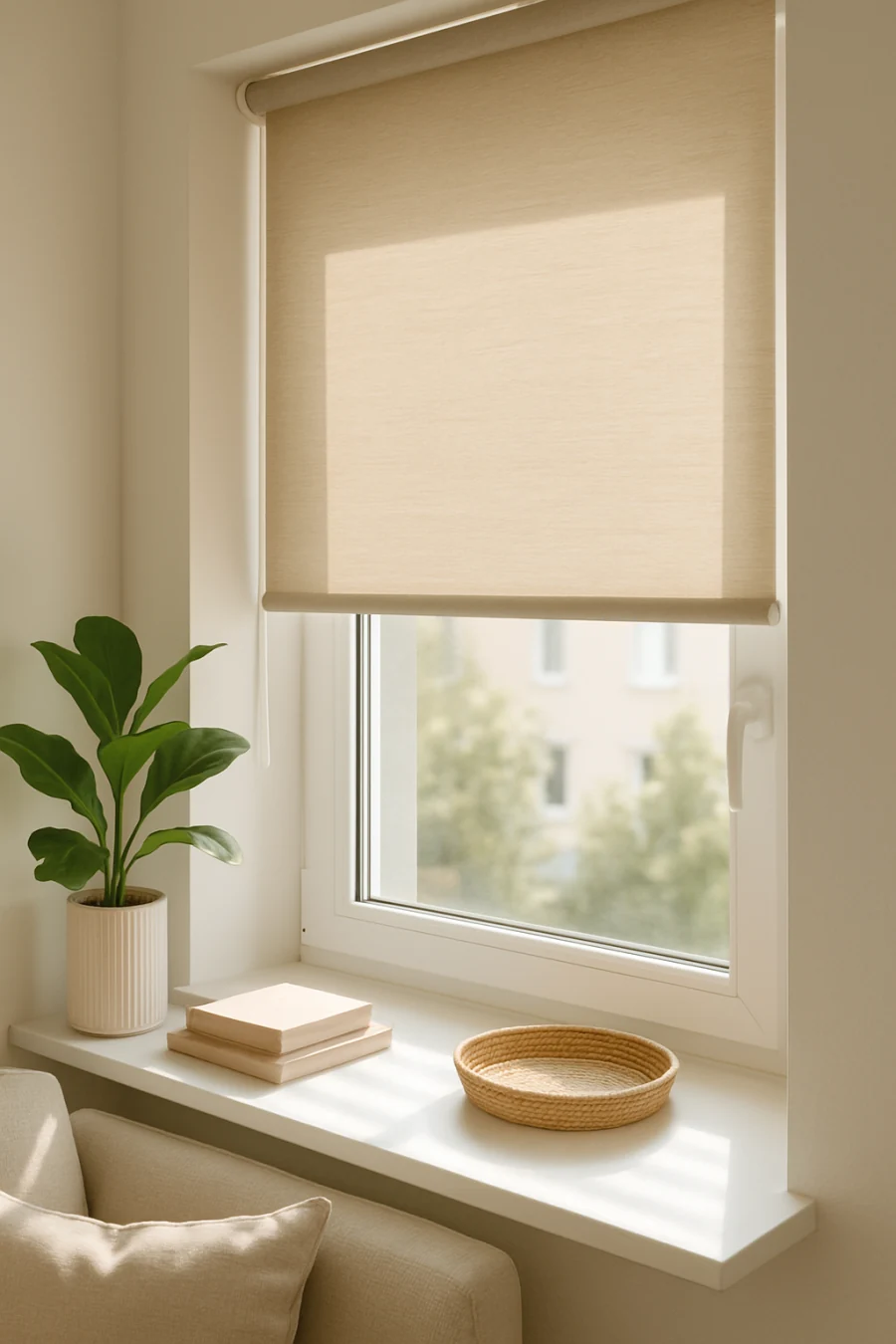


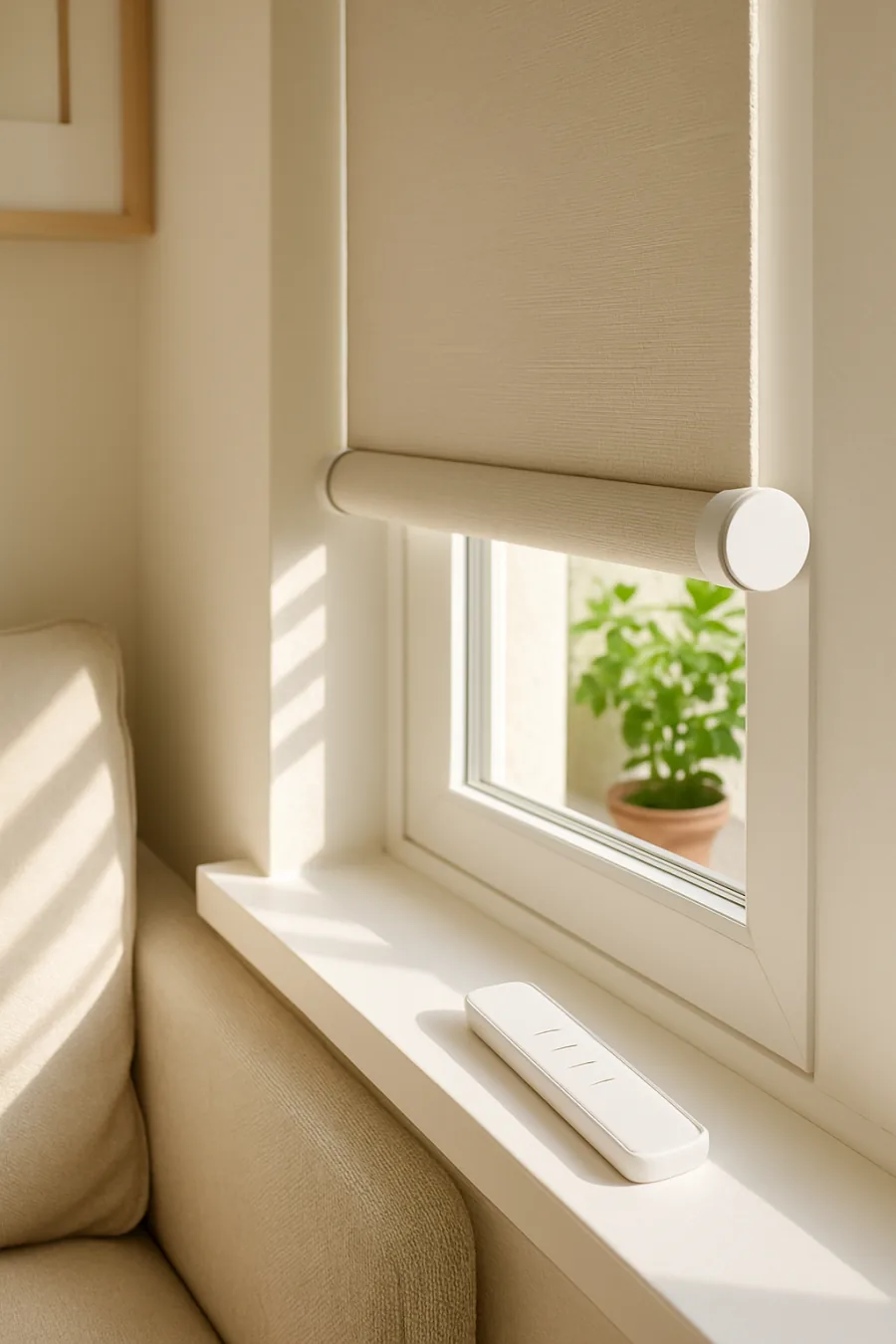


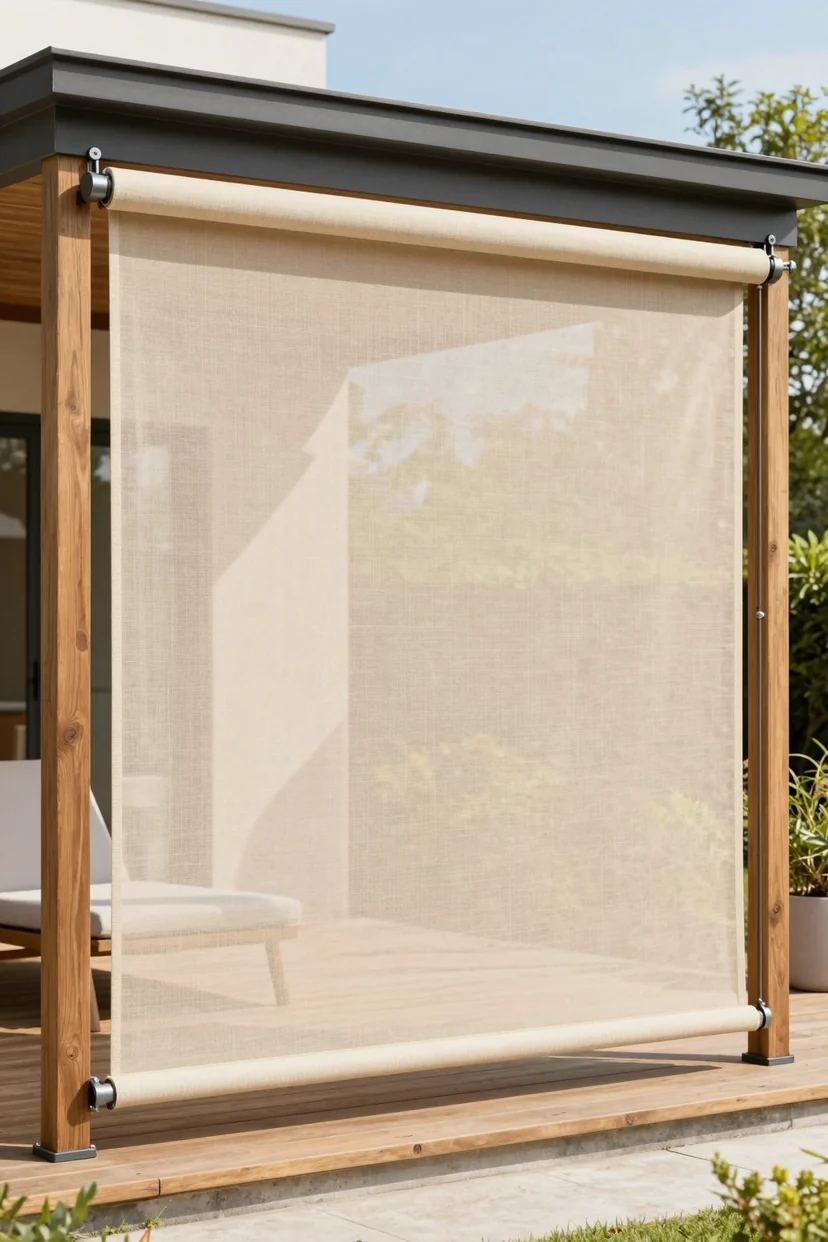











We make bamboo roller blinds in Almaty to measurement in our own workshop: a woven fabric of straw or a wide bar instead of a sheer and a rail. Price — from 9,400 ₸/m², installation — 4,500 ₸ per item. Measurement is free: the measurer brings weave samples and gives you the price right at the window.
How bamboo fabric behaves on an Almaty window
Bamboo roller blinds in Almaty behave like any natural finish: on the sunny side the fabric lightens over time, and in the dry air near a radiator the weave can dry out and crack. You cannot prevent this completely, but you can slow it down if you choose the right place for the blind and the right weave density. What exactly happens to the fabric on an Almaty window and what to look at before ordering — we will go through two factors: sun and dry air.
Bamboo straw is thin strips of the natural stem held together with thread. A gap remains between the strips, through which light and air pass. The fabric is not varnished or painted: nature itself gives it its colour. Jalusso says this openly, because how the material behaves determines which blind to order and where to hang it.
Sun: why bamboo lightens and how to slow it down
Bamboo lightens on the sunny side, like any wooden finish. This is not a defect or a manufacturing flaw but a natural process: ultraviolet light destroys the natural pigment of the fibre, and the caramel shade gradually turns lighter. The warranty on the mechanism does not cover this change.
What can you do? During the hottest hours, keep the blind raised or covered with a sheer curtain — that way less direct light reaches the weave. Our measurer looks at which way the window faces and advises where the fabric will keep its colour longer.
Dry air and the heating season
Almaty has a sharply continental climate: cold winters with frost and a temperature swing between day and night, and hot, sunny, dusty summers. The air is dry, and dry hot air causes the weave to dry out and crack. Near a radiator and right by the glass, the fabric dries out fastest.
That is exactly why we do not recommend hanging a blind right next to a radiator or against the glass where condensation collects. Our measurer looks at exactly where the fabric will hang and chooses the mounting with the window’s plastic profile in mind. On panoramic glazing or a floor-to-ceiling window this matters especially — there the blind sits against the glass all winter.
Bamboo is a natural material; on the sunny side it lightens over time, like any wood finish, and this is not a warranty case.
What the fabric is made of: thin bamboo, wide slats, dense weave
For a large window, wide bamboo slats are used; for a bedroom on the sunny side, a dense weave with double thread; and thin bamboo straw remains the choice for the kitchen and living room, where soft light is wanted. The difference between the three fabrics is not in the pattern but in how much light passes through the gap between the strips and how well the fabric holds its shape.
We make bamboo blinds from three types of weave. Each solves its own task, and our measurer shows all three on samples — touching them and looking at them against the window matters more than a description.
- Thin bamboo straw. Thin strips are held together with thread, and light and air pass freely between them. Thin straw lets through more light than a dense weave, so it is used in the kitchen or living room, where you want soft light during the day rather than semi-darkness.
- Wide bamboo slats. Flat wide slats are joined with threads, caramel in colour. A fabric of wide slats is stiffer and heavier than straw and sways less in a draught — on large living-room windows and in a country house this is noticeable right away.
- Dense weave with double thread. The strips are laid close together and woven with double thread: the gap between the strips is minimal, and the room is better screened from prying eyes. A dense weave with double thread reduces the gap between the strips almost to zero, and it is exactly this that is chosen for a bedroom on the sunny side.
Thin straw
Soft diffused light, a light fabric, a neat roll. In the kitchen and living room, thin straw works as a light filter: it cuts out direct rays without making the room dark.
Wide slat
The wider the slats, the heavier the fabric. On a wide opening this is a plus — the blind does not flap in a draught. But wide bamboo slats have a downside: a long fabric made of them is heavier, and on a very wide window it is divided into several parts so that it does not deform under its own weight.
Dense double-thread weave
A dense weave shades more than thin straw, but it does not give full blackout. For a bedroom this is usually a plus: in the morning the room is bright, without harsh sun on your pillow. If you need full darkness, then we look at blackout on a fabric base.
In everyday speech these blinds are often called bamboo roleta — the essence doesn’t change: it’s the same woven fabric that we make to measurement, not a ready-made item from a warehouse. And one more thing to keep in mind before ordering: the fabric of a bamboo blind is a natural material, and bamboo blinds on neighbouring windows may differ slightly in shade if they are assembled from different batches.
The density of the weave determines how much light passes through the fabric and how well the room is screened from prying eyes.
Lifting method: a roll on straps or a roller tube with a chain
For a bedroom and study, where the blind is rarely raised, a roll on straps is enough. For the kitchen and a floor-to-ceiling window, a roller tube with a chain is more convenient. The difference is not in the price of the fabric but in how often you touch the blind by hand.
A roll on straps has no lifting mechanism at all. The raised fabric rolls into a neat roll and is held by two cotton straps, and the height is set by hand. No chains, no jerking — you simply untie, lower, tie. Such a bamboo roller blind frees up the windowsill and does not get in the way of opening the sashes, because the fabric goes up rather than standing across the window. In a living room with two sashes we installed exactly this option: the owners lowered the fabric in the morning and raised it in the evening, and no one touched it again all day.
A chain-operated lifting mechanism works differently. The fabric winds onto the blind’s roller tube, and the chain on the side fixes it at the desired height without jerking — you can stop the blind exactly where you need it. In the kitchen this matters: the blind is often raised to open a sash or wash the window. Pulling on straps every time is inconvenient, while the chain hangs right at hand.
The difference between the two methods is shown in the table.
| What we compare | Roller on straps | Roller tube with a chain |
|---|---|---|
| How it is raised | By hand, by the straps | By the chain on the side |
| Mechanism | No | Yes |
| How it holds the height | Tied straps | Fixes without jerking |
| Where to install | Bedroom, study | Kitchen, floor-to-ceiling window |
| Windowsill | Freed up | Freed up |
When a roll on straps is convenient
In a bedroom and study, the blind is lowered in the morning and raised in the evening — or the other way round, depending on your habit. A roll on straps handles this routine calmly. Plus the fabric goes up and does not get in the way of opening the sashes. If you live on the top floor and do not close the window every hour, the straps will not be a nuisance.
When a chain mechanism is needed
The kitchen is the main scenario for a roller tube with a chain: the blind is raised to open a sash, wash the window, or simply let more light in over the work area. On a floor-to-ceiling window the chain is also more convenient: a long fabric is heavier, and raising it by hand with straps every day is tiring. We most often make bamboo roller blinds for the kitchen with a chain.
Electric motor
A blind on straps has no electric motor — it is a mechanical lift without a roller tube. We choose the control to suit the window and your habit: sometimes straps are enough, sometimes a chain. If you are thinking about a motor, that is already a different type of system, and we discuss it separately, for a specific window.
A roll on straps is raised by hand and has no mechanism, while a roller tube with a chain fixes the fabric at the desired height without jerking.
Mounting: in the opening, on the wall, on the sash
The mounting is chosen based on three points: on the sash, on the wall, or in the opening. The method depends on the size of the blind, the plastic window profile, and whether the blind will move together with the sash. Our measurer decides this on site, after measuring the opening.
Bamboo fabric is heavier than textile, so not all sizes can be held on the sash without drilling into the frame. This is the main limitation, and the whole choice follows from it.
For the sash
Mounting on the sash lets you avoid drilling into the frame: the brackets are placed directly on the plastic sash, and the blind moves together with the window. This works for balcony units and narrow sashes where there is nowhere to put a rail. But there is a weight limit. A wide or long blind is more reliably hung on the frame or on the wall — that way it won’t pull on the sash.
On the wall or in the opening
Wall mounting is chosen when the sash can’t bear the weight of the blind, or when the blind covers the whole opening rather than a single sash. Mounting in the opening gives a flush fit on the sides with no gaps, if the walls and reveals allow anchoring. For panoramic glazing in an office, we more often install wall-mounted systems: the sashes don’t open there, and the blind is long.
Balcony unit and door
We make bamboo blinds for doors in Almaty to measure: the blind covers the opening and doesn’t block the passage. For a balcony unit, we usually install separate systems on each sash so they can be opened individually. And here a small detail matters — the chain shouldn’t get tangled underfoot, so we choose the control side based on how you walk through the door.
What to check in order: the size of the blind, the type of profile, whether the sash opens and in which direction.
The choice of mounting determines whether the bamboo blind will work every day without skewing or catching. A bamboo roller blind for a window is installed using one of three options, not “however it turns out” — we check this during the measurement, before the quote.
How much light passes through the weave and what about evening privacy
During the day, the bamboo weave diffuses light and shields the room from prying eyes. In the evening, the picture changes: with the lights on, the weave lets more light through, and from the street you can see what’s happening in the room. Evening privacy suffers not from the material itself, but from the difference in lighting — it’s brighter inside than outside.
The gap between the strips determines how noticeable this is. With thin straw, the gaps are wider; with a dense double-thread weave, they’re minimal. With the lights on, even a dense weave doesn’t provide complete privacy: silhouettes and movement in the room can be made out. Bamboo doesn’t provide full blackout at all — for darkness you need blackout on a textile base, and we say this honestly during the measurement.
Is a bamboo blind suitable for a bedroom? Yes, if you want soft morning light rather than darkness. A dense weave blocks direct rays, the room stays bright, and the sun won’t wake you earlier than it would through an open window.
- Ground floor and street-facing windows: dense double-thread weave, with a sheer curtain under the blind if needed.
- Upper floors and courtyard-facing windows: thin straw is enough.
- Bedroom: dense weave plus curtains if you need darkness for sleep.
What to do on the ground floor
A dense double-thread weave is the first step. The second is a sheer curtain on the window: the bamboo blind is lowered over it, and in the evening less is visible from the room to the outside. A sheer curtain and curtains on the same window as bamboo don’t interfere with each other: the sheer takes care of soft light during the day, the curtain closes off the room when needed.
Bamboo and a sheer curtain on the same window
The combination works — we’ve installed it in ground-floor apartments. The order is: the sheer curtain closer to the glass, bamboo blinds over it on a separate mounting. During the day the raised blind lets in diffused light; in the evening the blind is lowered. With the lights on in the room, the weave still lets more light through than during the day, and this should be taken into account by those whose windows face directly onto the street.
What bamboo doesn’t like: sun, dry air, kitchen
A bamboo blind has four weak spots: sun, dry air from heating, kitchen odours, and condensation on the glass. This isn’t a defect or a rare case — it’s how a natural material behaves. Below we go through each one.
- Sun: bamboo blinds on the sunny side lighten, like any wood finish.
- Dry air: near a radiator and right by the glass, the weave can dry out and crack.
- Kitchen: the fibrous structure absorbs kitchen odours, so good ventilation and frequent wiping are needed.
- Bathroom: we don’t recommend a bamboo blind there.
- Condensation: the blind shouldn’t sit flush against the glass where moisture collects.
Sun and fading
Bamboo fading is the main drawback, and it’s more honest to mention it upfront. Bamboo blinds on a south-facing window lighten over time: the pigment fades unevenly, and the blind loses its original tone. The 3-year warranty on the mechanism and 1-year warranty on installation don’t cover this case — natural fading isn’t included. You can slow the process down: during the hottest hours, keep the bamboo blind raised or covered with a sheer curtain.
Dry air and radiator
Almaty’s sharply continental climate brings two extremes: a cold winter with frosts and temperature swings between day and night, and a hot, sunny summer with dust. During the heating season, the air in the room is dry, and near the radiator the weave dries out faster. Dry, hot air causes the weave to dry out and crack — the threads weaken, and the strips start to shift. That’s why the measurer looks at exactly where the blind will hang and doesn’t place it flush against the glass or radiator.
Kitchen and bathroom
In the kitchen, a bamboo blind survives under two conditions: good ventilation and frequent wiping. Near the stove, the weave absorbs odours, so the extractor hood should be running, and the blind should be wiped more often than usual. In the bathroom, we don’t install bamboo: constant moisture and temperature swings destroy the weave.
Condensation on the glass
In winter, condensation collects on the glass. If the blind sits flush, moisture gets into the fibres, and the bamboo blind gets wet at the bottom. The measurer sets the gap between the glass and the blind on site — based on the profile and the depth of the opening.
The fibrous structure of bamboo absorbs kitchen odours, so in the kitchen near the stove good ventilation is needed, and in the bathroom we don’t install bamboo.
Caring for the weave
The bamboo blind isn’t washed: it’s wiped with a dry or slightly damp cloth, and dust is removed with a vacuum cleaner using a soft brush attachment. Soaking and scrubbing with a brush are not allowed — this makes the weave lose its appearance. No cleaning products, no bucket of water.
The care routine for the weave is simple:
- Dust — a vacuum cleaner with a soft brush attachment, without pressing hard against the blind.
- Stain — a slightly damp cloth, wipe along the slats, not across.
- Greasy film in the kitchen — wipe more often, before it soaks in.
- Once a season — check the threads and edges: if something has come loose, it’s better to show us than to glue it yourself.
Everyday care
Bamboo blinds forgive little attention, but not none at all. A dry cloth over the fabric once a week is enough. In the kitchen next to the stove — more often: grease settles there, and smells with it. A bamboo roller blind in the kitchen needs wiping about as often as you wipe the countertop — as you cook, not by the calendar.
Vacuum cleaner
Soft brush attachment, lowest power, no pressure. The bamboo slats are held together by threads, and strong pressure pulls them sideways — the weave starts to ripple. It’s easier to vacuum with the blind lowered: then it’s taut and doesn’t catch on the attachment. If you’re unsure about the setting, start with the weakest — that’s enough.
Children and pets
The weave isn’t designed to be pulled down. A cat hanging on the bottom edge, or a child yanking the blind by the chain — that’s the most common cause of damage, and it’s not a warranty case: the warranty covers the mechanism for three years, not torn threads. The fabric itself is strong; the issue is the yank and the weight.
Wipe the bamboo fabric with a dry or slightly damp cloth, and remove dust with a vacuum cleaner with a soft brush attachment; do not soak or scrub with a brush.
How much do custom bamboo roller blinds cost in Almaty
The price of bamboo roller blinds is from 9,400 ₸/m². This includes the woven fabric, the tube and the fittings. We charge 4,500 ₸ per item for installation, but if the order total reaches 150,000 ₸ or more, installation is free. Manufacturing takes 7–10 days from the measurement and confirmation of the order.
What makes up the price
Each price-list item is its own line, and the price of bamboo blinds depends on what exactly you’ve chosen.
| Position | Price from | Lead time |
|---|---|---|
| Bamboo blinds | 9,400 ₸/m² | 7–10 days |
| Bamboo blinds with chain control | 10,000 ₸/m² | 7–10 days |
| Bamboo, dense weave | 10,600 ₸/m² | 7–10 days |
| Tinted bamboo | 11,800 ₸/m² | 7–10 days |
| Bamboo with a lining | 13,200 ₸/m² | 7–10 days |
| Bamboo blinds with electric motor | 17,400 ₸/m² | 10–14 days |
Dense double-thread weaving is a separate line from 10,600 ₸/m², and the chain lifting mechanism is also its own, from 10,000 ₸/m². Tinted bamboo and fabric with a lining cost more than the base.
Mounting coefficients are calculated on top of the line: mounting on the frame — ×1.05, no drilling — ×1.1, cassette system — ×1.28. The area of the opening is the most significant multiplier: it directly determines the metres of fabric.
Let me be clear: you don’t need to multiply the coefficients yourself. The measurer determines the mounting method based on the profile and the opening and gives you one final price — with no intermediate figures that later get “clarified”.
Electric motor
A blind on straps has no electric motor: no mechanism is provided for it. Bamboo roller blinds with an electric motor are a separate price-list item, from 17,400 ₸/m², the motor is already included in the roller tube price, and the manufacturing time is 10–14 days. If you need electric, we’ll discuss it at the measurement: it isn’t justified on every window.
Measurement and delivery
Calling a measurer for bamboo roller blinds and a consultation is free: they bring samples and give you the price right away. Within the city, measurement and delivery are also free. Kaskelen, Talgar, Issyk and Kapshagay are within our service area, and we tell you the travel cost in advance — before the measurer sets off.
To buy a bamboo blind means seeing the straw and the wide slat side by side once and getting the price straight away. You can’t give an exact price from a photo of the opening: you can’t see the profile, or how the blind will move together with the sash.
Warranty
We keep the mechanism of bamboo roller blinds under warranty for 3 years, and installation work is covered for 1 year, counted from the day the acceptance report is signed. When a breakdown of bamboo roller blinds is covered by the warranty, we carry out the work free of charge — within 5 working days. When the warranty period has already expired, we’re still ready to come — tighten the mechanism, adjust it, fit a new cord or chain.
The warranty does not cover mechanical damage, reinstallation by yourself, exposure to water or fading in the sun. Bamboo lightens in the sun — that’s the nature of the material, not a defect.
Installation takes a short time and ends with the signing of the acceptance report. What you saw in the samples is by then already on your window.
Bamboo or faux-bamboo fabric: when to choose the latter
A bamboo roller blind is a woven fabric made of straw or wide slats. A fabric roller blind is made of fabric on a woven base and only imitates the weave with a pattern. Everything else follows from that: the texture, the light and how the material behaves on the window.
A fabric roller blind gives a smooth surface and a wider choice of light control. There are semi-transparent fabrics, there are dense ones, there is blackout on a fabric base — it provides full darkening, which bamboo doesn’t. If you sleep during the day or watch movies on a projector, natural weave won’t help you there. But bamboo is a texture, not an imitation: a pattern on fabric reads as a print, a weave reads as the material itself.
| What we compare | Bamboo weave | Fabric roller blind |
|---|---|---|
| Surface | textured, made of slats | smooth |
| Light | diffuses light, no full darkening | from semi-transparent to blackout |
| Pattern | natural, varies from batch to batch | printed, repeats |
| Look in the interior | texture instead of a sheer and a rail | a smooth backdrop for the interior |
When fabric is better
Three cases when we ourselves recommend fabric rather than bamboo. You need full darkening for a bedroom — go for blackout. You need a smooth surface, for example for clean geometry in a modern living room. And the third: you need a wide choice of light control — from almost transparent to dense fabric. In all three cases bamboo remains a textured but not a universal material.
Roller or Roman bamboo
A Roman bamboo blind folds up in pleats and, when raised, covers more of the window — plus it has a valance that hides the mechanism. A roller blind is more compact: the fabric rolls up neatly above the opening and doesn't eat into the top of the window. For a narrow sash or a balcony unit, bamboo roller blinds are more convenient — they get in the way less when you open the window. On a large living-room window, where the blind is almost never raised, a Roman blind gives a denser drape.
A bamboo roller blind and a Roman blind differ not in material but in how they are raised: both have a woven fabric. A fabric roller blind gives a smooth surface and a wider choice in terms of light, while a bamboo roller blind gives texture and diffused light without full blackout.
How we make a blind: from measurement to installation
We don't keep ready-made products in stock: we are a manufacturer in Almaty, and everything is made for a specific window or door. Custom bamboo roller blinds start with measuring the opening, not with choosing from a catalogue.
Steps
- A request on WhatsApp — you describe the window and send a photo of the opening.
- The measurer arrives with samples: thin straw, wide slats, dense weave.
- We agree on the weave, the lifting method and the mounting right on site.
- The workshop makes the fabric to your dimensions.
- Installation and signing of the acceptance certificate.
Measurement and consultation are always free, and within the city delivery with measurement is free too. To the suburbs — Kaskelen, Talgar, Issyk, Kapshagay — we do travel, and we quote the call-out cost before we set off, so there are no surprises.
Wide window
A single fabric on a wide opening can deform under its own weight. That's why a wide window needs several fabrics instead of one — each on its own sash or its own section of the opening. It also lets you order a blind narrower than the window and mount it separately on each sash, so you can open them one at a time. The measurer makes the call: he looks at the width, the profile and how you use the window.
Shade on adjacent windows
A natural material varies in shade from batch to batch. This is not a defect but a property of bamboo. For a corner window and adjacent windows we select fabrics from the same batch — otherwise the difference is visible at the joint, especially with a dense weave. Tell the measurer in advance that you need blinds for several windows in one room.
What the lacquer does
Lacquer on the weave is not standard but a separate treatment. We discuss it if the fabric will be next to a work area or visible from the street. The measurer explains how the coating changes the look and the care of the weave.
Case study
In a living room with a loft interior, the customer wanted a warm texture instead of dark fabric: the straw against the brick wall looked exactly the way he wanted. The measurer chose wall mounting — that way the fabric doesn't hit the frame when the window is aired. After installation we signed the acceptance certificate. Our manufacturing time is 7–10 days, installation is 4,500 ₸ per item, free from 150,000 ₸.
Our approach is simple: manufacturing in our own workshop rules out ready-made products from stock, so every blind follows your window rather than being adjusted to fit it.
FAQ
Three questions come up most often: whether the fabric will hit the frame, whether the weave works with a sheer curtain, and whether the blind can be motorised. We answer them in order.
Will the fabric hit the frame when the window is aired
No, if the mounting is chosen correctly. The measurer determines the mounting method by the profile and the opening — he looks at how the sash opens, how much space is left above and beside it. Wall mounting is done with a gap so the fabric moves freely. On a sash, brackets are fitted, and then the blind moves with the window and doesn't touch the frame. A narrow frame with a rebate is taken into account too. The measurer determines the mounting method by the profile and the opening before the workshop starts work.
Does bamboo work with a sheer curtain or drapes on the same window
Yes. The weave diffuses light but doesn't fully replace a sheer curtain: during the day the sheer gives soft light, in the evening the weave shields the room from prying eyes. This is done in living rooms and on ground floors. Drapes at the sides add density for the winter. The order is simple: first the blind, then the sheer or drapes on a separate rail. It looks calm if the shades of the weave and the fabric don't clash.
Can a bamboo blind be motorised
A roller blind on straps has no electric motor — there is no lifting mechanism at all, the fabric is rolled up by hand. For heavy systems we discuss an electric motor separately, at the measurement. The warranty on the mechanism is 3 years, on installation — 1 year. A bamboo roller blind like a roller blind in a kitchen with frequent raising is more often taken with a chain: it holds the fabric at the required height without jerking.
The measurer chooses the mounting and the lifting method so that the fabric doesn't get in the way of the sash and doesn't hit the frame when the window is aired.
Conclusion
Bamboo roller blinds in Almaty are chosen by three criteria at once: the density of the weave, the lifting method and the mounting point. The material matters less here than it seems. Thin bamboo straw lets in more light and suits a kitchen and a living room, a wide bamboo slat holds its shape on a large window, and a dense double-thread weave shades a bedroom on the sunny side more strongly. None of them gives full blackout — for darkness you need a blackout on a fabric base.
The lifting method is chosen by habit, not by looks. A roller blind on straps is raised by hand, it has no mechanism, and in a bedroom or study that's enough. A chain mechanism holds the fabric at the required height without jerking — in a kitchen, where the blind is often raised to open the sash, you feel the difference every day. A blind on straps can't have an electric motor, and we won't promise one.
The measurer decides the mounting by the profile and the opening. Sash mounting needs no drilling into the frame and suits a balcony unit and narrow sashes, but a bamboo fabric is heavier than a fabric one, so not all sizes hold on a sash — a wide or long blind is more reliably hung on the frame or on the wall.
And the main thing we honestly say in advance: bamboo is a natural material. In the sun it lightens over time, like any wood finish, in dry hot air near a radiator the weave can dry out and crack, and the fibrous structure absorbs kitchen odours. Natural fading is not covered by the warranty.
The practical advice is simple: book a free measurement and look at the samples in your own light. The measurer will calculate the cost on site, and then the workshop will make the blind to your opening.

