










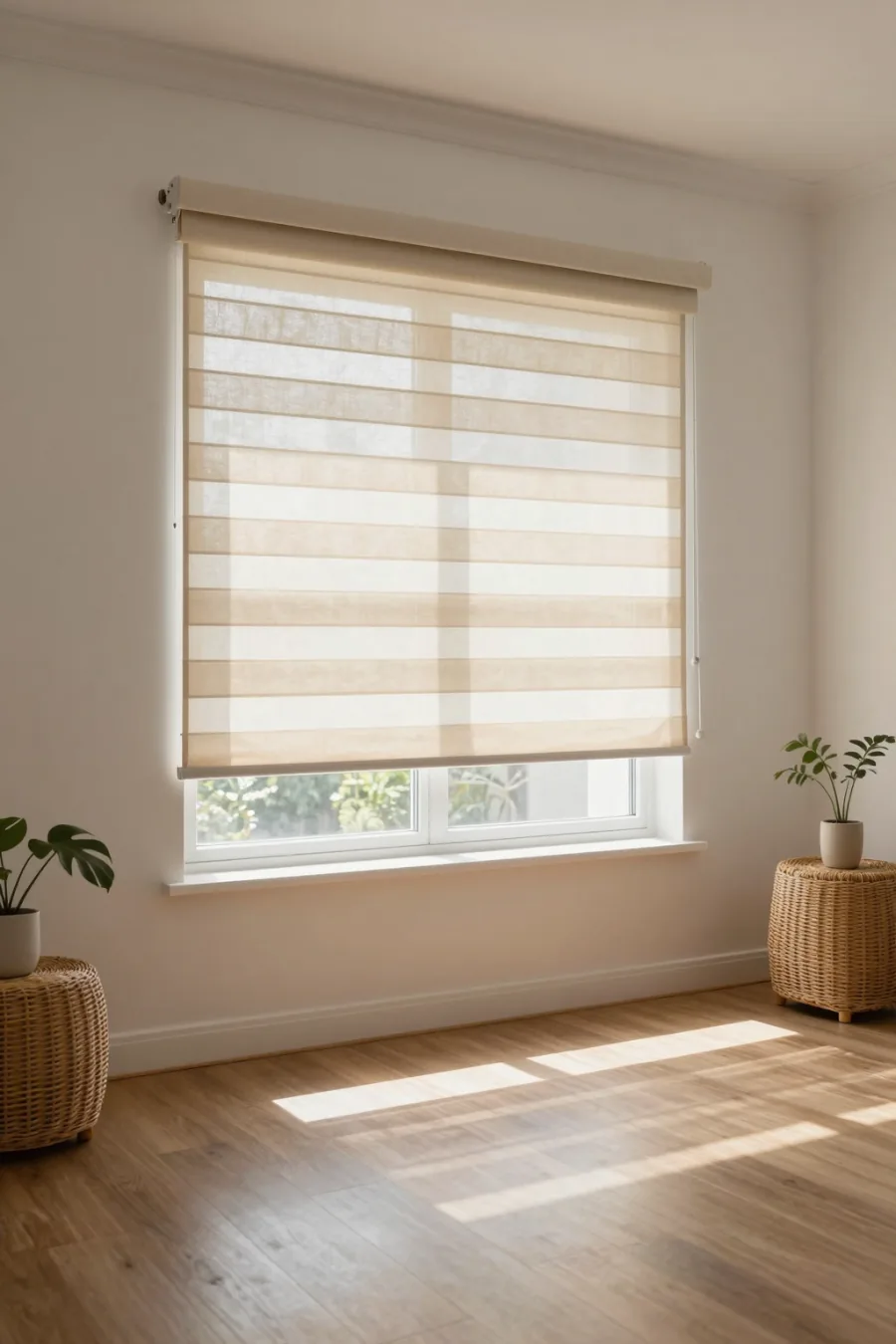











We make beige blinds in Almaty to measure: our measurer arrives with samples, you hold them up to your window in your own light and approve the shade. The same beige turns grey on a north-facing window, yellows on a south-facing one, and looks different on aluminium, PVC and fabric. Prices are per the price list, from 3,600 ₸/m².
Why the same beige looks different on different windows
Beige on a sample and beige on a window are two different colours. The shade of beige depends not on the catalogue but on which side the window faces, the time of day and the light in the room. The same piece of fabric turns grey on a north-facing window, yellow and pinkish on a south- or west-facing one, and in the evening under a warm lamp it almost merges with white.
Jalusso makes beige blinds in Almaty to measure, so it sees this difference on every job. A client brings a piece of fabric she liked from the market, holds it up to the frame — and doesn't recognise it: at home the same beige looks darker and duller. There's nothing to be done about it: a colour on a window has no single correct look, it has a look in a particular light.
What the window’s orientation does
A south- or west-facing window gets more sun and warmth, and beige on it yellows and turns pink. A north-facing window gives even, cool light — beige loses its warmth and reads as grey. We have a sharply continental climate: hot, sunny summers and cold winters with frosts and a big temperature swing between day and night, and the window works with this light all year round. An east-facing window turns warm in the morning and cools down by midday.
What the lighting in the room does
Lighting and time of day change the shade of beige more than the material itself. In the daytime, in diffused light, beige is calm; in the evening under a warm lamp it merges with white and almost disappears against the frame. That's why we don't advise approving a shade from a photo or in a showroom: you can't reproduce the light in your room with someone else's lamps.
That's exactly why the measurer comes with samples. A sample on the window shows how beige will behave in your home — it's the only honest way to check a shade. Before the measurement, any assessment of colour remains a guess.
How to choose a beige shade and check a sample on your own window
You can only get the shade wrong when the decision is made away from your window. We bring samples to the measurement: you hold them up to your frame, look in the morning and in the evening, in your own light — and approve what you actually saw, not what you remember from a showroom. That's the main way to avoid being disappointed with beige blinds.
The steps at the measurement
- Hold the samples up to the frame and the reveal, not to the wall opposite. Material on a window is lit from two sides, and beige on the frame reads differently than in your hand in the middle of the room.
- Look at the sample in the morning and in the evening. Morning light is cooler, evening light warmer, and the same beige shade behaves differently in these conditions.
- Compare the sample with the windowsill and the reveals. The finish next to the blind sets the tone for the whole combination, and a mismatch here is the most noticeable.
- Approve the shade and the material together. Beige on aluminium, PVC and fabric are different colours, so you're not choosing a shade in general but a shade on a specific material.
- Get a price calculation on the spot. The measurer calculates by your dimensions and gives you the amount right away, rather than sending it later.
And these steps all happen in one go, in a single visit. Stretching the choice over a week and coming to the workshop to look again is not a great idea: the lighting there is different, and the sample will again show something other than what it shows on your window.
What to ask the measurer
Ask about the side the window faces first — it explains why a sample in your hand and a sample on the frame look different. Then the material of the product, the operation and the shape of the window. The shade and the price both depend on these four things: the shape of the window affects the final amount, and the operation and mounting add their own coefficients.
A measurement with samples removes the risk of getting the shade wrong, because the decision is made in your lighting and at your time of day. Measurement and consultation are always free, the measurer arrives with samples and calculates the price on the spot; within the city, the visit and delivery are free too. If you're outside the city — in Kaskelen, Talgar, Issyk or Kapshagay — we'll come, and we'll tell you the cost of the visit before we set out.
Aida advises on fabrics, with five years of experience, and Kirill handles non-standard windows — nine years and arched, triangular and attic openings. One visit covers both the choice of shade and all questions about the design.
Beige in different materials: aluminium, PVC, fabric, bamboo, pleated
Beige fabric and beige aluminium with the same name are not the same colour. The material of the product changes the look of the same beige more than any shade in the sample: paint on metal gives an even matte surface, PVC plastic gives a soft semi-gloss, fabric gives depth through its pile and weave, and bamboo straw is a fibre where the tone varies on its own. That is why you should look at the sample in the very material you are ordering: a beige swatch of fabric tells you nothing about beige aluminium slats.
The table below is a starting point for the conversation at the measurement, not a replacement for a sample in your hands.
| Material | What beige looks like | Light | Care | Where to install |
|---|---|---|---|---|
| Aluminium slats 25 mm | Even matte tone with no pile and no shine | Holds its colour on the sunny side, cuts light into stripes | A damp cloth with a mild cleaner right on the window | Kitchen, bathroom, balcony |
| PVC plastic, slat 25 mm | Softer than white, a light semi-gloss | Diffuses evenly, with no harsh glare | Wipes clean with a cloth, flexes when touched | Living rooms, utility rooms |
| Fabric blind: screen | Dense tone with a woven texture | Diffuses light, keeps privacy during the day | Vacuum on low power or a sponge without soaking | Bedroom, living room |
| Day-night fabric | Stripes of the same tone, different density | Changes the light level smoothly, in stripes | Dry dusting, no machine washing | Bedroom, a room facing the street |
| Blackout | Dense, with almost no light through the fibre | Covers the room with dense shade | Dry dusting, do not soak | Bedroom, home office |
| Bamboo straw | Uneven tone along the fibre | Gives warm light with shadows from the fibres | Dry soft brush, no water | Living room, office |
| Pleated fabric | Even tone in the fold, soft transitions | Softens the light, holds its shape without sagging | Vacuum on low power | Sloped and non-standard windows |
Bamboo straw gives an uneven tone along the fibre: in the sun you see veins rather than an even fill, and that is its main difference from a slat. Day-night fabric changes the light level smoothly — its stripes are the same tone but of different density, so the transition from light to shade reads as a step rather than a contrasting stripe. Blackout covers the room with dense shade, but even it does not turn day into night: there is always a thin strip of light along the edge, so we fit the blind right up against the glazing bead.
The difference between a beige slat and a beige fabric blind shows both in the light and in the care. A slat cuts light into stripes and holds its colour on the sunny side, and it is washed right on the window — you do not need to take it down. A fabric blind diffuses light softly, but it can only be cleaned with a dry sponge or a vacuum, and it must not be machine washed.
Here is an illustrative calculation from the price list: horizontal beige aluminium blinds start from 4,200 ₸/m², vertical fabric ones from 4,600 ₸/m², day-night from 7,300 ₸/m², bamboo straw from 9,400 ₸/m². The spread is more than double, and it is about the material, not the shade.
Greige — is it beige or grey
Greige sits between warm and cool, and the window chooses its side. On the north side, where the light is even and cool, grey-beige reads as grey and shifts towards stone. On the south side, under warm sun, the same greige brings out its beige component. Arguing about the name is pointless — hold the sample up to your own window in the morning and in the evening and decide by what you see.
The single word “beige” on aluminium, PVC, fabric, bamboo straw and pleated blinds means different colours, because paint, plastic, fabric and fibre reflect light differently.
Beige blinds on a white plastic window: frame, windowsill, reveals
On a white plastic window, beige blinds look dirty in exactly one case — when the shade is matched to the walls rather than to the frame. A white window frame is cool and clean, with no yellowness or greyness, and against it any warm or muddy beige turns into a dirty-white patch. A white frame calls for matching the shade, not for contrast: next to it, beige should read as a colour in its own right, not as soiled white. That is why we always look not only at the walls, but also at the windowsill and reveals.
The windowsill and reveals are the surfaces closest to the blinds, and they are what sets the tone. If the windowsill is wood-effect, the beige blinds should be warmer than the window: such a windowsill suggests a warm beige with yellowness, and the fabric reads as one line with it. A white windowsill dictates something else — a shade closer to neutral grey-beige, so it does not clash with the frame and does not look yellowed against it. The colour of the walls and finishes takes a back seat: the walls are far away, while the windowsill is right there.
What we check at the measurement when the window is already in place:
- contrast with the white frame — the fabric should not look like a dirty version of it;
- the shade of the windowsill and reveals — wood-effect or white, warm or neutral;
- the difference from the wall finish — within two or three shades, so the room does not fall apart;
- the side of light — on a north-facing window, beige next to a white frame turns grey, on a south-facing one it turns yellow;
- the material — the same shade reads differently on aluminium and PVC.
In my view, the fear of “it will look dirty” comes precisely from matching to the walls. Yerlan, our sun-protection engineer, often hears this question at measurements, and almost always it is solved with one move: hold the samples against the frame and the windowsill, not against the wallpaper. And then beige on a white window looks not dirty but warm — a calm background that does not pull attention away from the room.
What to match the shade to
With a white windowsill, choose a neutral grey-beige — it does not clash with the frame and does not turn yellow. With a wood-effect windowsill, choose a warm beige with yellowness: it continues the pattern and works as a pair with it. With beige reveals, go by the reveals, not the walls, otherwise the fabric will shift to a different shade. The wall finish can differ from the fabric by two or three shades — that is enough for beige blinds to read as a separate colour rather than blending into the room.
Next to a white frame, beige reads as a dirty-white patch if the shade is not matched to the windowsill and reveals rather than to the walls.
Beige or white: which is more practical for dust, fading and care
For dust and streaks, beige is more practical; for fading in the sun, white aluminium is: dust is less visible on white than on dark, but yellow streaks show up on white, while on beige they dissolve into its own tone. And here is the main point: “more practical” is not one property but three different ones, and beige does not win at all of them.
An aluminium slat 25 mm holds its colour on the sunny side: the polymer coating does not fade to yellow, so a year later the slat looks as it did on the day of installation. Fabric behaves differently. Beige fabric blinds fade more noticeably in the sun — and most noticeably on a south- or west-facing window, where there is more light. A dust-repellent treatment slows fabric fading but does not cancel it: the treatment protects against dirt, while only the density of the fabric helps against ultraviolet.
What does “which beige will not look dusty a year later” mean? The one closer to its natural tone rather than to a bleached one. The lighter and cooler the beige, the more grey dust marks show up on it — on a shade with yellowness they get lost. Dust and grease in the kitchen settle on the fabric the same way, but beige aluminium can be washed right on the window, and streaks after a cloth do not stay as stripes on it the way they do on white.
| White | Beige | |
|---|---|---|
| Dust and streaks | visible right away | less noticeable |
| Fabric fading | turns into a yellow patch | blends into the tone, the patch is blurred |
| Slat fading | holds colour | holds colour |
| Care | washed on the window | washed on the window, streaks are unnoticeable |
Fabric care hardly depends on colour. Aluminium and PVC are wiped with a damp cloth and a mild product — no need to take them down. Fabric is cleaned with a vacuum cleaner on low power or a sponge without soaking: the fabric must not be washed in a machine. Beige fabric has to be vacuumed just as often as white — the film on the pile is equally visible, it just does not contrast with the background on beige.
In my view, practicality is overrated here: people choose not “which colour gets dirty less” but “which colour forgives its owner for rare cleaning”. Beige forgives.
On beige, dust and streaks are less noticeable than on white, but fabric fades more noticeably than a slat — on the sunny side this shows up earlier.
Which beige material to choose for the sunny and the north side
The beige material is chosen by the side of light the window faces. On the south and west side it makes more sense to install aluminium slats 25 mm or fabric with a sun-protection treatment; on the north side, fabric, which diffuses even cool light.
The side of light the window faces determines the choice between a slat and fabric not because of fashion but because of the load on the material. In Almaty, summers are hot and sunny, dust hangs in the air for months, and winter brings sharp temperature swings between day and night. An aluminium slat 25 mm holds its colour on the sunny side and is unaffected by dust or moisture. Fabric on a south-facing window fades more noticeably — fastest where the fabric is in direct light all day. Why is that? The pigment in the fibre breaks down under ultraviolet, and the treatment only slows this process rather than cancelling it. On beige, fading reads more softly than on white, but it happens just the same.
What changes on the north side:
- Beige fabric on a north-facing window shifts to a grey undertone, but the room does not get darker because of it.
- Day-night fabric gives smooth adjustment: light during the day, no visibility from the street.
- Blackout is chosen for the bedroom, where the room needs to be closed off with dense shade.
- An aluminium slat 25 mm on a north-facing window looks cooler than on a south-facing one — it is the same beige, but in different light.
In an office with monitors, the question is separate: glare comes not from the shade but from the surface. We do not recommend a glossy slat at a workstation — it catches reflections, and a stripe appears on the monitor. Matte fabric or day-night fabric in beige diffuses light, so there is no glare on the screen. For wide office openings, vertical slats 89 mm are used — even light all day, and soft beige does not clash with the equipment.
Beige fabric tints the light in the room warm: it does not hurt the eyes in the morning and does not give a cold grey shade on the walls. On the sunny side, aluminium slats 25 mm close the window opening more tightly than fabric and take away some of the heat that would otherwise enter the room.
For a sunny side, choose a slat or a coated fabric in beige; for a north-facing side, choose day-night fabric; and don't put a glossy slat above a desk with a monitor because of the glare.
One shade for the whole apartment: how to keep the tone consistent between rooms
It's possible to match the same shade on a repeat order, but we can't guarantee it. Fabric batches can vary in shade: fabric and aluminium are dyed and laminated in batches, and the next batch of the same article can be half a tone warmer or cooler than the previous one — on separate windows it's almost unnoticeable, but in the same room next to the earlier blind it's immediately visible.
That's why Jalusso always measures and installs the windows of one apartment together. If the living room and bedroom are covered with the same material, both openings go into one cutting and one batch — the tone matches not by the name of the shade, but in reality. But beige blinds ordered at different times are already a lottery, even when the same product material is specified in the order.
Different materials will never match in tone. Beige aluminium and beige fabric next to each other read as two different shades, and no batch will fix that. If you want a single tone throughout the apartment, choose one material for all the windows.
Case study
A typical situation: a customer covers the windows in the living room and bedroom in beige — first one room, then, after a while, the second. The shade of the second batch may not match the first, and then the difference is visible from one room to the other through the open door. The solution is simple: we measure and send both rooms to the workshop together.
The shade of blinds depends not on the colour name, but on the fabric batch — that's why the windows of one apartment are ordered all at once.
How much do beige blinds cost in Almaty
The beige colour doesn't add a single tenge to the price: Jalusso prices the product by the material's price list line, and the shade within that line is chosen freely. Horizontal aluminium slats 25 mm cost from 4,200 ₸/m², plastic PVC 25 mm — from 3,600 ₸/m², vertical fabric with a 89 mm slat — from 4,600 ₸/m². Then coefficients are applied to the base price, and it's because of them that the total for the same room can differ noticeably.
| Price list item | Price from, ₸/m² | Manufacturing time |
|---|---|---|
| Plastic blinds, PVC, slat 25 mm | 3,600 | 3–5 days |
| Horizontal blinds, aluminium, 25 mm slat | 4,200 | 3–5 days |
| Vertical blinds, fabric, slat 89 mm | 4,600 | 3–5 days |
| Day-night blinds, two-layer fabric | 7,300 | 5–7 days |
| Bamboo blinds, straw | 9,400 | 7–10 days |
| Pleated blinds | 9,800 | 7–10 days |
The control type affects it like this: manual comes with a coefficient of 1, chain — 1.06, electric motor — 1.85, electric motor with remote control — 2.1. Installation also changes the figure: wall-mounted — 1, frame-mounted — 1.05, no drilling — 1.1, cassette system — 1.28. Installation itself costs 4,500 ₸ per product, and for orders from 150,000 ₸ we install for free.
The shape of the window directly affects the final price. A rectangular opening is priced by area, while an arched, triangular or roof window requires separate cutting and mounting — our lead measurer Kirill handles such windows; he has nine years of experience with non-standard openings. As for the question “how much does it cost to cover a whole apartment” — there's no single figure. The calculation includes the material for each room, the type of control and the shape of each window, so we give the amount after the measurement, not before it.
One point about saving. Ordering the windows of one apartment in one batch is more cost-effective not only in terms of shade: with a combined order from 150,000 ₸, installation is no longer paid separately, and that's the same 4,500 ₸ per product that stays in your pocket. In my opinion, splitting an apartment into two purchases just to “try one room first” is almost never worth it.
The price depends on the design, material, fabric density, control type and window shape, not on the beige colour — there's no separate surcharge for the shade. The exact amount is given by the measurer on site, with samples in hand and a calculation for your window.
Beige blinds in the interior and by room
Beige blinds go well with warm finishes — wood, linen, light walls — and serve as a background rather than an accent. Cool grey, blue or pure white next to beige start to clash, but beige calmly accepts coloured walls in a kids' room: it doesn't steal the show. In loft and modern styles, beige comes in through texture: fabric with a visible weave, a slat with a soft matte sheen. Smooth glossy beige looks out of place in such interiors — in my opinion, that's the most common mistake when choosing.
Each room gets its own material, and the logic here is simple.
Rooms
- Bedroom. Fabric is best at softening morning light and doesn't create harsh shadows. When you need the sun not to wake you, choose day-night or blackout — they keep the room closed. That doesn't mean a slat doesn't work in a bedroom: it does, but the light from it is harsher.
- Living room. Fabric is most often used here — it tints the light warm and sits softly on large openings. If the window faces south and the wall gets hot in summer, a slat is more honest.
- Kitchen. Aluminium slats 25 mm are washed right on the window; steam and grease don't bother them. Fabric without a coating shouldn't be used near the stove.
- Kids' room. A side handle control removes the hanging chain — a child can't reach it. Beige works as a background here and doesn't clash with coloured walls.
- Office with glazing. Vertical blinds, 89 mm slat, hold their geometry on wide openings: even light all day and less glare on monitors than from horizontal ones.
- Small room. Choose a tone to match the walls, then the blind doesn't break up the space.
Care and no-drill mounting
Aluminium and PVC are wiped with a damp cloth and a mild product right on the window — no need to take the blind down. Fabric is cleaned with a low-power vacuum or a sponge without soaking; it can't be machine washed. Glazing-bead mounting and spring clips preserve the frame and the window warranty, so they suit rented housing and new windows. There's also adhesive-tape mounting, but it has a weight and temperature limit that we discuss at the measurement.
We travel to the suburbs: Kaskelen, Talgar, Issyk, Kapshagay. We quote the call-out cost before the visit; measurement and consultation are always free, and the measurer arrives with samples. Beige works as a background for warm finishes — wood, linen, light walls — and doesn't clash with coloured walls in a kids' room.
FAQ
How do I avoid getting the shade wrong if I'm covering two rooms?
We measure and install the windows of one apartment together, from one fabric batch. Otherwise a repeat order at another time may not match in tone, and the difference will be visible from the hallway. A sample on the window shows the shade in your light, but it doesn't protect against variation between batches — that's why the living room and bedroom are ordered in one calculation.
How does beige on aluminium differ from beige on fabric?
They're different colours, even though both are listed as beige in the price list. The product material reflects light differently: an aluminium slat 25 mm gives an even fill and hardly changes tone during the day, while fabric diffuses light and reads either warmer or greyer. Fabric on a north-facing window almost always goes cool, while a slat holds its colour more steadily.
What should I choose in beige for a sunny side?
Aluminium with a polymer coating or coated fabric — they lose their tone more slowly. Uncoated fabric on a south- or west-facing window fades most noticeably. In the kitchen near the stove, grease is added to that, and there we usually recommend aluminium: it's washed on the window with a damp cloth.
Can I match the same shade on a repeat order?
You can, if the fabric batch in the warehouse is still the same one, but we won't guarantee it. The shade varies between batches — more with fabric, less with slats. If you plan to cover the windows gradually, tell us at the measurement: we'll calculate all the rooms at once.
Does the beige colour affect the price per m²?
No. The total depends on the design, material, fabric density, controls and window shape. The price per m² comes from the material's price list item, and the shade within that item is chosen freely — there is no surcharge for beige.
All these questions come down to three things — shade, material and price — and are settled at a free measurement with samples.
Conclusion
Three things set the shade of beige at the window: the side of the light, the lighting in the room and the material of the product. A sample chosen in the showroom decides nothing — what decides is the sample held against your frame in your light. That is why we do not sell beige blinds in Almaty from stock: first the measurer brings samples, then the workshop makes the product, then installation.
The same beige on aluminium, PVC, fabric and bamboo straw is four different colours. Paint, plastic, fabric and fibre reflect light differently, and there is no point arguing with that. With a white frame, the tone is matched to the windowsill and window reveals, not the walls: beige next to white plastic easily turns into a dirty-white patch. On the sunny side, a slat holds its colour better than a fabric blind; on the north side, fabric diffuses an even, cool light.
Windows in the same apartment are ordered in one batch. Different batches of fabric can differ in shade, and a reorder a month later in the same tone is not guaranteed — we calculate and install both rooms together.
There is no separate surcharge for beige. The price follows the material's price list item: horizontal aluminium — from 4,200 ₸/m², PVC plastic — from 3,600 ₸/m², vertical fabric — from 4,600 ₸/m², day-night — from 7,300 ₸/m². The total is made up of the design, fabric density, controls and window shape.
There is one practical recommendation: book a free measurement. The measurer arrives with samples and calculates the cost on the spot, and you hold the beige fabric against your window in the morning and in the evening and approve the shade before the product goes to the workshop.

