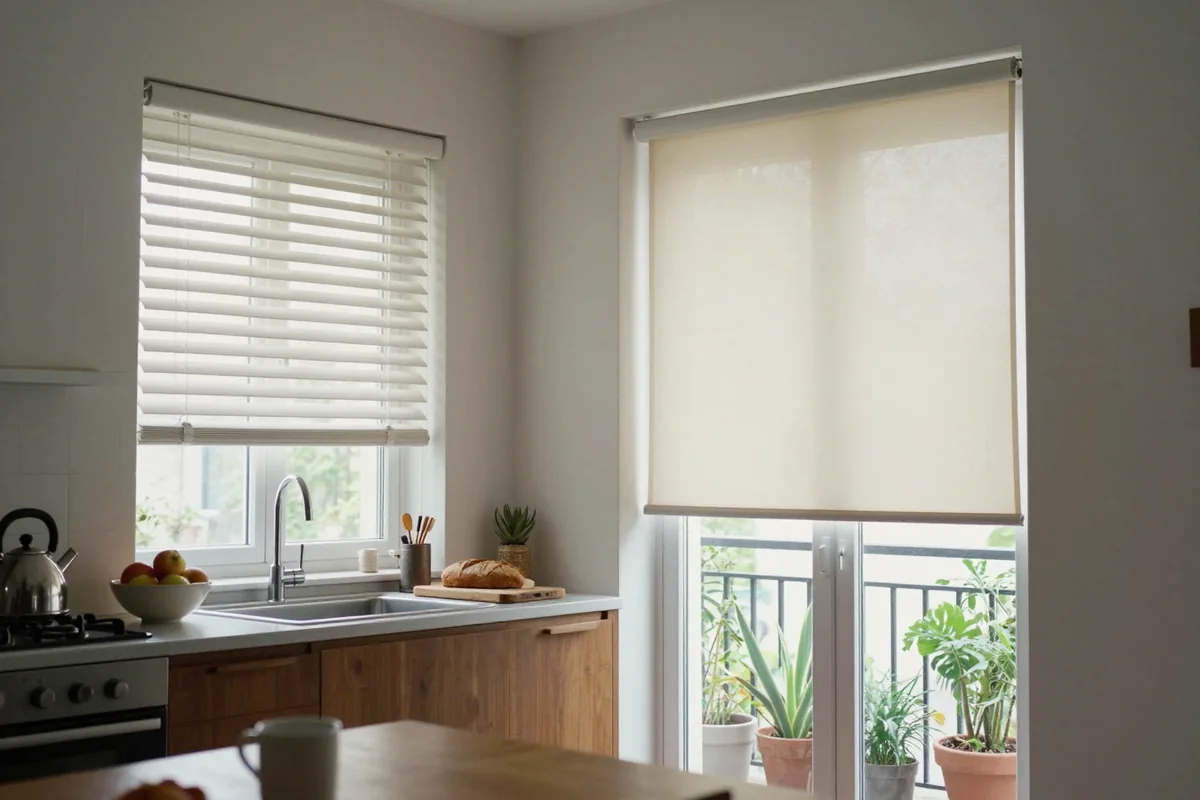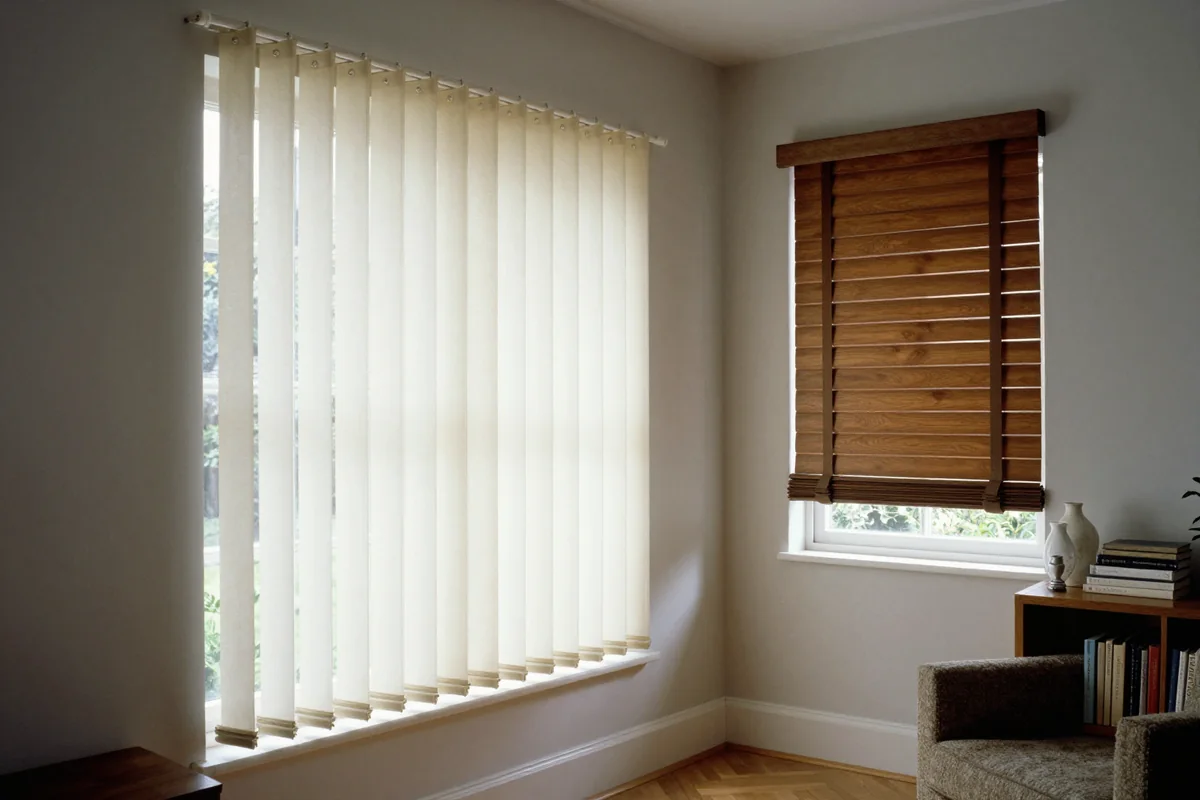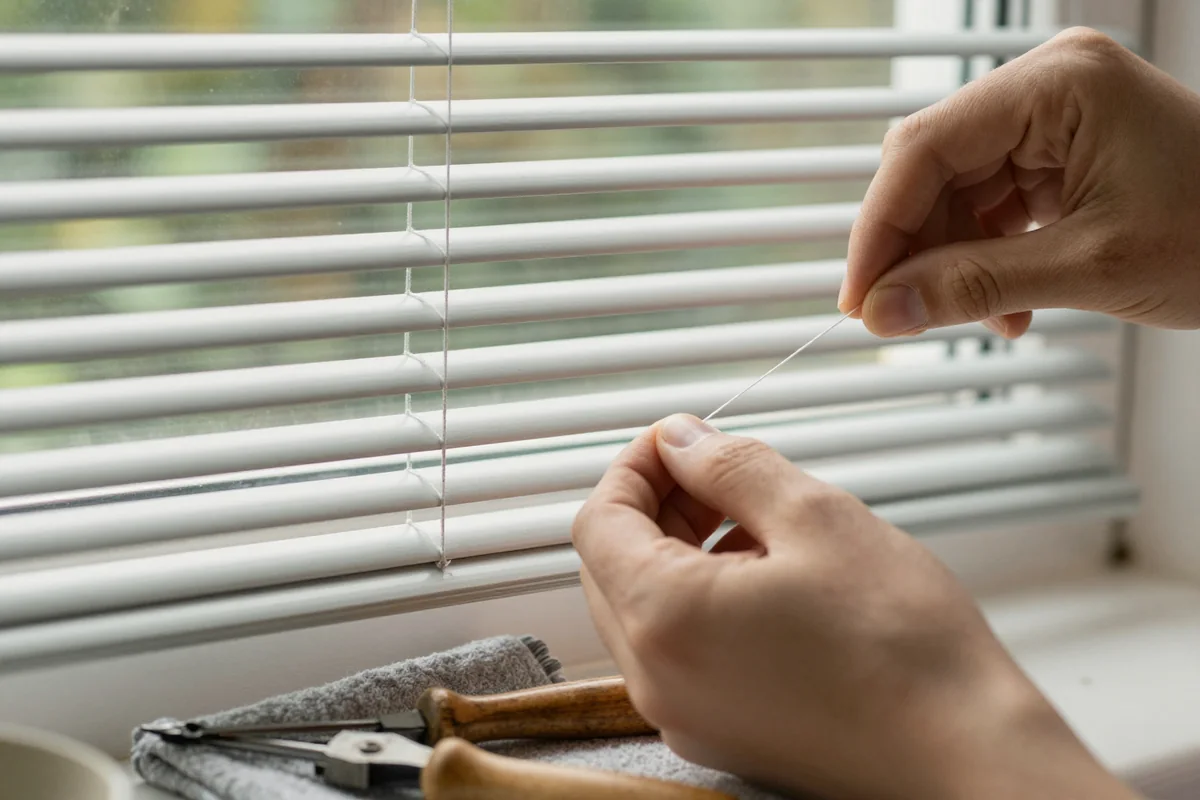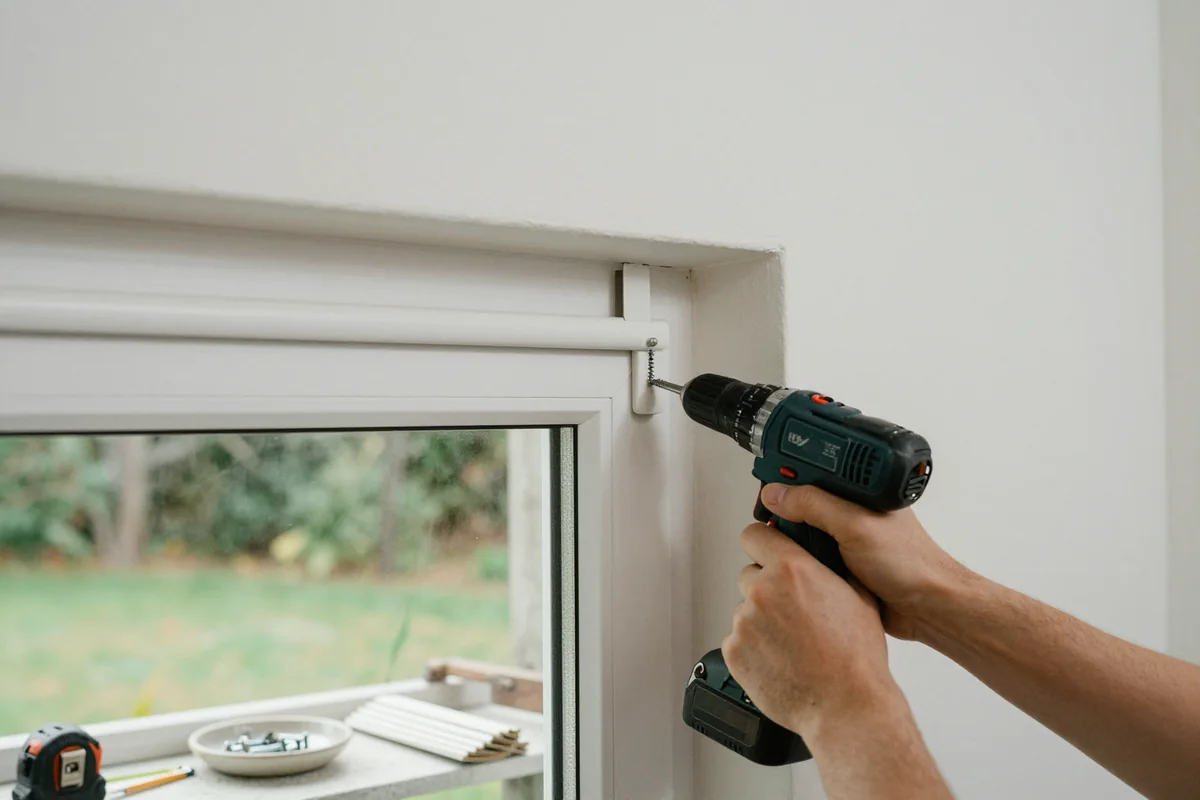
Both materials work, and we make both. A light-coloured aluminium slat reflects most of the sun’s heat back through the glass and lasts longer; PVC is cheaper and takes knocks more easily. For a south- or west-facing window under the Almaty sun, aluminium makes more sense; for a rented flat and a quiet window, plastic is enough. It’s the specific window that decides, not the material in general.
The short answer: where aluminium wins, where plastic wins
We make both aluminium and PVC in our own workshop, so the choice between aluminium or plastic blinds is decided by your window, not by our profit. Let’s be straight: both slats work, and the difference between them shows up not in the first months but over the long run.
An aluminium slat lasts noticeably longer than a plastic one. With PVC the wear shows earlier: on a sunny side the slat loses its whiteness. The second difference is about the sun: a light-coloured or mirrored aluminium finish reflects a significant part of the heat back through the glass, while PVC doesn’t reflect heat, it simply absorbs it.
Almaty summers mean heat, dust and sun from morning to evening, and in winter the frost comes with big swings between day and night. That is why at the measurement we look first at which way the window faces. A window in direct sun — south or west — calls for aluminium. A window facing a courtyard, where the sun rarely reaches, is fine with PVC, and you lose nothing.
Where the difference does not matter at all
Moisture is not an argument in this debate. Both PVC and aluminium slats are cleaned the same way and are not afraid of water. Mounting is not divided by material either: both are fitted on brackets into the glazing bead, on spring clips or on adhesive tape, and we do not drill the frame. Installation and warranty are the same for both options.
So if the window is not in the sun and the budget is tight, go with plastic and don’t treat it as a compromise. Let’s be clear: we won’t talk you into paying extra for aluminium just for the sake of a longer service life.
Sunny side: heating, heat reflection and yellowing
When you’re choosing blinds, plastic or aluminium, for a south-facing window, the question isn’t price but heat. A light-coloured or mirrored aluminium slat sends most of the sun’s heat back through the glass, and the blind barely heats up. A plastic slat can’t do that: it takes the heat itself. Hence the practical conclusion: for south and west, aluminium makes more sense than paying extra for something else.
What actually yellows
It is not every plastic that yellows, but cheap PVC without light stabilisers, and we are talking years, not the first summer. We work with slats that contain such additives. You cannot tell a stable slat from a new sample by eye — ask the seller about the composition. More about the material itself is on the “Plastic blinds” page.
One more thing about the blind heating up in the sun: a thin dark PVC slat on a south-facing window can warp over time. A light colour heats up less than a dark one in any material, so colour here matters no less than the material itself.
Why this matters especially in Almaty
The sun in Almaty is harsh in summer, and south- and west-facing windows heat the blind all season, not just for one week. On such a window, aluminium works as a screen, plastic as a heat collector. For a window facing a courtyard, where direct sun almost never reaches, the difference fades and both materials behave calmly.
If you are unsure which way your window faces, show it to our measurer — he comes with samples of both materials and looks at the window, not at a photo.
Three myths that get in the way: rattling, denting, yellowing
When someone is choosing blinds — plastic or aluminium — what usually gets in the way is not the properties of the materials but three common claims about them. All three are only partly true, and in each case what matters is the situation at the specific window.
“Aluminium rattles”
The tapping of aluminium slats is indeed audible with the sash open in a draught. The sound comes from the air flow passing between the slats and making them touch slightly. It is cured by fixing the bottom of the blind: the blind stops swinging freely and the tapping goes away. If you often keep the sash open for ventilation, mention it at the measurement. With the sash closed there is nothing to rattle — there is no air movement in the room.
“Aluminium dents, plastic doesn’t”
There is more truth here than in the first myth. An aluminium slat really does get dented by a blow or a child’s hand, and you cannot straighten it back evenly. But it can be replaced one at a time, without taking down the whole product. PVC behaves differently: the slat springs back from a blow and returns to shape, so the blind looks intact longer. But PVC has its own weakness — a thin dark slat in the southern sun can warp over time, and that cannot be fixed. For example, in a kitchen with a low windowsill, where elbows or pots brush against the blind, PVC takes such contact more calmly. But if that same window faces south, it is better not to choose a thin dark PVC slat.
“Aluminium gives full darkness, and plastic is brittle in the cold”
No material gives full darkness: there are gaps between the slats and along the edges of the blind, and light comes through both during the day and at dawn. If you need darkness, the question is not the slat material but a different type of product. We have no figures on frost resistance, and we won’t make them up. Blinds hang indoors, not outside, so outdoor frost does not reach them directly. On an unheated balcony, what matters more is not the frost itself but the temperature swing between day and night — winters in Almaty are cold, and the daily swings are noticeable.
The practical conclusion is simple: if you are worried about rattling or dented slats, get samples of both materials at the measurement and look at your own window. At the measurement you can see which way the window faces, whether there is a draught with the sash open, and where the blind will hang.
How much the difference costs and what is cheaper over the whole service life
Aluminium and plastic blinds differ in price far less than you might think from what people say: the difference per square metre is small, and you can see it in the table below. What is worth counting is not the receipt but the years of service. And the lifespans of the materials differ: aluminium slats last longer, PVC less.
Let’s take a window of 2 m² and simple mounting, without coefficients.
| Material | Price from, per m² | Price from, per window of 2 m² |
|---|---|---|
| Plastic blinds, PVC | 3,600 ₸ | 7,200 ₸ |
| Horizontal blinds, aluminium | 4,200 ₸ | 8,400 ₸ |
The difference is from 1,200 ₸ per window. The minimum calculated area of one unit is 0.5 m², so for a narrow sash or a small vent window the price follows this threshold, not strictly the glass.
If there are several windows
Multiply the difference by the number of units — and that is where the bill stops being the main argument. Installation of a unit costs 4,500 ₸, and with an order from 150,000 ₸ it is free, and for aluminium and PVC the rate is the same: installation does not affect the difference between the materials at all. You call a measurer within the city for free, and delivery of the unit also costs nothing. Add all this up — and you get not “expensive or cheap”, but the cost of a year of use.
A year of use, not the bill
The price over the whole service life takes into account the service life of the material, not just the purchase price. A material that lasts longer spreads its price over more years, and the gap in the bill smooths out. In our view, arguing about the difference on one window, when we are talking about service lives of different lengths, is overrated saving. But this is the logic of a long horizon, and it does not always work.
For a rented flat for a short term, plastic wins: you pay less now, and the window is not yours anyway. Plastic blinds are not afraid of water, wash normally and cover the rental term with a margin. There is no point in paying more to leave the unit for the next tenant.
Aluminium is more expensive in material, installation is the same for aluminium and PVC, and which is cheaper over the whole service life is decided by your horizon: a short one turns the choice towards PVC, a long one towards aluminium.
A sequence of five questions: how to decide for your window
Before choosing between aluminium and PVC, answer five questions about the specific window. Which way the window faces determines the sun load and the choice of material: south and west heat the fabric most in summer, north and east barely heat it. Look at which way the sash faces — this is the first and main question.
The second is whether it is a kitchen or not. Near a gas stove and a sink, the fabric should be kept away from fire and splashes; both materials are not afraid of water and can be washed, but near the stove it is more important to keep the blinds at a safe distance than to choose the material.
The third question is the balcony. On an unheated balcony in Almaty, what matters more is not the frost itself, but the temperature difference between day and night and the sun: blinds hang in the room, not outside, but on a glazed balcony the conditions are closer to the outside.
The fourth is whether there are pets at home. A cat reaching for the slats and a dog brushing against the fabric are about impact. An aluminium slat crumples from impact, PVC springs back and returns to shape.
The fifth is how long you plan to keep the blinds on this window. Aluminium lasts longer, PVC less, so we count not the purchase price but the cost per year.
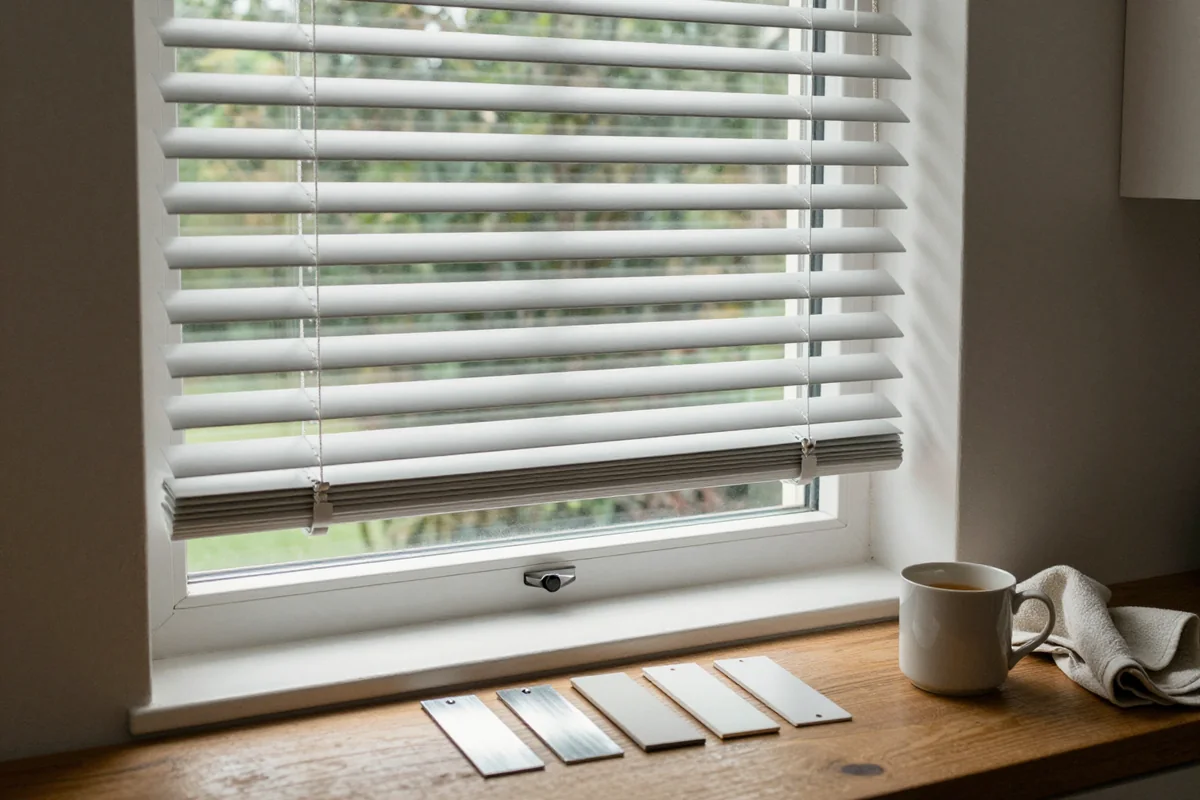
Measurement and consultation decide what cannot be decided from a photo: the measurer arrives with samples of both materials, and the material for the blinds — plastic or aluminium — is chosen right at the window. Measurement is free.
What to do with the answers
The five answers add up to one decision: if the window is in the sun and a long term is needed — aluminium, if the window is calm and the horizon is short — plastic. Arguing about this in messages is pointless. A measurement with samples lets you decide on the specific window: hold the slat in your hands, see how it reflects light at your glass, and only then name the material.
Comparison table by everyday properties
Before you is a table not by material characteristics, but by situations that happen at home. Find your window and read the relevant row — that way the decision is made faster.
| Situation at home | Aluminium | PVC |
|---|---|---|
| South or west window, bright sun | A light and mirrored slat returns most of the solar heat back outside the glass | Does not reflect heat, the whiteness fades in the southern sun |
| Moisture and washing | Not afraid of water, does not rust thanks to the coating | Not afraid of water, there is nothing to rust in principle |
| Impact and children’s hands | The slat crumples and will never be straight again, but can be replaced one by one | The slat deforms less from impact: it springs back |
| Open sash in a draught | The slats tap, fixed with bottom fixing of the fabric | We have no separate data |
| Service life | Longer than PVC | Shorter; on a sunny side the slat loses its whiteness |
| Installation and warranty | 4,500 ₸ per unit, 3 years on the mechanism and 1 year on installation | The same 4,500 ₸ per unit and the same warranty |
The materials differ in heat reflection, service life and how the slat behaves on impact. Installation, warranty and washing are the same for both.
The practical conclusion from the table: there is no point in looking for an overall winner in it. There is a row about your window, and the decision is made by that row alone.
Room by room: kitchen, bathroom, balcony, kids’ room, bedroom, office
For the kitchen, aluminium or plastic blinds are chosen by one criterion — how much sun is in the window. Near the sink and stove both materials are equal: both a PVC slat and an aluminium slat are not afraid of water and splashes, and can be washed with a cloth without care. If the window faces a sunny side, light aluminium is more sensible, it heats up less itself and gives off less heat to the room. With a gas stove, the rule is the same for both materials: keep the fabric raised and do not leave the slats over the burner.
A bathroom is just as quick to sort out. Damp air doesn’t harm either material, and you can wash both without worry. Here it’s usually not the material that decides things but the width of the sash: on a narrow window the slats fit the same either way, so there’s no point paying extra for aluminium.
A balcony in Almaty raises its own question. An unheated balcony means a big swing between day and night, and in summer direct sun is added on top. On a sunny balcony, light-coloured aluminium heats up less, while a thin dark PVC slat on a south-facing window can warp over time. If the balcony is shaded, you won’t notice any difference in how the materials behave.
For a child’s room, the choice comes down to two different characters of slat. A PVC slat springs back if a hand knocks into it. An aluminium slat dents on impact and won’t go back to being straight, but it can be replaced one at a time. In a flat with small children or a cat, that’s the main argument: one damaged slat is no reason to redo the whole blind.
About the bedroom and darkness, let’s be straight. Slatted blinds of any material leave gaps between the slats and at the edges, so neither aluminium nor PVC gives you full darkness — blinds aren’t made for that. That said, aluminium is a popular choice for bedrooms, but for other reasons: its long service life and calm appearance.
If an office with computers has large or floor-to-ceiling glazing, what matters more there is not the price of the product but how much heat gets into the room: a light-coloured aluminium slat reflects some of the sun’s heat back outside the glass, and in summer you feel it without any calculations. That’s why for an office with floor-to-ceiling glazing we more often quote aluminium.
Different materials on different windows
That’s fine, and we do it all the time. Aluminium for a sunny living room, plastic for a quiet bedroom or a second window facing the courtyard. If you pick a similar slat shade, from the outside the difference is barely noticeable, and on different windows you never see them at the same time anyway. We don’t promise to move a finished bracket from one window to another: each product is made for a specific opening.
An example from practice: one flat, different windows
Different materials on different windows in one flat is normal practice, not a compromise. Which way a window faces determines how much sun it gets, and we decide on each window separately: one blind’s job is to keep the heat out, another’s is simply to screen the room from prying eyes. We see this at measurements all the time. There’s no mismatch if you pick a similar slat colour — from the outside the flat looks calm, and guests rarely guess that the materials are different.
And one more thing about repairability. An aluminium slat can be replaced one at a time if damaged, and that’s a plus: you don’t have to change the whole blind. We cover exactly how that’s done separately; here the fact itself is what matters.
What it looks like at a measurement
A typical situation: a flat where one window faces south, another faces the courtyard, plus a child’s room. We come with samples of both materials and decide at each window separately, rather than picking one material for the whole flat at once. Here’s what we decided and why:
- For the south-facing window — light-coloured aluminium: there the slat works against the sun, and the light surface reflects heat back outside the glass.
- For the courtyard window — PVC: little sun exposure, no point paying extra for aluminium.
- For the child’s room — PVC: when the choice is between a slat that springs back under children’s hands and one that won’t straighten out after a hit, the second option loses at a window with a child.
- Mounting — no drilling into the frame, on brackets: both aluminium and PVC are installed the same way, and the frame stays intact.
The warranty is the same for both — 3 years on the mechanism and 1 year on installation, so there’s no point choosing plastic or aluminium blinds on that basis.
FAQ
Four questions come up most often at measurements and in messages. Here are short answers.
What should we get for a rented flat if we plan to live there a couple of years?
PVC. Plastic blinds are cheaper than aluminium, and over a short horizon you won’t wear out that difference — think about the cost per year of use, not the purchase price. A rented flat is a rare case where you can choose the material on price without reservations. We don’t recommend taking blinds down and moving them to a new place: the mounting is fitted to a specific window.
Will aluminium help in a bedroom if you need darkness?
No. Slatted blinds of any material leave gaps between the slats and at the edges of the blind, so neither aluminium nor PVC gives you full darkness. Aluminium wins on something else: a light-coloured slat reflects the sun’s heat back outside the glass, so during the day a south-facing bedroom is cooler. If what you need is darkness, blinds aren’t the right tool, and we’ll tell you that before the measurement, not after.
What happens to a plastic slat next to a radiator in winter?
We don’t have heating figures, and we won’t make them up. The practical advice is simple: the blind shouldn’t rest on the radiator or touch it — that goes for slats of any material, not just PVC. A PVC slat doesn’t mind water and doesn’t rust, and frost isn’t a threat because blinds hang inside the room.
How do I book a measurement in Almaty and the suburbs?
Message us on WhatsApp. Within Almaty the measurer comes free of charge, and we don’t charge for the on-site consultation either, and delivery within the city is free. We also travel to Kaskelen, Talgar, Issyk and Kapshagay, but the trip there is paid: the amount depends on the distance, and we tell you it in advance, before the measurer even gets in the car.
The measurer comes with samples of both materials, so you choose plastic or aluminium blinds not from a picture but from a real sample at your own window. The warranty on the mechanism and installation is the same for both materials, so under equal conditions the choice comes down to the window and the timeframe, not to which is more reliable.
Conclusion
Aluminium or plastic blinds isn’t an argument about which material is better in general, but a question about what’s on your window. A light-coloured or mirrored aluminium slat reflects most of the sun’s heat back through the glass and lasts longer. A PVC slat doesn’t reflect heat and lasts less, but it costs less and forgives knocks: it flexes and returns to shape.
Which way the window faces decides it. A south- or west-facing window in Almaty heats the blind most in summer — that’s where aluminium pays off the difference. A quiet window facing the courtyard, a rented flat, a short timeframe — plastic does the job without paying extra.
Don’t be afraid to mix. Aluminium for a sunny living room, PVC for a child’s room and a window without sun. If you pick a similar slat colour, from the outside the difference is barely visible.
The practical recommendation is simple: don’t choose the material from an article, choose it for your own window. Message us on WhatsApp — the measurer will come with samples of both materials and show them on site.
How we work
You message us on WhatsApp, the measurer comes with samples of both aluminium and PVC, then the product is made in our workshop and installed. The warranty terms don’t depend on the material: we service the mechanism on both aluminium and plastic blinds under warranty for three years, and installation for one year.